

The morning of 1 November 1911 is quiet over the oases outside Tripoli. A small monoplane drones above the palms at roughly 600 feet. In the cockpit, a young Italian second lieutenant reaches into a leather pouch, takes out something the size of a grapefruit, screws in a detonator and lets it fall over the side.
His name is Giulio Gavotti, and he has just carried out the first bombing raid ever flown from an aeroplane. Four hand grenades, perhaps two kilograms each, tossed from an aeroplane at Ottoman troops in the Libyan desert. Nobody on the ground was expecting it, because until that morning nobody anywhere had ever done it.
It happened 115 years ago today. Every bomber that followed, from the Gotha to the B-52, traces its job description back to that pouch.
Informazioni rapide
Data: 1 November 1911
Pilota: Sottotenente (Second Lieutenant) Giulio Gavotti, Italian Army
War: Italo-Turkish War, 29 September 1911 to 18 October 1912
Aeromobili: An early Etrich Taube monoplane in most accounts; some give a Blériot
Armi: Four Cipelli grenades of roughly 2 kg (about 4 lb), dropped by hand
Obiettivi: Ottoman positions at the Ain Zara and Tagiura (Tajura) oases near Tripoli
Altitudine: About 600 feet
A war with aeroplanes in it, for the first time
Italy declared war on the Ottoman Empire on 29 September 1911 to seize the provinces that would become Libya. It was a colonial war in most respects, fought with battleships, artillery and infantry. But the Italian Army had also shipped a handful of aeroplanes and pilots across the Mediterranean, one of the very first times an army had taken heavier-than-air machines to war.
They were meant to look, not to fight. On 23 October 1911 Captain Carlo Piazza flew over the Turkish lines on what Wikipedia and most histories record as the world's first aerial reconnaissance mission. Within days Italian aircraft were coming back with rifle bullets in their wings, and the Ottoman side would go on to claim a first of its own: the first aeroplane brought down by fire from the ground, with rifles.

Gavotti had trained as a pilot before the war; a surviving photograph shows him at the controls of a Farman biplane in Rome in 1910. In Libya he was one of a tiny group of officers flying fragile monoplanes over a front where nobody had a doctrine for what an aeroplane should do. He decided to write one, and he told his father exactly what he had in mind in a letter.
Four grenades and a leather pouch
The weapons were Cipelli grenades, named after Lieutenant Giuseppe Cipelli, who developed them. They were small spherical bombs filled with explosive, each weighing around two kilograms, about four pounds. Gavotti carried them in a leather pouch in the cockpit. There was no bomb rack, no bombsight and no release mechanism. He armed each one by screwing in the detonator, then threw it out by hand.
His own description of the method, in the translation of his letter that historians quote, is brutally practical: "I take the bomb with my right hand, pull off the security tag and throw the bomb out, avoiding the wing." The wing mattered. A monoplane of 1911 was mostly wood, wire and fabric, and a grenade bouncing off it would have ended the experiment very quickly.
Accounts agree he dropped four grenades, three on one oasis and one on another, but they disagree about which got the larger share. Even Wikipedia's pages are inconsistent about Ain Zara and Tagiura. What every source agrees on is the result Gavotti reported when he landed: everybody, he wrote, was satisfied.
HistoryPod's short account of 1 November 1911, the first aerial bombing in the Italo-Turkish War.
Which aeroplane, exactly?
Most accounts, including Wikipedia and NPR's centenary piece, say Gavotti flew an early Etrich Taube. The Taube, German for "dove", was designed by Igo Etrich in 1909 and first flew in 1910, with a distinctive bird-like wing that made it famously stable. That stability was exactly what a pilot needed if he planned to let go of the controls long enough to arm a grenade.
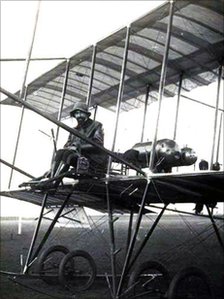
Some histories instead put him in a Blériot monoplane, the type that made up most of the Italian Army's small fleet in Libya. Surviving campaign photographs, like the one at the top of this page, show Italian Army Blériots in Libya. The honest answer is that the Taube is the majority view, and the question is not fully settled.

The protest, and the precedent
The raid did little physical damage. Historian Gerard De Groot, quoted by NPR, concluded that no Turks were injured. The Ottoman government nevertheless protested, claiming the bombs had fallen on a field hospital. Italy's answer was legal rather than moral: the 1899 Hague Convention banned dropping projectiles from balloons, and an aeroplane, Rome argued, was not a balloon.
The international press was less sure. The arguments that would follow bombing for the rest of the century, about accuracy, about civilians and about whether war from the air was fair, began in the newspapers within days.
Inside the Italian Army the verdict was the opposite. The aeroplane had shown it could do more than look. Italian aviators went on to fly further reconnaissance and bombing missions before the war ended with the Treaty of Ouchy on 18 October 1912, and the lesson was not lost on the general staffs of Europe two years later.
Italy's military aviation itself went on to become today's Italian Air Force, founded as an independent service in 1923. Gavotti's hand-thrown grenades sit at the very start of that lineage, and of every air force's.
The Great War channel's documentary on the Italo-Turkish War, the conflict that saw the first military reconnaissance flights and the first air raid.
Why 1 November 1911 still matters
Gavotti's raid was tiny. Four grenades, a few kilograms of explosive, no casualties anyone could confirm. But it changed the question. Before 1 November 1911, the aeroplane was a scout. After it, the aeroplane was a weapon, and every argument about air power since, from strategic bombing to precision strikes, starts from the moment a second lieutenant leaned over the side of his cockpit.
Piazza's reconnaissance flight a week earlier deserves its own place in that story, because the eyes came before the bombs.
HistoryPod on 23 October 1911, when Captain Carlo Piazza flew the first aircraft mission in war.
Sources: Wikipedia (Giulio Gavotti; Italo-Turkish War; Etrich Taube); BBC report by Alan Johnston, republished by the Atlantic Council (2011); NPR (March 2011); Historic Wings (November 2012).


0 Comments