
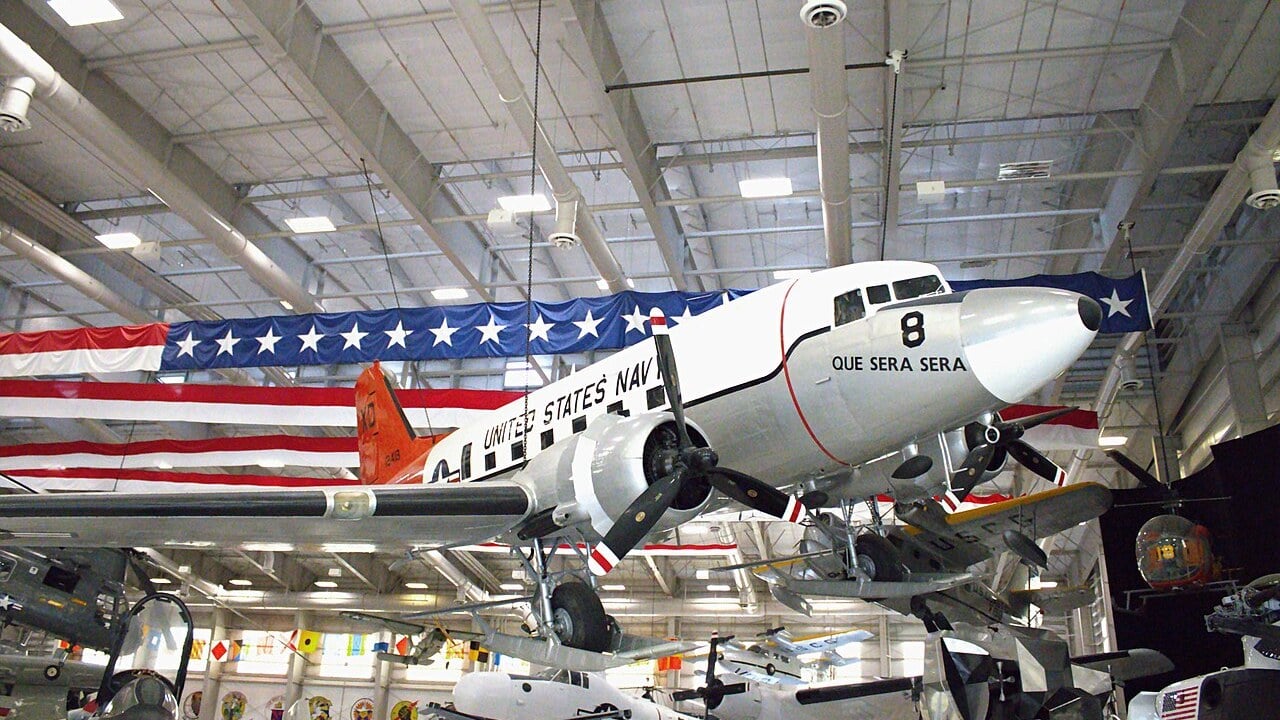
It was a Halloween evening, and the temperature outside was nearly 60 degrees below zero Fahrenheit. At 8:34 p.m. local time on 31 October 1956, a twin-engined Navy transport with skis bolted to its wheels bounced across the hard snow of the polar plateau and slid to a halt. Its engines kept running. Nobody aboard wanted to find out whether they would start again.
The aircraft was a US Navy R4D-5L, a ski-equipped version of the Douglas C-47 Skytrain, and someone had painted Que Sera Sera on her nose. Whatever will be, will be. She had just become the first aircraft ever to land at the South Pole, and the seven men inside were about to become the first people to stand there since Robert Falcon Scott in January 1912.
Seventy years ago yesterday, that landing turned the bottom of the world from a place you reached on foot, at enormous cost, into a place you could fly to. Everything that has happened at the Pole since, from the first station to today’s neutrino telescopes, began with one old Skytrain and a pilot who later admitted it was close to madness.
Informazioni rapide
- Aeromobili: US Navy Douglas R4D-5L Skytrain Que Sera Sera, Bureau Number 12418, ski-equipped C-47 variant
- Squadrone: US Navy squadron VX-6, Operation Deep Freeze II
- Atterrato: 31 October 1956, 8:34 p.m. local time, the first aircraft ever to land at the South Pole
- Pilota: Lt Cdr Conrad “Gus” Shinn; co-pilot Capt William Hawkes
- Aboard: Seven Navy men, including Rear Admiral George J. Dufek, Commander Task Force 43
- Volo: About 800 miles from McMurdo Sound to a plateau more than 9,000 feet high
- Sul campo: 49 minutes, at nearly 60 degrees below zero Fahrenheit
- Takeoff: 15 JATO rocket bottles carried, fired four at a time to break the frozen skis free
- Oggi: On display at the National Naval Aviation Museum, Pensacola, Florida
An old Skytrain for the hardest landing on Earth
The flight was part of Operation Deep Freeze II, the second season of the US Navy’s logistics effort for the International Geophysical Year. The plan for 1956–57 was to build a scientific station at the geographic South Pole itself. Before anyone could build there, someone had to prove an aircraft could land there and, much more importantly, take off again.
Rear Admiral George J. Dufek, commander of Task Force 43 and a veteran of Byrd’s expeditions and Operation Highjump, chose Lieutenant Commander Conrad “Gus” Shinn and his crew from the Navy’s Antarctic squadron VX-6 for the job. The aircraft was Bureau Number 12418, a wartime-built Skytrain converted for polar work, named after the Doris Day hit of that year.
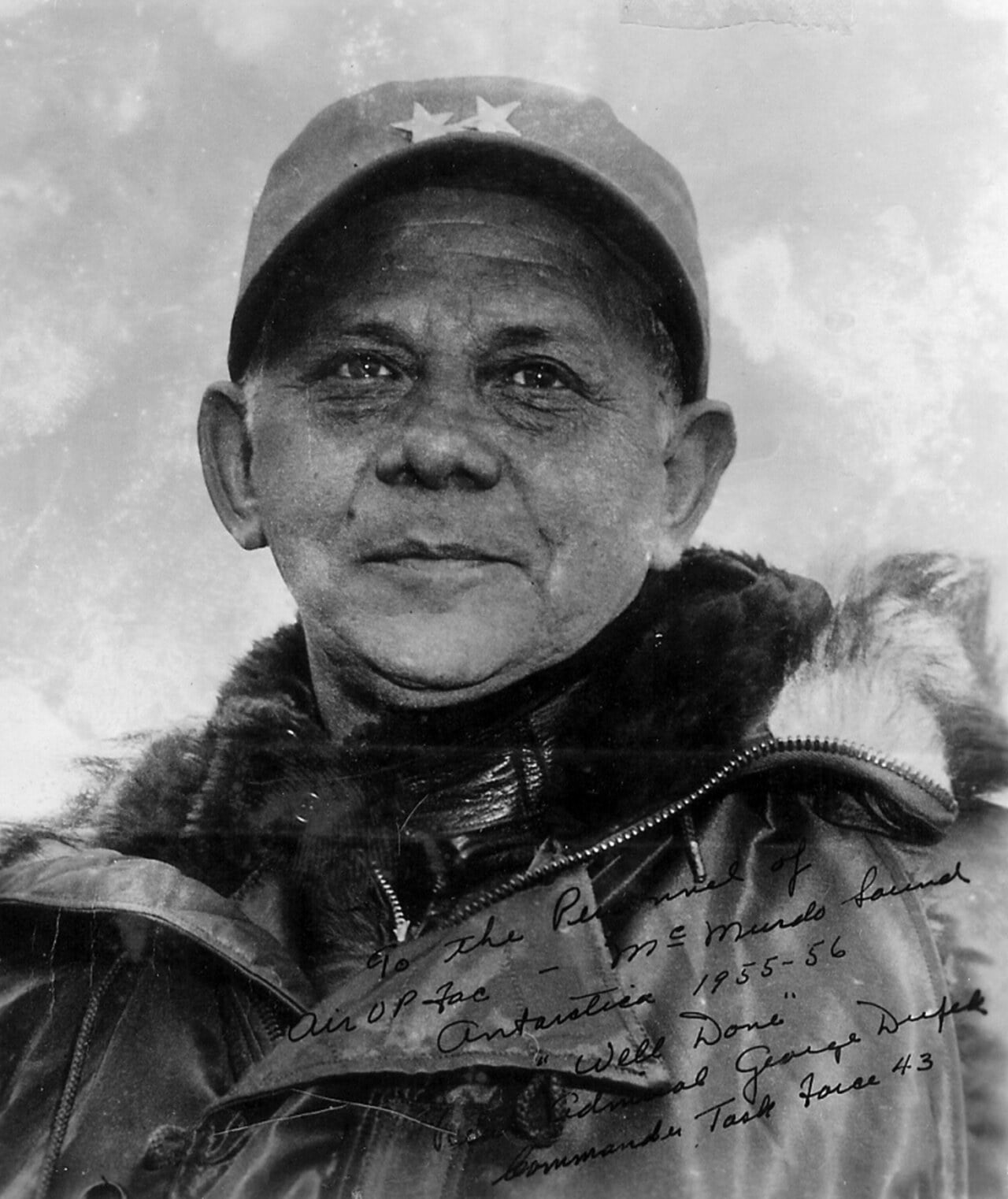
Shinn knew the aircraft well, and did not love her. As we told in our history of Operation Deep Freeze and 70 years of US aviation in Antarctica, his official report from the first season described 12418 as an aeroplane that flew in a perpetual skid. But she was what the Navy had, and the R4D was light enough to land on open snow that heavier aircraft would not have risked.
The problem was physics. The polar plateau lies at more than 9,000 feet, where the thin air saps engine power and wing lift at the same time. The loaded aircraft weighed around 28,000 pounds. To have any hope of getting back into the air, the crew fitted rocket bottles for jet-assisted takeoff, JATO, under the fuselage: fifteen of them.
Seven men, 800 miles, 49 minutes
Seven Navy men flew from McMurdo Sound on 31 October: Dufek; Captain Douglas Cordiner, commanding officer of VX-6; Shinn as pilot; Captain William Hawkes as co-pilot; navigator Lieutenant John Swadener; crew chief AD2 John P. Strider; and radioman AT2 William Cumbie Jr. The route ran about 800 miles south across the Ross Ice Shelf and up over the Transantarctic Mountains.
Archival footage of Rear Admiral Dufek and the crew boarding the ski-equipped R4D for the flight to the South Pole during Operation Deep Freeze.
They were not alone. A US Air Force C-124 Globemaster carrying journalists flew overhead, ready to drop survival supplies if things went wrong, and photographed the landing from above. Another ski-equipped R4D, Charlene, waited on the Liv Glacier with its engines running for most of the day, according to its pilots Eddie Frankiewicz and Jim Waldron, ready to fly a rescue.
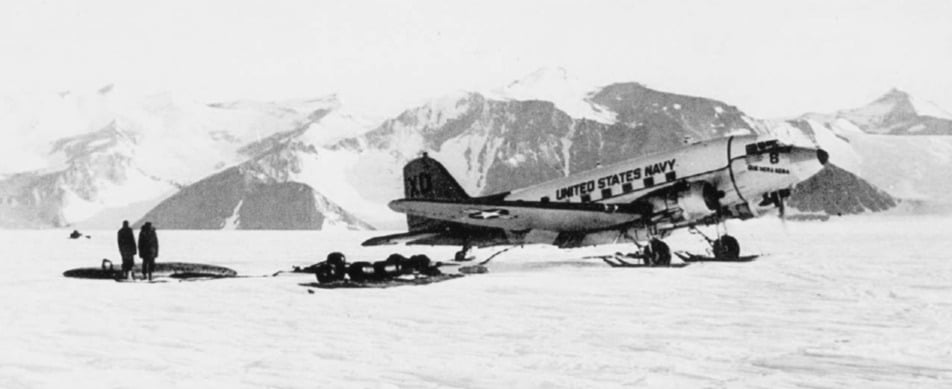
Shinn brought her in on the main skis with a hard, bouncing touchdown. Dufek was first out of the door. The party planted the American flag and set up a radar reflector and other navigational aids to guide future aircraft to the site. Two of the three cameras froze on arrival; Swadener had kept his inside his parka, which is why the moment survives on film.
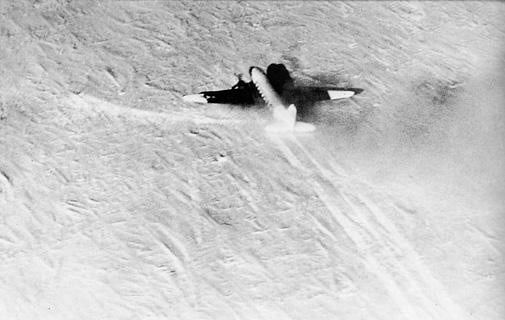
They stayed for 49 minutes. It was only the third time in history that people had stood at the South Pole, after Roald Amundsen’s party in December 1911 and Scott’s a few weeks later. Later surveys suggested the skis had actually come to rest a few miles from the precise geographic pole, which, with the navigation of 1956, everyone involved considered close enough.
“Like an old mud hen”
Getting there, Shinn said for the rest of his life, was the easy part. While the engines idled, the snow under the warm skis had melted and refrozen. When he opened the throttles, the R4D did not move. “We just sat on the ice like an old mud hen,” he told the Associated Press in 1999.
He began firing the JATO bottles, four at a time. Salvo after salvo roared out beneath the fuselage before the skis finally tore loose and Que Sera Sera staggered into the thin air, barely flying, inside a cloud of ice crystals she had blasted up herself. Shinn flew out on instruments until they cleared it, then turned north for the long trip home.
National Archives footage of Operation Deep Freeze aviation in 1956, including the crew of Que Sera Sera boarding at McMurdo and Navy JATO takeoffs from the snow.
Back at McMurdo, crew chief John Strider played the whole thing down to a reporter. The only problem on the flight, he joked, was that his coffee would not percolate at 12,000 feet. Years later, when strangers were introduced to Shinn as the first man to land at the South Pole, friends said he would gently point out that, more importantly, he was the first man to take off from it.
The first brick of a polar station
The landing was not a stunt. It proved that people and cargo could be flown to the Pole, and the build-up began within weeks. R4Ds landed the first Seabee construction crew there in November 1956, while Air Force Globemasters airdropped tons of material. The Amundsen–Scott South Pole Station has been occupied continuously ever since.
Shinn flew to the Pole about 17 times by his own count. He received the Legion of Merit, and Mount Shinn, one of the highest peaks in Antarctica, carries his name. Dufek went on to succeed Byrd as supervisor of US programmes in the South Polar regions, and Dufek Coast and the Dufek Massif are named after him.
The National Science Foundation marks the 60th anniversary of the first South Pole landing, which opened the Pole to the science it still supports there.
Que Sera Sera herself survived. She is preserved at the National Naval Aviation Museum aboard Naval Air Station Pensacola in Florida, suspended from the roof in her white-and-orange VX-6 colours, still carrying her skis and the racks for the JATO bottles that got her home. The same basic design is still at work in Antarctica today: turboprop conversions of the Douglas DC-3 fly to the Pole every summer alongside ski-equipped LC-130 Hercules.
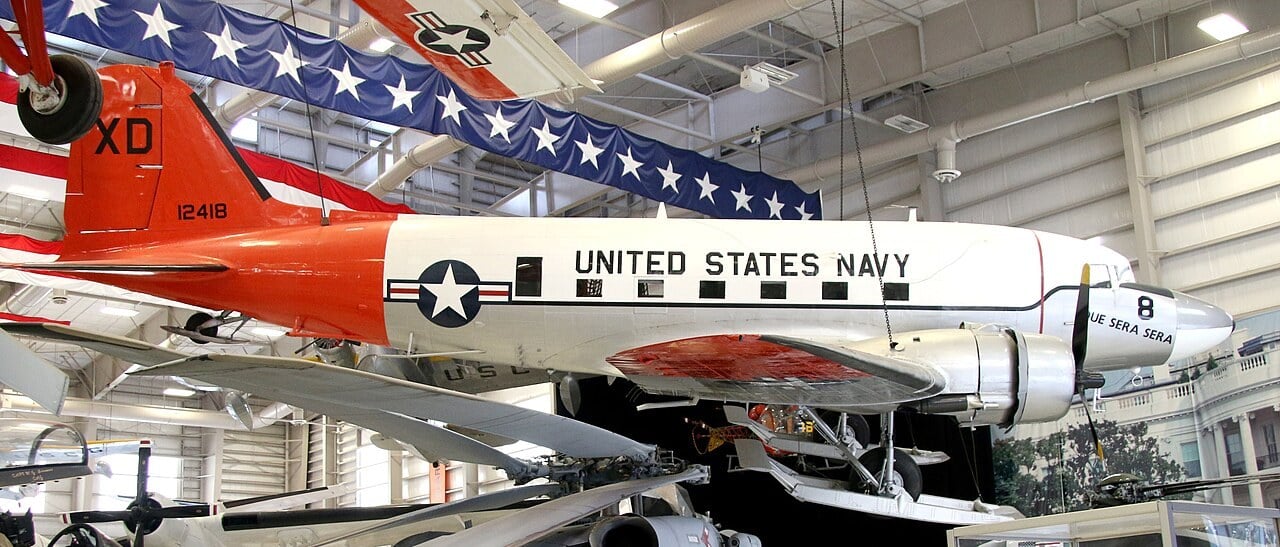
After he retired in 1963, Shinn settled in Pensacola and visited his old aeroplane at the museum for years, telling visitors how it had been done. He died on 15 May 2025, aged 102. “In retrospect, it was sheer madness,” he said of that Halloween flight. Whatever will be, will be. On 31 October 1956, it was history.
Sources: Naval History and Heritage Command (National Naval Aviation Museum), National Naval Aviation Museum Foundation, US Antarctic Program, The Boston Globe, Wikipedia (VXE-6, Operation Deep Freeze, George J. Dufek, Conrad Shinn), South Pole Station history (southpolestation.com), douglasdc3.com


0 Comments