
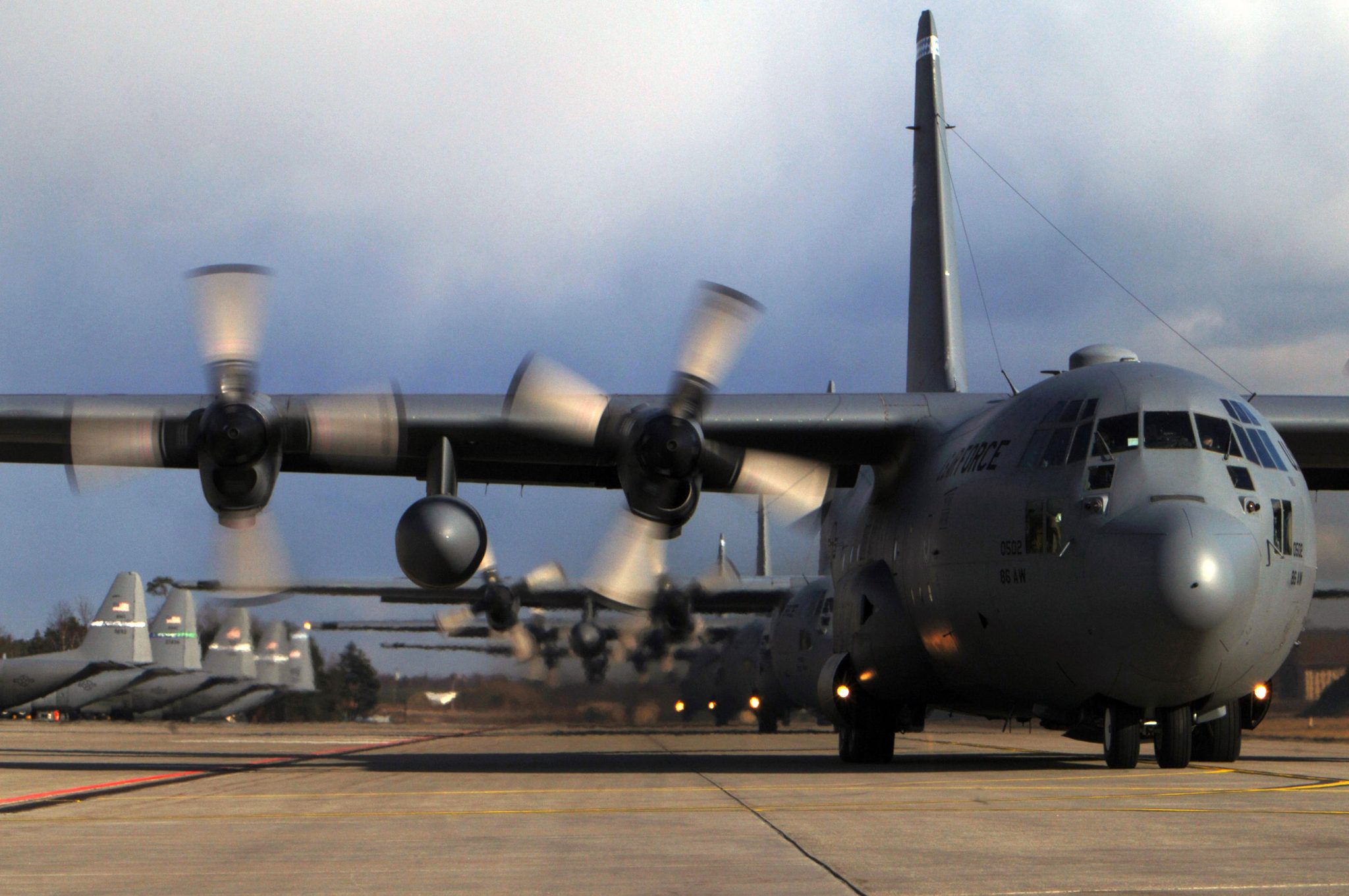
Lockheed C-130 Hercules
The airlifter that never stopped flying
The four-engine tactical transport that has hauled troops, tanks, paratroopers and disaster relief into the world’s roughest airstrips since the 1950s — and, more than seventy years on, is still rolling off the line.
The Lockheed C-130 Hercules: the workhorse that outlived its own era
In 1951 the United States Air Force, absorbing the hard lessons of the Korean War, issued a requirement for a new kind of transport aircraft. It wanted a turboprop-powered workhorse that could carry troops and heavy cargo, drop paratroopers and supplies, and — crucially — operate from short, unpaved, front-line airstrips. Lockheed’s design team answered with an aircraft that broke sharply with the airliner-derived transports of the day, and on 23 August 1954 the first YC-130 prototype took to the air from Burbank, California. It was the beginning of the longest continuous production run in the history of military aviation.
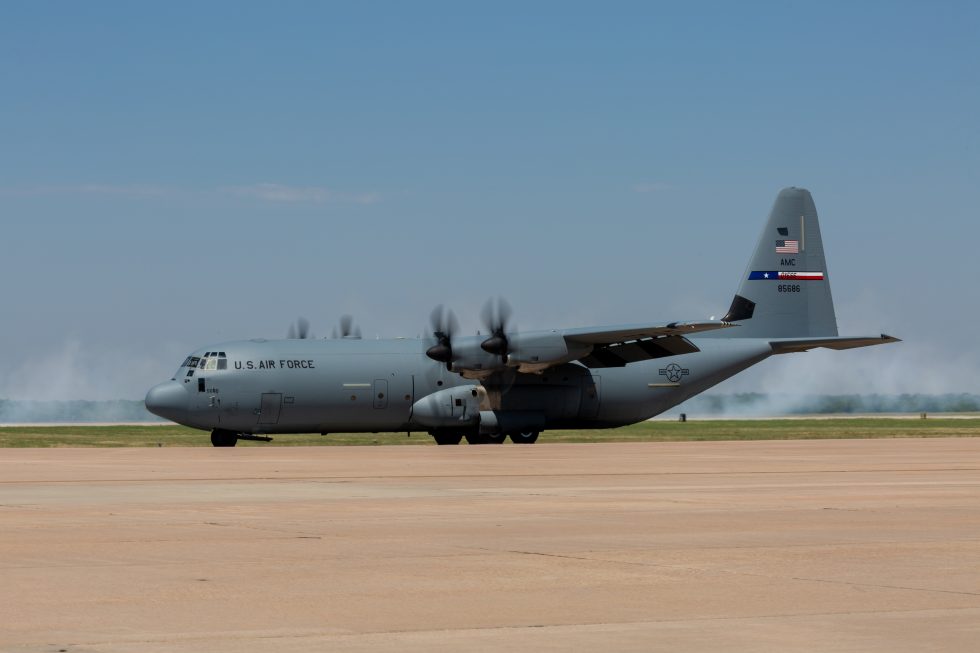
Almost everything about the design was shaped by that rough-field brief. The high wing kept the four engines and propellers clear of debris and let the fuselage sit low to the ground. A rear cargo ramp that lowered to truck-bed height turned loading and airdrop into fast, routine work. Sturdy multi-wheel landing gear and enormous flaps let the aircraft claw its way into and out of dirt strips that no jet transport could touch. And in place of the piston engines of its predecessors sat four Allison T56 turboprops — lighter, more powerful and more reliable, giving the Hercules both real lifting power and the low-speed control that short-field flying demands.
The C-130A entered US Air Force service in December 1956, and the type never looked back. Successive versions — the C-130B, the widely exported C-130E and the definitive C-130H — added range, power and payload while keeping the same rugged, unglamorous formula. Where a purpose-built airliner might be optimised for one job, the Hercules was designed to do almost anything, almost anywhere, and that is exactly what it went on to do.
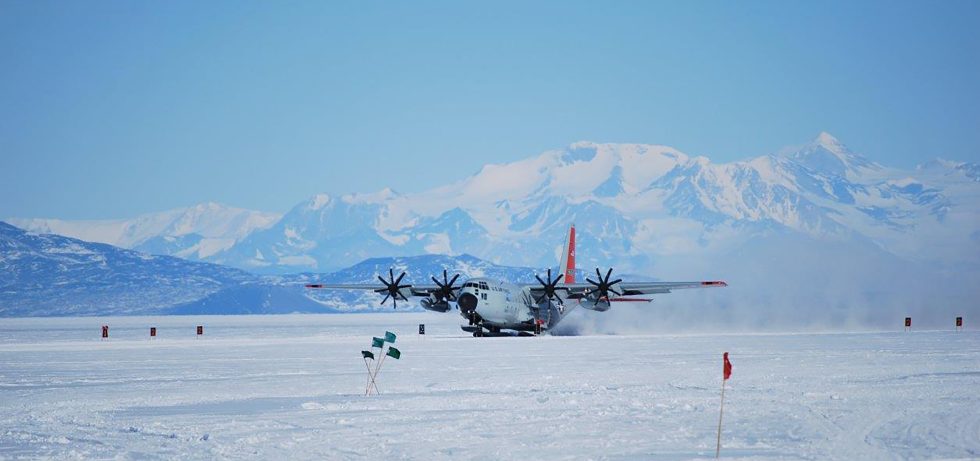
What sets the C-130 apart from nearly every other aircraft is the sheer breadth of its family. Over the decades Lockheed and its operators turned the basic airframe into more than seventy distinct variants: the KC-130 aerial tanker, the HC-130 combat search-and-rescue and refuelling aircraft, the MC-130 special-operations infiltrator, the EC-130 electronic-warfare and broadcast platform, the ski-equipped LC-130 that resupplies research stations in Antarctica and Greenland, the WC-130 “Hurricane Hunter” that flies deliberately into tropical storms, and the heavily armed AC-130 gunship. That last variant became a legend in its own right — you can read its story on our dedicated AC-130 gunship page.
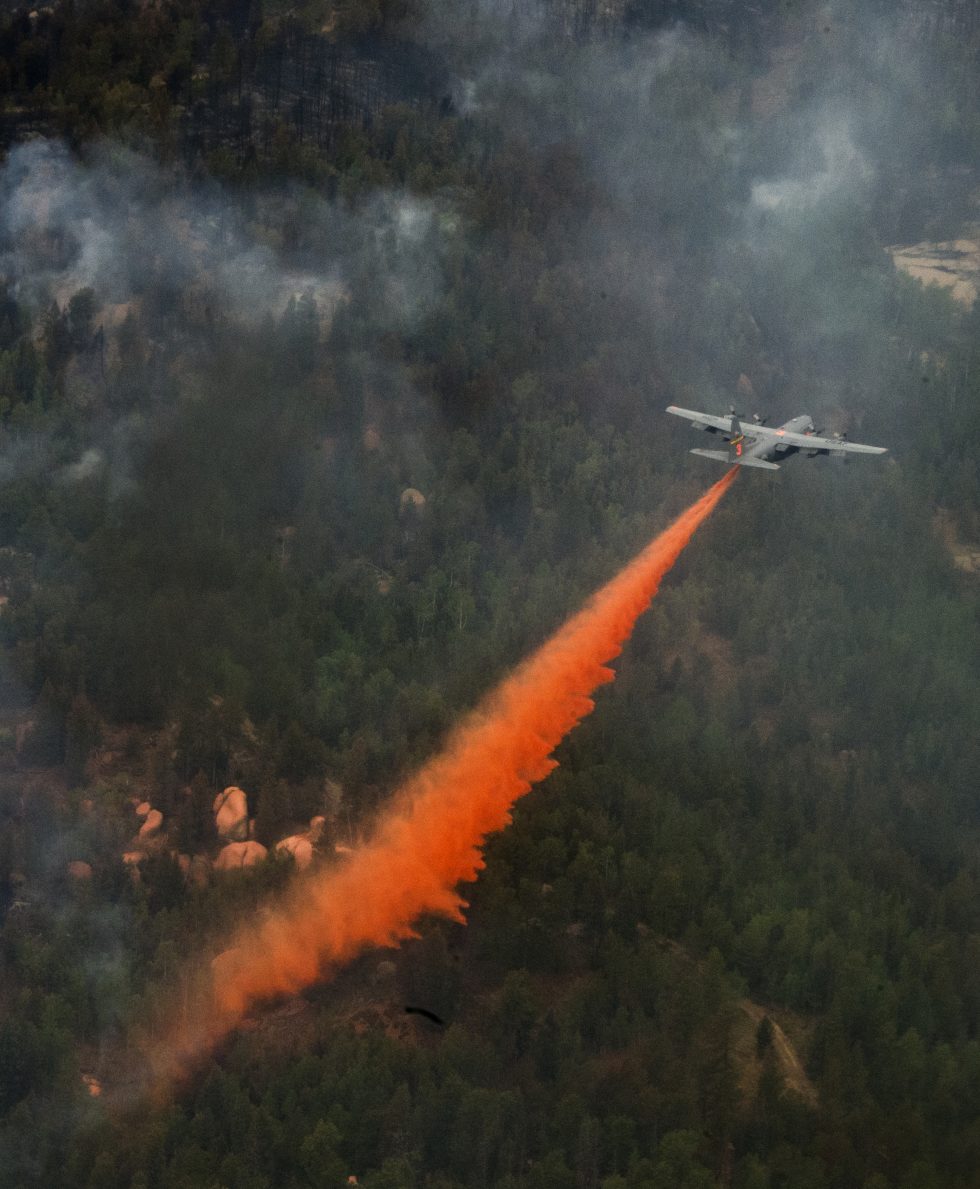
The Hercules also proved endlessly adaptable to peace. Fitted with the Modular Airborne Fire Fighting System (MAFFS), C-130s become airborne fire tankers, dropping retardant on wildfires. They fly humanitarian relief into earthquake and famine zones, carry out medical evacuation, support scientific expeditions to the poles, and haul everything from helicopters to armoured vehicles. Few aircraft have touched so many different missions, and fewer still have done so for so long.
In the 1990s Lockheed Martin comprehensively re-engineered the design as the C-130J Super Hercules: new Rolls-Royce turboprops driving distinctive six-blade composite propellers, a modern glass cockpit and a two-pilot crew, and a substantial jump in speed, range and payload. The J-model keeps the same unmistakable silhouette but is effectively a new aircraft inside, and it has kept the production line in Marietta, Georgia running into an eighth decade. Delivered to more than sixty nations and operated by around seventy air arms worldwide, the Hercules is that rarest of machines: a Cold War design that is still being built, still being bought, and still doing the job it was drawn up for.
01The Lockheed C-130 Hercules’s name and origins: how a 1951 airlift requirement created a legend
The C-130 grew out of a US Air Force requirement issued in 1951 for a turboprop tactical transport able to carry up to 92 troops or heavy cargo, drop paratroopers, and operate from short, rough airstrips near the front line. Lockheed won the competition, and its chief designer’s team deliberately rejected the sleek, airliner-style transports of the day in favour of a boxy, high-wing, ramp-loading aircraft built purely around the mission.
The name Hercules — after the hero of Greek myth famed for his strength and endurance — suited the aircraft so well that it stuck permanently, though crews the world over simply call it the “Herc.” The prototype first flew in 1954, production deliveries began in 1956, and the design has been in continuous production ever since, a record no other military aircraft can match.
What makes the Lockheed C-130 Hercules special
The high wing and rear ramp that redefined airlift
The Hercules was built around its cargo hold. A high-mounted wing keeps the engines clear of the ground and leaves the fuselage floor low and unobstructed, while a full-width rear ramp lowers to truck-bed height so vehicles can drive straight in and pallets or paratroopers can leave in seconds. That pressurised, straight-through cargo box — loaded from the back, not the side — became the template that virtually every military airlifter since has copied.
Four turboprops and genuine rough-field muscle
Four Allison (later Rolls-Royce) T56 turboprops give the C-130 the combination that jets struggle to match: strong low-speed thrust, excellent control at slow approach speeds, and the ability to reverse the propellers to stop short. Paired with rugged multi-wheel landing gear and huge flaps, that lets a fully loaded Hercules operate from short, unpaved, dirt or steel-mat strips where no jet transport could ever go.
One airframe, more than seventy missions
No other aircraft has been adapted so many ways. The same basic Hercules serves as tanker, gunship, hurricane hunter, ski-plane, electronic-warfare platform, search-and-rescue aircraft, air ambulance, firefighting tanker and special-operations transport. That extraordinary versatility — one cheap-to-run, easy-to-maintain airframe filling role after role — is exactly why so many were built and why around seventy nations still fly them.
02The Lockheed C-130J Super Hercules: how Lockheed rebuilt a legend for the 21st century
Launched in the 1990s, the C-130J Super Hercules is the most thorough modernisation in the type’s history. It replaces the classic T56 engines with more powerful and efficient Rolls-Royce AE 2100 turboprops driving six-blade composite propellers, adds a fully digital glass cockpit with head-up displays, and reduces the flight crew from a traditional four or five down to two pilots. The result is meaningfully faster, longer-legged and able to carry more, while burning less fuel. A stretched C-130J-30 variant adds nearly five metres of fuselage for even greater capacity. Outwardly almost identical to the original, the J-model is effectively a new aircraft under the skin — and it is what has kept the Marietta, Georgia production line running past seventy years.
03The Lockheed C-130 Hercules’s variants: gunship, tanker, hurricane hunter and more
The C-130 family is one of the largest of any aircraft. Beyond the standard transport, the major military variants include the KC-130 aerial-refuelling tanker; the HC-130 combat search-and-rescue and tanker aircraft; the MC-130 special-operations infiltrator for low-level clandestine flights; the EC-130 electronic-warfare, command and broadcast platform; the ski-equipped LC-130 that supports polar research; the WC-130 “Hurricane Hunter” weather-reconnaissance aircraft; and the side-firing AC-130 gunship. Civil and firefighting operators fly further versions, including the L-100 commercial Hercules and MAFFS-equipped fire tankers. Lockheed and its operators have fielded more than seventy distinct variants in all — for the full gunship story, see our AC-130 gunship page.
04The Lockheed C-130 Hercules’s engines: why the T56 turboprop was the right choice
The Hercules was one of the first transports designed around the turboprop — a turbine engine driving a propeller. Compared with the piston engines it replaced, the Allison T56 was lighter, more powerful and far more reliable, and compared with a pure jet it delivered much stronger thrust at low speed, which is exactly what short-field takeoffs and slow, precise airdrops demand. Early C-130A aircraft used the T56-A-1A of around 3,750 shaft horsepower; the classic C-130H flew behind four T56-A-15 engines of roughly 4,590 shp each. The modern C-130J switched to the Rolls-Royce AE 2100 with six-blade props for still more power and efficiency. The T56 itself became one of the most successful turboprops ever built, also powering the P-3 Orion and the E-2 Hawkeye.
Full Lockheed C-130H Hercules specifications
Baseline: the C-130J-30 Super Hercules, the stretched production aircraft Lockheed Martin has been building since the late 1990s and the mark most new customers buy. Deltas for the legacy C-130H in grey — the two are further apart than the shared silhouette suggests, the J having six-blade composite propellers, Rolls-Royce AE 2100D3 engines and a two-crew glass flight deck with no navigator and no flight engineer.
Dimensions & weights
- Crew
- 3 (two pilots and a loadmaster) C-130H: 5, adding a navigator and a flight engineer
- Length
- 34.37 m (112 ft 9 in) short-body C-130J and C-130H: 29.79 m (97 ft 9 in)
- Wingspan
- 40.41 m (132 ft 7 in)
- Height
- 11.84 m (38 ft 10 in) C-130H: 11.66 m (38 ft 3 in)
- Wing area
- 162.1 m² (1,745 sq ft)
- Cargo compartment
- 16.76 m long, 3.02 m wide, 2.74 m high (55 × 9 ft 11 in × 9 ft) short-body marks: 12.19 m (40 ft) long
- Rear ramp
- 3.12 m long, 3.02 m wide (123 × 119 in), loads at truck-bed height
- Operating weight empty
- 36,740 kg (81,000 lb) C-130H: 34,400 kg (75,800 lb)
- Maximum take-off weight
- 74,390 kg (164,000 lb) C-130H: 70,310 kg (155,000 lb)
- Maximum payload
- 19,960 kg (44,000 lb) short-body J and C-130H: 19,050 kg (42,000 lb); Lockheed quotes 22,670 kg (50,000 lb) at the 2.5 g structural limit
- Internal fuel
- ~20,800 kg (~45,900 lb, 6,700 US gal) in six integral wing tanks
- Troops or paratroops
- 128 seated troops or 92 paratroops short-body J and C-130H: 92 or 64
- Litters
- 97 with medical attendants short-body J and C-130H: 74
- Pallets and airdrop bundles
- 8 × 463L pallets or 24 CDS bundles short-body J and C-130H: 6 pallets or 16 bundles
Performance
- Maximum cruise speed
- 660 km/h (410 mph, 355 kt) at 6,700 m (22,000 ft) C-130H: 541 km/h (336 mph, 292 kt)
- Maximum speed
- 670 km/h (417 mph, 362 kt) C-130H: 592 km/h (368 mph, 320 kt) at 6,100 m
- Rate of climb
- 640 m/min (2,100 ft/min) C-130H: 558 m/min (1,830 ft/min)
- Service ceiling
- 9,315 m (30,560 ft); 7,925 m (26,000 ft) with maximum payload C-130H: 10,060 m (33,000 ft) light, 7,010 m (23,000 ft) with 19,050 kg
- Range, maximum normal payload
- ~3,900 km (~2,100 nmi, 2,417 miles) Lockheed also publishes 4,425 km (2,390 nmi) at an 18,140 kg payload; the two figures sit oddly together and the lower one is the safer planning number
- Ferry range
- ~7,400 km (~4,000 nmi) published for the C-130H; the J is broadly comparable on internal fuel
- Take-off distance
- 1,780 m (5,850 ft) at maximum weight; 945 m (3,100 ft) maximum effort C-130H: 1,093 m (3,586 ft) at 70,310 kg
- Landing distance
- 945 m (3,100 ft) at 61,235 kg; 497 m (1,630 ft) maximum effort
- Design load factor
- 2.5 g at maximum take-off weight
- Airdrop
- Heavy platforms to 19,050 kg (42,000 lb); LAPES extraction from 1.5–3 m above the ground
- Runway
- Cleared for unprepared strips: dirt, gravel, sand, pierced steel planking and, on skis, snow and glacial ice
Propulsion & systems
- Engines
- 4 × Rolls-Royce AE 2100D3 turboprop C-130H: 4 × Allison T56-A-15
- Power
- 3,458 kW (4,637 shp) each T56-A-15: 3,423 kW (4,591 shp) each
- Propellers
- Dowty R391 six-blade all-composite scimitar, 4.11 m (13 ft 6 in) diameter C-130H: Hamilton Standard 54H60 four-blade of the same diameter; many H-models now retrofitted with the eight-blade NP2000
- Fuel system
- ~25,360 litres (~6,700 US gal) internal; provision for two underwing tanks of 4,880 litres (1,290 US gal) each on C-130E/H
- Radar
- AN/APN-241 low-power colour weather and navigation radar with windshear prediction
- Flight deck
- Four multifunction liquid-crystal displays, dual head-up displays, digital flight management and autopilot C-130H: analogue instruments, a navigator’s station and a flight engineer’s panel
- Sights
- None fitted to the transport. Special-mission marks carry electro-optical and infrared turrets; the AC-130J adds an advanced targeting pod and a fire-control station in the cargo bay
- Self-protection
- AN/ALE-47 chaff and flare dispensers, AN/AAR-47 missile warning, radar warning receiver, AN/AAQ-24 LAIRCM on many aircraft fit varies enormously by operator; a good many export C-130s carry nothing at all
- Crew escape
- No ejection seats. Parachutes, the crew entrance door and the two paratroop doors
- First flight
- 23 August 1954 (YC-130 prototype); 5 April 1996 (C-130J)
- Service entry
- December 1956 (C-130A, USAF); February 1999 (C-130J, Royal Air Force)
- Number built
- More than 2,700 by 2024, of which over 500 are C-130Js still in production, the longest continuous military aircraft production run in history
05The Lockheed C-130 Hercules’s operating costs: what it takes to keep a Herc flying
Because the C-130 has served for seven decades in dozens of versions, there is no single authoritative cost figure — treat every number as an estimate. Published US Department of Defense reimbursable rates put the cost per flying hour of the legacy C-130H in the region of USD 15,000–16,000, while the modern C-130J is markedly cheaper to operate at roughly USD 10,000 per hour — one of the headline savings that justified the J-model programme. These figures typically cover fuel and maintenance but exclude aircrew pay, basing and other overheads, so true all-in ownership costs are higher. On the purchase side, a new C-130J has recently cost on the order of USD 100–110 million per aircraft as a complete weapon system, whereas a legacy C-130H was quoted at around USD 30 million in earlier-year dollars. As always with military aircraft, figures vary widely by variant, year, currency and accounting method.
06The Lockheed C-130 Hercules’s numbers: how many were built and who flies them
The Hercules is one of the most successful military aircraft ever produced. Lockheed Martin states that more than 2,700 C-130s have been ordered or delivered to 63 nations, and that around 70 countries currently operate the type — figures widely cited across the industry. Production has run continuously since the mid-1950s, making the C-130 the holder of the longest continuous military aircraft production run in history, now past seventy years. The worldwide C-130J fleet alone has logged more than one million flight hours. Exact totals vary depending on which variants and export machines are counted, so the numbers are best read as authoritative estimates rather than precise counts.
Armament & payload
The Hercules carries no weapons at all until somebody bolts a howitzer into the cargo bay
A standard C-130 is unarmed, and that is the point: its contribution to a fight is 19,960 kg of anything at all put down on a dirt strip, or pushed out of the back door onto a drop zone. The aeroplane earns its place through the ramp, the 463L pallet system, the paratroop doors and the low-pressure landing gear, not through hardpoints. The exception is spectacular. Since 1967 the United States has cut gun ports into the port side of the fuselage and turned the same airframe into the AC-130 gunship, the only aircraft in regular service that fires a 105 mm field howitzer in flight, hand-loaded by a crew standing up in the cargo compartment. Everything below the transport payload figures is variant-specific: the overwhelming majority of the world’s C-130s carry nothing more offensive than a chaff dispenser, and the gunship, tanker and special-operations fits described here belong to a small American minority of the fleet.
Gun
- The standard transport is unarmed. No C-130A through C-130J built as a cargo aircraft carries a gun of any kind.
- AC-130A/E/H Spectre: four 7.62 mm GAU-2/A miniguns and four 20 mm M61 Vulcan cannon on the early Pave Pronto fits, later joined by a 40 mm Bofors L/60 and a 105 mm M102 howitzer, all firing to port through a pylon turn.
- AC-130U Spooky II (retired 2020): a 25 mm GAU-12/U Equalizer, the 40 mm Bofors and the 105 mm M102, slaved to a digital fire-control system and a strike radar.
- AC-130W Stinger II and AC-130J Ghostrider: a 30 mm GAU-23/A Bushmaster chain gun; the Ghostrider adds the 105 mm M102 on a trainable mount.
- The M102 is loaded and fired by hand, in flight, by a gun crew wearing headsets — the only artillery piece in routine airborne service anywhere.
Air-to-air
- None carried. No C-130 of any mark has been fitted with an air-to-air weapon in more than seventy years of service.
- Defence against fighters is flares, chaff, terrain masking, darkness and, historically, the hope of not being found.
- The closest the type came to an air-to-air role was the JC-130B and its mid-air retrieval trapeze, which snatched descending Corona reconnaissance film capsules out of the sky by their parachutes — a catch, not a kill.
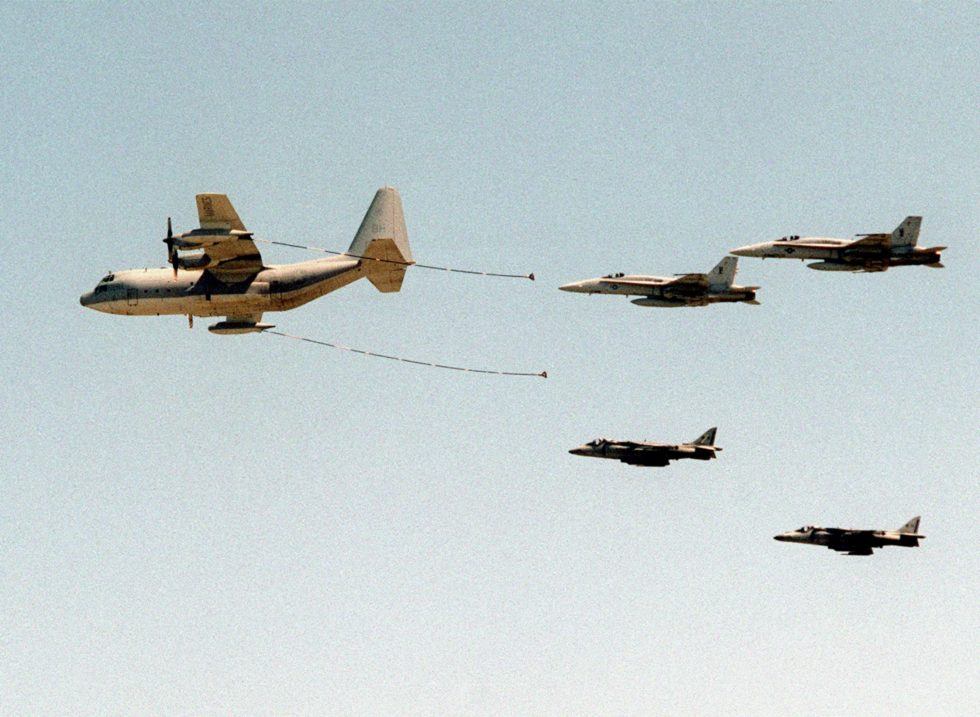
- KC-130 tankers pass fuel to fighters and helicopters at 1,135 litres per minute per basket. They support the air-to-air fight; they take no part in it.
Air-to-surface guided
- AGM-114 Hellfire, carried by the AC-130W and AC-130J and by the US Marine Corps KC-130J under the Harvest HAWK kit.
- AGM-176A/B Griffin, fired from a pressurised ten-round Gunslinger launch tube through the ramp, or from a Derringer Door in the rear fuselage.
- GBU-39/B Small Diameter Bomb and GBU-69/B Small Glide Munition, released from the AC-130J’s wing racks and common launch tubes.
- Rapid Dragon: palletised AGM-158 JASSM cruise missiles rolled off the ramp on a standard airdrop pallet and released under parachute, demonstrated from 2021. It turns any cargo Hercules into a stand-off missile carrier without touching the airframe.
- The ordinary transport carries nothing guided and has no pylons wired for weapons.
Bombs
- No C-130 has ever had a bomb bay or bomb racks. Everything below leaves through the back door on a pallet.
- BLU-82B Daisy Cutter, 6,800 kg (15,000 lb), parachute-extracted from MC-130E Combat Talons over Vietnam, then Afghanistan and Iraq; last dropped in 2008.
- GBU-43/B MOAB, 9,800 kg (21,600 lb), dropped from an MC-130 over Nangarhar province on 13 April 2017 — the largest conventional weapon ever used in combat, delivered by a cargo aircraft.
- BLU-118/B thermobaric weapons were extracted the same way against cave complexes in 2002.
- The AC-130J carries small precision bombs of the GBU-39 and GBU-53/B class on external racks, which is as close as the family comes to conventional bombing.
Rockets
- AGR-20 APKWS: 70 mm Hydra rockets fitted with laser guidance kits, fired from the AC-130J and AC-130W and now the cheapest precision round the gunship carries.
- Unguided rocket pods have never been a standard fit on any C-130, gunship or otherwise.
- Assisted-take-off rockets are a different matter: eight or more solid bottles bolted to the fuselage sides, used by ski-equipped LC-130s off deep snow and by the C-130A off short strips. Propulsion, not weaponry.
- The YMC-130H of Operation Credible Sport carried thirty rocket motors, forward-firing ones to stop the aeroplane inside a football stadium in Tehran. One of the two prototypes fired them out of sequence and was destroyed on landing in 1980.
- The standard transport carries no rockets at all.
Pods & other stores
- Two underwing pylons outboard of the outer engines, each rated for a 4,880 litre (1,290 US gal) fuel tank. On most airframes these are the only external stations that exist.
- KC-130J tanker: two Sargent Fletcher wing hose-drum units at about 1,135 litres per minute each, plus a removable fuselage tank, for a total offload of some 32,000 litres (8,455 US gal).
- MAFFS II: a roll-on, roll-off 11,350 litre (3,000 US gal) fire-retardant tank that discharges through the ramp under pressure, turning an ordinary C-130J into an air tanker in hours.
- Harvest HAWK and the AC-130 Precision Strike Package: an AN/AAQ-30 or MX-20 electro-optical and infrared turret, missile rails and a mission operator console installed in the cargo bay.
- Self-protection stores: AN/ALE-47 chaff and flare dispensers, AN/AAR-47 missile warning, AN/AAQ-24 directed infrared countermeasures. Fit varies wildly between operators.
Three typical loadouts
- Tactical airlift, C-130J-30
- 8 × 463L pallets, 19,960 kg (44,000 lb) total, flown some 3,900 km and put down on a 945 m unprepared strip; loadmaster and two pilots, no ground handling equipment required at the far end.
- Airborne assault and resupply
- 92 paratroops exiting through two side doors and the ramp, or 24 Container Delivery System bundles of up to 1,000 kg each released from 245 m, or a single heavy platform to 19,050 kg extracted by parachute.
- AC-130J Ghostrider gunship station
- 1 × 105 mm M102 howitzer, 1 × 30 mm GAU-23/A chain gun, 10 × AGM-176 Griffin in a ramp-mounted Gunslinger tube, AGM-114 Hellfire and GBU-39/B SDB on wing racks, orbiting left-hand at 4,500–6,000 m.
Payload, pallet and troop figures are Lockheed Martin and US Air Force published data for the C-130J-30. Gunship fits changed repeatedly within each mark — the AC-130H lost its 20 mm cannon in the 1990s, the AC-130U was retired in 2020, and the AC-130J’s Precision Strike Package is still being added to. Treat any single gunship weapons list as a snapshot rather than a specification.
Variants
The C-130 stopped being one aeroplane in about 1957 and became a chassis
Lockheed set out to build a tactical transport and instead built a general-purpose airframe that could absorb almost any mission somebody thought to bolt into it. The cargo box is unpressurised in the useful sense — big, square, at truck-bed height, with a door at the back the size of the fuselage — and the wing is stressed for weights and load factors that leave room for equipment. That combination has produced gunships, tankers, hurricane hunters, ski-equipped polar freighters, electronic-warfare jammers, drone controllers, psychological-operations broadcasters, aerial sprayers, firefighters and one aeroplane fitted with rockets to land inside a stadium.
The line divides cleanly in two. Everything up to the C-130H is the original aeroplane with progressively better Allison T56 engines and avionics; the C-130J is a genuinely new machine inside the same skin, with Rolls-Royce AE 2100D3 engines, six-blade composite propellers, a two-pilot glass flight deck and roughly forty per cent more range. More than 2,700 have been delivered since 1956 and the line is still open, which no other military aircraft can claim.
- C-130A / C-130B (1955–1963, ~230 and ~230)
- The originals: T56-A-9 and later T56-A-7 engines, three- then four-blade propellers, the blunt "Roman nose" replaced by the familiar radar nose. Short-ranged, which is why the wing pylon tanks appeared almost immediately.
- C-130E (1962–1974, 491 built, 389 for the USAF)
- The long-range mark: two 4,880 litre underwing tanks, a strengthened centre wing and a higher take-off weight. The Vietnam workhorse, and the airframe most Combat Talons and gunships were converted from.
- C-130H (1964–1996, ~1,000)
- The mass-production standard and still the most numerous mark in the world. T56-A-15 engines, a redesigned outer wing and, in the H2 and H3 sub-marks, ring laser gyros, GPS, colour radar and night-vision-compatible lighting.
- C-130K Hercules C.1/C.3 (1966–1968, 66)
- The Royal Air Force fleet, British avionics and instruments from new; thirty were later stretched by 4.6 m to C.3 standard, anticipating the C-130J-30 by two decades. Retired in 2023.
- C-130J / C-130J-30 (1996–present, 500+ delivered by 2022)
- New engines, new propellers, new avionics and a crew of three instead of five. The -30 adds 4.6 m of fuselage, two more pallets and thirty-six more troops, and is what almost everybody now orders.
- LC-130 F/R/H, ski-equipped
- Retractable Teflon-coated skis over the wheels, letting the aircraft use runways and glacial ice alike. Ten LC-130H fly Antarctic and Greenland resupply with the New York Air National Guard — the largest ski-equipped aircraft in the world, and the only routine heavy lift onto the polar plateau.
- HC-130 B/E/H/N/P Combat King, HC-130J Combat King II
- Long-range search and rescue and helicopter refuelling. Early aircraft carried the Fulton surface-to-air recovery yoke on the nose; the modern J-model tanks CV-22s and rescue helicopters and drops pararescue teams. The US Coast Guard flies its own maritime patrol version.
- MC-130 E/H Combat Talon I/II, MC-130J Commando II
- Special-operations infiltration: terrain-following radar, precision navigation, blacked-out low-level penetration and helicopter refuelling. The Combat Talons flew the Son Tay raid and Operation Eagle Claw, and delivered the BLU-82 and the MOAB.
- AC-130 A/E/H Spectre, U Spooky II, W Stinger II, J Ghostrider
- The side-firing gunship, in continuous development since 1967. From four miniguns and four 20 mm cannon to a 105 mm howitzer, a 30 mm chain gun, Hellfire, Griffin, small diameter bombs and laser-guided rockets. Roughly thirty AC-130J are in service.
- EC-130 E/H Compass Call, E/J Commando Solo, Q TACAMO
- Electronic attack and information operations. Compass Call jams enemy command networks; Commando Solo broadcasts television and radio from a flying transmitter; the naval EC-130Q trailed kilometres of antenna to talk to submerged ballistic-missile submarines.
- WC-130 A/B/E/H/J Hurricane Hunter
- Ten WC-130J of the 53rd Weather Reconnaissance Squadron fly into tropical cyclones at around 3,000 m, dropping instrumented sondes through the eyewall. The data feeds the National Hurricane Center directly and measurably improves track forecasts.
- KC-130 F/R/T/J tanker
- The US Marine Corps tanker and tactical transport, 74 KC-130J in service. Two wing hose-drum units refuel fighters and helicopters, and the Harvest HAWK kit adds sensors and Hellfire without giving up the tanking role.
- L-100 / LM-100J civil (1964–1992, 114; LM-100J from 2018)
- The certificated commercial Hercules, sold to oil companies, relief agencies and freight operators, and stretched as the L-100-20 and L-100-30. The LM-100J revived the idea on the J airframe.
Production totals by mark are approximate and disputed: Lockheed, the USAF and the standard Olausson production lists count conversions, rebuilds and export blocks differently, and many airframes changed designation more than once during their lives. The headline figure of more than 2,700 delivered by 2024 is Lockheed Martin’s own and is the most defensible single number.
The Lockheed C-130 Hercules from requirement to living legend
The requirement
The US Air Force issues a requirement for a turboprop tactical transport able to carry troops and cargo, drop paratroopers and operate from short, rough airstrips. Lockheed wins the competition.
First flight
The YC-130 prototype makes its maiden flight from Burbank, California, on 23 August 1954, powered by the new Allison T56 turboprop.
Enters service
The C-130A enters US Air Force service in December 1956, beginning the longest continuous production run in military aviation history.
The C-130E and combat airlift
The longer-range C-130E is widely exported and proves itself in Vietnam, flying resupply into besieged airstrips such as Khe Sanh and cementing the Hercules as the backbone of tactical airlift.
The gunship is born
Armed AC-130 gunship trials begin, turning the transport into a devastating side-firing fire-support aircraft — a role the type still fills today.
The definitive C-130H
The uprated C-130H enters service and becomes the most widely produced and exported version, serving air forces around the world for decades.
The Entebbe raid
Israeli C-130s fly a long-range special-operations mission to Entebbe, Uganda, to rescue hostages — one of the most famous Hercules operations ever flown.
The C-130J Super Hercules
The comprehensively modernised C-130J flies for the first time, with new Rolls-Royce engines, six-blade propellers and a glass cockpit, keeping the line alive into a new century.
From Desert Storm to disaster relief
C-130s fly combat airlift in the Gulf, Afghanistan and Iraq, and humanitarian relief after earthquakes, hurricanes and famines worldwide — the type’s two enduring faces.
Still in production
More than seventy years after its first flight, the C-130J is still being built and delivered, and around seventy nations keep the Hercules on the front line and the flight line.
From the flight line: twelve Lockheed C-130 Hercules stories
A transport built for dirt strips
The 1951 brief that rejected the airliner formula.
Read the full story
Why it is called Hercules
A mythic name that actually fit.
Read the full story
The engines that made it possible
Why four propellers beat pure jets for this job.
Read the full story
Loading from the back
The rear ramp that changed how armies move.
Read the full story
Backbone of combat airlift
Keeping besieged airstrips alive under fire.
Read the full story
The rescue at Entebbe
A long-range raid that stunned the world.
Read the full story
From transport to AC-130
How a cargo plane became a fearsome gunship.
Read the full story
Flying into the storm
The WC-130 that chases what everyone else flees.
Read the full story
The ski-equipped LC-130
The Hercules that lands on snow.
Read the full story
An airborne fire tanker
MAFFS turns transports into water bombers.
Read the full story
The relief flight of choice
First in after the disaster.
Read the full story
Seventy years and counting
A Cold War design still rolling off the line.
Read the full story
The Lockheed C-130 Hercules in pictures
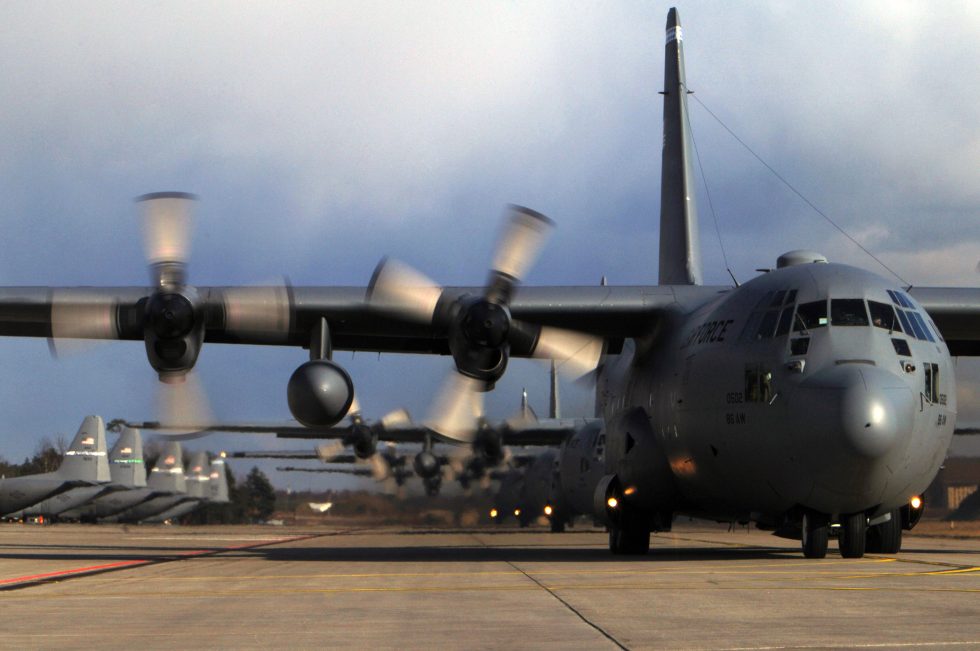
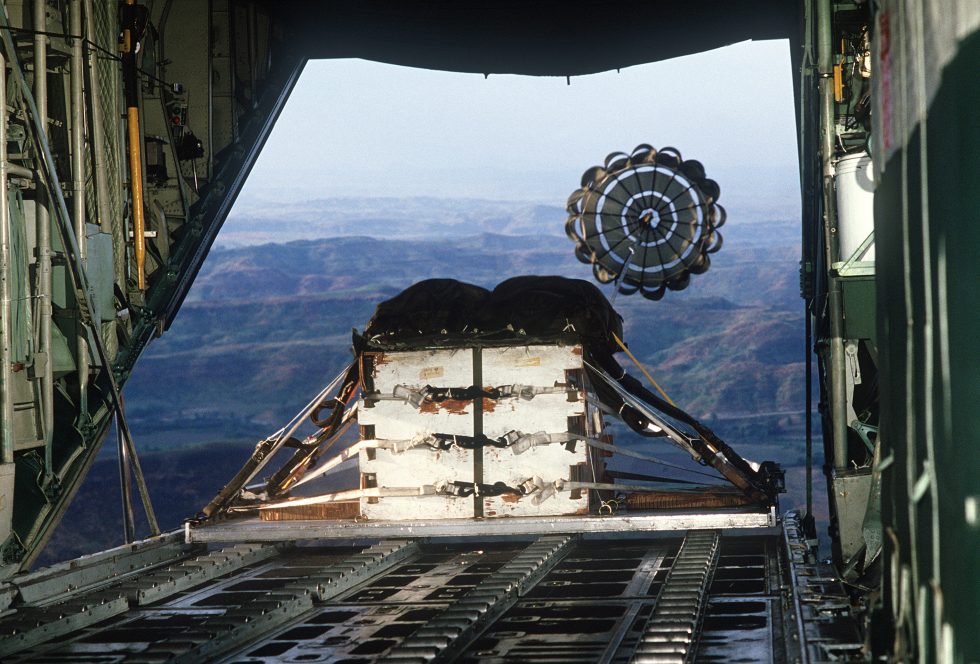
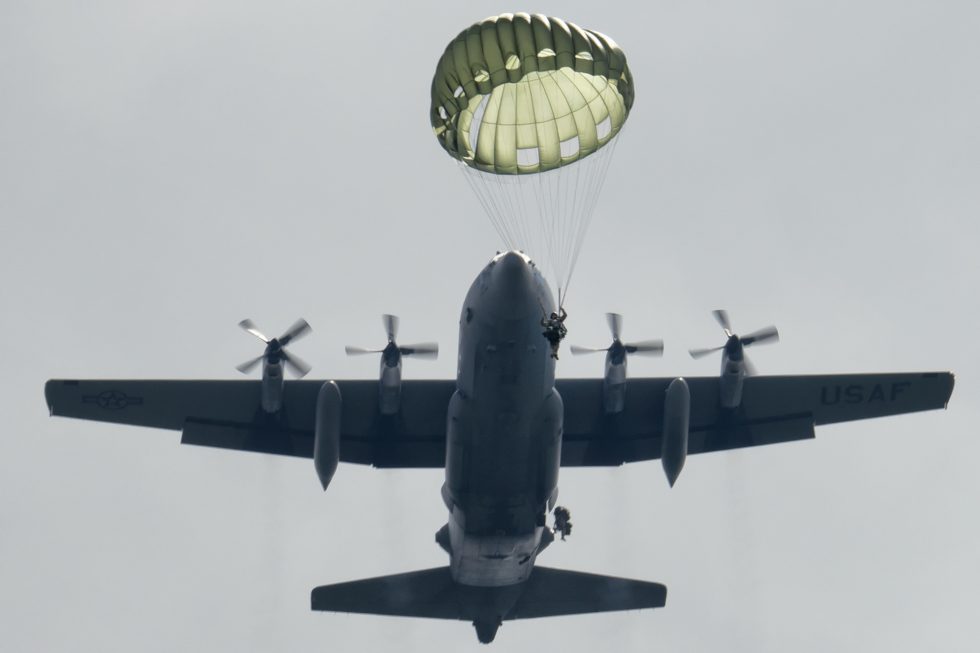
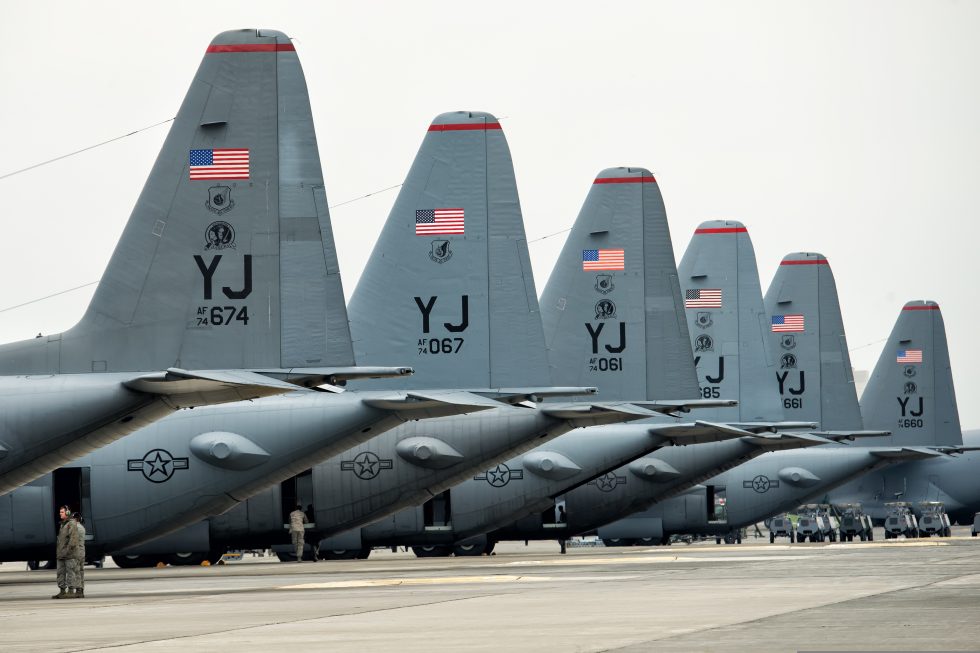
The Lockheed C-130 Hercules in motion
The History of the C-130 Hercules — from Popular Mechanics, a look at how Lockheed’s tactical transport was designed and why it has stayed in service and production for more than seventy years.
Where the Lockheed C-130 Hercules flies
Operators today
The Hercules is still the standard tactical transport of the Western world and much of everywhere else
Roughly 820 C-130s and civil L-100s were listed as active worldwide in the 2025 FlightGlobal directory, and about seven hundred of those are military. The distribution is lopsided in a way no other aircraft type matches: the United States alone operates well over half the fleet across four services, and no other country comes within an order of magnitude. The chart below is a top twelve by fleet size, not a full list — the C-130 has served with more than sixty air forces and is still flown by around sixty, most of them with fleets of one to ten aircraft that would be invisible at this scale.
These are estimates. The United States figure aggregates the Air Force (about 440 aircraft including AC-130, EC-130, HC-130 and MC-130 special-mission marks), 74 US Marine Corps KC-130J, roughly 29 US Navy C-130T and KC-130T, and about two dozen US Coast Guard HC-130s. Many airframes counted on paper are stored, in deep overhaul or not operational — Iran’s fleet in particular has been under sanction for four decades and its serviceable strength is far lower than its inventory. Turkey’s figure is the number grounded for inspection after the November 2025 loss and excludes twelve ex-Royal Air Force C-130Js still being delivered. Sources: FlightGlobal World Air Forces 2025 and IISS The Military Balance; entries that could not be corroborated are omitted.
The Lockheed C-130 Hercules’s record: the airlifter that goes everywhere
The Hercules is not measured in dogfights but in missions flown, tonnes carried and lives moved. Since 1956 it has been the backbone of Western tactical airlift, flying combat resupply into besieged strips in Vietnam, sustaining the Gulf, Iraq and Afghanistan campaigns, and carrying humanitarian relief into virtually every major disaster of the past half-century. Along the way the same airframe has served as tanker, gunship, hurricane hunter, ski-plane and firefighter. These roles are as varied as any aircraft has ever filled.
One of its most famous offspring is the side-firing gunship — read the full story of the AC-130 gunship, and see the rugged US types that flew alongside it, the A-10 Warthog and the UH-1 Huey.
Everything people ask about the Lockheed C-130 Hercules
Can I fly in a C-130 Hercules?
What is the Lockheed C-130 Hercules?
When did the C-130 first fly?
Why is it called the Hercules?
What engines does the C-130 have?
How much can a C-130 carry?
How many C-130s have been built?
What are the main C-130 variants?
Is the AC-130 gunship the same aircraft?
Can the C-130 really land on short, unpaved runways?
Is the C-130 still in production?
What does the C-130 do besides carry cargo?
You can’t fly the C-130 Hercules.
These, you can.
Some legends only live in museums — others are fuelled and waiting. MiGFlug has put civilians in real military jet cockpits since 2004.
 Fly the L-39 AlbatrosThe world’s most-flown jet trainer — aerobatics included
 Fly the F-104 Starfighter“The missile with a man in it”
 Fly the MiG-21The Cold War’s most-produced jet
 Fly the T-33 Shooting StarAmerica’s first jet trainer
 Fly the DH VampireA piece of early jet history
 Fly the S.211Agile Italian jet trainer
 Fly the MB-326The classic Aermacchi jet
 Fly the MiG-15The Soviet legend of the Korean War
Continue the tour
Every fact, checked
- Lockheed MartinThe manufacturer’s official C-130 history, production and operator figures.
- National Museum of the U.S. Air ForceFact sheet on the C-130 and its Air Force service and specifications.
- Smithsonian National Air and Space MuseumCollection background on the Lockheed C-130 Hercules.
- Air Mobility Command MuseumHistory and specifications of the C-130E Hercules.
- Rolls-RoyceBackground on the T56 and AE 2100 turboprop engines that power the Hercules.
- U.S. Air ForceOfficial service fact sheet for the C-130 Hercules.
- U.S. National Science FoundationThe LC-130 ski-plane in Antarctic and Greenland research support.
- Air & Space Forces MagazineSeventy years of the C-130 since its first flight.