
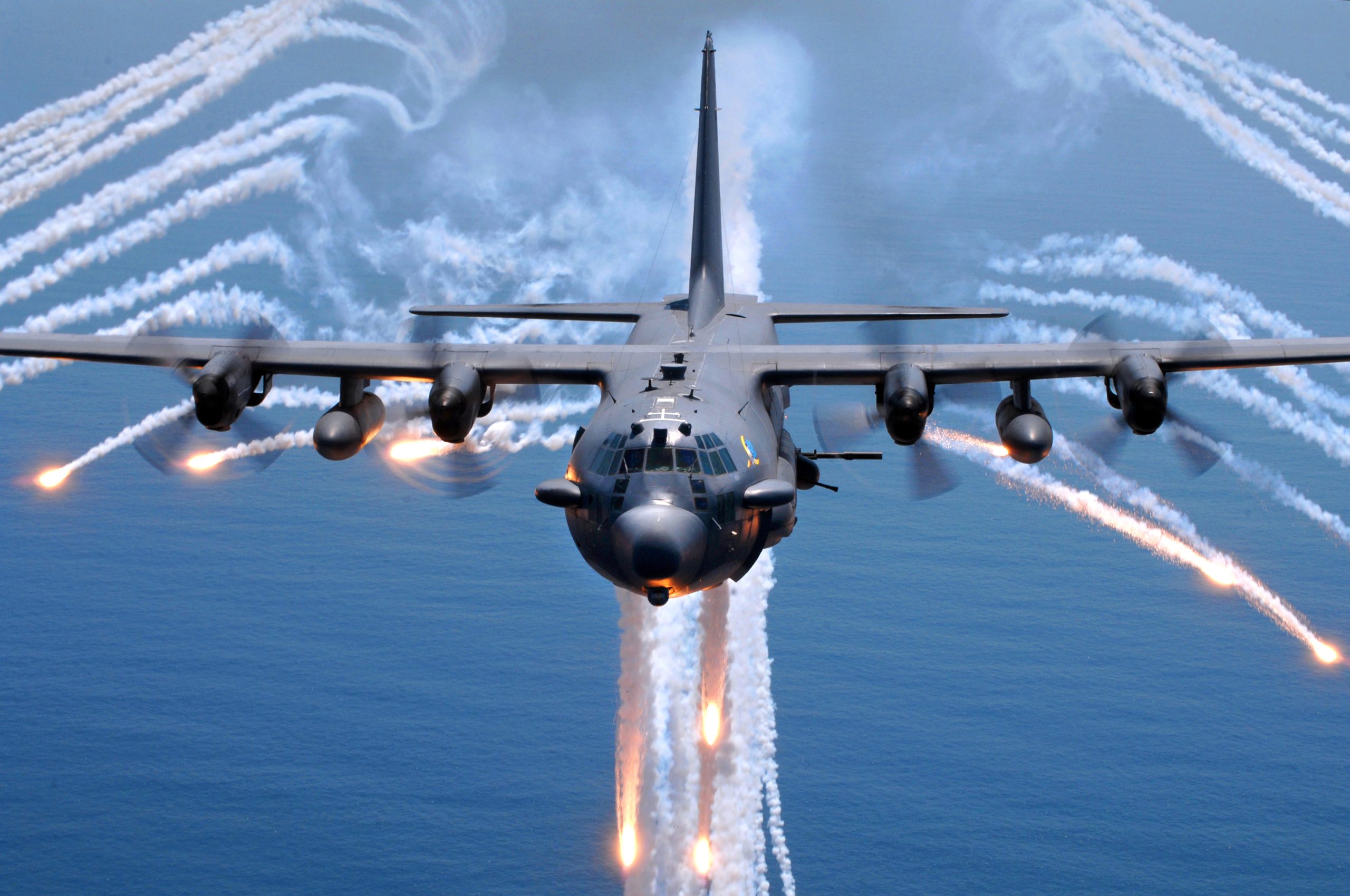
Lockheed AC-130 Gunship
“Spooky · Spectre · Ghostrider”
A Hercules transport rebuilt into a flying artillery battery — a heavily armed gunship that banks into a slow left-hand circle and rains cannon and howitzer fire down on a single point of ground.
The AC-130 gunship: a flying battery that turns circles in the sky
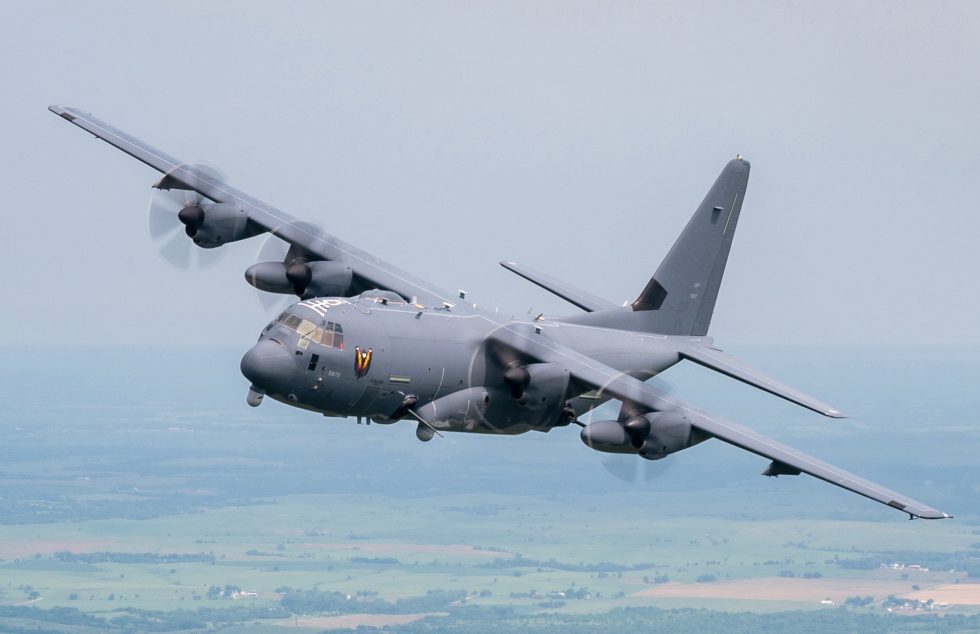
The AC-130 is one of the strangest and most lethal ideas in modern air warfare: take a lumbering four-engined Lockheed C-130 Hercules cargo plane, cut gun ports along its left side, fill the cargo hold with cannon, a howitzer, sensors and fire-control computers, and send it to war. Instead of diving on a target like a fighter, the gunship flies a continuous banking left-hand circle — a pylon turn — that keeps every side-firing weapon pointed at one spot on the ground while the aircraft orbits above it. The result is an aircraft that can loiter for hours and put a devastating, sustained weight of fire onto a single point.
The concept grew out of the AC-47 “Spooky” — the “Puff the Magic Dragon” of Vietnam, a converted Dakota with side-firing miniguns. It worked so well that the Air Force wanted a bigger, longer-ranged platform, and the C-130 was the obvious choice. The first AC-130A prototype reached Vietnam in 1967 and flew its first combat in 1968, hunting trucks moving supplies down the Ho Chi Minh Trail at night. Over the following decades the gunship evolved through a family of versions — the AC-130A/E/H Spectre, the AC-130U Spooky II, the AC-130W Stinger II and today’s AC-130J Ghostrider — each carrying a shifting mix of 7.62 mm miniguns, 20/25 mm Gatlings, a 40 mm Bofors and, on the heavy versions, a 105 mm howitzer.
What ties the family together is the marriage of firepower to sensors. Long before “precision strike” became routine, gunship crews fused low-light television, infrared and radar to find targets in the dark and walk rounds onto them with a precision no fast jet could match. The AC-130 became the signature aircraft of Air Force Special Operations Command (AFSOC), flown over Grenada, Panama, the Gulf, Somalia, the Balkans, Afghanistan and Iraq. It is also, by design, a slow, low-flying and vulnerable machine that depends utterly on friendly control of the sky: when that protection thinned, gunships paid for it — most starkly with the loss of Spirit 03 in the 1991 Gulf War. It is a uniquely American weapon, and one that carries real controversy alongside its reputation.
01Why the AC-130 gunship flies in circles: the pylon turn explained
A conventional attack aircraft points its nose at the target and fires along its flight path, which gives it only a fleeting firing pass. The AC-130 does the opposite. Because its guns fire out of the left (port) side of the fuselage, the aircraft banks into a steady left-hand turn and holds it, flying a circle around the target. In that geometry — the pylon turn — the guns stay locked on a single aim point on the ground for as long as the crew wants, and the aircraft can keep firing continuously rather than in split-second passes.
The trade-off is stark. To hold that orbit the gunship must fly relatively low and slow, which makes it an easy target for anti-aircraft guns and man-portable missiles. That is why the AC-130 is almost always used at night, and only where friendly forces already control the air. Its whole tactical logic — loiter, orbit, saturate one point with fire — only works when nothing is shooting effectively back.
What makes the AC-130 gunship special
Side-firing guns and the pylon turn
The defining feature. Weapons fire out of the aircraft’s left side, so the AC-130 attacks by flying a banking left-hand circle that keeps the guns trained on one ground point. Unlike a fighter’s fleeting pass, the gunship can orbit and fire continuously for as long as it loiters overhead — the essence of the “flying battery.”
Sensors, fire control and hours of loiter
The C-130’s size lets the gunship carry a fused sensor suite — low-light TV, infrared and radar — tied to fire-control computers that put rounds on target in darkness. Four turboprops give it the endurance to orbit for hours, so it can stay overhead a firefight far longer than any jet, watching and striking on call.
Escalating firepower — up to a 105 mm howitzer
Gunship armament has grown steadily: from 7.62 mm miniguns and 20 mm Gatlings to a 40 mm Bofors and, on the heavy AC-130H/U, a full 105 mm M102 howitzer — the largest gun routinely flown by any aircraft in the West. The AC-130J adds a 30 mm cannon and wing-mounted precision missiles and bombs.
02The AC-130 gunship’s guns: from miniguns to a 105 mm howitzer in the cargo hold
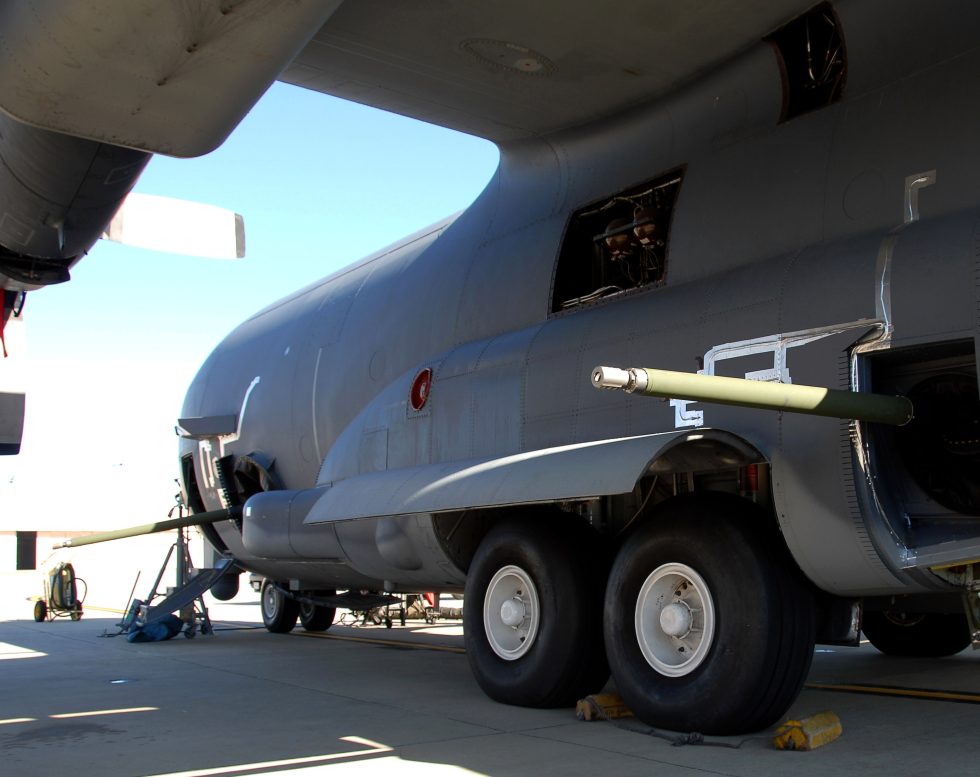
Early AC-130A gunships carried a mix of 7.62 mm miniguns and 20 mm Vulcan cannon. As targets hardened, the firepower grew: a 40 mm Bofors cannon was added for heavier punch, and then — remarkably — a 105 mm M102 howitzer, a towed field-artillery piece adapted to fire from a recoil mount inside the fuselage. On the AC-130U “Spooky II” the fit settled on a 25 mm Gatling, the 40 mm Bofors and the 105 mm. The newest AC-130J “Ghostrider” carries a 30 mm GAU-23/A cannon and the 105 mm, and adds standoff precision-guided munitions — small-diameter bombs and Griffin/Hellfire-class missiles — letting it strike from farther out than gunfire alone allows.
03The AC-130’s great weakness: a slow, low gunship that needs a friendly sky
Everything that makes the gunship deadly also makes it fragile. To hold its firing orbit it flies low and slow in a predictable circle — ideal conditions for anti-aircraft artillery and shoulder-fired missiles. The AC-130 has essentially no ability to dogfight or outrun a threat; it survives by operating at night, behind sensors and jammers, and only where friendly forces already own the air. When that cover failed, the cost was severe: several gunships were lost over Vietnam, and in 1991 Spirit 03 was shot down over Kuwait with the loss of all 14 aboard — the single largest US Air Force loss of life of the Gulf War. The gunship is a specialist, not an all-weather, all-threat warplane.
Full AC-130J Ghostrider specifications
Baseline note: the figures below describe the AC-130J Ghostrider in its Block 30 configuration, the standard to which the whole surviving gunship fleet was brought during the 2025 financial year. The AC-130J is a purpose-converted MC-130J Commando II airframe, so its dimensions are those of a standard-length C-130J and not of the stretched C-130J-30. Deltas for the retired AC-130H Spectre, AC-130U Spooky II and AC-130W Stinger II are in grey. Two cautions. First, the transport lineage is covered on its own page — this entry treats the gunship as its own aeroplane and refers to the C-130 Hercules only where the airframe explains the gunship. Second, official AFSOC fact sheets round and occasionally contradict themselves: the current sheet gives the wingspan as 39.7 m alongside the correct 132 ft 7 in, which is 40.41 m, and quotes an inventory of 37 that the programme never reached. Where the fact sheet and the delivery record disagree, the delivery record is used here.
Dimensions & weights
- Crew
- 8 — two pilots, two combat systems officers and four special mission aviators, of whom the aft crew load, arm and clear the guns and the launch tubes by hand in an unpressurised cabin — the AC-130U flew with 13 and the AC-130H with 14. Spirit 03 was an H, and all fourteen aboard were killed
- Length
- 29.79 m (97 ft 9 in)
- Wingspan
- 40.41 m (132 ft 7 in)
- Height
- 11.94 m (39 ft 2 in) — taller than the transport because of the sensor and countermeasures installations on the fin and rear fuselage
- Wing area
- 162.1 m² (1,745 sq ft)
- Cabin
- Unpressurised in the gunship role. The 30 mm gun port, the 105 mm port and the ten ramp-mounted launch tubes all breach the fuselage, so the aeroplane flies its attack orbit with the hold open to the outside air. This is why gunships work at 2,100 to 3,700 m rather than in the flight levels, and it is one of the reasons they are shot at
- Empty weight
- Not published for the gunship. The C-130J transport it is built from weighs 34,274 kg (75,562 lb) empty; the Precision Strike Package, armour, ammunition and mission systems add several tonnes to that
- Maximum take-off weight
- 74,390 kg (164,000 lb) — the AC-130U was limited to 70,310 kg (155,000 lb)
- Internal fuel
- ~25,550 litres (6,750 US gal / 5,620 imp gal) in the wing tanks. Endurance is set by the crew, not the tanks: with air refuelling the sortie ends when the crew duty day does
- Wing stores
- Up to 8 precision weapons on two BRU-61/A racks, four to a rack — GBU-39/B Small Diameter Bombs or AGM-114 Hellfires in any mix. The wing pylons are a Block 20+ and Block 30 addition; the earliest AC-130Js had none
- Ammunition
- Typically 100 rounds for the 105 mm and several hundred for the 30 mm, plus a magazine of ten common launch tubes with reloads carried inside — exact combat loads are not published and vary by mission. The AC-130H carried 100 rounds of 105 mm and 256 of 40 mm
- Number built
- 31 AC-130J converted from new-build MC-130J airframes, delivered July 2015 to 2 November 2022. One was damaged beyond airworthiness in testing and serves as a ground trainer, leaving 30 flyable. The programme of record was 37 and was cut in the 2023 budget request
Performance
- Maximum speed
- 671 km/h (362 kn, 417 mph)
- Cruise speed
- 644 km/h (348 kn, 400 mph)
- Firing speed
- Roughly 390–465 km/h (210–250 kn, 240–290 mph) in the orbit. Slow, banked and predictable is exactly what the gun solution wants and exactly what a gunner on the ground wants
- Attack altitude
- Usually 2,100–3,700 m (7,000–12,000 ft), higher when the threat allows. The 105 mm outranges nothing; the altitude is chosen to stay above small-arms and heavy machine-gun fire while keeping the sensors and the guns inside their solution
- Pylon turn
- A left-hand orbit of roughly 30 degrees bank and a radius of about 1.9–2.8 km (1–1.5 nmi). Hold bank, altitude and speed constant and a gun boresighted to port at a fixed depression stares at one point on the ground for as long as the fuel lasts. That is the whole trick, and it has not changed since 1965
- Service ceiling
- 8,530 m (28,000 ft)
- Range
- 4,830 km (3,000 mi, 2,610 nmi) unrefuelled
- Endurance
- Limited by the crew duty day once air refuelling is available. Two AC-130Us flew 36 hours nonstop from Hurlburt Field to Daegu on 22–23 October 1997 with seven refuellings, taking on 186,000 kg (410,000 lb) of fuel. In 1979 a pair of AC-130Hs flew 13,335 km (7,200 nmi) to Guam in 29 h 43 min
- Take-off run
- Short by the standards of anything its size — the C-130 wing and four turboprops give it a semi-prepared-strip capability the gunship almost never uses but which underwrites its basing flexibility
- Accuracy
- The 105 mm is credited with putting rounds inside a 10 m circle from the orbit, and the shell is both more accurate and far cheaper than a guided bomb — which is precisely the argument the Air Force used in 2015 to put the howitzer back on the AC-130J after planning to leave it off
- Survivability
- The honest number is the one nobody prints. Six AC-130s and 52 crew were lost in Vietnam to 37 mm and 57 mm guns, an SA-2 and an SA-7. Spirit 03 was brought down by one man with a Strela-2 on 31 January 1991. AFSOC itself states that the type is not expected to survive a future non-permissive environment: it is large, slow, hot, loud and flies in a circle
Propulsion & systems
- Engine
- 4 × Rolls-Royce AE 2100D3 turboprops — the AC-130H, U and W all used the older Allison T56-A-15 of 3,206 kW (4,300 shp), so the J is the first gunship on the modern engine and propeller
- Power
- 3,458 kW (4,637 shp) each — AFSOC rounds this to 4,700 shp
- Propellers
- Dowty R391, six composite blades, all-electric control — quieter and more efficient than the four-blade Hamilton Standard units on the earlier marks, which matters to an aeroplane whose approach is meant to go unnoticed
- Fuel system
- Wing tanks with a universal aerial refuelling receptacle slipway installation on the spine, taking fuel from KC-135 and KC-46 booms. The AC-130H fleet was retrofitted for refuelling in the late 1970s and it changed the type’s reach completely
- Radar
- AN/APN-241 multimode navigation and weather radar. The AC-130U was the only gunship with a true attack radar — the AN/APQ-180 synthetic-aperture set derived from the F-15E’s AN/APG-70, which could track its own 40 mm and 105 mm shells and report where they landed. Nothing on the J does that. An AN/APG-83 AESA is being integrated to close part of the gap
- Electro-optical sensors
- AN/AAQ-39 Gunship Multispectral Sensor System — mid-wave infrared, two image-intensified television channels, a laser designator and rangefinder with an eye-safe mode, and a near-infrared pointer for marking targets to troops on night-vision goggles — two independent turrets on the AC-130J, so the sensor operators can work two targets at once even though the guns cannot
- Fire control
- The Precision Strike Package: a mission computer that fuses the sensors, the gun solutions and the weapon rails and puts a firing cue on the pilot’s head-up display. The pilot flies the cue; the aeroplane is the gun mount. This is a direct descendant of the analogue box that Wing Commander Tom Pinkerton hand-built at Wright-Patterson in 1967
- Countermeasures
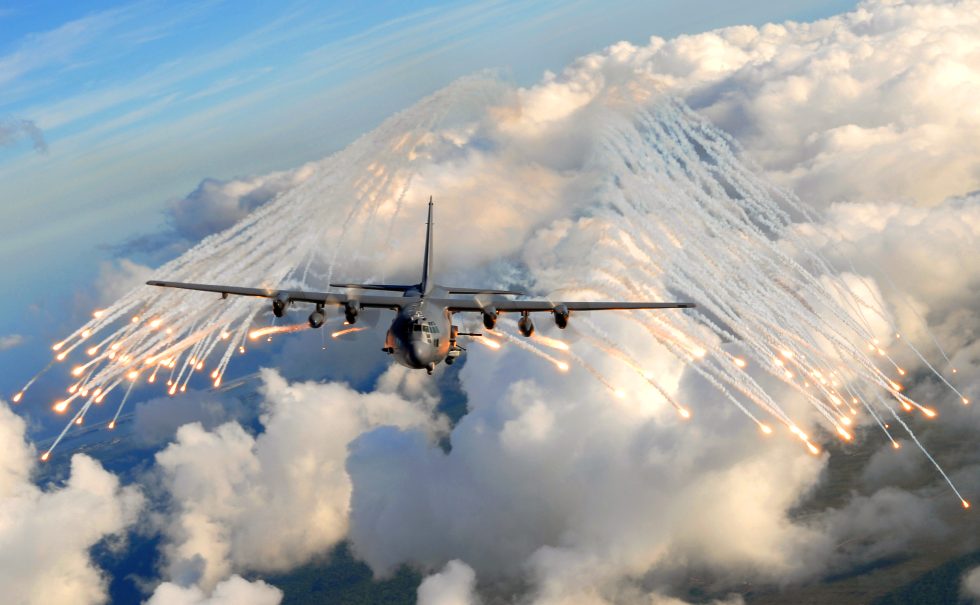
- AN/AAQ-24 Nemesis directional infrared countermeasures, AN/ALE-47 chaff and flare dispensers, and radio-frequency countermeasures added under Block 30. The DIRCM programme exists in its modern form partly because of Spirit 03: the loss pushed the Department of Defense into the laser-based system now fitted across the large-aircraft fleet
- Crew escape
- None. No ejection seats, no capsule. A gunship crew leaves through the doors and the ramp, by parachute, or not at all
- First flight and service entry
- Gunship II prototype 1967; first AC-130A combat sortie in South Vietnam from 21 September 1967. AC-130H 1969, AC-130U 1995, AC-130W 2012. The AC-130J was delivered to AFSOC on 29 July 2015 and declared initially operational on 30 September 2017
- Unit cost
- ~US$165 million per AC-130J (AFSOC figure). For comparison the AC-130H was quoted at $132.4 million and the AC-130U at $190 million in fiscal 2001 dollars — the U was the most expensive gunship the Air Force ever bought, and it had the best fire control of any of them
04The AC-130J Ghostrider’s operating costs: what a flying gunship is worth
The AC-130J is a low-rate, special-mission conversion of the C-130J, so precise, official cost figures are limited. Per-aircraft flyaway costs are commonly cited at around US$165 million, though published estimates vary and depend heavily on how the sensor and weapons fit is accounted for; the wider Ghostrider programme has been reported in the low billions of dollars for the fleet. No reliable public cost-per-flight-hour figure exists specifically for the AC-130 — open figures for C-130 variants run into the low tens of thousands of dollars per hour, but any precise gunship number should be treated as an estimate rather than an official figure.
Armament & payload
The AC-130 is the only aircraft in Western service built around a field artillery piece
Every other combat aeroplane carries weapons. The gunship is the weapon: a 105 mm howitzer and a 30 mm chain gun firing sideways through the fuselage, aimed by flying a circle. The 105 mm is an M137 tube and M37 recoil mechanism from the towed M102 field howitzer, loaded by hand, and it is the largest gun ever fitted to an aircraft in regular service. A single shell costs a fraction of a guided bomb, arrives in seconds, and is accurate enough from the orbit to be called in danger-close.
What has changed over sixty years is not the guns but what tells them where to point. Gunship I, the AC-47, was three miniguns and a pilot squinting through a grease-pencil mark on the side window. Gunship II added a night-vision telescope, an early infrared set in the wheel well and an analogue fire-control computer built by hand. By 1970 the Pave Pronto aircraft carried Black Crow, a magnetic detector sensitive enough to find the ignition coils of trucks hidden under jungle canopy. The AC-130U of 1995 had a synthetic-aperture attack radar that watched its own shells land. The AC-130J fuses two multispectral turrets, a laser designator and a rack of guided weapons into one Precision Strike Package.
The argument that runs through all of it is trainable guns versus fixed ones. The AC-130U mounted its 25 mm, 40 mm and 105 mm on powered mounts slaved to the fire-control computer, which let it engage two targets a kilometre apart at the same time with two sensors and two guns. The AC-130W and J went back to a simpler installation aimed by flying the aeroplane, and the dual-target trick has never been repeated. Fits varied enormously by mark and by year. The AC-130H lost its 20 mm cannon after about 1994; four AC-130Us were fitted with 30 mm Bushmasters in 2007 and had them removed again in 2008 when accuracy at operating altitude proved unacceptable; and the AC-130J’s own weapon set grew across Blocks 10, 20 and 30.
Gun
- 1 × 105 mm M102 howitzer — strictly the M137 barrel and M37 recoil mechanism of the towed field piece, firing to port. Roughly 100 rounds carried, loaded by hand by the aft crew. First fitted to an AC-130E in Vietnam on 17 February 1972; still the defining weapon of the type in 2026.
- 1 × 30 mm GAU-23/A (ATK Mk44 Bushmaster II) — dual-feed chain gun, 200 rounds per minute, firing PGU-46/B and other 30 × 173 mm natures. Standard on the AC-130W and AC-130J.
- Retired: 1 × 25 mm GAU-12/U Equalizer, the five-barrel rotary cannon of the AC-130U, on a trainable mount with the PGM-38/U enhanced high-explosive incendiary round developed for it. Left service with the last AC-130U in June 2020.
- Retired: 1 or 2 × 40 mm Bofors L/60, a Second World War naval gun carried on the AC-130A, E, H and U with 256 rounds. Slow-firing, hand-loaded, and much loved for the size of the hole it made.
- Retired: 2 × 20 mm M61 Vulcan and, on the earliest AC-130A, 4 × 7.62 mm GAU-2/A miniguns — the Vietnam-era area-fire fit, deleted from the AC-130H in the mid-1990s once precision mattered more than volume.
Air-to-air
- None carried. The AC-130 has no air-to-air capability whatsoever and never has.
- It cannot defend itself against an interceptor and is not expected to. Over Laos in 1968 the answer was an escort of three F-4 Phantoms per gunship; today the answer is a permissive air-defence environment or no sortie.
- The tail is unarmed. Unlike the Soviet bombers of the same era there is no rear turret, no radar-laid gun and no gunner.
- This is the single most important limitation on the aeroplane. Everything the gunship does well depends on somebody else owning the sky first.
Air-to-surface guided
- AGM-114 Hellfire — semi-active laser homing, 45 kg, roughly 8 km. Wing-mounted on the BRU-61/A racks from Block 20+, four to a rack, and the gunship’s standard answer to a moving vehicle it does not want to shoot with a howitzer.
- AGM-176 Griffin — a 20.5 kg laser and GPS-guided missile with a 5.9 kg warhead, ejected rearwards from the ten common launch tubes on the ramp. Reloadable in flight from stores carried inside the aircraft.
- GBU-69/B Small Glide Munition — a 27 kg Dynetics glide weapon, also from the launch tubes, with a 16 kg blast-fragmentation warhead. Unpowered, so it carries a heavier warhead than either the Hellfire or the Griffin, and glides about 32 km. Fielded from early 2017.
- Black Arrow (Small Cruise Missile) — launch-tube-fired and tested from the AC-130J in 2025, the first serious attempt to give the gunship reach that does not require it to be overhead.
- All of these exist for the same reason: to let the gunship shoot from further away than a 105 mm shell can reach, in places where flying an orbit above the target would be suicide.
Bombs
- GBU-39/B Small Diameter Bomb — 129 kg, GPS and inertial guidance, deployable wings giving a stand-off of up to 110 km from altitude. Four per BRU-61/A rack, eight per aircraft.
- GBU-53/B StormBreaker (SDB II) — the tri-mode-seeker successor, cleared for the same racks, capable of engaging moving targets through weather.
- GBU-44/B Viper Strike — the original laser-guided glide weapon for the Gunslinger launch-tube system on the AC-130W, since superseded by the Griffin and the GBU-69/B.
- No conventional free-fall bombs and no bomb bay. The gunship has no internal stores capability of the ordinary kind; everything is either fed to a gun, hung on a wing rack, or pushed out of a tube on the ramp.
Rockets
- APKWS (Advanced Precision Kill Weapon System) — the WGU-59/B laser-guidance kit that turns an unguided 70 mm Hydra rocket into a cheap precision weapon. Long identified by AFSOC as a stand-off option for the gunship.
- Honest caveat: APKWS is not confirmed as a standard fit on the Block 30 AC-130J. It appears in AFSOC upgrade planning and in the wider special operations inventory, but no official fact sheet lists it among the aircraft’s weapons, and the gunship’s launch tubes were built around the Griffin and the GBU-69/B instead.
- Where APKWS certainly does appear on the gunship is inside another weapon: the GBU-69/B’s terminal guidance uses four distributed-aperture semi-active laser seeker apertures adapted directly from the APKWS kit.
- No unguided rockets are carried. The AC-130 has never fired a dumb rocket in service, which sets it apart from every other propeller-driven attack aircraft of its generation.
Pods & other stores
- Ten common launch tubes on the rear ramp — 152 mm across and 1.22 m long, firing aft. The tubes are the gunship’s growth path: anything that fits goes in, which is how the Griffin, the small glide munition and now a cruise missile all reached the aircraft without cutting new holes in it.
- Expendable sensor drones — the Tactical Off-board Sensor concept, launched from the same tubes to loiter and pass video and coordinates back when the gunship itself cannot see through weather or must stand off.
- Countermeasures — AN/AAQ-24 Nemesis directional infrared countermeasures, AN/ALE-47 chaff and flare dispensers, and radio-frequency countermeasures under Block 30. On a gunship these are armament in all but name.
- Cancelled: the airborne laser. AFSOC pursued a 120 kW-class directed-energy weapon in the 30 mm gun’s place from 2015 and abandoned it in 2024, having concluded that firing a beam out of the side of a C-130 puts it straight through the aircraft’s own turbulent wake. A rare, and creditable, public admission that an idea did not work.
- Also considered and dropped: a breech-loading 120 mm M120 mortar to replace the 105 mm, attractive because 100 rounds weigh 1,450 kg against 1,905 kg and the recoil load is roughly half.
Three typical loadouts
- Close air support for a team in contact
- 105 mm and 30 mm loaded, ten Griffins in the ramp tubes with reloads inside, four AGM-114 Hellfires on one wing rack. The classic mission: hold an orbit for hours, talk to the ground party, and put a shell or a missile wherever they ask.
- Armed overwatch and interdiction
- Both sensor turrets working, 30 mm for vehicles, 105 mm for structures, eight GBU-39/B Small Diameter Bombs across two racks for targets that must be struck from stand-off. This is the fit that lets the gunship attack something it is not orbiting.
- Vietnam-era truck hunt (AC-130A Pave Pronto, 1970–72)
- Two 20 mm M61, two 40 mm Bofors, Black Crow magnetic ignition detector, low-light television and an early infrared set, orbiting the Ho Chi Minh trail at 2,100–2,400 m under an F-4 escort. Gunships were credited with destroying more than 10,000 trucks; six of them and 52 crew did not come home.
Sourcing caveat: gunship ammunition loads, common launch tube inventories and the exact configuration of each Block are not published in detail, and AFSOC fact sheets list weapon types without quantities. Figures here follow the USAF and AFSOC fact sheets, the Director of Operational Test and Evaluation annual reports, and contemporary programme reporting; where a number is inferred rather than stated it is described as such. The 30 mm gun’s early record is worth stating plainly: the DOT&E found in FY2017 that at its 200 rounds per minute maximum rate the GAU-23/A vibrated hard enough to throw itself out of alignment and trip a safety cut-out, that the fire-control system struggled to compensate for changes in altitude and aircraft attitude, and that the PGU-46/B round performed poorly against targets on soft ground.
Variants
Six generations of gunship, one idea, and a fleet that has never left American hands
The gunship line runs AC-47 to AC-119 to AC-130, and within the AC-130 it runs A, E, H, U, W and J. Every one of them is a converted transport. None was ever designed as a gunship from a blank sheet, and none was ever exported: the AC-130 is the rare modern American combat aircraft with exactly one operator in its entire history.
Two things drove the evolution. The first was sensors: each mark exists largely because a better way of seeing at night became available. The second was survivability, and there the record is less flattering. The gunship has been repeatedly re-equipped to stay useful, but nothing has changed the basic geometry of a large four-engined turboprop flying a predictable circle within reach of the ground.
- AC-130A Spectre (1967–95, 19 converted)
- C-130A conversions, beginning with JC-130A 54-1626 rebuilt at Wright-Patterson as the Gunship II prototype. Successive standards named Plain Jane, Surprise Package and Pave Pronto brought low-light television, a laser designator, an inertial navigation set, a digital fire-control computer and the Black Crow ignition detector. Passed to the Air Force Reserve in 1975 and retired in 1995.
- AC-130E Spectre (1971–early 1970s, 11 converted)
- Pave Spectre and Pave Aegis conversions of the C-130E, arriving in Vietnam from 25 October 1971 and known to crews as the Cadillac. The first aircraft to carry the 105 mm howitzer. Ten were later rebuilt to AC-130H standard.
- AC-130H Spectre (1973–2015, 8 aircraft)
- Re-engined and upgraded AC-130Es with in-flight refuelling, the AN/APQ-150 beacon tracking radar and the AN/AAQ-26 infrared detecting set. Fixed guns aimed by flying the aeroplane. Spirit 03 was an H. The last, 69-6569 Excalibur, retired at Cannon AFB on 26 May 2015.
- AC-130U Spooky II (1995–2020, 17 built)
- The high-water mark of gunship fire control. Trainable 25 mm, 40 mm and 105 mm mounts, the AN/APQ-180 synthetic-aperture attack radar, all-light-level television and later the AN/AAQ-39 turret, and a dual-target attack capability no gunship has had since. Twice the ammunition of the H. Withdrawn from its final combat deployment on 8 July 2019 and retired in June 2020.
- AC-130W Stinger II (2011–2022, 12 converted)
- Originally the MC-130W Dragon Spear, an interim measure to relieve the overworked H and U fleets. A C-130H special-mission tanker given a 30 mm GAU-23/A, ramp launch tubes, wing racks and, later, a 105 mm. It proved the Precision Strike Package that the AC-130J then inherited. Retired in July 2022.
- AC-130J Ghostrider (2015–present, 31 built)
- New-build MC-130J airframes converted on the production path proved by the Dragon Spear. Block 10 gave a 30 mm gun, Small Diameter Bombs and launch-tube missiles; Block 20 added the 105 mm, wing Hellfires and infrared countermeasures; Block 30 brought the whole fleet to a common standard in the 2025 financial year. The current and only gunship in service.
- AC-47 Spooky (1964–69, Gunship I, 53 converted)
- Where the idea started. A Second World War C-47 with three 7.62 mm miniguns firing to port and a pilot aiming through a mark on the window. Crude, decisive at defending isolated outposts at night, and the direct reason the C-130 was chosen for the job.
- AC-119G Shadow and AC-119K Stinger (1968–71, Gunship III, 52 converted)
- The intended stopgap between the AC-47 and the AC-130. The G carried four miniguns, the K added two 20 mm cannon and two auxiliary jet engines. Underpowered, and the reason gunship development moved decisively to the Hercules airframe.
- AC-130J with directed energy (2015–24, cancelled)
- A 120 kW-class solid-state laser intended to replace the 30 mm gun on a handful of aircraft, for silent engagement of vehicles, boats and communications masts and for burning down incoming missiles. Hardware was delivered in 2021. AFSOC gave up in 2024: the beam would have had to cross the aircraft’s own turbulent boundary layer, which degrades it beyond use.
Fleet arithmetic and retirements, since the AC-130 has never been exported and there are no foreign operators to count. The United States Air Force, through Air Force Special Operations Command, is the sole operator the type has ever had. Of roughly 78 AC-130s of all marks — 19 A, 11 E, 8 H, 17 U, 12 W and 31 J — only the AC-130J remains, and the E and H overlap because ten Es became Hs. The AC-130A left the Air Force Reserve in 1995, the AC-130H retired on 26 May 2015, the AC-130U in June 2020 and the AC-130W in July 2022. That leaves 31 AC-130Js built, one of them unairworthy after a test accident and used for ground training, and 30 flyable aircraft split between the 4th and 73rd Special Operations Squadrons at Hurlburt Field, Florida, and the 16th Special Operations Squadron at Cannon AFB, New Mexico, with the training unit at Kirtland AFB. The programme of record was 37 and was cut to 30 in the fiscal 2023 budget request, the remaining C-130J airframes going to the 193rd Special Operations Squadron as MC-130Js instead. Six AC-130s and 52 crew were lost in Vietnam; AC-130H 69-6567, call sign Spirit 03, was shot down over Khafji on 31 January 1991 with all fourteen aboard, the type’s heaviest single loss and the clearest statement of what happens when the environment is not permissive.
From “Puff the Magic Dragon” to the Ghostrider
The gunship idea proves itself
The side-firing AC-47 “Spooky” — “Puff the Magic Dragon” — shows the value of a circling gunship over Vietnam, driving demand for a bigger platform.
AC-130A to Vietnam
The first C-130-based gunship prototype (Gunship II) deploys to Southeast Asia for combat evaluation.
First AC-130 combat
The AC-130 flies its first combat missions, hunting trucks by night along the Ho Chi Minh Trail — the role that made its name.
Spectre over the Trail
Heavily armed AC-130s become the premier truck-killers of the war, but several are lost to increasingly dense North Vietnamese air defences.
Grenada and Panama
Gunships fly in Operation Urgent Fury (Grenada, 1983) and Just Cause (Panama, 1989), cementing their place in US special operations.
Spirit 03 is lost
On 31 January an AC-130H is shot down over Kuwait during the Battle of Khafji, killing all 14 aboard — the Gulf War’s largest single US Air Force loss of life.
Somalia, the Balkans, Afghanistan, Iraq
AC-130U “Spooky II” and AC-130H Spectre gunships fly over Mogadishu, the Balkans, and the post-2001 wars as an AFSOC mainstay.
The AC-130J Ghostrider
A new, precision-armed gunship built on the C-130J enters service, carrying a 30 mm cannon, the 105 mm howitzer and standoff guided munitions.
From the gun deck: twelve AC-130 stories
Puff the Magic Dragon
The AC-47 “Spooky” proved a circling, side-firing gunship could dominate a battlefield.
Read the full story
The geometry of the pylon turn
Because the guns fire left, the aircraft attacks by holding a banking left-hand circle around the target.
Read the full story
Truck-hunting on the Trail
By night, Spectre gunships stalked convoys moving supplies down the Ho Chi Minh Trail.
Read the full story
A field howitzer in the cargo hold
The heavy gunships mounted a 105 mm M102 howitzer — artillery, firing from an aircraft.
Read the full story
Urgent Fury
AC-130s provided fire support during the US invasion of Grenada.
Read the full story
Just Cause
Spectre gunships fired in support of the assault to remove Manuel Noriega.
Read the full story
The loss of Spirit 03
An AC-130H stayed on station past dawn at Khafji and was shot down with all 14 aboard.
Read the full story
Over Mogadishu
AC-130 gunships operated over Somalia during the US intervention.
Read the full story
Seeing in the dark
Fused low-light TV, infrared and radar let gunship crews find and hit targets at night.
Read the full story
AC-130U “Spooky II”
A pressurised, radar-equipped gunship carrying a 25 mm Gatling, a 40 mm Bofors and the 105 mm.
Read the full story
The Kunduz strike, 2015
A US AC-130U mistakenly struck an MSF hospital in Afghanistan, killing dozens.
Read the full story
AC-130J Ghostrider
The newest gunship pairs the 105 mm and 30 mm guns with standoff precision weapons.
Read the full story
The AC-130 gunship in pictures
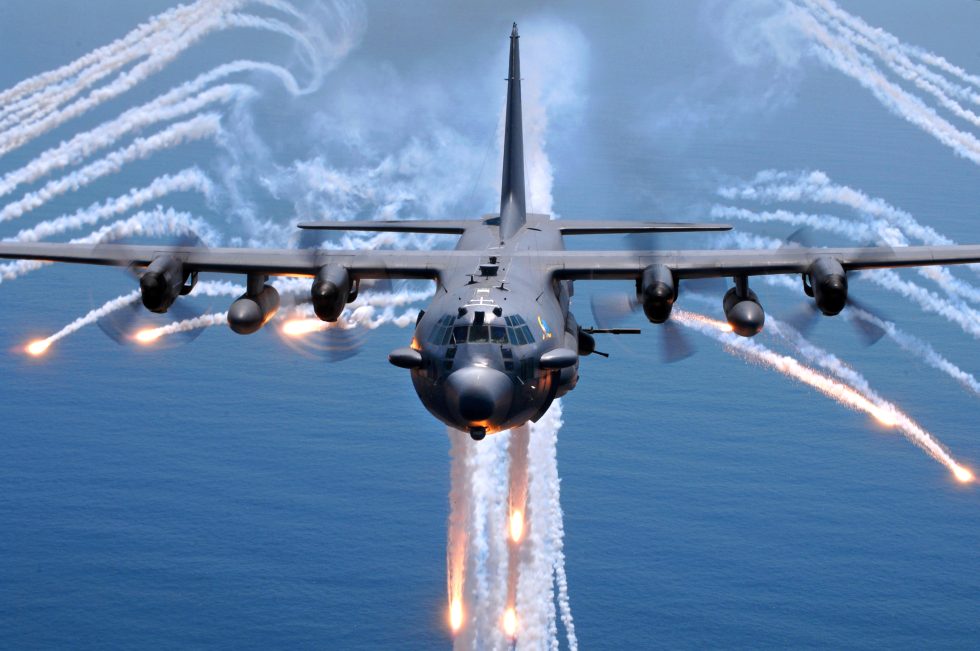
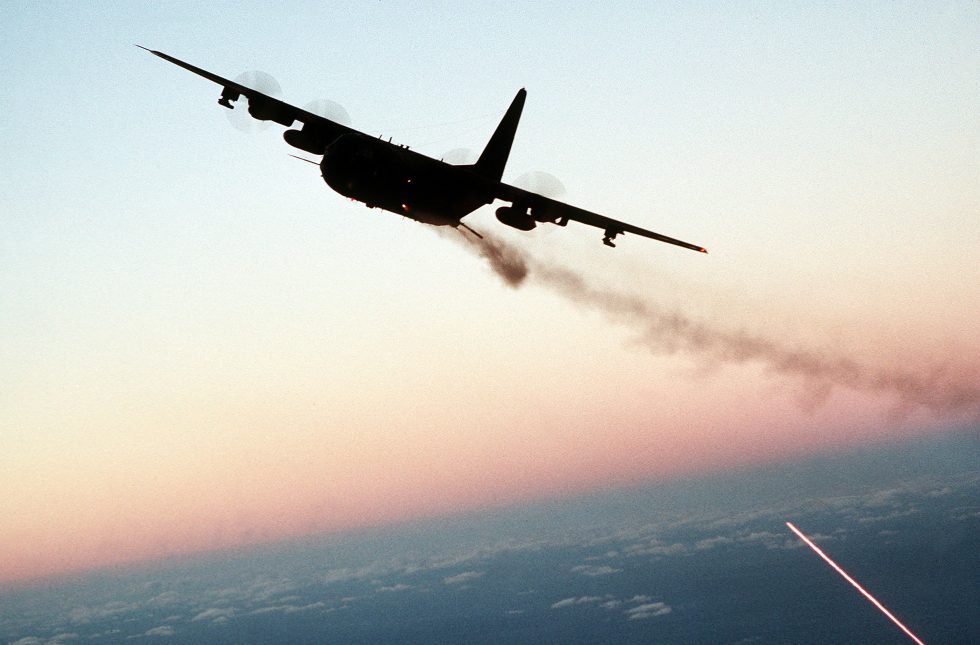
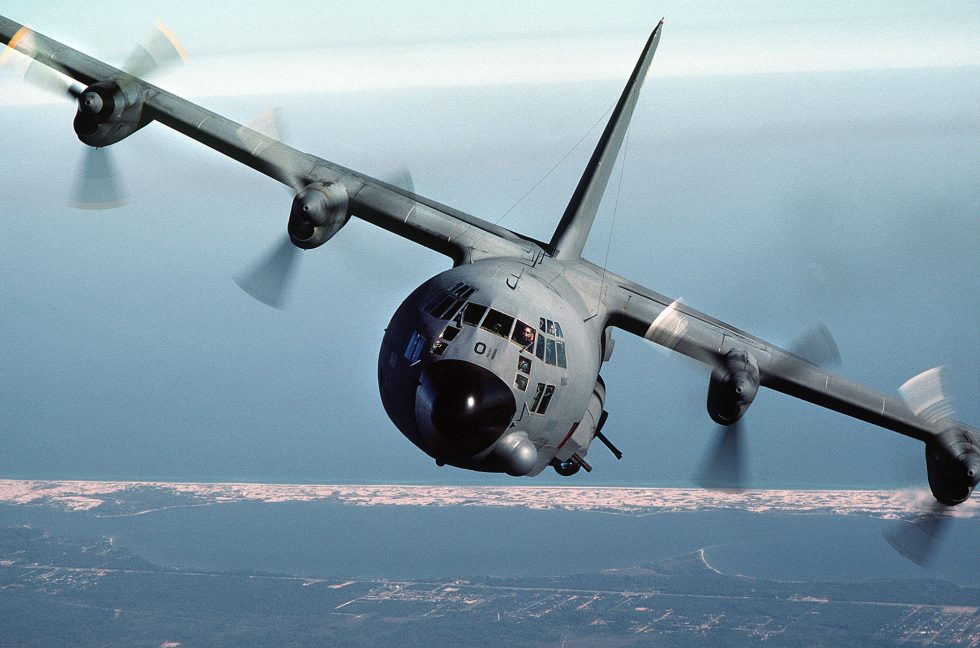
The AC-130 gunship in motion
A verified, high-authority video feature for the AC-130 is coming soon. In the meantime, explore the photo gallery above and the operations map below.
Where the AC-130 gunship operates
The gunship’s war record
The AC-130 is not an air-to-air fighter — its record is written on the ground. For more than half a century it has provided close air support and interdiction for US and allied forces, from the Ho Chi Minh Trail to the wars in Afghanistan and Iraq. Its greatest strength is persistence and precision; its greatest weakness, exposed most painfully in the loss of Spirit 03, is vulnerability whenever it is caught low and slow in a contested sky.
Compare the combat record of every military aircraft. Figures as of August 2026.
Everything people ask about the AC-130
Can I fly in an AC-130?
What is the pylon turn, and why does the AC-130 fly in circles?
What guns does the AC-130 carry?
What is the difference between Spectre, Spooky and Ghostrider?
Has an AC-130 ever been shot down?
Is the AC-130 still in service?
You can’t fly the gunship.
These, you can.
Some legends only live in museums — others are fuelled and waiting. MiGFlug has put civilians in real military jet cockpits since 2004.
 Fly the L-39 AlbatrosThe world’s most-flown jet trainer — aerobatics included
 Fly the F-104 Starfighter“The missile with a man in it”
 Fly the MiG-21The Cold War’s most-produced jet
 Fly the T-33 Shooting StarAmerica’s first jet trainer
 Fly the DH VampireA piece of early jet history
 Fly the S.211Agile Italian jet trainer
 Fly the MB-326The classic Aermacchi jet
 Fly the MiG-15The Soviet legend of the Korean War
Continue the tour
Every fact, checked
- Air Force Special Operations CommandOfficial operator of the AC-130; fact sheets on the Ghostrider and gunship mission.
- National Museum of the US Air ForceReference for AC-130 variants, armament and Vietnam-era gunship history.
- American Special Ops — AC-130 SpectreVariant breakdown, armament fits and operational history.
- Special Operations Warrior Foundation — Spirit 03Account of the 1991 loss of Spirit 03 at the Battle of Khafji.
- Task & PurposeOn Spirit 03 and why no AC-130 has been lost to enemy fire since.
- Médecins Sans Frontières — KunduzMSF account of the 2015 Kunduz hospital airstrike, presented alongside the US investigation.
- Air & Space Forces MagazineAC-130J Ghostrider specifications, weapons fit and fleet status.
- Airforce TechnologyTechnical reference for the AC-130J airframe, engines and munitions.