
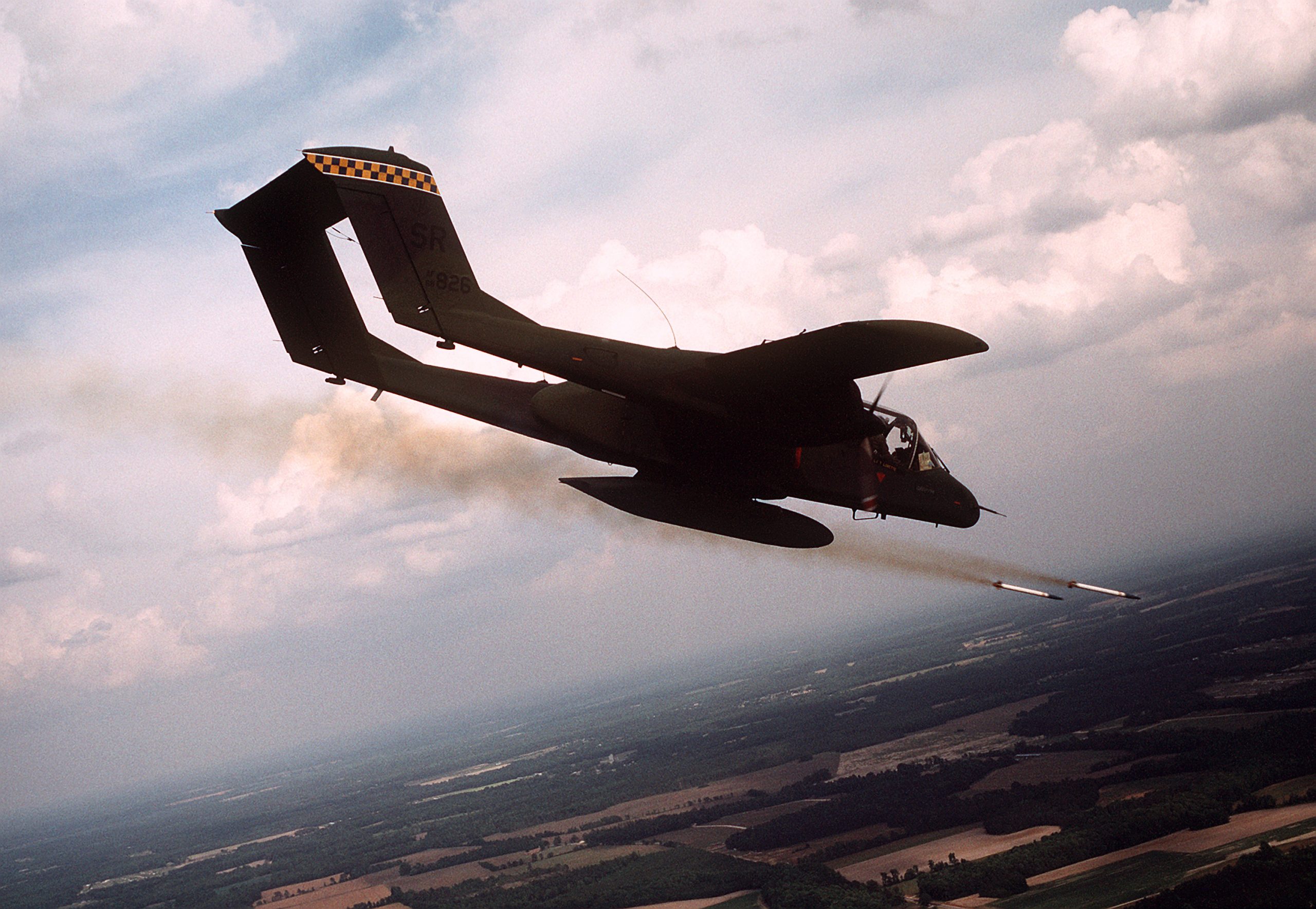
North American OV-10
“Bronco”
The twin-boom turboprop built for the brushfire wars — a slow, tough forward-air-control and light-attack aircraft that marked targets over Vietnam, flew fire lines over California, and returned to combat against ISIS half a century after its first flight.
The OV-10 Bronco: built for the brushfire wars
Most Cold-War aircraft were built to fly higher and faster than the last. The OV-10 Bronco was built to do the opposite — to fly low, slow and cheap, from a dirt strip a few hundred metres long, right next to the troops it supported. In the early 1960s American planners looking at Vietnam-style “brushfire” conflicts realised they had nothing suited to counter-insurgency: their jets were too fast to see the enemy and needed long paved runways. The tri-service LARA requirement — Light Armed Reconnaissance Aircraft — was written around that gap, and North American Aviation won the competition in 1964.
The result was one of the few US combat aircraft designed from scratch for the job. A short central nacelle carried two crew in tandem under a huge glazed “greenhouse” canopy, flanked by two turboprops on twin tail booms. Below the fuselage, stub-wing sponsons held four machine guns and hardpoints for rockets and bombs, while the nacelle hid a small cargo bay. The prototype first flew on 16 July 1965, and by July 1968 Broncos were in Vietnam with the US Air Force and Marine Corps.
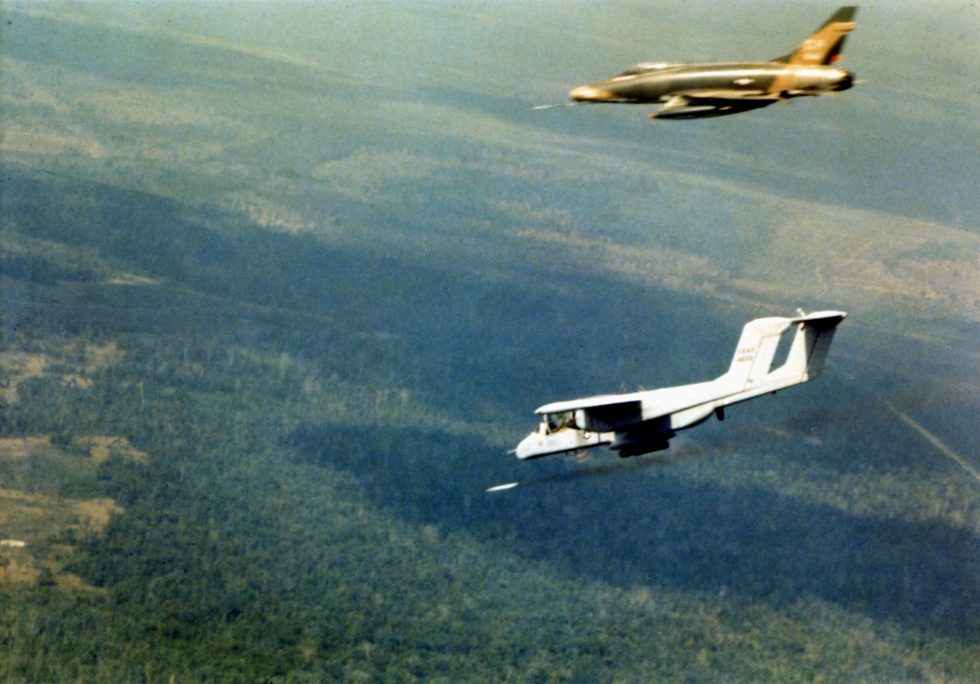
Its signature job was forward air control: loitering over the jungle, spotting hidden positions, then firing a white-phosphorus smoke rocket to mark the target for inbound strike jets. The US Navy went further, standing up its only Bronco squadron — Light Attack Squadron VA(L)-4, the “Black Ponies” — to hunt over the Mekong Delta and protect river patrol boats and SEAL teams. That blend of visibility, loiter, toughness and firepower proved so useful that the Bronco kept finding new work for six decades: the Gulf War, drug interdiction, wildfire spotting, and, in 2015, a startling return to frontline combat against ISIS.
01The OV-10 Bronco’s LARA origins: a warplane designed from scratch for counter-insurgency
By the late 1950s a small group of US Marine and Army officers argued that the wars America was actually fighting were small, dirty and close to the ground — and that supersonic jets were the wrong tool for them. Their thinking hardened into the tri-service LARA specification of the early 1960s: a cheap, rugged, two-seat aircraft able to take off and land in a few hundred metres from rough ground, loiter for hours, carry light ordnance, and be maintained in the field. North American Aviation’s NA-300 design won the competition in 1964, and seven YOV-10A prototypes were ordered.
Early testing forced real changes — the wing was widened and more powerful engines fitted before the production OV-10A flew in 1967 — but the concept held. The Bronco became one of the very few Western combat aircraft conceived specifically for counter-insurgency rather than adapted from a trainer or a fast jet, and that clarity of purpose is why the design kept proving relevant long after its contemporaries were scrapped.
What makes it special
A twin-boom flying observation deck
The Bronco was built around seeing the battlefield. Its crew sat in tandem under a vast glazed “greenhouse” canopy that gave near-panoramic views down and to the sides — essential for spotting, marking and directing strikes. The high straight wing and twin tail booms kept the aircraft stable and slow, and its STOL design let it operate from short, rough, unimproved strips close to the front line.
Light attack from stub-wing sponsons
Under the fuselage, two sponsons carried four 7.62 mm M60C machine guns plus hardpoints; total external load reached about 1,630 kg (3,600 lb) of rockets, gun pods and bombs. Uniquely for its size, the central nacelle hid a small utility bay that could carry five paratroopers, two litter patients with a medic, or cargo — and both crew had ejection seats, rare on a slow observation type.
Six decades of relevance
Cheap to fly and matched to counter-insurgency, the Bronco kept coming back. After Vietnam it served in the Gulf War, fought wildfires, chased smugglers, and flew with a string of foreign air forces. In 2015 two modernised OV-10G+ flew real combat sorties against ISIS in Iraq — a Vietnam-era design returning to the front line fifty years after its first flight.
02The OV-10 Bronco’s STOL design: why a warplane needed no runway
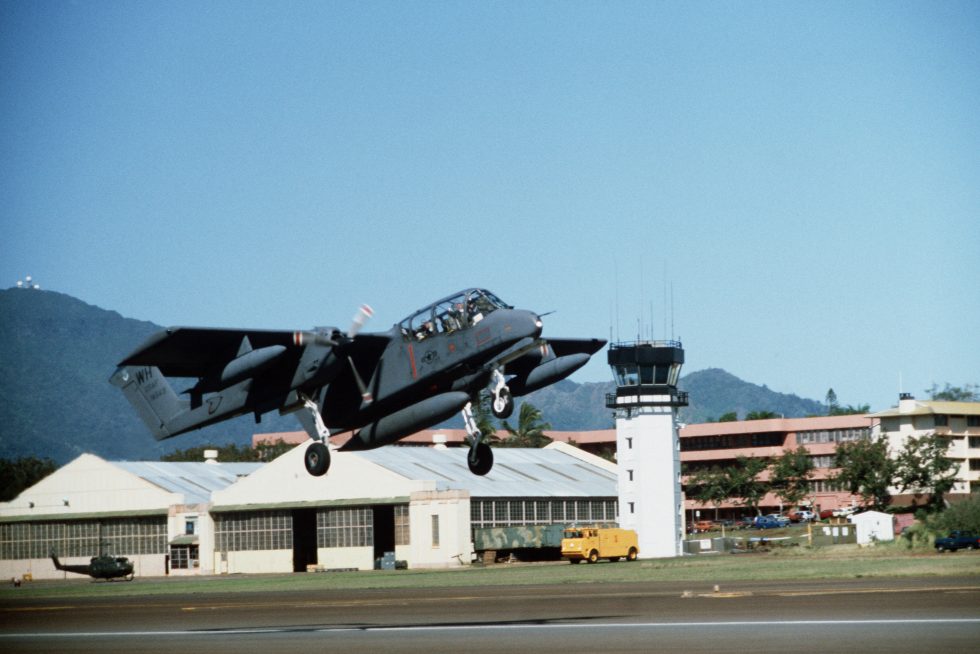
Short takeoff and landing was a hard LARA requirement, not a bonus. The Bronco’s big high-lift wing, light wing loading and twin turboprops let it get airborne and stop again in a few hundred metres of rough, unprepared ground — and in trials it operated from roads and even carrier decks. The point was basing: instead of flying from a distant paved airfield, a Bronco could work from a strip scraped out beside the troops it supported, cutting response time to minutes. That rough-field toughness, combined with hours of loiter, is exactly why counter-insurgency planners kept rediscovering the type across six decades.
03The OV-10G+ and Combat Dragon II: a fifty-year-old Bronco fighting ISIS
In 2015 the US ran an experiment called Combat Dragon II. Two ex-Marine Broncos — airframes that had passed through civilian agency hands — were rebuilt as OV-10G+, fitted with a stabilised L3 WESCAM MX-15 electro-optical sensor turret, laser-guided APKWS 70 mm rockets and secure datalinks, at a reported cost near $20 million for the pair. A tiny detachment deployed them to Iraq, where over roughly 120 sorties they reportedly acted as precise “flying snipers” against ISIS at a fraction of a jet’s operating cost. The trial fed directly into later US light-attack programmes.
Full specifications
Baseline note: the figures below describe the production OV-10A — 271 of the 360 airframes built, the mark every Vietnam operator flew and the basis of every export version. Deltas for the German OV-10B(Z) target tug and for the rebuilt OV-10D/D+ night model are in grey. Three disagreements are worth settling before the tables start. First, length: Anglophone sources give the OV-10A as 41 ft 7 in (12.67 m) and the extended-nose OV-10D as 44 ft 0 in (13.41 m), while German tables give 12.12 m and 12.49 m; the gap is far too large to be rounding, and the shorter numbers appear to stop at a different datum. Second, engine rating: the OV-10A’s Garrett T76-G-10/12 is rated 715 shp installed and the OV-10D’s T76-G-420/421 at 1,040 shp, so museum placards that hang 1,040 shp on an A-model are quoting an uninstalled thermodynamic figure the gearbox and the three-blade propeller could never absorb. Third, the ceiling, which is the most dishonest number in every published table: the brochure says 26,000 ft, the flight manual says 25,000 ft, German sources say 24,000 ft, and squadrons in Vietnam reported that a loaded Bronco in tropical air would not go above 18,000 ft.
Dimensions & weights
- Crew
- 2 — pilot forward, observer aft, both on ejection seats, both with a view over the nose and down past the sponsons that no jet has ever matched. The rear seat could be pulled to make the aeroplane a small freighter, and in the German OV-10B a third man sat in the cargo bay facing backwards under a clear dome to watch the towed target
- Length
- 12.67 m (41 ft 7 in); OV-10D 13.41 m (44 ft 0 in) with the FLIR nose. German tables give 12.12 m and 12.49 m for the same two marks
- Wingspan
- 12.19 m (40 ft 0 in) — and this single row is the argument of the whole aeroplane. Rice and Beckett specified 6.10 m (20 ft) so the thing could work off jungle roads; the prototype flew at 9.14 m (30 ft); the Department of Defense signed off 40 ft. The wing that made it fly well is the wing that tied it to an airfield
- Height
- 4.62 m (15 ft 2 in)
- Wing area
- 27.03 m² (291.0 sq ft)
- Aspect ratio
- 5.5 — aerofoil NACA 64A315, a thick, high-lift, entirely unglamorous section. Nothing about this wing was designed to go fast
- Empty weight
- 3,127 kg (6,893 lb); the same article’s design text gives 3,161 kg (6,969 lb) and museum placards run to 3,261 kg (7,190 lb). Equipment fit, not disagreement about the airframe
- Gross weight
- 4,494 kg (9,908 lb) — two crew, full internal fuel, guns loaded, four rocket pods. This is the weight the aeroplane actually flew at
- Maximum take-off weight
- 6,552 kg (14,444 lb), an overload figure. The OV-10B(Z) with its turbojet booster went to 6,671 kg (14,706 lb)
- Wing loading
- 166 kg/m² (34.0 lb/sq ft) at gross weight, rising to 242 kg/m² (49.6 lb/sq ft) at the overload limit. Low enough to loiter all afternoon and turn inside anything a forward air controller needed to look at twice
- Power loading
- 3.14 kg/shp (6.93 lb/shp) at gross weight on two 715 shp engines. The OV-10D’s 1,040 shp engines cut that to 2.16 kg/shp (4.76 lb/shp). The A-model figure is the one that killed crews in the mountains: it would not out-climb rising ground
- Internal fuel
- 954 L (252 US gal, 210 imp gal) in the centre section. The LARA specification asked for far less; the extra tankage was one of the changes that drove the wing out to 40 ft
- External fuel
- 1 × 556 L (150 US gal) on the centreline, or 2 × 375 L (100 US gal) on the sponsons. With tanks the endurance goes from about three hours to five and a half
- Cabin load
- 1,450 kg (3,200 lb) of freight, or five paratroopers out of the rear clamshell door, or two litters and an attendant. The LARA requirement asked for six paratroopers and 2,400 lb; the production aeroplane carried more weight and fewer men
- Unit cost
- ~US$480,000 in late-1960s dollars, as quoted on USAF museum placards. For comparison an F-4E of the same era cost roughly five times that, which is exactly the arithmetic the counter-insurgency lobby kept putting in front of Congress
Performance
- Maximum speed
- 452 km/h (281 mph, 244 kn) at sea level; the OV-10D is generally given as 463 km/h (250 kn). The LARA specification had demanded 350 mph and no Bronco ever reached it
- Maximum speed, OV-10B(Z)
- 620 km/h (385 mph, 335 kn) with the General Electric J85-GE-4 turbojet running on the fuselage spine — roughly 150 km/h faster, half the take-off run and triple the climb rate. It also drank fuel at a rate the Luftwaffe could not live with, and the jets were taken off again
- Cruising speed
- 359 km/h (223 mph, 194 kn)
- Stalling speed
- 130 km/h (70 kn) flaps down, 148 km/h (80 kn) clean. The gap between the stall and the marking-rocket dive is what made the aeroplane a good observation platform: it could go slowly enough to see and quickly enough to leave
- Rate of climb
- 15.3 m/s (3,020 ft/min) at gross weight, and considerably less than that hot, high and loaded. Underpowered is the word the crews used, and it is in the accident record
- Service ceiling
- 7,925 m (26,000 ft) claimed; the flight manual says 7,620 m (25,000 ft), German tables 7,315 m (24,000 ft), and Vietnam experience about 5,500 m (18,000 ft). Take the last one seriously — it is the altitude that decided whether a Bronco could stay above small-arms fire
- Combat radius
- ~367 km (198 nmi, 228 mi) on internal fuel with a useful load
- Ferry range
- ~2,224 km (1,200 nmi) with auxiliary tanks. In August 1990 six VMO-2 aircraft flew about 16,000 km (10,000 mi) from California to Saudi Arabia in stages, which remains the longest deployment ever flown by the type
- Endurance
- 3 h on internal fuel, 5½ h with external tanks — the number that mattered more than any other. A jet fast air controller had minutes over a target; a Bronco crew had an afternoon, and learned the ground
- Take-off run
- 226 m (740 ft); 341 m (1,120 ft) to clear a 15 m (50 ft) obstacle, and 853 m (2,800 ft) to the same obstacle at maximum weight
- Landing run
- 226 m (740 ft); 381 m (1,250 ft) at maximum weight, and 372 m (1,220 ft) over a 15 m (50 ft) obstacle. Fully reversing propellers did most of that work
- Load factors
- +8 / −3 g — a genuinely aerobatic airframe, stressed to the LARA figure, and one of the few parts of the original specification that survived contact with the procurement system intact
Propulsion & systems
- Engines
- 2 × Garrett T76-G-10/12 turboprops, 715 shp (533 kW) each. OV-10D and D+: T76-G-420/421 at 1,040 shp (776 kW). OV-10B(Z): T76-G-416/417 plus one General Electric J85-GE-4 turbojet of 12.7 kN (2,850 lbf) in a dorsal nacelle
- Engine architecture
- Single-shaft turboprop with an integral gearbox: two-stage centrifugal compressor, reverse-flow annular combustor, three-stage axial turbine. The military T76 is the Garrett TPE331, the same engine that hauls Metroliners and Ayres Thrushes about, which is why spares were cheap for thirty years and then suddenly were not
- Gearbox and shaft speed
- 21:1 reduction — 41,730 rpm at the compressor for 2,000 rpm at the propeller. A single-shaft engine means the propeller is geared straight to the gas generator, so throttle response is immediate and there is no spool-up lag; it also means a rejected landing is decided by the pitch lever rather than by patience
- Propellers
- 3-blade Hamilton Standard of 2.59 m (8 ft 6 in), constant-speed, fully feathering and fully reversing. They are handed: the left shaft turns clockwise and the right anticlockwise, so torque cancels and there is no critical engine. CAL FIRE has since put five-blade Hartzell units on part of its fleet, and the OV-10G+ conversions flew on four-blade Hartzells
- Fuel
- JP-4/JP-5 normally; in an emergency the engines will run on high-octane motor petrol with a slight loss of power. That was not a marketing line but a design requirement, written for a war fought out of places with no fuel farm
- Field support
- No ground equipment required to start the engines, and repairs designed around ordinary hand tools. The aeroplane could operate off unimproved strips, and it could take off from and land on carriers and large-deck amphibious ships with no catapult and no arrester wire
- Escape system
- North American LW-3B rocket-boosted ejection seats for both crew, an unusual fit on a slow observation aeroplane and a fully justified one: the type accumulated a long list of successful ejections. It never solved the other problem — no OV-10 crew is known to have survived ditching the aircraft
- Protection
- Armour plate around crew and engines, added during flight test and one of the changes that drove the weight up by 29 per cent. The OV-10D added chaff dispensers midway down the booms and infrared-suppressive exhaust stacks that mix cold air into the efflux. What no Bronco ever had was an effective infrared countermeasures suite, and in 1991 that killed two of them
- Marking and smoke
- Internal smoke generator injecting oil into the exhaust. In the 1968 Combat Bronco evaluation there were four recorded occasions on which strike crews saw the smoke before they saw the aeroplane making it, which for a forward air controller is close to an ideal result
- Sensors
- Eyeballs, and later rather more. The OV-10A had none worth the name beyond a starlight scope; Pave Nail aircraft got a stabilised night periscope, LORAN and the Pave Spot laser designator pod in 1971; the YOV-10D carried a forward-looking infrared turret with a laser designator and a slaved gun; the OV-10D put FLIR and a designator in an extended nose; the OV-10G+ of 2015 carried an L3 Wescam MX-15HD electro-optical turret with laser rangefinder and designator
- Communications
- UHF, VHF, FM and HF, the last on a long wire strung from the fin to the nacelle that identifies an A-model at a glance. The 2015 OV-10G+ carried four Harris AN/PRC-117G encrypted radios, Link 16, SADL and ANW2 data links, and an airborne precision geo-location fit that found targets by their mobile telephone emissions
- Structure
- Twin booms, central nacelle, high wing. The layout is not nostalgia for the P-38: booms in line with the propeller wash give directional control at take-off speeds, and the gap between them lets a rear clamshell door drop cargo and paratroopers clear of the tail. The sponsons under the fuselage were horizontal on the prototype and were angled down on production aircraft so that stores would fall away cleanly
04The OV-10 Bronco’s operating costs: the cheap-to-fly case for a turboprop warplane
The Bronco’s whole rationale was economy. A pair of small turboprops, a simple airframe and field maintenance meant it cost a small fraction of a jet fighter to buy and to fly — the argument that made LARA attractive in the first place and that resurfaced in the 2010s light-attack debate. No authoritative modern flyaway unit price or cost-per-flight-hour figure exists in the open record for the OV-10A, and the frequently quoted numbers are estimates rather than sourced accounting. What is well documented is the comparison the 2015 Combat Dragon II trial drew: a modernised Bronco could deliver precise strikes for a tiny fraction of the hourly cost of a fast jet — the enduring economic case for the type.
Armament & payload
The Bronco’s most important weapon was a rocket that killed nothing
Four rifle-calibre machine guns in the sponsons, seven pylons and up to 1,450 kg (3,200 lb) of stores made the OV-10 the most heavily armed observation aircraft anyone had ever fielded, and for most of its career the round that mattered was a 2.75 in white phosphorus marking rocket with no useful warhead. The Bronco’s job was to find a target, put a column of smoke on it and talk a flight of fighters onto the smoke; everything else it carried was there so the crew could hold the enemy’s attention while the strike ran in. That changed twice. In the Misty Bronco exercise of April–June 1969 the USAF concluded that its aircraft should stop pretending to be unarmed spotters, and by October every USAF OV-10A had its M60Cs loaded and high-explosive rockets authorised. The Navy went further still: VAL-4’s Black Ponies flew the Bronco as a pure attack aeroplane over the Mekong Delta, and their signature weapon was the five-inch Zuni, which is a great deal of rocket to hang on a 4.5-tonne turboprop. Fits varied enormously by service, by mark and by country: the German OV-10B carried no weapons at all, Indonesia swapped the 7.62 mm guns for .50 in Brownings, the Philippines integrated Paveway bombs in 2012, and much of the published stores list below is a clearance rather than something anyone routinely flew with.
Gun
- Four 7.62 mm M60C machine guns, two in each sponson, 500 rounds per gun for 2,000 rounds in all, reached through a large forward-opening hatch on top of each sponson. Rifle calibre, fixed, aimed by pointing the aeroplane
- The guns were often not fitted at all in 1968. Combat Bronco flew without them; Misty Bronco put them back, and from October 1969 every USAF OV-10A carried them loaded
- GPU-2/A centreline pod with a three-barrel 20 mm M197 Gatling and 300 rounds; the Hughes Mk 4 Mod 0 pod with a 20 mm cannon and 750 rounds; up to four SUU-11A/A pods each with a 7.62 mm M134 minigun and 1,500 rounds
- The YOV-10D Night Observation Gunship System put an M197 in a chin turret slaved to the FLIR aimpoint — the only Bronco that could shoot where it was looking rather than where it was flying. It worked in Vietnam and was not funded
- Indonesia retrofitted 12.7 mm M2 Browning heavy machine guns in place of the M60Cs, which is a fair verdict on what rifle calibre was worth against anything harder than a man
Air-to-air
- The LARA specification demanded AIM-9 Sidewinder capability and the Bronco was cleared for it: two LAU-7/A rails on the outboard wing stations, carrying AIM-9B or AIM-9C
- No OV-10 is known to have fired an air-to-air missile in anger, or to have claimed an aerial victory, in sixty years of service with nine air arms
- Thailand did at one point hold its OV-10Cs on air-defence alert, which says more about the Royal Thai Air Force’s inventory in the 1970s than about the aeroplane
- The Bronco’s actual air-to-air record runs the other way. On 27 November 1992 mutinous Venezuelan officers used OV-10Es to bomb police and government buildings in Caracas; four were lost, two of them shot down by a loyalist F-16
- Against a fighter the aeroplane has one asset: it can turn at a speed no jet can match, and every Bronco pilot who ever discussed the problem said the same thing — make him come down to you and hope his fuel runs out first
Air-to-surface guided
- For most of the Vietnam War, none. The Bronco guided other people’s weapons instead: from 1971 the 23rd TASS’s Pave Nail aircraft carried the Pave Spot laser designator pod, a stabilised night periscope and LORAN, and lit targets on the Ho Chi Minh Trail for laser-guided bombs dropped by F-4 Phantoms
- The OV-10D carried a laser designator of its own from the late 1970s; the NOGS prototype had one before that, paired with a gun
- Published clearances include four AGM-114 Hellfire on outboard rails and AGM-122 Sidearm anti-radiation missiles on LAU-7/A rails. These are German-sourced paper fits and there is no record of an operational Bronco squadron flying either
- The Philippine OV-10M was cleared for GBU-12 Paveway II and GBU-49 Enhanced Paveway II in 2012, making the PAF the only air force to drop guided bombs from a Bronco in combat — it did so over Marawi in 2017
- The 2015 OV-10G+ carried APKWS II, a 70 mm rocket with a laser seeker bolted between motor and warhead. It turned the Bronco’s oldest weapon into a precision one, and the briefing that followed used the phrase "one shot, one kill"
Bombs
- Mk 81 250 lb (113 kg) low-drag general-purpose bombs, up to nine; Mk 82 500 lb (227 kg), up to four, including the retarded Mk 82 Snake Eye for low-level release; a single Mk 83 1,000 lb (454 kg) on the centreline
- Mk 77 Mod 2/4 fire bombs and BLU-27B napalm — heavily used in Vietnam and in Indonesian operations over East Timor, and the reason a good many Bronco photographs from the period are difficult to look at
- CBU-55/B fuel-air explosive, an unusual store for an aeroplane this size and one that had to be dropped slowly, which the Bronco could do
- Bombs were a marginal part of the type’s work. Four Mk 82s consume the whole sponson rack, cost most of the loiter time and leave nothing for marking, which is why the standard Vietnam fit was rockets
- Indonesia initially adapted the racks to take Soviet-pattern bombs and rockets, because American ordnance did not arrive until 1980 — four years after the aircraft did
Rockets
- 2.75 in (70 mm) folding-fin aerial rockets in seven-tube LAU-3/A, LAU-59/A and LAU-68/A pods or nineteen-tube LAU-32/A, LAU-60/A, LAU-61/A and LAU-69/A pods, up to four pods at a time
- White phosphorus marking rounds were the forward air controller’s working ammunition; high-explosive heads were authorised for USAF aircraft from October 1969 after Misty Bronco
- 5 in (127 mm) Zuni in four-round LAU-10D/A or two-round LAU-33/A pods. This was VAL-4’s weapon of choice in the Delta: a Zuni fired in a 30-degree dive from 1,500 ft would open a bunker, and a Bronco could carry sixteen of them
- The whole aiming system was a fixed sight and a steady hand. There was no computing gunsight, no radar and no laser ranging until the D-model; accuracy came from flying the dive angle exactly and from having done it several hundred times
- APKWS II in seven- and nineteen-tube pods closed the circle in 2015: the same launcher, the same tube, and a rocket that hits what the turret is looking at
Pods & other stores
- Cluster dispensers: CBU-14/A with 114 BLU-3 bomblets, CBU-22/A with 432 BLU-17 smoke and incendiary bomblets, CBU-25/A with 132 BLU-24, and CBU-30/A with 1,280 BLU-39 CS bomblets
- SUU-40/A and SUU-44/A flare dispensers with Mk 24 and Mk 45 parachute flares — the Bronco’s answer to night work before infrared arrived
- ADSIDS air-delivered seismic sensors, hand-dropped along the Ho Chi Minh Trail for Operation Igloo White by 23rd TASS crews out of Nakhon Phanom
- One 556 L (150 US gal) centreline tank or two 375 L (100 US gal) sponson tanks, taking endurance from three hours to five and a half
- Non-combat fits tell their own story: a target-towing winch and its cable drum in the German OV-10B’s cargo bay, and on the US State Department aircraft a 1,900 L herbicide hopper, a wind-driven pump borrowed from crop-dusting and a spray bar running out to the tail booms
Three typical loadouts
- Forward air control, 20th TASS, Da Nang, 1970
- Four M60C with 2,000 rounds; two LAU-59/A seven-tube pods of 2.75 in white phosphorus marking rockets; two LAU-68/A pods of high-explosive 2.75 in; one 556 L centreline tank. Endurance about four hours. The marking rockets are the mission; the high-explosive is for holding an enemy’s head down between strikes, and the fuel is what lets the crew learn a valley well enough to notice when something in it changes
- Black Pony fire support, VAL-4, Binh Thuy, 1970
- Two LAU-10D/A pods with four 5 in Zuni each; two LAU-61/A nineteen-tube pods of 2.75 in high-explosive; four M60C loaded. Scramble alert for river patrol boats, SEAL teams and the Mobile Riverine Force, delivered in 30-degree dives from low level, often at night and often within 50 m of friendly troops. This is the Bronco used as it was originally conceived and never officially bought: an attack aeroplane that lives with the people it supports
- Combat Dragon II, OV-10G+, Iraq, 2015
- L3 Wescam MX-15HD electro-optical and infrared turret with laser designator; seven- and nineteen-tube pods of APKWS II laser-guided 70 mm rockets; four Harris AN/PRC-117G encrypted radios with Link 16, SADL and ANW2; sponsons and their gun installation retained. Two aircraft, 120 combat sorties in 82 days over Iraq and Syria in support of special forces, at a fraction of the hourly cost of anything else in theatre. The briefing that followed called them flying snipers
Sourcing caveat: the long stores list above is assembled from English- and German-language clearance tables and reflects what the aircraft was certified to carry rather than what any squadron habitually flew. The Hellfire and Sidearm fits in particular are documented only in secondary German sources and no operational use is recorded. Ammunition counts for the M60C installation are given as 500 rounds per gun in most references and 2,000 rounds total in others, which is the same thing stated twice; a few sources give 2,000 rounds per aircraft as the LARA requirement figure, which it was.
Variants
Rockwell built 360 Broncos, and almost every improved version was a rebuild rather than a new airframe
Production ran from the seven prototypes of 1965 to the last export batch, and 271 of the 360 aircraft were plain OV-10As. Everything that came afterwards — the night gunship, the FLIR-nosed D, the Philippine M, the sensor-laden G+ of 2015 — was cut from an existing airframe, which is why the type’s variant list reads less like a development programme and more like sixty years of people finding new uses for aeroplanes that were already paid for.
Two things are worth noticing in the list. The first is that the export versions are barely versions at all: the OV-10C, E and F differ from an OV-10A mainly in the plate on the cockpit sill. The second is that the only genuinely ambitious derivatives — the NOGS gunship, the jet-boosted German B(Z), the cargo-carrying OV-10T, Boeing’s OV-10X of 2009 — were either cancelled, unbuilt or converted back to standard. The Bronco was allowed to be useful, and never allowed to become something else.
- YOV-10A (1965–67 / 7)
- Prototypes to the NA-300 design, first flight 16 July 1965; 30 ft span, one pilot and passengers in a cramped bay behind him, 600 shp T76-G-6/8 engines. The last airframe flew with Pratt & Whitney YT74-P-1s. Flight testing added a second crewman, armour, fuel and weapons capacity, put empty weight up 29 per cent and forced the wing out to 40 ft.
- OV-10A (1967–69 / 271)
- The production standard: 40 ft wing, 715 shp T76-G-10/12, four M60Cs in the sponsons, long-wire HF aerial. 114 to the Marine Corps and 157 to the Air Force; the Navy borrowed 18 Marine aircraft for VAL-4. First deliveries in 1967 — English sources say June, German sources 6 August — and A-model production ended in April 1969.
- Pave Nail (1970–74 / 15 aircraft, 11 further kits)
- Not a mark but a modification, done by LTV at Dallas for the 23rd TASS: the Pave Spot stabilised low-light laser designator, LORAN for precise night navigation, wing drop tanks in place of the centreline tank, and later AN/APR-25/26 radar warning gear. Testing at Eglin from November 1970, in combat from Ubon in July 1971 and Nakhon Phanom that September, designating for F-4-dropped laser-guided bombs over the Ho Chi Minh Trail. Evaluation put 79.5 per cent of designated bombs within 40 ft of the aim point — against a loss rate of about 20 per cent of the converted fleet. The programme ended in 1974 and the survivors were returned to standard OV-10A configuration.
- OV-10B and OV-10B(Z) (1970 / 18)
- German target tugs: no weapons, no sensors, a glazed dome in place of the rear cargo door with an aft-facing operator, a winch in the cargo bay and conspicuous orange panels for the anti-aircraft gunners at Todendorf. Twelve were rebuilt as the B(Z) with a General Electric J85-GE-4 turbojet above the fuselage; it gave 150 km/h, halved the take-off run and tripled the climb, then broke repeatedly and drank too much fuel, and was removed. All retired in 1990 in favour of the Pilatus PC-9.
- OV-10C, Thai designation B.J.5 (1971–74 / 32)
- Royal Thai Air Force export, essentially an OV-10A. The first sixteen were shipped aboard USS Okinawa to Cam Ranh Bay in June 1971 and flown on to Lop Buri; the second sixteen were ferried across the Pacific in December 1974. Used against the communist insurgency in the north and, from Surat Thani, to protect Thai fisheries. Retired 7 April 2004, with eight airframes passed to the Philippines.
- YOV-10D (NOGS) and OV-10D / OV-10D+ (1970–80s / 2 plus 17 conversions)
- The Night Observation Gunship System: two OV-10As, BuNos 155395 and 155396, given a FLIR turret, a laser designator and a chin-mounted 20 mm M197 slaved to the aimpoint. It succeeded in Vietnam and was not funded further. The production OV-10D that followed kept the extended FLIR nose, the designator and the 1,040 shp engines but lost the gun; it added boom-mounted chaff dispensers and infrared-suppressive exhausts. The D+ was a Cherry Point rework of both A and D airframes with new wiring, strengthened wings and tape-readout engine instruments.
- OV-10E (1976 / 16)
- Venezuelan export to OV-10A standard, later supplemented by ex-USAF A-models. Used against mutineers’ targets — and by the mutineers — in the coup attempt of 27 November 1992, when four were lost, two of them to a loyalist F-16.
- OV-10F (1976 / 16)
- Indonesian export, ferried across the Pacific by way of Alaska, Wake and Clark Field. Guns changed to 12.7 mm Brownings, racks adapted for Soviet-pattern ordnance until American bombs arrived in 1980. Flown over East Timor from October 1976 under the callsign Kampret, over West Papua in 1977, and over Aceh in 2003. Grounded after a fatal accident on 23 July 2007 and replaced by Super Tucanos in 2012.
- OV-10M (2000s–2024 / Philippine rebuilds)
- Philippine Air Force upgrade of A- and C-model airframes by Marsh Aviation: larger engines, four-blade composite propellers, strengthened wings, new wiring, chaff dispensers and tape instrumentation, with GBU-12 and GBU-49 integration from 2012. The PAF received 24 OV-10As in 1991, nine more later and eight ex-Thai OV-10Cs in 2003–04, and flew them in combat over Jolo, against the Moro Islamic Liberation Front and at Marawi in 2017.
- OV-10G+ (2013–15 / 3 conversions)
- Combat Dragon II: OV-10D+ airframes that had passed through ATF and NASA hands, rebuilt by Naval Air Systems Command for roughly US$20 million total with four-blade Hartzell propellers, an MX-15HD turret, four networked encrypted radios and APKWS II. BuNos 155481 and 155492 deployed to Iraq in 2015. Note that German sources apply the bare designation OV-10G to an unapproved 45-aircraft South Korean export proposal of the 1970s, which is a separate and much less well attested use of the letter.
- Unbuilt proposals (1968–2009 / 0)
- The OV-10T of the Vietnam era would have carried 8–12 troops or 4,500 lb of cargo; Boeing’s OV-10X of 2009 offered a glass cockpit, modern sensors and guided bombs on the 1965 airframe for the USAF’s Light Attack/Armed Reconnaissance requirement. Neither was built. Nor, despite the name, was the Bronco II of 2020 a Bronco at all: it was Paramount’s South African AHRLAC offered by Leidos for the Armed Overwatch competition, which SOCOM awarded in 2022 to the Air Tractor and L3Harris OA-1K Skyraider II.
Survivors, and where the type stands now. No air force anywhere flies the Bronco: the Philippine Air Force retired the last military examples on 28 December 2024, after Colombia in November 2015, Indonesia in 2012 and Thailand in 2004. Every surviving airframe is an original Rockwell-built machine — no reproduction OV-10 has ever been constructed, and the type is too recent for the question to arise. The largest operator today is CAL FIRE, which as of 2025 flew fifteen OV-10As and one OV-10D as airborne fire-attack coordination platforms from bases between Redding and Ramona, with further stored airframes and two ex-Combat Dragon OV-10G+ awaiting restoration; some carry five-blade Hartzell propellers. Blue Air Training acquired seven OV-10D+ and G aircraft in March 2020 for joint terminal attack controller training, and Beaufort County Mosquito Control in South Carolina flies the type on vector control. On the warbird side the OV-10 Squadron at Chino is restoring seven ex-VAL-4 D-models, of which 155493 Holy Terror and 155474 White Lightning are flying; 155484 is airworthy at Planes of Fame; the Cactus Air Force and Stallion 51 each fly an ex-Luftwaffe OV-10B rebuilt to A-model configuration; and the Bronco Demo Team operates ex-German machines in Europe, one of which, F-AZKM, was substantially damaged in a gear-up landing at Leszno on 19 June 2026. Roughly 35 more are on public display across the United States, Indonesia, Germany, Thailand, France, Belgium, the United Kingdom and Australia. Survivor tallies are approximate: airframes move between museums, restorers and storage without a central register, and several listed as displayed are in fact stored or dismantled.
From LARA concept to the last Bronco
The LARA idea
US planners write a tri-service requirement for a cheap, rugged, short-field counter-insurgency aircraft — the Light Armed Reconnaissance Aircraft.
North American wins
North American Aviation’s NA-300 wins the LARA competition; seven YOV-10A prototypes are ordered.
First flight
The first YOV-10A flies on 16 July 1965. Testing widens the wing and adds more powerful engines before production.
Combat debut in Vietnam
USAF and Marine OV-10As reach Vietnam in July 1968 for forward air control and armed reconnaissance.
The Black Ponies
US Navy Light Attack Squadron VA(L)-4 stands up, flying Broncos on light attack over the Mekong Delta.
Desert Storm
Marine Broncos fly FAC and recon in the Gulf War; two OV-10s are shot down by shoulder-fired missiles.
Second careers
Retired from US service, Broncos go to work fighting wildfires (CAL FIRE) and flying drug-interdiction patrols.
Combat Dragon II vs ISIS
Two modernised OV-10G+ fly roughly 120 combat sorties against ISIS in Iraq — a 50-year-old design back at the front.
The last military Bronco
The Philippine Air Force retires the OV-10 on 28 December 2024 — the world’s last military operator stands the type down.
From the cockpit: twelve Bronco stories
Born for a brushfire war
The Bronco was designed from scratch for counter-insurgency, not adapted from a jet.
Read the full story
A decade before it fought ISIS
The first YOV-10A flew on 16 July 1965, one of seven prototypes.
Read the full story
The Black Ponies of the Mekong
The only US Navy squadron ever to fly the Bronco.
Read the full story
Marking targets with “Willie Pete”
A slow plane that told the fast jets where to bomb.
Read the full story
The greenhouse canopy
A cockpit built like a flying observation deck.
Read the full story
The off-road warplane
A combat aircraft that did not need a runway.
Read the full story
The Bronco’s secret cargo bay
A gunship that could also carry paratroopers.
Read the full story
Ejection seats on a slow plane
Escape engineered into a low-and-slow mission.
Read the full story
From gunfire to wildfires
The Bronco traded Vietnam for the California fire lines.
Read the full story
The smuggler-chasing Bronco
A drug-war castoff that became a combat aircraft again.
Read the full story
Fifty years old, fighting ISIS
“One shot, one kill” from a Vietnam-era design.
Read the full story
The Bronco’s last stand
The type’s final war, in the streets of a besieged city.
Read the full story
The Bronco in pictures
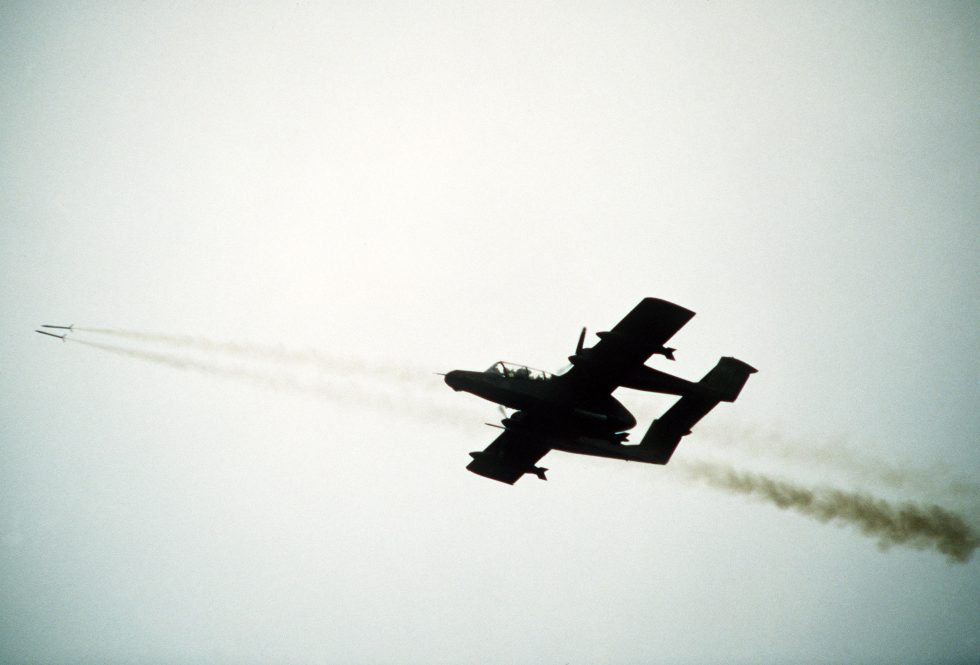
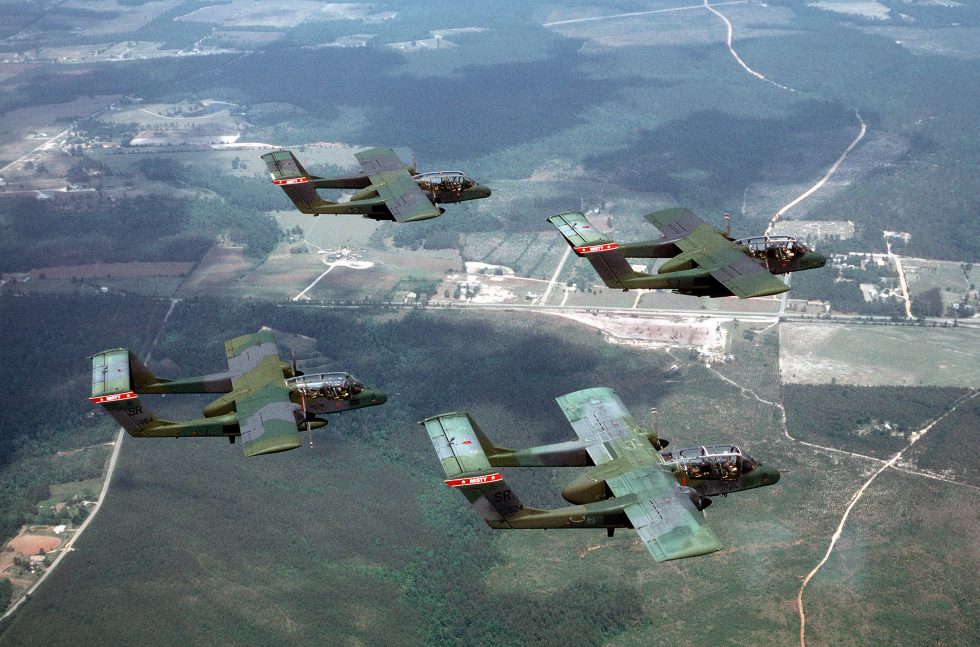
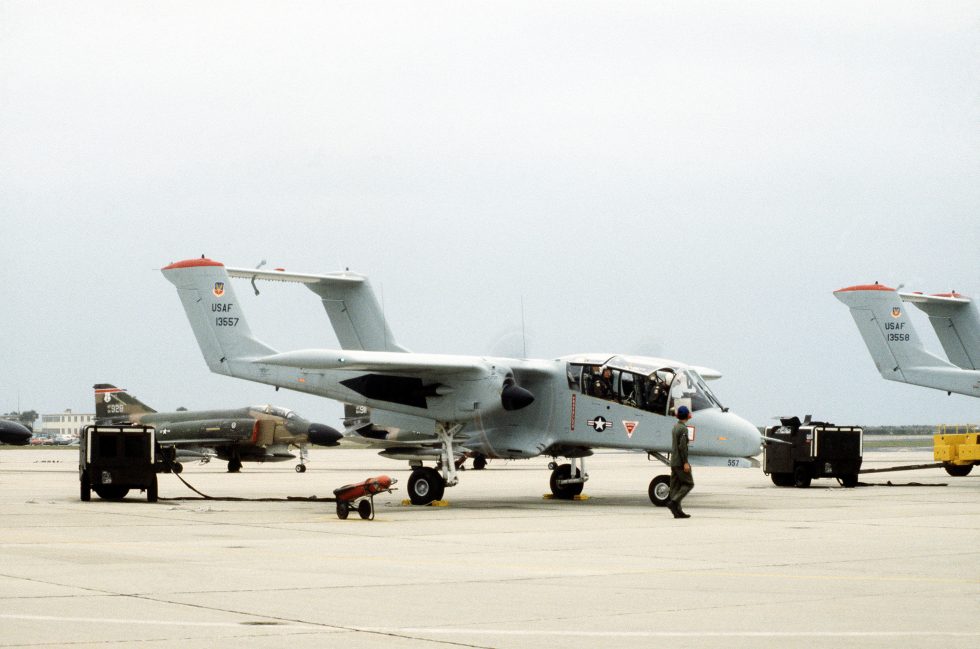
The Bronco in motion
A hand-picked video feature for the OV-10 Bronco is on the way. Video coming soon.
Where the Bronco flew
The score that defines it
The Bronco was never a dogfighter — its record is written in observation, target marking and low-level fire support across half a century of small wars. It directed countless air strikes over Vietnam, hunted over the Mekong Delta with the Black Ponies, flew forward air control in the Gulf, backed Philippine troops in the streets of Marawi, and returned to combat against ISIS in 2015.
Compare the combat record of every military aircraft.
Everything people ask about the OV-10 Bronco
Can I fly in an OV-10 Bronco?
What was the OV-10 Bronco used for?
How fast is the OV-10 Bronco?
Why does the Bronco have twin booms?
Did the OV-10 fight against ISIS?
Is the OV-10 Bronco still in service?
Which countries flew the OV-10 Bronco?
How many OV-10 Broncos were built?
You can’t fly the Bronco.
These, you can.
Some legends only live in museums — others are fuelled and waiting. MiGFlug has put civilians in real military jet cockpits since 2004.
 Fly the L-39 AlbatrosThe world’s most-flown jet trainer — aerobatics included
 Fly the F-104 Starfighter“The missile with a man in it”
 Fly the MiG-21The Cold War’s most-produced jet
 Fly the T-33 Shooting StarAmerica’s first jet trainer
 Fly the DH VampireA piece of early jet history
 Fly the S.211Agile Italian jet trainer
 Fly the MB-326The classic Aermacchi jet
 Fly the MiG-15The Soviet legend of the Korean War
Continue the tour
Every fact, checked
- National Museum of the US Air Force — OV-10A Bronco fact sheetSpecifications and USAF service history.
- Naval History and Heritage Command — OV-10 BroncoUS Navy service and the VA(L)-4 Black Ponies.
- US Naval Institute — “A Low, Slow Plane for Limited War”Design origins and combat use of the Bronco.
- Defense Media Network — Combat Dragon IIThe 2015 OV-10G+ modernisation and capabilities.
- The War Zone — the Broncos that fought ISISDetail on the Iraq deployment and results.
- The Aviationist — Philippines retire the OV-10The December 2024 retirement of the last military operator.
- The Aviation Geek Club — last USMC Bronco lossMarine OV-10 combat losses and Gulf War use.
- Military Factory — OV-10 BroncoProduction totals, variants and engine data.