
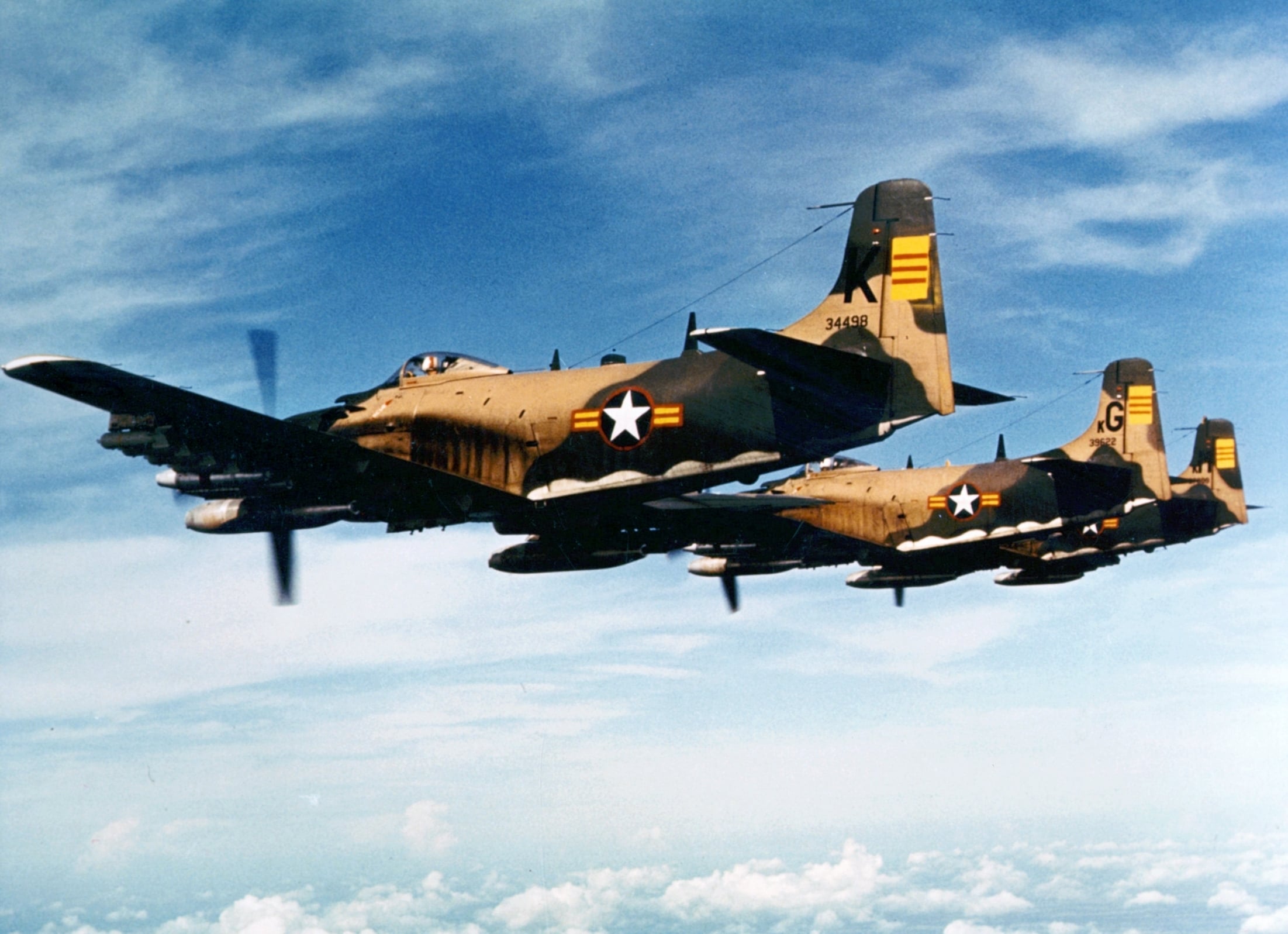
Douglas A-1 Skyraider
“Spad” · “Sandy”
The piston-engined attack aircraft that outlived the jets meant to replace it — a rugged, bomb-hauling brute that fought from Korea to Vietnam, guarded downed airmen as “Sandy,” and shot down jet fighters with its propeller still turning.
The attack plane that refused to become obsolete
In July 1944, with jet engines already on the horizon, Douglas chief engineer Ed Heinemann and two colleagues reportedly sat up overnight in a Washington hotel and re-drew a Navy attack aircraft from scratch. The result was the XBT2D-1 “Dauntless II,” a big single-seat carrier plane built around one enormous radial engine. It first flew on 18 March 1945, entered US Navy service in 1946 as the AD-1, and would go on to be built in around 3,180 examples across a dozen variants — a piston-engined design that arrived just as the piston era was supposed to end.
It never got the memo. Where fast jets burned fuel and could barely linger, the Skyraider could haul up to 8,000 lb of bombs, rockets and napalm — more than a four-engine B-17 — and loiter for hours over the troops who needed it. Air-cooled and heavily built, it soaked up battle damage that would have felled a sleeker machine. Crews nicknamed it the “Able Dog,” the “Spad” (after the rugged WWI fighter), and simply the flying dump truck.
In Korea it flew carrier strikes and close air support, and on 1 May 1951 a flight of eight Navy Skyraiders from USS Princeton pressed home the last aerial torpedo attack in US Navy history against the Hwacheon Dam — the strike that gave squadron VA-195 its enduring name, the “Dambusters.” A decade later, in Vietnam, the type found its most famous role: flying US Navy, US Air Force and South Vietnamese Air Force close air support, and above all serving as “Sandy” — the rescue-escort aircraft that shepherded helicopters in to pull downed airmen out of hostile territory.
And then there were the jets. On two occasions — 20 June 1965 and 9 October 1966 — US Navy Skyraiders shot down MiG-17 jet fighters in air combat, propeller against turbine. The Skyraider fought on with France in Algeria, with Britain as a carrier radar-picket, and with a string of air arms long after the US Navy and USAF retired their own around 1972. Today it is one of the most beloved warbirds in the world — the plane that proved a piston engine still had a war to fight.
01The Douglas A-1 Skyraider’s overnight design: how Ed Heinemann sketched an icon in a hotel room
By 1944 Douglas’s earlier BTD-1 Destroyer was overweight and underwhelming, and the Navy was ready to cancel it. According to the most-repeated account, Heinemann, Leo Devlin and Gene Root were summoned to Washington, told the program was in trouble, and worked through a single night in a hotel to conceive a cleaner, simpler replacement: one seat, one big Wright R-3350 radial, and a structure designed around carrying a huge external load off a carrier deck. The Navy ordered it, and the aircraft flew less than nine months later — nearly four months ahead of schedule. Heinemann’s design philosophy, “simplicate and add lightness,” produced an attacker so sound that it stayed in front-line service for more than a quarter of a century.
What makes it special
A bomb-hauler that out-lifted a B-17
The Skyraider carried up to about 8,000 lb of ordnance across 15 hardpoints — more than the typical bomb load of a four-engine B-17, off a single radial engine. In a 1953 demonstration an AD-4B lifted a record ~14,491 lb of ordnance and fuel, more than the aircraft’s own empty weight. Long endurance let it circle a battlefield for hours, earning it the nickname the “flying dump truck.”
Built to take hits and bring the pilot home
The air-cooled Wright R-3350 radial and the Skyraider’s heavy, simple structure gave it legendary battle-damage tolerance. Pilots routinely nursed shot-up aircraft home; Major Bernard Fisher famously flew his A-1E out of the A Shau Valley in 1966 with 19 bullet holes in it. Ruggedness and firepower, not speed, were its defining virtues.
“Sandy”: the plane downed airmen prayed for
In Vietnam the Skyraider became the heart of combat search and rescue. Under the callsign “Sandy,” A-1s escorted rescue helicopters into hostile territory, orbiting for hours and trading fire to suppress the enemy around a downed airman. Its loiter, low-speed handling and heavy firepower made it the ideal guardian for a rescue that a fast jet could never fly.
02The Douglas A-1 Skyraider’s Wright R-3350: the piston engine that carried it into the jet age
At the Skyraider’s heart was the Wright R-3350 Duplex-Cyclone, an 18-cylinder air-cooled radial of about 2,700 hp in its late A-1H/A-1J form. The same engine family powered the B-29 and the Lockheed Constellation. Air cooling made it far more tolerant of combat damage than a liquid-cooled engine — a single bullet through a radiator can down a Mustang, but a radial can keep running with cylinders shot away. Thirsty and heavy, the R-3350 nonetheless gave the Skyraider exactly what a close-support aircraft needed: brute low-altitude power and the endurance to stay on station long after jets had gone home to refuel.
03The Douglas A-1 Skyraider as “Sandy”: how a WWII-era attacker became the airman’s guardian angel
When a pilot went down over North Vietnam or Laos, the rescue was a race against enemy troops converging on the crash site. Fast jets could not slow down enough to protect a hovering helicopter; the Skyraider could. Flying as “Sandy,” A-1 pilots would arrive first, hunt for the survivor, mark and suppress enemy positions with cannon fire, rockets and smoke, then escort the “Jolly Green” helicopter in and out. It was slow, dangerous, hours-long work, often under heavy ground fire — and it made the Skyraider one of the most respected aircraft of the war among the men whose lives it saved.
Full specifications
Baseline note: the figures below describe the Douglas A-1H — the AD-6 as it was called until the tri-service redesignation of September 1962 — built at El Segundo between 1955 and 1957 with the Wright R-3350-26WA, four 20 mm cannon and fifteen stores stations. It is the right baseline for two reasons: at 713 airframes it was by a wide margin the most numerous single mark, and it is the aeroplane of the reputation, the one that flew Sandy over Laos and shot down two MiG-17s. Deltas for the earlier AD-4, for the wide-bodied AD-5 (A-1E) family, for the AD-3W and AD-4W airborne early warning conversions and for the final AD-7 (A-1J) are given in grey. Skyraider figures are unusually stable compared with most piston-engined types, because production ran continuously for eleven years under one manufacturer at one plant; where authorities do disagree, it is almost always about stores capacity rather than about the airframe.
Dimensions & weights
- Crew
- 1 — and this was the point of the design. Two side by side under a broad canopy in the AD-5 (A-1E), which the USAF then flew with a single pilot and an empty right seat; three in the AD-4N and the AD-4W, the second and third men down in an unlit belly compartment with the radar; four in the AD-5N, AD-5Q and AD-5W
- Length
- 11.84 m (38 ft 10 in); the AD-5 family stretched to 12.20 m (40 ft 1 in) on a widened, deeper fuselage
- Wingspan
- 15.25 m (50 ft 0.25 in), the outer panels folding hydraulically upward for the hangar deck
- Height
- 4.78 m (15 ft 8.25 in) in the tail-down attitude, which is tall for a single-engined aeroplane and is what a 4.11 m propeller costs you
- Wing area
- 37.19 m² (400.3 sq ft)
- Aerofoil
- NACA 2417 at the root, NACA 4413 at the tip — a thick, conventional, unfashionable section chosen for lift and structural depth rather than speed, and the reason the aeroplane would still fly with a wing full of holes
- Empty weight
- 5,429 kg (11,968 lb)
- Gross weight
- 8,213 kg (18,106 lb) in the standard carrier attack configuration
- Maximum take-off weight
- 11,340 kg (25,000 lb) — more than double the empty weight, a ratio no jet attack aircraft of the period came near
- Wing loading
- 221 kg/m² (45.2 lb/sq ft) at gross weight; published tables also give 46.6 lb/sq ft, which corresponds to a slightly heavier standard load. Either way it is a low figure, and low wing loading is what bought the loiter and the turn radius over a valley floor
- Internal fuel
- ~1,438 L (380 US gal) in self-sealing fuselage and wing cells
- External fuel
- Up to ~1,136 L (300 US gal) on the centreline plus two ~568 L (150 US gal) wing tanks; a Sandy sortie normally flew with the centreline tank fitted and never dropped it
- Armour
- 280 kg (618 lb) of bolt-on external aluminium plate, 6.4–12.7 mm (0.25–0.5 in) thick, added to the fuselage sides and underside after Korean losses to small-arms fire. It was ugly, it cost performance, and every squadron wanted it
Performance
- Maximum speed
- 518 km/h (322 mph, 280 kn) at 5,486 m (18,000 ft), clean
- Maximum speed, competing authority
- 515 km/h (320 mph) is the figure usually quoted for the AD-7 (A-1J). The two are the same aeroplane to within measurement error. What the numbers do not convey is that with fifteen stations loaded the Skyraider cruised at little more than half this, and nobody minded
- Cruising speed
- 319 km/h (198 mph, 172 kn) — slow enough that jet escorts had to weave, and slow enough to see a man waving on a hillside
- Rate of climb
- 14.5 m/s (2,850 ft/min) at sea level at gross weight
- Service ceiling
- 8,685 m (28,500 ft), an academic number for an aeroplane whose working altitude band was 150 to 1,500 m
- Range
- 2,118 km (1,316 miles, 1,144 nautical miles) on internal fuel in the ferry condition
- Combat radius
- ~460 km (285 miles) with a heavy external load, but radius was never the figure that mattered. Endurance was
- Endurance
- Four to six hours on a typical rescue-escort sortie with a centreline tank, and Korean-era claims of up to ten hours in the patrol configuration. This single number explains the entire career: a jet arrived, spent four minutes and left, while the Skyraider stayed until the helicopter got there
- Power-to-weight
- 0.245 kW/kg (0.149 hp/lb) at gross weight
- AD-4W and AD-5W delta
- The early warning aircraft carried a vast ventral radome for the AN/APS-20 and lost perhaps 40–50 km/h and a great deal of ceiling for it; they were flown as radar pickets at low level and their performance figures are close to irrelevant to the mission
- Deck performance
- Approach and arrest at very low speed on a wide-track undercarriage, with a stall well under 160 km/h in the landing configuration. The Skyraider was heavy but it was a docile carrier aeroplane, which is not something that could be said of the Martin AM Mauler it beat
Propulsion & systems
- Engine
- 1 × Wright R-3350-26WA Duplex-Cyclone, an 18-cylinder air-cooled twin-row radial of 54.9 L, 2,013 kW (2,700 hp) for take-off with water-alcohol injection. The AD-1 had left the line with the 2,500 hp R-3350-24W; the -26W and -26WA carried the type from the AD-4 to the end
- Supercharger
- Single-stage, two-speed geared supercharger. There was no turbocharger and no need for one: this was a low-altitude engine in a low-altitude aeroplane, and the R-3350 that had burned so publicly in the B-29 became, at these ratings and these heights, one of the more dependable big radials
- Propeller
- Aeroproducts four-blade constant-speed unit of 4.11 m (13 ft 6 in) diameter. The blade tips are why the undercarriage is so long and the aeroplane sits so tall
- Fuel
- 100/130 octane aviation petrol, with a separate water-alcohol tank feeding the injection system for take-off and combat power
- Dive brakes
- Three hydraulically operated panels — one under the belly, one on each fuselage side — opened for the dive-bombing pass the type was originally built to fly. The AD-5 family deleted them entirely, an admission that by 1953 the Skyraider had become an attack aeroplane rather than a dive bomber
- Wing folding
- Hydraulic upward fold of the outer panels just outboard of the main undercarriage, with the twelve light stores stations all inboard of the fold line so that a folded aeroplane could still be armed
- Stores stations
- 15 — one heavy centreline station and one heavy station under each wing root, each rated for a 907 kg (2,000 lb) store, plus twelve light stations of 227 kg (500 lb) each along the outer wings. No other single-engined aeroplane of the era offered anything like this arrangement
- Radar and avionics
- An AN/APS-19 or AN/APS-31 search radar in a pod on the port wing on radar-equipped marks; AN/APS-20 in the belly radome of the AD-3W, AD-4W and AD-5W; the AD-5Q carried a full electronic countermeasures suite with two operators. USAF aircraft in Southeast Asia gained AN/APR-25 radar warning gear and, on some airframes, ARC-type radios matched to the rescue nets
- Carrier equipment
- Arrestor hook, catapult attachment points, wide-track tailwheel undercarriage and full corrosion protection — all of it retained by the USAF aircraft, which flew from dirt strips at Pleiku and Nakhon Phanom carrying hardware designed for a steel deck
- Protection
- Self-sealing tanks, armour plate around the cockpit and, from Korea onward, the bolt-on external armour package. The airframe’s real protection was redundancy and mass: Skyraiders came home with cylinders shot away, with control cables severed and with metre-wide holes in the wing
- Design economy
- Heinemann’s team worked to a study showing that every 100 lb removed cut the take-off run by 8 ft, added 22 miles of combat radius and 18 ft/min of climb. They found more than 1,800 lb — 270 lb from simplifying the fuel system, 200 lb by deleting the internal bomb bay, 70 lb from the fuselage dive brakes, 100 lb from the tailwheel installation. Deleting the bomb bay is why the stores hang outside, and why there are fifteen of them
04The Douglas A-1 Skyraider’s operating costs: why no reliable dollar figure exists
The Skyraider was a 1940s–50s military product bought in bulk by the US Navy and Air Force, and no dependable modern cost-per-flight-hour figure exists for it in open sources. Period flyaway prices were quoted in the low hundreds of thousands of 1950s dollars, but those numbers are not directly comparable to today’s costs and vary by variant and contract. Any precise operating-cost figure you see attached to an A-1 today — whether for a museum warbird or a historical estimate — should be treated as an approximation rather than a sourced fact.
Armament & payload
The Skyraider carried more bombs than a wartime heavy bomber and stayed over the target long enough to aim every one of them
Fifteen stores stations, four 20 mm cannon with 200 rounds a gun, and a normal maximum external load of 3,629 kg (8,000 lb) — more than a B-17 took to Germany on a long mission, hung under a single-engined aeroplane that could stay airborne for the better part of a working day. That combination, not speed and not survivability, is the whole argument of the design. The three heavy stations took 2,000 lb stores; the twelve light ones took rockets, fire bombs, flares and gun pods, and because they sat inboard of the wing fold an armed Skyraider could still be struck below. Some modern tables give the capacity as 10,500 lb (4,763 kg), which reflects demonstrated overload trials rather than a load a deck crew would send off a catapult; the 8,000 lb figure is the one in the Navy documents and the one the reputation rests on. Fits varied enormously by mark, by operator and by year — the AD-1 and AD-2 carried only two cannon, French AD-4Ns were rebuilt to French standards, VNAF armourers improvised, and USAF Sandy aircraft were loaded to a mission profile that appears in no manual.
Gun
- 4 × 20 mm AN/M3 cannon, one pair in each wing, with 200 rounds per gun — 800 rounds total, and roughly twenty seconds of firing. The AD-1, AD-2 and AD-3 carried only two cannon; four became standard with the AD-4 and stayed to the end
- The guns were sighted and fired by the pilot through a fixed reflector sight. There was no computing sight worth the name and no need for one: the Skyraider attacked from a shallow dive at short range, and the pilot corrected by watching the strike
- Against soft targets the 20 mm was decisive. Against a truck park, a sampan or a gun pit it was the weapon of choice, and it was the weapon that killed both MiG-17s
- Muzzle blast and vibration from four cannon in a wooden-feeling piston airframe were severe enough that gun runs were kept short; jamming in cold, wet conditions was a recurring complaint in Korea
- The AD-4B nuclear-capable aircraft kept all four cannon, because the Navy was not prepared to send a special-weapon aeroplane to the target unable to defend itself or to strafe on the way home
Air-to-air
- No guided air-to-air weapon was ever carried operationally. The Skyraider’s air-to-air armament was four 20 mm cannon and the willingness of its pilots to use them
- On 20 June 1965, Lieutenant Clinton B. Johnson and Lieutenant (junior grade) Charles W. Hartman III of VA-25, flying A-1Hs from USS Midway, shot down a MiG-17 with cannon fire — the first gun kill of the Vietnam War, by a propeller-driven aeroplane, twenty years after the type first flew
- On 9 October 1966, Lieutenant (junior grade) William T. Patton of VA-176, flying from USS Intrepid, destroyed a second MiG-17 with 20 mm fire during a rescue escort. Two jet fighters lost to a 1945 dive bomber is a small statistic with a very long shadow
- On 16 June 1953 a US Marine Corps AD-4 of VMC-1 shot down a Polikarpov Po-2 biplane at night — the only documented Skyraider air-to-air victory of the Korean War, and a duel between two aeroplanes that had no business meeting
- Skyraiders were not fighters and did not pretend to be. Against a MiG that chose to fight properly the Skyraider’s only real defence was to turn inside it at low level, which is exactly what happened in both 1965 and 1966
Air-to-surface guided
- Effectively none, and the card is kept because the absence is the point. The Skyraider never routinely employed a guided air-to-surface weapon in nearly thirty years of combat
- Accuracy came from the delivery instead: a shallow dive, a slow aeroplane, a pilot who could see the target and a second and third pass if the first was wrong. Jet pilots got one look; the Skyraider pilot got as many as he wanted
- The AGM-12 Bullpup was cleared on some Navy attack types of the period, but the Skyraider’s recorded operational work with command-guided missiles is negligible and no squadron built a reputation on it
- Laser-guided bombs reached Southeast Asia in 1968, while USAF A-1s were still flying Sandy. The Skyraider went home without ever making a habit of them; the mission it flew wanted volume and persistence, not one expensive bomb
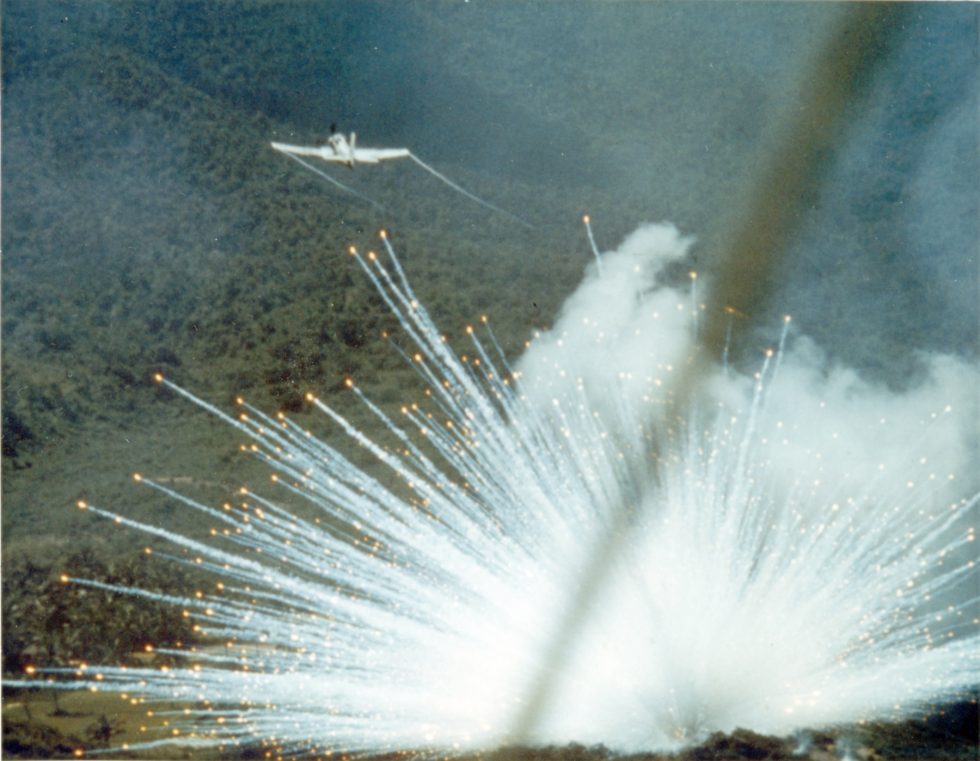
- What did substitute for guidance was marking: white phosphorus rockets and smoke put down by the Sandy lead so that fast movers, arriving at 800 km/h with fuel for one pass, knew exactly where to put their ordnance
Bombs
- Up to 3,629 kg (8,000 lb) of external stores across the fifteen stations, with 907 kg (2,000 lb) general-purpose bombs on the centreline and the two wing-root stations and 250 lb, 500 lb and 1,000 lb weapons distributed outboard
- Napalm and fire bombs — the Mk 77 and the BLU-1 and BLU-27 series — were the Skyraider’s signature close-support weapon in Korea, Algeria and Vietnam, delivered low and slow at the edge of a friendly perimeter where nothing faster could be trusted
- The Mk 13 aerial torpedo, carried on the centreline. On 1 May 1951 eight AD-4s of VA-195 and a detachment of VC-35 flew from USS Princeton with Mk 13s against the Hwacheon Dam, escorted by twelve Corsairs, after B-29s and a Tiny Tim rocket attack the previous day had failed. Seven of eight torpedoes hit and six detonated, destroying one sluice gate and damaging another. It was the last aerial torpedo attack in the history of warfare, and VA-195 has been the Dambusters ever since
- Nuclear special weapons on the AD-4B, which was built for the job with strengthened structure, a single heavy centreline carrier and a Low Altitude Bombing System for the toss delivery — run in at fifty feet, pull up, release on the way over the top and escape while the weapon flies on. A single-seat piston aeroplane as a strategic nuclear striker is one of the odder facts of the early 1950s, and 165 AD-4Bs were built for it with 28 more converted
- Cluster and incendiary stores in Southeast Asia: CBU-14 and CBU-25 dispensers, M47 white phosphorus, and by 1968 whatever the Nakhon Phanom armourers could hang on an aeroplane whose stations would take almost anything
Rockets
- 5 in HVAR — the wartime High Velocity Aircraft Rocket, universally called the Holy Moses — carried in rows on the outer wing stations and the standard Korean anti-vehicle and anti-bunker weapon
- 11.75 in Tiny Tim, a genuinely enormous rocket built around a 500 lb warhead, used against hardened targets. Skyraiders fired them at the Hwacheon Dam on 30 April 1951 and merely punctured a spillway gate, which is how the torpedo attack came to be flown the next day
- 2.75 in FFAR Mighty Mouse folding-fin rockets in LAU-3 nineteen-tube and LAU-32 seven-tube pods — the volume weapon of the Vietnam era, fired in ripples to suppress a treeline while a helicopter came in
- 5 in Zuni in LAU-10 four-tube pods, a heavier and far more accurate rocket than the FFAR and the Sandy pilot’s weapon of choice against a specific gun position
- White phosphorus marking rockets, carried on almost every rescue-escort sortie. Unglamorous, and probably the single most useful store the aeroplane ever hung
Pods & other stores
- SUU-11/A 7.62 mm minigun pods and Mk 4 HIPEG 20 mm gun pods, adding to an already heavy fixed battery when the mission was suppression rather than destruction
- Drop tanks: a 300 US gal centreline and two 150 US gal wing tanks, which is how a four-hour on-station time was actually achieved
- LUU-1 and LUU-2 parachute flares and Mk 24 flares for night interdiction and for lighting a survivor’s position — a routine and dangerous business, since the flare lit the Skyraider as well
- Mission kits rather than weapons on the AD-5 (A-1E): the wide fuselage took interchangeable packages that turned the aeroplane into a twelve-seat transport, a freighter, an air ambulance or a target tug in a few hours, the tug version becoming the UA-1E in 1962. Nothing else on a carrier deck could do that
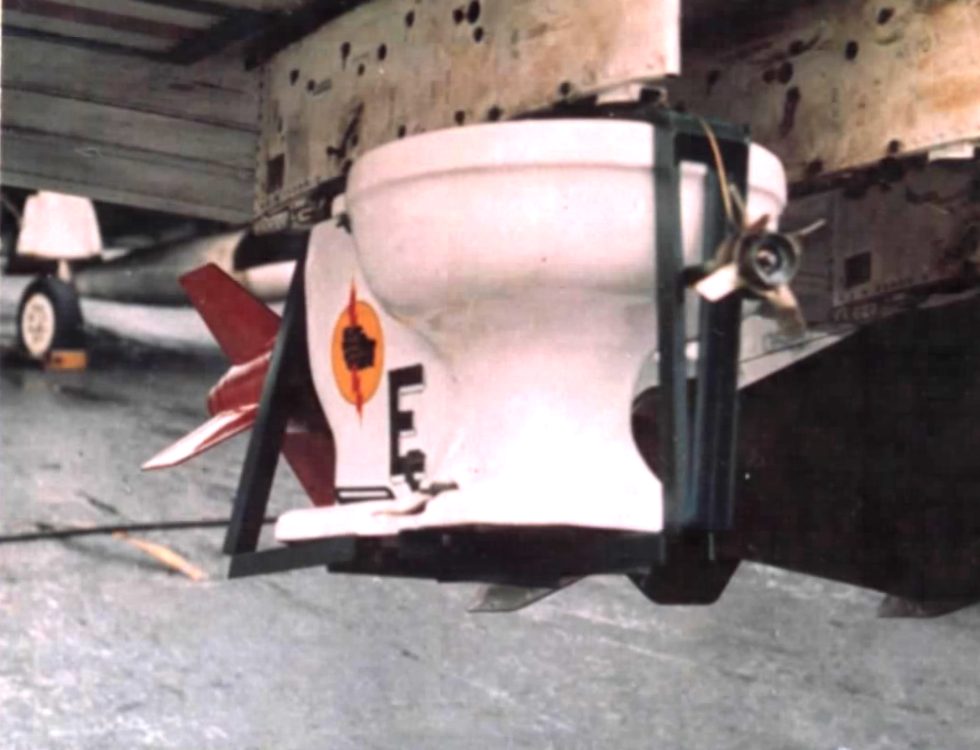
- And, in October 1965, a lavatory. Commander Clarence J. Stoddard of VA-25 hung a toilet on an A-1H to mark the six millionth pound of ordnance dropped by the air wing and released it over North Vietnam. In Chad, French-flown Skyraiders carried a man in the rear station dropping empty beer bottles, which whistle on the way down and were classed as non-lethal. Both stories are true, and both tell you what fifteen hardpoints and a spare seat invite
Three typical loadouts
- Sandy Low, rescue escort, northern Laos, 1968
- A-1H: 800 rounds of 20 mm; two LAU-3 nineteen-tube 2.75 in rocket pods; a LAU-10 pod of 5 in Zuni; four BLU-27 fire bombs; a rack of white phosphorus marking rockets; 300 US gal centreline tank retained throughout. The load is chosen for four hours over one man on a hillside, not for a target list — suppression, marking, and enough fire to keep a gun crew’s heads down while an HH-3E comes down the valley
- Deck strike and interdiction, Task Force 77, Korea, 1951
- AD-4: one 2,000 lb general-purpose bomb or a Mk 13 torpedo on the centreline; two 1,000 lb bombs on the wing-root stations; twelve 5 in HVAR outboard; 800 rounds of 20 mm; belly and side dive brakes used for the delivery. Launched from a straight-deck carrier in the Sea of Japan against bridges, marshalling yards and, on one famous morning, a dam
- Special weapon, Low Altitude Bombing System, Sixth Fleet, mid-1950s
- AD-4B: one nuclear store on the reinforced centreline carrier, two drop tanks, guns loaded, every other station empty. Ingress at wave-top height on a single-engined piston aeroplane, a timed pull-up, an over-the-shoulder release and a half-roll away — a one-way profile in all but name, flown by one man in a machine designed to drop iron bombs on tanks
Sourcing caveat: gun and stores fits are compiled from the standard published tables and squadron accounts, and they conflict constantly. Stores capacity in particular is quoted as 8,000 lb in Navy-era documents and as 10,500 lb in several modern references; both are defensible, since the second describes an overload trial and the first describes what was actually flown. Individual airframes were modified in the field throughout, and neither the French AD-4Ns nor the CIA-adjacent and VNAF aircraft were maintained to any published standard.
Variants
Douglas built one airframe eleven years running and turned it into a dive bomber, a night attacker, a radar picket, a jammer, a transport and a nuclear striker
The Skyraider began as a rescue. In June 1944 the Navy told Ed Heinemann that the Douglas BTD-1 Destroyer was to be cancelled; by Heinemann’s own account he, Leo Devlin and Gene Root worked through the night in a Washington hotel and presented a completely new design the following morning. Prototypes were ordered on 6 July 1944 as the XBT2D-1 and the first flew on 18 March 1945. The brief for this page describes the overnight design as following a change to the XBT2D-1 requirement; it is the other way round — the night of drawing is what produced the XBT2D-1 in the first place.
What followed was a masterclass in leaving a good airframe alone. Seven basic marks in eleven years, 3,180 aircraft, and the changes were almost all in equipment rather than in shape: more power in the AD-2 and AD-4, a stronger structure and better landing gear in the AD-3, a second and third crewman for night and radar work, a widened fuselage in the AD-5. Production ended in 1957. In September 1962 the tri-service redesignation swept the whole surviving fleet into the A-1 series, so that an AD-6 became an A-1H overnight and a great many published sources thereafter refer to the same aeroplane by two names on the same page.
There were no licence-built Skyraiders anywhere — the type was too closely tied to one plant and one engine, and the export story is instead one of second-hand transfers. The Royal Navy’s 50 AD-4Ws became the Skyraider AEW.1, the French Armée de l’Air’s 113 aircraft were rebuilt AD-4s and AD-4Ns known after 1962 as A-1Ds, and more than 350 went to the Republic of Vietnam Air Force. From France the aeroplanes went on again, to Cambodia in 1965, Gabon in 1972 and Chad in 1975.
- XBT2D-1 Dauntless II (1944–45, 25 prototypes)
- The overnight design, ordered 6 July 1944, first flown 18 March 1945 and too late for the war it was drawn for. The BT prefix — bomber-torpedo — was dropped when the Navy abandoned the category, and the aircraft became the AD.
- AD-1 and AD-1Q (1946–49, 242 and 35)
- First deliveries to VA-19A in December 1946 with the 2,500 hp R-3350-24W and two 20 mm cannon. The AD-1Q added a second seat and an electronic countermeasures operator, beginning a line of Skyraider jammers that ran for twenty years.
- AD-2 and AD-3 (1948–49, 156 and 125)
- The AD-2 introduced the R-3350-26W and more internal fuel; the AD-3 rebuilt the fuselage structure and the undercarriage after early-service cracking. Night-attack AD-3N and countermeasures AD-3Q sub-variants followed in small numbers.
- AD-3W and AD-4W airborne early warning (1949–52, 31 and 168)
- A vast ventral radome for the AN/APS-20 search radar, two operators in a windowless belly compartment and small auxiliary fins on the tailplane to cope with the radome’s side area. This is where carrier-borne airborne early warning began as a routine capability; 50 AD-4Ws went to the Royal Navy as the Skyraider AEW.1 with 849 Naval Air Squadron, flew from HMS Eagle and HMS Albion at Suez in 1956, were replaced by the Fairey Gannet AEW.3 in 1960 and retired in 1962. Fourteen of those then went to Sweden as civil target tugs with Svensk Flygtjänst until 1976.
- AD-4 and AD-4L (1949–53, 372)
- The definitive Korean War Skyraider: four 20 mm cannon at last, improved radar, a better windscreen and the R-3350-26WA. The AD-4L added de-icing and anti-icing equipment for the Korean winter. This is the mark that torpedoed the Hwacheon Dam.
- AD-4B (1952–54, 165 built plus 28 conversions)
- Structurally strengthened for nuclear special weapons, with a reinforced centreline carrier and Low Altitude Bombing System equipment for the toss delivery, and all four cannon retained. A single-seat propeller aeroplane in the strategic strike business, which lasted only as long as it took carrier jets to grow the range.
- AD-4N, AD-4NA and A-1D (1949–53, 307 built, 100 converted)
- Three-seat night and all-weather attack, with search radar and countermeasures gear and two operators below the pilot. A hundred were stripped back to single-seat day attack as the AD-4NA. Almost all the French aircraft came from this family: 20 AD-4s, 88 AD-4Ns and five AD-4NAs, rebuilt with French equipment and redesignated A-1D in 1962.
- AD-5 (A-1E) and the mission kits (1953–56, 212)
- The big change: a fuselage widened and lengthened for side-by-side seating, dive brakes deleted, and interchangeable kits that made the same airframe a twelve-seat transport, a freighter, an air ambulance or a target tug (UA-1E from 1962). The USAF flew A-1Es in Vietnam with one pilot and an empty right seat; Major Bernard Fisher landed one on the airstrip at A Shau on 10 March 1966 to pick up a downed pilot and was awarded the Medal of Honor for it.
- AD-5N (A-1G), AD-5W (EA-1E) and AD-5Q (EA-1F) (1954–57, 239, 218 and 54 conversions)
- The wide-body airframe in its specialist forms: four-seat night attack, three-seat airborne early warning with the APS-20, and a four-seat electronic warfare aircraft with a full jamming and intercept fit. The EA-1F outlasted every other Navy Skyraider mark in fleet service, flying from carriers into the late 1960s because nothing had yet replaced it.
- AD-6 (A-1H) and AD-7 (A-1J) (1955–57, 713 and 72)
- The last and best single-seat attack marks, and the most numerous. The AD-7 differed chiefly in a strengthened wing and undercarriage and the R-3350-26WB. These are the aircraft that flew Sandy for the USAF, shot down two MiG-17s for the Navy and served the VNAF until the end in April 1975.
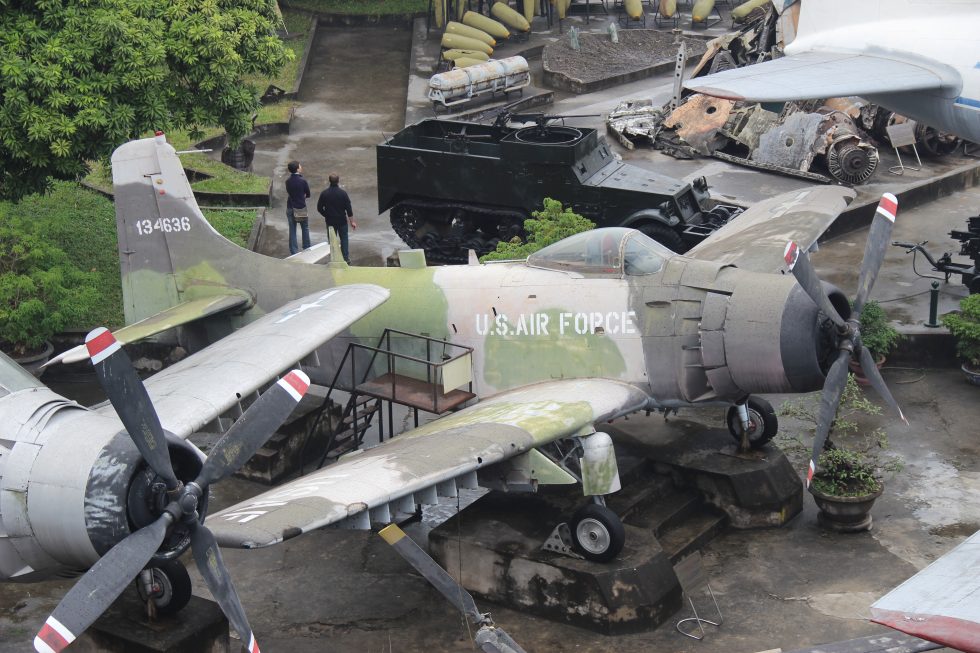
Survivors: something on the order of fifty Skyraiders survive worldwide, of which roughly a dozen are airworthy — a large population for a type with such a violent career, and one with an unusual property: every single survivor is an original Douglas airframe. No Skyraider reproduction exists and none is likely to, because nobody is going to build a new 18-cylinder Duplex-Cyclone. Airworthy examples cluster in the United States, with AD-1 09257 at the Warbird Heritage Foundation in Illinois, AD-4NA 126882 at the Lone Star Flight Museum and AD-4NA 126965 with the Heritage Flight Museum in Washington; AD-4NA 126922 flies in the United Kingdom with Kennet Aviation. On display: Bernard Fisher’s A-1E 52-132649 and, since 2022, VNAF A-1H 134600 at the National Museum of the USAF; AD-4W 127922 aboard USS Midway; three ex-Royal Navy AEW.1s in Sweden; five captured aircraft in Vietnam at Hanoi, Hué and Ho Chi Minh City; and an AD-7 at the Royal Thai Air Force Museum, one of the eleven that fled Vietnam in 1975. These totals should be read as indicative rather than exact: warbird registries, museum lists and the published survivor tables disagree with one another, restoration projects move between categories, and several airframes carry the identity of a different aircraft from the one on the data plate. The service span is the more solid number — first squadron delivery in December 1946, last combat sorties with the VNAF in April 1975, twenty-eight years, with French and African operators flying on into the later 1970s.
From WWII dive bomber to Vietnam legend
Designed overnight
Ed Heinemann and colleagues re-conceive the aircraft as the XBT2D-1 in a single night in a Washington hotel.
First flight
The prototype flies on 18 March, nearly four months ahead of schedule, with test pilot LaVerne Browne.
Enters Navy service
The aircraft joins the US Navy as the AD-1 Skyraider, a carrier-based single-seat attack plane.
The Hwacheon Dam
On 1 May, eight Skyraiders from USS Princeton torpedo the Hwacheon Dam — the last US Navy aerial torpedo attack.
Becomes the A-1
Under the new tri-service system the AD Skyraider is redesignated the A-1; the AD-6 becomes the A-1H.
Propeller downs a jet
On 20 June, two VA-25 Skyraiders from USS Midway shoot down a MiG-17 during a rescue patrol.
Medal of Honor
On 10 March, Major Bernard Fisher lands under fire in the A Shau Valley to rescue a downed pilot — the first USAF Medal of Honor of the war.
US retirement
The US Navy and Air Force withdraw the Skyraider; it flies on with South Vietnam, France, Gabon and others.
From the cockpit: twelve Skyraider stories
Designed overnight in a hotel
With the BTD-1 failing, Ed Heinemann re-drew the whole aircraft in one all-night session.
Read the full story
The Dambusters’ torpedo run
Eight Skyraiders from USS Princeton torpedoed the Hwacheon Dam — the last US Navy aerial torpedo attack.
Read the full story
A propeller plane kills a MiG
On 20 June 1965, two VA-25 Skyraiders downed a MiG-17 in a head-on gun pass.
Read the full story
The second MiG, from the Intrepid
On 9 October 1966, Lt William Patton of VA-176 out-turned four MiG-17s and shot one down.
Read the full story
The toilet bomb
A VA-25 crew mounted a scavenged toilet as a bomb to mark the air wing’s six-millionth pound of ordnance.
Read the full story
Bernard Fisher’s Medal of Honor
Major Fisher landed on a cratered, fire-swept strip to rescue a downed pilot, then flew out with 19 bullet holes.
Read the full story
More bombs than a B-17
The Skyraider hauled up to 8,000 lb of ordnance — a heavy-bomber load off one radial engine.
Read the full story
Home on a wing and a prayer
Air-cooled and heavily built, the Skyraider brought pilots home from damage that would have downed a jet.
Read the full story
The plane downed airmen prayed for
As “Sandy,” the Skyraider escorted rescue helicopters in to pull downed airmen out of enemy territory.
Read the full story
The Skyraider goes to war for France
France bought around 113 ex-US Navy Skyraiders and flew them hard in the Algerian War and across Africa.
Read the full story
Britain’s radar-picket Skyraider
The Royal Navy flew about 50 as the AEW.1 — a carrier airborne early-warning platform, not an attacker.
Read the full story
The warbird that won’t quit
Retired by the US around 1972, the Skyraider soldiered on abroad — and is a beloved airshow warbird today.
Read the full story
The Skyraider in pictures
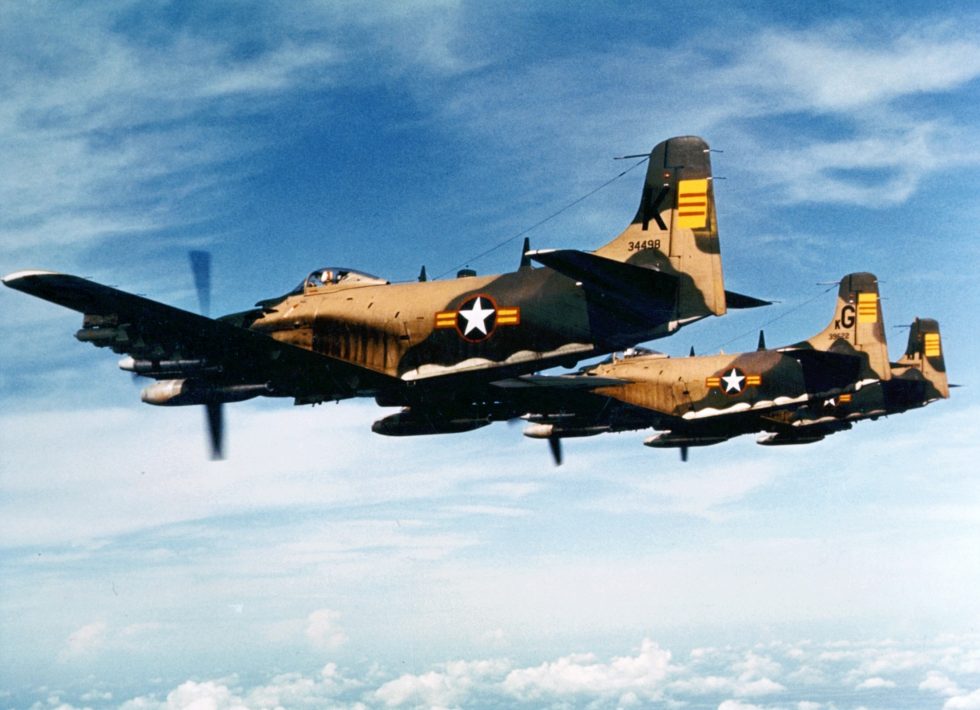
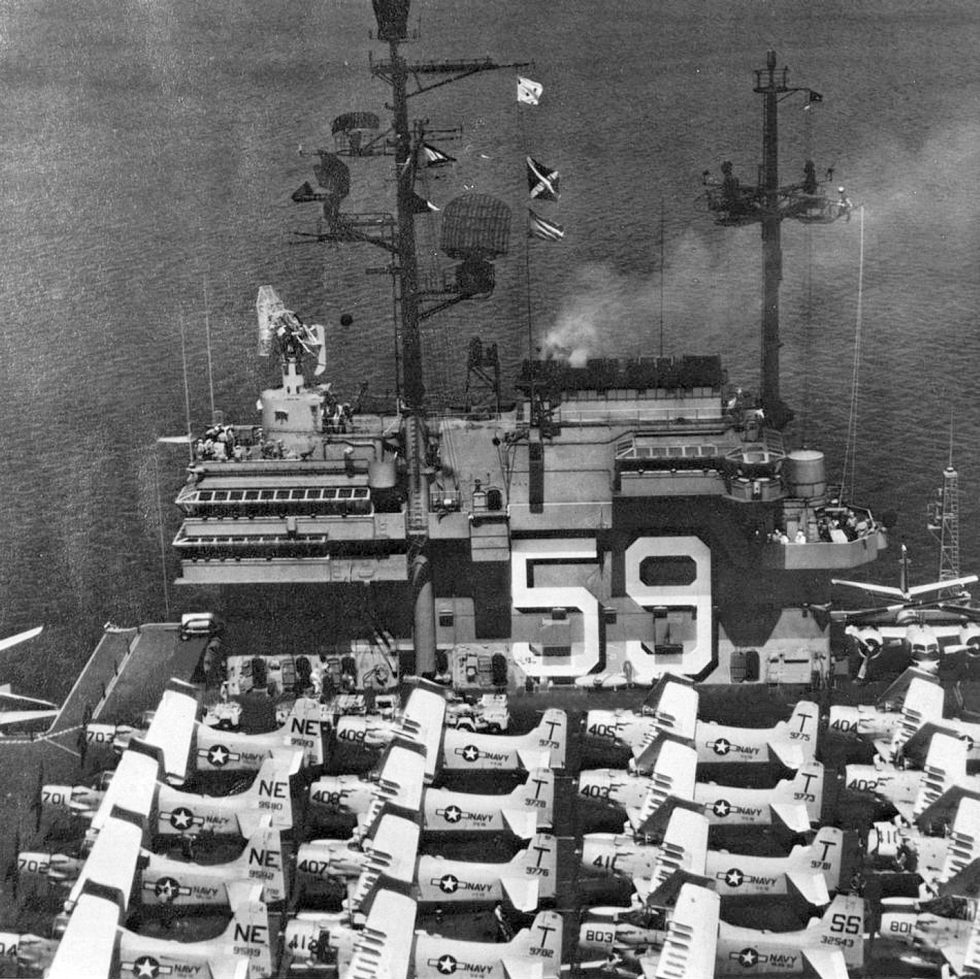
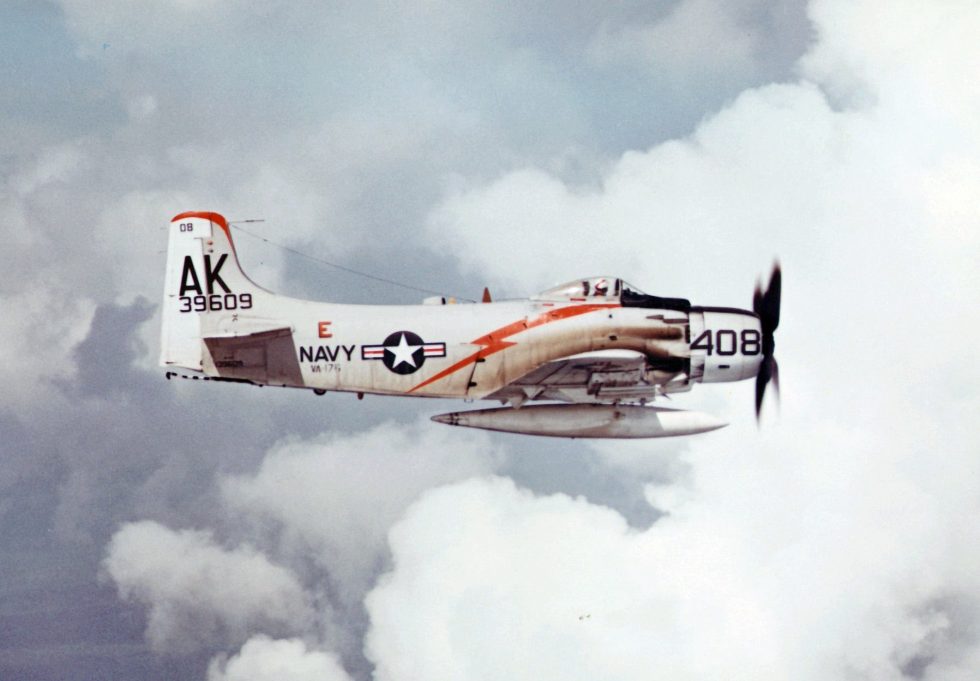
The Skyraider in motion
A hand-picked, high-authority documentary on the Douglas A-1 Skyraider is coming soon to this exhibit. In the meantime, explore the stories, photo gallery and operations map above and below.
Where the Skyraider flew
The score that defines it
The Skyraider’s record was written on the ground it protected and the airmen it brought home — but it also did something almost no other propeller plane of its era managed: it shot down jet fighters. Its combat legend rests on payload, endurance and courage rather than speed.
Compare the combat record of every military aircraft. Figures as of July 2026.
Everything people ask about the A-1 Skyraider
Can I fly in an A-1 Skyraider?
Why is the A-1 Skyraider called “Spad” and “Sandy”?
How could a propeller plane shoot down a jet?
How much ordnance could the A-1 Skyraider carry?
What was the Skyraider’s role in Vietnam?
Did the A-1 Skyraider serve in Korea?
Is the A-1 Skyraider still flying?
You can’t fly the Skyraider.
These, you can.
Some legends only live in museums — others are fuelled and waiting. MiGFlug has put civilians in real military jet cockpits since 2004.
 Fly the L-39 AlbatrosThe world’s most-flown jet trainer — aerobatics included
 Fly the F-104 Starfighter“The missile with a man in it”
 Fly the MiG-21The Cold War’s most-produced jet
 Fly the T-33 Shooting StarAmerica’s first jet trainer
 Fly the DH VampireA piece of early jet history
 Fly the S.211Agile Italian jet trainer
 Fly the MB-326The classic Aermacchi jet
 Fly the MiG-15The Soviet legend of the Korean War
Continue the tour
Every fact, checked
- Smithsonian National Air and Space Museum — Douglas A-1H (AD-6)Design origin, first flight, production numbers and the 1953 lift record.
- National Naval Aviation Museum — The Dambusters at Hwachon DamDefinitive account of the 1 May 1951 aerial torpedo attack.
- National Naval Aviation Museum — A-1H SkyraiderEngine, ruggedness and the 8,000 lb ordnance load versus a B-17.
- National Museum of the US Air Force — Douglas A-1E SkyraiderUSAF service, Bien Hoa deployment and the “Sandy” rescue role.
- National Museum of the USAF — Major Bernard FisherThe A Shau Valley rescue and first USAF Medal of Honor of Vietnam.
- The Aviationist — The Skyraider’s MiG-17 killsBoth 1965 and 1966 air-to-air victories, with the correct pilots and units.
- HistoryNet — Able Dog: the best attack bomber ever built?Design, nickname, ordnance and the type’s long service life.
- Navy Wings — Skyraider AEW.1The Royal Navy’s airborne early-warning Skyraider and its service.