
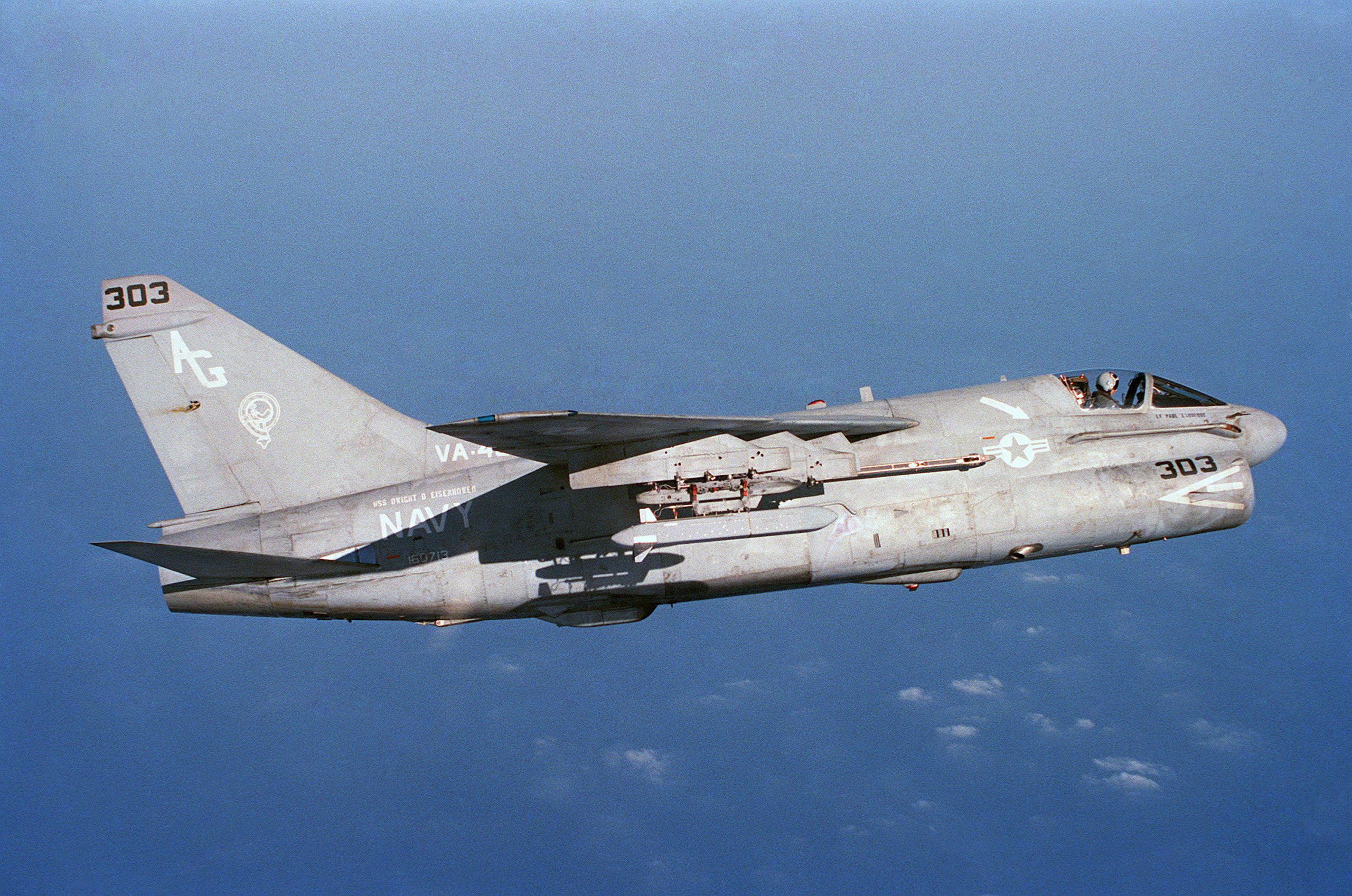
Vought A-7 Corsair II
“SLUF”
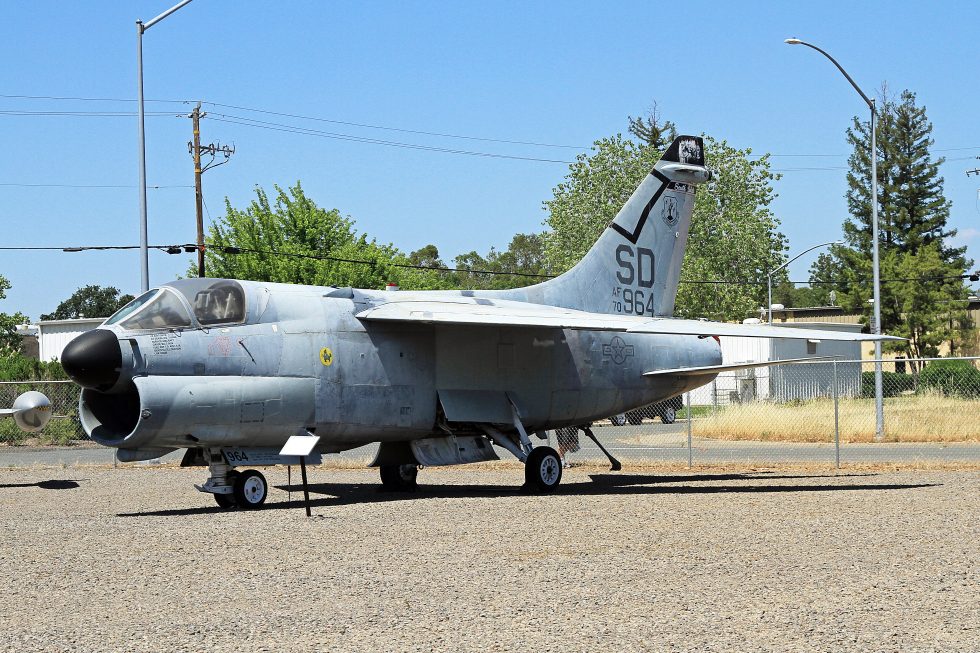
A stubby, subsonic light-attack jet cut down from the supersonic F-8 Crusader — the “Short Little Ugly Fellow” that traded speed for a huge bomb load, marathon range and the most accurate bombing system of its generation.
Built to hit the target, not break the sound barrier
In the early 1960s the U.S. Navy wanted something unfashionable: not a faster fighter, but a cheaper, harder-hitting bomb truck to replace the small A-4 Skyhawk. Its 1963 VAL (light attack) requirement asked for range and payload rather than supersonic dash, and it asked for it quickly and affordably. Ling-Temco-Vought (LTV / Vought) won by doing something clever — it took its own supersonic F-8 Crusader fighter, shortened the fuselage, deleted the afterburner, broadened the wing and rebuilt the whole aircraft around fuel and ordnance. The result first flew on 27 September 1965 and reached the fleet in 1967.
The trade was deliberate. Where the Crusader chased Mach 1.8, the A-7 topped out just below the speed of sound — and in exchange it could carry up to about 15,000 lb (6,800 kg) of bombs on eight hardpoints and loiter for hours on a single, fuel-sipping non-afterburning turbofan. Crews took one look at the short, blunt shape and named it the “SLUF” — Short Little Ugly Fellow (the polite version). The nickname stuck, and so did their affection for it.
What made the A-7 genuinely revolutionary was hidden inside. The definitive A-7D (Air Force) and A-7E (Navy) carried an integrated digital navigation/attack computer, inertial navigation, a projected moving-map display and one of the first production head-up displays (HUD). Together they computed a continuously updated bomb-impact point, giving the SLUF bombing accuracy that pilots reckoned two to three times better than contemporaries — precision strike a full generation before it became routine.
It went to war almost immediately — over Vietnam from December 1967 with the Navy, and from 1972 with the Air Force — and then kept going: the 1986 raid on Libya, Grenada in 1983, and finally Operation Desert Storm in 1991, its last U.S. combat. Long after America retired it, the SLUF soldiered on abroad. Greece flew the world’s very last Corsair IIs until 17 October 2014.
01The A-7 Corsair II’s origins: how Vought turned a supersonic fighter into the Navy’s best bomber
The A-7 shares its DNA with the Vought F-8 Crusader, but it is not simply a Crusader with bombs. To meet the Navy’s VAL specification, Vought kept the F-8’s rugged carrier structure and general layout while shortening the fuselage, fitting a broader, thicker wing for low-speed lift and heavy loads, enlarging the internal fuel, and removing the afterburner entirely. The famous variable-incidence wing of the Crusader was retained in spirit but the airframe was optimised for stability at bombing speeds rather than agility.
Because so much was carried over from a proven design, Vought delivered a flying prototype barely 18 months after contract award — fast and cheap by any standard. That pragmatism defined the whole programme: the A-7 was never the most glamorous jet on the carrier deck, but it was reliable, easy to maintain, endlessly upgradable, and it hit what it aimed at.
What makes it special
A digital brain and a HUD, years ahead
The A-7D/E paired an IBM digital nav/attack computer with inertial navigation, Doppler radar, a projected moving map and an early head-up display. It continuously computed the bomb-impact point and drew it on the HUD, so a pilot flew the target rather than guessing. Veterans describe accuracy two to three times better than other jets of the day — precision bombing before the phrase existed.
Bomb truck range on one thrifty turbofan
A single non-afterburning Allison TF41 turbofan — a U.S. licence-built Rolls-Royce Spey — gave the SLUF excellent fuel economy. That meant three-hour-plus missions, long loiter over the battlefield and a large ordnance load on one engine. One preserved A-7D flew a documented nine-hour rescue-support sortie over Southeast Asia in 1972.
Crusader-tough, carrier-hardened
Built on F-8 Crusader heritage, the A-7 was a stout, dependable carrier aircraft — strong landing gear, a robust structure and, in fleet service, excellent up-time. Its digital architecture also let the Navy and Air Force keep upgrading avionics and weapons across a service life stretching more than 25 years in U.S. hands and nearly 50 worldwide.
02The A-7 Corsair II’s nav/attack system: why the “A-7 mafia” loved it
Pilots who flew the A-7D/E often called its bombing system the finest of its era, and spoke of themselves as an “A-7 mafia” loyal to the type. The reason was the integrated nav/attack suite: an onboard digital computer fused inertial and Doppler navigation with radar ranging and projected it all through the HUD as a single, continuously updated aiming solution. Where other attack pilots relied on fixed sight settings and practised dive angles, the SLUF pilot could roll in from varied geometry and still put iron on target. One former Navy aviator likened the moving-map display to “Google Maps before there was Google Maps.”
03The A-7 Corsair II’s engine: a British Spey at the heart of an American attack jet
The A-7A and A-7B used the Pratt & Whitney TF30, but the definitive A-7D and A-7E switched to the Allison TF41 — an American licence-built version of the British Rolls-Royce Spey turbofan. It was an unusual pedigree for a frontline U.S. combat aircraft, and it paid off: the non-afterburning turbofan delivered roughly 14,250–15,000 lbf of thrust with excellent specific fuel consumption, the quality that gave the SLUF its trademark range and loiter. Thrust figures vary between museum and reference sources, so treat the exact number as approximate.
Full specifications
Baseline note: the figures below describe the A-7E, the definitive US Navy model — Allison TF41 turbofan, M61A1 rotary cannon and the full AN/ASN-91 navigation and weapon delivery suite — of which 529 were built and which flew the type’s last combat missions in Desert Storm. Deltas for the TF30-powered A-7A and A-7B, the USAF A-7D and the Greek A-7H are in grey. One point of housekeeping: the A-7 is not a cut-down F-8 Crusader. It borrows the Crusader’s configuration and a good deal of its manufacturing knowledge, but according to Gunston and Gilchrist the two aircraft share no common structure at all, and the A-7 has a shorter, broader fuselage, a bigger and less swept wing, and none of the F-8’s variable-incidence mechanism.
Dimensions & weights
- Crew
- 1 (TA-7C, A-7K, TA-7H and TA-7P: 2 in tandem, all of them fully combat-capable rather than trainers only)
- Length
- 14.06 m (46 ft 2 in) — about 2.4 m shorter than the F-8 Crusader it descends from
- Wingspan
- 11.80 m (38 ft 9 in), folding to 7.24 m (23 ft 9 in) for the carrier deck. The Greek A-7H kept the folding wing but lost the air-refuelling probe
- Height
- 4.90 m (16 ft 1 in)
- Wing area
- 34.83 m² (375 sq ft) — larger and less swept than the Crusader’s, with a fixed leading edge and a dog-tooth discontinuity, large inboard slotted flaps and conventional outboard ailerons
- Aerofoil
- NACA 65A007 at root and tip — a thin section, but on a wing sized for load and endurance rather than speed
- Empty weight
- 8,676 kg (19,130 lb)
- Maximum take-off weight
- 19,050 kg (42,000 lb) in the overload condition. A-7A units routinely operated about 1,800 kg (4,000 lb) below the A-7E’s rated maximum because the TF30 simply would not carry it off a hot deck
- Internal fuel
- ~5,065 litres (~1,338 US gal; ~1,114 imp gal), 3,945 kg (8,697 lb)
- External fuel
- Up to 4 × 300, 330 or 370 US gal drop tanks on the four plumbed pylons, and frequently a buddy refuelling store as well — A-7Es tanked other aircraft routinely, including throughout Desert Storm
- Hardpoints
- 6 underwing pylons plus 2 fuselage cheek stations. The cheek stations take Sidewinders, an ECM pod or the FLIR pod and nothing heavy; all the ordnance goes under the wing
- Maximum external load
- ~6,800 kg (~15,000 lb) as a structural figure. In practice it is bounded by maximum take-off weight, so the full load can only be carried with internal fuel greatly reduced — which is exactly the trade every A-7 mission planner actually made
- Wing loading
- 378 kg/m² (77.4 lb/sq ft)
Performance
- Maximum speed
- 1,111 km/h (690 mph; 600 kn) clean at sea level. There is no afterburner and no supersonic dash: the A-7 is subsonic by deliberate choice, and that choice is the entire design
- Speed with a war load
- 1,041 km/h (647 mph; 562 kn) at 1,525 m with twelve Mk 82 bombs aboard, rising to 1,102 km/h (685 mph; 595 kn) once they are gone. The gap between the two is small, which is the point of a big wing and a turbofan
- Combat radius, strike
- ~1,430 km (~890 mi; ~772 nmi) hi-lo-lo-hi with six Mk 82 Snakeye and three 300 gal tanks, 185 km of the run in and out flown at sea level
- Combat radius, unrefuelled
- ~800 km (~497 mi; ~432 nmi) on internal fuel alone with twelve Mk 81, 370 km of it at sea level. A nuclear profile with one Mk 43 and three tanks stretched to ~1,696 km (~916 nmi)
- Range
- 1,981 km (1,231 mi; 1,070 nmi) on maximum internal fuel
- Ferry range
- 2,485 km (1,544 mi; 1,342 nmi) with maximum internal and external fuel
- Service ceiling
- 12,800 m (42,000 ft)
- Rate of climb
- 76.2 m/s (15,000 ft/min)
- Sustained turn
- 1,615 m (5,300 ft) radius at 4.3 g and 926 km/h (575 mph; 500 kn) at 13,050 kg (28,765 lb). The aircraft was genuinely manoeuvrable, whatever the jokes said; what it lacked was acceleration, and in a fight that is the thing you cannot do without
- Take-off run
- 1,705 m (5,595 ft) at 19,050 kg from a runway. In Vietnamese heat and humidity a fully armed A-7A off a maximum-weight runway often needed a deliberate low transition, held in ground effect while the gear came up and flown for up to 16 km at treetop height before it had the speed to raise flaps
- Fuel consumption
- 1,520 kg/h (3,350 lb/h) for an A-7D carrying twelve 500 lb bombs at 772 km/h and 10,050 m. Roughly 14 kg per minute during a carrier recovery against more than 45 kg per minute for a Phantom, and a specific fuel consumption about one sixth that of an F-100 Super Sabre at equivalent thrust. This is what the Navy bought when it chose a turbofan and no afterburner
- Thrust-to-weight
- 0.50 at full internal fuel with no stores
Propulsion & systems
- Engine
- 1 × Allison TF41-A-2, a non-afterburning turbofan built under licence from the Rolls-Royce Spey. The A-7D used the TF41-A-1; the A-7A used a Pratt & Whitney TF30-P-6 and the A-7B a TF30-P-8, later a TF30-P-408. Buying a British engine for an American attack aircraft caused political trouble on both sides of the Atlantic, and was worth it
- Thrust
- 66.7 kN (15,000 lbf) for the TF41-A-2. A-7D TF41-A-1: 63.4 kN (14,250 lbf) — some sources give 64.5 kN (14,500 lbf) and the discrepancy is not resolved. A-7A TF30-P-6: 50.5 kN (11,350 lbf). A-7B TF30-P-8: 54.2 kN (12,190 lbf), rising to 59.6 kN (13,390 lbf) with the TF30-P-408 retrofit from 1971. The TF41 also cured the severe compressor stalls that plagued the TF30 aircraft
- Intake
- A simple, unswept nose inlet inherited conceptually from the F-8, sitting under the radome. It is famously and permanently hazardous to deck crew, and no amount of striping around the lip ever changed that
- Weapon delivery computer
- AN/ASN-91(V) navigation and weapon delivery computer, built by IBM — the reason this aircraft exists in the form it does. It takes inertial position from the AN/ASN-90(V) platform, Doppler drift from the AN/APN-190(V), ranging from the radar and air data from the CP-953A/AJQ, and computes a continuously updated release solution. The effect on accuracy was step-change rather than incremental: an A-7D or A-7E could release from a stand-off distance and a slant range that a faster aircraft could not use, and the USAF flew 12,928 A-7D combat sorties in Southeast Asia for six losses, the lowest rate of any US fighter in the theatre, while dropping more bombs per sortie with greater accuracy than any other American attack aircraft
- Head-up display
- AN/AVQ-7(V) by Marconi-Elliott — the first head-up display fitted to an American production aircraft, and the ancestor of every combat HUD since. It put the flight path marker, the continuously computed impact point and the release cue in the pilot’s line of sight, so weapon delivery stopped being an act of memory and interpolation. The common claim that it was the world’s first production HUD is not right: the Blackburn Buccaneer’s Strike Sight, flown from 1958 and in Fleet Air Arm service from 1962, got there first. The A-7’s claim is the more useful one — it was the first HUD tied to a digital weapon-aiming computer in large-scale service
- Radar
- AN/APQ-126(V) multimode terrain-following and ground-mapping radar, integrated into the ILAAS digital navigation system, feeding ranging data straight to the delivery computer. The A-7A carried a far cruder fit: an AN/APN-153 navigation radar, an AN/APQ-115 terrain-following set and a separate AN/APQ-99 attack radar, three boxes doing badly what one later did well
- Navigation and displays
- AN/ASN-99 Projected Map Display slaved to the inertial platform, showing aircraft position over a real chart below the radar scope — in 1968. The all-axis autopilot would fly the aircraft hands-off to nine waypoints, and the inertial set accepted flyover, radar and TACAN updates to trim its drift. With the approach power compensator and the carrier datalink it would also fly a hands-off deck landing, which in 1968 was close to science fiction
- Defensive systems
- Radar warning receivers of the AN/ALR-45 and AN/ALR-50 family, AN/ALE-29 and later AN/ALE-39 chaff and flare dispensers, and a jamming pod — typically an AN/ALQ-126 on the Navy aircraft, AN/ALQ-119 or AN/ALQ-131 on the Air Force ones — carried on a cheek station. Fits changed repeatedly across 25 years and by operator; treat any single list as a snapshot
- Escape system
- Escapac rocket-assisted zero-zero ejection seat
- Refuelling
- Retractable probe on the starboard side for Navy probe-and-drogue. From the seventeenth A-7D the Air Force substituted a boom receptacle on the spine, offset to port. The Greek A-7H had neither
- First flight
- 26 September 1965 for the A-7A, at Dallas. YA-7D with a TF30 on 6 April 1968; the first Spey-powered A-7D on 26 September 1968, three years to the day after the first Corsair II flew
- Service entry
- 1 February 1967 with the US Navy; VA-147 took the type to Vietnam aboard USS Ranger before the year was out. USAF A-7D service from 1970 with the 57th Fighter Weapons Wing; combat from Korat in September 1972
- Number built
- 1,545 new-build airframes, 1965–1984 (199 A-7A, 196 A-7B, 67 A-7C, 459 A-7D, 529 A-7E, 60 A-7H, 5 TA-7H, 30 A-7K), plus around 110 two-seat and Portuguese conversions from existing airframes. At peak the Dallas plant employed 35,000 people and delivered one aircraft a day
- Cost
- ~US$2.9 million flyaway per aircraft in early-1970s dollars, of the order of US$22 million in 2025 money. This is the figure most commonly attached to the A-7D and it should be treated as an order of magnitude rather than an audited number; contemporary programme accounting rarely separated airframe, engine and avionics cleanly, and the A-7’s whole justification was that it was cheap next to a supersonic alternative
04The A-7 Corsair II’s operating costs: what the SLUF actually cost to fly
The A-7 was procured as an affordable attack aircraft, and a late-1960s flyaway price is commonly cited around US$2.6–2.9 million — but that figure is approximate and varies by variant, year and how support costs are counted, so treat it as an order-of-magnitude guide rather than a hard number. No credible cost-per-flight-hour figure for the type appears in authoritative public sources, so we do not quote one. What is well documented is the operating philosophy: a single efficient turbofan and simple, robust systems made the SLUF relatively cheap to fly and maintain compared with twin-engine strike aircraft of its era.
Armament & payload
The A-7 traded speed for bombs and then spent the difference on a computer that could aim them
In December 1962 the US Navy’s Sea-Based Air Strike Forces study worked through 144 notional aircraft and reached a conclusion the era found faintly heretical: for the attack mission a subsonic aeroplane beats a supersonic one. Drop the dash speed and the airframe gets smaller, simpler, cheaper and quicker to develop, you can buy more of them, and you can hang more under them. The resulting VAL requirement of May 1963 put its emphasis not on performance but on accurate delivery, on the grounds that hitting the target first time is the cheapest ordnance policy there is.
Vought won it with a shortened, broadened F-8 and eight hardpoints. What made the aircraft historically important, though, is what went in the nose. The AN/ASN-91 weapon delivery computer, the AN/APQ-126 radar, the inertial platform and the AN/AVQ-7 head-up display together gave a 1968 attack aircraft bombing accuracy that nothing before it approached, and they did it while burning a sixth of the fuel of an F-100. That combination is why the A-7D flew 12,928 sorties over Southeast Asia for six losses, and why it put more ordnance on Hanoi than anything except the B-52.
The load-out list below is long because the A-7 outlived four generations of weapons and carried all of them, from iron bombs in 1967 to HARM in 1986 and Paveway in 1991. Clearances differ sharply between the A-7A/B, the A-7D, the A-7E and the export A-7H and A-7P, and by period within each; nuclear and some electronic-warfare fits were never fully described in public. Treat what follows as the documented span of the type rather than the manifest of any one aeroplane.
Gun
- 1 × M61A1 Vulcan 20 mm rotary cannon with 1,030 rounds, on the A-7D, A-7E, A-7H, A-7K and the rebuilt A-7P. Roughly 6,000 rounds per minute, and enough ammunition for about ten seconds of it.
- A-7A and A-7B: 2 × Colt Mk 12 20 mm cannon, single-barrelled, with 250 rounds per gun. Slower-firing, less reliable and far less dense on target; replacing them with the Vulcan was one of the USAF’s better contributions to a Navy design.
- The gun sits low on the port side of the forward fuselage. Its aiming solution comes from the same AN/ASN-91 computer that handles the bombs, displayed on the HUD, which is why A-7 strafing was unusually accurate for the period.
- In the Panama operation of December 1989, two Air National Guard A-7D squadrons on a Coronet Cove rotation flew 34 combat sorties and expended 2,715 rounds — a reminder that the gun stayed in use to the very end of the type’s American service.
Air-to-air
- 2 × AIM-9 Sidewinder on the two fuselage cheek stations, which exist for this purpose and take nothing heavy. That is the entire air-to-air fit.
- There is no radar-guided missile capability, no air-intercept radar and no meaningful beyond-visual-range function. The AN/APQ-126 is a ground-mapping and terrain-following set.
- The Sidewinders are for self-defence on the way home, not for fighting. No A-7 is credited with an air-to-air kill in any service.
- Pilots put it best themselves: the Corsair "is not very fast, but it sure is slow". For dissimilar air combat training and for the Blue Angels the Navy kept the nimbler A-4 Skyhawk, and the Marine Corps rejected the A-7 outright in favour of the AV-8 Harrier.
Air-to-surface guided
- AGM-45 Shrike anti-radiation missile — the original Iron Hand weapon, carried from the Vietnam era and still in use over Libya in 1986.
- AGM-88 HARM — and this is a genuine first: A-7Es from USS Saratoga fired the first HARMs ever used in combat on 24 March 1986 against Libyan SA-5 sites in the Gulf of Sidra, and again the next day and in Operation El Dorado Canyon the following month.
- AGM-62 Walleye television-guided glide bomb and GBU-8 HOBOS electro-optically guided bomb. On 6 October 1972 four A-7Cs of VA-82 put 3,600 kg of Walleye and Mk 84 into the Thanh Hoa Bridge, broke the span and had it removed from the target list — a bridge that had absorbed hundreds of sorties since 1965.
- AGM-65 Maverick from the mid-1970s, and Paveway laser-guided bombs, which the surviving A-7E squadrons used over Iraq in 1991.
- Two per station on the wing pylons for most of these, and the delivery solutions ran through the same computer and HUD as everything else.
Bombs
- Up to 30 × Mk 82 500 lb or other Mk 80 series general-purpose bombs, including retarded Snakeye tails for low-level release, plus 3 kg and 14 kg practice bombs. The realistic loads were twelve to eighteen; thirty is a structural number rather than an operational one.
- Mk 20 Rockeye and other cluster munitions, used extensively in Vietnam and in the Kuwait kill boxes in 1991.
- Up to 4 × B28, B43, B57, B61 or B83 nuclear bombs. The single-weapon nuclear strike profile with three drop tanks was one of the mission radii the aircraft was formally specified against, at ~916 nmi.
- The A-7 could carry double an A-4E’s bombload, or the same load twice as far. That comparison, demonstrated publicly at the roll-out in November 1965, is the whole sales pitch of the aircraft in one line.
- Accuracy, not tonnage, is what the crews valued. The delivery computer let an A-7 release from stand-off ranges and unusual profiles and still hit, which is exactly what the 1962 study had asked for.
Rockets
- 4 × LAU-10 pods, each with four 127 mm Zuni unguided rockets — the heavy rocket of the period, used for close air support and for suppressing gun positions.
- 2.75 in (70 mm) Hydra 70 / FFAR pods of the LAU-61 and LAU-68 families for lighter area work.
- Rockets were central to the Sandy mission the A-7D inherited from the A-1 Skyraider in 1972: escorting rescue helicopters and beating down whatever was shooting at a downed pilot.
- Major Colin Clarke won the Air Force Cross leading one of those, an 8.8-hour rescue near Thanh Hoa on 18 November 1972, taking repeated 12.7 mm hits. His aircraft, 70-0970, is in the National Museum of the USAF.
Pods & other stores
- FLIR pod on a cheek station of the later A-7E, feeding an infrared picture to the head-up display and giving the aircraft a genuine night attack capability — the last major capability the type gained.
- ECM pods: AN/ALQ-126 on Navy aircraft, AN/ALQ-119 and AN/ALQ-131 on Air Force ones, with AN/ALE-29 or AN/ALE-39 dispensers built in.
- Buddy refuelling store plus drop tanks. A-7Es tanked other aircraft as a matter of routine, and did a great deal of it in Desert Storm; a strike aircraft that can give away fuel is telling you something about its own efficiency.
- Drop tanks of 300, 330 or 370 US gal on the four plumbed pylons, for ferry, extended radius or loiter.
- Nothing else is carried. There is no internal bay, no gun pod, no conformal tankage and no reconnaissance pod in general service.
Three typical loadouts
- Alpha strike, North Vietnam (A-7E, VA-146 and VA-147 off USS America, 1970–72)
- Twelve Mk 82 or a pair of AGM-62 Walleye, two 300 gal tanks, two AIM-9 on the cheeks, full Vulcan magazine. Ingress low, release computed by the AN/ASN-91 and cued on the HUD, egress high. This is the fit that mined Haiphong harbour and flew Linebacker I and II.
- Iron Hand and SEAD, Gulf of Sidra (A-7E, VA-72 and VA-46 off USS Saratoga and USS America, March–April 1986)
- Two AGM-88 HARM or AGM-45 Shrike, ECM pod on one cheek, Sidewinder on the other, two tanks. On 24 March 1986 this loadout put the first HARM ever fired in anger into a Libyan SA-5 site, and the same aircraft repeated it over Benghazi and Tripoli three weeks later in El Dorado Canyon.
- Deep interdiction, Iraq (A-7E, VA-46 and VA-72 off USS John F. Kennedy, January–February 1991)
- Paveway laser-guided bombs or Walleye, HARM for the defences, tanks, and often a buddy store instead of a weapon. Day and night against heavily defended targets across Iraq and into the Kuwait kill boxes. These two squadrons, the last A-7s in the fleet, flew the type’s final combat sorties and retired three months later.
Sourcing caveat: weapon clearances follow the A-7E Standard Aircraft Characteristics issued by Naval Air Systems Command in April 1972, Jane’s All the World’s Aircraft 1982–83 and the standard operational histories. Nuclear loadings are as published and were never routinely carried. Sortie and loss figures for Southeast Asia are the USAF and USN official totals; the frequently repeated claim that the A-7D had the lowest loss rate of any US fighter in the theatre rests on those same official counts and on a fairly narrow definition of "fighter".
Variants
Vought built five American Corsair IIs, three export models and one Swiss proposal that never flew
The A-7 improved in one direction throughout its life: more thrust, then better avionics, then both. The A-7A of 1965 was underpowered and equipped with three separate radars doing one job badly. The A-7D of 1968 fixed the engine, the gun and the electronics in a single step at the Air Force’s insistence, and the Navy was impressed enough to buy the Air Force’s engine back for its own A-7E. Everything after that is refinement and export.
Two oddities are worth knowing. The A-7 spent eight years as a deliberate deception: from 1981 to 1989 the 4450th Tactical Group flew about twenty A-7Ds and A-7Ks from Nellis and Tonopah as a surrogate trainer and chase aircraft for the F-117, and left them parked outside the hangars in daylight precisely so that Soviet satellites would photograph something boring. And the type came within an inch of Swiss service: the A-7G was offered to Switzerland and never built.
- A-7A (first flight 26 September 1965; 199 built)
- The original: TF30-P-6, twin Colt Mk 12 cannon, three separate radars. Underpowered, especially hot and heavy, and flown 1,800 kg below what the airframe could take. First combat deployment aboard USS Ranger in late 1967.
- A-7B (1968; 196 built)
- TF30-P-8 at 54.2 kN, later retrofitted from 1971 with the TF30-P-408 at 59.6 kN, and an AN/APQ-116 terrain-following set. A stopgap: the Navy cancelled 257 of them in 1967 once the A-7E was in prospect.
- A-7C (1968–69; 67 built)
- A-7Es in everything but the engine. TF41 deliveries slipped, so the first 67 aircraft came with TF30-P-8s, kept all the new avionics and the Vulcan, and were redesignated after delivery. They fought: it was A-7Cs of VA-82 that finally dropped the Thanh Hoa Bridge.
- A-7D (first Spey-powered flight 26 September 1968; 459 built)
- The Air Force model, and the one that made the type. TF41-A-1, M61A1 Vulcan, AN/APQ-126 radar, AN/AVQ-7 head-up display and the AN/ASN-91 delivery computer. Boom refuelling from the seventeenth aircraft. Passed to the Air National Guard from 1974.
- A-7E (1969; 529 built)
- The A-7D navalised: TF41-A-2, folding wings, arrester hook, AN/APN-190 Doppler and AN/APQ-128. The most-built variant and the one that flew Vietnam, Grenada, Lebanon, Libya, Eagle Claw and Desert Storm.
- TA-7C, A-7K and EA-7L (60 conversions, 30 built, 8 conversions)
- Two-seaters, all fully combat-capable. The TA-7C came from A-7Bs and A-7Cs; 49 were re-engined with TF41-A-402s to A-7E standard in 1984. The A-7K was new-build for the Air National Guard. The EA-7L served with VAQ-34 at Point Mugu as an electronic aggressor, flown by a pilot and a naval flight officer.
- A-7H and TA-7H (Greece; 60 and 5 built, ordered 1974, delivered from 1975)
- A-7E without air-refuelling capability, for 347, 340 and 345 Squadrons of the Hellenic Air Force. Greece later took 62 surplus A-7Es and 19 TA-7Cs in 1993 for 335 and 336 Squadrons, and became the type’s final operator.
- A-7P and TA-7P (Portugal; 44 and 6 conversions, in service 1981)
- Ex-US Navy A-7As rebuilt with TF30-P-408 engines and an avionics fit close to the A-7E. Phased out from 1994 as F-16A Block 15s arrived; the last unit stood down in 1999.
- A-7G (proposed for Switzerland; none built)
- Vought offered a Corsair II to the Swiss Air Force under this designation. Nothing was ordered, nothing was built, and no A-7 has ever worn Swiss markings.
- YA-7F Strikefighter (1989; 2 prototypes)
- The last attempt: a stretched, afterburning A-7 with an F100 turbofan, optimised for interdiction and genuinely supersonic. It flew well and was cancelled — by then the Air Force wanted F-16s and the Navy wanted Hornets, and the whole point of the A-7 had been not to have an afterburner.
Closing note, with the retirement chronology, since there is no operator chart on this page: the A-7 is fully retired everywhere and has been for over a decade. United States Air Force: active-duty A-7Ds began moving to the Air National Guard in 1974; the last active USAF operator was the 4450th Tactical Group, whose F-117 surrogate aircraft went to AMARC in January 1989. United States Navy: phase-out began in the mid-1980s as the F/A-18 arrived, and the last two fleet squadrons, VA-46 and VA-72, retired their A-7Es in May 1991, weeks after flying the type’s final combat missions from USS John F. Kennedy in Desert Storm. Notably the USAF kept its A-7s at home for that war and sent A-10s instead. Air National Guard: 1993, the last aircraft going from Rickenbacker in Ohio, Des Moines in Iowa, Tulsa in Oklahoma and Springfield in Ohio, replaced by F-16s; ANG Corsairs had flown combat over Panama in December 1989. Portugal: 1999, after eighteen years. Thailand: ex-US Navy A-7Es and TA-7Cs delivered to the Royal Thai Navy in 1995 have been non-operational since 2007. Greece: the last A-7Es were withdrawn from 336 Bomber Squadron in October 2014, making the Hellenic Air Force the final operator of the type anywhere and closing a service career of 49 years. By the end of 1998 every American airframe not preserved as a static display had been disposed of through AMARC. A great many survive in museums and on base gate guards across the United States, Greece and Portugal.
From Vietnam bomb truck to the last Corsair aloft
The VAL requirement
The U.S. Navy issues its light-attack (VAL) specification for a cheap, high-payload A-4 replacement; Vought/LTV wins with an F-8-derived design and is awarded the contract in early 1964.
First flight
The prototype A-7A flies on 27 September 1965, barely 18 months after contract award.
Combat debut
Squadron VA-147 deploys aboard USS Ranger; the A-7 flies its first Vietnam combat missions in December 1967.
The Air Force joins
The A-7D first flies (April) with the new Allison TF41 turbofan and the definitive digital nav/attack system.
Peak Vietnam use
The A-7E enters combat with the Navy (1970); during Operation Linebacker (1972) the type flies a large share of Navy strike sorties, and USAF A-7Ds fight from Thailand.
El Dorado Canyon
A-7Es from USS America fire Shrike anti-radiation missiles to suppress Libyan air defences in the 14–15 April raid.
Desert Storm swan song
VA-46 and VA-72 fly the A-7E’s last U.S. combat from USS John F. Kennedy — hundreds of missions, no A-7 lost. The squadrons stand down that June.
The last Corsair II
The Hellenic Air Force retires the world’s final A-7s on 17 October 2014, ending nearly 50 years of Corsair II service.
From the cockpit: twelve SLUF stories
Short, Little, Ugly — and beloved
Crews named the stubby jet the “SLUF” — the irreverence hid real affection.
Read the full story
Crusader’s little brother
The A-7 was cut down from Vought’s own supersonic F-8 Crusader fighter.
Read the full story
Google Maps before Google
The A-7’s digital nav/attack computer and HUD were a generation ahead.
Read the full story
Two to three times better
SLUF crews could bomb far more accurately than their contemporaries.
Read the full story
A British Spey goes to war
The SLUF’s heart was a licence-built Rolls-Royce Spey.
Read the full story
The nine-hour mission
One A-7D flew a marathon rescue-support sortie over Southeast Asia.
Read the full story
Linebacker workhorse
During 1972 the Navy A-7 flew a huge share of the strike load.
Read the full story
First shots over the Gulf of Sidra
A-7Es opened the El Dorado Canyon raid by blinding Libyan radars.
Read the full story
A hard lesson at Fort Frederick
Navy air strikes during Urgent Fury caused a tragic friendly-fire loss.
Read the full story
No losses in the desert
In Desert Storm the A-7 flew its finale without a single combat loss.
Read the full story
The last launch
The final A-7 combat carrier launch closed a 25-year U.S. career.
Read the full story
The last pirates of Araxos
Greece flew the world’s final Corsair IIs until 2014.
Read the full story
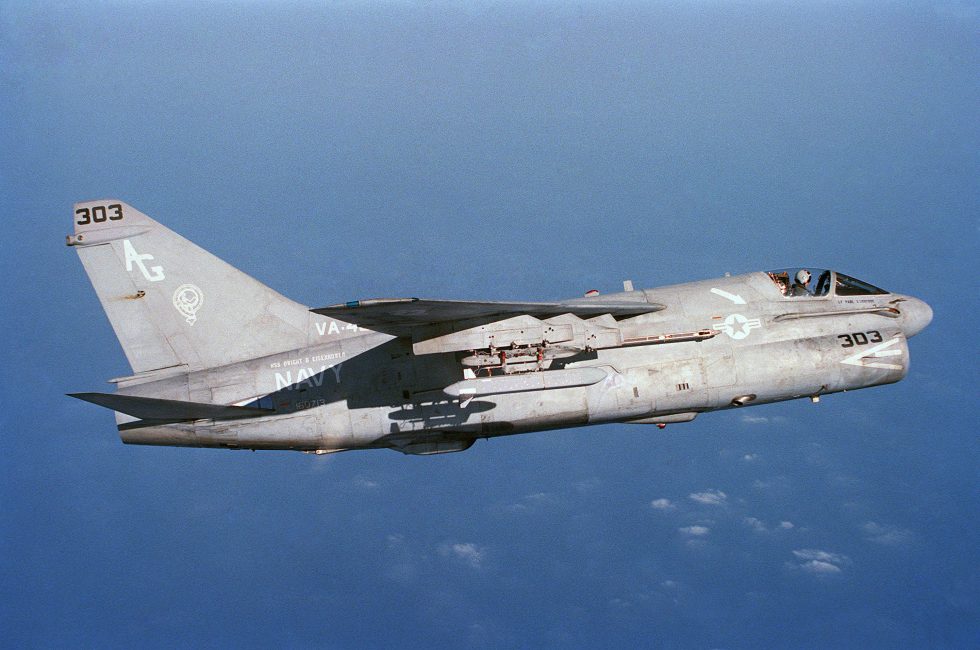
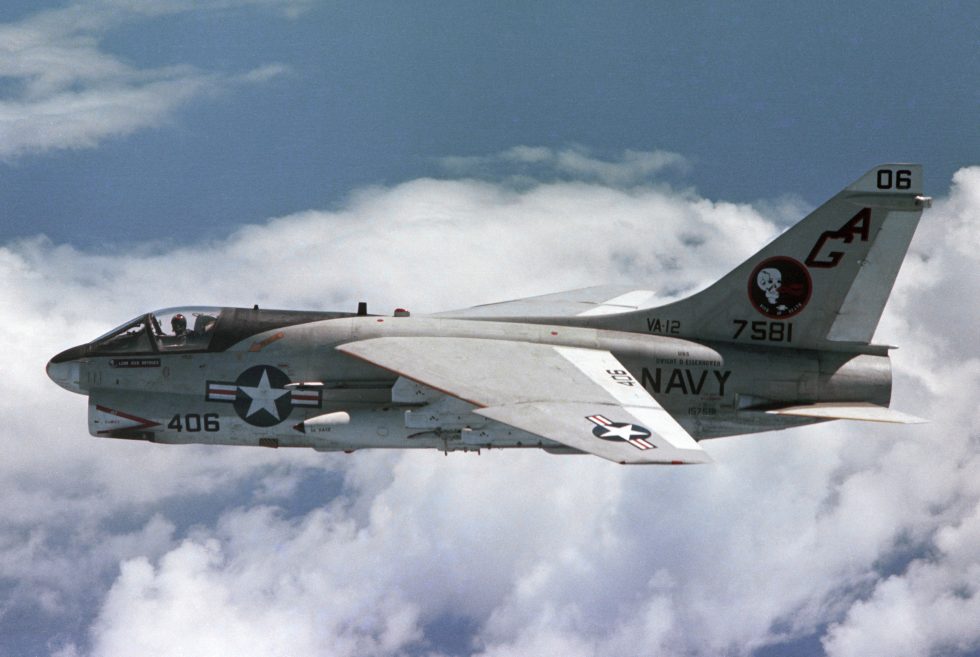
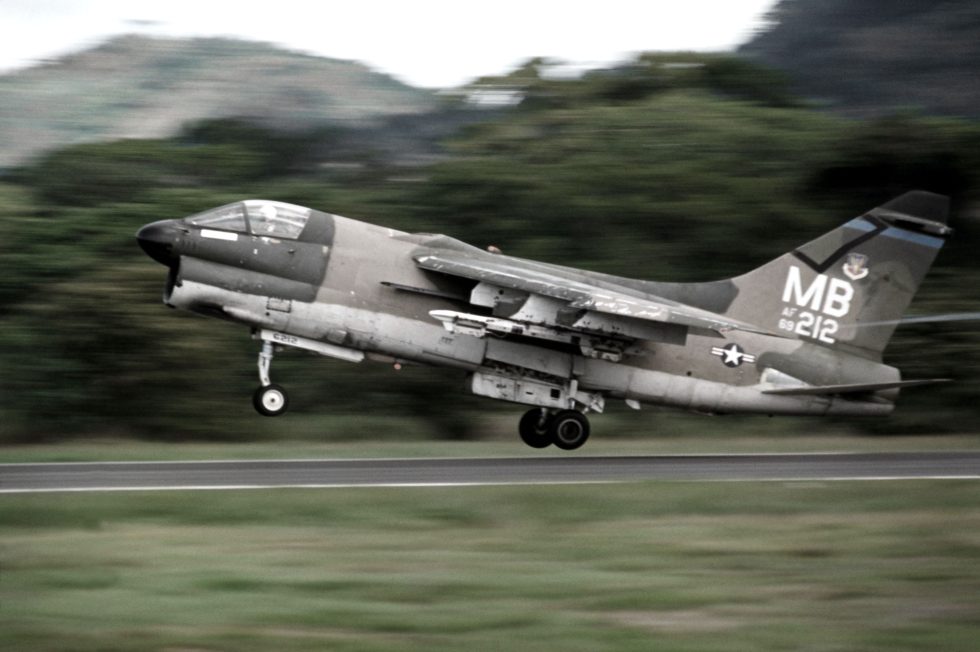
The A-7 Corsair II in pictures
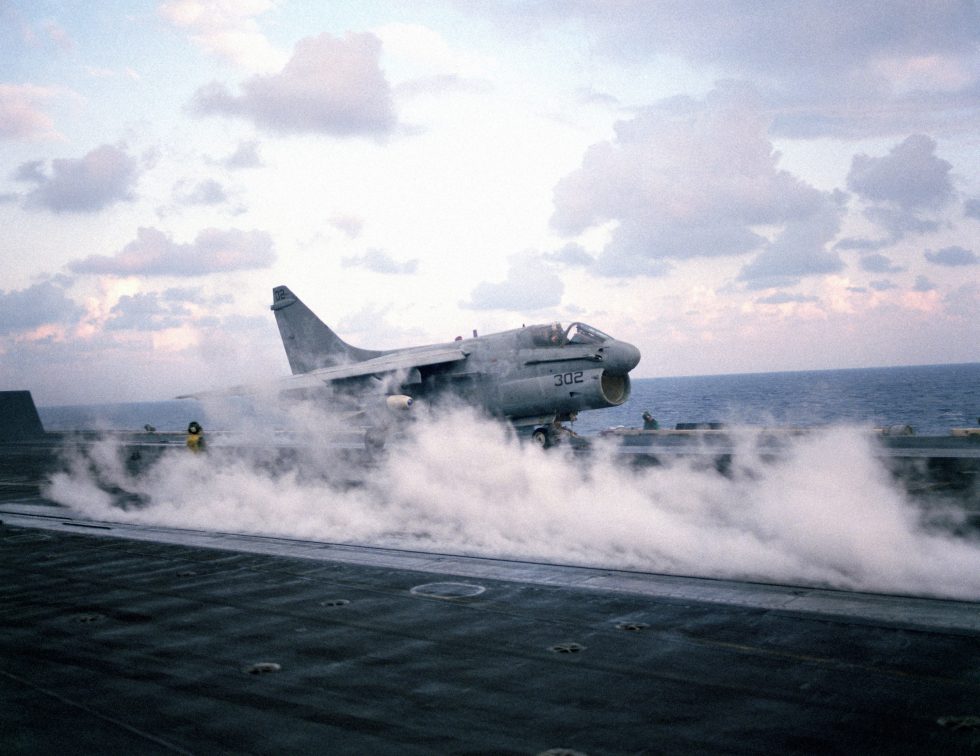
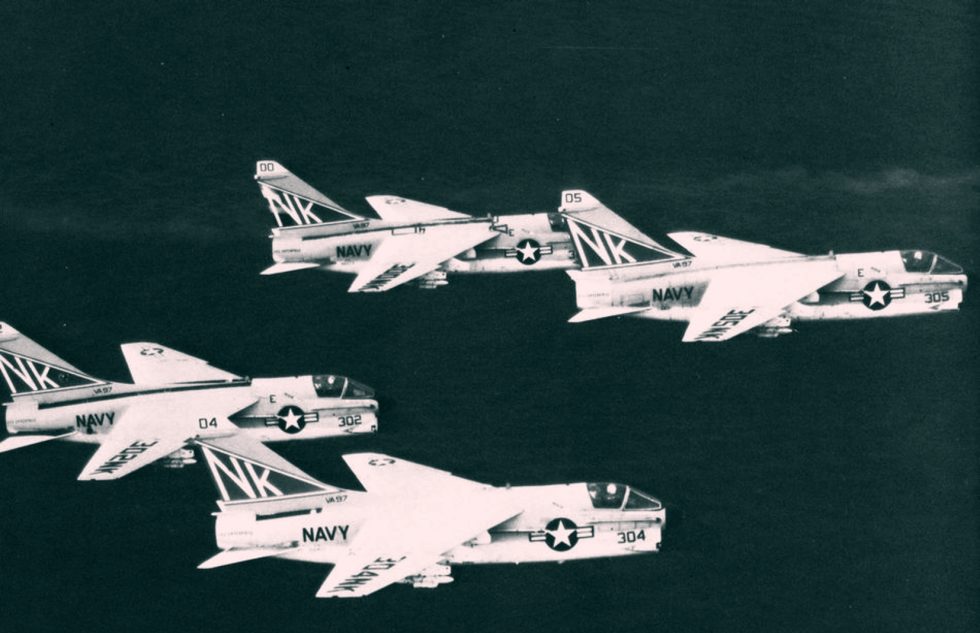
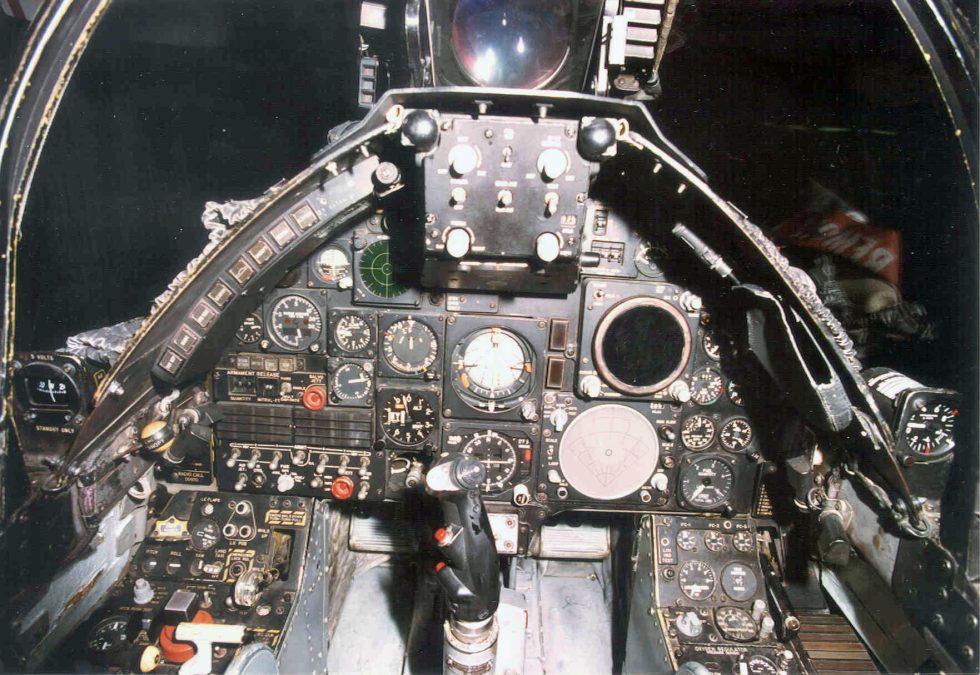
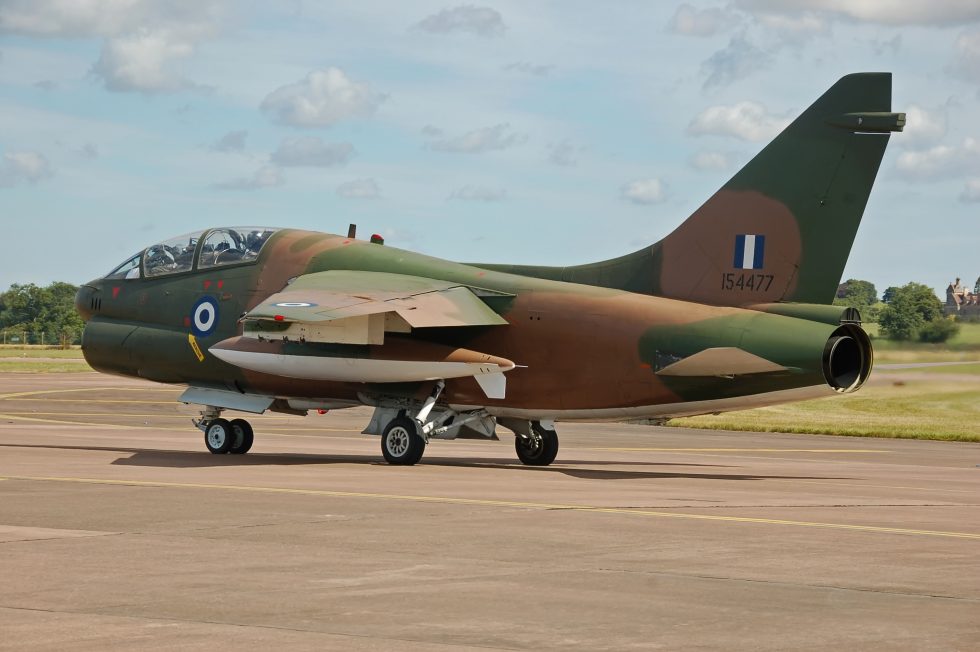
The A-7 Corsair II in motion
A hand-picked A-7 Corsair II documentary is coming soon to this exhibit. In the meantime, explore the photo gallery above and the full combat record and operations map below.
Where the A-7 Corsair II served
The score that defines it
The A-7 was an attack jet, not a dogfighter — its record is written in bombs on target, not air-to-air kills. Across Vietnam, Libya, Grenada, Panama and the Gulf, the SLUF earned a reputation for accuracy and reliability, and it closed its U.S. combat career in Desert Storm without a single aircraft shot down.
Compare the combat record of every military aircraft. Figures as of July 2026.
Everything people ask about the A-7 Corsair II
Can I fly in an A-7 Corsair II?
Why is the A-7 called the “SLUF”?
Was the A-7 developed from the F-8 Crusader?
Was the A-7 supersonic?
What engine did the A-7 use?
What made the A-7’s bombing so accurate?
Where did the A-7 see combat?
Who was the last operator of the A-7?
How many A-7s were built?
You can’t fly the A-7.
These, you can.
Some legends only live in museums — others are fuelled and waiting. MiGFlug has put civilians in real military jet cockpits since 2004.
 Fly the L-39 AlbatrosThe world’s most-flown jet trainer — aerobatics included
 Fly the F-104 Starfighter“The missile with a man in it”
 Fly the MiG-21The Cold War’s most-produced jet
 Fly the T-33 Shooting StarAmerica’s first jet trainer
 Fly the DH VampireA piece of early jet history
 Fly the S.211Agile Italian jet trainer
 Fly the MB-326The classic Aermacchi jet
 Fly the MiG-15The Soviet legend of the Korean War
Continue the tour
Every fact, checked
- National Naval Aviation Museum — A-7E Corsair IIOfficial U.S. Navy specifications, production numbers and service history.
- National Museum of the U.S. Air Force — LTV A-7DA-7D fact sheet: first flight, TF41 engine, Korat operations and specs.
- HistoryNet — The Corsair’s Last HurrahVA-46 and VA-72 in Desert Storm, the final launch and zero losses.
- The Aviation Geek Club — the “A-7 mafia”Pilot interview on the SLUF nickname, nav/attack system and bombing accuracy.
- U.S. Naval Institute Proceedings — El Dorado CanyonA-7E defence-suppression from USS America in the 1986 Libya raid.
- Vintage Aviation News — Greece retires the A-7The Hellenic Air Force retirement on 17 October 2014 as the world’s last operator.
- GlobalSecurity.org — A-7 variantsFirst flight date, TF30 vs Spey-derived TF41, and variant lineage.
- 19FortyFive — the Short Little Ugly FellowService overview across Vietnam, Grenada and Desert Storm.