
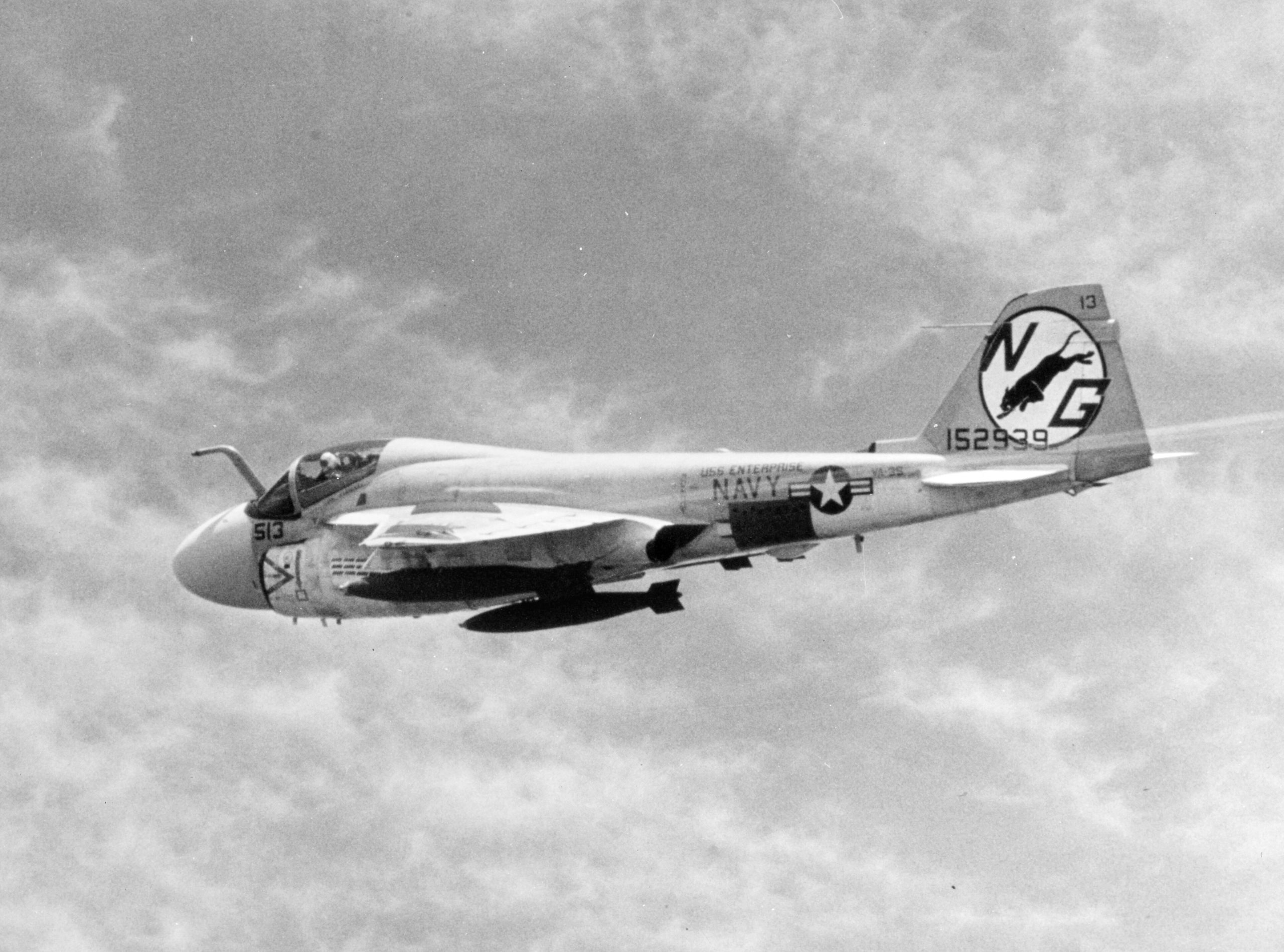
Grumman A-6 Intruder
“The Iron Tadpole”
The US Navy and Marine Corps’ all-weather bomb truck — a stubby, subsonic Grumman that could find and hit a pin-point target on the blackest night, in the worst weather, when nothing else in the fleet could.
The jet that owned the night
By the mid-1950s the US Navy had fast jets and nuclear jets, but it still could not reliably put an iron bomb on a small target in cloud, at night, or in a storm. In 1957 it issued a requirement for a carrier-based all-weather attack aircraft, and on 2 January 1958 Grumman’s Type G-128 design was chosen. What emerged was unlike the sleek supersonic fighters of the day: a broad, blunt-nosed, subsonic machine built around a radar, a computer and a huge load of bombs.
The A-6 first flew on 19 April 1960 and entered service in February 1963. Its heart was DIANE — the Digital Integrated Attack/Navigation Equipment — a search and track radar tied to one of the first airborne digital attack computers. The two-man crew sat side by side, pilot on the left and bombardier/navigator on the right, staring into the same radar picture. Together they could fly to a target they never saw with their eyes and drop on it accurately in zero visibility.
That capability made the Intruder the Navy and Marine Corps’ all-weather workhorse for more than thirty years. It carried the fleet’s heaviest conventional loads deep into the most heavily defended airspace of the Vietnam War, struck Libya in 1986, and served as the Navy’s primary laser-guided-bomb platform in the 1991 Gulf War before retiring in 1997. Its stretched electronic-warfare cousin, the EA-6B Prowler, jammed enemy radars for another two decades after that.
01The A-6 Intruder and DIANE: the computer that could bomb blind
At the core of the A-6 was DIANE, the Digital Integrated Attack/Navigation Equipment: a track-while-scan attack radar, a separate search radar, a ballistics computer and an inertial navigation system, all wired together. In an era when most attack pilots still bombed by eye in a dive, DIANE let the Intruder crew fly a low-level approach in cloud or darkness, have the computer solve the release point and drop unguided bombs with an accuracy nobody else could match at night.
The system was famously temperamental — early DIANE was maintenance-hungry and often only partly working — but when it worked it was revolutionary. It is the single reason the A-6 existed: not speed, not agility, but the ability to deliver ordnance precisely in weather and darkness that grounded everything else. Decades of upgrades, culminating in the A-6E TRAM with its turreted infrared and laser sensor, turned that promise into routine precision strike.
What makes the A-6 Intruder special
DIANE — all-weather attack, before anyone else
The Intruder was the first carrier aircraft that could genuinely find and hit a target in cloud and darkness. Its DIANE suite fused radar, an inertial platform and a digital bombing computer so the crew could bomb accurately without ever seeing the ground — the capability that defined the whole aircraft and kept it in front-line service for over three decades.
A carrier bomb truck built around payload
The A-6 traded speed for load and reach. Its deep, roomy fuselage held large internal fuel tanks and its five hardpoints could lift about 8,200 kg (18,000 lb) of ordnance — a heavier practical strike load, further, than the supersonic fighters around it. It could haul that from a pitching carrier deck deep into defended airspace and back.
The rugged, subsonic twin-J52 design
Two Pratt & Whitney J52 turbojets, buried in the wing roots, gave dependable, fuel-efficient thrust rather than raw speed — the Intruder never went supersonic. The blunt, tadpole-shaped airframe was tough, simple and forgiving, able to absorb battle damage and keep flying. There was no internal gun; the A-6 was a pure bomber.
02The A-6 Intruder’s side-by-side cockpit: why the crew sat shoulder to shoulder
Unlike almost every other attack jet, the A-6 seated its two crew side by side rather than in tandem, with the bombardier/navigator’s seat set slightly lower and to the right. The reason was DIANE: pilot and B/N needed to share the same radar scope and work the attack together, and side-by-side seating let them do that and communicate by glance and gesture. It made the cockpit wide — part of the Intruder’s bulbous, stubby look — but it turned the two-man crew into a single weapons system.
03The A-6 Intruder’s tilting tailpipes and the loss of a supersonic dream
Grumman’s original design gave the A-6 jet exhausts that could tilt downward to boost short-field and carrier performance. The feature was dropped early as unnecessary and heavy, and the fixed-tailpipe subsonic aircraft that entered service was slower and plainer than first imagined. It did not matter. The Intruder was never meant to win races; its job was to carry a heavy load a long way and put it on target in any weather, and the rugged, unglamorous machine that resulted did exactly that for thirty-four years.
Full A-6E Intruder specifications
Baseline note: the figures below describe the Grumman A-6E TRAM Intruder as it stood from 1979 to the end — the definitive attack version, with a single Norden AN/APQ-148 multi-mode radar (AN/APQ-156 on later aircraft), the AN/AAS-33 turret under the nose, and two Pratt & Whitney J52-P-8B turbojets of 9,300 lbf each. It is the right baseline because it is the aeroplane that fought at Benghazi and over Iraq, and because roughly half of all A-6Es were rebuilt A-6As: the TRAM standard is where the type finally became what the 1957 requirement had asked for. Deltas for the A-6A, the KA-6D tanker and the A-6B and A-6C special-mission conversions are in grey. Six cautions before any number here is used. First: the EA-6B Prowler is not this aeroplane and none of its figures appear on this page. It shares an ancestor with the Intruder and very little else — a fuselage stretched by roughly 1.5 m, four seats instead of two, J52-P-408 engines of 11,200 lbf, a fin-top receiver pod, five ALQ-99 jamming pods and a mission that has nothing to do with bombing. Compilers who blend Prowler weights and engine ratings into an A-6E table are describing a machine that never existed. Second: dimensions are not agreed. Many widely reproduced tables give 53 ft 0 in span and 16 ft 2 in height; several reference sites give 53 ft 2 in and 15 ft 7 in for the same aircraft. The differences are almost certainly measurement conventions — static versus jacked, probe tip included or not — rather than different aeroplanes, but they should not be quoted to the inch as though they were settled. Third: 560 kt at sea level is a clean airframe on a test card. No Intruder of any mark was ever supersonic in level flight. A loaded A-6E with a war load on all five stations was a 400–450 kt machine and everybody who flew one knew it. Fourth: the 919 nmi combat range is one specific hi-lo-hi profile carrying six Mk 83s and nothing else; the 2,818 nmi ferry figure is with external tanks and no weapons. Neither is a general-purpose radius, and the two must never be printed as though they bracketed the same mission. Fifth: the unit cost of US$43 million in 1998 dollars circulates through almost every online reference without a primary source attached to it, and it is not obvious what it is meant to include — flyaway, programme unit, or rebuild-plus-rewing. It is quoted here because it is what the literature says, not because it has been verified. Sixth: weights. 26,660 lb empty and 60,400 lb maximum are the best-attested pair; 60,500 lb and 60,626 lb both appear elsewhere, and the maximum catapult weight was lower than the maximum gross weight, which is why a heavily loaded Intruder off a hot deck was a genuinely marginal proposition.
Dimensions & weights
- Crew
- 2 — pilot on the left, bombardier/navigator on the right, sitting side by side with the B/N set slightly lower and further aft so the pilot’s view to the right was not entirely blocked. This is the single most important design decision on the aeroplane. In a tandem cockpit the two men cannot see the same thing at the same time; in the Intruder the pilot could look across at the radar scope his B/N was interpreting, and the B/N could see the attitude the pilot was flying. At 400 kt, at night, at 500 ft, in cloud, over hills, that shared picture was the difference between a mission and a smoking hole
- Length overall
- 16.69 m (54 ft 9 in), consistent across every attack mark. The EA-6B was some 1.5 m (5 ft) longer, and that plug is the quickest way to tell the two apart in a photograph after the fin-top pod
- Wingspan
- 16.15 m (53 ft 0 in) in the most-cited tables; 16.20 m (53 ft 2 in) in several others. Sweep was a modest 25°, which is why the Intruder looked slow and was — and why it could be brought aboard a ship at a sane speed with a full bomb load still hanging on it
- Wingspan, wings folded
- 7.67 m (25 ft 2 in). The outer panels folded upward hydraulically at roughly mid-span. A deck handler could park two Intruders in the space of one Vigilante, and on a Forrestal-class hangar deck that arithmetic decided how many aeroplanes a wing could carry
- Height
- 4.93 m (16 ft 2 in) as usually published; 4.75 m (15 ft 7 in) appears in other compilations. Nothing on the Intruder folded except the wings — no folding fin, no folding radome — which for a carrier aircraft of this size was unusually simple
- Wing area
- 49.13 m² (528.9 sq ft). A generous wing for the weight, fitted with full-span leading-edge slats and large Fowler flaps. It bought approach speed and low-level ride quality, and it cost top-end speed. Grumman made that trade deliberately and it was the correct one
- Roll control
- Spoilers only — no ailerons of any kind on any mark. The entire trailing edge was given over to flaps, and roll came from upper-surface spoiler panels. This is a bomber’s wing, optimised for lift at low speed and for carrying things, and it is why the Intruder rolled with a deliberate, slightly reluctant feel that fighter pilots disliked and attack crews stopped noticing
- Speed brakes
- Split panels at the wingtips — opening above and below the tip like a clamshell. The prototypes had fuselage-mounted brakes, which changed the downwash over the tail badly enough that they had to be moved. Later A-6Es retained fuselage brakes as well, but the wingtip pair did the work, and they are one of the type’s recognition features
- Empty weight
- 12,093 kg (26,660 lb) for the A-6E TRAM. The A-6A was a few hundred kilograms lighter before the turret, the composite wing and thirty years of accreted avionics went on. Weight growth on this airframe was relentless and largely invisible: nothing changed shape, and everything got heavier
- Maximum take-off weight
- 27,397 kg (60,400 lb); 60,500 lb and 60,626 lb also appear. Maximum catapult weight was lower still. An Intruder at maximum gross was carrying more than its own empty weight in fuel and ordnance, which is an extraordinary figure for a carrier aeroplane and the reason the type kept its job for so long
- Internal fuel
- ~9,030 litres (2,385 US gal) in five fuselage cells and the wings. Endurance rather than speed was the Intruder’s currency: it could stay out, loiter, hold, be re-tasked and still come home, and on a night when the weather closed the deck it needed every drop of that margin
- External fuel
- Up to 5 × 1,136-litre tanks (300 US gal). Four tanks and a single bomb rack was a common Vietnam configuration for long over-water transits; a KA-6D flew with four tanks and the hose reel on the centreline
- Hardpoints and maximum ordnance
- 5 stations, ~8,165 kg (18,000 lb) total — four wing pylons and one centreline, each rated at 1,633 kg (3,600 lb). Some references give 19,500 lb as maximum payload including fuel. There was no internal bay: everything the Intruder carried, it carried in the airflow, which is a large part of why it was subsonic
Performance
- Maximum speed, sea level
- 1,037 km/h (560 kt, 644 mph) clean. This is the number that gets quoted and it describes an aeroplane carrying nothing. With bombs and tanks the Intruder was a 400–450 kt machine, and on the run-in it was often slower still because the attack solution wanted stability, not speed
- Speed limit
- High subsonic, always — the Intruder was never supersonic in level flight in any variant, and Grumman never intended it to be. In 1957 the Navy asked for an aeroplane that could find and hit a target at night in bad weather. Speed was not on the list, and every kilogram not spent on afterburners and area ruling was spent on fuel, ordnance and electronics instead
- Cruising speed
- 763 km/h (412 kt, 474 mph). A long, unglamorous, economical cruise. This is what an Intruder did for most of its airborne life
- Approach speed
- ~220 km/h (~120 kt) at typical recovery weight. One widely mirrored table gives 98 kt, which would correspond to a very light aeroplane indeed. Whatever the exact figure, the Intruder came aboard slowly, honestly and with good over-the-nose visibility, and its landing accident record was correspondingly better than that of the aeroplanes that were faster and prettier
- Combat range
- ~1,702 km (919 nmi, 1,057 miles) on a hi-lo-hi profile with six Mk 83 1,000 lb bombs. This is a profile figure, not a general radius. Working combat radius with a realistic mixed load and reserves was considerably less, and the KA-6D existed precisely because it was
- Ferry range
- 5,219 km (2,818 nmi, 3,243 miles) with external tanks and no weapons. Enough to cross oceans in stages, which mattered for a type that deployed to Marine Corps expeditionary fields as well as to carriers
- Service ceiling
- 12,925 m (42,400 ft). Rarely relevant. The Intruder’s working altitude band in Vietnam was measured in hundreds of feet, and the whole point of the aeroplane was that it could operate down there without visual reference
- Rate of climb
- 38.7 m/s (7,620 ft/min) clean. Modest by fast-jet standards of the 1960s and entirely adequate for the job. A fully loaded Intruder off a catapult on a hot night climbed at a rate that gave the crew time to think about their life choices
- Take-off run
- 1,387 m (4,550 ft) from a land runway at high weight — a figure that matters for Marine Corps operations from Da Nang and Chu Lai and from Shaikh Isa in 1991, and not at all from a catapult
- Landing run
- 777 m (2,550 ft) ashore. Aboard ship the answer was a wire and about 100 m
- Wing loading
- 557 kg/m² (114 lb/sq ft) at maximum take-off weight; roughly 246 kg/m² (50 lb/sq ft) empty. The low figure at light weight is why the Intruder handled well in the pattern; the high figure at maximum weight is why a full one accelerated like a barge
- Thrust-to-weight
- 0.31 at maximum take-off weight, about 0.70 empty. No afterburner, no reheat, nothing held in reserve. Two dry turbojets of 9,300 lbf each is all the Intruder ever had, and the aeroplane was designed from the first sketch around that fact
Propulsion & systems
- Engines
- 2 × Pratt & Whitney J52-P-8B non-afterburning turbojets — 9,300 lbf (41.4 kN) each, buried low in the fuselage sides with short intakes ahead of the wing root. The A-6A entered service on the J52-P-6A of 8,500 lbf (37.8 kN) and was progressively re-engined with the P-8A and P-8B. The EA-6B, with four crew and a much heavier fit, needed the J52-P-408 at 11,200 lbf (49.8 kN)
- Tilting tailpipes
- Fitted to the prototypes, deleted in production — the YA-6A’s exhausts could be rotated some 23° downward to shorten the take-off run. Testing showed the gain did not repay the weight, complexity and thrust loss, and the production aeroplane got plain fixed pipes canted slightly down and out. The stubby downturned exhausts on surviving early airframes are the fossil of this idea
- Attack and navigation suite
- DIANE — Digital Integrated Attack Navigation Equipment — the entire reason the aeroplane exists. On the A-6A it tied together the Norden AN/APQ-92 search radar, the AN/APG-46 track radar, the AN/APN-141 radar altimeter, an AN/APN-122 Doppler navigation radar, a Litton AN/ASN-31 inertial platform and an AN/ASQ-61 ballistics computer into one solution that could take the aeroplane to a target it had never seen and release on a computed point. Nothing else in the American inventory could do this in 1963. DIANE was also, for its first several years, chronically unreliable: it took most of the 1960s and a great deal of squadron sweat before the promise on paper became a capability at sea
- Radar (A-6E)
- Norden AN/APQ-148 multi-mode — one set replacing the A-6A’s separate search and track radars, doing terrain-following, terrain avoidance, ground mapping and target tracking. Later aircraft received the AN/APQ-156, which added airborne moving target indication and could pick a lorry out of a wadi at night
- TRAM turret
- AN/AAS-33 DRS under the nose — a small gyro-stabilised ball containing a forward-looking infra-red sensor boresighted with a laser designator and spot tracker, fitted from 1979. This is what turned the Intruder from a radar bomber into a precision one: the B/N could slew the FLIR onto what the radar had found, identify it visually in the dark, designate it with the aircraft’s own laser and put a Paveway through it without help from anybody. The turret is the small bulge that distinguishes a TRAM aircraft from every earlier A-6 at a glance
- Inertial navigation
- CAINS with AN/ASN-92 — the Carrier Aircraft Inertial Navigation System, which could be aligned on a moving deck. An inertial platform that must be aligned on a stationary ramp is of no use to a carrier aeroplane, and solving that problem was one of the quiet enablers of the whole all-weather mission
- Mission computer
- IBM AN/ASQ-133 digital computer on the A-6E, replacing the A-6A’s AN/ASQ-61. The pilot flew to a Vertical Display Indicator that drew a contact-analogue picture of the world ahead — a synthetic horizon, the terrain, and steering to the release point — while the B/N worked the radar and the FLIR beside him. Two men, two very different displays, one problem
- Self-protection
- AN/ALQ-100, later AN/ALQ-126 deception jammers with radar warning (AN/ALR-45/50, later AN/ALR-67) and AN/ALE-39 chaff and flare dispensers. The Intruder had no gun and, in practice, no air-to-air weapon: it survived by being somewhere the enemy was not looking, at an altitude and in a weather state that made it hard to find. When that failed it had very little left
- Escape system
- Martin-Baker zero-zero ejection seats — GRU-7A on the A-6E, earlier marks on the A-6A. Side-by-side seats fire on a sequenced divergent trajectory so the two crew do not collide; the Intruder’s system worked well enough that a great many crews who lost their aeroplane did not lose their lives, though Lieutenant Mark Lange over the Bekaa in 1983 is the reminder that a low-altitude, high-bank ejection remains a coin toss
- In-flight refuelling
- Fixed probe above the nose — ahead of and slightly right of the windscreen, in plain sight of the pilot, which made night tanking easier than on types where the probe was buried. The KA-6D added a hose-and-drogue package: an internal transfer system plus a D-704 store on the centreline, offloading on the order of 9,500 kg (~21,000 lb) and providing the air wing’s organic tanking for two decades
- Wing structure
- Aluminium originally; graphite/epoxy composite from the late 1980s — after persistent fatigue cracking, roughly 85% of the surviving fleet was fitted with new wings of graphite/epoxy with titanium and aluminium. The new wing was stronger and lasted longer, and it was also stiffer, so it fed more load into a fuselage that was itself thirty years old. The rewing bought life; it also moved the fatigue problem aft, and airframes were still queued for the modification when the whole programme was cancelled out from under them
- Production
- ~693 built of all Intruder and EA-6A types — 8 prototypes, 480 A-6As, 445 A-6Es of which roughly 240 were rebuilt A-6As rather than new airframes, 28 EA-6As, plus conversions to A-6B, A-6C and KA-6D. The 170 EA-6B Prowlers are counted separately and belong to a different aeroplane. Grumman built Intruders at Bethpage and Calverton on Long Island from 1960 to 1993 — thirty-three years of continuous production of one attack aircraft, which is close to a record
04What did an A-6 Intruder cost to buy and fly?
Because the Intruder was a government-procured Navy aircraft built across three decades, no single tidy price exists. Period program figures put the flyaway cost of an A-6E in the low tens of millions of dollars — very roughly $30–43 million depending on year and how research and development is counted — and no reliable, officially published cost-per-flight-hour figure exists in open sources. Any exact dollar number attached to an A-6 should be read as an estimate rather than a sourced fact.
Armament & payload
The Intruder carried no gun at all, and put eighteen thousand pounds on a target it had never seen
Everything about the A-6’s armament follows from one decision: there is no internal bay and no cannon, so the whole payload hangs in the airflow on five pylons rated at 3,600 lb apiece, and the aeroplane is subsonic because of it. What the Intruder bought with that penalty was the ability to deliver the load in conditions that grounded everyone else. A radar bomber that can find a bridge through ten-tenths cloud and release on a computed point is worth more than a fast one that has to see the target, and from 1979 the TRAM turret added the second half of the argument: the bombardier/navigator could pick the target out of the dark on infra-red, designate it with the aircraft’s own laser, and guide his own Paveway onto it without a buddy, a pod or a forward air controller.
Two mornings in the 1980s show what that capability was worth and what it cost. On 4 December 1983 the Sixth Fleet was ordered to strike Syrian anti-aircraft positions in the Bekaa Valley after Syrian gunners had fired on US reconnaissance flights. USS John F. Kennedy put up twelve A-6Es from VA-85 and VA-75 and USS Independence five more alongside A-7Es, and the strike was a shambles — not because of the aeroplanes but because of the orders. A flash execute message arrived around 0300 setting a time on target barely four hours away, with the time-zone conversion wrong in the signal itself, which cost the air wings two of the few hours they had. Aircraft launched under-loaded and out of sequence, into the rising sun, against alerted defences. Two were shot down. One was Buckeye 556, an A-6E of VA-85 (BuNo 152915), hit by a Syrian infra-red-guided missile: Lieutenant Mark Adam Lange was killed in the ejection and his bombardier/navigator, Lieutenant Robert "Bobby" Goodman, was captured and held in Damascus until his release on 3 January 1984. The second aircraft was an A-7E flown by the Independence air wing commander, Commander Ed Andrews, who was recovered. The bitterness that followed produced the Naval Strike Warfare Center at Fallon, and the Navy’s tactical aviation has been better at planning strikes ever since because of that morning.
On 15 April 1986, in Operation El Dorado Canyon, it went the other way. Six A-6E TRAMs of VA-34 from USS America went to the Jamahiriyah barracks at Benghazi with Mk 82s while eight of VA-55 from USS Coral Sea attacked Benina airfield with CBU-59 APAM cluster weapons and Mk 82s — two aborted, five pressed on — destroying three or four MiGs, two Mi-8 helicopters and an F27 transport, with A-7Es and F/A-18As firing HARM and Shrike ahead of them. The whole raid lasted about twelve minutes. The Navy element lost nothing; the USAF F-111F element from Lakenheath lost one aircraft and both its crew. Five years later the same aeroplane flew more than 4,700 combat sorties in Desert Storm, dropping most of the Navy’s laser-guided weapons, mining Iraqi waters, sinking Iraqi patrol craft and losing three of its own.
The result is a weapons list that spans thirty-five years and three generations of technology on the same five pylons — iron bombs and Zuni rockets at one end, SLAM and HARM at the other, and nuclear gravity weapons quietly present throughout. It is also a list with two conspicuous holes. The Intruder had no gun, so it could not strafe, and it carried no air-to-air weapon worth the name, so it could not defend itself. Both were deliberate. Fits varied enormously by mark, by year and by service: a 1966 Marine A-6A at Chu Lai and a 1991 Navy A-6E SWIP off Saratoga shared an airframe and almost nothing else, and any single armament table for "the A-6" is a composite that no individual aeroplane ever matched.
Gun
- None. No Intruder of any mark carried an internal gun. There was no cannon, no machine gun and no provision for either.
- This was a requirement, not an oversight. The 1957 specification asked for a night and all-weather attack aircraft; a gun is a clear-weather, visual-range weapon, and the weight was spent on radar and fuel instead.
- Gun pods on the wing pylons were technically possible and were not part of the operational fit. Intruder crews did not strafe, and were not trained to.
- The practical consequence in Vietnam was that an A-6 caught in daylight over a defended target had nothing to answer with. Of 84 Intruders lost, 56 fell to conventional ground fire and anti-aircraft artillery — the threat a gun would not have helped against, and against which the aeroplane’s only defence was darkness, weather and speed.
Air-to-air
- Effectively none. The Intruder was never an air-to-air aeroplane and never pretended to be one.
- AIM-9 Sidewinder carriage on the outboard pylons appears in the literature as a self-defence option, but it was not a normal operational fit and no Intruder is credited with an air-to-air kill.
- Two A-6s were shot down by MiGs over North Vietnam. The doctrinal answer was not to arm the Intruder but to keep it where MiGs were not — low, dark and alone — and to give it F-4 Phantom II escort when it had to go in with the pack.
- The AGM-88 HARM added under the SWIP programme is an anti-radiation weapon, not an air-to-air one, and should never be counted in this column.
Air-to-surface guided
- Anti-radiation: AGM-45 Shrike and AGM-78 Standard ARM on the A-6B "Iron Hand" conversions from 1967; AGM-88 HARM on A-6E SWIP aircraft from the early 1990s.
- Electro-optical: AGM-62 Walleye glide bomb, guided by television and, on later versions, controlled through an AN/AWW-13 data-link pod carried on a wing station.
- Laser-guided bombs: the Paveway family — GBU-12 on a 500 lb Mk 82, GBU-16 on a 1,000 lb Mk 83, GBU-10 on a 2,000 lb Mk 84 — self-designated by the TRAM turret. This was the Intruder’s defining capability in Desert Storm.
- Anti-ship and stand-off: AGM-84A Harpoon, and from 1990 the AGM-84E SLAM, whose combat debut on 18 January 1991 was flown by A-6Es of VA-75 with an A-7E providing terminal control. AGM-65 Maverick and the rocket-boosted AGM-123 Skipper II were also cleared.
- Nuclear gravity weapons — B43, B57 and B61 — were part of the type’s certified repertoire throughout the Cold War, delivered by loft or toss using the DIANE solution. None was ever released in anger.
Bombs
- The Mk 80 series was the Intruder’s daily bread: Mk 82 (500 lb), Mk 83 (1,000 lb) and Mk 84 (2,000 lb), with Snakeye retarded tails for low-level release.
- Maximum theoretical load was 28 × Mk 82 on multiple ejector racks across all five stations — a figure that assumes no fuel tanks. Real missions traded bombs for tanks and typically flew with 12 to 22 weapons and two or three tanks.
- Cluster: Mk 20 Rockeye II anti-armour dispensers and CBU-59 APAM. Rockeye was the load that went to Benina airfield in April 1986 and that opened up Iranian warships in 1988.
- Mines: the Mk 36 and Mk 52 Destructor series, Mk 60 CAPTOR and later Quickstrike weapons. The Intruder was the US Navy’s principal aerial minelayer for two decades — A-6As of VMA(AW)-224 from USS Coral Sea laid the Haiphong harbour minefield in Operation Pocket Money on 9 May 1972.
- Nuclear shapes and practice bombs on the same racks; a squadron’s conventional and special-weapons qualifications ran side by side.
Rockets
- 5-inch Zuni in LAU-10 four-round pods and 2.75-inch folding-fin rockets in LAU-61 and LAU-68 pods were cleared and carried, principally by Marine Corps A-6s in the close air support role.
- Rockets sat awkwardly on this aeroplane. They are an aimed, visual, shallow-dive weapon and the Intruder’s whole reason for existing was to attack things it could not see.
- Parachute flares — LUU-2 and similar — were a more characteristic Intruder store than rockets, dropped to illuminate a target area for other aircraft on night interdiction work.
- By the A-6E TRAM era rockets had largely disappeared from operational loadouts. A laser-guided 500 lb bomb did the job that a rocket pod could not.
Pods & other stores
- D-704 refuelling store on the centreline — the hose-and-drogue package that made the KA-6D, and which any suitably wired A-6E could carry to act as a mission tanker.
- 300 US gal (1,136-litre) drop tanks, up to five. Four tanks and one bomb rack was a routine long-transit configuration.
- AN/AWW-13 data-link pod for controlling Walleye and SLAM; on the SLAM debut the launching Intruder handed the terminal guidance to another aircraft entirely.
- TRIM pod on the twelve A-6C conversions of 1970 — a ventral package with a forward-looking infra-red sensor and a low-light-level television camera, built to hunt lorries on the Ho Chi Minh trail and a direct ancestor of the TRAM turret.
- ALQ-series jamming pods, buddy stores and travel pods on the outboard stations as required. The Intruder’s pylons were plumbed, wired and genuinely multi-role in a way that few 1960s aircraft managed.
Three typical loadouts
- Night single-ship interdiction, North Vietnam, 1972
- A-6A: 13 × Mk 82 Snakeye on three multiple ejector racks, plus two 300 US gal tanks on the outboard stations. No escort, no wingman, no chatter — one aeroplane crossing the coast alone at 400 kt and a few hundred feet, its B/N working the radar down through the karst, with the whole solution computed by DIANE and released on a point the crew never saw. This is the mission no other American aircraft could fly, and the reason 84 Intruders did not come back.
- Precision strike, Desert Storm, January 1991
- A-6E TRAM: 4 × GBU-12 Paveway II laser-guided bombs on the inboard and mid stations, two 300 US gal tanks outboard, TRAM turret self-designating. The B/N found the aim point on FLIR, lased it himself and steered the weapon in from the same seat. Navy and Marine Intruders flew more than 4,700 combat sorties in six weeks on variations of this load, and lost three aircraft to SAMs and AAA doing it.
- Anti-shipping, Operation Praying Mantis, 18 April 1988
- A-6E TRAM of VA-95 from USS Enterprise: AGM-84 Harpoon on a wing station, Mk 20 Rockeye and laser-guided bombs on the remainder, one tank. The Iranian frigate Sahand was sunk and Sabalan crippled by a laser-guided bomb placed down her funnel — a demonstration, in daylight and against a moving warship, of exactly the sensor-and-weapon chain that had been built for a bridge at night.
Sourcing caveat: weapons clearance and squadron practice are different things. Almost every store listed above was certified for the type at some point in a thirty-five-year career, but no single aeroplane could carry all of them and few squadrons trained on more than a fraction. Loadout figures are reconstructed from published mission accounts and standard reference tables rather than from release authorities, and the maximum-bomb figures in particular are arithmetic rather than operational practice.
Variants
Thirty-three years of one airframe, and a cancellation that left it with no successor at all
The Intruder family is unusually simple in shape and unusually complicated in bookkeeping. There is essentially one airframe, built from 1960 to 1993, into which four generations of electronics were fitted; almost every interesting variant is a conversion rather than a new aeroplane, and roughly half of all A-6Es were rebuilt A-6As wearing a new designation. The special-mission marks — the A-6B defence-suppression conversions, the twelve A-6C night hunters — were wartime expedients built in tens, not hundreds, and most were converted back afterwards.
The EA-6B Prowler belongs on this family tree and nowhere near this page’s specification grid. It shares the Intruder’s ancestry and its wing, and then diverges completely: the fuselage is stretched by roughly 1.5 m to seat four, the engines are J52-P-408s of 11,200 lbf, the fin carries a receiver pod, and the payload is five AN/ALQ-99 jamming pods and AGM-88 HARM rather than bombs. 170 were built, they flew from 1971 to 2019, and they outlived the aeroplane they were derived from by twenty-two years. Blending Prowler figures into an A-6E table is the single most common error in the online literature on this type.
The end came from two directions at once. The wings cracked, and were replaced with composite ones on about 85% of the fleet at considerable expense — which then loaded a thirty-year-old fuselage harder than before. And the McDonnell Douglas A-12 Avenger II, the stealthy flying wedge that was to replace the Intruder from 1994, grew 30% overweight, ran wildly over cost, and was cancelled outright by Secretary of Defense Dick Cheney on 7 January 1991 after some US$2 billion had been spent, with litigation dragging on until Boeing and General Dynamics settled with the Navy in January 2014. It is worth being precise about what that cancellation did: it did not cause the Intruder’s retirement, it removed the Intruder’s replacement. Faced with paying to keep an ageing airframe alive with no successor in prospect, a post-Cold War Navy chose instead to retire it early and bridge the gap with LANTIRN-equipped F-14D Tomcats and F/A-18 Hornets until the Super Hornet arrived. The last Marine Corps A-6E left service on 28 April 1993; the last Navy Intruders were retired on 28 February 1997.
- YA-6A / A2F-1 (1960–62, 8 prototypes)
- First flight 19 April 1960. Fitted with rotating tailpipes that could deflect exhaust 23° downward for a shorter take-off; the idea was tested, found not to repay its weight, and deleted. Redesignated YA-6A under the 1962 tri-service system.
- A-6A (1963–69, 480 built)
- The original production aircraft and the first genuinely all-weather attack bomber in history, built around DIANE with separate AN/APQ-92 search and AN/APG-46 track radars. Entered squadron service February 1963; DIANE took most of the decade to become reliable, and the early Vietnam deployments were flown on a system that frequently did not work.
- A-6B (1967–70, 19 conversions)
- Defence suppression. A-6As stripped of the standard attack fit and given radar-homing equipment for AGM-45 Shrike and AGM-78 Standard ARM, in three successive and mutually incompatible sub-standards. Flown on "Iron Hand" missions against North Vietnamese SA-2 sites; most survivors were converted back to A-6E.
- A-6C (1970, 12 conversions)
- Night interdiction over the Ho Chi Minh trail, carrying the ventral TRIM pod with forward-looking infra-red and low-light-level television. A small, short-lived and directly consequential programme: TRIM proved the sensor case that TRAM later industrialised.
- KA-6D (from 1970, ~90 conversions)
- Tanker — 78 A-6As and 12 A-6Es rebuilt with an internal transfer system and a D-704 hose-and-drogue store on the centreline, offloading on the order of 21,000 lb. The attack systems came out and a limited navigation fit went in. For twenty years the KA-6D was the carrier air wing’s organic tanking, and at least 16 served in the Gulf War; when the type went, so did the wing’s ability to refuel itself without borrowing from the Air Force.
- A-6E (1970–93, 445 including ~240 conversions)
- The definitive attack version. One Norden AN/APQ-148 multi-mode radar replaced the A-6A’s two, an IBM AN/ASQ-133 computer replaced the ASQ-61, and CAINS with the AN/ASN-92 gave an inertial platform that could align on a moving deck. Roughly half were rebuilt A-6As rather than new-build aircraft.
- A-6E TRAM (from 1979, fleet-wide)
- The AN/AAS-33 Detecting and Ranging Set — a gyro-stabilised chin turret with FLIR boresighted to a laser designator and spot tracker — plus the AN/APQ-156 radar with moving-target indication. This is the modification that made the Intruder a precision weapon rather than a radar bomber, and it is the standard this page describes.
- A-6E SWIP (early 1990s, ~85 aircraft)
- Systems/Weapons Improvement Program: new stores management and wiring for AGM-65 Maverick, AGM-84E SLAM, AGM-62 Walleye and AGM-88 HARM. Run in parallel with the composite rewing that eventually covered about 85% of the fleet. The last substantive investment in the type, completed shortly before the decision to retire it.
- A-6F Intruder II and A-6G (1987–88, 5 development aircraft; A-6G unbuilt)
- The A-6F would have replaced the J52 turbojets with non-afterburning General Electric F404 turbofans and fitted an AN/APQ-173 synthetic-aperture radar and two extra wing stations. Five were built and flown; the Navy declined to authorise production, preferring to wait for the A-12. The A-6G was the cheap fallback — A-6F avionics, old engines — and was cancelled too. Both decisions look considerably worse in hindsight than they did at the time.
- EA-6A and EA-6B Prowler (28 and 170 respectively)
- The EA-6A was a modest Marine Corps electronic-warfare conversion of the A-6A — two prototypes, 15 new-build and 11 conversions — that kept the two-seat cockpit. The EA-6B Prowler that followed is a genuinely different aeroplane: first flight 25 May 1968, in service July 1971, stretched fuselage, four crew, J52-P-408 engines, ALQ-99 jamming and HARM. It served through Vietnam, the Gulf, the Balkans, Afghanistan and Iraq, was retired by the Navy in June 2015 and by the Marine Corps in March 2019, and for its last decade was the only tactical radar-jamming aircraft the entire United States armed forces possessed. It should never be described as a variant of the aircraft on this page in anything but the genealogical sense.
Survivors: no Intruder of any mark is airworthy anywhere in the world, and none is likely to be — a carrier attack aircraft with a fatigue-limited airframe and a specialised support chain is not a warbird proposition. Several dozen original airframes survive as static museum exhibits and gate guards, all of them genuine aeroplanes rather than reproductions; there are no A-6 replicas, because nobody has ever had a reason to build one. Notable examples include an A-6E at the Steven F. Udvar-Hazy Center of the National Air and Space Museum, one at the National Naval Aviation Museum at Pensacola, one aboard USS Midway at San Diego, one aboard USS Lexington at Corpus Christi, one at Patriots Point, one at the Museum of Flight in Seattle and one at Pima Air & Space; both surviving A-6F development aircraft are preserved on Long Island and in New York, at the Cradle of Aviation Museum and aboard USS Intrepid, and two YA-6A prototypes and several KA-6Ds are also on display. A further batch went to the AMARG boneyard at Davis-Monthan. The most striking disposal was the least dignified: a number of retired A-6s that were still sitting at the Northrop Grumman plant at St Augustine, Florida, waiting for the composite wings they would now never receive, were stripped, cleaned and sunk off the coast of St Johns County to form an artificial reef named Intruder Reef. Airframes built to fly at 400 kt in the dark now sit upright on the sea floor growing coral, which is either a waste or a rather good end, depending on the day.
From night-attack requirement to Gulf War veteran
The requirement
The US Navy asks industry for a carrier-based all-weather attack aircraft able to bomb accurately at night and in bad weather.
Grumman wins
Grumman’s Type G-128 design is selected on 2 January 1958 and becomes the A2F, later redesignated A-6.
First flight
The prototype flies on 19 April 1960 from Grumman’s Long Island facilities.
Enters service
The A-6A joins the fleet in February 1963; VA-75 takes it to sea and into combat by 1965.
Vietnam workhorse
Intruders fly the fleet’s toughest all-weather night interdiction missions; 84 are lost over Southeast Asia.
The definitive A-6E
The much-improved A-6E arrives, later gaining the TRAM turret for infrared imaging and laser-guided bombs.
Strike on Libya
Carrier A-6Es hit Libyan targets during Operation El Dorado Canyon and the Gulf of Sidra clashes.
Desert Storm
Navy and Marine A-6s fly thousands of sorties as the fleet’s primary laser-guided-bomb strike aircraft.
Retirement
The Marines retire the A-6 in 1993 and the Navy on 28 February 1997; the F/A-18 takes over the mission.
The Prowler bows out
The EA-6B Prowler, the Intruder’s electronic-warfare derivative, flies its last Marine Corps mission — the family’s final chapter.
From the flight deck: twelve Intruder stories
The bomb that needed a brain
A 1957 Navy requirement for all-weather bombing gave birth to a radar-and-computer jet.
Read the full story
Why it sat two side by side
The A-6’s wide cockpit put pilot and bombardier shoulder to shoulder over one radar scope.
Read the full story
The jet they kept sending into the dark
Nothing else could bomb as accurately at night, so the Navy flew the A-6 into the worst defences.
Read the full story
DIANE, the temperamental genius
The Intruder’s attack computer was revolutionary — and maddeningly unreliable at first.
Read the full story
Shot down over Beirut
A December 1983 strike on Syrian positions cost an A-6 and led to a famous prisoner release.
Read the full story
El Dorado Canyon
Carrier Intruders struck Libya in the 1986 raid answering a Berlin terrorist bombing.
Read the full story
The fleet’s laser-bomb truck
In Desert Storm the A-6 was the Navy’s primary precision strike aircraft.
Read the full story
Flight of the Intruder
A former A-6 bombardier turned the jet into a bestselling novel and a Hollywood film.
Read the full story
The KA-6D and the airborne gas station
Stripped of its bombing gear, the Intruder became the carrier air wing’s tanker.
Read the full story
The cousin that jammed the radars
The stretched, four-seat EA-6B Prowler turned the Intruder into an electronic-warfare legend.
Read the full story
Ugly, and beloved
Crews gave the Intruder rough nicknames — and trusted it with their lives.
Read the full story
What replaced the unreplaceable
The F/A-18 took the mission, but for years nothing matched the A-6’s range and load.
Read the full story
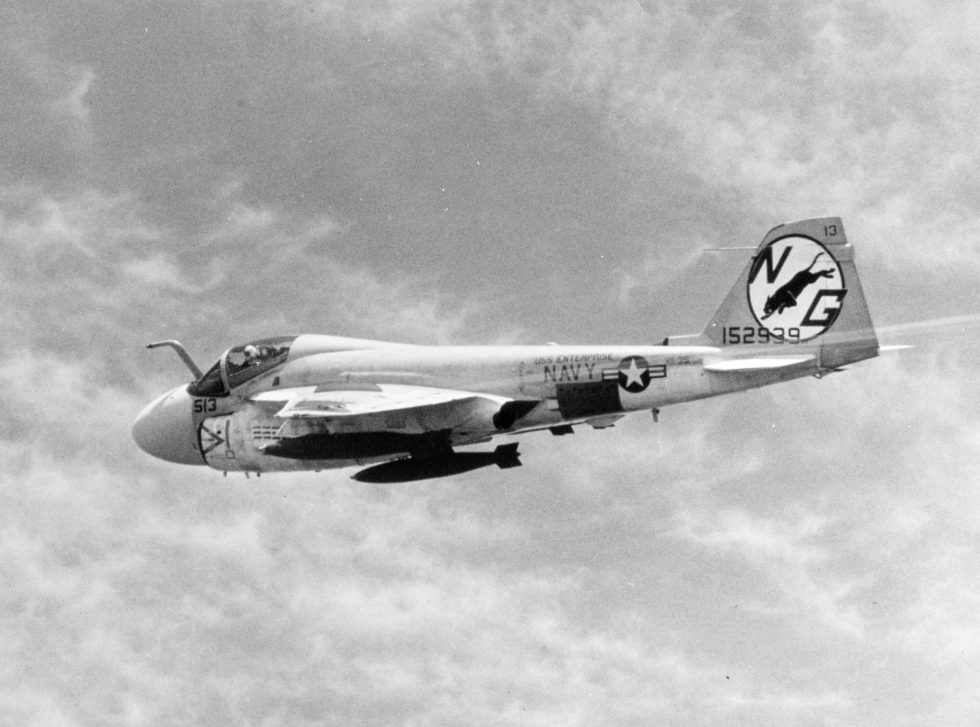
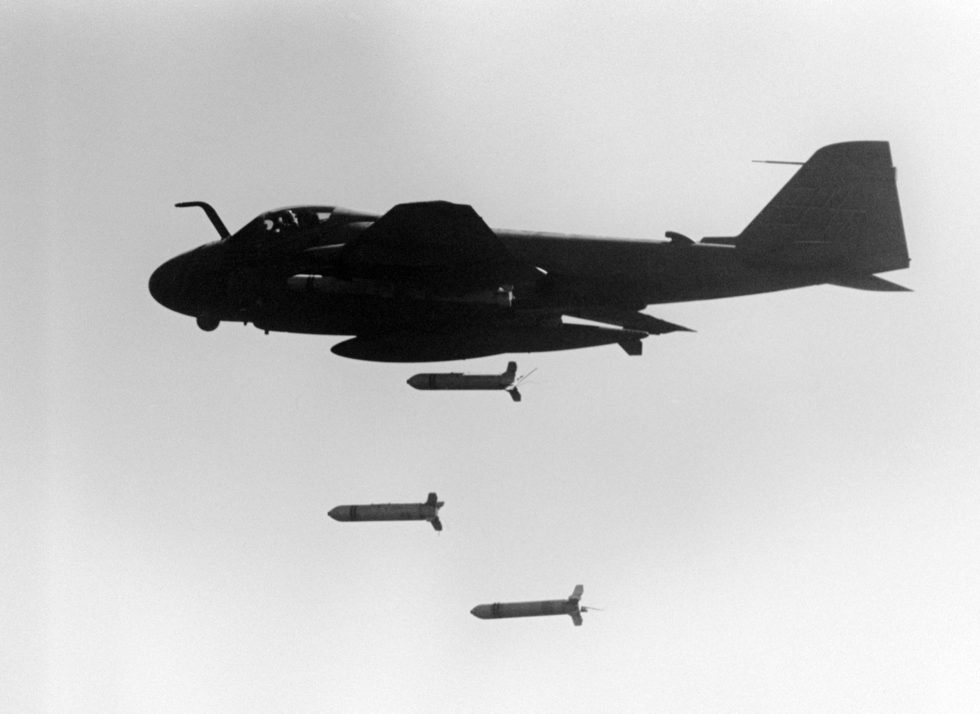
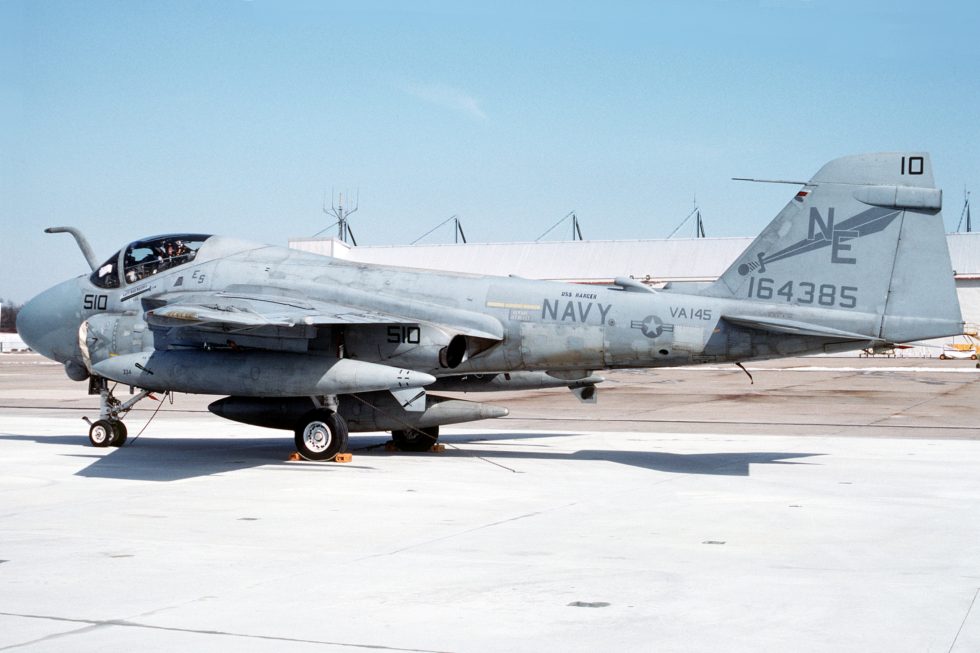
The Intruder in pictures
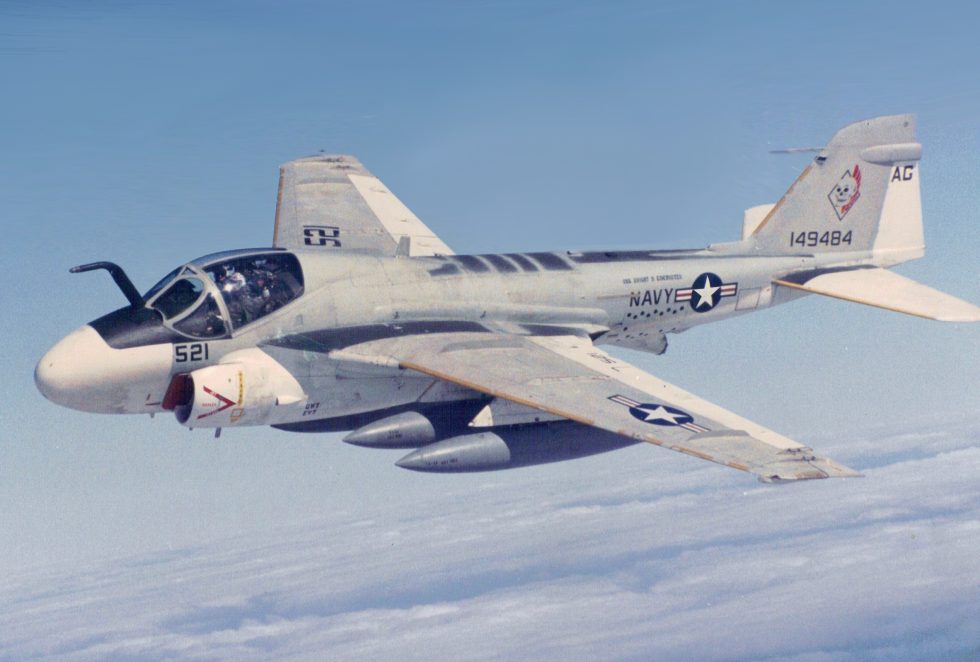
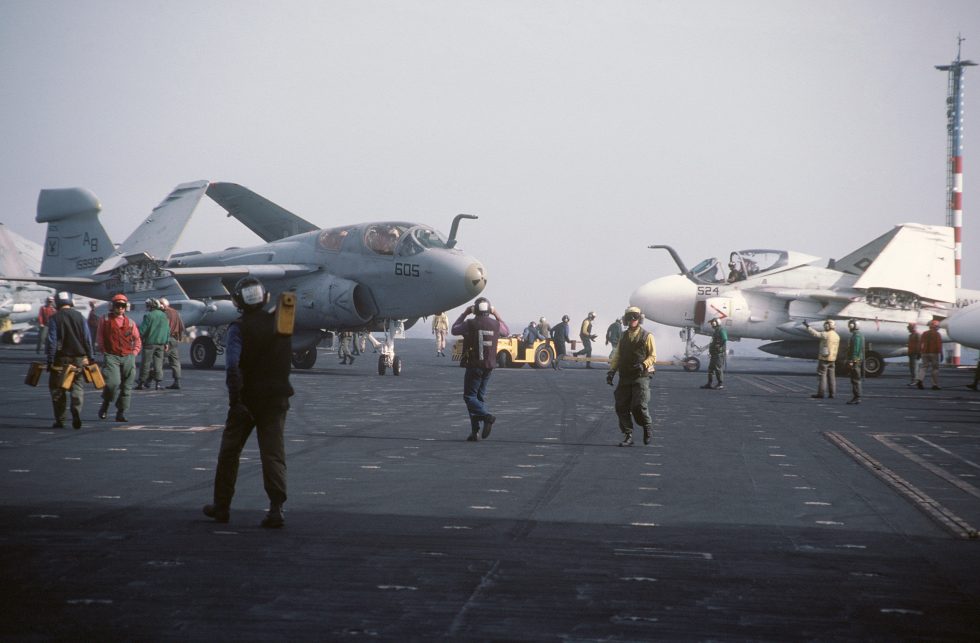
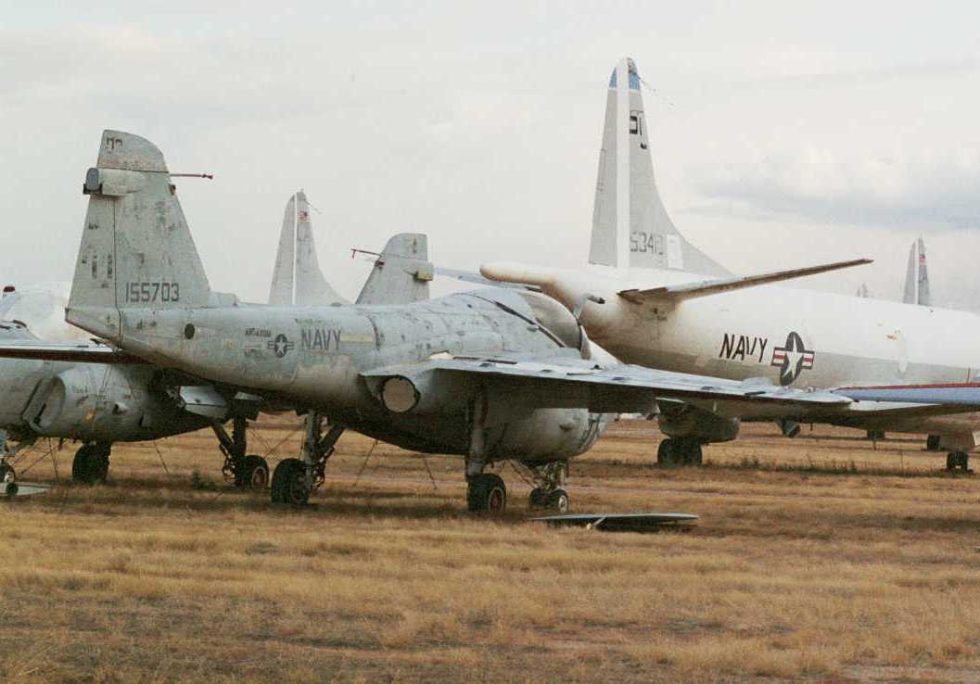
The A-6 Intruder in motion
A dedicated A-6 Intruder video feature is coming soon. In the meantime, explore the gallery above and the twelve stories from the flight deck.
Where the Intruder flew
The record that defines it
The Intruder was a bomber, not a dogfighter — it had no gun and never claimed an air-to-air kill. Its record is written in tonnage delivered precisely, in the worst weather and darkness, into the most heavily defended airspace of four decades of conflict. It paid for that in blood: it was vulnerable at the low altitudes where it worked best.
Compare the combat record of every military aircraft. Figures as of July 2026.
Everything people ask about the A-6 Intruder
Can I fly in an A-6 Intruder?
Can a civilian fly the A-6 Intruder?
Why was the A-6 Intruder so special?
How fast was the A-6 Intruder?
Did the A-6 Intruder have a gun?
What is the difference between the A-6 Intruder and the EA-6B Prowler?
What replaced the A-6 Intruder?
Where can I see an A-6 Intruder today?
You can’t fly the A-6 Intruder.
These, you can.
Some legends only live in museums — others are fuelled and waiting. MiGFlug has put civilians in real military jet cockpits since 2004.
 Fly the L-39 AlbatrosThe world’s most-flown jet trainer — aerobatics included
 Fly the F-104 Starfighter“The missile with a man in it”
 Fly the MiG-21The Cold War’s most-produced jet
 Fly the T-33 Shooting StarAmerica’s first jet trainer
 Fly the DH VampireA piece of early jet history
 Fly the S.211Agile Italian jet trainer
 Fly the MB-326The classic Aermacchi jet
 Fly the MiG-15The Soviet legend of the Korean War
Continue the tour
Every fact, checked
- Naval History and Heritage Command — A-6E IntruderOfficial US Navy specifications, service history and retirement dates.
- The Intruder AssociationCrew-community history of the A-6 programme, DIANE and squadron service.
- GlobalSecurity.org — A-6 IntruderVariants, DIANE avionics and combat-deployment detail.
- The Aviation Geek Club — Intruders over LibyaFirst-hand crew accounts of the 1986 El Dorado Canyon raid.
- Smithsonian National Air and Space MuseumAirframe reference and development background for the A-6E.
- U.S. Naval Institute — EA-6B ProwlerThe Prowler’s electronic-warfare legacy and 2019 retirement.
- Stephen Coonts — Flight of the IntruderThe author, former A-6 bombardier/navigator, on the novel and its origins.
- National Naval Aviation MuseumPreserved A-6E reference and displayed-airframe detail.