
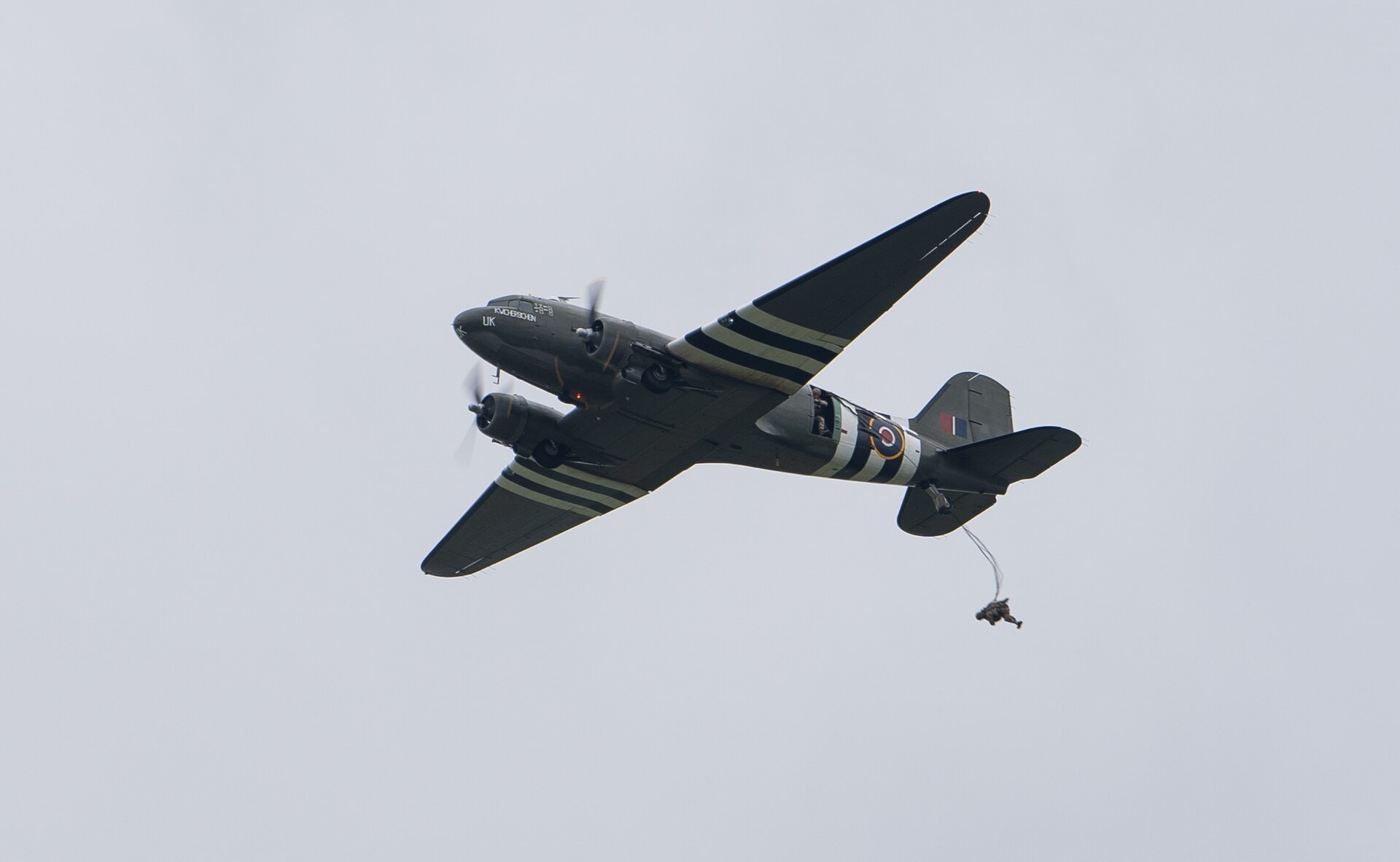
Douglas C-47 Skytrain
The Dakota
The military DC-3 that dropped the paratroopers of D-Day, flew the Hump, opened the Berlin Airlift, landed at the South Pole and, re-engined as the Basler BT-67, still works for air forces today.
The C-47 Skytrain: how an airliner became the workhorse of the war
Shortly before midnight on 5 June 1944, a C-47 named That’s All, Brother lifted off from England at the head of a stream of more than 800 troop carriers. Flown by Lieutenant Colonel John Donalson, it led the main American airborne assault on Normandy, and in the dark hours that followed the Skytrains put more than 13,000 paratroopers over the Cotentin peninsula. The aircraft doing it was not a warplane at heart. It was the Douglas DC-3, the airliner that had made passenger flying pay, given a strengthened floor, a wide double cargo door, a glider hook and a row of bucket seats along each wall. That ordinary origin was its genius: it was rugged, forgiving, easy to maintain and already in mass production when the war needed it most.
The DC-3 family began with the Douglas Sleeper Transport, which first flew on 17 December 1935. By the late 1930s the type carried most of America’s airline traffic, and when the US Army Air Corps needed a standard transport it ordered a militarised version in 1940. The C-47 itself first flew on 23 December 1941, a fortnight after Pearl Harbor. Douglas plants at Long Beach and Oklahoma City turned them out by the thousand; the Army Air Forces had procured some 9,348 by the end of the war, and Douglas built more than 10,000 military DC-3 variants in all. The US Navy called its aircraft the R4D, the RAF and Commonwealth air forces the Dakota, and crews everywhere the Gooney Bird.
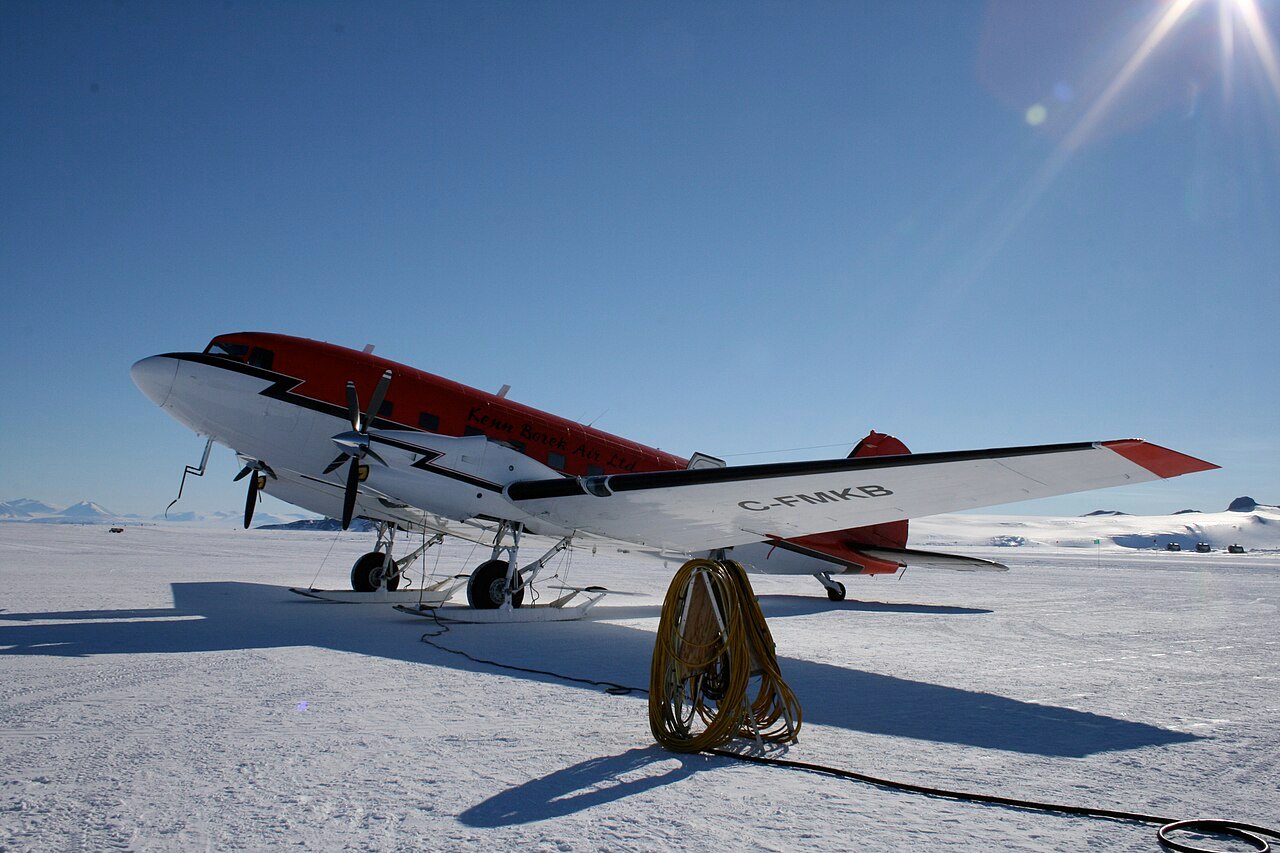
The war did not end the story. C-47s flew the first sorties of the Berlin Airlift in June 1948, carried casualties out of Korea, and in Vietnam became radio-intercept aircraft, psychological-warfare broadcasters and the AC-47 Spooky gunship. A Navy R4D made the first landing at the South Pole in 1956. Surplus aircraft equipped dozens of new air forces after 1945, and from 1990 Basler Turbo Conversions in Oshkosh began rebuilding old airframes as the turboprop BT-67, which flies today on Antarctic ice and with air forces from Colombia to Thailand. More than eighty years after its first flight, the Skytrain has never quite left military service. Few aircraft in history have served so many nations for so long.
01The C-47’s D-Day: the night of the troop carriers
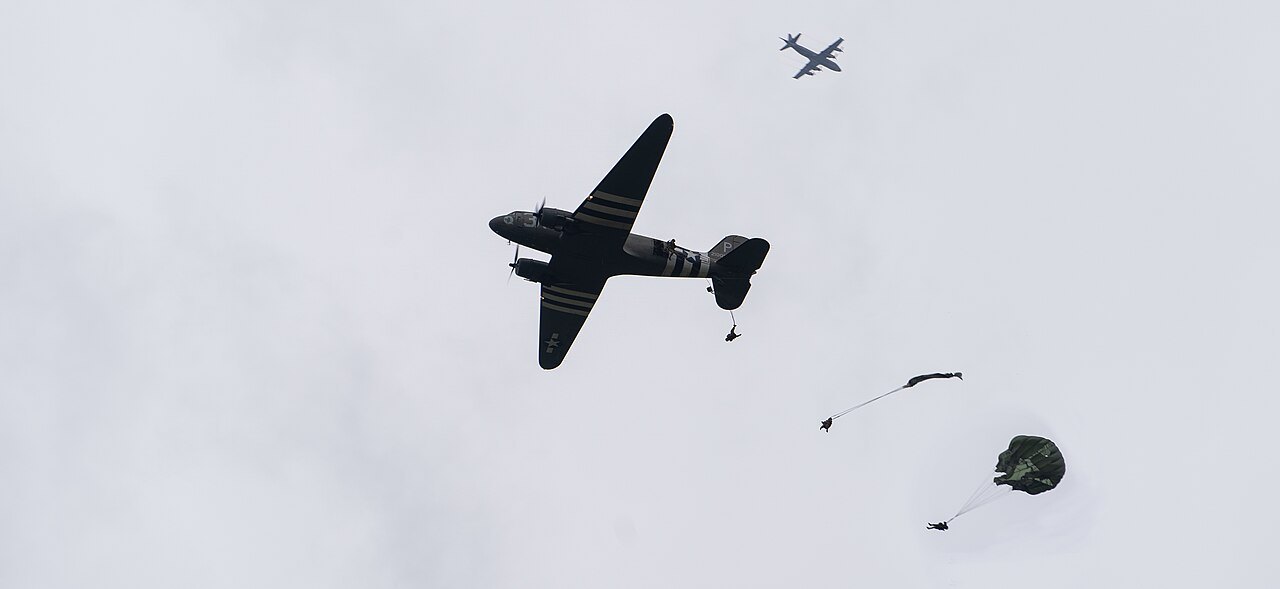
The airborne assault on Normandy was, above all, a C-47 operation. The troop carrier groups of the US Ninth Air Force flew the American 82nd and 101st Airborne Divisions to their drop zones behind Utah Beach, while RAF Dakotas carried much of the British 6th Airborne Division to the east. At the head of the main American stream flew That’s All, Brother, piloted by Lieutenant Colonel John Donalson; behind it came more than 800 C-47s that dropped over 13,000 paratroopers.
It was a brutal night for the crews. They flew low and slow in tight formation, without armour or self-sealing tanks in many aircraft, into cloud banks over the coast and then into flak and small-arms fire. Formations broke up, and many sticks of paratroopers landed miles from their drop zones. Yet the scattered drops confused the German defenders as much as the attackers, and the airborne troops seized enough causeways and crossroads to help the beach landings succeed.
The C-47s came back for the next airborne operations: Dragoon in southern France, Market Garden in the Netherlands and Varsity across the Rhine in March 1945. That’s All, Brother flew most of them. Sold to civilian owners after the war, it lost its identity for decades until two Air Force Reserve historians traced it to a boneyard in Wisconsin. The Commemorative Air Force restored it to its 1944 configuration, and it flew back over the Normandy drop zones for the 75th anniversary in 2019.
02The C-47’s long afterlife: from the Berlin Airlift to the Basler BT-67
When the Soviet Union closed the land routes into West Berlin in June 1948, the aircraft immediately to hand were C-47s, and the Smithsonian credits them with starting the Berlin Airlift. USAF Skytrains and RAF Dakotas flew the first weeks of the lift until the bigger four-engined C-54 Skymaster took over the bulk of the work. In Korea, C-47s flew supplies, flare missions and casualty evacuation from rough strips; in Southeast Asia the US Air Force fitted them with side-firing miniguns as the AC-47, with direction-finding receivers as the EC-47 and with loudspeakers for psychological operations.
Meanwhile tens of thousands of hours of airline and military flying created a global fleet of tired but sound airframes. The fix was turbine power. Basler Turbo Conversions was founded in 1990 to convert existing C-47 and DC-3 airframes into the BT-67: Pratt & Whitney Canada PT6A-67R turboprops with five-blade Hartzell propellers, a lengthened fuselage, strengthened structure and modern systems, certificated to FAR Part 25 standards. Around seventy have been built. The Colombian Air Force armed its conversions as gunships for counter-insurgency, other air forces in Latin America, Africa and Asia use them as transports and patrol aircraft, and ski-equipped BT-67s operated by Kenn Borek Air carry scientists across Antarctica. South Africa ran its own turboprop conversion, the C-47TP, for maritime patrol and transport.
What makes the C-47 Skytrain special
An airliner built for abuse
The DC-3 was designed around a multi-cell wing structure of great strength, and the military C-47 added a reinforced cargo floor, large double doors on the left side and fittings for paratroop static lines, stretchers and a glider tow hook. The result could carry 28 troops, 18 to 22 fully equipped paratroopers, about 6,000 lb of cargo or 18 stretchers with medical staff, and it tolerated overloading, rough strips and battle damage that would have grounded more delicate types.
Two Twin Wasps and a forgiving wing
Two Pratt & Whitney R-1830 Twin Wasp radials of 1,200 hp gave a maximum speed of about 224 to 232 mph and a range of around 1,500 to 1,600 miles. The big, gently loaded wing gave docile low-speed handling, so pilots trained in a hurry could fly it into short fields, and it would keep flying on one engine. Its tailwheel layout and steep cabin floor on the ground are the price paid for that simple, robust design.
One airframe, a hundred jobs
Over its life the C-47 has been a troop carrier, glider tug, air ambulance, VIP transport, navigation trainer, radar and radio-intelligence platform, ski-equipped polar aircraft, crop sprayer, firefighter and gunship. Rarely has a single airframe been adapted to so many missions by so many services, and its systems were simple enough that small air forces could keep it flying for decades with modest workshops and spare parts from a global pool.
03The C-47’s cabin and systems: inside the Gooney Bird
The crew of the C-47 sat side by side in a cockpit that was essentially that of the airliner, with a navigator and radio operator behind them in wartime aircraft and a crew chief in the cabin. The cabin itself was a long tube with folding troop seats along both walls, tie-down rings in the floor and a cargo door on the left rear fuselage large enough for a jeep or a light artillery piece to be loaded with ramps. An astrodome above the navigator’s station allowed celestial navigation over ocean and jungle.
The paratroop version carried a jump door, static-line cable and signal lights; jumpmasters stood the stick up at the red light and went at the green. Glider towing used a hook beneath the tail, and late in the war crews practised the extraordinary snatch pickup, hooking a glider off the ground from low level. The Navy’s R4Ds added equipment for naval logistics, and Antarctic aircraft wore large skis over their wheels. In every version the fundamentals stayed the same: cable-operated controls, hydraulically retracting main gear and two big radials that rewarded careful handling with long lives.
Douglas C-47 Skytrain specifications
Specifications
- Crew
- 3 to 4 (pilot, co-pilot, navigator, radio operator)
- Capacity
- 28 troops, 18–22 paratroopers, 18 stretchers or about 2,700 kg (6,000 lb) of cargo
- Length
- 19.43 m (63 ft 9 in)
- Wingspan
- 29.11 m (95 ft 6 in)
- Height
- 5.18 m (17 ft 0 in)
- Empty weight
- 8,226 kg (18,135 lb)
- Max take-off weight
- 14,061 kg (31,000 lb)
- Powerplant
- 2 × Pratt & Whitney R-1830-90C Twin Wasp radials, 1,200 hp (895 kW) each
- Maximum speed
- about 360–373 km/h (224–232 mph)
- Cruise speed
- about 257 km/h (160 mph)
- Range
- about 2,400–2,600 km (1,500–1,600 mi); ferry about 5,800 km (3,600 mi)
- Service ceiling
- 8,050 m (26,400 ft)
Costs & production
- Unit cost
- Commonly given as about US$138,000 per C-47 in wartime dollars; contract prices varied by batch
- Cost per flight hour
- Hedged estimate for a privately operated C-47 or DC-3 today: roughly US$3,000–5,000, driven by two radials burning on the order of 90–100 US gallons of avgas an hour plus overhaul reserves; operator figures vary widely
- Production
- 9,348 procured by the USAAF by the end of the war; more than 10,000 military DC-3 variants built by Douglas, plus roughly 3,000 or more Li-2s in the USSR and nearly 500 L2Ds in Japan
- Programme
- DC-3 first flight 1935, C-47 first flight 1941; Basler BT-67 turboprop conversions from 1990, around 70 completed
04The C-47’s variants: from Skytrain to Basler BT-67
- C-47, C-47A, C-47B: the main wartime production versions; the B had supercharged engines for high-altitude routes such as the Hump.
- C-53 Skytrooper: a lighter troop-carrier version without the big cargo door.
- R4D: US Navy and Marine Corps designation; the R4D-5L and R4D-8 among later versions.
- Dakota I to IV: RAF and Commonwealth names for the C-47 family.
- C-117 and Super DC-3: post-war rebuilt versions with longer fuselage and new tail.
- AC-47 Spooky, EC-47, VC-47: Vietnam-era gunship, electronic reconnaissance and VIP versions.
- Lisunov Li-2: Soviet licence-built derivative with Shvetsov engines; Showa/Nakajima L2D in Japan.
- C-47TP: South African turboprop conversion.
- Basler BT-67: Oshkosh-built PT6A-67R turboprop remanufacture with stretched fuselage, around 285 kt maximum speed, 210 kt cruise, 38 passengers and up to 2,140 nm range with long-range tanks.
05The C-47’s operating costs: radials versus turbines
A wartime C-47 was cheap because it was mass-produced on airliner tooling. Running one today is another matter. The R-1830 radials need skilled engineers, overhauls and avgas, which is increasingly expensive and scarce outside North America and Europe; warbird operators budget accordingly, and the figures above are an estimate rather than a published rate. The Basler conversion attacks exactly this problem: PT6A turboprops burn jet fuel available at any military airfield, need far less routine maintenance and add power for hot-and-high and ski operations, which is why air forces and polar operators have paid for rebuilt airframes rather than new aircraft.
The C-47 from the DC-3 to the Basler BT-67
The family flies
The Douglas Sleeper Transport, first of the DC-3 family, makes its first flight on 17 December.
The Army orders
The US Army Air Corps orders the first militarised C-47s.
C-47 first flight
The first C-47 flies on 23 December, two weeks after Pearl Harbor.
Sicily
C-47s drop more than 4,000 Allied paratroopers in the invasion of Sicily, the first big Allied airborne assault.
D-Day and Arnhem
More than 800 C-47s drop over 13,000 paratroopers into Normandy; in September Dakotas resupply the British at Arnhem under heavy fire.
Across the Rhine
Operation Varsity; the USAAF has procured 9,348 C-47s by the end of the war.
Berlin Airlift
USAF C-47s and RAF Dakotas fly the first sorties of the airlift into blockaded Berlin.
South Pole
The US Navy R4D-5L Que Sera Sera makes the first aircraft landing at the South Pole on 31 October.
Spooky
Gunship conversions armed with miniguns go to war in Vietnam as the AC-47.
Basler Turbo Conversions
Basler is founded in Oshkosh to rebuild C-47s and DC-3s as the turboprop BT-67.
Back to Normandy
A fleet of C-47s and DC-3s, That’s All, Brother among them, crosses the Channel again for the 75th anniversary of D-Day.
Stories & eyewitnesses: the C-47 at war and on the ice
That’s All, Brother leads the way
The lead aircraft of the American airborne assault on D-Day survived a boneyard to fly again.
Read the full story
Flight Lieutenant David Lord at Arnhem
A burning Dakota went round again so its crew could finish the drop.
Read the full story
The glider snatch at Remagen
A C-47 hooked a glider full of wounded off the ground and towed it home.
Read the full story
Over the Hump
Skytrains carried China’s war supplies over the Himalaya.
Read the full story
Opening the Berlin Airlift
The aircraft on hand in June 1948 were Skytrains.
Read the full story
Que Sera Sera lands at the South Pole
A ski-equipped Navy R4D made the first landing at 90 degrees south.
Read the full story
Puff the Magic Dragon
Three miniguns turned the old transport into a night gunship.
Read the full story
Eisenhower’s list
A general counted the C-47 among the tools that won the war.
Read the full story
Basler BT-67s on the ice
Eighty-year-old airframes still carry scientists across Antarctica.
Read the full story
The last C-47 in routine USAF use
Dayton keeps a Skytrain that served into the 1970s.
Read the full story
The C-47 in pictures
Where the C-47 flies and flew
The C-47 Skytrain’s record
The C-47 was unarmed for most of its career, yet few aircraft saw more war. It carried paratroopers and towed gliders in every major Allied airborne operation of the Second World War, flew supply and casualty evacuation in Korea, and in Vietnam served as gunship, electronic-intelligence platform and transport. Its losses were heavy on nights like D-Day and at Arnhem, where it flew low and slow into fire.
See how training and combat types compare in the military aircraft statistics database. Figures are approximate.
Everything people ask about the C-47
Can I fly in a Douglas C-47 Skytrain?
What is the difference between the DC-3, C-47 and Dakota?
How many C-47s were built?
How many paratroopers could a C-47 carry?
Is the C-47 still in military service?
What is the Basler BT-67?
Where can I see a C-47 today?
You can’t fly the C-47.
These, you can.
Most of this museum you can only look at. These genuine military jets you can fly yourself with MiGFlug — with aerobatics and time on the controls.
 Fly the L-39 AlbatrosThe world’s most-flown jet trainer — aerobatics included
 Fly the F-104 Starfighter“The missile with a man in it”
 Fly the MiG-21The Cold War’s most-produced jet
 Fly the T-33 Shooting StarAmerica’s first jet trainer
 Fly the DH VampireA piece of early jet history
 Fly the S.211Agile Italian jet trainer
 Fly the MB-326The classic Aermacchi jet
 Fly the MiG-15The Soviet legend of the Korean War
Continue the tour
Every fact, checked
- Douglas C-47D SkytrainNational Museum of the US Air Force: production, capacity, specs and the Remagen glider snatch
- Douglas DC-3Smithsonian National Air and Space Museum on DC-3 origins, production and the Berlin Airlift
- That’s All, BrotherCommemorative Air Force on the D-Day lead aircraft, its pilot, rediscovery and restoration
- BT-67 SpecificationsBasler Turbo Conversions on the BT-67’s engines, propellers and cabin
- Basler historyManufacturer history of the turboprop conversion programme
- Basler BT-67 aircraftAustralian Antarctic Division on BT-67 operations, range and payload
- D-Day 75th anniversary: Miss Montana flight to NormandyCBS News on the 2019 Channel crossing by restored C-47s