
Douglas AC-47 Spooky
“Puff the Magic Dragon”
The first American fixed-wing gunship — a WWII-era Dakota transport turned night dragon, pouring minigun fire from a slow banking turn to save hamlets and outposts across Vietnam.
The AC-47 Spooky: a transport turned night dragon
By the mid-1960s the war in South Vietnam had a cruel rhythm. In daylight, American air power dominated; after dark, the Viet Cong emerged to overrun the isolated hamlets, Special Forces camps and outposts that dotted the countryside. Fast jets screaming overhead could not deliver sustained, accurate fire onto a single besieged fort in the dark without hitting the friendly troops packed inside its perimeter. What the defenders needed was an aircraft that could loiter for hours and put a continuous, precise stream of fire exactly where it was wanted.
The answer was an old idea finally made to work. Firing sideways from a banking aircraft — so that a steady turn keeps the guns trained on one spot on the ground — had been demonstrated as far back as the 1920s and was revived in the early 1960s by engineer Ralph Flexman and a small circle of believers. The U.S. Air Force tested it under Project Tailchaser and then bolted three side-firing 7.62mm miniguns into the left side of a C-47 — the military version of the Douglas DC-3 airliner, a rugged transport that had already flown through the Second World War as the Dakota and Skytrain.
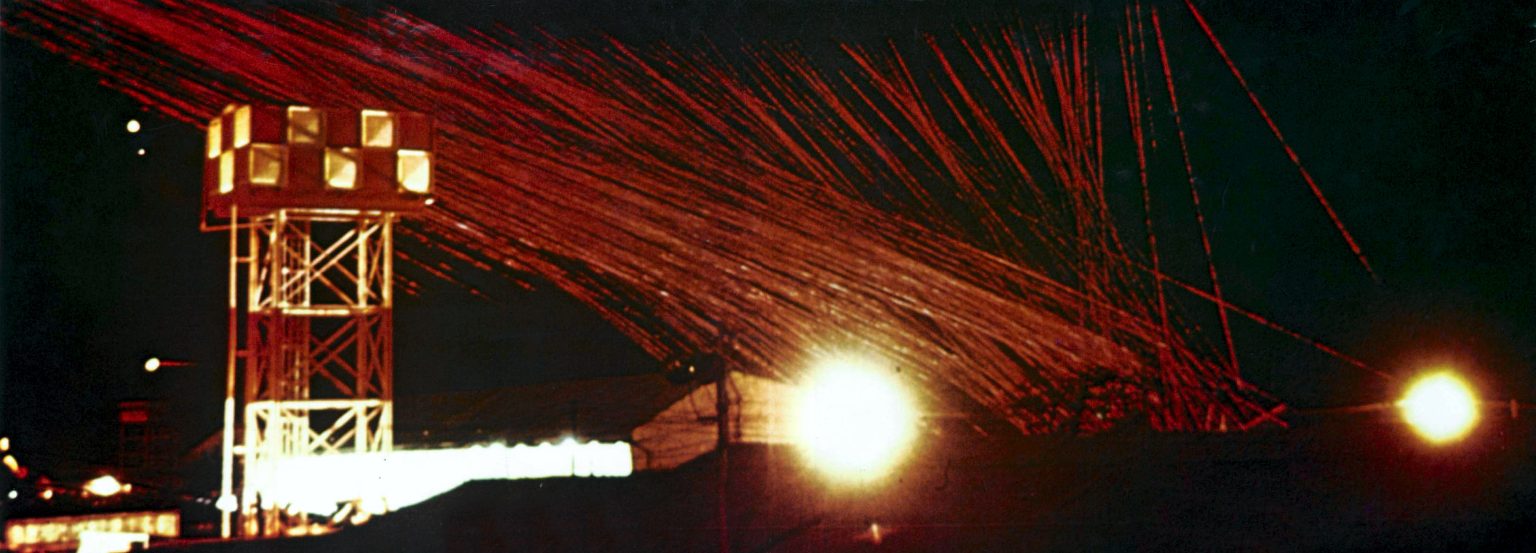
It worked spectacularly. On its first combat missions in December 1964 the gunship — first designated FC-47, soon redesignated AC-47 — broke night attacks that had been overwhelming outposts. Circling in a left-hand “pylon turn,” the pilot could saturate an area the size of a football field in seconds. To the South Vietnamese troops below, the solid rope of glowing tracer pouring from the sky earned it the name Dragonship; the Americans gave it the radio call sign “Spooky” and the affectionate nickname “Puff the Magic Dragon,” after the Peter, Paul and Mary song then on the radio. It also carried powerful magnesium flares to turn night into day.
Spooky flew the dangerous, unglamorous work of close air support and night defence, and it is remembered for saving countless defenders — a much-repeated claim holds that no outpost it defended was ever overrun. Its crews paid for that record: on 24 February 1969, gravely wounded, Airman First Class John Levitow smothered a burning flare inside his aircraft and dragged it out before it could destroy the ship, an act that earned the Medal of Honor. By the end of the decade the AC-47 was handed to the South Vietnamese, Lao and Cambodian air forces as the far heavier AC-130 took over — but every side-firing gunship since traces its bloodline directly to Puff.
01The AC-47 Spooky’s origins: how the pylon-turn gunship idea finally flew
The concept of firing sideways from a circling aircraft was not new — it had been shown to work in the 1920s and 1930s — but it was revived in earnest in the early 1960s. Bell engineer Ralph Flexman championed the idea, and after wind-tunnel and flight studies the U.S. Air Force ran live tests under Project Tailchaser. Captain Ronald Terry and a small team fitted podded 7.62mm miniguns to a C-47 and proved that a gentle left bank held the guns steadily on a ground target. Rushed to Vietnam for a combat evaluation in December 1964, the gunship’s results were so dramatic — broken sieges, shattered night attacks — that the type was adopted almost immediately and a dedicated squadron formed in 1965.
What makes it special
A gunship built from a 1930s airliner
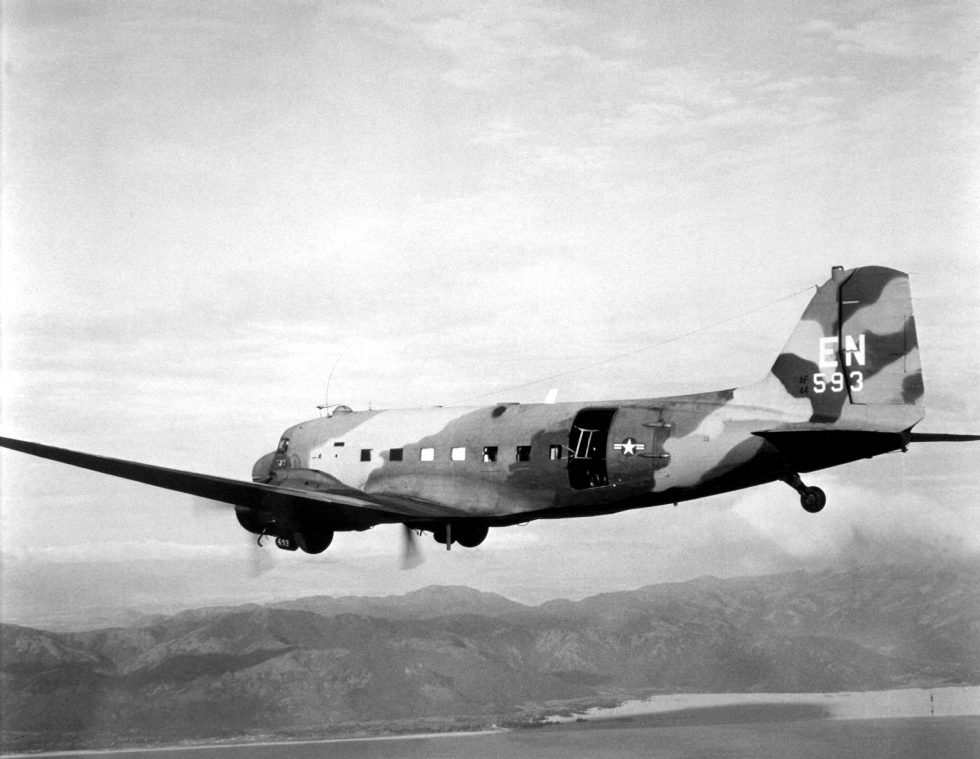
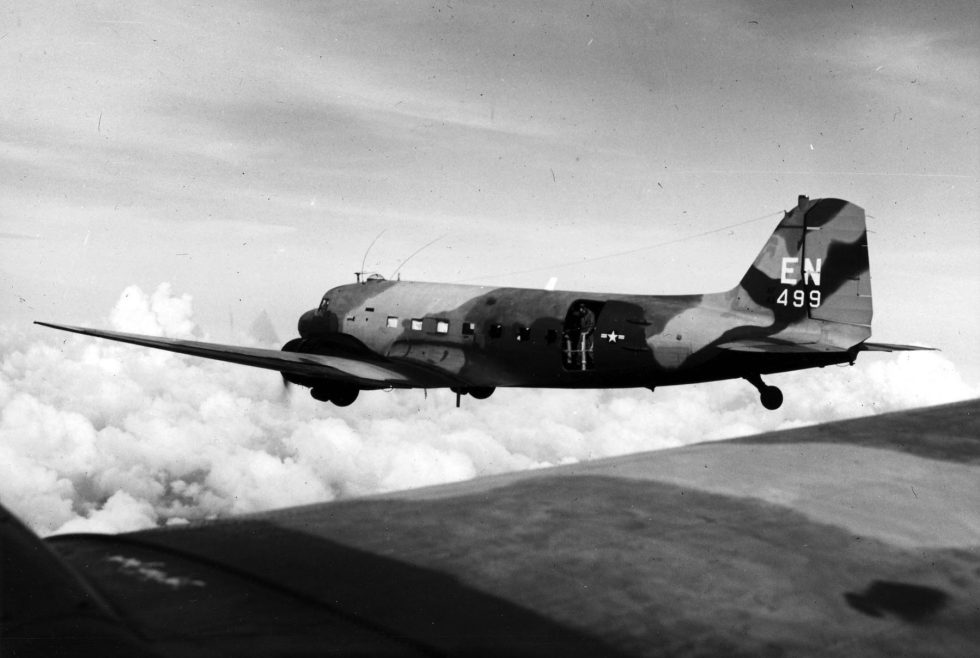
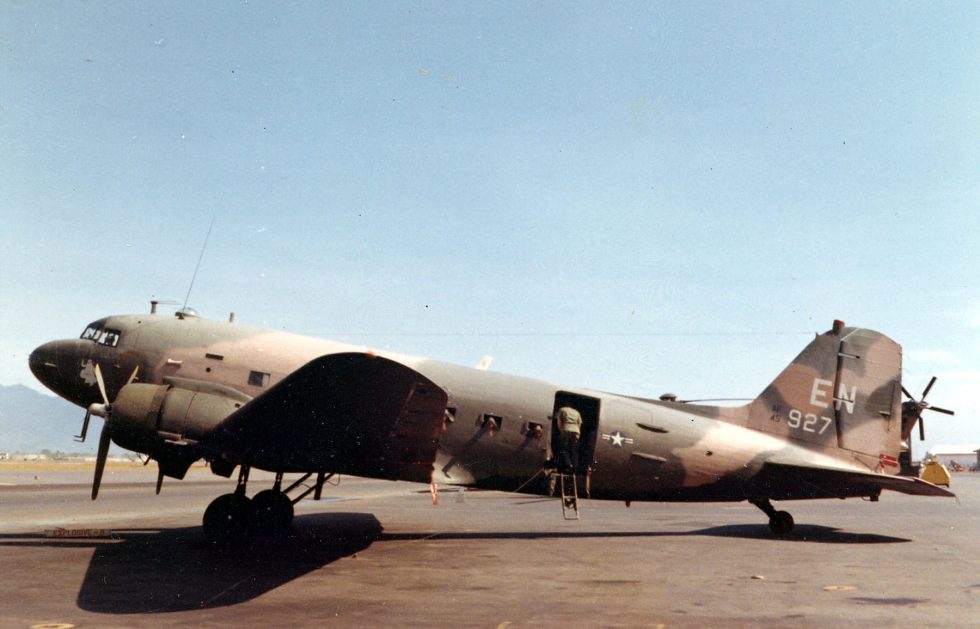
The AC-47 was a converted C-47 Skytrain — the military DC-3, one of the most rugged and plentiful aircraft ever built. It was slow and unpressurised, but it could loiter for hours at low altitude carrying guns, tens of thousands of rounds and a load of flares. Surplus airframes were everywhere, making the gunship cheap to field when the war demanded it.
Three side-firing miniguns
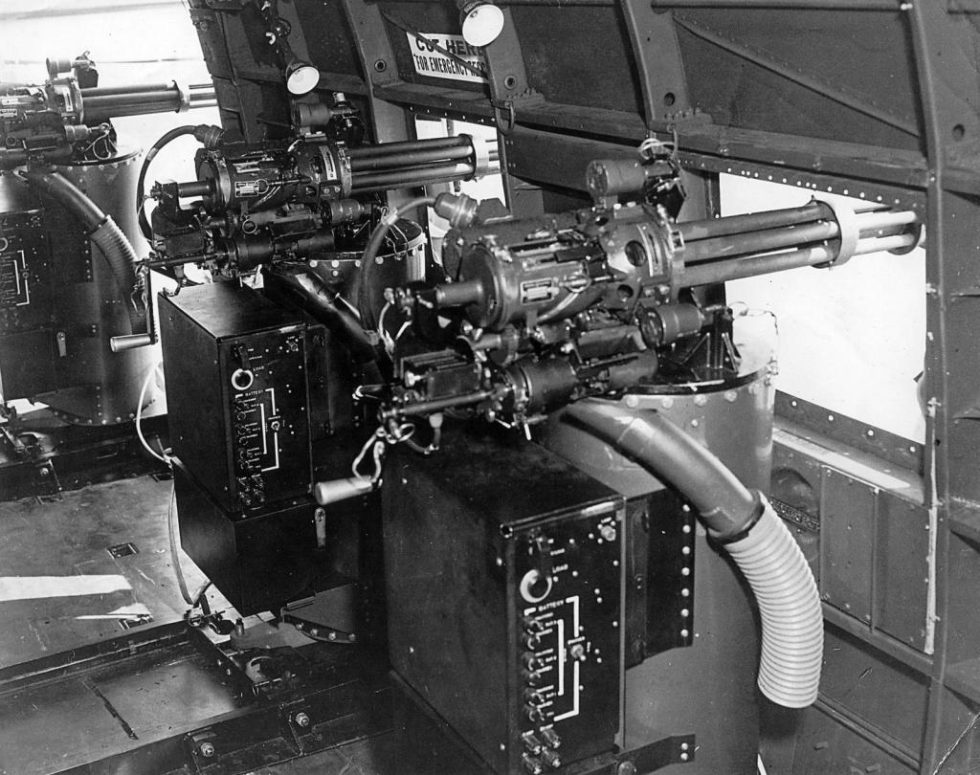
Its weapon was three 7.62mm General Electric miniguns (SUU-11 gun pods, later the MXU-470 module; the GAU-2/M134 family), all pointing out of the left side through the rear windows and cargo door. Each could fire up to 6,000 rounds per minute, usually set lower in service. Fired together they laid down an almost unbroken curtain of fire.
Flares that turned night into day
Spooky carried up to about 45 Mk 24 magnesium flares, each burning at roughly two million candlepower. Dropped over a contact, they stripped the enemy of the cover of darkness and let the crew — and the defenders on the ground — see what they were fighting.
02The AC-47 Spooky’s guns: how three miniguns saturated a target
Each minigun was an electrically driven six-barrel Gatling firing the 7.62×51mm NATO round. A single gun could reach 6,000 rounds per minute; with three firing, Spooky could put thousands of rounds into a small area in seconds. Carrying on the order of 24,000 rounds, it is commonly said the aircraft could place a bullet into every square yard of a football-field-sized area in a few seconds — a vivid claim that is widely repeated and gives a fair sense of the density of fire, even if the exact geometry is hard to pin down. Every fifth round or so was a tracer, which is what produced the unbroken glowing line the troops below described.
03The AC-47 Spooky’s tactics: flying the pylon turn at night
Because the guns were fixed to fire out the left side, the aircraft itself was the aiming system. The pilot rolled into a steady left bank — a pylon turn — at roughly 3,000 feet and around 120 knots, pivoting the aircraft around an imaginary pole planted on the target. Sighting through a simple gunsight in his side window, he walked the fire onto the enemy while circling. It was deadly effective but left the slow, low, predictable gunship exposed to ground fire, which is exactly how several were lost.
Full specifications
Baseline note: the figures below describe the USAF AC-47D as it stood in 1966–68 — a wartime C-47D transport rebuilt with three side-firing 7.62 mm minigun modules, the standard against which every later gunship was measured. Deltas for the December 1964 FC-47 prototypes, which used borrowed SUU-11/A pods, and for the .50 in-armed Thai, Cambodian, Indonesian, South African and Salvadoran conversions are in grey. Four disagreements are worth settling before the tables start. First, the airframe dimensions: the gunship literature gives 19.63 m (64 ft 5 in) long and 28.96 m (95 ft 0 in) in span, while standard C-47 data gives 19.43 m (63 ft 9 in) and 29.11 m (95 ft 6 in) for the same aeroplane. Nothing was done to a Spooky that could change either figure; the gap is a datum and rounding artefact, and both sets are quoted below. Second, the ammunition load, for which published figures run 15,000, 21,000 and 24,000 rounds — all three are true of different aircraft on different nights, because the load was traded against flares and fuel. Third, the losses: the most-cited tally is 19 airframes lost from the 41 sent to Vietnam, 12 of them to enemy action, but 15 is also widely printed. Fourth, and least forgivable, a number of otherwise careful accounts date John Levitow’s Medal of Honor action to February 1968. It was 24 February 1969.
Dimensions & weights
- Crew
- 7 — aircraft commander, copilot, navigator, flight engineer, loadmaster and two gunners. An eighth seat was frequently filled by a Vietnamese observer, carried to talk to the friendly troops below, confirm that the shapes in the dark were not a village, and give the strike its legal authority. On the night Levitow was hit there were eight men aboard, five of them working in the cargo compartment
- Length
- 19.63 m (64 ft 5 in) in the gunship sources; standard C-47 data gives 19.43 m (63 ft 9 in). The conversion changed nothing forward of the tailwheel, so the difference is bookkeeping
- Wingspan
- 28.96 m (95 ft 0 in); the C-47 airframe tables say 29.11 m (95 ft 6 in)
- Height
- 5.16 m (16 ft 11 in) tail down on the ground
- Wing area
- 91.7 m² (987 sq ft) — an enormous wing for the weight, and the single reason the whole idea worked. A gunship must fly a steady banked circle for hours at a speed low enough to keep the target in the sight, and no aeroplane in the 1964 inventory did that as patiently as a Dakota
- Aerofoil
- NACA 2215 at the root, NACA 2206 at the tip — a thick, docile, 1934 section with gentle stall behaviour. Spooky crews spent their whole sortie at 30° of bank and 120 kn, which is exactly where a less forgiving wing would have killed them
- Empty weight
- 8,201 kg (18,080 lb) as converted, against 8,226 kg (18,135 lb) for a plain C-47. The guns, mounts, armour and flare racks weighed almost exactly what the removed cargo fittings and seats did
- Combat gross weight
- ~13,600 kg (30,000 lb) on a typical night launch — full fuel, three loaded modules, some 21,000 rounds in cans and forty-odd flares strapped down aft
- Maximum take-off weight
- 14,969 kg (33,000 lb), which is the C-47’s wartime overload limit rather than its normal 11,793 kg (26,000 lb) gross. A fully bombed-up Spooky was flying at the top of its structural envelope every night for five years, off pierced-steel planking, in tropical air
- Wing loading
- 163 kg/m² (33.4 lb/sq ft) at maximum weight. Low by any standard, and the reason a Spooky could hold a tight orbit at low airspeed without falling out of the sky when the pilot pulled harder to keep the sight on a moving target
- Power loading
- 6.24 kg/hp (13.75 lb/hp) at maximum weight on two 1,200 hp engines. This is the number that eventually retired the type: an AC-47 with an engine shot out and a full ammunition load could not hold altitude, and several were lost exactly that way
- Internal fuel
- ~3,040 L (804 US gal, 669 imp gal) in four wing tanks. Enough for a full night on station, which mattered more than anything else the aeroplane did — a jet could arrive faster but could not stay
- Ammunition load
- ~21,000 rounds of 7.62×51 mm linked, in cans stacked along the cabin floor, roughly 640 kg (1,400 lb) of ammunition alone. Sources give 15,000, 21,000 and 24,000; the load was traded against flares and fuel from night to night. At the maximum rate of fire the entire load could be gone in seventy seconds, so nobody ever fired at the maximum rate for long
- Flare load
- ~45 Mk 24 Mod 3 parachute flares (published fits run from 24 to 56), each a 12 kg (27 lb) magnesium canister burning at around two million candlepower for three minutes. They were stowed loose in the cabin and thrown out of the open cargo door by hand
- Unit cost
- Effectively nil for the airframe — every AC-47 was an already-paid-for wartime C-47 pulled from the transport fleet, and the only real expenditure was the gun modules and the labour. That arithmetic is precisely why the programme survived a service that had no interest in armed transports; the first twenty conversions were done by Air International at Miami, Florida
Performance
- Maximum speed
- 370 km/h (230 mph, 200 kn), which no crew ever had cause to use. The Spooky’s tactical problem was never getting there quickly
- Cruising speed
- 282 km/h (175 mph, 152 kn) in transit to and from the orbit
- Firing orbit speed
- 222 km/h (138 mph, 120 kn) indicated, in a left-hand pylon turn at about 30° of bank. This one line is the aeroplane: hold that speed, that bank and that height and the wingtip stays pinned on a fixed point on the ground, and the guns stay pointed at it indefinitely
- Firing altitude
- 900 m (3,000 ft) above the ground was standard, sometimes lower over friendly perimeters and higher where anti-aircraft fire was expected. Below about 600 m (2,000 ft) small arms became lethal; above about 1,500 m (5,000 ft) the crew could no longer see what it was shooting at
- Slant range to target
- ~1,700 m (5,600 ft) from a 900 m orbit, with the guns depressed roughly 12° below the horizontal and the bank doing the rest of the aiming. At that range the minigun’s dispersion spread the burst into a cone several metres across, which was the point
- Density of fire
- Three guns at 6,000 rounds per minute each — 300 rounds a second, enough to put a round into every square metre of a target the size of a football pitch in about three seconds. Every fifth round was tracer, so the stream appeared solid: this is where the dragon’s breath came from
- Stalling speed
- 124 km/h (77 mph, 67 kn) flaps down, clean and light. The margin between the stall and the firing orbit was comfortable in the cold, and much less so hot, high, heavy and in a steep turn
- Rate of climb
- 5.7 m/s (1,130 ft/min) at light weight; nearer 3 m/s (600 ft/min) at gunship weights, and negative on one engine with a full load. This is not a performance figure so much as an epitaph
- Service ceiling
- 7,450 m (24,450 ft), an irrelevance. Spooky worked between 600 and 1,500 m and everything above that was for ferry flights
- Range
- ~3,500 km (2,175 mi, 1,890 nmi) ferry. Operationally the number that mattered was the radius from Tan Son Nhut, Nha Trang, Da Nang, Pleiku, Binh Thuy or Udorn to a hamlet, which was usually well under an hour
- Endurance on station
- ~5 hours typical, and longer if the ammunition ran out first. Standard practice was to sit over a threatened outpost all night, orbiting in the dark with everything switched off, and only announce the aeroplane’s presence by opening fire
- Reaction time
- Minutes — on the first combat sortie, on the night of 23–24 December 1964, an FC-47 arrived over the Tranh Yend Special Forces camp in the Mekong Delta 37 minutes after the request, fired 4,500 rounds and broke the attack. Nothing else in theatre could loiter overhead for hours and then deliver that weight of fire within metres of a friendly wire
Propulsion & systems
- Engines
- 2 × Pratt & Whitney R-1830-90C or -90D Twin Wasp 14-cylinder two-row air-cooled radials — the most-produced aero engine in history, entirely unremarkable and entirely reliable, which in an aeroplane orbiting over hostile ground for five hours a night is the whole of the argument
- Take-off power
- 1,200 hp (895 kW) each at 2,700 rpm, 1,000 hp continuous at 4,400 m (14,500 ft)
- Supercharger
- Single-stage, single-speed — the C-47D designation means a C-47B with the second, high-blower supercharger speed disabled or removed after 1945. It cost high-altitude performance the gunship never needed and simplified an engine the gunship needed to keep running
- Propellers
- 2 × Hamilton Standard 23E50 three-blade constant-speed fully feathering units, 3.51 m (11 ft 6 in) diameter
- Guns
- 3 × 7.62 mm General Electric miniguns firing to port — two through the fifth and sixth cabin window openings, the third through the open cargo doorway. Selectable 3,000 or 6,000 rounds per minute per gun. The mounts were not on the airframe centreline and the recoil, about 130 kg (300 lb) per gun firing, was fed straight into the fuselage frames
- Gun modules
- SUU-11A/A pods or MXU-470/A modules — the first aircraft used SUU-11/A and SUU-11A/A pods designed for helicopters and aircraft wing pylons, hurriedly clamped into locally welded cabin mounts because the purpose-built module was late. The General Electric MXU-470/A, delivered from 1965, was a self-contained gunship module: a rotating 2,000-round drum magazine under the gun, feeding a linkless system that a loadmaster could reload in the dark
- Fire control
- A switch on the pilot’s yoke and a selector panel at the gunner’s station that decided which guns were live and at what rate. That is the entire system. The pilot fired; the navigator and gunners kept the modules fed and cleared jams, which were constant
- Sight
- Mk 20 Mod 4 reflector sight — a gunsight taken off an A-1 Skyraider and bolted into the left cockpit side window, aligned so the pilot aimed by flying the aeroplane. There was no computing sight, no radar, no low-light television and no infrared. Spooky hit what its pilot could see
- Illumination
- Mk 24 Mod 3 parachute flares deployed by hand: the loadmaster pulled the safety pin, set the ten-second fuse and threw the canister out of the cargo door on the crewman’s lanyard. It is a startlingly primitive procedure to find at the heart of the most feared weapon in the theatre, and it is what put an armed, burning flare loose inside Spooky 71
- Protection
- Local armour plate and flak curtains around the cockpit and gun positions, fitted piecemeal in theatre. There were no self-sealing tanks worth the name, no fire-suppression system, no ejection seats and no armour under the wing. An aeroplane that advertises its own position with tracer, orbits predictably for minutes at a time and cannot climb away is defended by darkness and by nothing else
- Avionics
- UHF, VHF and FM radios — the FM set was the important one, because it let the crew talk directly to the soldier in the trench who was calling the fire. Navigation was ADF, a compass and a navigator with a map and a flare
- Retained transport fit
- Cargo floor, tie-downs and the doorway — the AC-47 remained a C-47 in every structural sense, so it could still carry freight, and the cargo door it fired through was the same one paratroopers had jumped from over Normandy twenty years earlier
04The AC-47 Spooky’s cost: what a converted gunship was worth
Because the AC-47 was not built new but converted from surplus C-47 transports already in the inventory, there is no meaningful flyaway unit price for it — the “cost” was mostly the guns, ammunition-handling gear, flare systems and the labour to install them onto an airframe the Air Force already owned. No reliable public cost-per-flight-hour figure exists for the type either. Any precise dollar figure attached to an AC-47 should be read as an estimate; its real value lay in taking a cheap, abundant, decades-old airframe and turning it into a weapon that was, hour for hour, extraordinarily effective at night defence.
Armament & payload
Spooky carried one weapon, pointed sideways, and it changed how air forces think about ground attack
The AC-47’s armament list is three lines long and every other line on it is a flare. Three 7.62 mm miniguns fired to port — two through cabin window openings, one through the cargo doorway — and the aeroplane aimed them by flying a pylon turn, a banked circle flown at the exact combination of height and speed at which the wingtip appears to pivot on one fixed point of ground. Hold the turn and the guns are locked on that point for as long as the ammunition lasts. Nothing about that is new: an Army pilot named Fred Nelson had demonstrated a sideways gun on a DH-4 in the mid-1920s, and Coast Artillery officer Gilmour Craig MacDonald proposed lateral fire against U-boats in 1942 and kept proposing it, without success, for nineteen years. What was new in 1964 was the minigun, whose rate of fire made the dispersion of a moving, banking gun platform an advantage rather than a defect, and a war in which the enemy attacked isolated outposts at night and fast jets could not help. The proof that the geometry worked came from outside aviation altogether: Ralph E. Flexman, a Bell Aerosystems engineer and reserve officer who knew MacDonald, remembered reading how a South American missionary pilot had lowered supplies to a jungle clearing in a bucket on a long rope by holding a steady banked circle overhead, and how airmail pilots used the same long-line loiter to deliver post to places with no strip. If a bucket on a string could be held motionless over one patch of ground, so could a stream of bullets. Flexman took the idea to Captain John C. Simons at Wright-Patterson in 1963, Simons flew the turn himself in a T-28 and then in a C-131B under Project Tailchaser, and Captain Ronald W. Terry picked the file up in 1964 and flew it to Vietnam. Fits varied widely: the first two aircraft used borrowed SUU-11/A helicopter pods, later USAF aircraft the purpose-built MXU-470/A module, and Thai, Cambodian, Indonesian, Philippine, South African, Uruguayan and Salvadoran conversions substituted .50 in Brownings or 20 mm cannon because 7.62 mm minigun ammunition and spares were not available to them.
Gun
- 3 × 7.62 mm General Electric minigun (GAU-2/A, M134 family), electrically driven six-barrel Gatlings, selectable at 3,000 or 6,000 rounds per minute per gun, all three firing to port through fixed depressed mounts
- The first two aircraft, converted in-country in October–December 1964, used SUU-11/A and SUU-11A/A pods — helicopter and pylon gun pods with 1,500 rounds apiece — bolted into welded cabin frames, because the proper module did not exist yet
- From 1965 the General Electric MXU-470/A gunship module replaced them: gun, drive motor and a rotating 2,000-round drum magazine in one unit that a loadmaster could reload in the dark, in a bucking aeroplane, in a matter of minutes
- An interim fit of ten .30 in AN/M2 Brownings, five per window, was tried and abandoned as useless — the whole concept depends on volume of fire, and rifle-calibre belt guns could not supply it
- Allied conversions ran on whatever they had: three .50 in M2 Brownings for Thailand, Cambodia, Indonesia, the Philippines, Uruguay and El Salvador; 20 mm cannon on the South African "Dragon Dak" and later on Thai aircraft with the M197
Air-to-air
- None, ever. No AC-47 carried an air-to-air weapon, had a forward-firing gun, or mounted a defensive position facing anywhere but left and down
- This was survivable only because of where it flew. North Vietnamese MiGs never operated over the areas Spooky worked, and no AC-47 was lost to a fighter in eleven years of war
- Against anything with an air force the concept collapses entirely, and every gunship operator since has accepted that: the AC-130 fleet is grounded by a credible air threat in exactly the same way
- The theoretical geometry is amusing and was never tested. A left-hand orbit with three miniguns depressed to port describes a cone that a slower aircraft could in principle be flown into; no crew was ever given the chance
- The threat that mattered came from the ground and is discussed under protection: 12.7 mm heavy machine guns and, over Laos, 37 mm anti-aircraft artillery, against which a lit, predictable, 200 km/h orbit at 900 m is very nearly the ideal target
Air-to-surface guided
- None. Spooky had no guided weapon, no laser designator, no radar, no low-light television, no infrared and no computing sight — the aiming device was a Mk 20 Mod 4 reflector sight taken off an A-1 Skyraider
- That absence defines what the aeroplane could and could not do. It was superb at defending a place whose position was already known and marked, and close to useless at finding anything for itself in the dark
- It is exactly why truck interdiction over the Ho Chi Minh Trail failed: the crew had to drop a flare to see, the flare told the gunners where the aeroplane was, and the trucks were gone before the guns bore
- The AC-130 answered every one of these gaps — Black Crow ignition sensing, side-looking radar, low-light television, infrared and eventually a laser designator — and that is the real reason Spooky was retired, not the age of the airframe
- Colombia’s modern AC-47T Fantasma, a turbine Basler BT-67 rather than a Douglas AC-47, finally gave the formula what it always needed: GAU-19/A guns slaved to a forward-looking infrared turret
Bombs
- No bombs, no racks, no shackles, no external hardpoints of any kind. The AC-47 was the only strike aircraft in Vietnam that dropped nothing explosive
- What it did drop was light: Mk 24 Mod 3 parachute flares, roughly 45 of them, each a 12 kg (27 lb) magnesium canister burning at about two million candlepower for three minutes. The loadmaster pulled the pin, set the fuse and threw it out of the cargo door by hand
- The flare mission was a job in its own right. Spooky routinely worked as a flareship for other people’s strikes, for helicopter extractions and for downed-aircrew recoveries, and turned up over Khe Sanh night after night in early 1968 to light the perimeter
- Flares were also the aeroplane’s most dangerous cargo. On 24 February 1969, over the Long Binh army post, Spooky 71 of the 3rd Special Operations Squadron took an 82 mm mortar round in the starboard wing that opened a 0.6 m (2 ft) hole and punched more than 3,500 fragment holes through the fuselage. The blast wounded all five men in the cargo compartment, tore an armed Mk 24 out of the gunner’s hand and left it rolling loose among some 19,000 rounds of ammunition
- Airman First Class John L. Levitow, 23, a loadmaster flying as a substitute on his 181st sortie, took more than 40 fragments in his back and legs and lost the use of one leg. In an aircraft banked 30° he dragged himself across the sloping floor, threw his body over the smoking flare because he could not grip it, hauled it to the cargo door and pushed it out. It ignited as it cleared the aeroplane. Major Ken Carpenter landed Spooky 71 at Bien Hoa with the whole crew alive; Richard Nixon presented Levitow the Medal of Honor on Armed Forces Day, 14 May 1970
Rockets
- None. No AC-47 in any air force carried an unguided rocket, and the omission was deliberate rather than an oversight
- The pylon turn works because a gun can be walked continuously onto a point while the aeroplane orbits. A rocket fired from a banked, sideslipping platform with no computing sight goes wherever the airflow sends it
- The point of the gunship was accuracy inside the friendly wire — Spooky was regularly asked to fire within 25 m of troops in contact — and no unguided rocket of the period could be trusted at that distance
- It took fifty years and a laser seeker to change that: APKWS-guided 70 mm rockets on the OV-10G+ and AC-130 fleets do now what the miniguns did, with far less ammunition
Pods & other stores
- SUU-11/A and SUU-11A/A minigun pods — 1,500 rounds each, a fixed or selectable rate, and the improvised answer to a module that had not been built yet
- MXU-470/A minigun modules — the definitive fit, a purpose-designed gunship unit with a rotating 2,000-round magazine, and one of the very few pieces of new hardware the entire programme bought
- Ammunition cans, roughly 21,000 rounds of 7.62×51 mm, stacked and lashed along the cabin floor with the flare racks; the loadmaster’s working space was a corridor between them
- Local armour plate and flak curtains around the cockpit and the gun positions, fitted in theatre, plus a bank of FM, VHF and UHF radios so the crew could talk directly to the ground
- Nothing else. There were no external stores, no pylons and no drop tanks: whatever the AC-47 was going to do that night was already inside the fuselage when it took off
Three typical loadouts
- Hamlet defence, the mission it was invented for
- Three MXU-470/A modules with about 21,000 rounds, some 45 Mk 24 flares, full fuel; orbit a threatened outpost at 900 m (3,000 ft) and 120 kn all night with the lights out, drop flares on request, fire three-second bursts on the FM controller’s call. The 4th Air Commando Squadron claimed that no hamlet or outpost defended by a Spooky overhead was ever overrun — a claim repeated so often it has hardened into fact, and one that ought to be read as what a squadron believed rather than as an audited figure.
- Flareship, working for someone else’s guns
- Reduced gun ammunition, maximum flare load, a higher orbit; illuminate a target area for fighter-bombers, a helicopter extraction or a night rescue, and shoot only if asked. This was the mission over Khe Sanh through the siege of early 1968, and it is the one the crews found most exhausting: hours of straight and level over the same piece of sky, throwing burning magnesium out of an open door.
- Trail interdiction over Laos, the mission it could not do
- Full ammunition, full flares, an orbit pushed as high as the crew could still see from; hunt trucks on the Ho Chi Minh Trail by flare-light. It failed. Without sensors the aeroplane could not find moving vehicles, the flares advertised its position, and 37 mm anti-aircraft artillery made a predictable low orbit untenable. The lesson — that the gunship needed to see in the dark and to fly higher — produced the AC-130.
Sourcing caveat: figures for ammunition and flare loads differ between the USAF museum system, Jack Ballard’s official history of fixed-wing gunships and squadron accounts, because the load was a nightly trade against fuel and endurance. Rate-of-fire figures quoted as 6,000 rounds per minute are the gun’s maximum; the 3,000 rpm setting was more commonly used because it doubled the time the aeroplane could keep shooting. The often-quoted totals of 3,926 hamlets and outposts defended and 97 million rounds expended come from USAF wartime summaries and have never been independently audited. Levitow is routinely described as the first enlisted airman awarded the Medal of Honor, which was true when he received it in 1970; William H. Pitsenbarger, who was killed in 1966, had his Air Force Cross upgraded to the Medal of Honor only in December 2000, a month after Levitow’s own death. Several otherwise reliable accounts date the Spooky 71 action to February 1968 rather than 1969.
Variants
Fifty-three Dakotas became gunships, and almost every one of them ended its life in someone else’s air force
The AC-47 has no variant tree in the normal sense. There was one conversion standard, applied to 53 airframes, and then a long tail of national rebuilds in which allied air forces bolted whatever guns they could get into the same three holes. Understanding the designations matters more than usual here, because two entirely different aircraft have worn nearly the same letters. The gunship was briefly the FC-47D, then the AC-47D; the EC-47N, EC-47P and EC-47Q were unarmed Airborne Radio Direction Finding aircraft hunting enemy transmitters, which had nothing to do with gunships at all; and a small number of pre-1962 electronic C-47s that had already been called AC-47D under the old system were redesignated EC-47D, which is a naming collision no one has ever fully untangled.
The lineage forward is far clearer. Gunship I was the AC-47. Gunship II was the AC-130, whose prototype flew in 1967 with four miniguns, four 20 mm cannon and the sensors Spooky never had. Gunship III was the AC-119G Shadow and AC-119K Stinger, 52 conversions between them, which took over the AC-47’s work in Vietnam from late 1968 and let the USAF hand its Dakotas to its allies. Everything the AC-130J does today — the orbit, the side-firing gun, the crew talking to a man on the ground — was worked out in a twenty-year-old transport over the Mekong Delta at Christmas 1964.
- Project Tailchaser (1963–64, 1 aircraft)
- Not an AC-47 at all but its direct parent: a Convair C-131B fitted with a single side-firing minigun and tested at Eglin under Captain John C. Simons. Funding lapsed and the trials stopped, which is why Captain Ronald W. Terry had a finished set of test data waiting for him when he came back from Vietnam in 1964.
- FC-47D (Dec 1964 – 1965, 2 initially)
- The original designation, F for fighter. The first aircraft, 43-48579, was operational on 11 December 1964 and the second on 15 December; both went to the 1st Air Commando Squadron at Bien Hoa. The fighter community objected loudly to a transport wearing an F, and the designation was changed within months.
- AC-47D Spooky (1965–69, 53 conversions)
- The definitive standard: three 7.62 mm miniguns in MXU-470/A modules, flare racks, armour, extra radios. The first twenty were converted by Air International at Miami. Forty-one went to Vietnam with the 4th and 3rd Air Commando (later Special Operations) Squadrons under the 14th Air Commando Wing; 19 were lost from all causes, 12 of them to enemy action. USAF flew its last AC-47 combat sortie on 1 December 1969.
- VNAF AC-47D "Hoa Long" (1969–75, ~30+)
- The largest second-hand fleet. The Republic of Vietnam Air Force’s 817th Combat Squadron took 16 aircraft by late August 1969 and flew 507 sorties between November 1969 and May 1970. The Vietnamese name means Fire Dragon. Surviving aircraft were destroyed, captured or flown out in April 1975.
- RLAF AC-47 (1969–75)
- Royal Lao Air Force aircraft, the first arriving in 1969 with SUU-11/A pods and later ones with MXU-470/A modules or .50 in guns. Serviceability and aircrew training were persistent problems; even so the Laotian squadron was flying over 200 sorties a month by February 1971. They were among the last AC-47s in combat anywhere.
- Khmer Air Force AC-47 (1973–75)
- Cambodian aircraft delivered late in the war, some rearmed locally with .50 in Brownings. Several were flown to Thailand as the Khmer Republic collapsed in 1975 and entered Royal Thai Air Force service there.
- RTAF AC-47D and BJL.2 (1967–90s)
- Thailand converted its first AC-47D in 1967 with SUU-11/A pods for counter-insurgency work in the north-east, absorbed ex-Cambodian aircraft from late 1975, and eventually standardised on mixed fits of .50 in Brownings and a 20 mm M197 cannon under the local designation BJL.2. These were the longest-serving gunship Dakotas outside Latin America.
- Other national conversions (1970–90s, small numbers)
- Indonesia armed a civil DC-3 with three .50 in guns in 1970 and used the type over East Timor in 1975; the Philippine Air Force fielded .50 in gunships at the Battle of Jolo in 1974; the South African Air Force flew 20 mm-armed "Dragon Daks" with traversing mounts; Uruguay converted a single C-47, T-508, in 1980–81. El Salvador received two genuine ex-USAF AC-47Ds in December 1984 and January 1985, rearmed with .50 in guns, and its air force called them the most effective weapon it possessed.
- AC-47T Fantasma and AC-47TP (1990s–present, not Douglas aircraft)
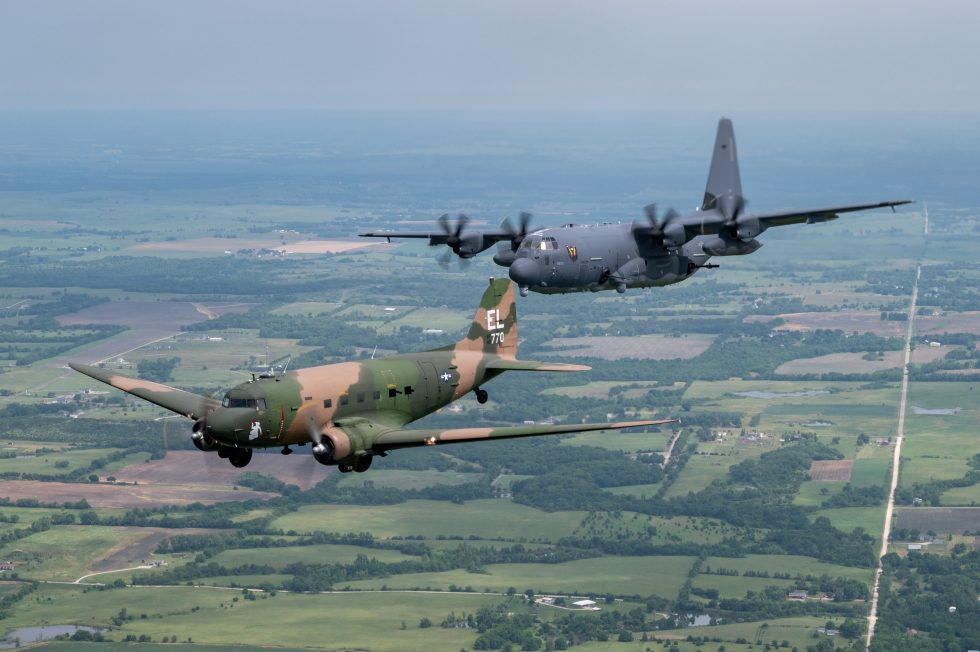
- The living descendants are Basler BT-67s: airframes rebuilt with Pratt & Whitney Canada PT6A turboprops, a stretched fuselage and new systems. Colombia has operated five AC-47T "ghost planes" since 2006 with GAU-19/A guns slaved to a FLIR turret; El Salvador flies the AC-47TP. They do the same job with sixty years of hindsight, and they are not AC-47s.
- Gunship II and Gunship III (1967–69, the succession)
- The AC-130A prototype flew in 1967 with four miniguns, four 20 mm M61 cannon, low-light television, infrared and side-looking radar; 26 AC-119G Shadows and 26 AC-119K Stingers followed, the K adding two 20 mm cannon and a pair of J85 booster jets. Both were faster, higher-flying, better protected and could actually find a target in the dark. Their arrival is what freed the AC-47 fleet for transfer to allied air forces.
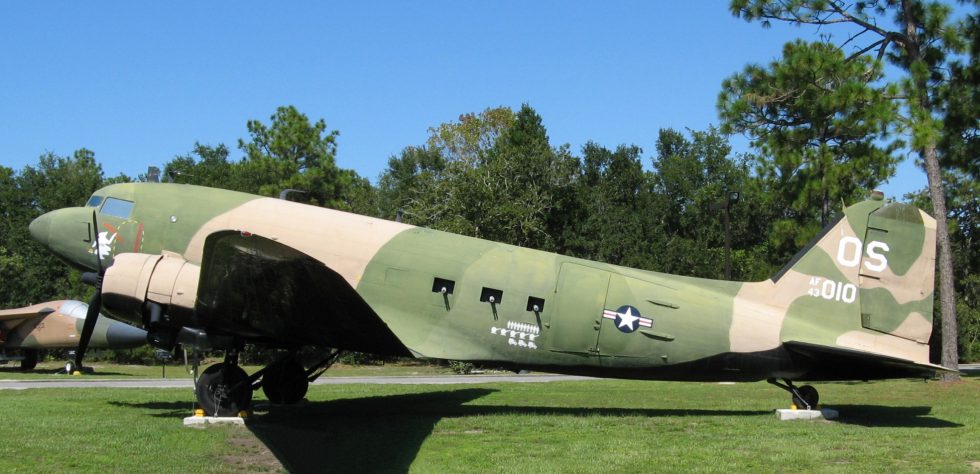
Survivors, precisely: no confirmed original Douglas AC-47D gunship conversion is known to be preserved on public display in the United States. The two aircraft most often photographed as AC-47s are repainted transports — C-47A 43-15510 at Air Commando Park, Hurlburt Field, Florida, and C-47K 44-76486 at the Air Force Armament Museum, Eglin AFB, Florida, the latter finished as AC-47D 43-49010, an aircraft that served with the 4th Special Operations Squadron at Udorn in 1969–70 and was one of the first twenty converted by Air International. Gunship-configured Dakotas displayed elsewhere are generally national rebuilds rather than USAF AC-47D conversions, and the airworthy AC-47T and AC-47TP gunships flying in Colombia and El Salvador today are Basler BT-67 turboprop rebuilds. Of the 53 aircraft converted, 19 of the 41 sent to Vietnam were written off there and most of the remainder were consumed in Vietnamese, Laotian and Cambodian service and lost in 1975 — which is why so little of this aeroplane survives.
From D-Day Dakota to Vietnam dragonship
The gunship idea revived
Engineer Ralph Flexman and the USAF revisit side-firing fire support; Project Tailchaser tests miniguns on a C-47.
First combat
The FC-47 flies its combat evaluation over South Vietnam and shatters night attacks on outposts.
“Spooky” is born
Redesignated AC-47; the 4th Air Commando Squadron forms and the names “Spooky” and “Puff the Magic Dragon” take hold.
Nightly defence
AC-47s orbit hamlets, forts and Special Forces camps across South Vietnam, dropping flares and pouring fire onto attackers.
Levitow’s Medal of Honor
Wounded aboard Spooky 71, A1C John Levitow throws himself on a burning flare and drags it clear, saving the crew.
Passed to new hands
The USAF begins retiring the AC-47, handing aircraft to the VNAF, Laos and Cambodia as the AC-130 and AC-119 arrive.
Gunships reborn abroad
New AC-47T “Fantasma” conversions enter service in Latin America for counter-insurgency night work.
Still on patrol
Colombia keeps modernised AC-47T Fantasma gunships flying — the Spooky concept in its sixth decade.
From the flight line: twelve Spooky stories
Why the outposts kept falling
By night the Viet Cong owned the ground; by day US air power owned the sky. The gunship was built to close that gap.
Read the full story
A circle of fire, revived
Firing sideways from a banking aircraft was a 1920s idea; the USAF finally made it a weapon in 1964.
Read the full story
The nights Spooky saved a fort
On its first combat outings in December 1964 the gunship broke night attacks that had been overrunning outposts.
Read the full story
How “Puff” got its nickname
South Vietnamese troops watching the glowing tracer called it the Dragonship; the Americans borrowed a folk song.
Read the full story
A wall of fire
Three miniguns firing together could lay an almost unbroken curtain of rounds onto the ground.
Read the full story
Flying a circle to aim
With fixed guns, the pilot banked left and pivoted the whole aircraft around the target.
Read the full story
John Levitow and the loose flare
Riddled with shrapnel, A1C Levitow smothered a burning flare and dragged it out before it could destroy the aircraft.
Read the full story
Turning night into day
Spooky dropped million-candlepower flares that robbed the enemy of the darkness.
Read the full story
“Nothing we defended was overrun”
A widely repeated claim holds that no hamlet or outpost defended by Spooky ever fell.
Read the full story
Passed to new hands
As the AC-130 arrived, AC-47s went to the VNAF, Laos and Cambodia for their own night wars.
Read the full story
From Spooky to Spectre
Every side-firing gunship since — the AC-130 above all — descends directly from the AC-47.
Read the full story
Colombia’s Fantasmas
Modernised AC-47T Fantasma gunships still fly counter-insurgency missions decades after Vietnam.
Read the full story
The AC-47 Spooky in pictures
The AC-47 Spooky in motion
Dark Skies: The Douglas AC-47 Spooky — Puff The Magic Dragon. A well-produced documentary on the birth of the gunship, the pylon turn and the Vietnam night war — one of the most-watched Spooky films on YouTube.
Where the AC-47 Spooky flew
The score that defines it
The AC-47’s record is not measured in air-to-air kills — it never fought other aircraft. It is measured in sieges broken and defenders kept alive. As the first fixed-wing gunship it rewrote how air power supported troops on the ground at night, and it did so with a weapon converted from a decades-old transport.
Compare the combat record of every military aircraft. Figures as of August 2026.
Everything people ask about the AC-47 Spooky
Can I fly in a Douglas AC-47 Spooky?
Why is the AC-47 called “Puff the Magic Dragon”?
What guns did the AC-47 Spooky carry?
How did the AC-47 aim its guns?
Who was John Levitow?
Is the AC-47 the same as the AC-130?
Are any AC-47 gunships still flying?
You can’t fly the AC-47 Spooky.
These, you can.
Some legends only live in museums — others are fuelled and waiting. MiGFlug has put civilians in real military jet cockpits since 2004.
 Fly the L-39 AlbatrosThe world’s most-flown jet trainer — aerobatics included
 Fly the F-104 Starfighter“The missile with a man in it”
 Fly the MiG-21The Cold War’s most-produced jet
 Fly the T-33 Shooting StarAmerica’s first jet trainer
 Fly the DH VampireA piece of early jet history
 Fly the S.211Agile Italian jet trainer
 Fly the MB-326The classic Aermacchi jet
 Fly the MiG-15The Soviet legend of the Korean War
Continue the tour
Every fact, checked
- National Museum of the U.S. Air Force — Douglas AC-47DPrimary reference for the gunship’s development, armament and Vietnam service.
- NMUSAF — Airman 1st Class John L. LevitowOfficial account of the 24 February 1969 Medal of Honor action aboard Spooky 71.
- Smithsonian National Air and Space MuseumReference for the C-47 / DC-3 airframe and its wartime lineage.
- Air Force Historical Support DivisionGunship development, Project Tailchaser and the 4th Air Commando Squadron.
- HistoryNet — Spooky Gunship OperationsOperational history, tactics and the pylon turn in Vietnam.
- The Aviationist — The Spooky Story of the AC-47Armament, flares, conversion numbers and the nickname’s origin.
- War History Online — 50 Years of C-47 GunshipsThe lineage from Vietnam Spooky to Colombia’s AC-47T Fantasma.
- The War Zone — Where AC-47 Gunships Still FlyColombia’s modernised Fantasma gunships in current service.