
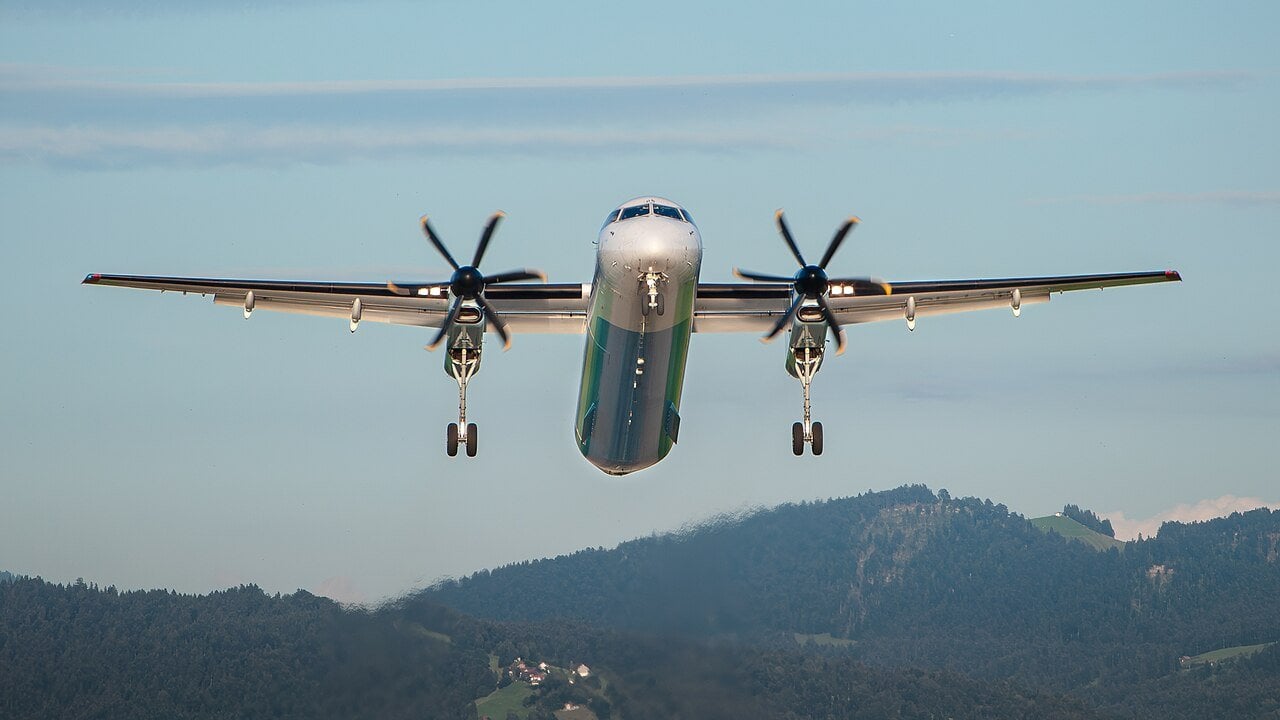
Look out of the window on a short regional hop in Europe, Asia or Canada and there is a good chance you will see a propeller turning just a few metres away. If you do, it almost certainly belongs to one of two aircraft: the Franco-Italian ATR 72 or the Canadian Dash 8-400, still widely known as the Q400.
They look alike, carry similar numbers of people and burn similar amounts of fuel per seat. Yet they are built around opposite ideas. One is designed to be as cheap as possible to run; the other is built for speed.
Here is how the two last big Western turboprop airliners really compare, using the manufacturers' own published figures, and why airlines choose one over the other.
Informazioni rapide
- ATR 72-600 maker: ATR (Airbus and Leonardo), Toulouse
- Dash 8-400 maker: De Havilland Canada
- Typical seats: 72 (up to 78) vs 82 (up to 90)
- Motori: PW127XT-M, 2,750 shp vs PW150A, 5,071 shp max
- Max cruise speed: 270 kt vs 360 kt
- Max take-off weight: 23,000 kg vs 29,574 kg
- Full-passenger range: 683 nm vs 862 nm (different assumptions)
- Consegne: 1,700+ ATRs (42 and 72) vs 630+ Dash 8-400s
- Production status: ATR in production; Dash 8-400 paused
Two Families, Two Histories
ATR, short for Avions de Transport Régional or Aerei da Trasporto Regionale, was born in the 1980s as a joint venture between France's Aérospatiale and Italy's Aeritalia. Today those shareholders are Airbus and Leonardo. The first ATR 42 flew on 16 August 1984, and the stretched ATR 72 followed: launched in January 1986, first flown on 27 October 1988 and put into service by Finnair on 27 October 1989. Every ATR has been completed on the final assembly line in Toulouse.
The Dash 8 began at de Havilland Canada, which introduced the first version in 1984. The company passed to Boeing in 1986, then to Bombardier in 1992, and in 2019 to Longview Aviation Capital, which revived the De Havilland Canada name. The much-stretched Series 400 entered service in 2000. Bombardier called its quieter Dash 8s the Q Series, after a noise and vibration suppression system fitted to every Series 400, which is why so many people still say Q400.
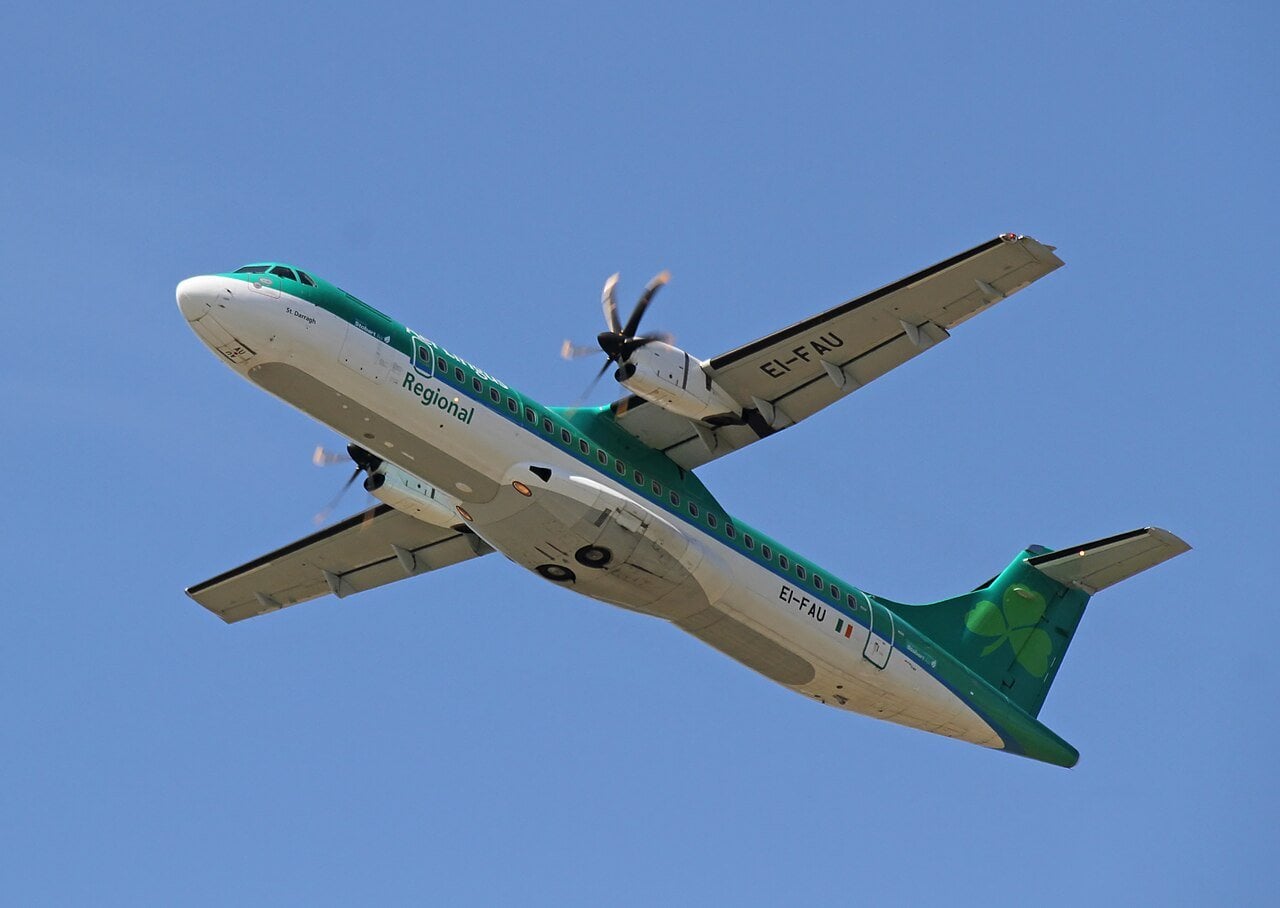
The current ATR 72 is the -600 series, launched in 2007 with improved engines and a glass cockpit. The latest -600s use the Pratt & Whitney Canada PW127XT. The Dash 8-400 has gone through its own NextGen and high-capacity updates, but the basic aircraft is the one that entered service at the turn of the century.
Size and Seats
On paper they fight in the same weight class, but the Dash 8-400 is the bigger aircraft. De Havilland's July 2026 specification sheet gives a maximum take-off weight of 29,574 kg, against 23,000 kg for the ATR 72-600 in ATR's own factsheet. That extra weight buys more cabin.
ATR's standard layout is 72 seats at 29-inch pitch, with up to 78 available. De Havilland's standard Dash 8-400 cabin is 82 seats at 30-inch pitch, with a 74-seat two-class option and high-density versions of up to 90 seats. De Havilland calls it the highest-capacity turboprop on the market.
Engines and Speed: The Real Difference
This is where the two part company. The ATR 72-600's PW127XT-M engines each produce 2,750 shp. The Dash 8-400's PW150A engines are rated at 4,580 shp for normal take-off and 5,071 shp at maximum, almost twice as much.
The result shows up on the clock. ATR quotes a maximum cruise speed of 270 knots true airspeed, about 500 km/h, at 20,000 feet. De Havilland quotes a maximum cruise of 360 knots, or 667 km/h, with a ceiling of 25,000 feet. That is the Dash 8-400's whole sales pitch: De Havilland says it offers 30 per cent faster cruise speeds and 40 per cent more range than conventional turboprops.
Over a short sector, the gap is small. Both manufacturers publish a 200-nautical-mile example: ATR gives a flight time of 52 minutes, De Havilland a trip time of 51 minutes. The difference grows with distance. For 500 nautical miles, De Havilland quotes 110 minutes; ATR's published tables stop at 400 nautical miles, which ATR puts at 1 hour 38 minutes.
ATR's guided tour of its final assembly line in Toulouse, where every ATR 42 and ATR 72 is completed.
Fuel, Range and Runways
Speed costs fuel, but less than you might think. On ATR's 200-nautical-mile example at maximum payload, block fuel is 616 kg. De Havilland's 200-nautical-mile example, with 82 passengers, gives 696 kg of trip fuel. Per seat, the two figures are close, and so are the manufacturers' carbon numbers: 69 g of CO2 per seat-kilometre for the ATR on a 300-nautical-mile route, and 72.4 g per available seat-kilometre for the Dash 8-400.
Treat those comparisons with care. ATR quotes block fuel, De Havilland trip fuel; ATR assumes 95 kg per passenger and De Havilland 102 kg; the route lengths and reserves differ. Neither sheet is built to be read against the other, and an airline would run its own numbers on its own routes.
Range follows the size of the aircraft. ATR quotes 683 nautical miles (1,265 km) with a full load of passengers at long-range cruise speed, while De Havilland gives 862 nautical miles (1,596 km) for a full Dash 8-400. Both can work from short, rough strips. ATR lists a take-off field length of 1,315 m at maximum weight; De Havilland lists 1,277 m. The landing figures, 915 m for the ATR and 1,268 m for the Dash 8, are calculated on different regulatory bases and are not directly comparable.
Both airframes have also found work beyond the passenger cabin. ATR markets a dedicated freighter, the ATR 72-600F, and the type has been adapted for maritime patrol. More than sixteen Dash 8-400s have been converted into airtankers, according to Wikipedia, and France's Sécurité Civile operates eight multi-role versions. Cargo-combi and full freighter conversions of the Dash 8-400 exist too, with Air Canada and Jazz among the first to fly a converted aircraft.
Who Is Winning?
In sales, the answer is clear. ATR says it has delivered more than 1,700 aircraft to around 200 operators in 100 countries, counting both the ATR 42 and ATR 72. De Havilland says more than 630 Dash 8-400s have joined the fleets of over 75 owners and operators. Wikipedia records that by late 2018, Q400 sales were already slower than those of the cheaper ATR.
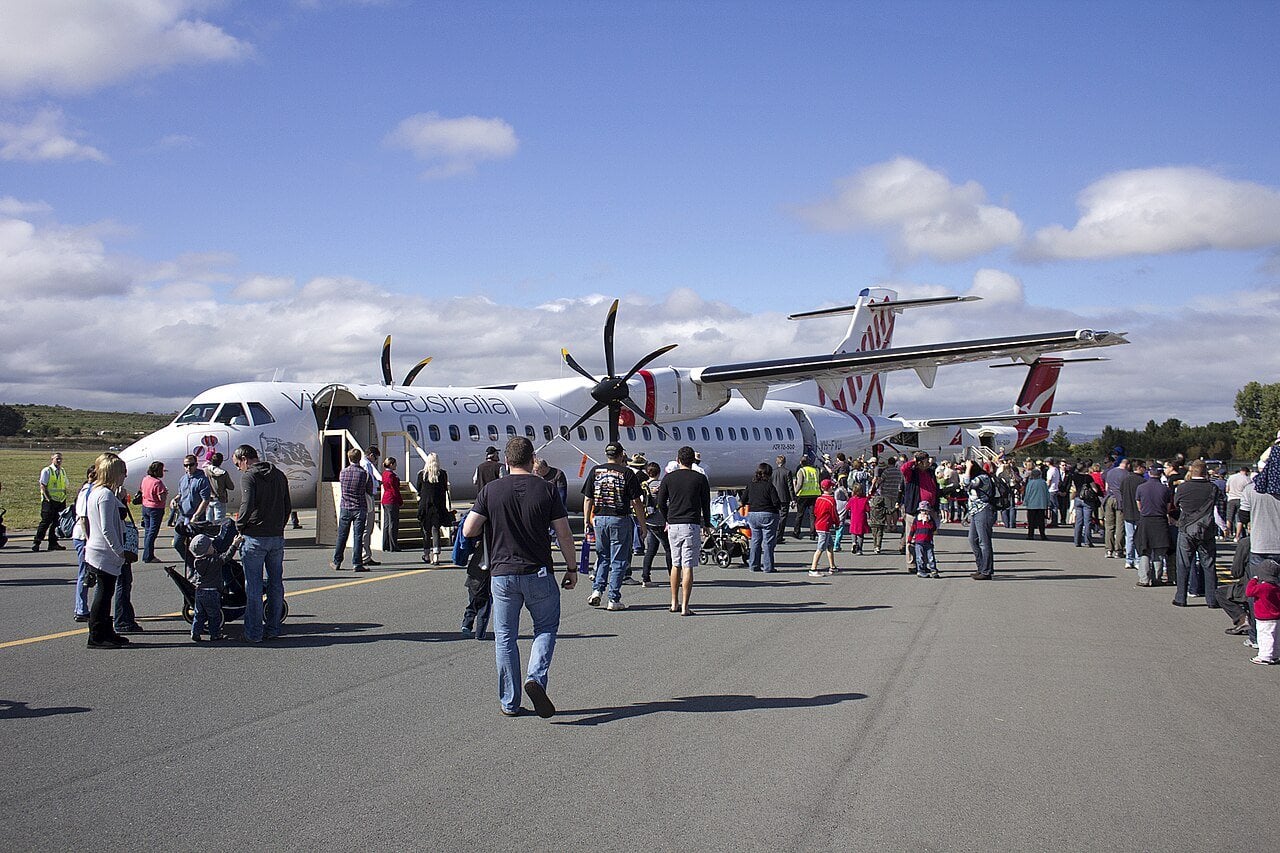
ATR's own results show a manufacturer struggling to build fast enough rather than to sell. In 2025 it booked 60 gross orders but delivered only 32 aircraft, blaming supply-chain problems, and it is targeting a 20 per cent increase in deliveries for 2026. Its commercial chief argues that turboprops are the only way to make thin regional routes pay.
De Havilland, meanwhile, has not built new Dash 8-400s for several years. It paused production after a lack of orders in 2021 and left its Downsview factory in Toronto in 2022. It has talked of restarting at a new site in Wheatland County, near Calgary, but in June 2025 FlightGlobal reported that the decision was still unsettled. In the meantime it is investing in the existing fleet, such as a 2026 programme with Norway's Widerøe to extend maintenance intervals.
So Which Is Better?
The ATR 72 vs Q400 question is really a question about route length. Neither aircraft is better in the abstract. The ATR 72 is lighter, simpler and cheaper to buy and run, and it shines on short sectors where the speed difference barely registers. That is why it dominates island networks, developing markets and the many routes under an hour.
The Dash 8-400 earns its higher costs where time matters. Its extra speed lets an airline fit more rotations into a day or fly sectors that would otherwise need a jet, and its extra power helps on hot, high or short runways. Operators such as Widerøe in Norway, with its dense network of short airstrips, have flown it for decades.
The 1995 launch promotional film for the Dash 8 Series 400, from the Canadian Aviation History channel.
For now, only one of the two is rolling off a production line. If De Havilland restarts the Dash 8, airlines will again have a genuine choice between economy and speed. If it does not, the 70-seat turboprop market will belong to Toulouse.
Next time you board a regional flight with propellers outside the window and land a little sooner than you expected, you were probably on the Canadian.
Sources: ATR 72-600 factsheet and 2025 results release (ATR), De Havilland Canada Dash 8-400 specification sheet (July 2026), Wikipedia (ATR 72, De Havilland Canada Dash 8), FlightGlobal, AeroXplorer, Air Data News, Air Journal

0 Comments