
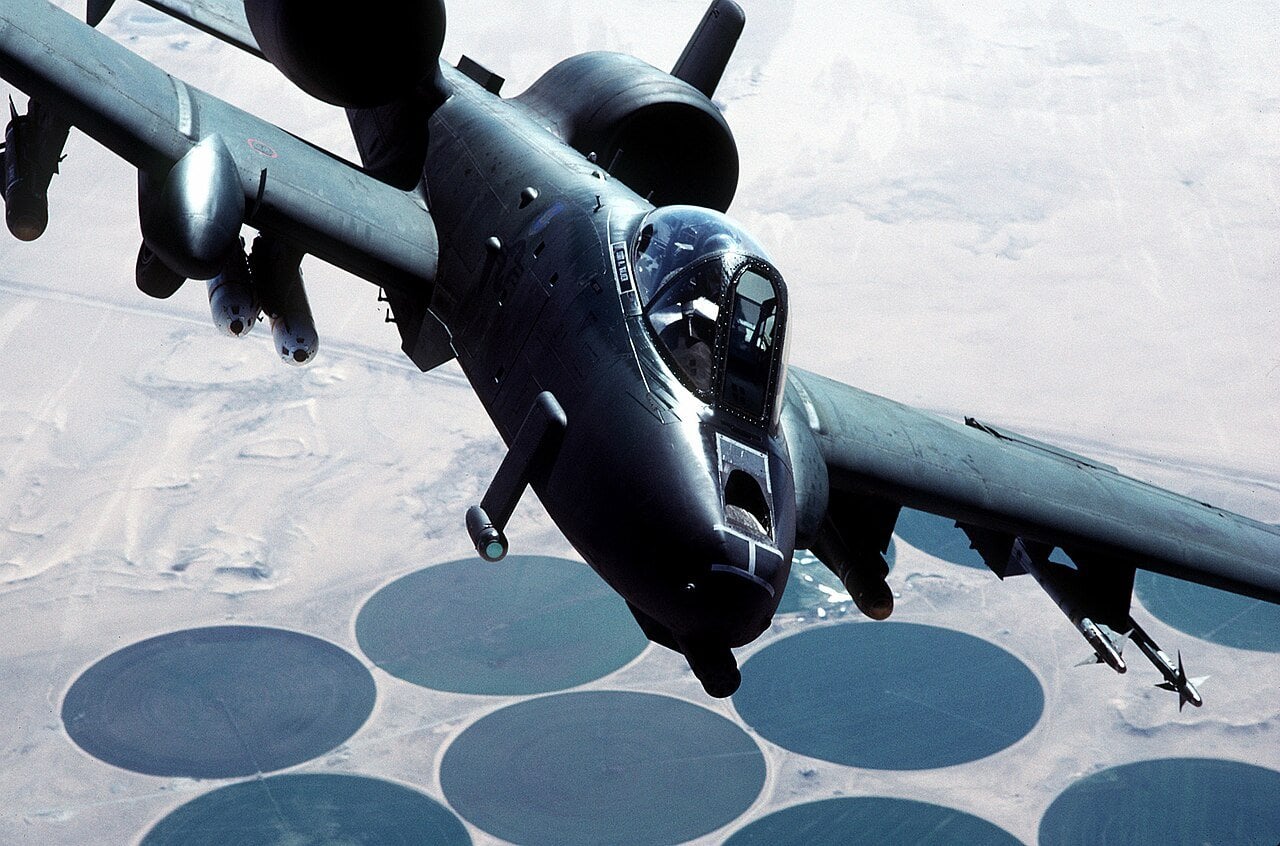
Lieutenant Devon Jones had dug himself a hole in the Iraqi desert with his survival knife and pulled the landscape over the top. He was so well hidden that when an American A-10 thundered directly over him at about 300 feet, its pilot saw nothing at all. The Iraqis, though, were listening to the same radio Jones was using. And now a truck was coming.
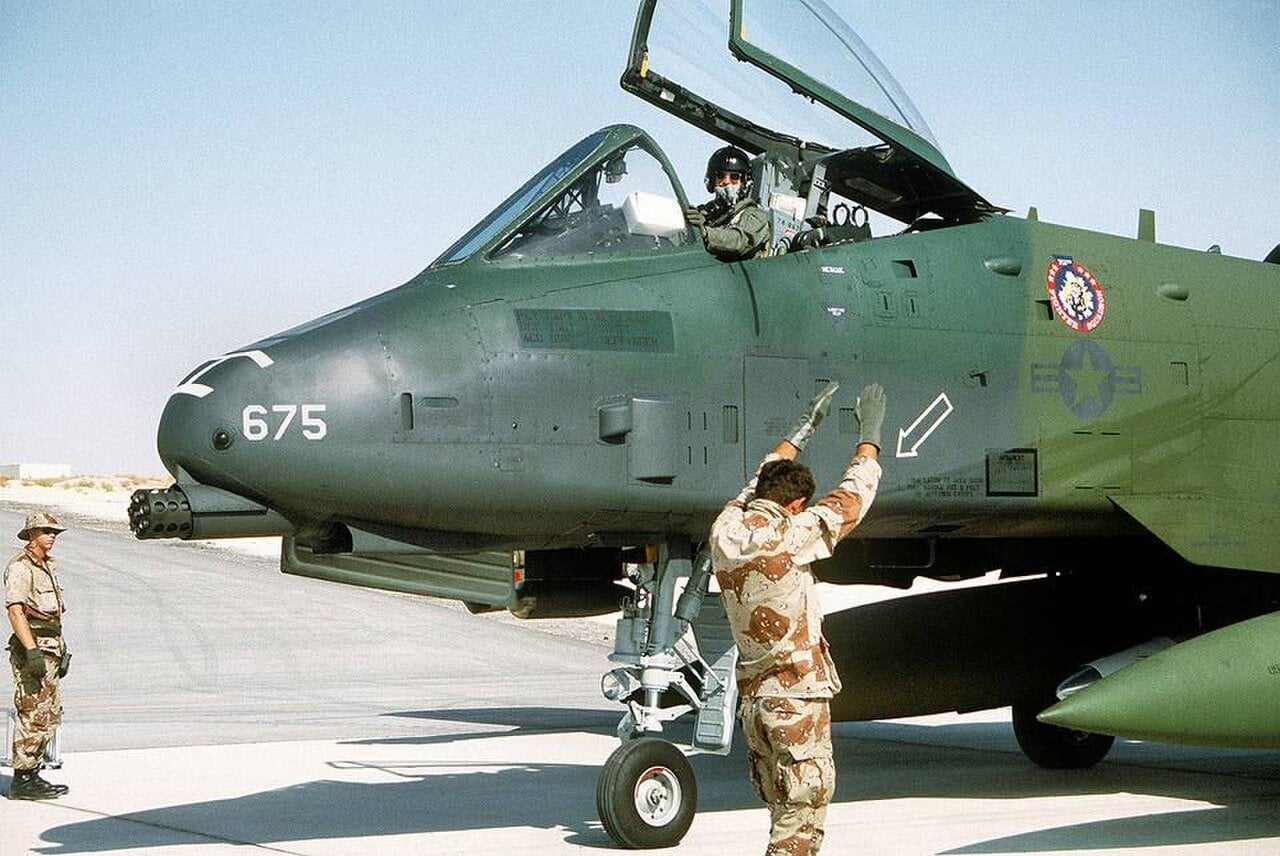
Overhead, Captain Paul T. Johnson, call sign Sandy 57, had been airborne for hours, had refuelled three times and was deeper inside Iraq than any A-10 had ever flown. What he did next earned him the Air Force Cross, and it was the first combat rescue in the Warthog's history.
Informazioni rapide
- Data: 21 January 1991, day five of Desert Storm
- Rescue lead: Capt. Paul T. Johnson, Sandy 57, 353rd TFS / 354th TFW
- Wingman: Capt. Randy Goff, Sandy 58
- Sopravvissuto: Lt. Devon Jones, U.S. Navy, VF-103, call sign Slate 46
- Abbattuto: F-14 Tomcat hit by a surface-to-air missile
- Pick-up: MH-53J Pave Low Moccasin 05, Capt. Thomas J. Trask
- Navigation aids: Automatic Direction Finder and drifting inertial system
- Johnson's flight time: 8 h 45 min of combat time, four aerial refuellings
- Awards: Air Force Cross for Johnson; Mackay Trophy for the Pave Low crew
The Farmer in the Warthog
Paul Johnson was not supposed to be a fighter pilot. He grew up in the rural South, earned an agriculture degree from Murray State University in Kentucky in 1980 and started farming row crops and cattle. A neighbour, an Air National Guard lieutenant colonel named Elliot Lambert, talked him into trying the Air Force instead. Johnson entered pilot training at 27, four months short of being too old to qualify.
Training took him to Davis-Monthan in Arizona and the A-10 Thunderbolt II, which he summed up, in Walter J. Boyne's profile for Air & Space Forces Magazine, as a move from slopping hogs to flying hogs. He joined the 353rd Tactical Fighter Squadron at Myrtle Beach, South Carolina, became an instructor and squadron weapons officer, then was pulled out just as the squadron deployed to Saudi Arabia, to attend the USAF Fighter Weapons School at Nellis.
He caught up with the squadron at King Fahd in time for the war. The 353rd's A-10s were given a job most of their pilots did not want: sitting on combat search and rescue alert, as the Sandys who would escort rescue helicopters and protect downed airmen. In the first four days of Desert Storm, every American shot down had come down somewhere too dangerous to reach or had been captured almost at once.
Slate 46 Is Down
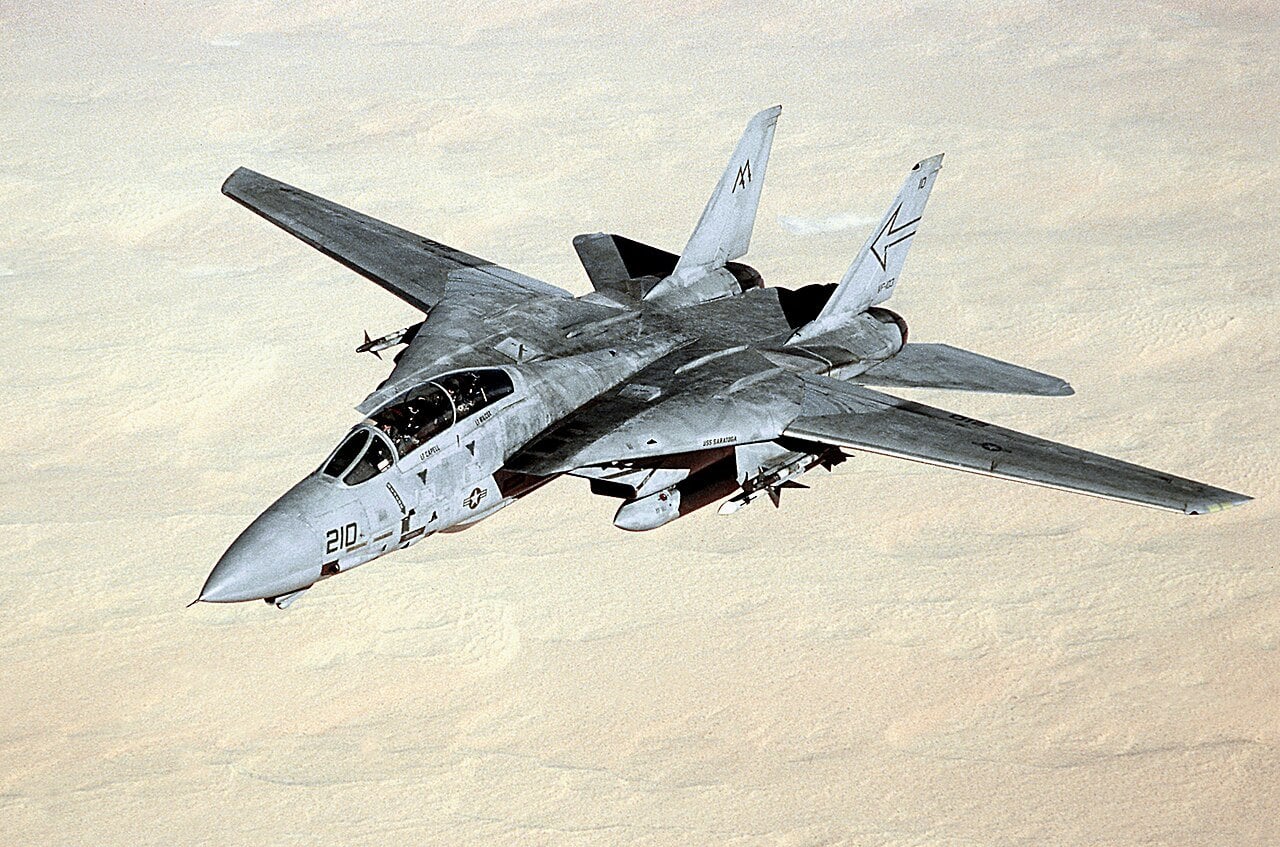
On the night of 20 January 1991, an F-14 Tomcat of the Marina degli Stati Uniti's VF-103, flying from USS Saratoga with the call sign Slate 46, was hit by a surface-to-air missile over western Iraq. The pilot, Lieutenant Devon Jones, and his radar intercept officer, Lieutenant Lawrence R. Slade, ejected. Jones managed to make radio contact with rescue coordinators. Nothing was heard from Slade.
Next morning, after a weather hold, Johnson took off from King Fahd for the alert site at King Khalid Military City as Sandy 57, with Captain Randy Goff as Sandy 58. An hour into the flight, ten minutes before landing, the pair were retasked: find Slate 46. Johnson was handed a tentative set of coordinates and the call signs of a KC-10 tanker and the MH-53J Pave Low rescue helicopter, and turned west.
He tanked, checked in with an E-3 AWACS, and was immediately diverted. Scud hunting outranked almost everything that week, because coalition planners feared Iraqi missile attacks could pull Israel into the war, so the AWACS sent Sandy 57 to check a suspected Scud site. It was empty. Johnson refuelled again and was sent back to the original coordinates.
Hunting a Voice With a Needle
Here the 1991 rescue starts to look like 1968. The tool Johnson had for finding a man on the ground was the A-10's Automatic Direction Finder, an instrument designed to point at a radio source. In Boyne's words it was imprecise, to say the least. Johnson flew east and could hear Jones on the radio, but the ADF needle would not move. He tried west, then north, and the voice grew louder.
The coordinates he had been given turned out to be wrong. By the time the needle finally swung, Sandy 57 was west of al Asad Air Base, about 60 miles north of the first position and, by the citation's account, deeper inside enemy territory than any A-10 had ever been. Flying under the cloud at around 300 feet according to Boyne, and at 500 feet according to the citation, he passed directly over Jones and still could not see him.
That left Johnson with a navigation problem. He memorised the terrain and stored a mark point in his inertial navigation system. But after about five hours of flying, the INS had drifted considerably. Any coordinates he read out to the Pave Lows would send them to the wrong patch of desert, and the helicopters, flying low, were too close to the ground for their own ADF to pick up Jones's signal.
The radio was another problem. By now two Pave Lows, the AWACS, the KC-10 and a flight of F-15 Eagles were all on the rescue frequency, talking almost nonstop. Johnson cleared the channel, ordering everyone off it except the survivor, the A-10s and the Pave Lows.
Former F-14 RIO Ward Carroll tells the story of Slate 46 from the Tomcat side.
Bingo, Tanker, Back Again
Then the fuel ran out. Johnson was past bingo, the minimum needed to get home, and had to break the first rule of search and rescue: never leave the survivor. He told Slate 46 to stay put and headed south to the KC-10, whose crew had flown about 25 miles into Iraq at 15,000 feet to meet him.
Topped up, he came straight back and joined Moccasin 05, the Pave Low flown by Captain Thomas J. Trask with copilot Major Michael Homan. Using his mark point and the terrain he had memorised, Johnson led the helicopter to the area and got the ADF needle to swing again, pointing out Jones's position.
The Americans were not the only ones homing on that radio. Across the desert, trailing a plume of dust, an Iraqi military truck was heading for the survivor. Johnson still could not see Jones, so he asked him to describe where the truck was relative to his hole. Then Sandy 57 and Sandy 58 turned low over the desert to attack. They missed on the first pass, hauled round and came back.
Jones went back to Saratoga. Slade was less lucky: he had been captured about four hours after ejecting, was paraded on Iraqi television on 25 January and released with other prisoners on 3 March.
The First A-10 Rescue
Johnson's day was not over. He refuelled a fourth time, escorted the Pave Low until he was released, and flew back to King Fahd. Boyne puts his total for the day at eight hours and 45 minutes of combat flight time; speaking to Air Force Magazine in 2016, Johnson remembered nine hours in the air with Goff. The Air Force Cross citation called it the first rescue in the history of the A-10 weapons system, and Trask's Pave Low crew received the Mackay Trophy.
A few days later Johnson's own jet was hit by ground fire while he tried to attack a missile site in bad weather. With one hydraulic system gone, a hole in the right wing's leading edge and a damaged engine still running, he refuelled the crippled A-10 in flight and landed it at King Khalid Military City. It was repaired in theatre and he flew it home after the war.
Twenty-five years later, by then a major general in the Aeronautica militare statunitense, Johnson said what stayed with him was not the shooting but the coordination: crews from different services, many of whom had never spoken to each other, all willing to do whatever it took for one Navy pilot in a hole.
The rescue also says something about how technology really works under pressure. The jet was a 1970s design, the direction finder would have been familiar to Vietnam-era Sandy pilots, and the inertial system had wandered off by miles. What closed the gap was a pilot who memorised a patch of empty desert, a tanker crew willing to fly into Iraq, and a helicopter crew who trusted both.
For the record, the A-10 was built to kill tanks. Its first rescue was won with a radio needle, a mental map, four tankings and one burning truck.
Maj. Gen. Paul Johnson recalls the rescue in a full interview for the 25th anniversary of Desert Storm.
Sources: Wikipedia (Paul Johnson, United States Air Force), Air & Space Forces Magazine (Walter J. Boyne, 'Hog Heaven', 2010; 'A Rescue Deep in Enemy Territory', 2016), Air Force Historical Foundation, William L. Smallwood, Warthog, Ward Carroll, Maxwell-Gunter AFB
0 Comments