
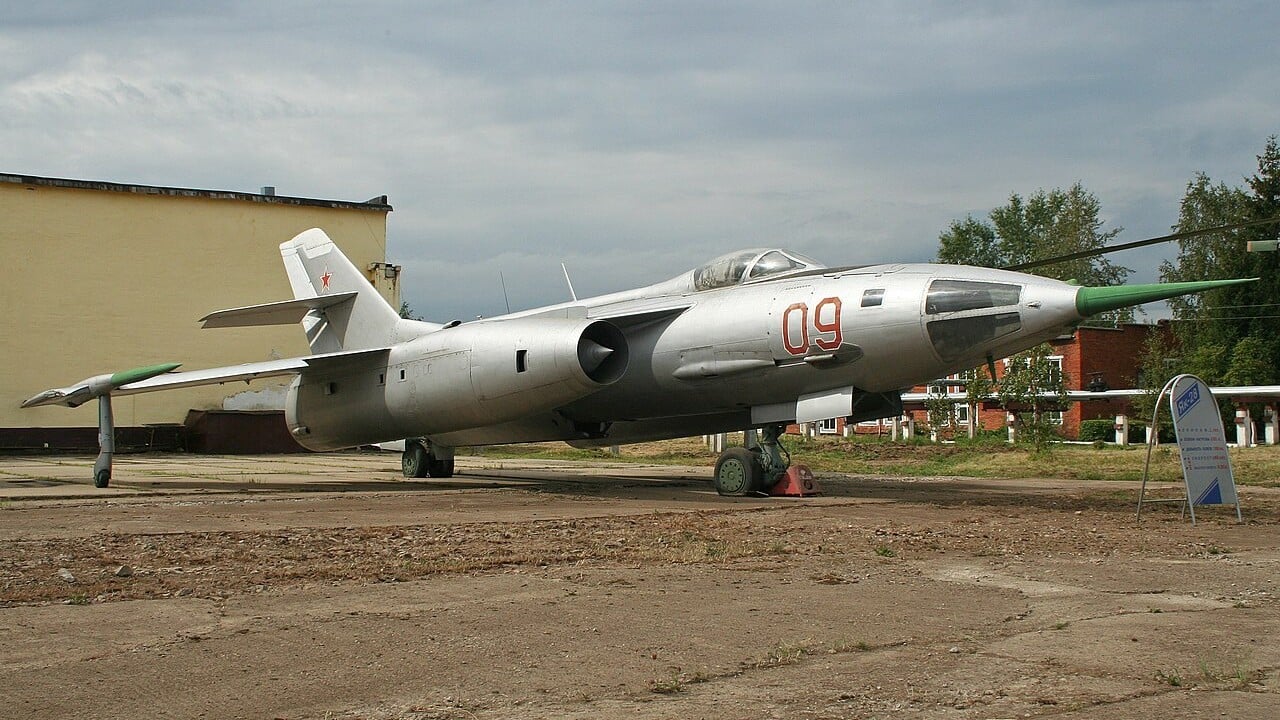
On the afternoon of Wednesday 6 April 1966, a Soviet jet with a failing engine came down out of the sky over West Berlin, missed the houses along the Heerstrasse, and plunged into a small lake called the Stößensee. Only part of its tail fin showed above the water. The British soldiers who threw a cordon around it thought at first it was a MiG-19.
It was not. It was a Yak-28P, and within hours it had become one of the luckiest intelligence windfalls of the Cold War. To understand why the West wanted it so badly, you have to understand the strange, versatile and now largely forgotten aircraft it belonged to: the Yakovlev Yak-28.
Informazioni rapide
- Aeromobili: Yakovlev Yak-28, twin-engine swept-wing combat aircraft
- Primo volo: 5 March 1958 (Yak-129 prototype)
- NATO names: Brewer (bomber, recon, ECM), Firebar (interceptor), Maestro (trainer)
- Motori: Two Tumansky R-11 afterburning turbojets in wing pods
- Velocità: Mostly subsonic; could exceed Mach 1 at high altitude
- Costruito: 1,180 of all versions, including 435 Yak-28P interceptors
- Berlin: 6 April 1966: Yak-28P crashed into the Stößensee in West Berlin; crew Kapustin and Yanov killed
- Pensionato: Yak-28P in the early 1980s; other versions flew until at least 1992
A bomber the West mistook for a fighter
The Yak-28 began life as the Yak-129 prototype, which first flew on 5 March 1958. It was related to Yakovlev’s earlier Yak-25 and shared its distinctive layout: two engines in pods on the wings, and a bicycle undercarriage, with two main wheel units in tandem under the fuselage and small outrigger wheels in fairings near the wingtips.
That arrangement freed most of the long fuselage for fuel and equipment. The wing was mounted mid-fuselage and swept at 45 degrees, with slats on the leading edge and slotted flaps behind. Power came from two Tumansky R-11 afterburning turbojets.
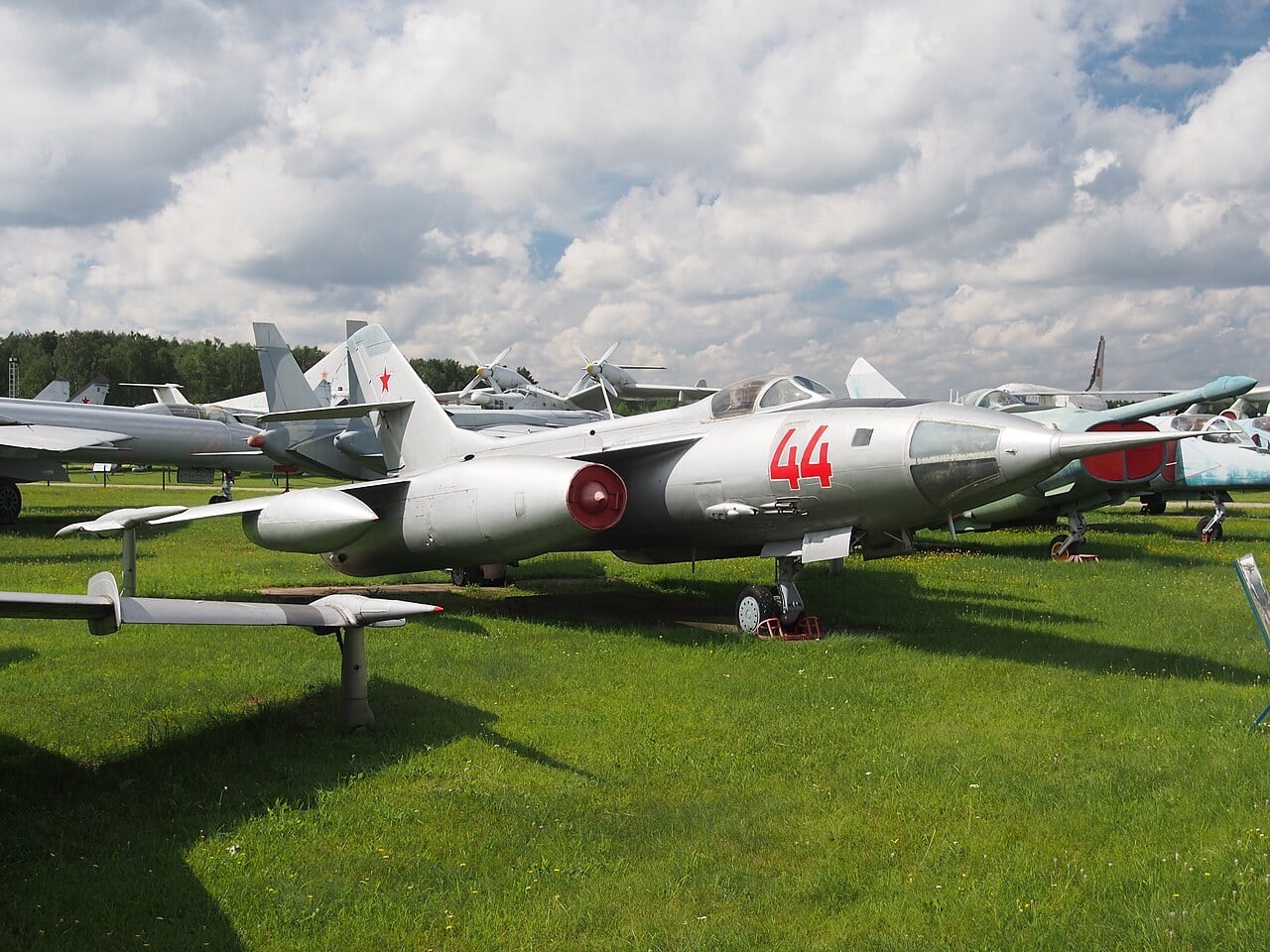
Western observers got their first look at the Tushino air show in 1961, and they guessed wrong. Analysts first took it for a fighter rather than an attack aircraft. Once its real role as a tactical bomber became clear, NATO gave the bomber versions the reporting name “Brewer”.
Despite the afterburning engines, the Yak-28 was primarily a subsonic aircraft; it could exceed Mach 1 only at high altitude. Its strength was not raw speed but range, payload and room inside for equipment, and that made it unusually easy to reinvent.
One airframe, five jobs
The Soviet Union built 1,180 Yak-28s, and very few of them did the same job. The bomber line ran from the Yak-28B through the Yak-28L, which found its targets by triangulating signals from transmitters on the ground (111 built), to the Yak-28I with its own Initsiativa-2 ground-mapping radar (223 built).
The Yak-28R reconnaissance version, NATO’s “Brewer-D”, carried interchangeable equipment pallets for different missions, and 183 were built. The Yak-28U trainer, “Maestro”, added a second cockpit in the nose for the student. Then, in 1970, came the Yak-28PP “Brewer-E”, an unarmed jammer with its bomb bay full of electronic warfare equipment and heat exchangers under the fuselage to dump the heat it generated. It is regarded as the first Soviet electronic countermeasures aircraft.
A short history of the Yakovlev Yak-28 and its Brewer, Firebar and Maestro versions.
The most important version, though, was the one that went into the Stößensee. The Yak-28P “Firebar” was a long-range interceptor developed from 1960 and operational from 1964. It gave up the internal weapons bay for extra fuel, gained an Oriol-D interception radar and carried R-98 air-to-air missiles, known to NATO as AA-3 “Anab”. A total of 435 were built before production ended in 1967.
Six April 1966: the Firebar in the lake
According to the Military Intelligence Museum’s account, the crew of the Yak-28P that afternoon, Captain Boris Kapustin and Lieutenant Yuri Yanov, steered their stricken aircraft away from nearby built-up areas and brought it down in the lake, in the British Sector of the divided city. Neither man survived.
A tense stand-off followed. Soviet troops from the Tiergarten war memorial guard arrived and a Soviet officer demanded that the British withdraw. He was told that no interference would be tolerated in the British Sector. Overnight analysis of photographs, including some taken by an RAF officer who rowed out to the wreck, identified the aircraft, and Washington took notice.
Royal Navy divers were flown in from Britain, together with RAF technical intelligence officers, later joined by their American counterparts. Working behind screens on recovery rafts, they examined the airframe and its electronics as quickly as they could, expecting the Soviets to get it back soon. The bodies of the two crew were recovered from the cockpit and handed over in the early hours of Good Friday, with a guard of honour from both Soviet and British troops.
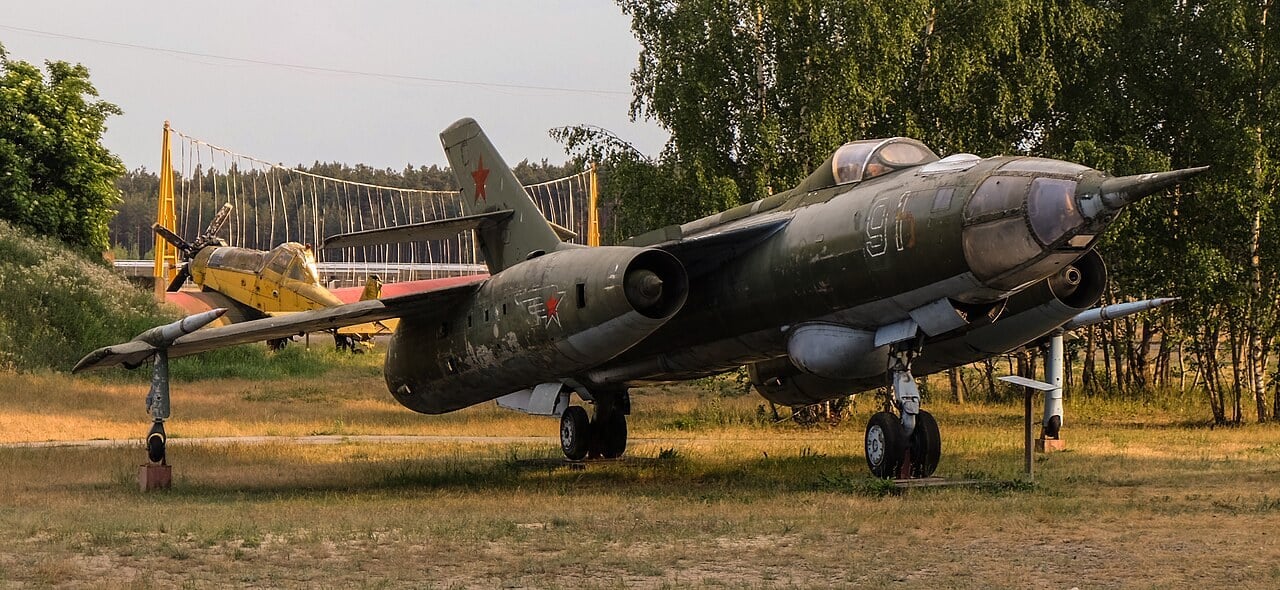
By then, items of intelligence value had already been taken away for closer study. The wreckage went back to the Soviets on 13 April, and some parts removed for analysis had been quietly put back after being photographed. The two R-11 engines, buried in the lake mud, were recovered later in April; one was dismantled and examined at RAF Gatow before both were returned on 2 May.
Archive footage from the broadcaster rbb of the Soviet jet that crashed into the Stößensee in West Berlin on 6 April 1966.
“A rich harvest”
The Soviets protested that parts were missing. The British replied that the wreckage had been returned after an operation carried out under “very difficult conditions”. Privately, the Ministry of Defence was delighted. On 9 May 1966, its Deputy Chief of the Defence Staff (Intelligence) wrote to the commander of RAF Germany that keeping the engine had not been worth the risk of raising tension over Berlin, but that the electronics were another matter.
Kapustin and Yanov were posthumously awarded the Order of the Red Banner, and memorial plaques were placed on the Stößensee bridge. Their decision to steer away from the houses, rather than eject over the city, won the two airmen much praise.
Il lungo addio
The Yak-28P Firebar was withdrawn in the early 1980s. The reconnaissance and jamming versions were eventually replaced by variants of the Su-24 Fencer, but trainers and other versions kept flying until after the Soviet Union itself was gone, until at least 1992.
After the break-up, the Aeronautica militare ucraina inherited Yak-28s; Air Forces Monthly listed an electronic warfare regiment at Chortkiv with about 30 Brewer-Es in early 1994. Today the type survives in museums, including the Central Air Force Museum at Monino and the Estonian Aviation Museum, which displays a Yak-28PP.
It was never a famous aircraft. It was mistaken for a fighter, outshone by its successors, and remembered in the West mostly for a crash in a Berlin lake. But for a quarter of a century, one ungainly airframe on a bicycle undercarriage bombed, spied, jammed, trained and hunted for the Soviet Union, and that is a career most aircraft never get.
Sources: Wikipedia (Yakovlev Yak-28), Military Intelligence Museum (1966: The Firebar Incident), Estonian Aviation Museum, rbb media archive

0 Comments