
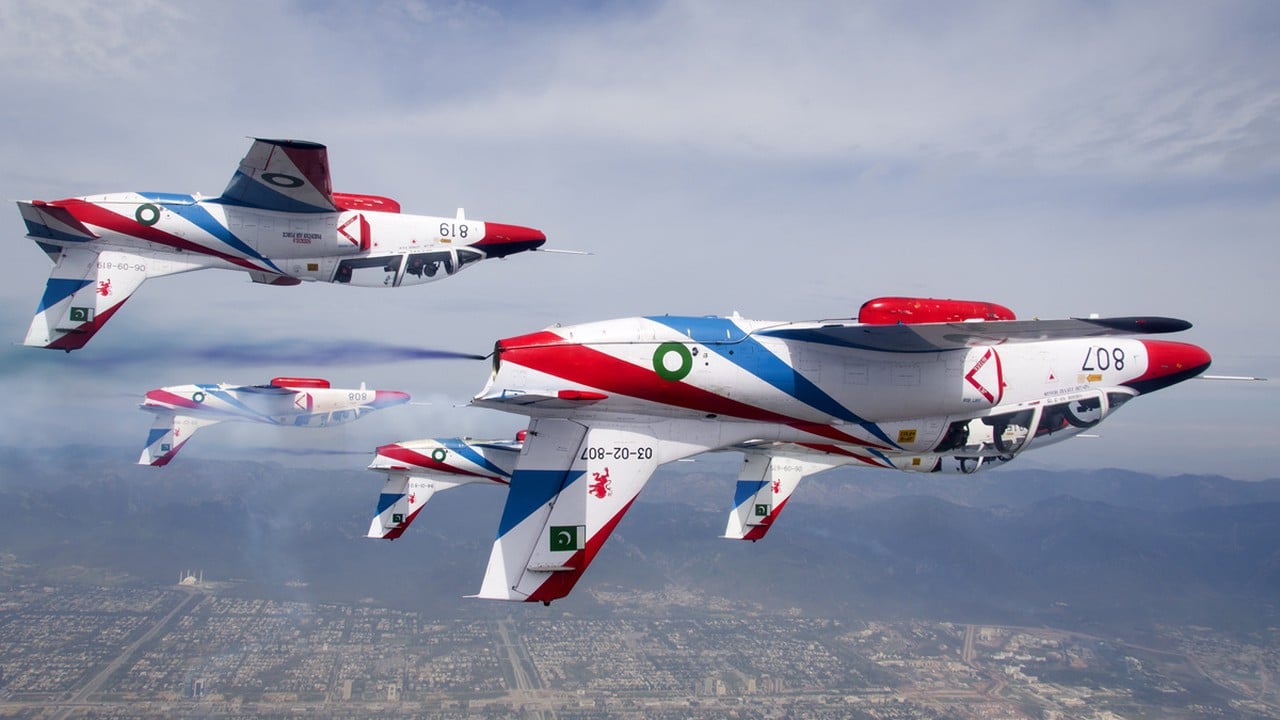
Few aircraft are named after a mountain range, and fewer still after one that marks a friendship. The K-8 Karakorum takes its name from the Karakoram, the range that straddles the border between China and Pakistan. That is exactly what the aircraft is: a two-seat jet trainer designed by both countries, built in both, and flown today by air forces from Cairo to Caracas.
In China it is the Hongdu JL-8. Everywhere else it is the K-8. Under either name it has become a widely exported jet trainer, serving air forces across Asia, Africa and Latin America.
Informazioni rapide
- Tipo: Two-seat intermediate jet trainer and light attack aircraft
- Progettisti: China (Nanchang/Hongdu) and Pakistan (Pakistan Aeronautical Complex)
- Development: Proposed 1986; full-scale development from 1987
- Primo volo: November 1990
- Motore: Honeywell TFE731-2A-2A (export); AI-25TLK or WS-11 (Chinese JL-8)
- Misurare: Length 11.6 m, wingspan 9.63 m
- Armi: Four underwing pylons of 250 kg each plus a 23 mm cannon pod
- Costruito: More than 500 by 2010 (estimate)
A partnership born in the 1980s
The idea of a joint trainer was proposed by the governments of Pakistan and China in 1986, and full-scale development began in 1987 at the Nanchang Aircraft Manufacturing Company in China. Pakistani engineers worked alongside the Chinese team. According to Aerospaceweb, the Pakistan Aeronautical Complex at Kamra took on the fin, tailplane and other components, about a quarter of the airframe.
The original plan leaned heavily on American hardware: a Garrett turbofan and avionics from Collins and Magnavox. Then came 1989. After the Tiananmen Square crackdown, US restrictions on China nearly cancelled the project, according to Aerospaceweb, and other suppliers had to be found for parts of the design. The partners pressed on with a conventional straight-wing, tandem-seat layout.
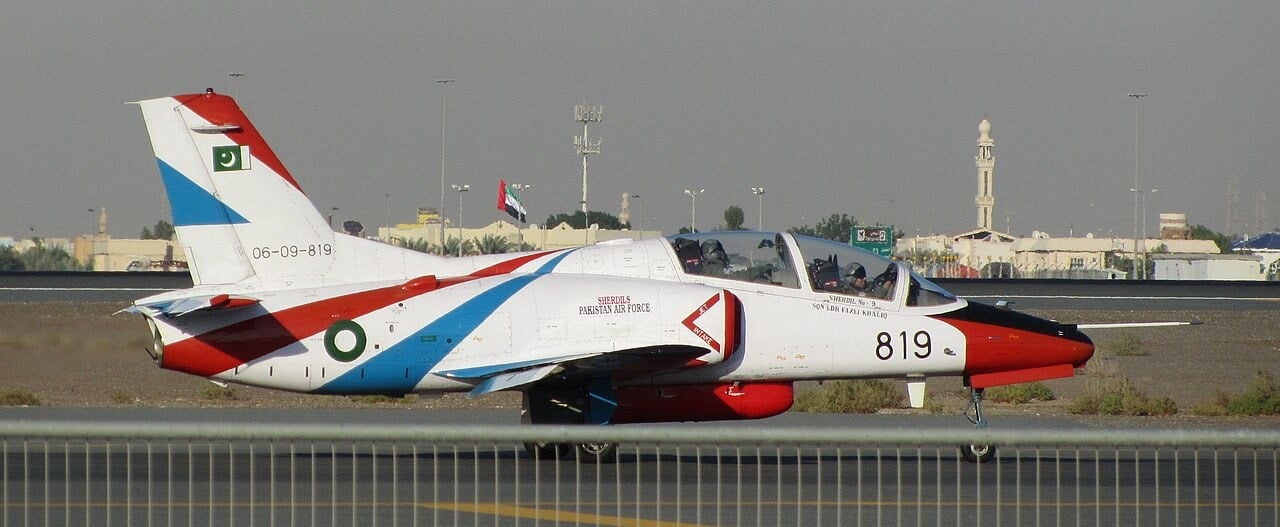
The first prototype flew in November 1990, and flight testing with Chinese and Pakistani pilots was completed in 1993. A small first batch followed, and the Aeronautica militare pakistana received its first K-8s in 1994. A year later it ordered 75 more to replace its Cessna T-37 Tweet trainers.
Built to be easy to own
The K-8 was never meant to be exotic. It is a low-wing aluminium monoplane with a single turbofan, two side-mounted intakes and tandem seats, designed for a long life and low running costs. The airframe structure is rated for 8,000 flight hours, and the strap-on air-conditioning system is designed to work on the ground in temperatures from minus 40 to plus 52 degrees Celsius, a useful feature for desert and tropical customers.
Export versions use the Honeywell (formerly Garrett and AlliedSignal) TFE731-2A-2A turbofan with digital engine control. China’s own JL-8 instead used the Ukrainian Ivchenko AI-25TLK and later its Chinese-built version, the WS-11. Both crew sit on Martin-Baker MK-10L rocket-assisted ejection seats with zero-zero capability, usable even when the aircraft is stationary on the runway.
Global Times takes a closer look at the K-8 jet trainer.
It can also fight a little. Four underwing pylons can each carry up to 250 kg, and a centreline mount takes a 23 mm cannon pod, so the K-8 can serve as a light attack aircraft as well as a weapons trainer. It is subsonic, with a top speed of about 800 km/h, and is roughly 11.6 metres long with a 9.63-metre wingspan.
From Kamra to Cairo and Caracas
The biggest export win came early. Egypt chose the K-8 and built it under licence. The K-8E variant was assembled in Egypt from Chinese-supplied kits, 80 of them completed by 2005, with licence production of a further 40 afterwards. Egyptian K-8Es have since appeared at international air shows in their red, white and black display colours.
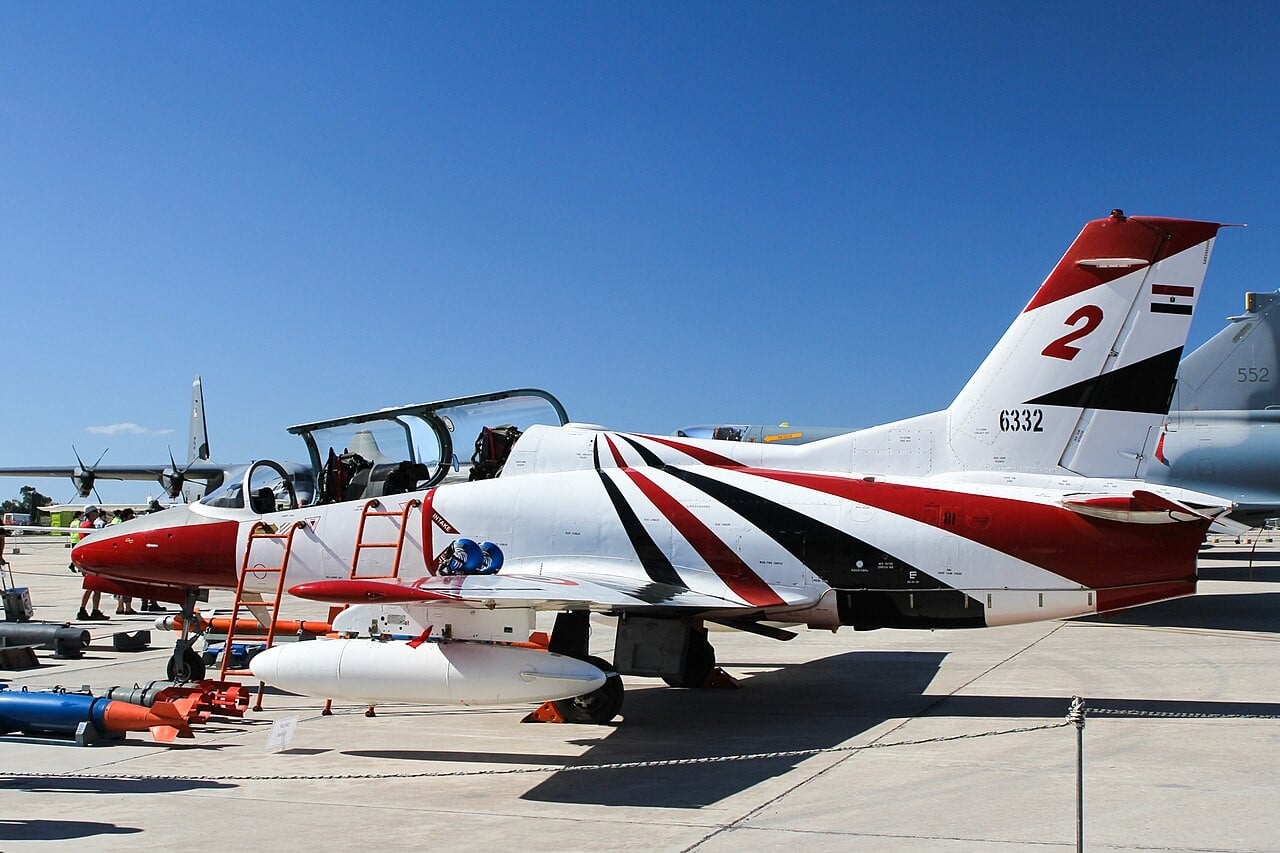
The customer list published by the Pakistan Aeronautical Complex reads like a map of China’s defence relationships: China, Pakistan, Egypt, Sri Lanka, Namibia, Ghana, Sudan, Zimbabwe, Myanmar, Bolivia and Venezuela. Other operators listed in public sources include Bangladesh, Angola, Zambia and Laos. By 2010, total production of all variants was estimated at more than 500 aircraft.
For many of these air forces the K-8 does double duty. Venezuela and Bolivia ordered versions without US-controlled parts. Pakistan’s K-8P, with a head-up display, multi-function displays and GPS, carries training bombs, gun pods and short-range air-to-air missile launchers.
The Sherdils and the K-8
The best-known K-8s in the world wear red, white and blue and fly in tight formation. The Sherdils, or “Lion Hearts”, are the aerobatic team of the Pakistan Air Force Academy at Risalpur. The team was formed in 1972 on the Cessna T-37 and switched to the K-8 in 2009, flying its first public display with the new type in April 2010. Its pilots are instructors from the academy’s advanced jet training squadron, not full-time display pilots.
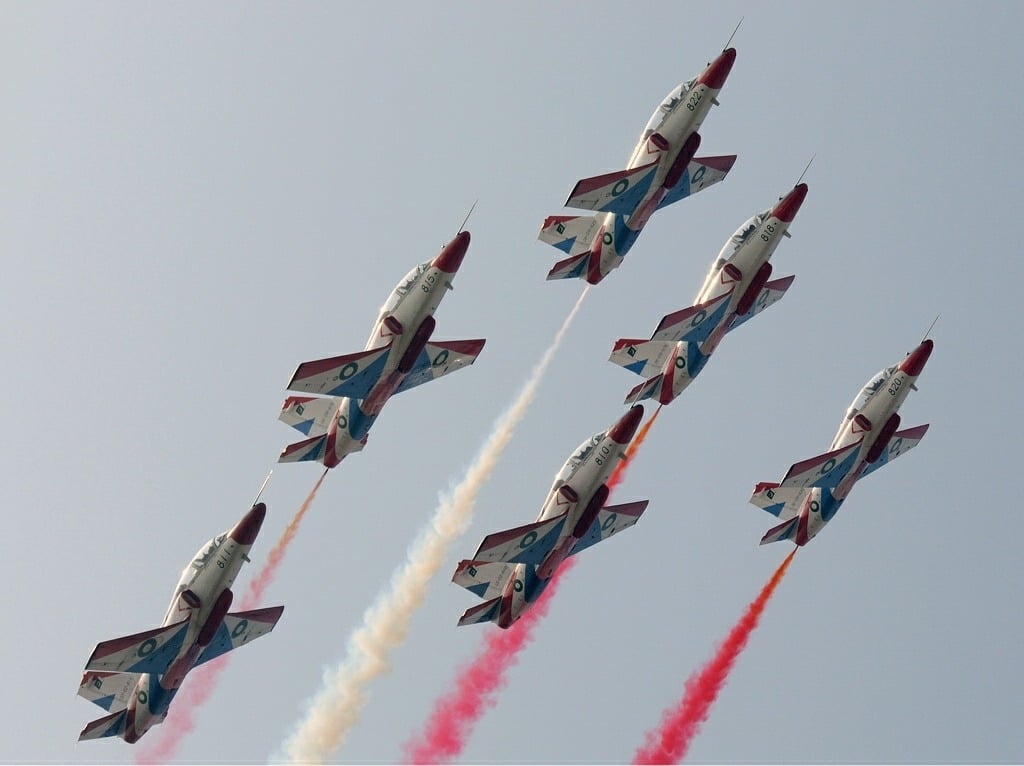
Today the team flies nine K-8Ps, and has taken the type to air shows abroad, including Dubai. For a trainer that was nearly cancelled by an embargo in 1989, a nine-ship formation over Islamabad is a fine way to show what Chinese and Pakistani engineers built together.
Cockpit footage of the Sherdils K-8 aerobatic team, released by the Pakistan Air Force.
The K-8 now sits in a crowded field of jet trainers, alongside the Czech L-39 Albatros, IL BAE Hawk and the Russian Yak-130. Its pitch has always been the same: simple, robust and affordable. Judging by how many air forces still use it, that pitch keeps working.
Sources: Pakistan Aeronautical Complex (K-8 page), Aerospaceweb.org (K-8 Karakorum), GlobalSecurity.org (K-8 Karakorum / JL-8 / L-11)
Header photo: Asuspine / Wikimedia Commons, GFDL 1.2
0 Comments