
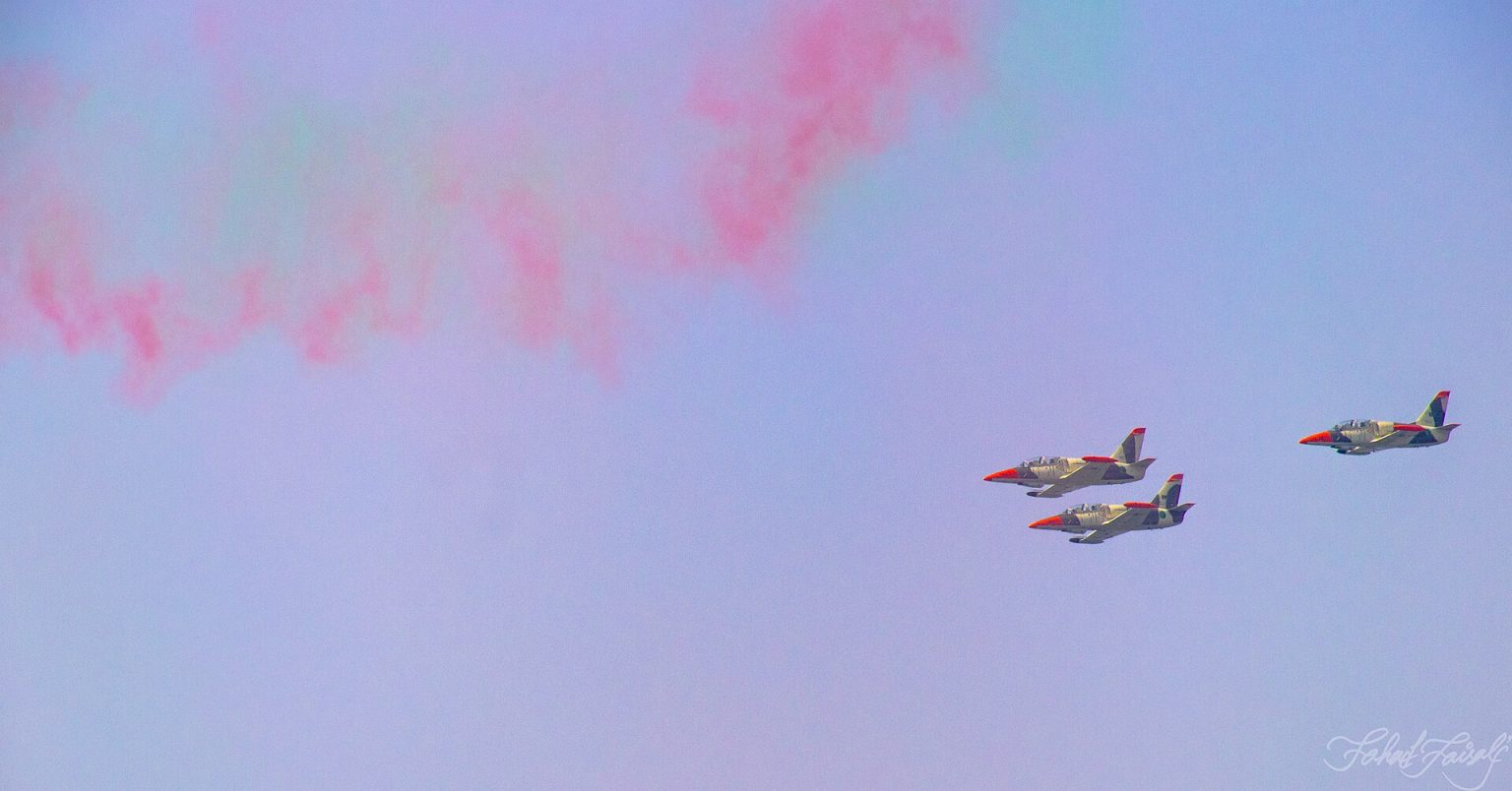
Aero L-39
“Albatros”
The most-produced jet trainer in history — a docile, rugged Czech jet that taught pilots across more than 30 air forces, became the world’s most common privately-owned jet warbird, and is today MiGFlug’s flagship flight: the single most popular jet experience the company sells.
The jet that put everyone in a cockpit
If any single aircraft democratised the jet-fighter experience, it is the L-39 Albatros. Designed in the mid-1960s under Jan Vlček at Aero Vodochody to replace the first-generation L-29 Delfín, the Albatros was built to teach — its whole design philosophy is docile, forgiving, honest handling. First flown on 4 November 1968 and in service from 1972, it became the standardised jet trainer of almost the entire Warsaw Pact and trained tens of thousands of military pilots across more than 30 nations.
Its defining claim is scale. With roughly 2,900 airframes built into the late 1990s, the L-39 is the most widely produced jet trainer in history and the most exported trainer of the Cold War era. When the Cold War ended, hundreds of these rugged, cheap-to-run jets flooded onto the civilian market, and the Albatros quietly became the most common privately-owned jet warbird on Earth — flown by air-racers, collectors and civilian display teams like the Breitling Jet Team.
That is exactly why it is MiGFlug’s flagship jet experience, the single most popular flight the company sells. Strapped into the elevated rear seat under a long bubble canopy, an ordinary passenger gets aerobatics, high-G turns and a genuine taste of military jet flying — no licence required. The L-39 is the world’s jet-flight gateway, and MiGFlug flies you in one.
01The L-39 Albatros family: from the baseline trainer to the L-39NG
The baseline L-39C advanced trainer is by far the most numerous version. From it grew a whole family: the single-seat L-39V target-tug; the armed L-39ZO with four underwing hardpoints; and the light-attack L-39ZA, which added a belly-mounted 23 mm GSh-23L cannon. The heavily upgraded L-39MS / L-59 introduced a more powerful DV-2 engine and modern avionics, while the 1990s L-139 prototype tried a Western Garrett/Honeywell turbofan.
Aero never retired the design — it modernised it. The current L-39NG (“Next Generation”) swaps in a Williams FJ44-4M turbofan, glass cockpit, five hardpoints and a 15,000-hour airframe life, earning full certification and beginning deliveries in 2024. Half a century on, the Albatros line is in serial production again.
What makes the L-39 special
The frugal AI-25TL turbofan
The Albatros is powered by a single Ivchenko-Progress AI-25TL turbofan (~16.9 kN / 1,720 kgf). Chosen over a thirstier turbojet, the bypass engine gives good fuel economy, long endurance and modest running costs — a decisive reason the type stays cheap enough for civilian owners and flight operators to keep flying decades on. Shoulder-mounted lateral intakes keep the engine clear of runway debris.
Docile, forgiving handling
Everything about the L-39 is tuned to be teachable: benign stall behaviour, predictable controls, stable low-speed flight and straightforward systems. That same forgiving character is exactly what makes it ideal for civilian passenger rides — spirited and fully aerobatic, yet safe and manageable enough to carry a first-time flyer.
Rugged systems & stadium seating
The airframe is robust, low-maintenance and tolerant of rough fields. Instructor and student — or pilot and passenger — sit in tandem on VS-1 ejection seats, with the rear seat raised for a genuine forward view. That “stadium seating” under the long bubble canopy gives passengers one of the best all-round cockpit outlooks of any jet.
02Why the L-39’s turbofan is the secret to its survival
Most 1970s military jets are ruinously expensive to run, which is why so few survive in flying condition. The L-39 is the great exception. Its Ivchenko AI-25TL is a bypass turbofan, not a thirsty turbojet — economical, reliable and long-legged. That single engineering choice is the reason a Cold War military jet can still be operated by civilian owners and adventure-flight companies without bankrupting them, and it is the foundation of the L-39’s dominance of the private-warbird world.
03The L-39’s cockpit: built so the back-seater can actually see
The tandem cockpit raises the rear seat above the front so the instructor — or, on a MiGFlug ride, the passenger — gets a real forward view through the long one-piece canopy. It is a small design choice with a big payoff: the L-39 offers one of the best panoramic outlooks of any jet, which is exactly why it makes such a spectacular experience for a paying passenger who wants to actually watch the world roll around them during aerobatics.
Full specifications (L-39C)
Baseline note: the figures below describe the production Aero L-39C Albatros as built at Aero Vodochody between 1971 and 1996 — the tandem two-seat basic and advanced trainer with a low-set double-taper wing, non-jettisonable wingtip tanks, shoulder-mounted intakes and one Ivchenko AI-25TL turbofan of 16.87 kN (3,792 lbf). The C is the right baseline for three reasons: it is by a wide margin the most numerous mark at roughly 2,260 of about 2,900 airframes, it is the version the Soviet Air Forces bought in their thousands, and it is the version almost every civil operator flies, MiGFlug’s own aircraft included. Deltas for the four-hardpoint L-39ZO, the gun-armed L-39ZA, the single-seat L-39V target tug and the re-engined L-39NG are given in grey. Four points of disagreement are worth settling before the tables begin. First, the first-flight date: Aero Vodochody’s own corporate history states that prototype X-02 flew on 4 November 1968 with Rudolf Duchoň at the controls, and that is the date used here; some widely read online references give 4 November 1969, and some are internally inconsistent on the point. Second, production: Aero says "nearly 3,000", its own reference figure is 2,900, and English-language encyclopaedias prefer "in excess of 2,800 with over 30 air forces". All three describe the same programme; 2,900 is used below. Third, maximum speed: 750 km/h at 5,000 m is the manufacturer and Jane’s figure for level flight, while trade references print 910 km/h as a maximum with 750 km/h as the cruise. The 910 figure is a limiting indicated speed reached in a dive rather than a level-flight maximum, and quoting it as a top speed flatters the aeroplane; both appear below with their meaning attached. Fourth, the gun: the GSh-23L installation on the L-39ZA is repeatedly described as firing "150 rounds per minute", which is a garbled reading of the 150-round magazine. The gun itself fires at roughly 3,400 rounds a minute, which is why 150 rounds lasts under three seconds.
Dimensions & weights
- Crew
- 2 in tandem under two separate canopies, both hinged on the starboard side and opened by hand, with the instructor’s rear seat raised to see past the pupil. The L-39V target tug deleted the rear station and flew as a single-seater with the winch operator’s equipment in its place. The cockpit layout, switchology and even the ejection-seat firing drill were deliberately made to match Soviet front-line types — the seat drill is identical to a MiG-29’s — because the point of the aeroplane was to produce pilots who could step into a MiG or a Sukhoi without relearning the basics
- Length
- 12.13 m (39 ft 10 in), unchanged across L-39C, ZO, ZA and V. The new-build L-39NG is shorter at 11.83 m (38 ft 10 in) because the Williams FJ44-4M is a physically smaller engine than the AI-25TL and the rear fuselage was redrawn around it
- Wingspan
- 9.46 m (31 ft 0 in), measured over the permanently fitted 100-litre wingtip tanks, which are structural and not jettisonable. Removing them is not an option on any Albatros mark. The L-39NG spans 9.37 m (30 ft 9 in) precisely because it deletes them: its Stage 2 airframe uses a wet wing instead, and losing the tip tanks is the quickest way to tell an NG from an Albatros at a distance
- Height
- 4.77 m (15 ft 8 in) to the top of the swept fin. The tailplane is mounted low, at the base of the rudder and directly over the jet efflux — not a T-tail. This is the single clearest visual break from the L-29 Delfín it replaced, which has its own page in this encyclopedia and carried its tailplane at the top of the fin
- Wing area
- 18.8 m² (202 sq ft), with a double-taper planform and 2½ degrees of dihedral from the roots. Double-slotted flaps inboard, mass-balanced ailerons outboard, separated by small wing fences
- Aspect ratio
- 4.76 — deliberately low. A short, stiff, thick wing gives high roll rate, benign stall behaviour and enough structural margin for a lifetime of ham-fisted student handling, at the cost of cruise efficiency nobody was buying the aeroplane for
- Aerofoil
- NACA 64A012 modified — a twelve-per-cent laminar-flow section, and a thoroughly conventional choice. There is nothing exotic anywhere in the L-39’s aerodynamics, which is the reason it has proved so tolerant of forty years of civil ownership by pilots with no Warsaw Pact conversion course behind them
- Empty weight
- 3,455 kg (7,617 lb). The L-39NG comes in at 3,100 kg (6,834 lb) empty despite carrying more fuel, which is the measure of what fifty years of structural design and a modern engine buy you
- Normal take-off weight
- 4,200 kg (9,259 lb) — the reference weight at which the aeroplane is cleared to plus 8 and minus 4 g, and the weight at which almost every quoted handling figure was measured. A clean L-39C on internal fuel with two crew sits very close to this number
- Max take-off weight
- 4,700 kg (10,362 lb) for the L-39C. The strengthened-wing L-39ZO and the L-39ZA go higher: the ZO carries a total external load of 1,150 kg (2,535 lb) and the ZA 1,290 kg (2,844 lb), on reinforced structure and heavier undercarriage. The L-39NG is rated to 5,800 kg (12,787 lb)
- Internal fuel
- ~1,255 litres (331 US gal, 276 imp gal) — five rubber bag tanks totalling 1,055 litres in the fuselage behind the cockpit, plus 100 litres in each wingtip tank. Civil owners routinely strip the heavy Soviet radio racks out of the aft avionics bay and put a 70-gallon tank there instead, which is the single commonest modification on the warbird fleet
- Max fuel with external tanks
- ~1,955 litres (517 US gal) with two 350-litre drop tanks on the inboard pylons. On an L-39C with only two hardpoints that means fuel or stores, never both — the reason the four-pylon L-39ZO exists at all
- Max external stores
- ~284 kg (626 lb) on two pylons for the L-39C, which is a training fit rather than a war load. The L-39ZO’s four pylons are stressed for 500 kg inboard and 250 kg outboard. The L-39NG carries up to 1,640 kg (3,616 lb) on five hardpoints
- Wing loading
- 250 kg/m² (51.2 lb/sq ft) at 4,700 kg — half again what the L-29 Delfín carried, and the reason the Albatros feels like an aeroplane rather than a glider with a jet strapped on. It also explains the landing distances below
- Undercarriage
- Retractable tricycle, hydraulic, low-pressure tyres — mains retracting inboard into the wing, nose leg forward. Specified from the outset for grass and unprepared strips; Warsaw Pact regiments and, later, Russian training units operated from frozen lakebeds on it. The L-39ZO and L-39ZA use a strengthened version to carry the heavier stores
Performance
- Max speed
- 750 km/h (405 kn, 466 mph) in level flight at 5,000 m (16,400 ft). This is the manufacturer’s and Jane’s figure and it is the honest one. Trade references that print 910 km/h as a maximum are quoting a limiting indicated speed, not level flight
- Never-exceed speed
- 980 km/h (529 kn, 609 mph) / Mach 0.80 — a placard limit reached in a dive. The Albatros is firmly subsonic and was never asked to be anything else; its successor the L-59 raised the level-flight maximum to 872 km/h and the L-159 to 936 km/h without ever going supersonic either
- Rate of climb
- 21 m/s (4,134 ft/min) at sea level — half as much again as an L-29 Delfín and enough that a student can be taught proper energy management rather than taught to hoard what little he has. The L-39NG manages 23 m/s (4,530 ft/min)
- Time to altitude
- 5,000 m in 5 minutes (16,400 ft). A useful number for a syllabus, because it fixes how much of a 40-minute detail is spent getting to the training block and how much is spent working in it
- Service ceiling
- 11,000 m (36,100 ft). The cockpit is only partially pressurised, so crews go on oxygen masks above about 7,000 m (23,000 ft) — a simplification that saved weight, cost and maintenance, and one that every L-39 pilot notices
- Range, internal fuel
- 1,100 km (594 nmi, 684 mi). The L-39NG, on the same nominal thrust from a Williams FJ44-4M, reaches 2,590 km (1,398 nmi) on internal fuel. That figure is not a tribute to Czech aerodynamics; it is a measure of how thirsty a 1960s Soviet turbofan is
- Ferry range
- 1,750 km (945 nmi, 1,087 mi) with internal and external fuel. Some references give 1,350 km for range with drop tanks on a light-attack profile; the difference is altitude and reserve assumptions rather than a dispute about the aeroplane
- Endurance
- 2 hr 30 min on internal fuel, 3 hr 50 min with external tanks. Long enough for consecutive circuit details without refuelling, which is what a training regiment actually cares about. The L-39NG claims four hours thirty on internal fuel alone
- g limits
- plus 8 / minus 4 at 4,200 kg (9,259 lb) — a genuinely aerobatic clearance, and a large part of why the type became the standard mount for civil jet display teams from the Breitling Jet Team to the Patriots. Reduced at higher weights and with external stores
- Take-off roll
- 530 m (1,740 ft) at normal weight on a paved surface. Longer off grass, and longer again on a hot day with stores, which is the practical limit that armed L-39 operators in Africa and the Middle East have run into repeatedly
- Landing roll
- 650 m (2,130 ft), with side-by-side ventral airbrakes ahead of the wing leading edge and double-slotted flaps to help. There is no braking parachute and no thrust reverser; the wheel brakes do the work
- Thrust-to-weight ratio
- 0.37 at normal take-off weight — markedly better than the L-29’s 0.27 and comfortably short of a Hawk or an Alpha Jet. The Albatros accelerates adequately, climbs adequately and, flown by an instructor who understands it, teaches energy management honestly because there is not much energy to squander
Propulsion & systems
- Engine
- 1 × Ivchenko AI-25TL turbofan — the whole reason the L-39 exists in the shape it does. When the X-02 flew in November 1968 it became the first turbofan-powered trainer in the world, four years before the Hawk was even ordered. The AI-25 family was designed for the Yakovlev Yak-40 airliner and uprated for the Albatros, and it brought airliner reliability logic into a training aeroplane
- Thrust
- 16.87 kN (1,720 kgf, 3,792 lbf) at take-off; 5.05 kN (515 kgf) at cruise. The L-39NG’s Williams FJ44-4M is rated at 16.89 kN (3,800 lbf) — within a fraction of a per cent of the Soviet engine. Aero chose it for fuel burn, life and support, not for power
- Engine architecture
- Twin-shaft medium-bypass turbofan — three fan and low-pressure compressor stages, nine high-pressure stages, annular combustor, one high-pressure and two low-pressure turbine stages. Bypass ratio 2.0:1, overall pressure ratio 9.5:1. A bypass engine is quieter, more economical and far less prone to compressor stall at the low speeds and high angles of attack a student generates — which is precisely why the choice mattered
- Engine size and weight
- 3,358 mm long (132.2 in), about 612 mm (24.1 in) across the intake casing, 350 kg (772 lb) dry. The whole rear fuselage detaches for an engine change, which is one of the design features that keeps civil maintenance costs where they are
- Fuel consumption
- 468 kg/h (1,032 lb/h) — specific fuel consumption 0.6 at take-off rating and 0.815 at cruise, in pounds per pound of thrust per hour. Those are 1960s numbers. Civil operators quote roughly 1,000 to 2,000 US dollars a flight hour all-in, which is the cheapest jet warbird economics on the market and the single commercial fact that has kept several hundred Albatroses flying
- Time between overhaul
- 1,000 flight hours on the AI-25TL, and it is widely reported as cheaper to overhaul than most turbine engines of comparable size. More than 9,360 AI-25s of all marks were built, so the spares pool is deep. Ukrainian upgrades fit the uprated AI-25TLSh; a grimmer modern use is Ukraine’s Fire Point company, which has been buying up surplus AI-25s — some with ten hours of life left — to power the FP-5 Flamingo cruise missile
- Auxiliary power unit
- Saphir 5 single-shaft gas turbine — a genuinely important detail. The APU starts the main engine and supplies ground power, so an L-39 needs no external starter trolley and no ground power cart. For a Warsaw Pact training regiment dispersing to a grass strip that was operational doctrine; for a private owner on a general-aviation field today it is the difference between owning a jet and owning a hangar ornament
- Air intakes
- Shoulder-mounted semicircular, with splitter plates — set behind the cockpit and well clear of the ground, with the jet pipe exiting under the tailplane. As with the L-29’s wing-root intakes, the layout is dictated by the requirement to operate from unpaved surfaces without eating the debris the nosewheel throws up
- Fuel system
- Five fuselage bag tanks plus fixed tip tanks — 1,055 litres in the fuselage, 100 litres in each tip. No in-flight refuelling, no tank inerting, no self-sealing. Optional tanks can go in the rear cockpit position and on the inboard pylons; the tip tanks themselves can be enlarged. The L-39NG replaces the lot with an integral wet wing
- Flight controls
- Pushrod-actuated, unboosted, with electric servo tabs on ailerons and rudder. Variable-incidence tailplane with inset elevators. Flaps, undercarriage, wheel brakes and airbrakes are hydraulic, and an automatic trim system is interconnected with the flaps to cancel the pitch change a vigorous flap selection would otherwise produce — a small, thoughtful piece of engineering aimed squarely at a student who has just done something abrupt
- Escape system
- 2 × VS-1 ejection seats developed by VZLÚ at Letňany. These are not zero-zero seats: they need forward speed and some height, and that limitation is well understood by everyone who flies the type. A number of civil operators and several military upgrade programmes have refitted modern seats, and it is the most frequently raised safety point about the aeroplane
- Avionics
- RSBN-5S short-range navigation, ILS, RKL-41 radio compass, RV-5 radio altimeter, MRP-56PS marker receiver — a Soviet-standard fit with no radar of any kind on any Albatros mark. Weapon aiming is by a gyro gunsight in the front cockpit only. Thailand’s L-39ZA/ART aircraft were rebuilt with Elbit avionics in the 1990s, Slovakia’s L-39CM and ZAM took a NATO-compatible fit, and the L-39NG is glass-cockpit from the outset
- Hardpoints
- 2 underwing on the L-39C — and normally not even fitted, because most L-39Cs spent their lives as pure trainers. Four on the L-39ZO and L-39ZA with a strengthened wing; the ZA adds a ventral gun pod. Five on the L-39NG, two of them wet
- Production and cost
- 2,900 built, 1971–1996 — the most-produced jet trainer of the Cold War and, by Aero’s own count, "nearly 3,000 units". Roughly 200 a year were selling in the late 1980s, and in 1993 L-39 export orders were 80 per cent of the value of all Czech military exports for the year. Surplus airframes sold in the United States for 200,000 to 300,000 US dollars in the mid-2000s. New L-39NGs are a different market entirely: Ghana’s December 2021 contract for six was worth 111.4 million euros including training and support, about 18.6 million euros an aircraft for the package
04The L-39’s running costs: why it rules the civilian jet world
Low operating cost is the entire reason the L-39 dominates private jet ownership. New airframes cost around a million dollars in the Cold War era; today ex-military examples change hands as civilian warbirds for roughly US$200k–500k, and cost-per-flight-hour figures are commonly cited around US$1,000–2,000 — a fraction of what a supersonic fighter costs to fly. Treat the exact numbers as estimates: they vary widely by variant, operator, country and how hard the jet is flown. But the comparison is what matters — no other jet of this capability is anywhere near as cheap to buy and run, which is precisely why the Albatros fills civilian hangars worldwide.
Armament & payload
Most Albatroses never carried a weapon, and the ones that did have fought in more wars than any other trainer
The standard L-39C has two underwing pylons, and they are usually not even fitted. That is the correct starting point for understanding this aeroplane: roughly 2,260 of the 2,900 built were pure trainers whose most aggressive load was a practice bomb carrier, and Aero Vodochody sold them into a Warsaw Pact market that already had thousands of MiG-21s and Su-17s to do the shooting. The armed marks are a separate business decision, taken for export. The L-39ZO of 1975 added four pylons and a strengthened wing and went to Iraq, Libya and Syria in quantity. The L-39ZA of 1977 added a 23 mm GSh-23L in a conformal ventral pod and heavier undercarriage, and became a genuine, if modest, light attack aeroplane.
What that modest capability has actually done is out of all proportion to its specification. Syrian L-39ZAs flew the first fixed-wing strikes of the civil war at Aleppo in 2012 and, according to Reuters reporting from 2014, became one of the Syrian Arab Air Force’s preferred ground-attack platforms precisely because they were slow and agile enough to hit small targets in urban fighting — an argument that reads very differently depending on which end of it you were standing. Libyan L-39ZOs fought over Chad and eleven were captured intact at Ouadi Doum in March 1987. Azerbaijani aircraft flew close air support throughout the First Nagorno-Karabakh War and were shot down doing it. Afghan, Chechen, Abkhaz, Iraqi, Malian and Ukrainian Albatroses have all been to war. In every case the aeroplane was chosen because it was what the air arm had, and in every case it took losses that a purpose-built attack aircraft would not have taken. Weapon fits vary enormously by mark, by operator and by decade, and Aero has never published a consolidated clearance list. Treat every line below as "on some aircraft, for some operators" rather than as a universal capability.
Gun
- No gun of any kind on the L-39C, the L-39ZO or the L-39V. Weapons training on those marks is done with podded stores or with nothing at all.
- L-39ZA only: 1 × Gryazev-Shipunov GSh-23L, a 23 mm twin-barrelled Gast-principle cannon in a conformal pod under the forward fuselage, fed from a 150-round magazine inside the airframe.
- The GSh-23L fires at roughly 3,400 rounds a minute, so the full magazine lasts under three seconds. References that describe the installation as "150 rounds per minute" have confused the magazine with the rate of fire.
- Aiming is by a gyro gunsight in the front cockpit only. There is no ranging radar, no laser and no computing sight on any Albatros mark; the sight is a reflector and a depression setting.
- The L-39NG carries no internal gun either, but is cleared for 12.7 mm and 20 mm gun pods such as the FN Herstal HMP-400 on its underwing stations.
Air-to-air
- R-3S / K-13, NATO reporting name AA-2 Atoll — a pair could be fitted to give an L-39 a rudimentary air-defence capability, a fit reported from the early 1980s onwards for operators with nothing better.
- R-60, NATO reporting name AA-8 Aphid — the outer pylons of the L-39ZA are wired for it. This is the more credible of the two fits, because the R-60 is light, agile and does not need much of a launch aircraft.
- There is no radar on any Albatros, no missile approach warning and no radar warning receiver in the production standard. An L-39 shooting at another aeroplane is a visual, close-range, stern-quarter proposition and nothing else.
- The type’s only widely reported air-to-air claim is an Abkhaz one from 2008, that a missile-armed L-39 downed a Georgian Hermes 450 drone. A United Nations investigation concluded the footage in fact showed a Russian MiG-29 firing an R-73.
- The reverse case is far better attested. Armenian air defences shot L-39s out of the sky over Karabakh; a Turkish F-16 shot down a Syrian L-39 over Idlib on 3 March 2020; a Russian aircraft shot down a Ukrainian L-39 on the first morning of the 2022 invasion.
Air-to-surface guided
- None, on any mark of the L-39 Albatros. No precision-guided air-to-ground weapon was ever integrated by Aero Vodochody or by any operator of the C, ZO, ZA or V.
- There is no laser designator, no targeting pod interface, no data link and no weapons computer in the production standard. The guidance system is the pilot, the gunsight and the dive angle.
- This is the honest limit of the light-attack claim, and it is why Syrian and Malian L-39 strikes have been so indiscriminate: unguided bombs and rockets aimed by eye from low level over contested ground.
- The capability arrives with the successors. The L-159 ALCA carries the AGM-65 Maverick and laser-guided bombs behind a Grifo-L radar; the L-39NG is cleared for laser-guided bombs and 70 mm laser-guided rockets with a FLIR turret and targeting pod.
Bombs
- Soviet-pattern general-purpose bombs in the 50, 100 and 250 kg classes — FAB-100 and FAB-250 being the usual fit on armed export aircraft.
- L-39ZO and L-39ZA: inboard pylons stressed for 500 kg (1,100 lb) each and outboard for 250 kg (550 lb), for a total external load of 1,150 kg on the ZO and 1,290 kg on the ZA.
- L-39C: nothing heavier than practice bombs on carriers, and in practice not even those on most airframes. Its two pylons are rated for about 284 kg (626 lb) in total.
- Practice bomb carriers are by a wide margin the most common ordnance any Albatros has ever lifted, and the only kind the overwhelming majority of the fleet ever saw.
- The L-39NG adds Western stores including the Mk 82 and laser-guided bombs on five hardpoints, up to 1,640 kg (3,616 lb).
Rockets
- UB-16-57 pods carrying sixteen S-5 57 mm unguided rockets each — the standard Soviet-bloc fit and the weapon most often seen under a Syrian, Libyan or Azerbaijani Albatros.
- Larger S-8 80 mm rockets in B-8M pods appeared on Syrian aircraft during the civil war, after Russian resupply put newer natures into the inventory.
- Western-supplied and Western-upgraded aircraft, including Thailand’s L-39ZA/ART, have used 70 mm FFAR and CRV7 rockets instead.
- Rockets are the type’s most effective real weapon. A salvo from a stable, slow aeroplane against soft targets is more accurate than two iron bombs, and the pods are light enough not to ruin the climb.
- A curiosity worth knowing: mock UB-16 pods, inert and purely cosmetic, are a factory option and are widely fitted to civil warbirds. If you see rocket pods on an air-show L-39, they are almost certainly empty shells.
Pods & other stores
- 2 × 350-litre drop tanks on the inboard pylons, taking total fuel to about 1,955 litres. On a two-pylon L-39C this consumes the entire store-carrying capability.
- L-39V target tug: a single-seat conversion equipped to tow a KT-04 target on a 1,700 m (5,600 ft) cable. One prototype and eight production aircraft, two of which went to the East German Air Force.
- Reconnaissance and camera pods on some operators’ aircraft; Hungary’s L-39NG order of April 2022 includes four aircraft in a dedicated reconnaissance configuration.
- No electronic countermeasures pod, no chaff or flare dispenser and no radar warning receiver in the production Albatros standard — an omission that has cost the type dearly everywhere it has been used against a defended target. The L-39NG offers a programmable jamming pod.
- Improvised uses belong here too. Chechen forces in 1994 were reported to be preparing L-39s as flying bombs, packing the ejection seat space with explosive, and it was partly this that prompted the Russian Su-25 strikes that destroyed the Chechen air force on the ground.
Three typical loadouts
- Basic and advanced training sortie, Soviet training regiment
- Clean L-39C, internal fuel, no pylons fitted, two crew, 40 to 50 minutes. This is what the aeroplane was for and what the overwhelming majority of the 2,900 built actually did, day after day, for twenty years. Over 2,000 L-39Cs went to the Soviet Air Forces alone, and an entire generation of MiG-23, MiG-29, Su-24 and Su-25 pilots learned to fly jets on one.
- Counter-insurgency strike, Syrian Arab Air Force, Aleppo 2012–2016
- L-39ZA with the GSh-23L pod loaded, two UB-16-57 rocket pods and two 250 kg bombs, flown from Kweiris or Al-Jarrah at low level over a city. Syrian L-39s flew the first fixed-wing strikes of the war and kept flying them for years; rebels captured a number intact at Al-Jarrah in February 2013 and claimed to have flown two of them. It is the most-used combat loadout in the type’s history and the one that defines its reputation.
- Weapons and gunnery conversion, export air force
- L-39ZO with two practice rocket pods inboard and two practice bomb carriers outboard, internal fuel, gyro gunsight. The syllabus fit that Iraq, Libya, Nigeria, Thailand and a dozen others bought the armed marks for: enough to teach sight picture, dive angle, tracking and release discipline on an aircraft that costs a fraction of an hour in a fighter.
Sourcing caveat: Aero Vodochody has never released a consolidated weapons clearance document for the L-39 family, and no operator has published one either. The fits above are reconstructed from Jane’s All The World’s Aircraft, Jon Lake’s variant briefing in World Air Power Journal, manufacturer material and operator reporting, and should be read as typical rather than definitive. The K-13 and R-60 fits in particular are consistently described in secondary literature but rarely documented with serial numbers or clearance dates. Store weights differ between the ZO and ZA even where the pylons look identical, because the ZA has the heavier undercarriage to absorb the landing loads. Nothing here applies to a civil-registered aircraft: demilitarised warbirds carry no live armament, and the pods you see at air shows are inert.
Variants
Aero built one aeroplane in four flavours, then spent thirty years trying to build its replacement out of the same drawing
In 1964 Aero Vodochody set up a design team under Jan Vlček to meet a requirement for a "C-39" — C for cvičný, trainer — to replace the L-29 Delfín. What emerged was the first turbofan-powered trainer in the world. Prototype X-02 flew on 4 November 1968 with Rudolf Duchoň at the controls; serial production of the L-39C began in 1971; the Czechoslovak Air Force took its first aircraft on 28 March 1972, and in that same year the Warsaw Pact adopted the type as its standard trainer. That decision, taken in Moscow, is the reason the L-39 outsold every other jet trainer of the Cold War.
The variant tree is unusually shallow for a 2,900-aircraft programme, and that is a compliment. The airframe was right at the first attempt and the changes that followed were all about weapons: two pylons became four on the ZO in 1975, and the ZA of 1977 added a gun and the undercarriage to land with it. Everything else — the L-39MS that became the L-59, the L-139 with a Garrett engine, the L-159 with a Honeywell one, the L-39NG with a Williams — is an attempt to keep the same basic shape competitive against newer designs. Two of those attempts sold in useful numbers; two did not.
Production ended in 1996 with the loss of the captive Warsaw Pact market. Aero has never stopped supporting the fleet, and since 2004 its Defence and MRO division has run a formal programme of overhaul, life extension, demilitarisation and civil certification for privately owned aircraft — the reason a 1980s Albatros can still be legally maintained and flown today. In October 2024 the line reopened, after a fashion, when the L-39NG entered serial production as the L-39 Skyfox.
- L-39X-01 to X-07 (1968–71, 5 flying prototypes and 2 static airframes)
- X-02 made the maiden flight on 4 November 1968. Early testing was troubled enough that the programme slipped; the aeroplane that emerged was worth the wait.
- L-39C (1971–96, approximately 2,260 built)
- The production standard and the mark this page describes: two seats, one AI-25TL, two underwing pylons normally left off. Originally just "L-39", renamed C when the armed marks appeared. Over 2,000 went to the Soviet Air Forces. Almost every civil Albatros in the world is one of these.
- L-39V (from 1972, 1 prototype and 8 production)
- Single-seat target tug for Czechoslovakia, the rear cockpit given over to a winch towing a KT-04 target on a 1,700 m cable. Two were passed to the East German Air Force. A tiny production run for an unglamorous job, and the rarest Albatros mark by a wide margin.
- L-39ZO (first flight 25 June 1975, 337 built)
- Z for zbraně, weapons. Four pylons on a strengthened wing, stressed for 500 kg inboard and 250 kg outboard, with modified landing gear. First deliveries to Iraq in 1977; Libya took around 180, Syria 55. This is the mark that turned a trainer into an exportable light combat aircraft.
- L-39ZA (first flight 1977, roughly 200 built)
- The armed mark proper: the ZO’s four pylons plus a GSh-23L 23 mm cannon in a ventral pod with 150 rounds, sturdier undercarriage and a higher external load of 1,290 kg. Syria bought 44, Bulgaria, Slovakia, Nigeria, Uganda and Bangladesh among others took smaller batches. Note that some widely reproduced variant lists give the ZA a first flight of 30 September 1986 and say it became the L-59; that date and that lineage belong to the L-39MS, not the ZA.
- L-39ZA/ART (1990s, about 40 for Thailand)
- Built for the Royal Thai Air Force, which knows them as the B.KhF.1, and fitted by Elbit Systems of Israel with Western avionics, a head-up display and a modern weapons interface. The first serious attempt to put a Western cockpit in an Albatros, and the template for everything after. Retired by Thailand in 2021 after 27 years.
- L-39CM, L-39ZAM and L-39M1 (Slovak and Ukrainian upgrades, 2000s onwards)
- Slovakia rebuilt its C and ZA fleets with NATO-compatible communications and navigation so that a small air force could keep training its own pilots after accession, and still flies a handful of each. Ukraine went further: from 2009 Odesaviaremservis converted L-39Cs to L-39M1 standard with the uprated Ivchenko AI-25TLSh engine, which gives noticeably better acceleration and hot-and-high performance. Six were completed by 2014 against a planned thirteen, and they are the aircraft on which Ukrainian fast-jet pilots were still training when Russia invaded in 2022.
- L-39MS, in service the L-59 Super Albatros (first flight 30 September 1986, about 80 built)
- A substantially new aeroplane rather than a modification: longer nose, strengthened fuselage, new cockpit and a Lotarev DV-2 turbofan of 21.6 kN. Six went to the Czechoslovak Air Force in 1992–93, 48 to Egypt as the L-59E in 1993–94 and 12 to Tunisia as the L-59T in 1995–96. Out of production by 2013.
- L-159 ALCA (first flight 2 August 1997, 72 built)
- Preceded in 1993 by the L-139 Albatros 2000, a single prototype with Western avionics and a Garrett TFE731-4-1T of 17.99 kN that flew, worked and found no customers. Its successor was the full combat development: single-seat L-159A with Grifo-L radar and a Honeywell/ITEC F124-GA-100 of 28 kN, plus two-seat T1 and T2 trainers. The Czech order of 72 was cut to 24 in service in 2003; Iraq bought 28 in 2012 and used them against Islamic State at Fallujah in May 2016 and Mosul that autumn; Draken International took 21 ex-Czech airframes as aggressors from 2015. The Czech Air Force still flies 16 L-159A and 8 trainers.
- L-39NG, in service the L-39 Skyfox (first flight 22 December 2018, about 24 by 2025)
- The current aeroplane. A Williams International FJ44-4M of 16.89 kN — within a whisker of the AI-25TL’s rated thrust but far more economical — five hardpoints, a glass cockpit and a wet wing in place of the tip tanks. Aero offers it as a Stage 1 re-engining of existing airframes and as Stage 2 new-build, with a validated life of up to 15,000 flight hours against roughly 5,000 for the original. Certified to EMAR 21 in July 2022, named Skyfox in October 2024, first delivery to the Flight Training Centre at Pardubice in January 2025.
Closing caveat on numbers and survivors. Variant totals for the Albatros are less firm than the round figures suggest: 2,260 for the L-39C and about 200 for the L-39ZA are best estimates from Jon Lake’s variant briefing rather than factory ledgers, and only the 337 built as L-39ZO is quoted consistently. The programme total is given as 2,900 by Aero’s own reference material and as "in excess of 2,800, with over 30 air forces" by English-language encyclopaedias. For the L-59, six plus 48 plus 12 accounts for 66 delivered aircraft against a build total usually stated as 80, the difference being prototypes and undelivered airframes. Every flying Albatros anywhere in the world is an original Aero Vodochody airframe: no reproduction L-39 has ever been built and none ever will be, because surplus airframes and a pool of more than 9,360 AI-25 engines made the question moot. The one facsimile is the Skyleader UL-39 Albi, a carbon-fibre ducted-fan ultralight conceived at the Czech Technical University in Prague and first flown on 4 April 2016, which looks like an Albatros and is not one. The predecessor, the L-29 Delfín, has its own page in this encyclopedia and remains the essential comparison for anyone trying to understand what the Albatros improved on.
Operators today
The Albatros is still in service with twenty-one air forces, and the largest fleet belongs to the country that spent twenty years trying to sell it off
Sixty years after the design team started work, the L-39 is still the standard jet trainer of the former Soviet Union and of a long list of air forces that bought Czechoslovak equipment during the Cold War. Russia holds the largest fleet by a wide margin, which is an irony worth pausing on: by 2005 Russia was trying to sell as many as 800 surplus Albatroses, and the Yakovlev Yak-130 was selected specifically to replace the type. Twenty years later the L-39 is still flying at Armavir, Kushchyovskaya and Kotelnikovo, because a training pipeline cannot be re-equipped faster than the money arrives.
Three names are missing from the chart and their absence is the most interesting part of it. Syria bought 55 L-39ZOs and 44 L-39ZAs in the 1970s and 1980s and flew them harder than any other operator; when the Assad government fell in December 2024 the Syrian Arab Air Force was dismantled, and FlightGlobal removed every Syrian aircraft from its World Air Forces 2026 tally. Whether the reconstituted Syrian Air Force has a flyable L-39 at all is genuinely unknown. Libya took around 180 L-39ZOs and had lost half of them to serviceability by 2001; nothing corroborable survives of that fleet. Egypt is the third: its remaining Albatros-family aircraft are chiefly L-59E Super Albatroses, a different type with its own designation, and published L-39 figures for Egypt range from one aircraft to eleven, which is not a range you can draw a bar from.
Two things the chart cannot show. The first is the L-39NG, which is not a variant on this list but a new aeroplane: the Czech and Hungarian rows below are Skyfoxes, not Albatroses, and Vietnam is running both together at Tuy Hoa while it transitions. The second, and far larger, is the civil fleet. There is no comparable warbird population for any other jet in the world. The United States civil register alone carried 255 L-39s in September 2012, and the type has supported a whole industry: the Breitling Jet Team, the Patriots Jet Team, the Baltic Bees, the Black Diamond Jet Team, a dedicated L-39 class at the Reno Air Races from 2002, and the civilian jet-flight operators — MiGFlug among them, flying L-39Cs in Florida, California, the Swiss and Italian Alps, Czechia, Australia and New Zealand. Aero Vodochody has run a formal maintenance, demilitarisation and civil-certification programme for these aircraft since 2004. The reasons are not sentimental: an AI-25TL is cheap to overhaul, the Saphir 5 auxiliary power unit makes the aeroplane independent of ground equipment, and more than 9,360 AI-25s were built. That is what a warbird fleet actually runs on.
These are estimates, current to September 2026. Many airframes counted on paper are stored, in deep overhaul, or not operational. Sources are FlightGlobal World Air Forces 2026 and 2025 and IISS The Military Balance as reflected in published operator tabulations, cross-checked against delivery and loss reporting; entries that could not be corroborated are omitted. Four rows need qualifying individually. Yemen’s 28 aircraft are carried in the World Air Forces tally but the Yemeni Air Force has not been a functioning organisation for a decade, and the figure should be read as a register entry rather than a flying fleet. Russia’s 182 is a 2025 figure for a fleet that is being displaced by the Yak-130 and includes aircraft in long-term storage. Ukraine’s 42 predates further wartime attrition: an L-39 of the 39th Tactical Aviation Brigade was shot down in the opening hours of 24 February 2022, and two more collided over Zhytomyr on 25 August 2023, killing three pilots including Andrii Pilshchykov, callsign "Juice". Mali’s twelve is the December 2025 figure; two were lost in 2023 and one was shot down in 2024. The Slovak total, six L-39CM and three L-39ZAM, is the least well sourced entry here. Several small fleets are left off the chart rather than drawn as bars of one or two: Mozambique holds a single ex-Romanian L-39ZO, Estonia leases two civil-registered aircraft for air force use, Turkmenistan has two, and the Taliban-run Afghan Air Force is credited with one active unit. Syria, Libya, Egypt, South Sudan and Kyrgyzstan are omitted for the reasons given above or because no defensible number exists. The civil fleet is deliberately not shown as a bar, because it is not an air force — but at several hundred airframes worldwide it is larger than every military operator on this chart except Russia, and it is the reason the L-39 will still be flying long after the last military one is grounded.
Six decades of the Albatros
Designed to replace the Delfín
Aero Vodochody develops the L-39 under Jan Vlček to succeed the L-29 Delfín as the Warsaw Pact’s standard jet trainer.
First flight
The prototype (XL-39) makes its maiden flight, powered by a new Soviet turbofan.
Series production begins
Full-scale manufacture starts at Aero Vodochody.
Enters service
The L-39 joins the Czechoslovak Air Force and becomes the standardised Warsaw Pact jet trainer.
Mass export
Sold to more than 30 air forces worldwide; the armed L-39ZO and L-39ZA light-attack variants are introduced.
The upgraded L-59
First flight of the more powerful second-generation L-39MS / L-59.
The warbird boom
Cold War surplus L-39s flood the civilian market; the type becomes the dominant privately-owned jet warbird.
MiGFlug adopts the L-39
MiGFlug begins operating the Albatros as its core civilian jet-flight aircraft.
The L-39NG revives the line
The next-generation L-39NG flies, earns full certification and begins deliveries, putting the Albatros back into serial production.
From the flight line: twelve Albatros stories
The most-produced jet trainer ever
~2,900 built — and still counting.
Read the full story
The civilian jet-warbird king
The world’s most common privately-owned jet.
Read the full story
The Breitling Jet Team
Europe’s largest civilian jet display team flew seven Albatros.
Read the full story
MiGFlug’s flagship jet experience
The signature flight, sold worldwide.
Read the full story
The L-39NG new generation
A 50-year-old design, reborn.
Read the full story
The armed ZA goes to war
A trainer that fought.
Read the full story
Stadium seating under glass
Built so the back-seater can see.
Read the full story
The frugal turbofan
Why the Albatros is still affordable.
Read the full story
Elon Musk flew one
Even billionaires pick the Albatros.
Read the full story
From Hanoi to Havana
A jet that circled the globe.
Read the full story
Replacing the Delfín
The Albatros grew from Aero’s first jet.
Read the full story
The people’s jet racer
Cheap jet thrills at the races.
Read the full story
The Albatros in pictures
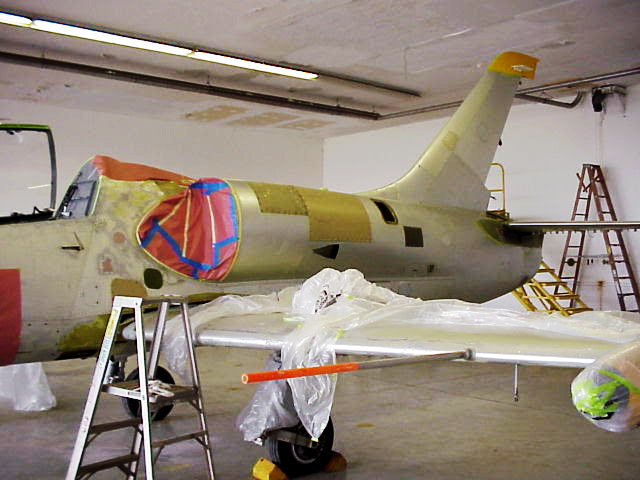
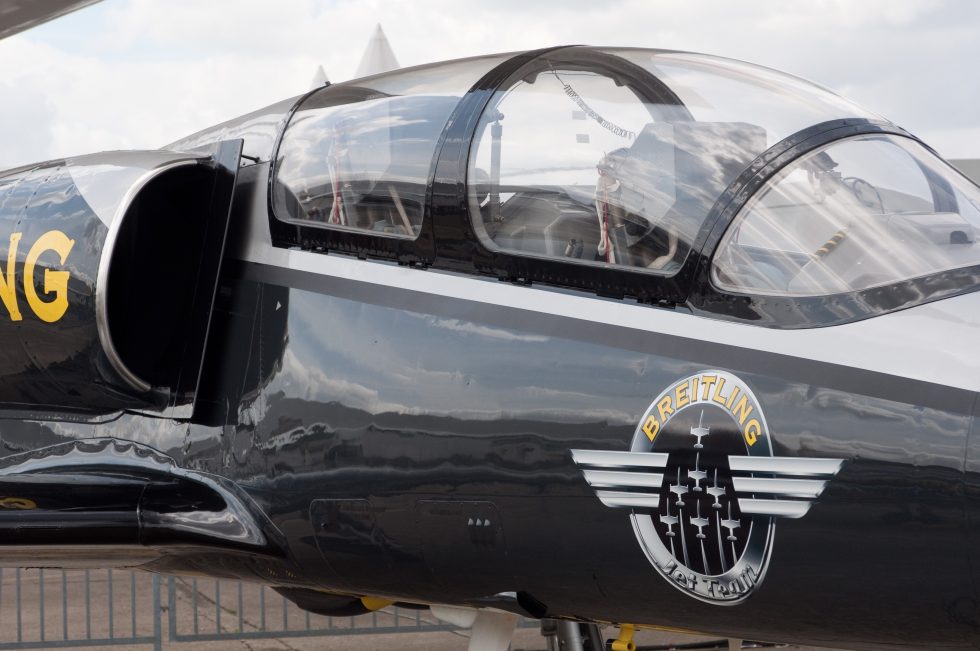
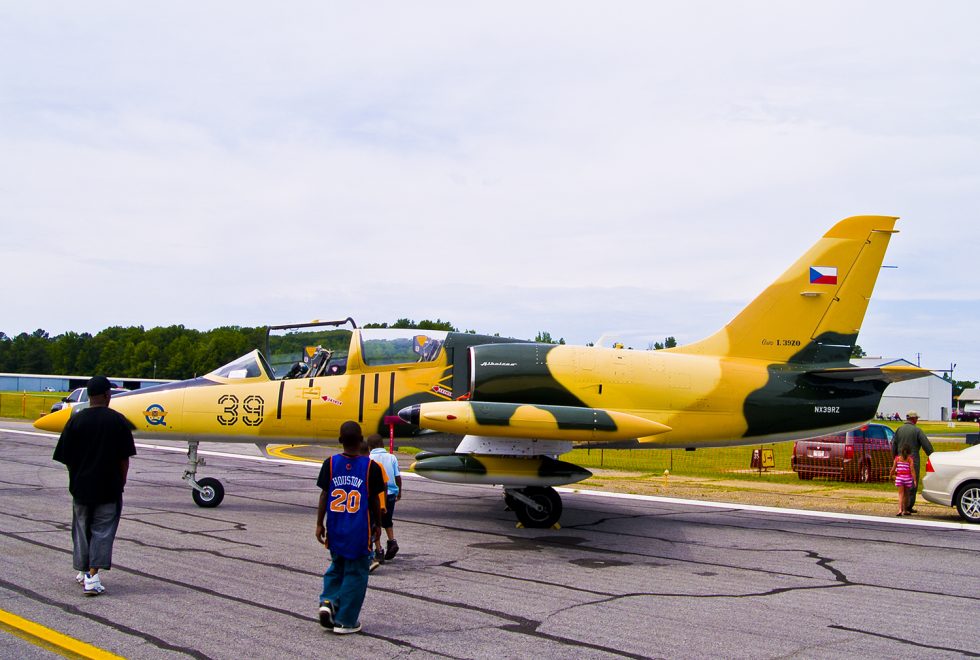
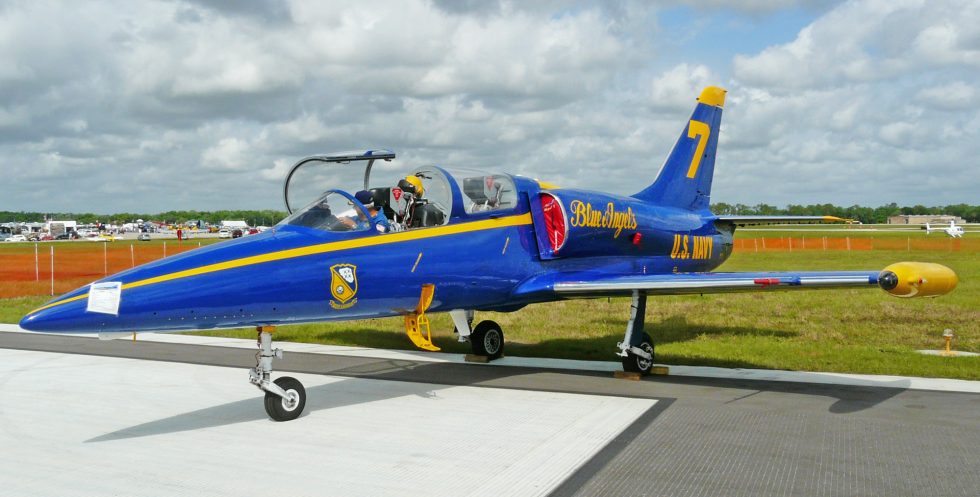
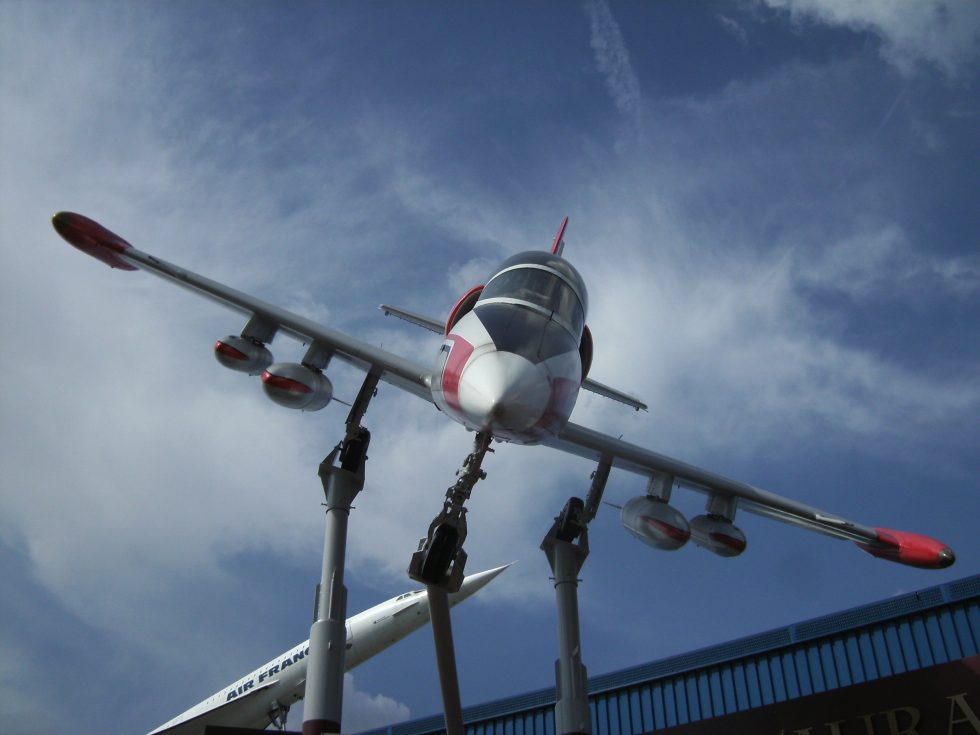
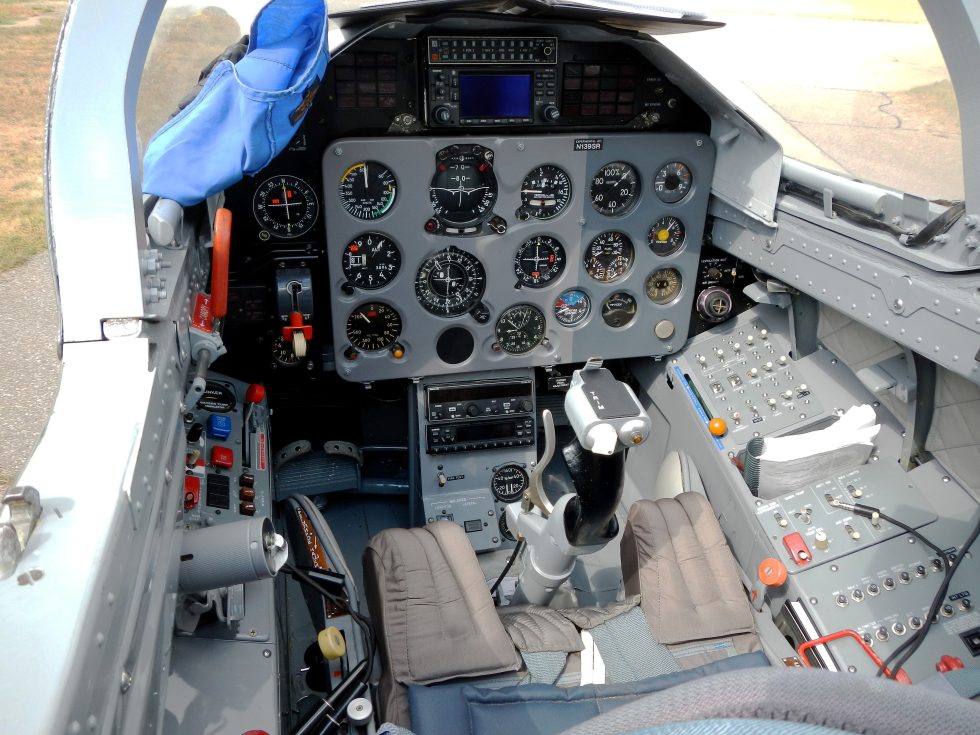
The Albatros in motion
Onboard aerobatic footage of the L-39 experience showcases exactly what makes it MiGFlug’s flagship flight — the elevated rear seat, the panoramic canopy and real high-G manoeuvring.
The L-39 Albatros in motion
Megaprojects — one of the most-watched L-39 Albatros films on YouTube.
Where the Albatros flew
A trainer that also went to war
First and foremost the L-39 is a trainer, but the armed L-39ZO / L-39ZA light-attack variants have seen real combat — a counter-insurgency and close-support record, not front-line air-to-air fighting. Its standout “record” is industrial rather than martial: the best-selling and most-produced jet trainer ever built, and the most numerous civilian jet warbird in the world.
Combat highlights: Syria (2011– ), where ~50 armed L-39s became a preferred ground-attack platform around Aleppo; Libya (2011); appearances in the Nagorno-Karabakh conflict; and delivery of surplus L-39ZA jets to Ukraine in 2024. Compare the combat record of every military aircraft. Figures as of July 2026.
Everything people ask about the L-39 Albatros
Can I fly an L-39 Albatros?
How fast is the L-39? Is it supersonic?
How much does an L-39 flight cost and where can I do it?
Is the L-39 still made?
How many L-39s were built?
Is the L-39 hard to fly?
You can actually fly the L-39.
Pick your cockpit.
Some legends only live in museums — others are fuelled and waiting. MiGFlug has put civilians in real military jet cockpits since 2004.
 Fly the L-39 AlbatrosThe world’s most-flown jet trainer — aerobatics included
 Fly the F-104 Starfighter“The missile with a man in it”
 Fly the MiG-21The Cold War’s most-produced jet
 Fly the T-33 Shooting StarAmerica’s first jet trainer
 Fly the DH VampireA piece of early jet history
 Fly the S.211Agile Italian jet trainer
 Fly the MB-326The classic Aermacchi jet
 Fly the MiG-15The Soviet legend of the Korean War
Continue the tour
Every fact, checked
- MiGFlug — L-39 Albatros flight experienceThe flagship booking page: locations, prices and what the flight includes.
- MiGFlug — Flights & PricesConfirms the L-39 as MiGFlug’s most popular jet-flight offering.
- MiGFlug blog — “Elon Musk flew an L-39”The celebrity L-39 story and the accessibility of the flight.
- GlobalMilitary.net — L-39 specs & operatorsPerformance data and a current operator list (2026).
- MilitaryFactory — Aero L-39 AlbatrosDevelopment history, variants and specifications.
- Airforce-Technology — Aero L-39Trainer and ground-attack role overview.
- The Aviation Geek Club — Breitling Jet Team L-39sThe civilian display team and the jets’ later life training fighter pilots.
- FlyingMag — L-39NG certificationThe modernised L-39NG and its return to production.
- EurasianTimes — L-39 combat use in SyriaThe armed Albatros in the Syrian civil war.