

By October 2023 the jets had been sitting on Indian aprons for five months. A judge of the Delhi High Court, reviewing the photographs the lessors had filed, recorded what she could see in them: “evident cannibalization of the Aircraft.” Elsewhere in the papers were complaints of corrosion on the skin and algae growing on the fuselages. The lessors asked for permission to post 24-hour security guards on their own aircraft, at their own expense. The court granted it.
Go First had stopped flying in May 2023. All 54 of its aircraft were leased, every one of them from somebody else. The owners wanted them back, and for about a year they could not have them.
This is the part of aviation nobody photographs. Roughly half the world’s airliners are not owned by the airline whose name is painted on the tail — Air Lease Corporation put the leasing share at 50.6 per cent for 2025 on Cirium data, and other industry counts in 2026 ranged from about 41 to 58 per cent depending on what was being counted. Every one of those leases carries, somewhere in its paperwork, the machinery for getting the aircraft back. Here is what that machinery actually is, and what happens when it jams.
Informazioni rapide
- Treaty: Convention on International Interests in Mobile Equipment and its Aircraft Protocol, done at Cape Town, 16 November 2001
- In force: 1 March 2006
- Contracting states: 90 to the Convention, 87 to the Aircraft Protocol (UNIDROIT, April 2026)
- International Registry: Dublin, run by Aviareto; ICAO is the supervisory authority
- Registrations held: over 1.8 million, around USD 1 trillion of collateral (reported to UNIDROIT, December 2025)
- Priority rule: first to file
- Key instrument: the IDERA, a one-page irrevocable de-registration and export request authorisation
- Priority search certificate: USD 27
The treaty that made modern aircraft leasing possible
Lending against an aircraft used to be a nerve-racking business. The collateral has wings. It can be in a different legal system by dinner time, and recovering it meant finding out, country by country, whether the local courts would help you or bury you.
The fix was signed at Cape Town on 16 November 2001: the Convention on International Interests in Mobile Equipment, with a separate Protocol for aircraft. Both entered into force on 1 March 2006. On UNIDROIT’s own count as depositary in April 2026, 90 states are party to the Convention and 87 to the Aircraft Protocol. ICAO’s published list counts slightly differently, which tells you something about how fiddly treaty bookkeeping is; the order of magnitude is not in doubt.
What the Convention created was an International Registry. It sits in Dublin, it is run by Aviareto — a joint venture of SITA and the Irish government — and ICAO is its supervisory authority. By December 2025 it was reported to UNIDROIT’s General Assembly as holding over 1.8 million registrations covering around a trillion dollars of collateral.
Two features of it matter more than the rest. The first is the priority rule, which Article 29(1) states without hedging: “A registered interest has priority over any other interest subsequently registered and over an unregistered interest.” First to file wins, and Article 29(2) adds that this holds even if the first filer knew about the other interest.
The second is what the registry indexes on. Aircraft are registered by manufacturer, model and manufacturer’s serial number — not by registration mark. Repainting a jet and putting it on another country’s register does not touch the international interest recorded against that serial number. The registry does not care what is on the tail.
The one-page letter that does the work
The instrument at the centre of an aircraft repossession is not a court order. It is a letter the airline signs, often years earlier, at the moment it takes delivery.
An IDERA — Irrevocable De-Registration and Export Request Authorisation — is lodged with the national civil aviation authority that holds the aircraft register. In it, the airline names the lessor as the “authorised party” and agrees that this party alone may take the aircraft off the register and out of the country. Protocol Article XIII puts it beyond argument: the authorised party or its certified designee “shall be the sole person entitled to exercise the remedies specified in Article IX(1),” and the authorisation “may not be revoked by the debtor without the consent in writing of the authorised party.”
Then Article IX(5) tells the registry what to do with it: “The registry authority in a Contracting State shall, subject to any applicable safety laws and regulations, honour a request for de-registration and export” where the request comes from the authorised party under a recorded IDERA and prior-ranking interests have been discharged or have consented. Not may. Shall.
The Annex to the Protocol prints the form itself, and it is startlingly short — a single letter addressed to the registry, identifying the aircraft by manufacturer, serial number and registration mark, naming the creditor, and asking the authorities to co-operate “with a view to the speedy completion of such action.” It even cites the Chicago Convention of 7 December 1944 by name, stitching the 1944 nationality-registration regime and the 2001 security regime together in one sentence.
National law then implements it. In the United States, 14 CFR 47.47(b) is blunt: “If the aircraft is subject to the Cape Town Treaty and an irrevocable deregistration and export request authorization has been filed with the Registry, the Registry will honor a request for cancellation only if an authorized party makes the request.” India went further and put a clock on it: Rule 30(7) of the Aircraft Rules requires cancellation “within five working days, without seeking consent or any document from the operator of the aircraft or any other person.”
What actually happens on the day
A repossession does not begin with a man climbing into a cockpit at night. It begins with paperwork and a grounding.
The English Commercial Court spent four months in 2024 and 2025 picking through roughly 150 real attempts, and the resulting judgment is the best public description of the sequence that exists. The lessor issues grounding notices and terminates the lease. It then tracks the aircraft, and waits for it to leave the airspace it cannot reach into. Once the jet has landed somewhere useful, the lessor goes to the state of registry — Bermuda and Ireland, for most of the world’s leased fleet — and obtains an official letter confirming the certificate of airworthiness has been suspended. That letter, with the termination notice, goes to the aviation authority of the country the aircraft is actually sitting in, with a request to ground it.
The aircraft is not seized. It is made unflyable in law. Everything after that is negotiation, local court process, and politics.
How much politics is best shown by a single episode from that judgment. An Aeroflot aircraft landed in Sri Lanka on 2 June 2022 and the lessor obtained an interim order for its arrest the same day. Russia let it be known that it might revoke a facility for exporting oil and gas to Sri Lanka; Aeroflot announced it would stop flying there altogether. On 6 June the Sri Lankan authorities released the aircraft. Four days from arrest to release, and the treaty had nothing to say about any of it.
The records are worth as much as the airframe
Here is the part outsiders never guess. The most valuable thing in an aircraft repossession is frequently not the aircraft. It is the paperwork.
An airliner’s value rests on traceability: the airworthiness certificate, the noise certificate, the status of every life-limited part, hard-time component status, airworthiness directive and service bulletin compliance, and above all back-to-birth records for the rotating parts inside the engines — every operator and every maintenance shop a disc has passed through, certified hours on wing, a statement that it was never in an accident. The appraisers at mba Aviation put it plainly in a 2018 paper: a significant portion of any aircraft’s value is in the logbooks, and without them the value is severely impaired. In their worked example, an engine with five life-limited parts lacking back-to-birth traceability takes a $135,000 reduction, because each affected part is valued at zero.
The Delhi High Court turned that commercial fact into law, holding that the term “Aircraft” includes Aircraft Documents, so a court-ordered inspection had to cover the records as well as the metal.
The Russian authorities worked it out immediately. On 4 March 2022, ten days into the invasion, the Russian aviation agency sent a telegram directing that access to the archives of technical records for foreign-leased aircraft be placed under special control. Lessors subsequently spent real money on technical representatives in Russia trying to reach and scan records they were not allowed to touch.
That is also why a normal, peaceful lease return is such a grind. Standard redelivery conditions require the airframe to come back fresh out of a check with months and hours in hand — typically not less than 24 months, 6,000 flight hours and 4,500 cycles clear — engine life-limited parts with at least 3,000 cycles remaining, landing gear with at least 24 months or 2,000 cycles to its next overhaul, brakes and tyres averaging at least half their service life with nothing below a quarter, and an APU no more than 2,000 hours since overhaul. Airlines routinely spend upwards of a million dollars per narrowbody meeting conditions like these, and widebody overspend can easily be double that.
One clause from the standard form is worth quoting for its sheer practicality: for a period beginning three months, but not earlier than one month, before redelivery, the airline must assemble all the aircraft records and historical documents in one central room, with a telephone, a photocopier and an internet connection. That room is where the value is.
Go First: when the registry simply says no
India is a Cape Town state. It acceded in 2008. None of that helped the lessors of Go First for about a year.
When the airline collapsed in May 2023, an insolvency tribunal applied the moratorium in India’s bankruptcy code to the leased aircraft, and the regulator refused to process the deregistration applications — rejection letters went out on 11, 12 and 19 May 2023. A government notification in October 2023 carved Cape Town transactions out of the moratorium. The aircraft still did not move.
It took a 141-page judgment of the Delhi High Court, pronounced on 26 April 2024, to break it. Justice Tara Vitasta Ganju set aside the rejection letters and ordered the regulator to process the applications within five working days. The passage that should be read by every transport ministry is the one about the bill the country had already run up: because of the delay, the judgment records, India’s Cape Town compliance rating had fallen from 3.5 to 2 out of 5 — a drop with long-term consequences for every airline in the country, including higher lease rentals.
Winning was not the end of it. Deregistered aircraft that have sat unmaintained for the better part of a year do not simply fly away. Vishok Mansingh, chief executive of the leasing company Vman, told PTI in May 2024 that the jets had not undergone continuous maintenance since the previous July, that the lessors would need approvals from Pratt & Whitney and Airbus for a technical ferry, and that with those approvals the aircraft could be flown out in three to four weeks. For the rest it was worse: “most of them do not have engines and spare parts,” he said, and getting those out could take six months or even a year. Industry sources told the same agency that at least 30 of the 54 would need an engine replacement.
Russia: the largest repossession failure in history
And then there is the case that broke the system entirely.
When the full-scale invasion began, somewhere between 500 and 600 Western-leased aircraft were with Russian airlines; the figures in circulation include 515 (Vedomosti), 513 (IBA), “more than 500” (the Financial Times) and around 600 (Holland & Knight), measured on slightly different bases. Lessors issued grounding and termination notices within days. AerCap had terminated the leases on all its Russian aircraft by 10 March 2022.
That date matters, because on the same day a Russian government resolution banning the export of aircraft and engines came into force. The jets were inside, and the door shut.
What followed was not a legal argument the Convention was built for. Russia suspended its 1999 agreement with Bermuda on the oversight of its leased fleet, passed a law letting its own regulator issue airworthiness certificates for foreign-leased aircraft, and began moving them onto the Russian register. On 22 March 2022 the transport minister, Vitaly Savelyev, told a Federation Council committee: “Now we are transferring to the Russian register even foreign-leased aircraft... We have already transferred almost 800 aircraft; we insure them with a Russian insurance company.”
A dual registration is not a thing that exists. Mr Justice Butcher dealt with it in a sentence.
The fight moved to insurance. In the judgment handed down on 11 June 2025, Butcher J found that the aircraft were lost on 10 March 2022, that the proximate cause was the export ban, and that the lessors could recover under the contingent cover of their own policies — a win for the lessors, and a bill for the war-risks insurers rather than the all-risks market. Six lessors had sued on 147 aircraft and 16 engines with an aggregate insured value above US$4.5 billion.
It is not over. The war-risks insurers have been given permission to appeal, with a Court of Appeal hearing listed for February 2027, and a second mega-trial covering claims under the Russian airlines’ own policies began in London on 5 October 2026. Meanwhile Russia’s transport ministry proposed on 6 November 2026 extending to the end of 2028 the special regime that lets its airlines keep flying the aircraft; of the 515 it counts, 407 remain, and 204 of those have had lessor claims settled.
Where the jets actually go
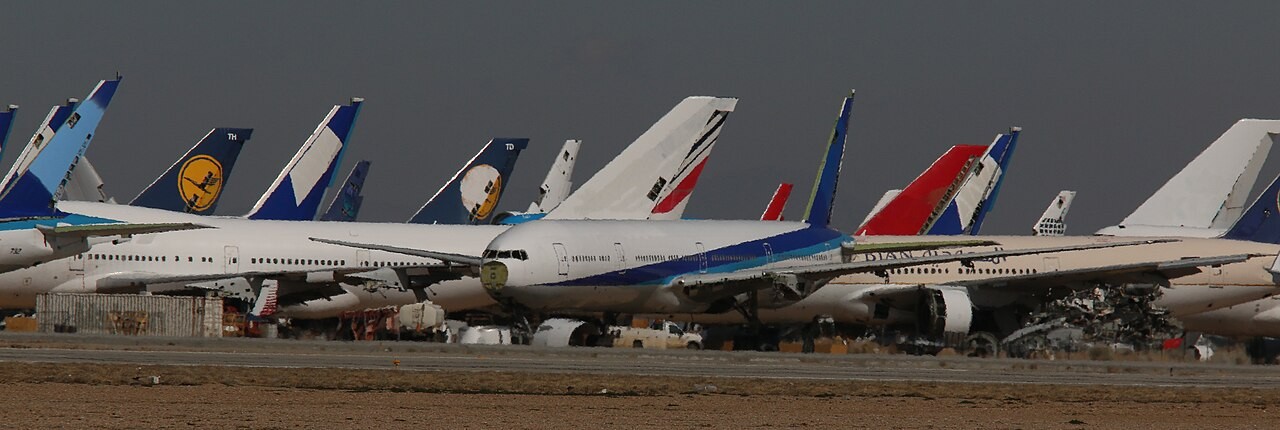
A recovered aircraft rarely goes straight back to work. It goes to a field in a dry climate with room to park it: Victorville and Mojave in California, Pinal Airpark in Arizona, Teruel in Spain. There it waits for a buyer, a lessee, a records reconstruction, or a disassembly crew.
The scale is larger than most passengers imagine even in a good year. Cirium counted approaching 2,300 Airbus and Boeing passenger aircraft in storage in mid-July 2025, fewer than half of them managed by operating lessors — and just over 600 of those were A320neos grounded by engine problems rather than by any financial trouble at all.
Sam Chui on where the world’s airlines park aircraft they are not flying. The fields in this video are the ones a repossessed jet usually ends up in.
What the Cape Town Convention can and cannot do
Read the treaty and the machine looks beautiful. A registry that indexes by serial number, so paint cannot hide an interest. A priority rule with no exceptions for bad faith. A one-page letter that obliges a sovereign registry to hand an aircraft back. Five working days, in the better jurisdictions.
Watch it operate and you see the limits. Every one of those obligations runs through a national authority, and a national authority answers to its own government. The Convention worked in India in the end, but it took a year, a High Court, and a measurable hit to the country’s credit with the leasing industry. It did not work in Russia at all, because a state that has decided to keep the aircraft is not a legal problem; it is a political one, and it settles in an insurance court years later.
The industry’s real enforcement mechanism turns out not to be the IDERA. It is the compliance score. India’s fall from 3.5 to 2 was cited by a judge as a reason to act, because everyone involved understood what it meant: higher lease rates, fewer aircraft, for every airline in the country. The treaty’s teeth are not in the courtroom. They are in the price of the next lease.
Sources: Convention on International Interests in Mobile Equipment and Protocol thereto on Matters Specific to Aircraft Equipment (official texts, UK Treaty Series Cm 8786 and Cm 8787); UNIDROIT Governing Council document C.D. (107) 10 and General Assembly report A.G. (85) 14; International Registry (Aviareto) and ICAO; 14 CFR 47.47; Federal Register, 71 FR 9907 (28 February 2006); Aircraft Rules 1937 (India), Rule 30(7); Accipiter Investments Aircraft 2 Ltd v Union of India, High Court of Delhi, 26 April 2024; Russian Aircraft Lessor Policy Claims [2025] EWHC 1430 (Comm); Holland & Knight; mba Aviation; Aircraft Monitor; Air Lease Corporation investor materials; Cirium; Financial Times; Business Standard; Vedomosti.

0 Comments