
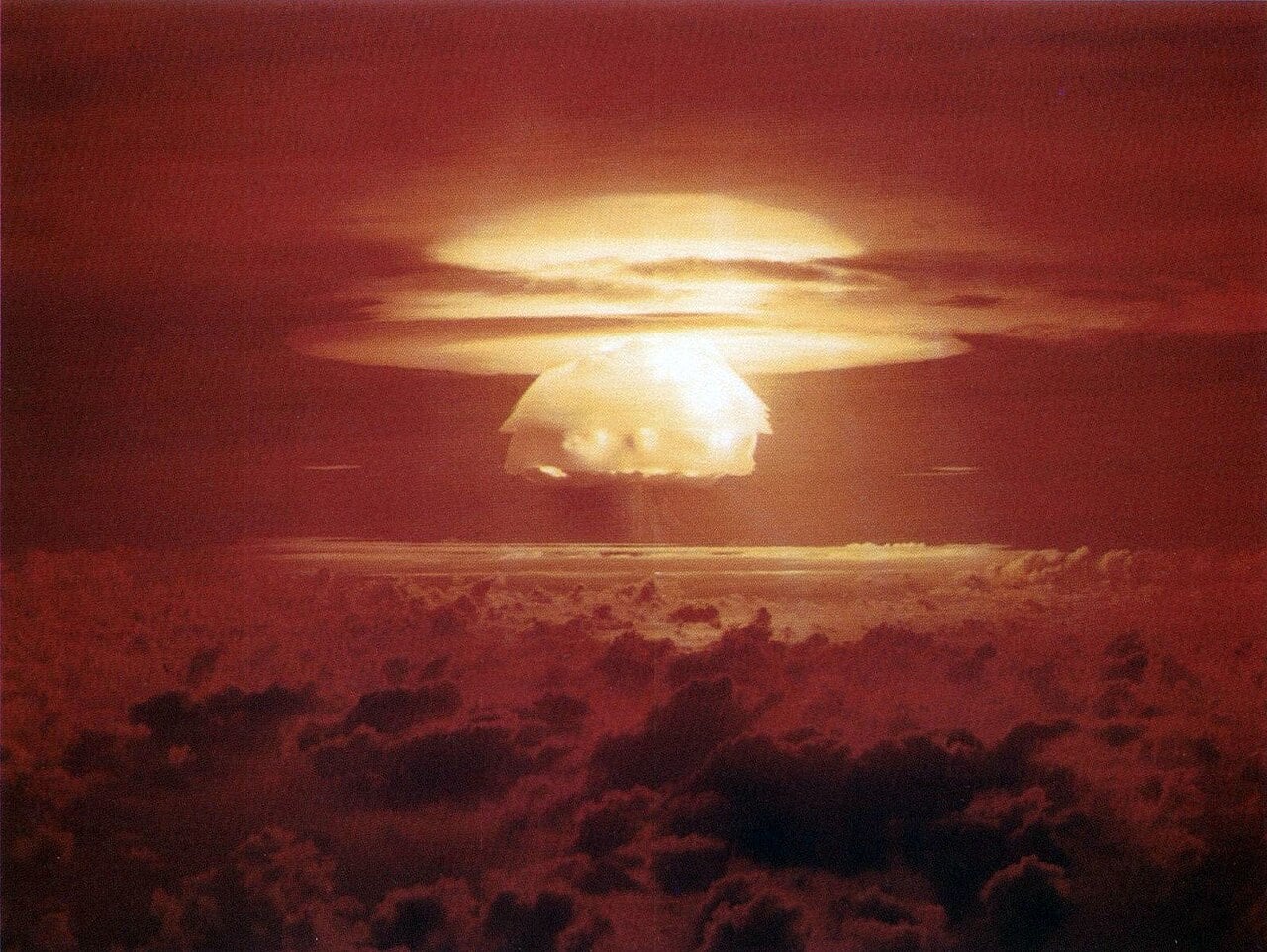
It is a quarter to seven on the morning of 1 March 1954, and in a concrete blockhouse on the island of Eneu, at the southern tip of Bikini Atoll, a small group of scientists and technicians are watching a clock count down to zero. Their firing bunker, Station 70, is about twenty miles across the lagoon from a sandspit off Namu Island, where a cylinder the size of a small truck sits in a shed on the reef. At 06:45 the device fires. There are no windows. For a few seconds nothing happens.
Then the building begins to move. The test director, Dr John C. Clark of Los Alamos, later described the concrete structure rolling like a ship as the ground shock arrived, followed by the air blast. Water forced up from the lagoon gushed in through cable conduits behind the control panel. When the men stepped outside to look at the climbing cloud, their radiation counter began to rise. They went back in and shut the door.
Some 80 to 90 miles to the east, the 23 men of a Japanese tuna boat called the Daigo Fukuryū Maru were hauling in their lines when the western sky lit up before dawn. The crewman Matashichi Oishi would later call his memoir The Day the Sun Rose in the West. About an hour and a half later, a fine white ash began to fall on their deck.
Informazioni rapide
- Test: Castle Bravo, first shot of Operation Castle
- Date and time: 1 March 1954, 06:45 local time
- Posizione: Reef off Namu Island, Bikini Atoll, Marshall Islands
- Device: “Shrimp”, a lithium deuteride thermonuclear device, about 23,500 lb
- Predicted yield: About 6 megatons (uncertainty range roughly 4 to 8)
- Actual yield: 15 megatons, the largest US nuclear test ever
- Compared with Hiroshima: About 1,000 times more powerful
- Crater: About 6,500 ft wide and 250 ft deep
- Cloud top: About 130,000 ft within minutes
- Exposed: Islanders of Rongelap, Ailinginae and Utirik, 28 US servicemen on Rongerik, US Navy crews, 23 Japanese fishermen
Operation Castle and the “dry” bomb
Castle Bravo was the opening shot of Operation Castle, a series of thermonuclear tests run by Joint Task Force Seven at Bikini and Eniwetok in the spring of 1954. Its purpose was urgent. The first American hydrogen explosion, Ivy Mike in November 1952, had used liquid deuterium kept at cryogenic temperatures in a building-sized apparatus. It proved the principle, but nobody could drop it from an aircraft.
Shrimp was the answer: a “dry” device that used a solid compound, lithium deuteride, as its fusion fuel. According to Carey Sublette’s Nuclear Weapon Archive, the lithium was enriched to between 37 and 40 per cent lithium-6, the isotope known to breed tritium under neutron bombardment. The remaining 60 per cent or so was ordinary lithium-7, which the designers expected to do very little. Their prediction for the shot was around 6 megatons, with a range of 4 to 8.
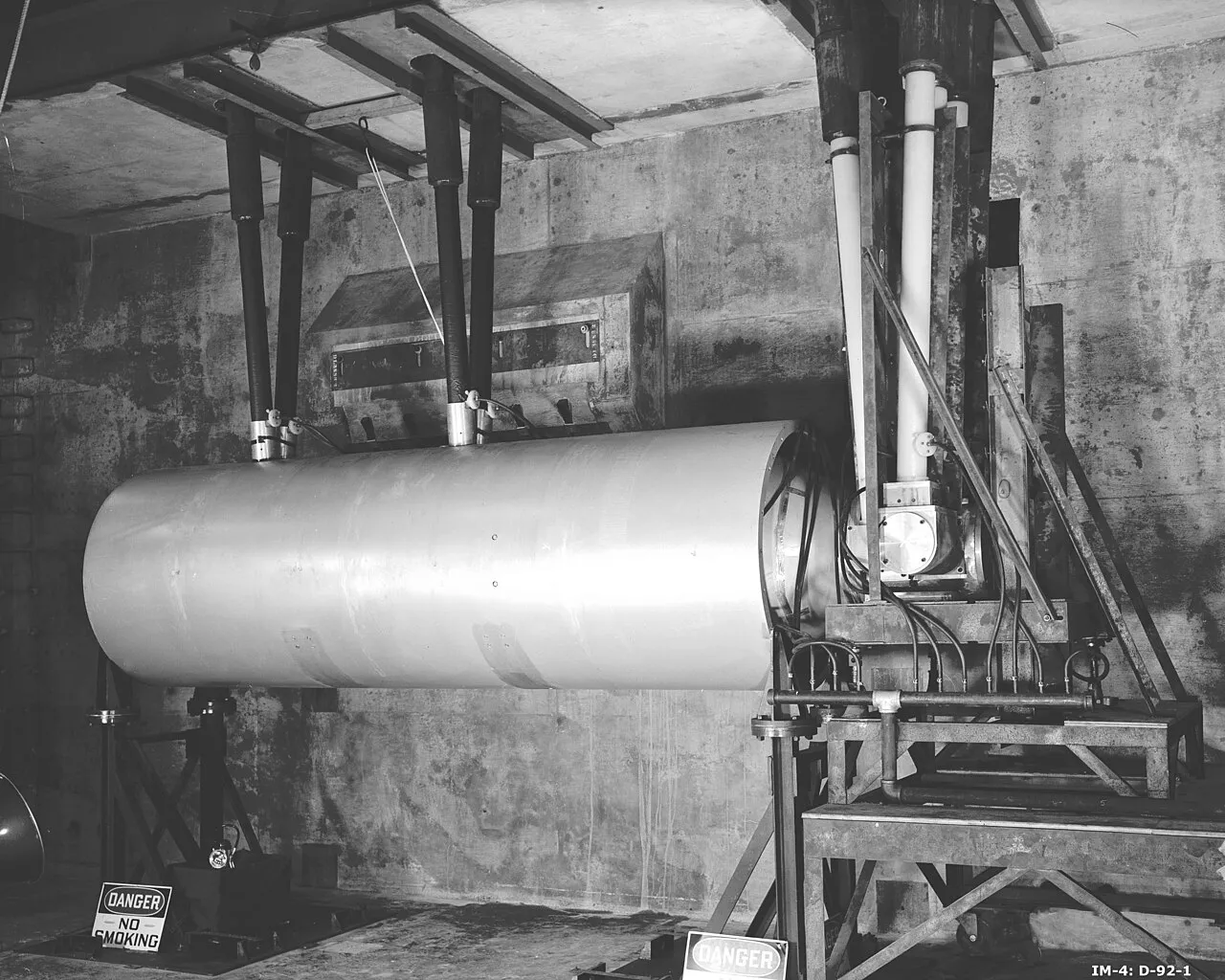
The assumption about lithium-7 was wrong. Under the flood of high-energy neutrons from the fusion reaction, lithium-7 also splits and releases tritium, adding fuel that nobody had counted. More fusion meant more fast neutrons, and those neutrons split the natural uranium tamper around the device. The result was about two and a half times the expected yield. The Atomic Heritage Foundation puts it at roughly 1,000 times the power of the Hiroshima bomb.
Fifteen megatons on a coral reef
The Air Force history of Task Group 7.4, the air component of the operation, records that Bravo was the only shot of the entire series fired on schedule. Early fireball and bhangmeter readings put the yield at approximately fifteen megatons. Because the device sat on the reef rather than high in the air, the fireball touched the ground and sucked millions of tons of pulverised coral into the rising cloud.
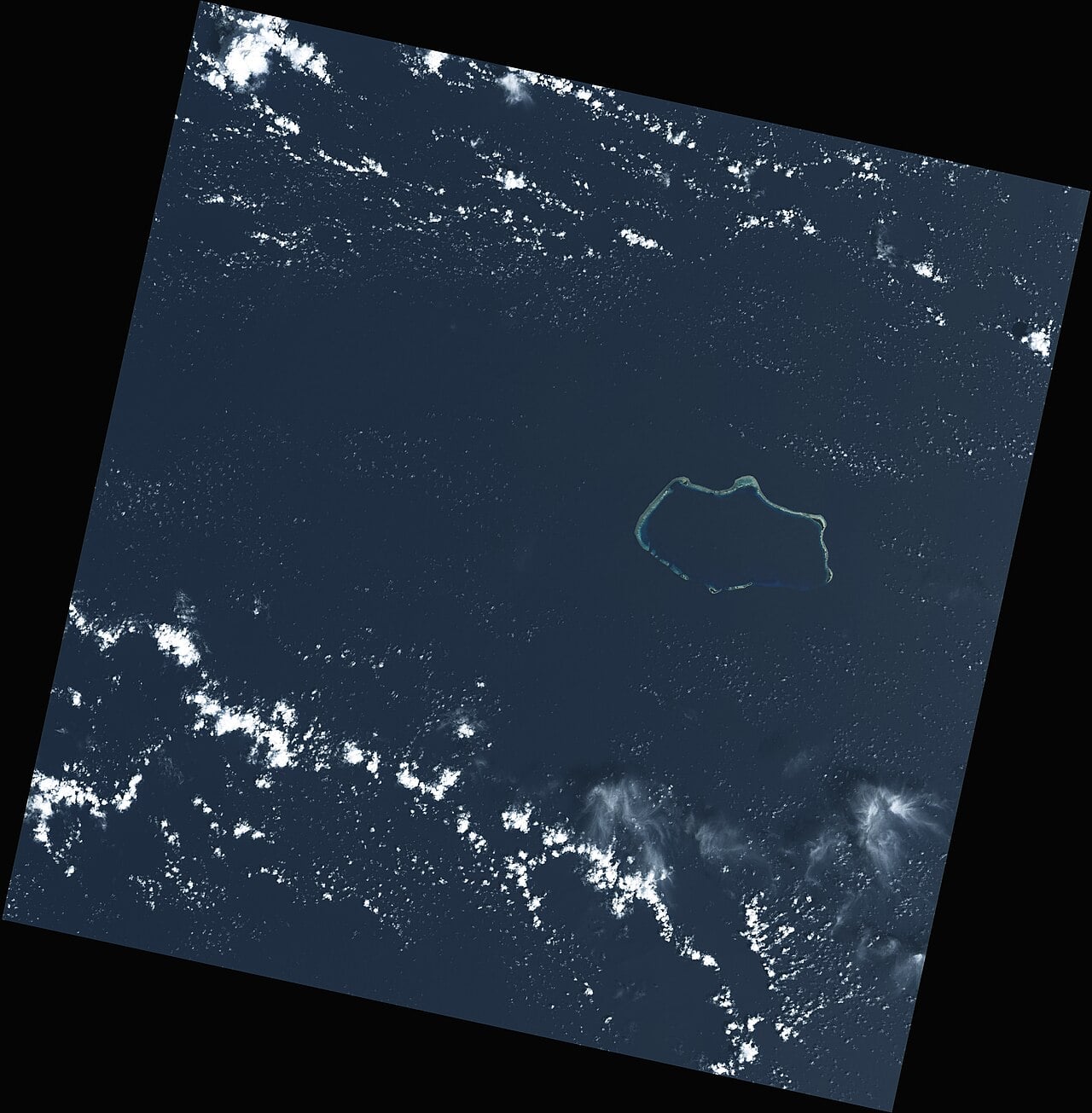
According to the Atomic Heritage Foundation, the cloud was about 4.5 miles wide within seconds and climbed to around 130,000 feet. Sublette’s figures have it passing 100,000 feet within two minutes and topping out at about six minutes. The explosion left a crater in the reef about 6,500 feet across and 250 feet deep. It is still visible from space.
Back on Eneu, the radiation outside the blockhouse climbed steadily. About an hour after the shot, by Clark’s account, a meter held outside the door read forty roentgens, and hours later the level outside was still around twenty roentgens per hour. Inside, the thick walls kept levels low enough to survive. A helicopter rescue was planned for the late afternoon. When it came, about eleven hours after the shot, the men wrapped themselves completely in bed sheets, drove jeeps half a mile to the landing mat and were flown out to a ship in minutes.
An excerpt from the official 1954 film report on Operation Castle, released by the National Security Archive for the test’s 60th anniversary. Video: National Security Archive.
The aircraft that flew into the cloud
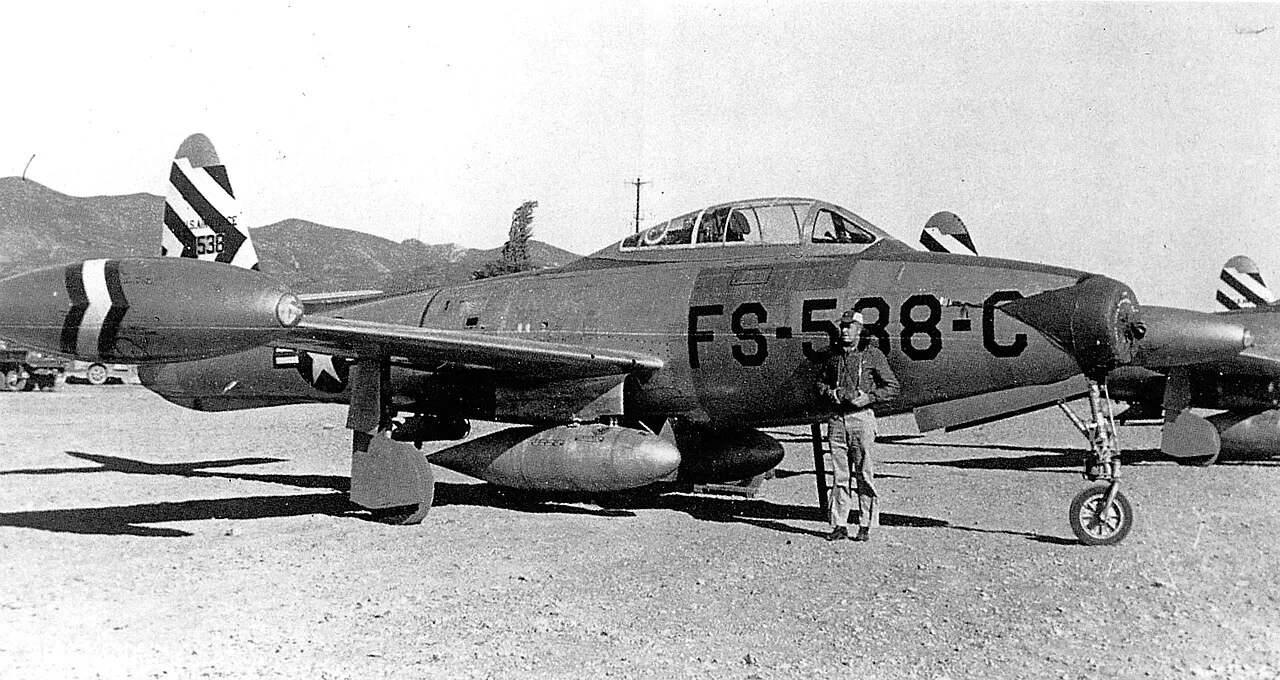
Bravo was also one of the most ambitious air operations of the early nuclear age. Task Group 7.4, built around the Air Force Special Weapons Center at Kirtland Air Force Base, flew aircraft whose job was to go towards the bomb, not away from it. Its centrepiece was a team of cloud samplers from the 4926th Test Squadron (Sampling), flying specially modified Republic F-84G Thunderjets.
The task group history states that fifteen F-84s and two B-36s were readied for sampling on Bravo day, with twelve operational F-84s considered the required number. Radioactive particles were caught on filter paper in specially built wingtip tanks, while gas samples were pumped into bags or bottles. To protect the jet pilots on their passes through the cloud, the 4926th designed lead vests, and the seats of the F-84 samplers were sheathed in sheet lead.
Above them flew the control team, aboard a Convair B-36. Led by the Los Alamos scientist Dr Hal Plank, it had directed sampling on more than thirty-five nuclear detonations before Castle. From the bomber they watched the cloud grow, picked the parts most worth sampling, and then sent each F-84, B-36 and B-29 sampler in at a given point and altitude for a set time. The two sampling B-36s tried for higher altitudes in the main cloud, and a single WB-29, a weather version of the B-29 Superfortress, went in an hour after the shot with a “shoe box” sampler for heavy elements.
On landing, ground crews pulled the filters out with long-handled tools, packed them in lead containers, and put them on long-range transports to the laboratories in the United States. The aircraft themselves were so contaminated that they needed special decontamination areas, and the task group history counts radiation exposure from flying, returning and cleaning the samplers among its main problems.
Elaine One and Elaine Two
Two more aircraft were there to be hit. Code-named Elaine One and Elaine Two, an instrumented B-36D and a Boeing B-47 Stratojet were flown as close to the explosion as planners dared, to measure what heat and blast would do to a nuclear bomber. Because of doubts about the yield, they were positioned for the largest possible result: the B-36 at 50,000 feet horizontal range and 33,000 feet altitude, the B-47 at 48,000 feet range and 35,000 feet altitude. The underside of the B-36D had been painted white, and asbestos curtains covered its windows.
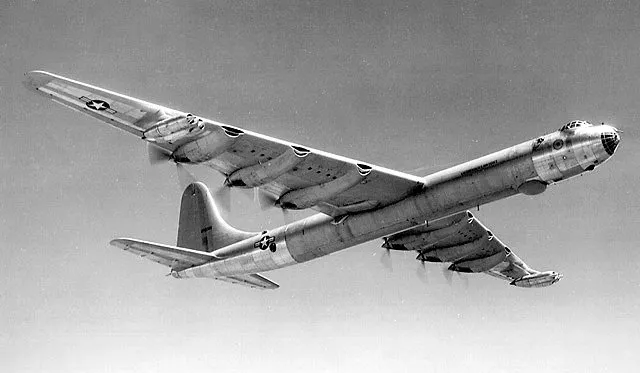
Even so, the crew of Elaine One saw a bright red glow through the aluminised asbestos shields at the peak of the thermal pulse. The tailpipe temperatures of its jet engines, normally about 500°C, rose to 750°C. The blast wave crushed the radar dome from the rear, flattened a main gear door against its wheel, blew in a nacelle fairing and tore skin around the nose doors. The aircraft landed safely at Eniwetok, but the task group history notes that the damage was more than calculated. The data from both bombers went into the techniques for delivering megaton weapons safely from the air.
Snow on Rongelap
Forecasts had shown the fallout narrowly missing the inhabited atolls to the east. The Task Group 7.4 history blames a slight wind shift, probably no more than ten per cent, for carrying it directly over them. About five hours after the shot, fallout reached Rongelap and Ailinginae. It reached Rongerik after about eight hours and Utirik several hours later.
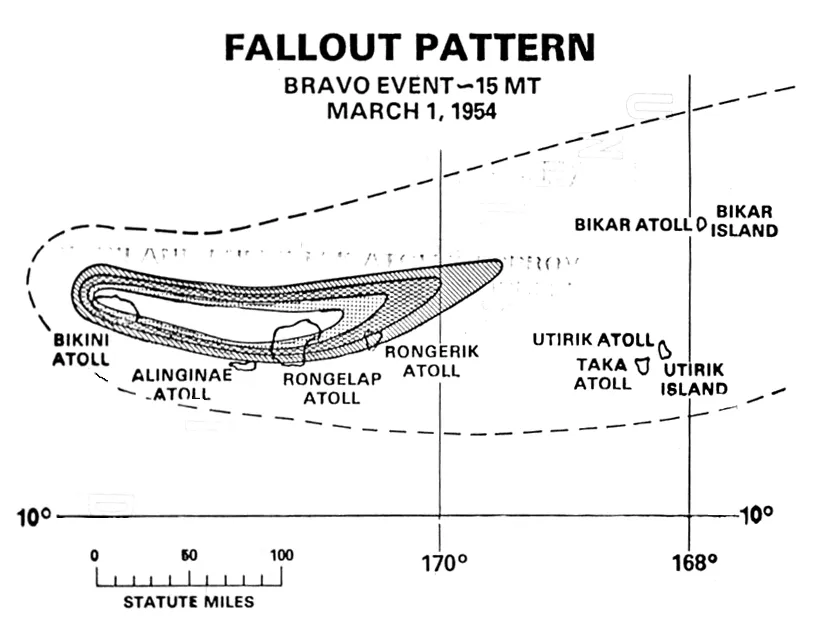
On Rongelap, 64 people watched a white to yellowish-white powder settle on their homes, water cisterns and food. The task group history says it was likened to snow. About fourteen hours after the shot some complained of loss of appetite, mild diarrhoea and malaise, and some vomited; itching skin followed. Contaminated food and water were freely consumed, because nobody had told them what the powder was.
The only instruments in the area were on Rongerik, where 28 Americans, 25 airmen of a weather station and three Army technicians, read their recording meter as it went off-scale at 100 milliroentgens per hour. The station radioed a reading of “100 plus repeat 100 plus, pen off chart”. The next morning a Task Group 7.4 officer flew out in an amphibian, made low passes over the island, then landed and measured up to 3.2 roentgens per hour near the ground. He flew eight men out at once, and the other twenty were taken to Kwajalein by a Navy PBM flying boat that evening.
The islanders waited longer. Because of communication and logistics problems, the evacuation of Rongelap did not begin until about fifty hours after the shot, when the people were taken off by a Navy destroyer. Ailinginae followed at about sixty hours and Utirik, with roughly 160 inhabitants, at about eighty. Navy crews were caught too: the official Castle report records beta burns among 21 men of the destroyer escort USS Philip and 16 of the escort carrier USS Bairoko.
The long shadow over the Marshall Islands
Within days a US medical team led by Commander Eugene Cronkite began studying the exposed islanders at Kwajalein, under a project known as Project 4.1. Brookhaven National Laboratory ran their long-term medical programme for decades. Its 1980 review estimated whole-body gamma doses of about 175 rem on Rongelap, 69 on Ailinginae and 14 on Utirik, and thyroid doses far higher, especially in young children.
The consequences followed for years. The Brookhaven report records thyroid abnormalities and tumours among the exposed, growth retardation in some children, and the death from leukaemia in 1972 of a young Rongelap man who had been about a year old in 1954. The historian April Brown, quoted by the Atomic Heritage Foundation, notes that the islanders were not asked for consent or told that a study was under way. The people of Rongelap returned home in 1957 and left again in 1985, carried away by the Greenpeace ship Rainbow Warrior because they no longer trusted that the island was safe.
The Lucky Dragon comes home
The Daigo Fukuryū Maru reached her home port of Yaizu on 14 March 1954. Her crew were sick and burned, and her hold carried more than nine tons of contaminated tuna. According to the Bulletin of the Atomic Scientists, the boat had been about 86 miles from the test site, outside the declared danger zone. All the men were taken to hospital.
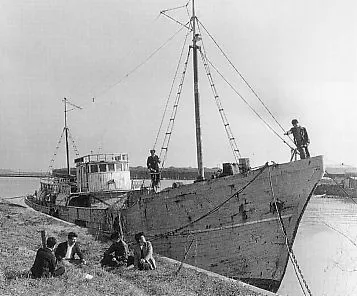
The ship’s chief radio operator, Aikichi Kuboyama, died on 23 September 1954, aged 40. Japanese doctors attributed his death to radiation; American officials pointed instead to hepatitis contracted from blood transfusions in hospital, and the cause is still debated. A monument outside the Daigo Fukuryū Maru Exhibition Hall in Tokyo carries words attributed to him.
Japan erupted. Tuna fell out of the markets, and a nationwide movement against nuclear weapons was born in a country that had already lived through Hiroshima and Nagasaki. In January 1955 the United States paid compensation to Japan without admitting legal liability. Oishi spent the rest of his life telling the story and died in March 2021, aged 87.
“Large enough to take out a city”
The secret could not be kept. On 31 March 1954, at a White House press conference with President Eisenhower, Atomic Energy Commission chairman Lewis Strauss tried to calm the uproar. Asked what a hydrogen bomb could do, he told reporters it could be made as large as anyone wished, and then said more than he perhaps intended.
Asked how big a city, Strauss replied “Any city.” The phrase went around the world. In November 1954 the Toho studio released Ishirō Honda’s Gojira, in which a monster awakened by nuclear testing first attacks Japanese fishing boats before trampling Tokyo. Audiences understood the reference at once.
Scientists responded too. On 9 July 1955, Bertrand Russell released a manifesto signed by Albert Einstein shortly before his death and by nine other leading scientists. It named the Bikini test and the fishermen directly, and ended with the appeal “Remember your humanity, and forget the rest.” It led to the Pugwash Conferences, which shared the Nobel Peace Prize in 1995.
Archival film of the Operation Castle tests, published by the Nevada National Security Sites, part of the US National Nuclear Security Administration. Video: Nevada National Security Sites.
Bravo, Tsar Bomba and Bikini today
Castle Bravo remains the largest nuclear explosion the United States has ever set off. The record for the whole world belongs to the Soviet Tsar Bomba, dropped from a Tupolev Tu-95 over Novaya Zemlya on 30 October 1961 with a yield of about 50 megatons, more than three times Bravo. The comparison is not as simple as the numbers. Tsar Bomba was detonated high in the air and was deliberately designed to be relatively “clean”, while Bravo was a surface burst wrapped in uranium, which is why its smaller blast produced far worse fallout.
Bikini itself has never really recovered. Its people had been moved off in 1946 for the first atomic tests there, and repeated attempts at resettlement failed. In 2010 UNESCO listed the Bikini Atoll Nuclear Test Site as a World Heritage Site, a reminder of the dawn of the thermonuclear age. In July 2019, three studies led by Columbia University researchers in the Proceedings of the National Academy of Sciences found gamma radiation on Bikini Island roughly double the agreed limit for resettlement, plutonium and americium in the floor of the Bravo crater far above background levels, and fruit contaminated with caesium-137.
Seventy years on, the lesson of Castle Bravo is not only that a weapon turned out bigger than its makers expected. A single unexpected nuclear reaction, combined with a small change in the wind, turned a test into a disaster for people who had no say in it, from the children of Rongelap to the crew of a tuna boat. Many of the jets, bombers and flying boats that flew that day were there to measure the bomb. In the end, their records also show what it cost.
Sources: Air Force Special Weapons Center, History of Task Group 7.4 Participation in Operation CASTLE, 1 January 1953 – 26 June 1954 (1954, DOE OpenNet); Defense Nuclear Agency, CASTLE Series 1954, DNA 6035F (1982), and DTRA Nuclear Test Personnel Review fact sheet “Operation CASTLE”; Robert A. Conard et al., Review of Medical Findings in a Marshallese Population Twenty-Six Years After Accidental Exposure to Radioactive Fallout, Brookhaven National Laboratory BNL 51261 (January 1980); Atomic Heritage Foundation, Castle Bravo; John C. Clark as told to Robert Cahn, We Were Trapped by Radioactive Fallout, The Saturday Evening Post (July 1957); Ariana Rowberry, Castle Bravo: The Largest U.S. Nuclear Explosion, Brookings Institution (27 February 2014); William Burr (ed.), 60th Anniversary of Castle BRAVO Nuclear Test, National Security Archive Electronic Briefing Book 459 (2014); Carey Sublette, Operation Castle, Nuclear Weapon Archive (2006); David Ropeik, How the Unlucky Lucky Dragon Birthed an Era of Nuclear Fear, Bulletin of the Atomic Scientists (28 February 2018); Honolulu Civil Beat, Bikini Atoll: The Day the Sun Rose in the West (March 2015); The Japan Times, obituary of Matashichi Oishi (March 2021); TIME (April 1954); Pugwash Conferences on Science and World Affairs, The Russell–Einstein Manifesto (9 July 1955); Columbia News, Radiation in Parts of Marshall Islands Is Higher than Chernobyl (16 July 2019); UNESCO World Heritage Centre, Bikini Atoll Nuclear Test Site (2010); CTBTO Preparatory Commission, 30 October 1961: The Tsar Bomba.

0 Comments