
Boeing B-47
“Stratojet”
The swept-wing, six-engine jet bomber that carried Strategic Air Command’s nuclear deterrent through the 1950s — and whose radical shape became the template for almost every jet airliner that followed.
The bomber that invented the jet age’s shape
In 1943 the U.S. Army Air Forces asked for a jet-powered bomber, and Boeing’s first answers were timid — straight-winged machines with engines buried in the fuselage, barely faster than the piston bombers they were meant to replace. The leap came from the wreckage of wartime Germany. In May 1945 Boeing aerodynamicist George Schairer, touring captured German research, grasped that sweeping a wing backwards delayed the sharp rise in drag near the speed of sound. He wrote home, and Boeing tore up its design.
What emerged was the Model 450: a thin wing swept 35 degrees, with six turbojets slung in streamlined pods beneath it rather than buried inside. The XB-47 first flew on 17 December 1947 — the 44th anniversary of the Wright brothers’ flight — and it looked like nothing else in the sky. That swept-wing, podded-engine formula would within a decade become simply what a jet was supposed to look like, carried straight into Boeing’s own B-52 and the 707 airliner, and from there into essentially every jetliner flying today.
Entering service in 1951, the B-47 became the numerical backbone of Strategic Air Command. At its peak SAC fielded well over 1,500 Stratojets across dozens of wings, kept on alert to strike the Soviet Union with nuclear weapons. Building them took an industrial army: Boeing, Douglas and Lockheed together turned out more than 2,000 aircraft between 1947 and 1957, one of the largest bomber programmes of the postwar era.
For all that, the B-47 never dropped a bomb in anger. Its war was fought quietly, by unarmed and lightly armed RB-47 reconnaissance versions that flew electronic-intelligence sorties along — and sometimes across — Soviet frontiers, mapping radar and air defences. Several were fired on; some were lost. As intercontinental missiles and the longer-legged B-52 took over, the Stratojet left the bomber role in 1965–66, with the last special-mission aircraft flying until 1969.
01The Boeing B-47 Stratojet’s swept wing: how captured German data rewrote the jet age
Boeing’s early jet-bomber studies — the Models 424 and 432 — kept the straight wings of the piston era and performed poorly. The decisive input came in 1945, when George Schairer, serving on General Hap Arnold’s scientific mission in occupied Germany, examined German high-speed aerodynamic research showing that a swept wing delays compressibility drag as an aircraft nears the speed of sound. Schairer’s letter back to Seattle prompted Boeing to abandon the straight-wing layout. Engineer Vic Ganzer worked out an optimum sweep of about 35 degrees, and after the Air Force rejected fuselage-buried engines as a fire risk, the team hung six engines in underwing pods. The resulting Model 450 was so far ahead of its rivals that it effectively defined the shape of the jet age — a shape Boeing reused on the B-52 and the 707.
What makes it special
A swept wing and six podded engines
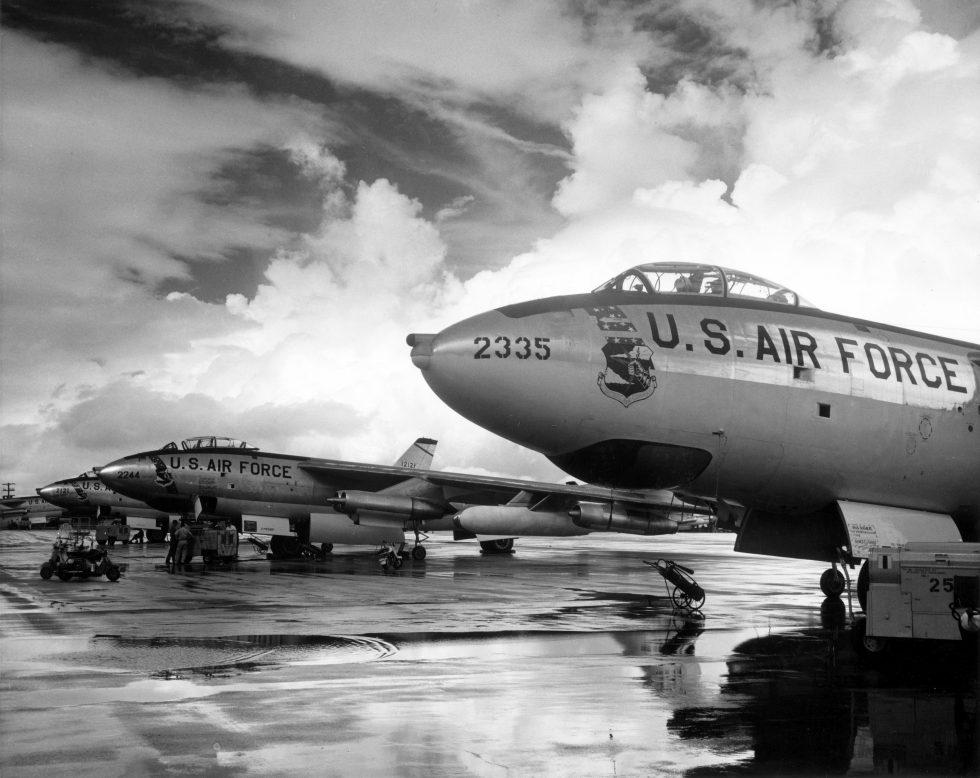
The B-47’s thin, high-aspect-ratio wing was swept 35 degrees and carried its six General Electric J47 turbojets in streamlined pods — a twin-engine nacelle inboard on each wing plus a single engine near each tip. Hanging the engines below and ahead of the structure kept fire away from the wing and eased maintenance. It became the standard layout Boeing carried into the B-52 and the 707, and thus almost every jet airliner since.
Bicycle landing gear
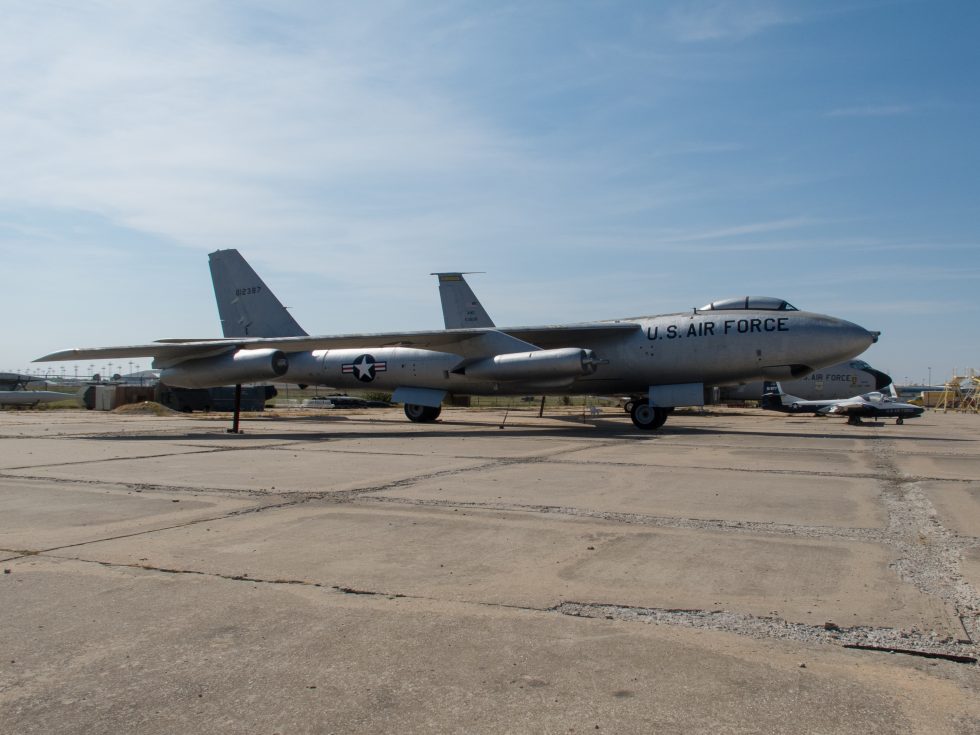
The wing was too thin and too flexible to house landing gear, so Boeing put the wheels in the fuselage: two twin-wheel tandem bogies fore and aft of the bomb bay, with small outrigger wheels that folded out of the inboard engine pods for balance. The jet sat nose-high and could not rotate on takeoff, and because the gear could not be de-crabbed, crews landed still angled into a crosswind.
Rocket takeoffs and toss-bombing
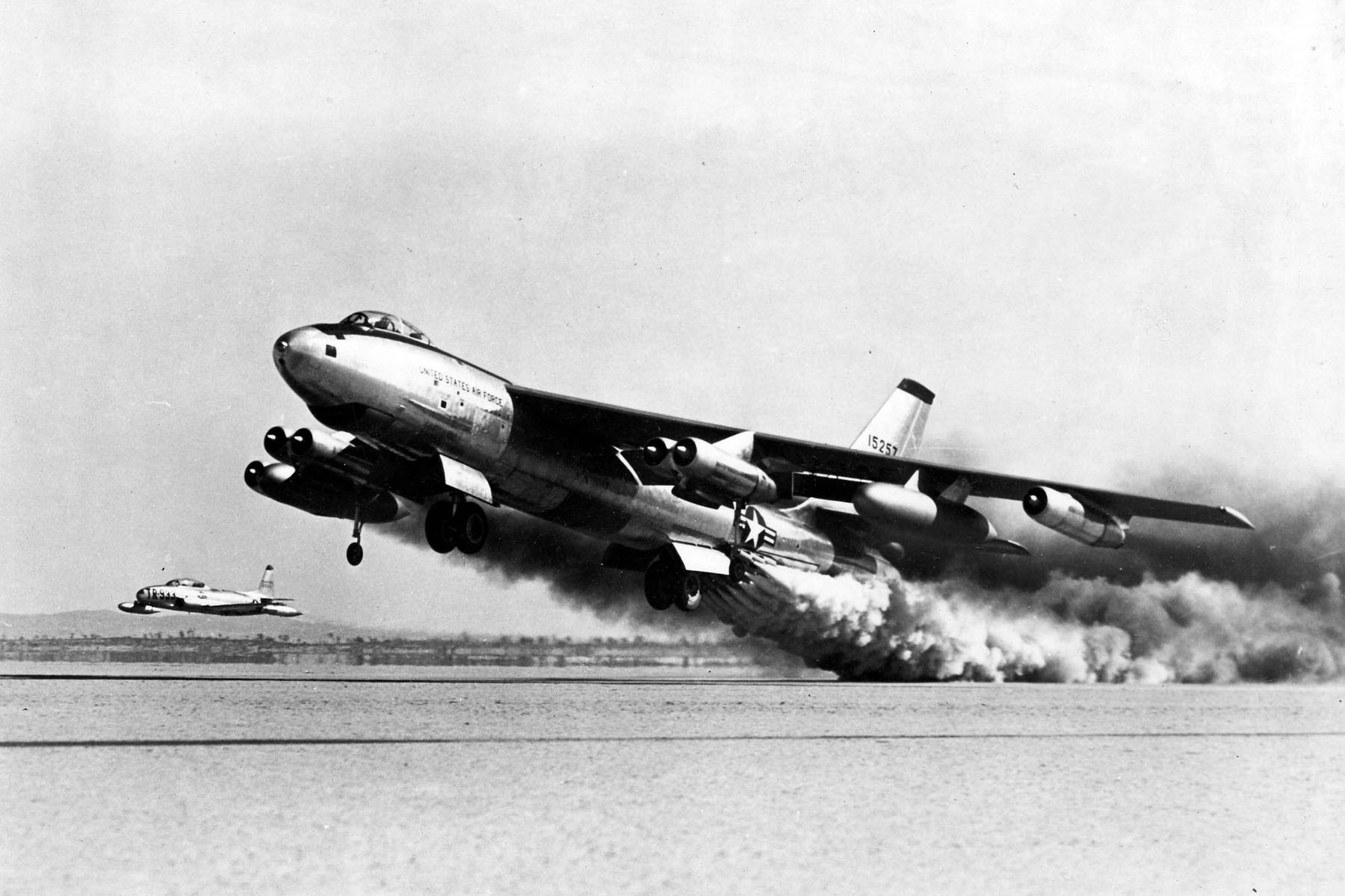
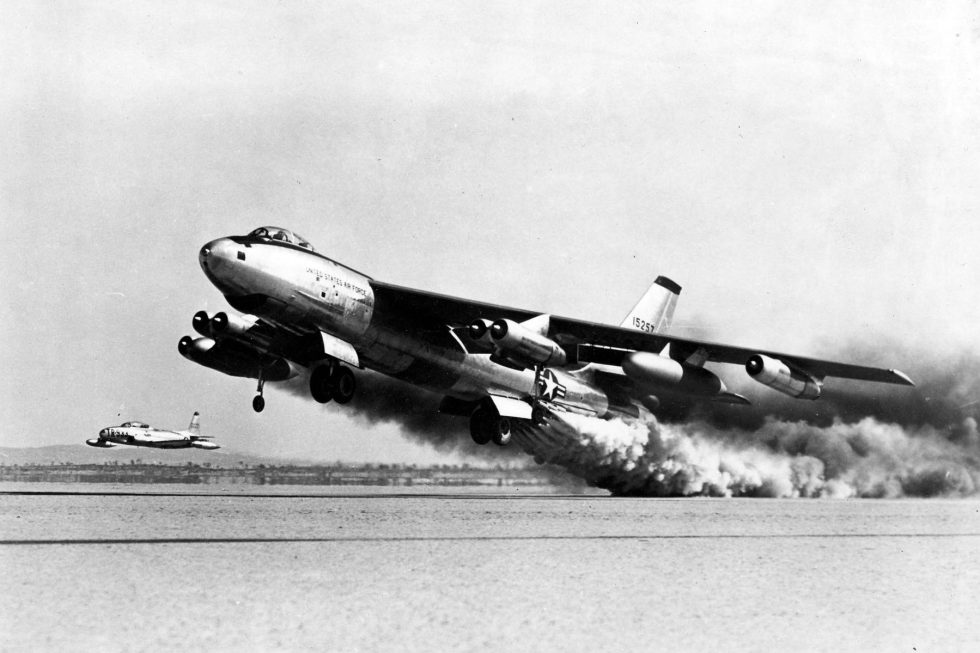
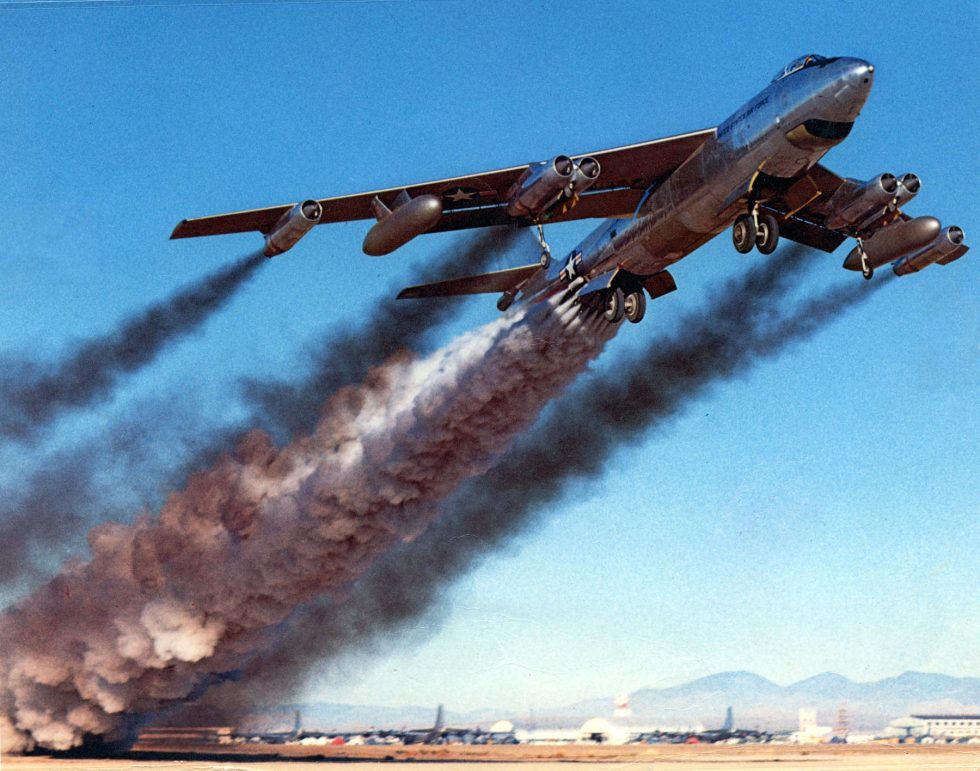
Heavy and underpowered on early turbojets, the B-47 used RATO rocket bottles — up to 33 units of around 1,000 lbf each — for its smoke-belching assisted takeoffs. To deliver a nuclear weapon and survive the blast, it flew the LABS “toss-bombing” maneuver: run in low, pull up into a half-loop that lobbed the bomb forward, then roll out and escape.
02The B-47 Stratojet’s flexible wing: the flaw that grounded the fleet
The same thin, flexible wing that made the B-47 fast also made it fragile. The wingtips could move through roughly 17 feet of total deflection between full up-bending and down-bending — and the constant flexing, worsened by punishing low-level manoeuvres, fatigued the metal where the wing met the fuselage. In 1957–58 the fleet suffered a wave of fatal in-flight break-ups. The Air Force responded with a major structural-reinforcement effort (nicknamed “Project Milk Bottle”) plus temporary groundings and speed restrictions. It was a hard lesson in metal fatigue that fed directly into later jet design.
03The B-47 Stratojet’s drag chutes: how you stop a slippery jet bomber
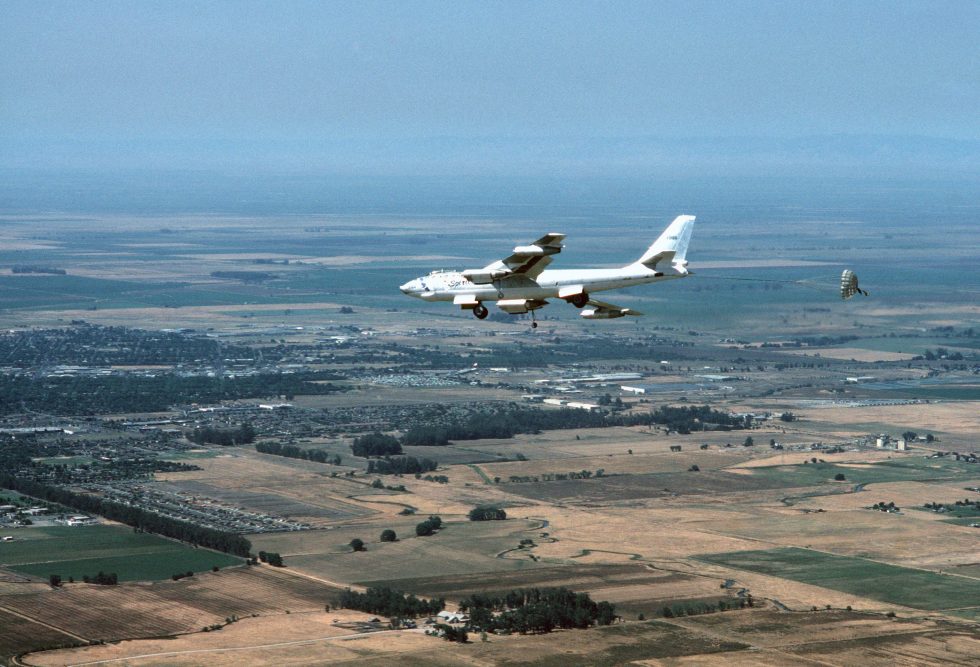
The clean swept wing that made the B-47 fast also made it hard to slow down. Crews used two parachutes. On final approach a small approach chute was streamed so the engines could be kept at high RPM — ready to spool up instantly for a go-around — without the aircraft accelerating. On the runway a large brake chute was deployed to haul the fast, heavy bomber to a stop in a reasonable distance. The techniques, like so much of the B-47, were later refined on Boeing’s jet airliners.
Full specifications
Baseline note: the figures below describe the B-47E as built from 1953 — the definitive production standard, with six General Electric J47-GE-25 turbojets on water-alcohol injection, ejection seats restored after the B-47B had done without them, and a radar-directed twin 20 mm tail barbette. Deltas for the ten service-test B-47As of 1950, the 399 B-47Bs of 1951–53, the RB-47E and RB-47H reconnaissance aircraft and the EB-47 electronic-warfare conversions are given in grey. Three cautions apply before any number below is quoted. First, the B-47E was not one aeroplane but four blocks: the B-47E-IV had strengthened landing gear, more fuel and a higher permitted gross weight than the B-47E-I, so a single weight row compresses a moving target. Second, English-language sources swap range and radius for this type almost at random — the widely reproduced "combat range 2,013 miles" and Joe Baugher’s "combat radius 1,965 miles" are too close together to be different quantities, and the figure is treated here as a radius. Third, the production total genuinely disagrees. 2,032 is the most-quoted number and is what the manufacturer split yields (1,373 Boeing, 274 Douglas, 385 Lockheed); one widely reproduced variant table adds to 2,042 and the Federation of American Scientists prints 2,039. The gap sits in the reconnaissance batches and in how the Lockheed-assembled aircraft are counted, not in any dispute about how many airframes existed.
Dimensions & weights
- Crew
- 3 — pilot and copilot in tandem under a fighter-style bubble canopy, the copilot swivelling aft to lay the tail turret, and a navigator-bombardier in a windowless compartment below and ahead of them. It was a fighter cockpit bolted to a 100-tonne bomber, and it was deliberate: SAC wanted a bomber flown like an aeroplane, not run like a ship. The RB-47H carried six — the same three plus three electronic warfare officers, universally called Ravens or Crows, sealed into a pressurised capsule in the bomb bay with sitting room only, poor noise insulation and worse heating. The ERB-47H carried two
- Length
- 32.64 m (107 ft 1 in). The RB-47E added a 0.86 m (34 in) nose plug for its camera fit, taking it to about 33.5 m; the RB-47H wore a blunt receiver radome instead. Aviastar prints 107 ft 11 in, which is a transcription slip
- Wingspan
- 35.36 m (116 ft 0 in) — unchanged across every production mark. For scale, a Boeing 707-120 spans 39.9 m and a B-52H 56.4 m; the B-47 is the smallest member of the family it founded
- Wing sweep
- 35° at quarter chord — the single most consequential number on this page. Boeing settled on it after George Schairer, travelling with the von Kármán mission, found the German swept-wing data at Braunschweig-Völkenrode in May 1945 and posted it home. Every large jet transport flying today sits within a few degrees of it
- Height
- 8.53 m (28 ft 0 in) — low, because the fuselage sits close to the ground on tandem gear rather than on legs
- Wing area
- 132.7 m² (1,428 sq ft), aspect ratio 9.42 — a long, slender, high-aspect-ratio wing, which is why it flexed as it did and why it eventually cracked
- Aerofoil
- NACA 64A(.225)12 modified (Boeing BAC 145) — roughly 12 per cent thick. Thin enough that there was nowhere inside it to stow a main undercarriage leg, which is the whole reason for the bicycle gear
- Wing-tip deflection
- up to 5.3 m (17.5 ft) at the tip between one-g level flight and a hard pull — visible from the cockpit, alarming to passengers on tanker rendezvous, and structurally intended. The wing was designed to bend; the fuselage joint that held it on was the part that failed
- Empty weight
- 36,290 kg (80,000 lb). B-47A 33,220 kg (73,240 lb); B-47B 35,430 kg (78,102 lb)
- Combat weight
- 60,340 kg (133,030 lb) — the weight at which most of the performance figures opposite were measured. B-47B 55,630 kg (122,650 lb)
- Maximum take-off weight
- 100,240 kg (221,000 lb). B-47A 71,220 kg (157,000 lb); B-47B 83,880 kg (184,908 lb); the B-47E-IV, with reinforced gear, is cleared in some tables to about 104,300 kg (230,000 lb). The type therefore roughly trebled its own empty weight at the ramp
- Internal fuel
- ~64,000 L (17,000 US gal), rising to ~69,600 L (18,400 US gal) in later B-47E blocks, all of it in the fuselage. Two jettisonable underwing tanks of about 6,740 L (1,780 US gal) each could be added. Fuselage-only tankage meant the centre of gravity marched as fuel burned, and the crew managed it by hand
- Wing loading
- 455 kg/m² (93 lb/sq ft) at combat weight, but 755 kg/m² (155 lb/sq ft) at maximum take-off weight — the arithmetic behind the 180 kn approach and the reputation
Performance
- Maximum speed
- 977 km/h (607 mph, 527 kn) at about 4,970 m (16,300 ft) — near Mach 0.84 higher up. B-47B 979 km/h (608 mph) at the same height and 909 km/h (565 mph) at 10,670 m; B-47A 966 km/h (600 mph). The XB-47 prototype touched 930 km/h (578 mph) on early trials, 119 km/h faster than the rival Martin XB-48
- Cruise speed
- 896 km/h (557 mph, 484 kn). B-47B 801 km/h (498 mph). In 1951 this was faster than most of the fighters expected to escort it and faster than the interceptors expected to stop it, which was the entire strategic argument for the aeroplane
- Placarded IAS limit
- 787 km/h (425 kn) indicated — an airframe limit, not an engine one. Above it, aileron deflection twisted the slender wing enough to reverse the roll response, so the crew flew a bomber with a speed restriction written on the panel
- Approach speed
- ~330 km/h (180 kn) — roughly the take-off speed of a modern airliner, flown as an approach speed, with a 16 ft drogue streamed to keep the engines spooled up because a J47 took an age to accelerate from idle. Too fast and it floated the length of the runway; too slow and it sank onto the runway on the rear truck. There was no comfortable margin either side
- Rate of climb
- 13.0 m/s (2,560 ft/min) initial for the B-47B at gross weight; the lighter B-47A managed 17.1 m/s (3,375 ft/min). Figures near 23.7 m/s (4,660 ft/min) circulate for the B-47E but describe a lightly loaded combat weight rather than a better aeroplane, and should not be compared with the gross-weight numbers
- Service ceiling
- 12,300 m (40,500 ft). B-47B service ceiling 10,330 m (33,900 ft) with a combat ceiling of 12,440 m (40,800 ft); the very light B-47A reached a combat ceiling of 13,500 m (44,300 ft). All of these were above the practical reach of Soviet interceptors in 1951 and none of them were by 1957
- Combat radius
- ~3,160 km (1,965 miles) with a 4,540 kg (10,000 lb) load, from the B-47B tables. The often-quoted 3,240 km (2,013 miles) with a 9,070 kg (20,000 lb) load is labelled a range in most sources and a radius in others; see the baseline note. Unrefuelled, the B-47 could not reach the Soviet interior from the continental United States, which is why it lived in Morocco, Spain, Britain and Greenland
- Ferry range
- 7,479 km (4,647 miles) with underwing tanks; 7,152 km (4,444 miles) for the B-47B. With two KC-97 brackets a Reflex sortie ran to about 18 hours, which for a three-man crew in a fighter cockpit was a genuine physiological problem
- Take-off run
- 2,774 m (9,100 ft) for the B-47B at gross weight, falling to 2,195 m (7,200 ft) with JATO. Heavy B-47Es on hot days needed every foot SAC had and then the rockets as well; the JATO rack was not a stunt, it was the difference between flying and not
- Landing roll
- shortened by a 9.8 m (32 ft) ribbon brake chute plus anti-skid brakes — the B-47 was the first mass-produced aeroplane fitted with an anti-skid system, because a bicycle undercarriage with all the weight on two trucks will lock a wheel and burn a tyre through in seconds
- Thrust-to-weight
- 0.32 at combat weight but 0.20 at maximum take-off weight, using the wet rating. That second number explains the rocket bottles, the water injection and the black smoke
- Manoeuvre envelope at altitude
- ~9 km/h (5 kn) at 10,670 m (35,000 ft) between the Mach limit above and the stall below — the coffin corner, monitored by hand on a raw airspeed indicator. A moment of inattention at cruise altitude in a fully fuelled B-47 was a loss-of-control accident
Propulsion & systems
- Engines
- 6 × General Electric J47-GE-25 axial-flow turbojets — the same engine family as the F-86 Sabre, which is why it was available, reliable enough and cheap enough to buy six at a time
- Rated thrust
- 26.6 kN (5,970 lbf) dry, 32.0 kN (7,200 lbf) with water-alcohol injection, per engine. B-47A: J47-GE-11 of 23.1 kN (5,200 lbf). B-47B: J47-GE-11, then J47-GE-23 of 26.6 kN from the 89th airframe. The XB-47 first flew on Allison-built J35-GE-7/9 of 16.7 kN (3,750 lbf) and was hopelessly underpowered until re-engined
- Engine installation
- four in twin pods beneath the inner wing, two singles outboard — all six slung forward of and below the wing on pylons. This is the invention. Podding the engines put their mass ahead of the elastic axis where it damped flutter, kept fire and burst debris away from the wing structure, let a mechanic change an engine on a stand rather than inside the aeroplane, and freed the wing to be as thin as the aerodynamicists wanted. The Model 450 layout of 1946 is, line for line, the layout of the aeroplane that flew you on holiday
- Water-alcohol injection
- tank feeding all six engines at take-off for roughly two minutes of augmented thrust — the source of the type’s trademark departure, a dense black smoke trail across the whole airfield
- Take-off assistance
- JATO/RATO bottles of ~4.4 kN (1,000 lbf) each — 18 in an internal installation buried in the rear fuselage on the B-47B, later replaced on the B-47E by a jettisonable external "horse collar" rack carrying up to 33 bottles in rows. The internal fit saved drag; the external rack saved the structural weight of carrying rocket fittings on every sortie, and could be dropped after climb-out
- Landing gear
- tandem bicycle main gear with wingtip outriggers — two twin-wheel trucks in the fuselage fore and aft of the bomb bay, plus small outrigger wheels retracting into the inboard engine pods. It solved the thin-wing problem and created two new ones: the aircraft sat at a fixed attitude and could not be rotated, so it flew itself off the runway when the wing was ready and not before; and it landed on the rear truck first, so a crosswind or an uneven fuel state would put it down on one outrigger with a wing low
- Deceleration
- 9.8 m (32 ft) ribbon brake chute and a 4.9 m (16 ft) approach chute, plus anti-skid brakes. The approach chute is the more interesting of the two: it was not there to slow the aeroplane down but to let the pilot fly a stabilised approach at high engine rpm, so that a go-around did not depend on spooling six turbojets up from idle
- Bombing-navigation system
- MA-7A with AN/APS-64 radar on the B-47E-IV, with mapping range out to about 385 km (240 miles). Earlier: the K-2 on the B-47A and early B-47B — 370 valves and close to 20,000 separate parts, and a byword for unserviceability — then the K-4A on most B-47Bs
- Tail fire control
- B-4, A-5 or MD-4 depending on block, driving the remotely controlled tail barbette from the rearward-facing copilot’s position. The B-4 was so unreliable that many aircraft flew with a simple N-6 optical sight instead, and a good number flew with no guns fitted at all
- Stability augmentation
- yaw damper and wing vortex generators — the swept wing brought Dutch roll, cured by an automatic rudder-deflecting yaw damper, and high-speed pitch-up, cured by rows of small vanes that kept the outer wing flow attached. Both fixes are now standard equipment on every swept-wing aeroplane; both were learned here first
- Air refuelling
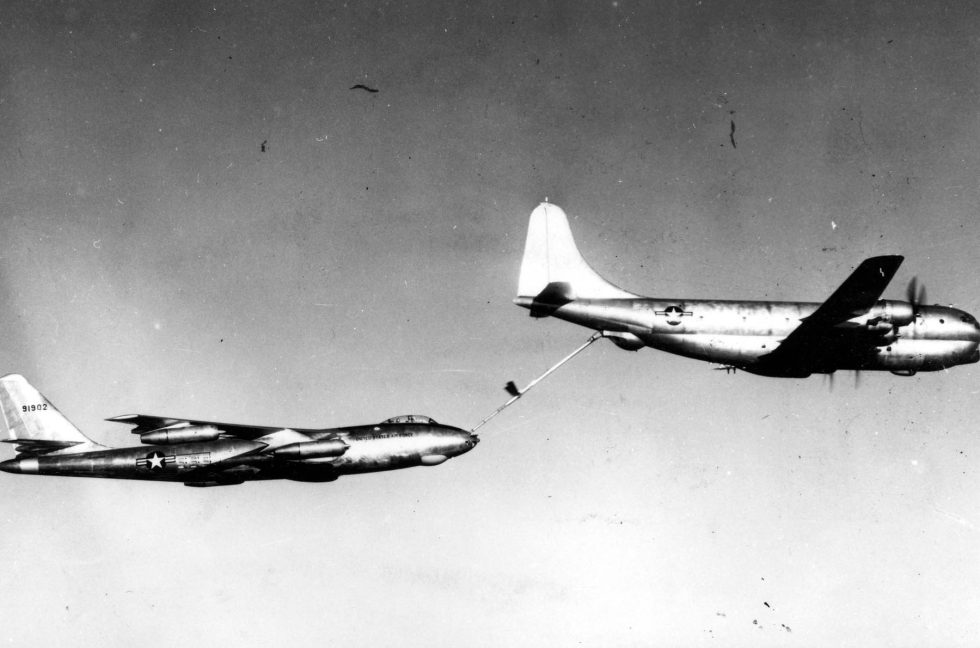
- nose receptacle for the flying boom — from KC-97 and KB-50 tankers. The pairing was awkward: a piston KC-97 had to dive to give a B-47 enough speed to stay flying, so the tanker descended while transferring and the bomber followed it down. The KC-135, which fixed this, arrived only as the B-47 was leaving
- Escape system
- upward ejection for the pilots, downward for the navigator — minimum safe altitude around 150 m (500 ft), and nothing at all for the navigator below that. Fitted to the B-47A, deleted from the B-47B as a weight saving with predictable results, restored on the B-47E
04The B-47 Stratojet’s operating costs: what the numbers really say
A B-47E is commonly cited at a flyaway cost of about $1.9 million in early-1950s dollars — a useful order-of-magnitude figure, though period accounting mixed airframe, engine and equipment costs in ways that make any single number approximate. No credible cost-per-flight-hour figure for 1950s Strategic Air Command operations exists in the open record, so any precise dollar-per-hour value attached to the type should be treated as an estimate rather than a sourced fact. What is certain is that the programme was vast: with more than 2,000 aircraft and a fleet flying constant alert, the B-47 was one of the most expensive military undertakings of its decade.
Armament & payload
The B-47 carried one bomb that mattered, two guns pointing backwards, and rockets only to get off the ground
For a machine built in greater numbers than any other American jet bomber, the B-47’s armament is a short subject. It carried a single bomb bay, and for most of its career SAC filled it with exactly one nuclear weapon. It carried two guns, both in the tail, aimed by a copilot swivelling his seat to face backwards. It never dropped a weapon in anger. The whole armament story of the B-47 is therefore a story about a weapon that was never used, mounted in an aeroplane that was fast enough not to need the guns and too short-legged to reach the target it was designed for without a foreign runway to start from.
What is genuinely interesting is how the delivery method changed under it. The B-47 was conceived as a high-altitude bomber that would cross the Soviet border above the interceptors and release from around 12,000 m. By 1957 the SA-1 and SA-2 had made that plan lethal, and SAC reversed the profile: in at 150 m and 425 kn, then a pull-up into the Low Altitude Bombing System manoeuvre — a half-loop with the weapon released on the way up, tossing it several kilometres forward while the bomber rolled off the top and ran for the horizon. Crews called it the idiot’s loop. A B-47 demonstrated it publicly at Eglin on 7 May 1957. It was the only way a subsonic bomber could put a thermonuclear weapon on a target and survive its own detonation.
It also broke the aeroplane. A wing designed to bend 5 m in cruise was never meant to be pulled through 2.5 g at low level in dense air, sortie after sortie. Fatigue cracks appeared at the wing-to-fuselage joint, three aircraft lost wings in early 1958, and SAC grounded or restricted the fleet while Project Milk Bottle replaced the wing attachment pins across well over a thousand airframes. Weapon clearances varied enormously by production block, by wing and by year, and the declassified record is patchy; the weapons named below are those repeatedly attested for the type rather than a complete or contemporaneous loading list.
Gun
- 2 × 20 mm M24A1 cannon in a remotely controlled tail barbette on the B-47E — the American Hispano derivative, radar-laid, the only offensive or defensive gun on the aircraft.
- 2 × 0.50 in AN/M2 Browning in the tail on the B-47A and B-47B, a marked step down in reach and hitting power against jet fighters.
- Aimed by the copilot, who rotated his seat to face aft and worked the turret through the fire control system. There was no gunner and no other gun position anywhere on the aeroplane.
- Fire control: B-4, A-5 or MD-4 by block. The early B-4 was unreliable enough that units substituted a plain N-6 optical sight, and a great many B-47Bs flew with no guns installed at all — the turret was as much a morale fitting as a weapon.
- Doctrine, not hardware, was the real defence. At 896 km/h in 1951 the B-47 outran what could be sent after it; by 1957 it could not, and the answer was to go low rather than to fit more guns.
Air-to-air
- None, ever. No air-to-air missile was carried, trialled or planned for the B-47. Guided air-to-air weapons were not in usable service when it entered squadrons and it was leaving them by the time they were.
- The tail barbette was the only air-to-air capability the aeroplane possessed, and it was a deterrent to a stern attack rather than a genuine defence against a MiG-17 or MiG-19.
- No parasite-fighter scheme was attached to the B-47 — that experiment belonged to the B-36. Where the B-36 tried to carry its own escort, the B-47 simply tried to be faster than the problem.
- In practice the reconnaissance versions did the fighting, or rather the surviving: an RB-47E outran MiG-17s over the Kola Peninsula on 8 May 1954, and an ERB-47H came home to Yokota on three engines after North Korean MiG-17s worked it over on 28 April 1965.
Air-to-surface guided
- Bell GAM-63 RASCAL — a 9.5 m rocket-powered supersonic stand-off missile with a nuclear warhead, carried on a small number of YDB-47E and DB-47E director conversions from the mid-1950s. The idea was to launch roughly 160 km short of the target and keep the bomber outside the defences.
- It never entered service. RASCAL was cancelled in 1958, beaten by guidance problems and overtaken by the ballistic missile. The B-47 finished its career with no stand-off weapon at all.
- Project Brass Ring went the other way entirely: an unmanned MB-47, flown to the target by autopilot and stellar tracking after its crew had baled out, so that a thermonuclear weapon could be delivered without asking anyone to survive it. Cancelled in 1953 once parachute-retarded weapons made manned delivery survivable.
- No television, radar or laser-guided conventional weapon was ever integrated. The B-47’s aiming solution for its entire life was a radar bombsight and gravity.
Bombs
- Maximum load 11,300 kg (25,000 lb) on the B-47E, in a single internal bay; 8,200 kg (18,000 lb) on the B-47A and B-47B. Internal carriage only — the underwing hardpoints took fuel tanks, not weapons.
- Nuclear, first and last. Attested fits run from the early implosion weapons (Mk 5, Mk 6) through the thermonuclear Mk 15 and Mk 36 to the lighter, parachute-retarded Mk 39, B28 and B43 that made the low-level LABS toss practical. A single weapon was the normal alert load.
- Conventional alternative: around 13 × 500 lb or 8 × 1,000 lb general-purpose bombs. It is listed in every manual and was flown on ranges; it was never used operationally, because there was no conventional war the B-47 was sent to.
- Nuclear test drops were flown for Operations Greenhouse (1951), Ivy (1952), Castle (1954) and Redwing (1956) — effects sampling and live releases, the closest the type came to using its primary weapon.
- Zero combat releases. In fifteen years and more than two thousand airframes, no B-47 dropped a bomb on an enemy.
Rockets
- No air-to-ground or air-to-air rocket was ever carried. The only rockets on a B-47 pointed backwards and were there to get it airborne.
- 18 × ~4.4 kN (1,000 lbf) JATO bottles in an internal installation in the rear fuselage of the B-47B, fired for about fourteen seconds to cut roughly 580 m off the take-off run.
- Up to 33 bottles on a jettisonable external rack on the B-47E — the "horse collar", a split-V frame clamped round the rear fuselage in rows and dropped after climb-out, so the airframe did not carry rocket structure on every sortie.
- Not a display item. A B-47E at 100 tonnes on a hot day at a dispersal base in Morocco or Spain needed the bottles to leave the ground at all. The JATO launch is the defining image of the type for the same reason the black smoke is: both are symptoms of an aeroplane operating at the edge of its installed thrust.
Pods & other stores
- Two jettisonable underwing fuel tanks of about 6,740 L (1,780 US gal) each, mounted between the inboard and outboard engine positions — the only external stores a bomber B-47 routinely carried.
- Camera fits: an eight-camera pod on the interim RB-47B conversions, and a purpose-built eleven-camera nose on the RB-47E with a 0.86 m nose extension. Daylight photography only on the earliest fit.
- Electronic warfare modules: the "Blue Cradle" removable cradle of 16 jammers in the bomb bay of the Phase IV EB-47E, and a pressurised 13-jammer module in the Phase V aircraft. The EB-47E(TT) "Tell Two" added cheek blisters for telemetry intelligence against Soviet missile tests.
- The Raven capsule: on the RB-47H, a pressurised crew compartment carrying three electronic warfare officers and their receivers, occupying the space where a bomber carried its weapon — the clearest statement of what the type actually did for a living.
- Chutes as equipment: the 9.8 m brake chute and 4.9 m approach chute were consumable stores in the operational sense, packed and replaced between sorties like any other expendable.
Three typical loadouts
- High-altitude nuclear alert, B-47E, 1955
- One thermonuclear weapon of the Mk 15 or Mk 36 class in the bay; full internal fuel plus two 1,780 US gal underwing tanks; external JATO rack fitted; tail barbette loaded. Sat on a hardstand at Sidi Slimane, Fairford or Thule with a third of the wing at cocked readiness, crews in the alert hut, engines cartridge-started for a minimum-interval take-off.
- Low-level LABS strike, B-47E, post-1958
- One retarded weapon — Mk 39, B28 or B43 — underwing tanks retained, run-in at 150 m and 425 kn under the radar, then the pull-up: release past 45° nose-up, half-roll off the top, and outbound at full power. Cut the survivable release problem down to size and cut the airframe’s fatigue life down with it.
- Peripheral ELINT sortie, RB-47H, 1960
- No weapons but the tail guns. Three Ravens in the pressurised bay capsule with receivers and recorders, full fuel, flying a track along a Soviet coastline to make air defence radars switch on and talk. This is the loadout that got people killed: RB-47H 53-4281 of the 55th Strategic Reconnaissance Wing was flying it over the Barents Sea on 1 July 1960 when a MiG-19 shot it down.
Sourcing caveat: bomb loads, weapon clearances and fire control fits changed by production block and by wing, and much of the nuclear loading record remains thinly documented in open sources. Figures here follow Joe Baugher’s B-47 pages, commonly reproduced specification tables, the Federation of American Scientists nuclear forces guide and museum fact sheets; where those disagree the disagreement is stated rather than averaged.
Variants
Boeing built 2,032 Stratojets in eleven years and scrapped almost all of them in five
The B-47 is one of the great production runs in aviation history and one of the shortest careers. Just over two thousand were built between 1947 and 1957 across three factories — Boeing at Wichita and Seattle, Douglas at Tulsa, Lockheed at Marietta, the same three-plant arrangement that had built B-29s. By 1956 SAC had more than 1,300 B-47 bombers on strength plus around 250 reconnaissance aircraft, in 28 bomber wings and five reconnaissance wings. It was the largest fleet of jet bombers anyone has ever assembled, and within a decade of that peak it was gone.
Nothing about the B-47 failed. It was retired because the problem it solved stopped existing. Its unrefuelled radius always required foreign bases, and the political cost of those bases rose steeply through the late 1950s. Its high-altitude sanctuary closed when surface-to-air missiles arrived. The low-level profile that replaced it ate the airframe’s fatigue life. And the B-52, which is simply a B-47 grown up — same 35° sweep, same podded engines on pylons, same bicycle-derived gear philosophy — could do the job intercontinentally without anyone’s permission. The ICBM finished the argument. Final phase-out of the bomber wings began in 1963 and the last B-47 bomber left SAC in February 1966, though reconnaissance, weather and electronic aircraft flew on considerably longer.
It was also expensive in crews. Over its life 203 B-47s were lost in accidents with 464 deaths — about a tenth of the fleet, in an aeroplane that never fought. Some of that is the era; a great deal of it is a machine that landed at 180 kn on tandem gear, cruised in a five-knot envelope, and gave a slow-spooling engine to a pilot who might need thrust immediately.
- XB-47 (first flight 17 December 1947 / 2 built)
- The prototypes, and the point at which the modern jet aeroplane appears. Boeing had already worked through the Model 424 (a jet B-29), the Model 432 (engines buried in the fuselage) and the Model 448 before the German swept-wing data and an Air Force objection to internal engines produced the Model 450: 35° wing, six engines on external pylons. Flown initially on Allison J35s and grossly underpowered until J47s were fitted.
- B-47A (1950 / 10)
- Service-test aircraft, J47-GE-11 engines, ejection seats, K-2 bombing system, delivered from December 1950. Never combat-capable and never intended to be: they existed to teach SAC how to operate the thing. Underpowered and with brakes that could not stop it.
- B-47B (1951–53 / 399)
- The first operational model, in service with the 306th Bombardment Wing from October 1951. Added the nose refuelling receptacle, underwing tanks and a strengthened wing; deleted the ejection seats to save weight, a decision reversed on the next mark and paid for in the meantime. The K-2 bombing system, with 370 valves, was its worst feature. Eight were finished by Lockheed and ten by Douglas from Boeing-supplied components; the rest were Wichita-built.
- B-47E (1953–57 / 1,341)
- The definitive aircraft and the one described in the specifications above: J47-GE-25 with water-alcohol injection, twin 20 mm tail barbette, ejection seats restored, external JATO rack, higher weights. Built in four progressive blocks, the B-47E-IV having strengthened gear, more fuel and the MA-7A bombing system with AN/APS-64 radar. Split roughly 691 Boeing, 386 Lockheed, 264 Douglas. Surviving B-47Bs were brought up to a similar standard as B-47B-II, later redesignated B-47E-II.
- RB-47E and RB-47K (1953–55 / 240 and 15)
- Photographic reconnaissance, with a 0.86 m nose extension housing up to eleven cameras and no bombing system. The RB-47K was a weather and photographic conversion carrying dropsondes. These aircraft flew the deep overflights: 156 penetrations the length of Siberia between 21 March and 10 May 1956 under Project HOMERUN, and Captain Harold Austin’s celebrated run past the Kola Peninsula on 8 May 1954, chased by MiG-17s and saved by speed.
- RB-47H and ERB-47H (1955–57 / 32 and 3)
- Electronic intelligence aircraft with a blunt receiver nose and three Ravens (two on the ERB-47H) in a pressurised bomb-bay capsule. The most exposed job in the Cold War air forces: fly a border track, invite the radars to light up, record everything. RB-47H 53-4281 of the 55th SRW was shot down by a MiG-19 flown by Vasily Polyakov over the Barents Sea on 1 July 1960 — four of the six crew killed, Captains John McKone and Freeman Olmstead pulled from the water by a Soviet trawler and held in the Lubyanka until their release in January 1961, immediately after Kennedy’s inauguration.
- EB-47E, EB-47E(TT) and EB-47L (1958–63 / ~40 and 36 conversions)
- Electronic warfare and relay conversions. The Phase IV "Blue Cradle" carried 16 jammers on a removable cradle in the bomb bay, the Phase V a pressurised 13-jammer module. The EB-47E(TT) "Tell Two" carried telemetry receivers in cheek blisters to eavesdrop on Soviet missile tests. Thirty-six B-47Es became EB-47L airborne communications relays between 1961 and 1963 — a stopgap national command link. Two Tell Two aircraft outlived everything else, flying with the US Navy until December 1977.
- WB-47B and WB-47E (1956–69 / 1 and 34 conversions)
- Weather reconnaissance for the Air Weather Service, with the bomb bay given over to instrumentation. These were the last B-47s in United States Air Force service, retired in 1969 — four years after the bombers, doing meteorology in an aeroplane designed to end the world.
- TB-47B, QB-47E and the trials aircraft (1953–61 / ~107 and 14 conversions)
- TB-47B crew trainers with a fourth seat; QB-47E full-scale target drones converted from RB-47Es and expended in missile trials; YDB-47E and DB-47E RASCAL missile directors; YB-47J and the MB-47 Brass Ring drone project. A large fleet generates a long tail of conversions, and this one is longer than most.
- XB-47D and CL-52 (1955–57 / 2 and 1 conversions)
- The curiosities. The XB-47D replaced each inboard twin jet pod with a single Wright YT49-W-1 turboprop of about 9,700 shp swinging a four-blade propeller, first flying on 26 August 1955 — a serious attempt at a long-range turboprop bomber that went nowhere once the jets improved. The CL-52 was a single B-47B loaned to Canada in 1956 as a flying testbed for the Orenda Iroquois engine intended for the Avro Arrow, carried on the rear fuselage; the crews who flew it disliked it thoroughly.
Survivors: between 23 and 24 complete B-47 airframes remain, depending on whether one counts a fuselage held in storage, and every one of them is in the United States. All are original airframes; no B-47 reproduction exists and none is likely to, given the size and the structure. Among them are the first prototype XB-47 46-066, moved to the Air Force Flight Test Museum at Edwards in 2016, and B-47E 53-4299 at the National Museum of the United States Air Force. None is airworthy. The last flight by any B-47 was made on 17 June 1986, when 52-0166 was restored to flight status for a single ferry from Naval Air Weapons Station China Lake to what is now the Castle Air Museum at Atwater, California — a museum delivery flown by volunteers, twenty years after the type left the bomber force.
From German research to Cold-War alert
The requirement
The U.S. Army Air Forces call for a jet bomber. Boeing’s first straight-wing studies (Models 424/432) fall short.
The swept-wing letter
George Schairer, studying captured German aerodynamic data, writes home; Boeing adopts a 35° swept wing with six podded engines.
First flight
The XB-47 flies for the first time on 17 December, from Boeing Field to Moses Lake, Washington.
Enters service
The B-47 joins Strategic Air Command and begins replacing piston-engine bombers as the core of the nuclear deterrent.
The spy variant
The RB-47H electronic-reconnaissance version enters service and begins hazardous intelligence flights along Soviet borders.
The fatigue crisis
A wave of wing-fatigue break-ups forces groundings, speed limits and a major structural-reinforcement programme.
Shot down over the Barents Sea
On 1 July a Soviet MiG-19 downs an RB-47H off the Kola Peninsula; four crew die and two are captured and held in the Lubyanka.
Retirement
The bomber role ends in 1965–66 as the B-52 and ICBMs take over; the last special-mission WB-47E flies on 30 October 1969.
From the flight line: twelve Stratojet stories
A letter from the ruins of Germany
One engineer’s note pushed Boeing to sweep the wing — and changed the jet age.
Read the full story
Six engines that became the template
Every jetliner you fly copies this layout.
Read the full story
Holy smoke — RATO
Thirty-three rockets and a wall of black smoke.
Read the full story
The wing that waved
The tips flexed some 17 feet — until the metal cracked.
Read the full story
Riding a bicycle at 180 mph
No room in the wing for wheels, so the gear went in the belly.
Read the full story
Bombing over your shoulder
A four-engine bomber flying half a loop.
Read the full story
Spying on the bear
Unarmed jets flew where no one else dared.
Read the full story
Seven months in the Lubyanka
A MiG-19, the Barents Sea, and a KGB prison.
Read the full story
Chutes to slow the jet
A parachute on final, another on the runway.
Read the full story
The jet that pointed to the B-52
Fast, but short of legs.
Read the full story
Two thousand jets, three companies
An industrial army built the Stratojet.
Read the full story
The men who first tamed it
Robbins, Osler and the swept-wing unknown.
Read the full story
The Stratojet in pictures
Where the Stratojet flew
The war it never fought
The B-47 never dropped a bomb in anger. Built to carry nuclear weapons in a war that thankfully never came, its combat history is written entirely in reconnaissance — the unarmed and lightly armed RB-47s that flew intelligence missions along the edge of Soviet airspace, and occasionally paid for it.
Compare the combat record of every military aircraft. Figures as of July 2026.
Everything people ask about the B-47
Can I fly in a B-47?
What made the B-47 revolutionary?
Was the B-47 ever used in combat?
Why did the B-47 have bicycle landing gear?
How many B-47s were built?
What replaced the B-47?
Are any B-47s still flying?
You can’t fly the B-47.
These, you can.
Some legends only live in museums — others are fuelled and waiting. MiGFlug has put civilians in real military jet cockpits since 2004.
 Fly the L-39 AlbatrosThe world’s most-flown jet trainer — aerobatics included
 Fly the F-104 Starfighter“The missile with a man in it”
 Fly the MiG-21The Cold War’s most-produced jet
 Fly the T-33 Shooting StarAmerica’s first jet trainer
 Fly the DH VampireA piece of early jet history
 Fly the S.211Agile Italian jet trainer
 Fly the MB-326The classic Aermacchi jet
 Fly the MiG-15The Soviet legend of the Korean War
Continue the tour
Every fact, checked
- National Museum of the U.S. Air Force — RB-47H fact sheetPrimary reference for service history, the reconnaissance role and specifications.
- Strategic Air Command & Aerospace MuseumB-47E exhibit data on dimensions, performance and production numbers.
- AirVectors — The Boeing B-47 StratojetDetailed development history, the swept-wing decision and design evolution.
- This Day in AviationAccount of the XB-47’s first flight on 17 December 1947.
- GlobalSecurity — B-47 designEngineering detail on the podded engines, bicycle gear and RATO takeoff.
- MilitaryHistoryNowThe 1957–58 wing-fatigue crisis and the structural-reinforcement programme.
- The Aviation Geek ClubThe 1 July 1960 Barents Sea RB-47H shootdown and its aftermath.
- SkytamerCross-reference for B-47E dimensions, weights and unit cost.