
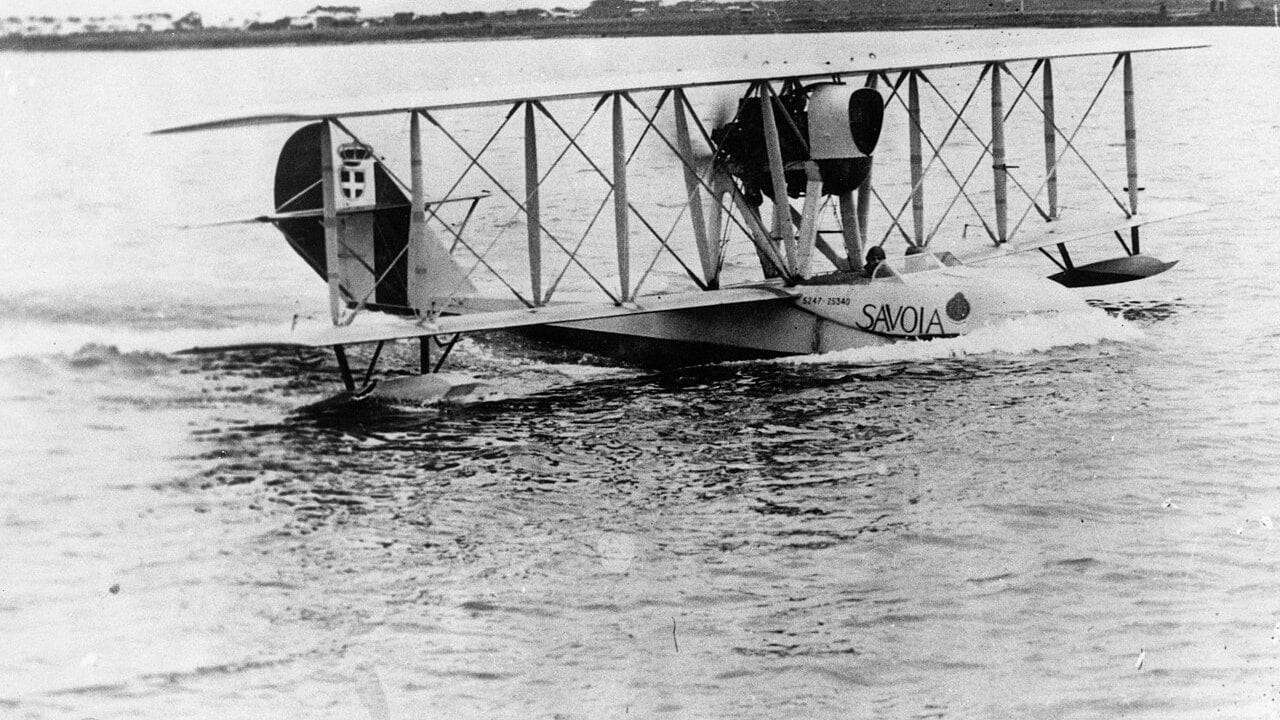
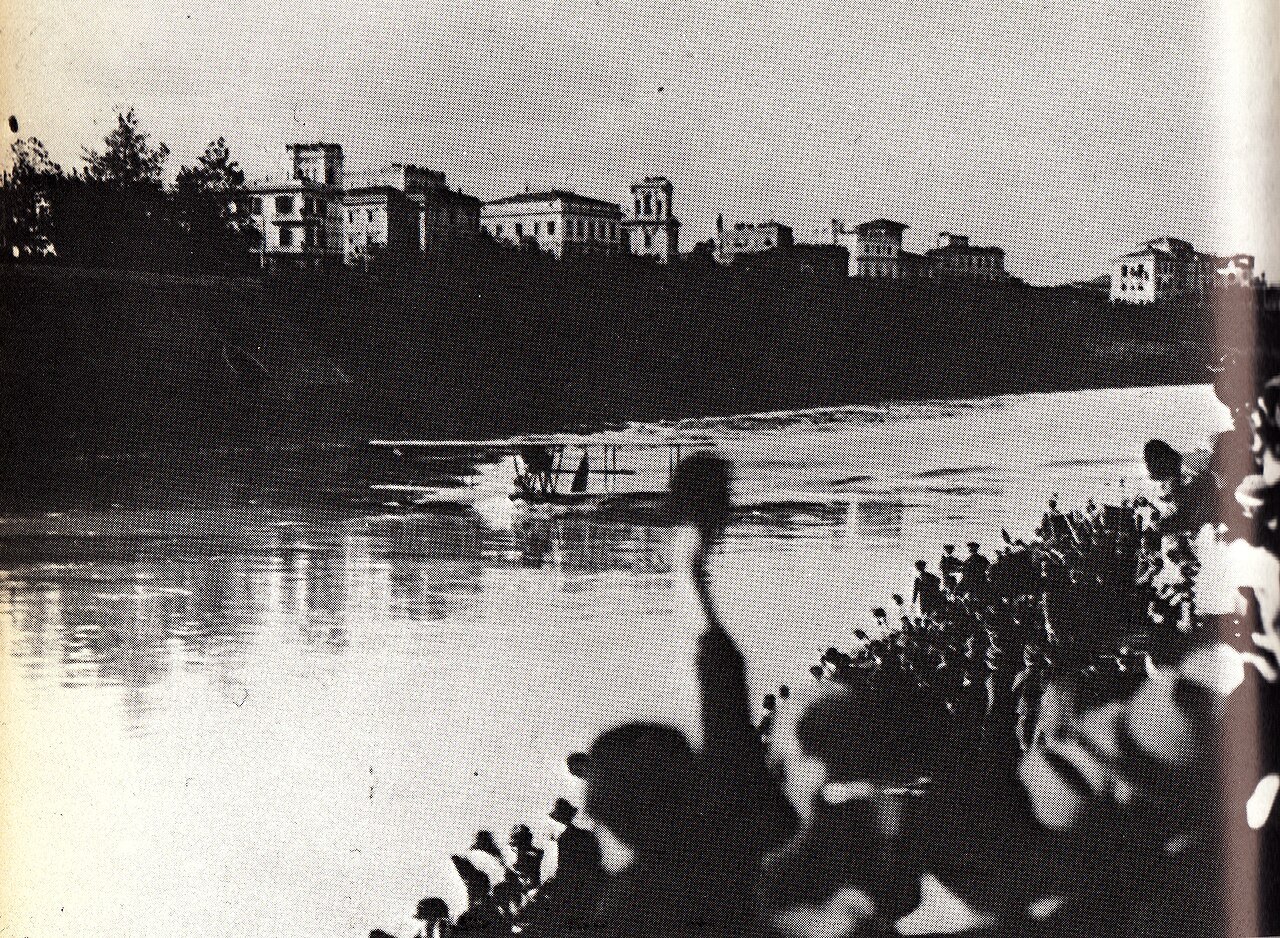
On the afternoon of 7 November 1925, several thousand people lined the banks of the Tiber in Rome and watched a small, battered biplane flying boat settle onto the river. Its pilot climbed out, and the first man to greet him was his father. Then came Benito Mussolini and the members of his cabinet.
The pilot was Francesco de Pinedo, and he had just flown home from Tokyo. Before that he had flown to Melbourne. In a little over 200 days, with one mechanic, one single-engined flying boat and almost no ground support, he had covered something like 55,000 kilometres. The British magazine Volo did not hesitate to call it the most extensive aerial tour on record.
Informazioni rapide
- Pilota: Francesco de Pinedo, Regia Aeronautica
- Mechanic: Ernesto Campanelli
- Aeromobili: SIAI S.16ter flying boat Gennariello, one Lorraine-Dietrich engine
- Partito: Late April 1925 (21 April per Volo; 20 April from Sesto Calende per Italian sources)
- Melbourne: Arrived 10 June 1925
- Tokyo: Arrived 26 September 1925 (Kasumigaura)
- Back in Rome: 7 November 1925, landing on the Tiber
- Distanza: About 55,000 km (some 35,000 miles) in just over 200 days
- Engine changes: One, at Tokyo
A naval officer who believed in seaplanes
De Pinedo was born in Naples on 16 February 1890 into an old patrician family. He entered the Naval Academy at Livorno in 1908, came ashore with the first landing parties in Libya during the Italo-Turkish War and won a bronze medal for valour. In the First World War he moved to the navy’s air service and flew reconnaissance missions for the navy.
When the Regia Aeronautica, the forerunner of today’s Italian Air Force, became an independent service in 1923, de Pinedo transferred to it. He was a natural staff officer, quiet and meticulous. But he had a conviction he wanted to prove in the air: that the seaplane, able to land on any harbour, river or lake, was the key to long-distance travel in an age with almost no airports.

His instrument was a SIAI S.16ter, a single-engined biplane flying boat from the Società Idrovolanti Alta Italia works at Sesto Calende on Lake Maggiore. It was, Volo stressed, a standard production machine, powered by a Lorraine-Dietrich engine of around 400 horsepower. It was not an amphibian: it had no wheels, and could only come down on water. De Pinedo named it Gennariello.
Outbound: Rome to Melbourne
The flight began in late April 1925. Volo dated the departure to 21 April; the Italian national biography puts the start at Sesto Calende on 20 April. In the cockpit with de Pinedo was his mechanic, Ernesto Campanelli. They carried, as Volo put it, “but a minimum of equipment”, and no fuel dumps or support teams had been prepared along the route.
The route reads like an atlas of the 1920s. From Brindisi and Leros they flew to Baghdad, Bushire and Chabar in Persia, then reached Karachi on 5 May. Bombay, Cocanada and Calcutta followed, then Akyab, Rangoon, Tavoy and Mergui in Burma, Phuket in Siam, Penang and, on 24 May, Singapore.
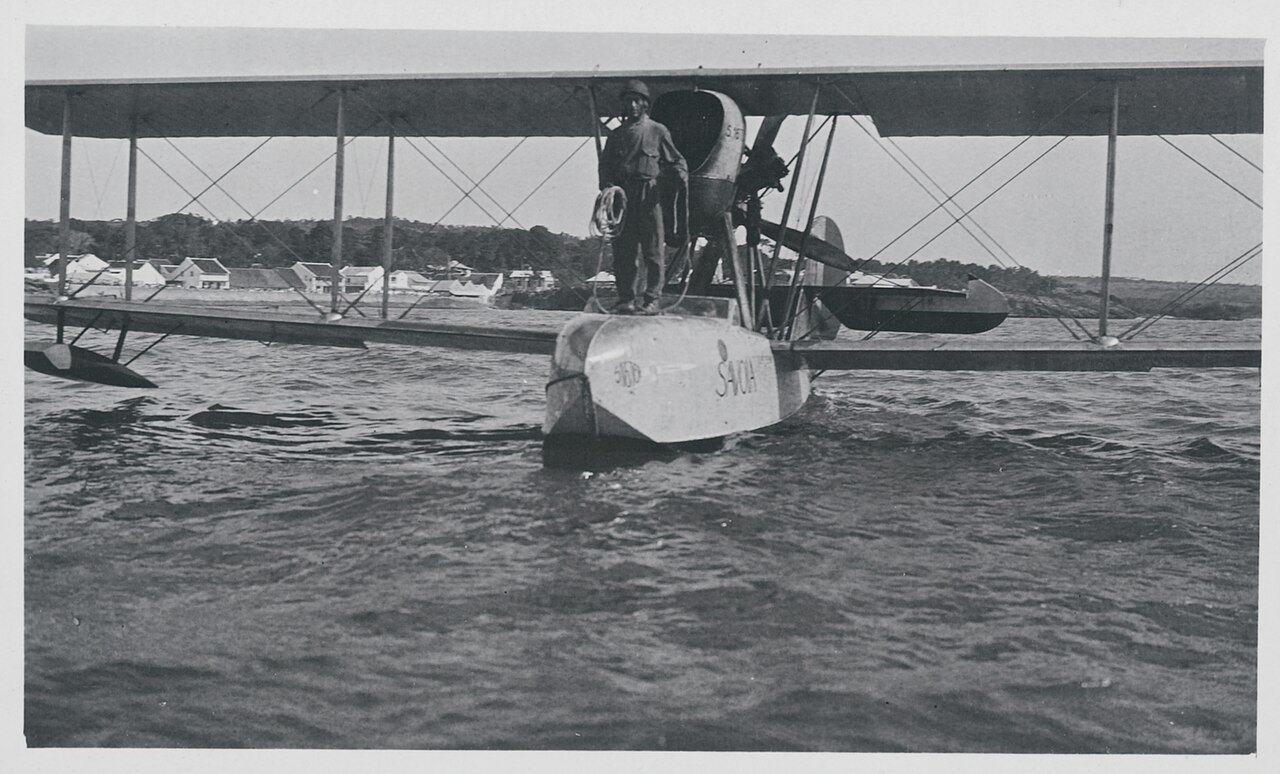
Across the Netherlands East Indies they hopped from Batavia to Surabaya, Sumbawa and Kupang on Timor, and on 31 May they reached Australia at Broome. Instead of cutting across the desert, Gennariello followed the coast: Carnarvon, Perth, Bunbury, Albany, Israelite Bay and Adelaide. On 10 June 1925, de Pinedo and Campanelli alighted at Melbourne.
They stayed for about five weeks. On 16 July they flew on to Sydney, spent three more weeks there, and on 6 August set off up the Queensland coast to Brisbane, Rockhampton, Townsville, Innisfail, Cooktown and Thursday Island.
Archive footage via Italy’s Tg2000 of de Pinedo and Campanelli alighting on the Tiber at the end of the flight (Italian commentary).
Northbound: the islands, China and Japan
From the tip of Cape York the flying boat crossed to Merauke in Dutch New Guinea, then worked through Dobo, Amboina and Menado to the Philippines, reaching Manila on 27 August. Weather was the real enemy. Volo noted that only the weather had been unkind, causing several delays, and the pair did not reach Aparri in northern Luzon until 16 September.
Tamsui on Formosa, Shanghai, Mokpo in Korea, Yamakawa and Kagoshima followed. At 4 p.m. on 26 September 1925, Gennariello came down at the Kasumigaura naval air station near Tokyo, where the Italian ambassador and an enthusiastic Japanese crowd were waiting. While there, Volo reported, de Pinedo was promoted to lieutenant colonel.
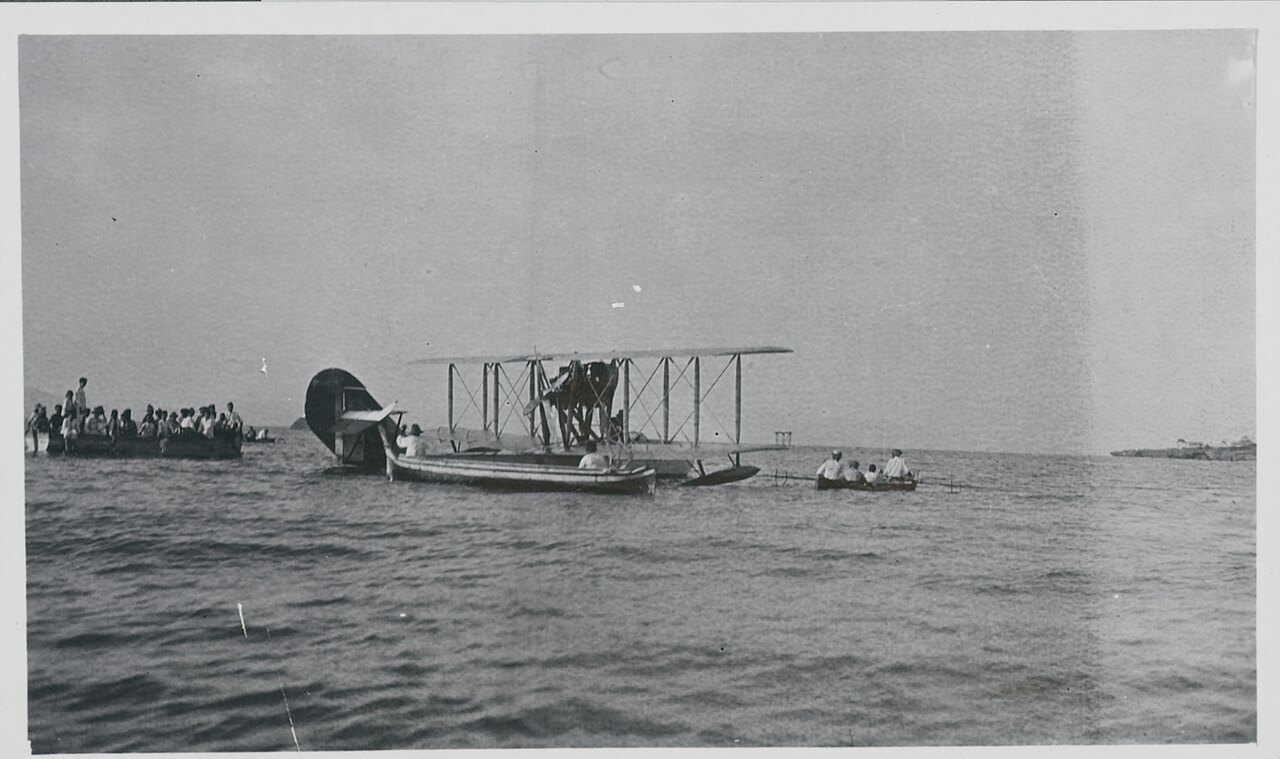
During three weeks in Tokyo the flying boat was overhauled and given a new engine. It was the only engine change of the whole trip. The airframe and the propeller were the same ones that had left Italy in April.
Home in 22 days
On 17 October de Pinedo and Campanelli started for home, and now they flew fast: Kagoshima, Shanghai, Hong Kong, Haiphong, Saigon, Bangkok, Rangoon, Calcutta, Benares, Delhi and Karachi, then Bandar Abbas, Bushire, Baghdad and Alexandretta. The homeward 15,000-odd miles, around 24,000 kilometres, took just 22 days, which Volo called something of a record for long distance in shortest time.
Twice, once in each direction, the non-amphibious flying boat had crossed the Indian subcontinent over more or less dry land, on legs of roughly 600 and 1,200 miles. An engine failure there would have left de Pinedo with nowhere to put a hull down.
At Taranto, thousands of spectators turned out, and pilot and mechanic each received a silver cup. Naples, de Pinedo’s home city, gave him another great reception. Then, on 7 November, came the landing on the Tiber, the drive with Mussolini to the Palazzo Chigi and the appearance on the balcony before a huge crowd.
What the flight proved
In round figures, Gennariello had flown about 35,000 miles, some 55,000 kilometres, in a little over six and a half months. Others had already flown from Europe to Australia and to Japan. What set this flight apart was the combination: three continents in a single round trip, in a standard production flying boat, along a route nobody had prepared for it.
Two days after the Tiber landing, de Pinedo was promoted to colonel and made a Knight of the Military Order of Savoy. In 1927 he went further still, flying the Savoia-Marchetti S.55 Santa Maria across the South Atlantic and around the Americas on his “Four Continents” flight, more than 43,000 kilometres in all.
A talk from the Italian aerospace association AIDAA on de Pinedo’s life and his record flying-boat flights (in Italian).
His later career was overshadowed by a rivalry with Italo Balbo, who preferred mass formation flights to individual record attempts. De Pinedo died in September 1933 when his aircraft failed to get airborne from an airfield on Long Island, possibly because of an excessive fuel load, at the start of a distance record attempt.
But the 1925 flight remains his monument. With a single engine, an open cockpit and one mechanic, he had shown that a seaplane could reach almost anywhere in the world by following its coasts and rivers. For a few years in the 1920s, it looked as if he was right about the future of flight.
Sources: Flight (1 October and 12 November 1925), Dizionario Biografico degli Italiani (Treccani, vol. 39, 1991), State Library of Queensland, KITLV/Leiden University Libraries, San Diego Air and Space Museum Archive


0 Comments