
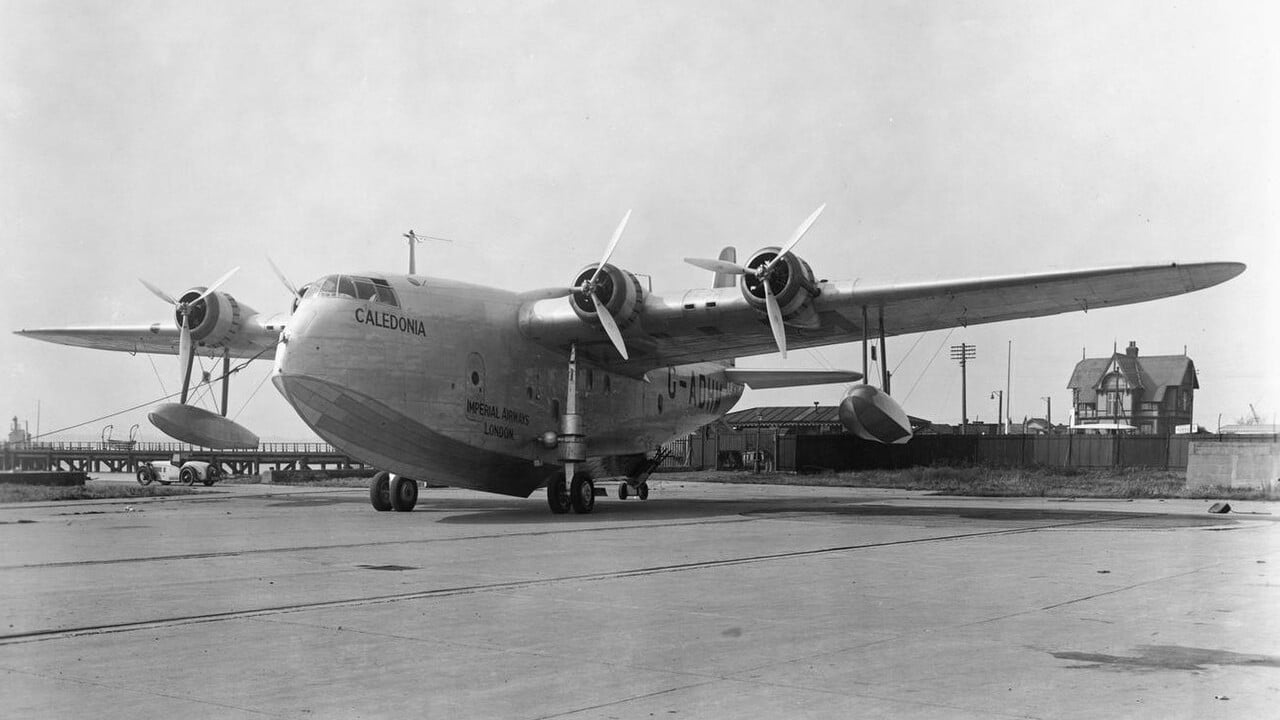
On 3 July 1936, Short Brothers’ chief test pilot John Lankester Parker took a brand-new flying boat out onto the River Medway at Rochester for what was meant to be nothing more than taxi trials. The big silver hull handled so well that Parker simply opened the throttles and took off. He flew over Rochester for 14 minutes, then brought her back down.
The official first flight came the next day, 4 July 1936. The aircraft was G-ADHL, named Canopus, the first Short S.23 “C-class” Empire flying boat. Ninety years ago this week, at the end of October 1936, she was working her way across France and Italy on her first route-proving flight for Imperial Airways, bound for Alexandria.
Within two years, her sisters were carrying passengers and sacks of mail from Southampton to Durban and Sydney, with nine nights in hotels along the way. For a brief moment before the Second World War, the Empire boat was the closest thing aviation had to an ocean liner.
Informazioni rapide
- Aeromobili: Short S.23 “C-class” Empire flying boat
- Primo volo: 4 July 1936, Canopus (G-ADHL), Rochester, pilot John Lankester Parker
- Motori: Four 920 hp Bristol Pegasus Xc radials
- Misurare: Wingspan 114 ft, length 88 ft
- Velocità: Maximum 200 mph, cruise about 165 mph
- Operatori: Imperial Airways, BOAC, Qantas Empire Airways, TEAL; RAF and RAAF in wartime
- Costruito: 42 C-class boats (31 S.23, 9 S.30, 2 S.33)
- Australia to England: About nine to ten days, versus more than 40 days by sea
An order for an aircraft nobody had built
By the mid-1930s Imperial Airways, Britain’s flag carrier, wanted a single aircraft that could carry passengers, mail and freight along the whole Empire route network. Its specification called for 24 passengers in comfort, a cruising speed of 170 mph and a normal range of at least 700 miles. For a network built around harbours, rivers and coastlines, the answer was a flying boat.
Short Brothers wanted to build and test a prototype first. Imperial Airways, desperate to replace its ageing fleet, refused. In 1935 the airline ordered 28 flying boats of a type that existed only on paper, straight off the drawing board. The British press called it one of the boldest experiments in aviation.
The money behind it came from the Empire Air Mail Scheme. Conceived in 1934 by Imperial Airways’ chairman Sir Eric Geddes, it aimed to send all first-class mail within the British Empire by air at a cheap standard rate, with subsidies from Britain, the dominions and the colonies. Geddes preferred flying boats because he believed building airfields across the Empire would cost too much.
Period newsreel footage from AP Archive, dated 26 October 1936, showing the crew being briefed and the Empire mail boat Canopus taking off from Rochester for the Mediterranean.
“Ships that fly”
Arthur Gouge’s design team at Rochester produced a clean, high-wing monoplane with four 920 hp Bristol Pegasus radial engines, a wingspan of 114 feet and a length of 88 feet. It could reach 200 mph and cruised at about 165 mph. Sections of the wing leading edge beside each engine folded down to become working platforms for the mechanics.
To get the propellers high enough above the waves, Shorts made the hull unusually deep, around 17 feet. That gave room for two decks. The flight deck, radio station, mail hold and the office of the ship’s clerk sat upstairs. Below were the passenger cabins, a galley and the mooring compartment with its anchor, drogues and boat hook. Its patented Gouge flaps raised the wing’s lift by 30 percent while adding little drag.
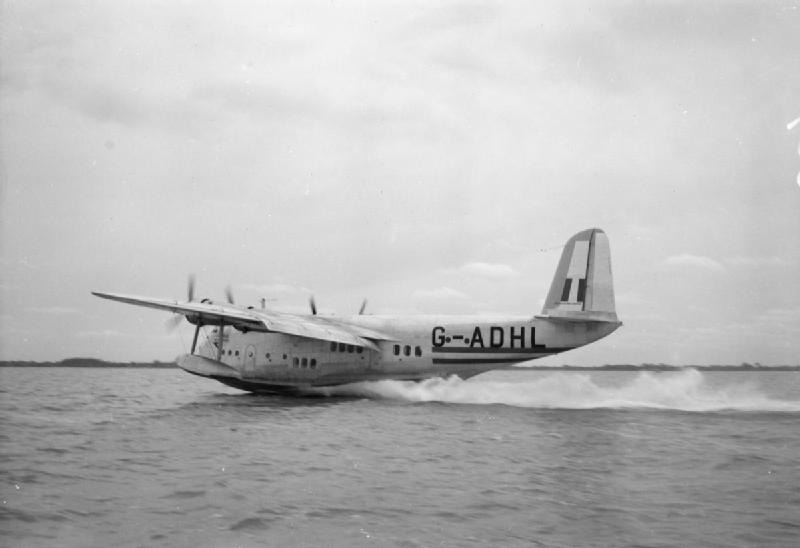
The builders were in no doubt what they had made. Shorts liked to say that its Empire boats were ships rather than aircraft, and the language stuck. Crews were captains and first officers, the cockpit was the bridge, and newsreel announcers routinely called the aircraft “ships”.
Grapefruit, steak and a stroll at 5,000 feet
For passengers, the Empire boat felt more like a small, very fast ship than an airliner. There was a smoking cabin in the bow, a midships cabin, an aft cabin and, the highlight, a promenade cabin where windows set at standing height let passengers stroll and watch the landscape drift past. The boats usually flew no higher than about 5,000 feet, so the view was close and vivid.
Stewards in smart uniforms served food prepared without any proper cooking facilities. Museums of History NSW records a typical breakfast of grapefruit, steak and pineapple juice, and lunches of ham, salad and strawberry ice cream, with generous servings of fresh Hawkesbury oysters. The boats did not fly at night, so passengers slept in hotels such as Raffles in Singapore.
It was a luxury few could afford. A ticket between Australia and England cost about the equivalent of a year’s salary, and there was only one class. In return, a journey of more than 40 days by sea shrank to about nine or ten days.
Qantas and the water airport at Rose Bay
The far end of the route belonged to Qantas Empire Airways, the joint company formed by Qantas and Imperial Airways in 1934. With help from the Australian government it ordered six Empire boats, and in May 1938 it moved its rapidly growing operation from Brisbane to Sydney. The harbourside suburb of Rose Bay became Australia’s first international airport, chosen because it was a large, calm bay close to the city.
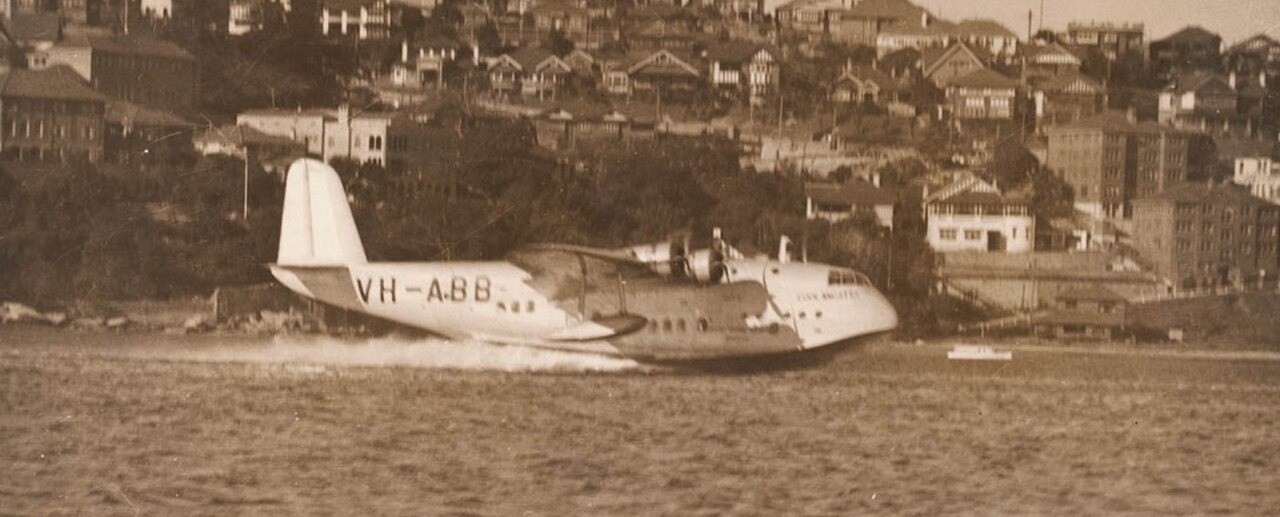
In July 1938 a thrice-weekly flying-boat service between Sydney and Southampton replaced the old landplane connection. Qantas crews flew the Sydney to Singapore sector, with overnight stops on the way, and Imperial Airways crews took the boats onwards to England. Canopus herself joined the pool of aircraft shared by the two airlines on the route.
“Ticket to Sydney from Southampton by Empire Flying Boat, 1938”, shared by the Southampton on Video channel.
Too much mail, too few boats
The scheme’s cheap mail rates worked almost too well. By December 1938 the public was posting far more letters than the Air Ministry had expected, while several Empire boats were out of service after accidents. Most of the type’s accidents happened on landing, often blamed on pilots used to smaller aircraft who found it hard to judge height from the Empire’s lofty cockpit. Imperial Airways had to lease extra landplanes, including Douglas airliners from Swissair, to keep the mail moving.
Shorts and Imperial Airways also pushed the design towards the North Atlantic. On 5 July 1937 Caledonia flew a survey crossing from Foynes in Ireland to Botwood in Newfoundland. The S.23 did not have the range for a commercial transatlantic service, which led to in-flight refuelling trials and to the remarkable Short Mayo Composite, in which a modified Empire boat carried a smaller floatplane on its back.
The Horseshoe Route and the war
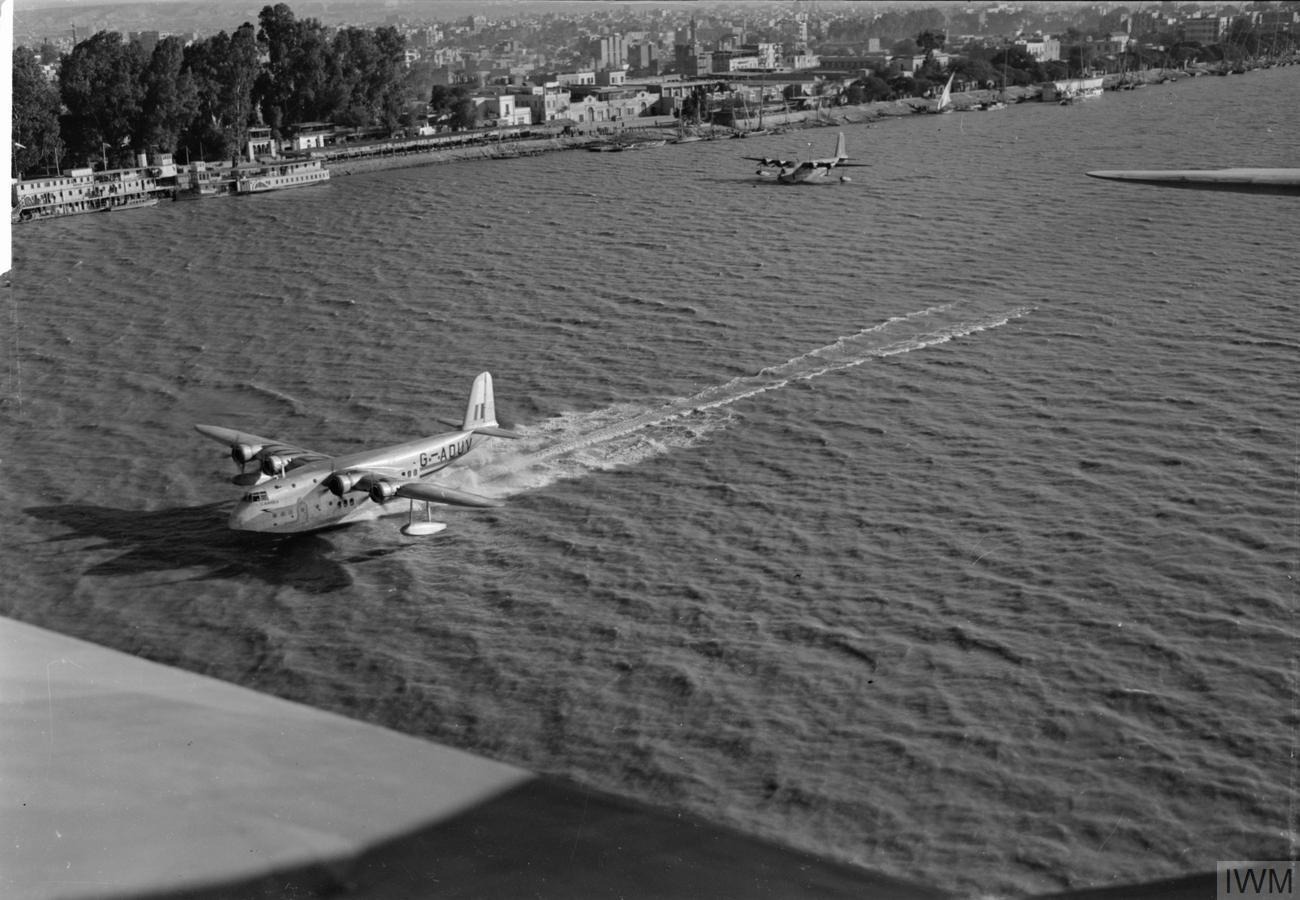
The Second World War ended the age of luxury almost overnight. When Italy entered the war in June 1940, the Mediterranean was closed to British civil flights. Canopus was flying from Singapore towards Karachi at the time and had to turn back. Within weeks, the airlines had improvised the “Horseshoe Route”: Sydney to Durban by flying boat via Singapore, India and Cairo, then onwards to Britain by sea.
The Horseshoe was a vital link between Australia and Britain until Singapore fell in February 1942. The Australian government also impressed Empire boats into service with the Aeronautica militare reale australiana, and in Britain they worked alongside the Short Sunderland, the maritime patrol bomber developed in parallel from the same design ideas. Its story is told in The Flying Porcupine.
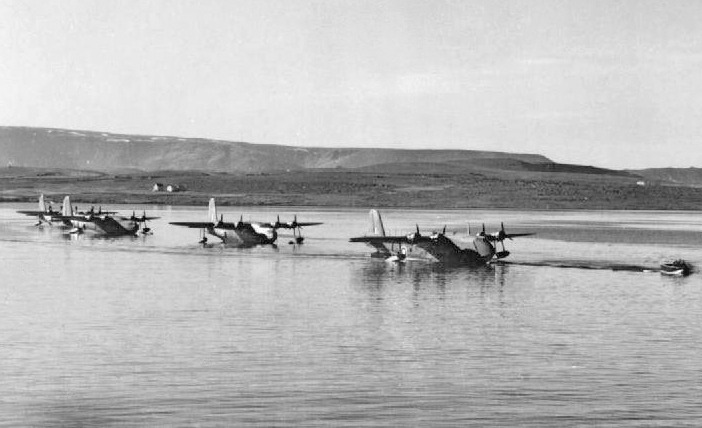
The war was hard on the civilian boats. Accidents and enemy action destroyed about half of the Qantas-operated fleet, and at least two Empire boats were shot down by Japanese aircraft in early 1942. Museums of History NSW notes that by 1944, all the Empires that had seen service there had either crashed or been destroyed by enemy fire.
The end of the line
Canopus survived it all. She ended the war flying between Cairo and Durban for BOAC, Imperial Airways’ successor, and operated her last commercial service in September 1946. After a ferry flight to Poole, she was offered to the town for preservation. The offer was turned down, and she was broken up at Marchwood on Southampton Water in 1947, having flown around 15,200 hours and some two million miles.
Only 42 C-class Empire boats were built, and by the time the war was over, landplanes had moved on. The airstrips and long-range landplanes built for the war made the big flying boat airliner more expensive and less useful, and its era faded quickly.
The Queensland Air Museum talks to historian Paul Sheehan about the design and performance of the Short Empire flying boats.
Yet the Empire boat set the pattern for long-haul flying. Scheduled departures across half the world, a uniformed crew, meals served at your seat, a promenade where you could stretch your legs: much of what we still expect from a long flight started on a silver hull lifting off the Medway in the summer of 1936.
Sources: Museums of History NSW, Wonders of World Engineering, aussieairliners.org (G-ADHL history), Imperial War Museums, State Library of New South Wales, AP Archive, Wikipedia (Short Empire; Empire Air Mail Scheme; Imperial Airways; History of Qantas)
0 Comments