

Climb out of an airfield in a Cessna 172, level off at cruise, and something odd happens. The aircraft keeps trying to do something you did not ask for. Let go of the yoke and the nose wanders. Hold it where you want it and, within a few minutes, your arm starts to ache.
Then you roll a small wheel next to your knee a few turns, and the pressure melts away. The aircraft now flies straight and level on its own, hands off. That wheel drives one of the smallest and cleverest parts of any aircraft: the trim tab. This is how trim works, why pilots use it constantly, and why it deserves respect when it goes wrong.
Informazioni rapide
- Che cos'è: A small hinged surface on a control surface’s trailing edge, set from the cockpit
- Cosa fa: Holds a control surface in position so the pilot needs no constant pressure
- Trim tab: Moves opposite to its elevator: tab up gives nose down
- Anti-servo tab: Moves the same way as a stabilator, adding feel and acting as trim
- Balance tab: Moves automatically opposite to its surface to lighten control forces
- Big jets: Trim by tilting the whole horizontal stabiliser with a jackscrew
- Golden rule: Attitude, power, then trim; retrim after every change
Why an aircraft needs trimming
An aircraft can be designed to fly hands-off at only one narrow combination of speed, power, weight and configuration. Change any of them, by climbing, slowing down, lowering flaps or burning fuel, and the balance of forces on the tail changes. To hold the attitude you want, you have to keep pushing or pulling on the controls.
Trim removes that constant pressure. The FAA’s Pilot’s Handbook of Aeronautical Knowledge describes trim systems as small hinged devices on the trailing edge of a control surface, operated from the cockpit, that aerodynamically help to move and hold that surface in position. In practice, trim sets the position where a control surface wants to rest.
This is why instructors drum in a simple sequence: set the attitude, set the power, then trim. The FAA handbook puts it the same way. Pilots establish power, pitch attitude and configuration first, then trim to relieve the control pressure, and they retrim every time one of those things changes.

The backwards little tab
On most light aircraft, pitch trim is a single tab on the trailing edge of the elevator. Here is the part that surprises people: it moves the opposite way to the result you want.
Wind the trim wheel to nose-down, and the tab moves up into the airflow. The air pushing down on the raised tab forces the trailing edge of the whole elevator down, which lifts the tail and lowers the nose. Wind in nose-up trim and the tab goes down, the airflow pushes the elevator up, the tail drops and the nose rises.
Pilot Institute on how trim works and the most common mistakes pilots make with it.
The trick is leverage. The tab sits far behind the elevator’s hinge line, so a small force on a small surface produces a turning moment big enough to hold the whole elevator in place. The elevator settles where the two moments balance, and the pilot no longer has to hold it there. For the pilot, none of this backwards motion is visible. If you are holding back pressure, you need nose-up trim, and you keep trimming until the pressure is gone.

Stabilators and the anti-servo tab
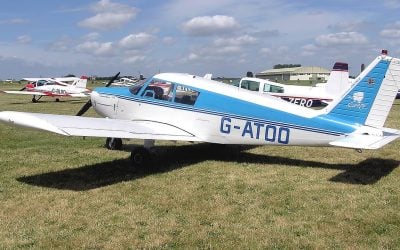
Some aircraft, such as the Piper Cherokee and the Cessna 177, have no separate elevator at all. Instead the entire horizontal tail is one piece that pivots about a central hinge: a stabilator. Pull back and the whole slab’s trailing edge rises. Push forward and it falls.
Because a stabilator pivots near its middle, it is extremely sensitive. The FAA notes it can be too easy to overcontrol. The fix is the anti-servo tab, and it works the other way round from a trim tab. When the stabilator’s trailing edge moves up, the anti-servo tab moves up too, in the same direction. That adds resistance, giving the pilot a heavier, more natural feel. Certification rules require an aircraft to show increasing resistance to increasing control input, and on a stabilator the anti-servo tab is what provides it. The same tab is also connected to the trim system, so it doubles as the trimming device.

There are close cousins, too. A balance tab moves automatically opposite to its control surface to make a heavy control lighter. A servo tab, used mainly on large aircraft, is moved by the pilot and in turn drags the main surface with it. Many small aircraft also carry a simple metal tab on the rudder that is bent by hand on the ground, adjusted by trial and error until the aircraft stops skidding left or right in cruise.
FLY8MA explains how trim works on a Piper with an all-moving stabilator.
Big jets trim the whole tail
On airliners and most jet transports, a tab on the elevator is not enough. Instead, the whole horizontal stabiliser moves. A jackscrew, driven by an electric motor, tilts the stabiliser about its rear spar to change its angle. The FAA notes that the trimming effect and cockpit indications are similar to those of a trim tab.
Trim is not only about the elevator. Many aircraft have rudder or aileron trim, which lets pilots cancel out, for example, the left-turning tendency of many propeller aircraft without holding constant rudder pressure. Proper trim also saves fuel, because a control surface held deflected against its natural position creates extra drag.
When trim runs away
Electric trim is a convenience on many modern aircraft, usually worked by a thumb switch on the control wheel. It brings one rare but serious failure mode: a trim runaway, where the motor keeps driving the trim in one direction without being commanded.
The European Union Aviation Safety Agency warns that, depending on the aircraft type, a pilot can be out of trim in just three seconds, and that the aircraft can become unmanageable in only five. The forces needed to hold the nose against full trim can be large and tiring, at exactly the moment the pilot has to fly, navigate and talk to air traffic control.
The defence is preparation. EASA advises pilots to check that the electric trim moves freely and in the correct sense before flight, to know where the disconnect button and the trim circuit breaker are, and to learn the procedure for every type they fly, because procedures vary between aircraft.
FlightInsight on levelling off from a climb: pitch, then power, then trim.
None of that should make trim sound sinister. Used properly, it is the pilot’s best friend, the reason a light aircraft can be flown smoothly for hours without tiring. A few turns of a small wheel, moving a strip of metal the wrong way, quietly takes the effort out of flying.
Sources: FAA Pilot’s Handbook of Aeronautical Knowledge (FAA-H-8083-25, chapter 6), EASA safety topic Trim Runaway, Wikipedia (Trim tab), Flying Magazine

0 Comments