
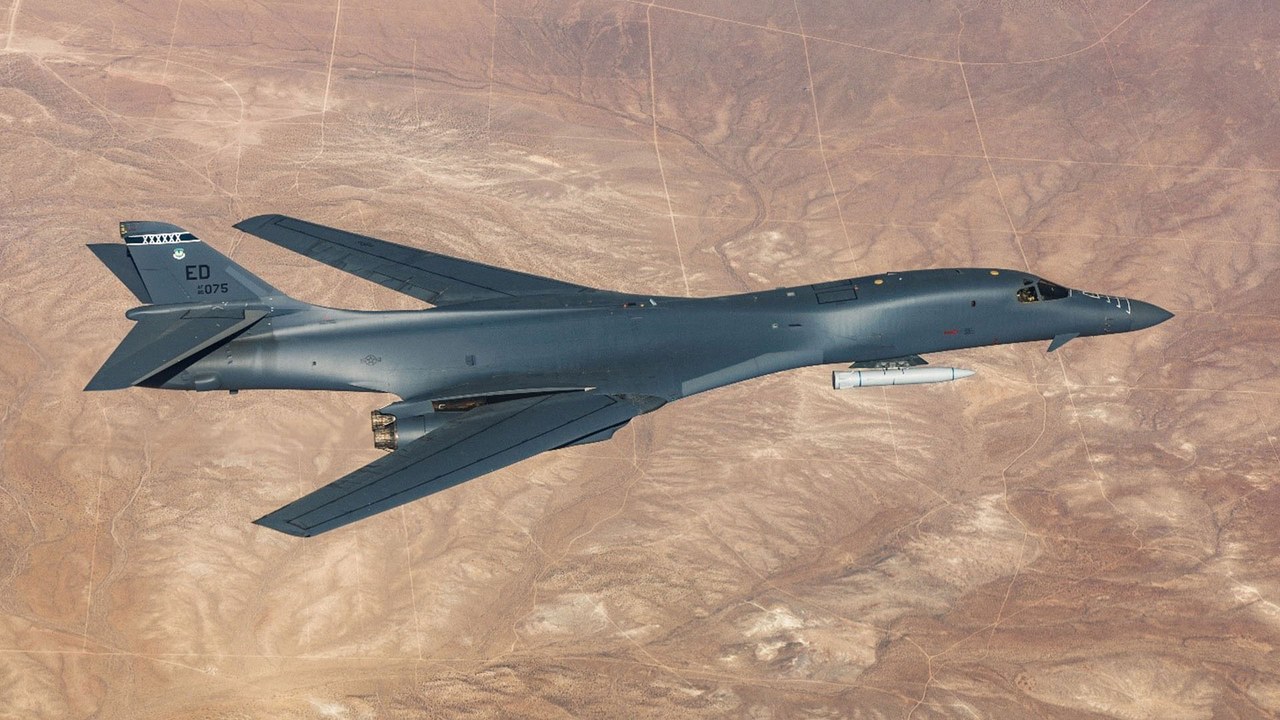
Six hardpoints under the belly of the B-1B Lancer were built for nuclear cruise missiles, then deliberately put out of business by arms control. Boeing now says the pylon that brings them back to life, the B-1B LAM pylon, has passed its most important paper test.
On Tuesday 17 November 2026, Boeing announced that its Load Adaptable Modular pylon, the LAM, has completed critical design review. The company says the milestone confirms the design is mature enough to move into the next phase: preparing hardware and software for manufacturing, integration and test.
It is the next step in a story Afterburner covered in May, when we reported how the B-1B gets 50% more firepower with external pylons. Boeing’s own claim is now bolder: the LAM, it says, could double the bomber’s payload capacity.
Informazioni rapide
- Aeromobili: Rockwell (now Boeing) B-1B Lancer
- Sistema: Load Adaptable Modular (LAM) external pylon
- Pietra miliare: Critical design review completed, announced by Boeing on 17 November 2026
- Mounting: Six existing hardpoints originally intended for the Air-Launched Cruise Missile
- Boeing claim: Could double the B-1’s payload capacity
- Weapons seen in testing: JDAM, GBU-72, JASSM and AGM-183A ARRW (as reported)
- Next step: Preparing hardware and software for manufacturing, integration and test
What critical design review actually means
Critical design review is the checkpoint where a program stops being a drawing and becomes something a factory can build. Boeing describes it as the stage that shows the system design is complete, technically sound and ready to support the work ahead.
The engineering trick is that the B-1B does not need new hardpoints. According to Boeing, the LAM pylon mounts on six existing hardpoints originally intended for the Air-Launched Cruise Missile. Under the New START treaty those hardpoints were modified so that nuclear weapon pylons could no longer be attached, and the bomber has since flown its conventional missions almost entirely from its three internal weapons bays.
By repurposing those mounting points, Boeing says, the pylon lets the bomber carry external payloads again, including future advanced munitions such as hypersonic weapons. That matters because some of the weapons the US Air Force wants on the bomber are simply too big for the bays.
Named after the engineer who drew it
The pylon’s name is a small piece of company folklore. Boeing says the concept came from its Oklahoma City B-1 team, led by engineer Tristin Lam, after whom the pylon is named. The team developed it under Boeing’s independent research and development, so the company owns the intellectual property and started the program before the Air Force had even asked for it.
The hardware has been flying in some form for years. In November 2020, a B-1B of the test community at Edwards Air Force Base flew a captive-carry demonstration with an AGM-158 JASSM cruise missile hung outside the fuselage. On 4 December 2020, a B-1B of the 419th Flight Test Squadron followed up with an external release demonstration of a JASSM from an external pylon.
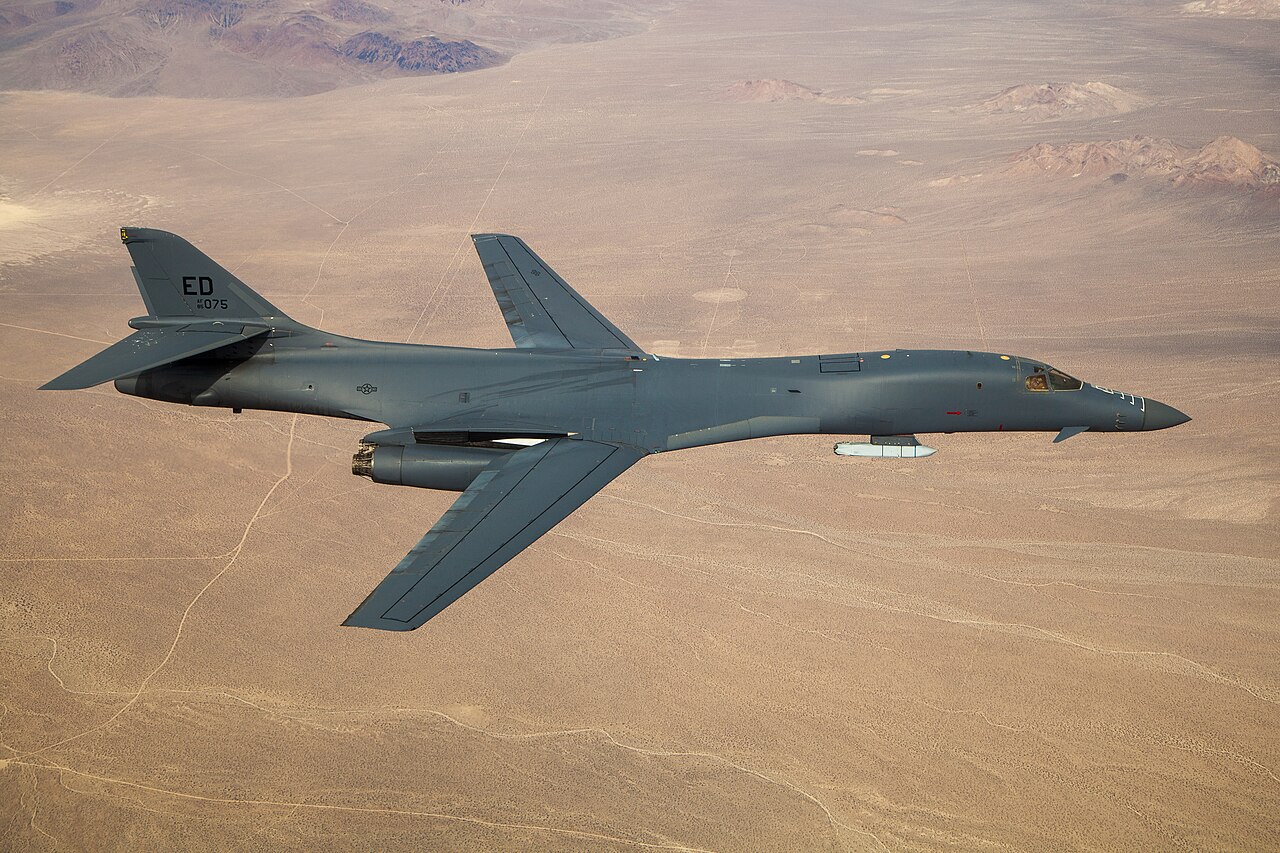
The Aviationist reports that at least three weapons have since been seen on the bomber during LAM testing: the GBU-31 JDAM, the 5,000-pound-class GBU-72 Advanced 5K Penetrator, and the AGM-183A Air-Launched Rapid Response Weapon, or ARRW. Boeing’s announcement came with a new photo of an Edwards-coded B-1B carrying an ARRW under its fuselage.
A hypersonic test bed, and a longer life
The hypersonic angle is the headline capability. The Aviationist notes that Air Force budget documents describe plans to use the B-1B with LAM pylons as a test bed for hypersonic weapons. In October 2026, the Air Force awarded Lockheed Martin a $694 million contract to begin production of the ARRW, a story Afterburner covered at the time.
All of this is about squeezing more out of a fleet that was once due to go much sooner. The Air Force had planned to retire the B-1B around 2030, but The Aviationist reports the service now wants to keep it flying to at least 2037, while the B-21 Raider enters service.
Critical design review is not a delivery date. Neither Boeing nor the Air Force has said when the first production pylons will reach operational squadrons, and the next phase is build and test. But for a bomber that first flew in the 1980s, the message is clear: the BONE is being prepared to carry more, and heavier, weapons than it has carried in decades.
US Air Force footage of the November 2020 B-1B external captive-carry demonstration at Edwards, an early step towards the external carriage the LAM pylon now formalises.
The six hardpoints under the Lancer’s belly sat idle for years. Boeing’s engineers in Oklahoma City have now proved, on paper at least, that they can carry weapons again.
Sources: Boeing (B-1 external carriage design completes critical design review, 17 November 2026), Boeing Defense on X, The Aviationist, US Air Force / 412th Test Wing imagery, Wikipedia (Rockwell B-1 Lancer)
Header photo: Boeing



0 Comments