
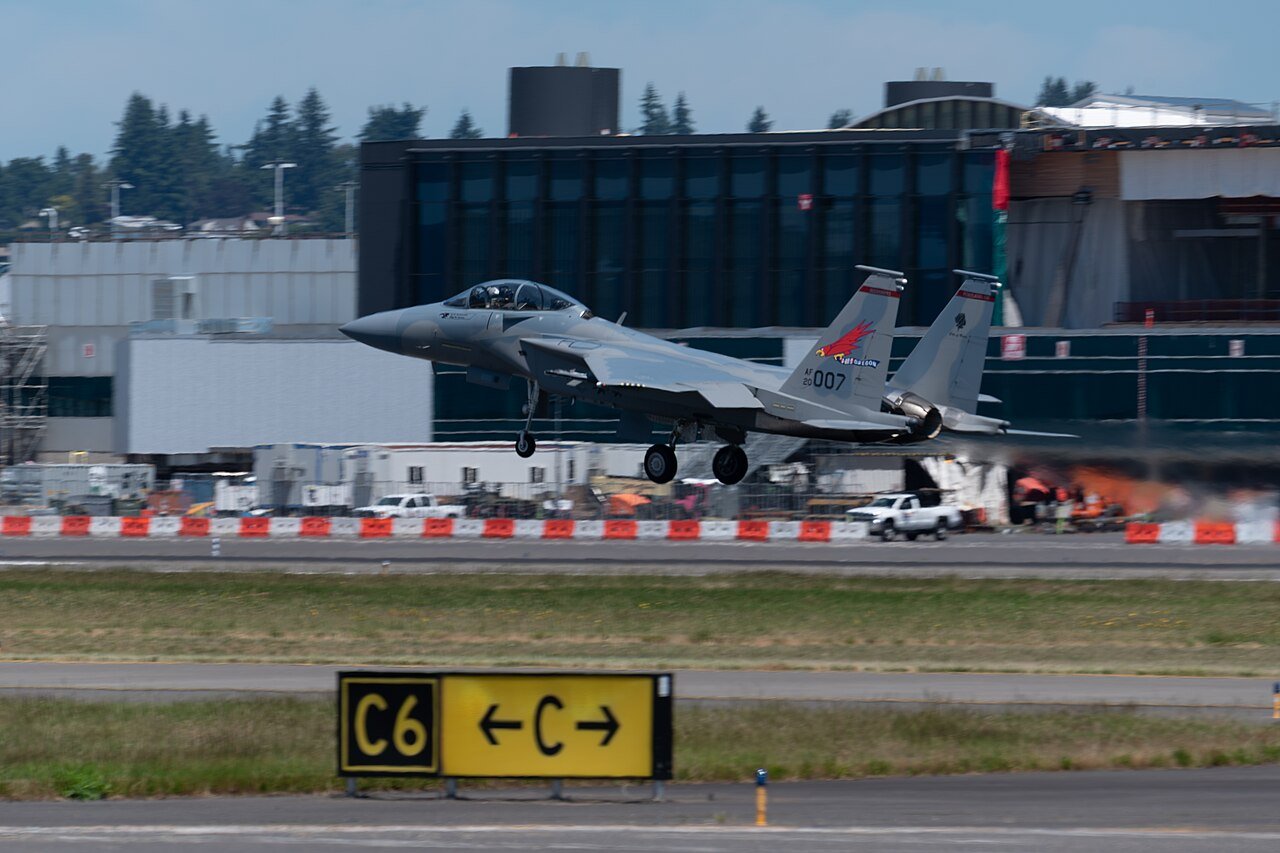
For years, the US Air Force insisted its newest Eagles did not need the extra padding. The F-15EX was an air-to-air replacement for the F-15C/D, the argument went, and air-to-air Eagles fly with drop tanks. Conformal fuel tanks were for the bomb trucks.
Now two Oregon jets are wearing them anyway. Operational F-15EX Eagle IIs of the Oregon Air National Guard's 142nd Wing have started flying with conformal fuel tanks, or CFTs, TWZ reported on 6 November 2026, and the wing has confirmed it to the outlet.
Informazioni rapide
- Aeromobili: Boeing F-15EX Eagle II
- Unità: 142nd Wing, Oregon Air National Guard, Portland
- Jets with CFTs: Two, including serial 20-0012
- Tanks from: Air Combat Command; one CFT carries 366th Fighter Wing insignia
- Flying since: About two weeks before 6 November 2026, per the Oregon ANG
- Fuel per CFT: About 750 US gallons, per TWZ
- Extra pylons: Six per CFT, per TWZ
- F-15EX fleet: 22 delivered as of September 2026, out of 267 planned
- First reported: TWZ, 6 November 2026
Borrowed Tanks, Approved Configuration
The F-15EX conformal fuel tanks were first spotted by photographer Bill Shemley, who caught the jets operating at Portland International Airport. The airfield is shared with Portland Air National Guard Base, home of the 142nd. One of the jets is serial number 20-0012, from the first batch of production Eagle IIs that began arriving in Oregon in 2024.
The wing did not deny it. Quite the opposite: it told TWZ exactly where the tanks came from and how long they had been flying.
That puts the first flights in the second half of October, although the wing has not given an exact date. Afterburner could not find any official imagery of the configuration, which leaves Shemley's photograph as the main public evidence so far.
There is a nice detail in it. The tank visible in the photo carries the insignia of the 366th Fighter Wing, the F-15E Strike Eagle outfit at Mountain Home Air Force Base, Idaho. The 142nd has spent the past year or so sending jets, pilots and maintainers to Mountain Home for air-to-ground training, so the hand-me-down hardware has an obvious family tree.
The Tanks the Air Force Said It Didn't Need
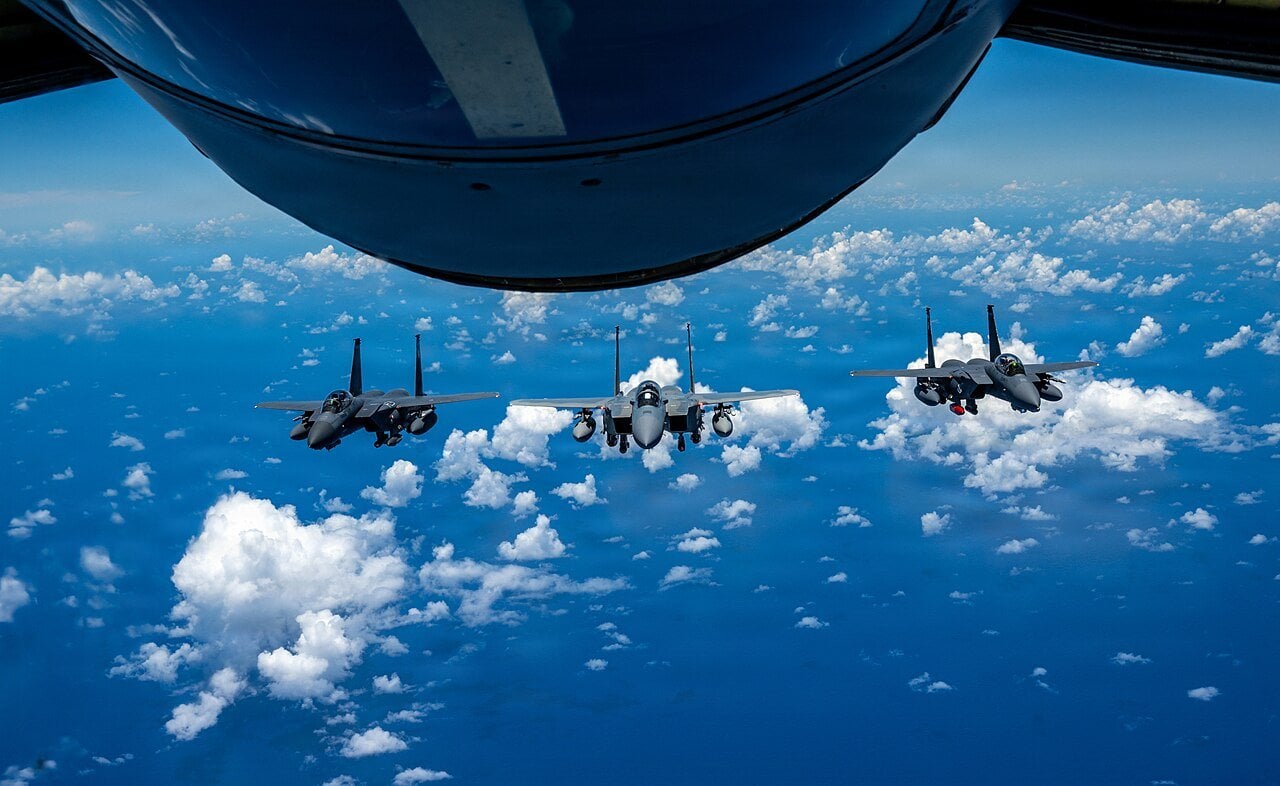
The F-15EX was built to take the same CFTs that are standard on the F-15E and on the F-15QA for Qatar, the jet it was directly derived from. Test Eagle IIs have flown with surplus CFTs for years. But when the first operational jets were funded, the US Air Force left the tanks off the shopping list.
In 2023 a service spokesperson explained the logic to TWZ: the jets funded from FY20 to FY23 were a direct replacement for the F-15C/D in the air-to-air and homeland defence role, the F-15C/D does not typically fly with CFTs, and the first operational F-15EXs therefore had none funded. The Eagle IIs would hang drop tanks under the wings instead, like the Eagles they replaced.
That was always a slightly awkward position. F-15C/Ds did fly with CFTs, then called FAST Packs, late in the Cold War, mainly from bases in Alaska and Iceland where long patrols and quick-reaction alert were the job. And the Air Force's Fiscal Year 2027 budget request, released earlier this year, explicitly asked for CFT funding for all 24 Eagle IIs in production Lot 8.
The National Guard's own film on flying the F-15EX Eagle II, the jet the 142nd Wing now operates. It predates the CFT configuration.
What 750 Gallons Buys You
The numbers explain the change of heart. Each CFT holds some 750 gallons of fuel and adds six pylons, according to TWZ. A 600-gallon underwing drop tank holds 150 gallons less, occupies a hardpoint that could carry a weapon, and creates far more drag.
There is no free lunch, of course. CFTs affect speed and manoeuvrability, and unlike drop tanks they cannot be jettisoned when a fight starts. Former F-15C/D pilots have told TWZ how much they valued punching off their wing tanks to clean up the jet for air combat.
But the Eagle II's world has changed. In July the Oregon Guard dropped training bombs from an F-15EX for the first time at Mountain Home, and in September one of its jets released a live bomb during training out of Nellis, as Afterburner reported. Bombs, range and payload are exactly where conformal tanks earn their keep, and the Pacific, with its long distances and scarce tankers, is where the Air Force wants that reach.
From Eagle Replacement to Strike Eagle Successor
The bigger picture makes the tanks look inevitable. As of September the Air Force had received 22 F-15EXs, test jets included, out of a planned fleet that has roughly doubled from 129 to 267. The service has said the larger buy is meant to help begin recapitalising the ageing F-15E fleet, and it has been retiring its older F100-PW-220-powered Strike Eagles, roughly half of the F-15Es in the inventory.
Replace Strike Eagles with Eagle IIs and you inherit the Strike Eagle's missions, conformal tanks included. TWZ notes it is still unclear how the Air Force plans to fit CFTs across the whole operational fleet, including the Eagle IIs bound for Kadena in Japan.
For now, two Oregon Eagles are flying the configuration the Air Force once said they would not need, on tanks borrowed from Idaho. It is not a programme decision yet. It is, however, a very large hint.
Sources: TWZ (including statement from Oregon Air National Guard public affairs), U.S. Air Force and Air National Guard imagery via Wikimedia Commons, Afterburner archive



0 Comments