
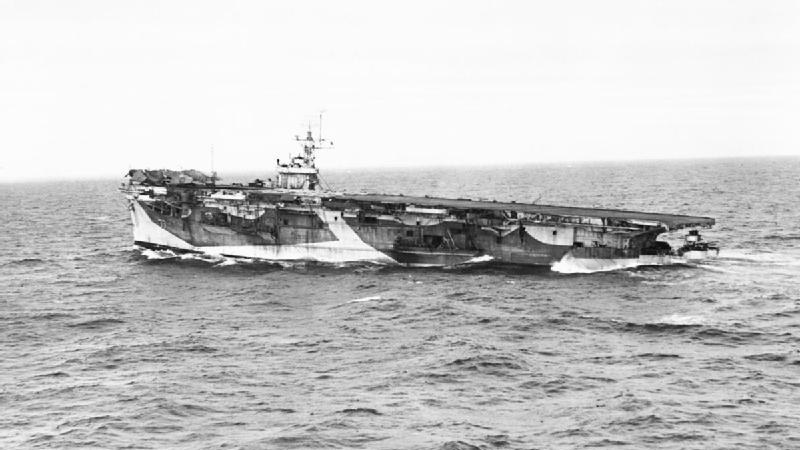
HMS Nabob was a Royal Navy escort carrier with a Royal Canadian Navy crew, and on 22 August 1944 a German torpedo opened her starboard side below the waterline, dropped her stern fifteen feet, killed twenty-one of her men and left her dead in the water in the Barents Sea. The Commander-in-Chief Home Fleet signalled that if she could not raise steam she was to be sunk. She raised steam. Five days and something over a thousand miles later she limped into Scapa Flow under her own power — and on the way, in the small hours of the first night, she flew two Avengers off her sloping deck and got them both back aboard.
Quick Facts: HMS Nabob
- Nave: HMS Nabob (D77), Ruler-class escort carrier
- Costruito: Seattle-Tacoma, laid down 20 October 1942 as the freighter USS Edisto
- Converted: Burrard Dry Dock, Vancouver — 150 modifications in 51 days
- Commissioned: Royal Navy, Tacoma, 7 September 1943
- Equipaggio: 504 Royal Canadian Navy, 327 Royal Navy, 9 Royal New Zealand Navy
- Capitano: Captain Horatio Nelson Lay, OBE, RCN, from 15 October 1943
- Air group: 852 Naval Air Squadron — Grumman Avengers and Wildcats
- Torpedoed: 22 August 1944, about 17:15, by U-354 off North Cape
- Dead: 21 — 11 Royal Canadian Navy, 10 Royal Navy
- Voyage home: 1,070 to 1,100 miles to Scapa Flow under her own power, arriving 27 August
- Destino: Paid off 30 September 1944, constructive total loss; rebuilt 1951–52 as a cargo liner; scrapped 1977–78
Why a Royal Navy ship had a Canadian crew
The arrangement that produced Nabob was a piece of wartime accounting. Canada wanted escort carriers and could not buy them: she was not a party to Lend-Lease, and the United States would not sell to her directly. Britain was a party. So Britain bought the ships and Canada manned them.
She had been laid down at Seattle-Tacoma on 20 October 1942 as a C3-S-A1 freighter, taken over by the US Navy as USS Edisto, and commissioned into the Royal Navy at Tacoma on 7 September 1943. The conversion into a carrier was done not in the United States but at Burrard Dry Dock in Vancouver — 150 separate modifications, fifty-one days in hand, 130 tons of pig-iron ballast. Two of those modifications, changes to the aviation-fuel stowage and extra buoyancy drums to limit list after a torpedo hit, would matter enormously eleven months later.
The crew was 504 Royal Canadian Navy, 327 Royal Navy and nine Royal New Zealand Navy, with British Merchant Navy men in the engine room. The Canadians ran the ship. The British provided the aircrew and the aircraft maintainers, because the RCN had no naval air arm of its own to provide them. Her captain was Horatio Nelson Lay, OBE, RCN, in command from 15 October 1943, a nephew of the Canadian prime minister.
She was never HMCS Nabob. Lay asked for the name change and was refused; she remained an HM Ship for her whole commission, which is one reason a story this remarkable is so little known in the country that crewed her.
The near-mutiny over pay
Three sets of men on one ship meant three rates of pay and three victualling scales. The Canadians drew Canadian pay and marriage allowance but ate and were allowanced at Royal Navy rates. In March 1944, after Panama, it boiled over. The Royal Navy Research Archive’s history of the ship records “a mass protest or ‘near mutiny’” — first a brief lock-in, a refusal to work, and then, on reaching Norfolk, “a large number of desertions”.
Lay did not reach for the disciplinary code. He flew from Norfolk to Ottawa, put the seriousness of it to the Naval Board in person, and proposed that every man aboard, British and Canadian alike, be borne on Canadian books for pay and fed at Canadian scale. Legion Magazine records his recommendation that pay and food “be raised to Canadian standards, ‘if necessary this being a commitment of the Canadian navy’”. It was approved. He flew back to Norfolk and rejoined his ship.
An account of HMS Nabob and her refusal to sink.
Mines off Norway: Operation Offspring
Nabob joined the Home Fleet at Scapa Flow on 1 August 1944. Her whole war as a fighting ship lasted twenty-one days.
Her air group was 852 Naval Air Squadron — twelve Grumman Avengers, formed at Squantum, Massachusetts in November 1943, with a flight of four Wildcats added in June 1944 — under Lieutenant-Commander R.E. Bradshaw, DSC, RN.
Operation Offspring, begun on 9 August, sent her and the escort carrier HMS Trumpeter to lay aerial mines in the Norwegian leads. The Royal Navy Research Archive records the result plainly: “47 aerial mines were successfully laid by the Avenger crews of 846 and 852 squadrons: 29 were laid in Harhamsfiord and 17 in Lepsorev.”
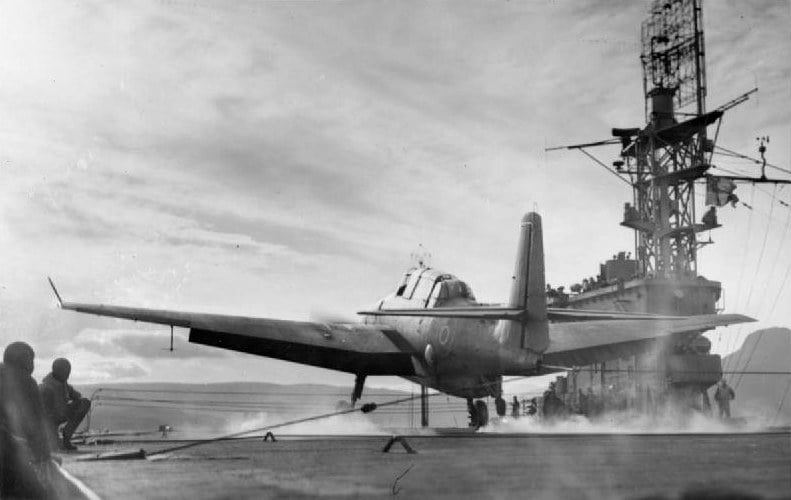
Two things about that sentence are worth pausing on. The first is that the squadrons were 852, from Nabob, E 846, from Trumpeter. A widely mirrored account gives 842 Squadron instead; the archive’s own order of battle for the operation lists “NABOB (852 Avenger), TRUMPETER (846 Avenger)”, and Trumpeter’s separate history names 846 as her embarked squadron. The second is that 29 and 17 make 46, not 47 — the source’s own totals do not quite reconcile, so “some 47” is as precise as anyone can honestly be.
22 August 1944
The next operation was Goodwood, the Home Fleet’s renewed attempt on the battleship Tirpitz in Kaafjord. Nabob E Trumpeter were not in the strike force. They formed Force Two with the cruiser Kent and the 5th Escort Group, tasked with anti-submarine cover and minelaying.
The plan for the Avengers was unusual and rather clever. Rear-Admiral McGrigor intended each aircraft to place two 1,000-lb aerial mines near Tirpitz herself and at the mouth of Kaafjord, the ones by the ship fitted with time-delay fuses, in the hope of frightening her captain into moving her out over the others. Careful routeing would give each crew about fifteen seconds over the target.
British Pathé newsreel of the 1944 carrier attacks on the Tirpitz, the operation Nabob was supporting.
It never happened. The Avengers began launching at about 09:00 on the 22nd, were held in a holding pattern, and were recalled and landed on when low cloud closed the target. Nabob’s actual contribution to Goodwood that day was four Wildcats flown off at 12:25 for combat air patrol. At 15:30 Force Two was detached westward, and she was ordered to fuel three destroyers from 18:00, about 120 miles west-north-west of North Cape.
She was preparing to do it — flight deck being cleared, fuelling hose being laid out, the rum issue being dispensed — when at about 17:15 the torpedo hit.
Fifteen feet down by the stern
The boat was U-354, under Oberleutnant zur See Hans-Jürgen Sthamer. Eight minutes later a second torpedo hit the frigate HMS Bickerton, which lost her propeller shafts and thirty-eight men and was scuttled that night by torpedoes from HMS Vigilant. A third torpedo missed both.
The hole in Nabob is one of those facts that has been quietly corrupted by repetition. The original wording, “a hole about 32 feet square”, means thirty-two feet on a side; somewhere along the line it became “32 square feet”, which would be a gap under six feet across — nowhere near enough to do what was done to her. The honest position is that accounts cluster in two groups: about thirty-two feet across, which is roughly ten metres, and forty to fifty feet, which is twelve to fifteen. The Royal Canadian Navy’s own history gives ten metres by fifteen.
What followed is not in dispute. From the archive’s account: “She began to take on water at an alarming rate; within minutes NABOB was listing to Starboard and was 15 feet down by the stern. All electrical power had been lost and NABOB was dead in the water.” Temperature in the engine spaces climbed as the fans stopped. The galley, the messdecks and the provision rooms were gone. Two hundred thousand gallons of aviation spirit sat in her forward tanks.
Lay gave the order to prepare to abandon ship, and boats and Carley floats were lowered. That order very nearly killed the ship a second time: in the confusion the boats were never made fast, and they drifted astern. When Lay changed his mind, Nabob had no boats left. Individual lifejackets, and seventy-five dinghies stripped out of her aircraft and lashed on deck, were the whole of her life-saving equipment for the next five days.
At 17:34 the Commander-in-Chief in Duke of York signalled that Bickerton E Nabob were both to be sunk if they could not get under way.
“A ruddy good try”
By 18:00 the flooding was under control and diesel generators had restored some electrical power. Counter-flooding brought a seven-degree list down under two degrees by 02:30, at the cost of a draught of fifteen feet forward and forty-one and a half aft against a normal twenty-three and twenty-five. Steam was raised from 20:00, the engines restarted at 21:00, and by 21:39 she was making slow ahead at ten revolutions.
Two hundred and ten men were taken off by the frigate Kempthorne, most of them squadron personnel, on the assumption that Nabob would never fly again. The next day the Canadian destroyer HMCS Algonquin took off about another two hundred. Hot meals were cooked for those who stayed in the officers’ galley, from emergency stocks scattered round the ship, because the main galley no longer existed.
Two Avengers off a sloping deck
The U-boat was still out there, and a carrier crawling at three knots is not a difficult target. So at 02:30 on 23 August, with the after lift jammed in the up position and the deck tilted, Nabob flew off aircraft.
Lieutenant-Commander Bradshaw went first in Avenger FN875, and Sub-Lieutenant D.G. Jupp, RNVR, followed him. Both carried depth charges. They flew a four-hour patrol and found nothing — the archive is careful to say they “did not detect the U-Boat” — but the ship altered course west under their cover, and the submarine never got back into a firing position.
Getting back aboard was worse than getting off. Visibility closed in. Jupp landed safely. Bradshaw missed the wires, took the barrier, and came down into the deck park on top of another Avenger. His guns fired on impact and his depth charges broke loose and rolled down the tilting deck; they were stopped before they went over the side. Two Avengers were jettisoned as beyond repair and two more aircraft and both Wildcats were damaged.
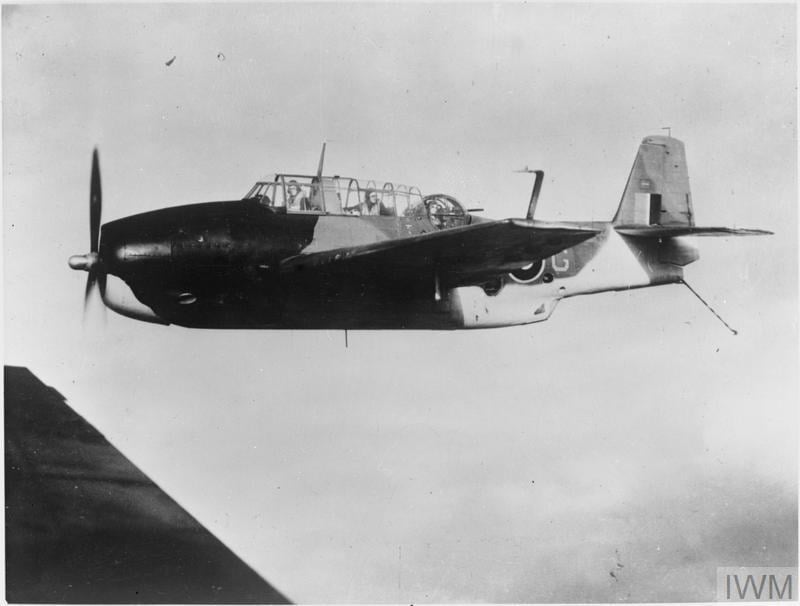
The archive’s own historian appends a question nobody has answered: Trumpeter was in company throughout, undamaged, with nine Avengers and four Wildcats of her own. Why did the crippled carrier fly the patrol?
The Grumman Avenger, the aircraft flown off Nabob’s sloping deck, at the Fleet Air Arm Museum.
Eleven hundred miles
She made three knots at first, then five, then rather more, in weather that included a thirty-three-knot gale on the port bow. Her escort was Trumpeter, Algonquin, Kempthorne E Keats, relieved off the Faroes by four destroyers out of Scapa. The men who stayed aboard spent five sleepless days on potatoes and bully beef, improved by the recovery of a ten-gallon keg of rum.
She secured at Scapa Flow at 08:00 on 27 August, having steamed, by the archive’s reckoning, 1,100 miles under her own power. The Imperial War Museum’s wartime caption on the photograph of her coming home says 1,070. Either way, she had crossed the Norwegian and Northern seas with a hole in her big enough to drive a bus through.
Her Avengers flew off to Hatston, her crew was cut to 270 ratings and 30 officers, and on 9 September she went down to Rosyth under tow escort. On 28 September she was flooded forward to trim her and docked, and when the dock was pumped out the bodies were brought up out of the flooded compartments. The dockyard workers refused the job. Lay’s own account of it, quoted from his memoir, is one sentence long: his men “each had a stiff noggin of whisky or rum and handed the bodies up, deck by deck.”
Twenty-one men, and a year of silence
Twenty-one died: eleven Royal Canadian Navy and ten Royal Navy. Forty were injured, though one scholarly account puts the injured far lower, at six, which may be counting only the serious cases.
Then the Admiralty closed the file. The ship’s log records the order verbatim: “Admiralty does not intend to make any announcement regarding damage to ship. No explanation can therefore be given to next-of-kin to account for the delay in burial service. Next-of-kin who enquire should be requested to communicate direct with Admiralty.”
Families were told nothing. The official news release describing the action was not made public for a year. That censorship, applied to a ship crewed by Canadians but flying the White Ensign as an HM Ship, is the best single explanation of why Nabob is not a famous name in Canada.
She was paid off on 30 September 1944, never repaired, and declared a constructive total loss. Her main gearing was pulled out and fitted into HMS Puncher, the other Canadian-manned escort carrier.
The ship that refused to die twice
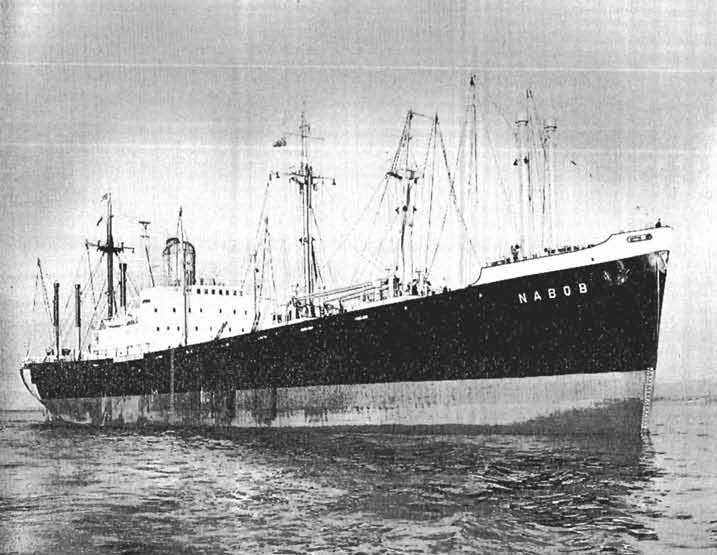
Here the story becomes genuinely strange. Nabob was sold for scrap in 1946 and went to a Netherlands breaker in 1947 — and the breakers, having cut off her flight deck, looked at a four-year-old hull and decided it was worth saving. In 1951 she was sold on to Norddeutscher Lloyd in Bremen, rebuilt at AG Weser between October 1951 and June 1952, and emerged as the cargo liner Nabob, 7,900 tons, carrying cadets and eight passengers on the North America run.
In August 1964, twenty years to the month after the torpedo, her German owners hosted forty of her former Canadian officers and men at a reception aboard her in Vancouver. Her wartime navigator, Glen McDonald — by then Vancouver’s city coroner — recognised her from the dockside: “I thought she was made into razor blades long ago. But that’s her, all right. There’s the dent in her bows where we hit the gate vessel in the Firth of Forth.”
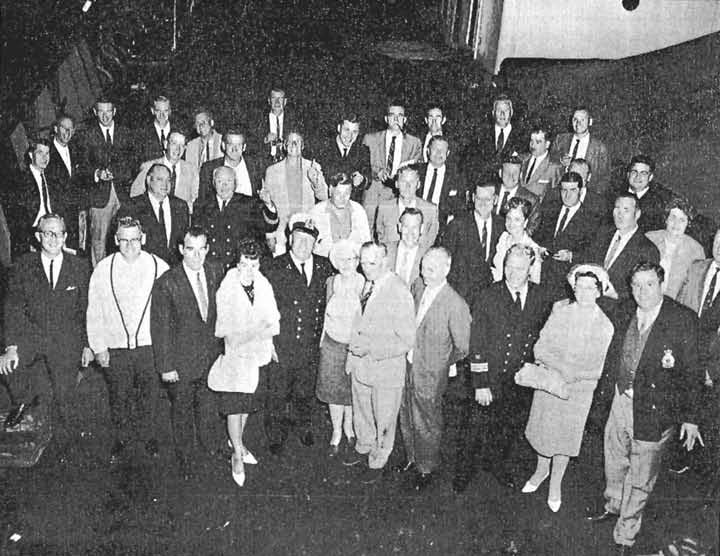
Berthed a hundred yards away that same day was her sister, the former HMS Begum, converted at the same Vancouver yard, by then the Dutch Raiki. And the master of Nabob herself, Captain Karl Kuhlig, had spent August 1944 in the German catapult ship Friesenland, about fifty miles from where his present command was torpedoed.
She was sold to Panamanian owners in 1967, renamed Glory, and sold for breaking on 6 December 1977, going to the scrapyards in Taiwan thirty-three years after the Royal Navy wrote her off as a total loss.
What is still unsettled
Two things about Nabob resist tidying, and it is better to say so than to pick the neater version.
The first is the battle honour. A peer-reviewed article in Canadian Military History states that she received “Tirpitz” as a battle honour for Goodwood. The Royal Navy Research Archive’s data block for the ship says, flatly, “Battle Honours: None.” Both cannot be right and we have not been able to settle it.
The second is the revenge story. U-354 was sunk two days later, on 24 August 1944, in the Barents Sea north-east of North Cape, by depth charges from the sloop HMS Mermaid and the frigate HMS Loch Dunvegan, with all fifty-one hands. She was not, as was long believed and is still often repeated, destroyed on 22 August by a Swordfish from HMS Vindex — that attack is now attributed to U-344, a different boat, a correction made in 2011. And we found no evidence at all that the hunt that killed her was mounted in reprisal for Nabob. The escorts that sank her were convoy escorts doing their ordinary work.
Fonti: Royal Navy Research Archive, “A History of H.M.S. NABOB” and its companion history of HMS Trumpeter; Shawn Cafferky, “Battle Honours Won: HMS Nabob, 1944”, Canadian Military History 19, no. 3 (2010); Legion Magazine, “The near-sinking of HMS Nabob”; Canadian War Museum; Department of National Defence, The Maple Leaf; uboat.net; naval-history.net; Gordon Angus Mackinlay, Naval Historical Review, Naval Historical Society of Australia, September 2005; T.W. Paterson, Cowichan Valley Citizen, 9 November 2016; For Posterity’s Sake. Figures that differ between sources are flagged in the text.
0 Comments