
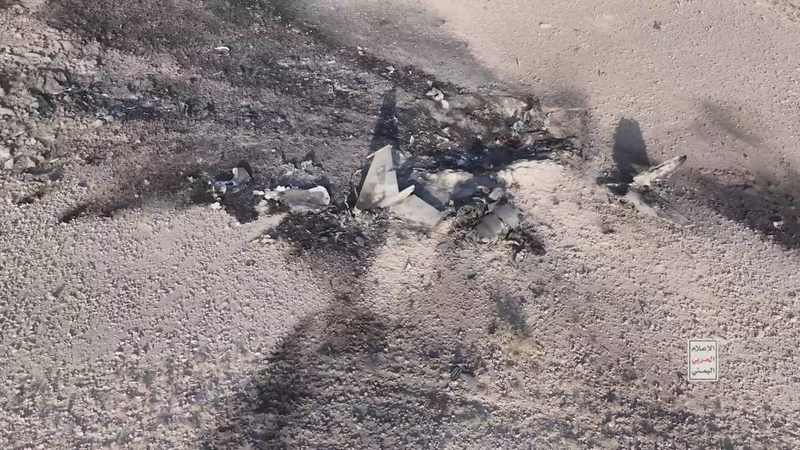
The first thing the world saw was a tailfin. Scorched, standing upright in a burnt patch of Marib scrub, with the green and white of the Saudi flag still legible through the soot.
On 16 September 2026, Yemen’s Houthi movement — formally Ansar Allah — said it had shot down a Royal Saudi Air Force F-15 over Marib governorate. Houthi military spokesman Brig. Gen. Yahya Saree, speaking on the group’s al-Masirah television network, said the fighter was brought down by a locally manufactured surface-to-air missile. He did not name the system, and he did not say when the engagement happened.
Then came the pictures: an aerial pass over a debris field, close-ups of a fin with a Saudi roundel, armed men standing on what used to be a wing. Riyadh has said nothing. That silence is doing a lot of work.
Informazioni rapide
What is claimed: A Royal Saudi Air Force F-15 shot down over Marib governorate, Yemen
Who claims it: Ansar Allah (the Houthis), via military spokesman Brig. Gen. Yahya Saree
Date of the claim: 16 September 2026
Weapon claimed: A locally manufactured surface-to-air missile, type not specified
Equipaggio: The F-15S/SA family is two-seat; the fate of the two crew is not established
Saudi response: No acknowledgement from the Saudi Ministry of Defense or the coalition at the time of writing
Independently verified: No. Wreckage imagery exists; the cause does not
What the Houthis say happened
Saree’s account has two halves. The first is the shootdown itself: a Saudi F-15 working over Marib in support of Saudi-backed Yemeni government forces, engaged and destroyed by a missile the Houthis say they built themselves.
The second half is the bit that would sting more, if true. Saree said Houthi air defences then fired on two formations of Saudi F-15s and Eurofighter Typhoon that came into Marib airspace looking for the downed jet, and that those formations turned around. He also claimed Saudi aircraft had flown more than 450 strikes across several Yemeni provinces. None of that has been independently confirmed.
Footage released by the group shows the sort of ground-based forward-looking infrared imagery that Yemeni air defences have put out before — a grainy thermal picture, a target, a flash.
What the imagery establishes is narrow but real: a Saudi F-15 was destroyed on Yemeni soil. What it does not establish is how. A missile, a mechanical failure, a bad night in bad terrain — the wreckage looks the same from a drone camera.

Which Eagle was it?
TWZ, which examined the imagery closely, identifies the aircraft as tail number 5539 of the 55th Squadron at King Khalid Air Base, and assesses it as an F-15SR — one of the 68 older F-15S airframes rebuilt in Saudi Arabia to something close to the standard of the 84 new-build F-15SA jets the kingdom bought outright. That identification is TWZ’s, not an official one, and Riyadh has not confirmed it.
Either way it is a two-seat aeroplane, which is why the crew question is a crew question and not a pilot question. Saudi Arabia operates more than 200 F-15s in total, a fleet the US State Department cleared for a roughly $3 billion sustainment package in February 2026.

The air defences nobody can find
The Houthi air-defence network is not an integrated system in any textbook sense. It is a scrapyard with good ideas: mobile launchers, air-to-air missiles cut down for surface launch — infrared R-73s and radar-guided R-27s — and Iranian-derived weapons such as the Saqr/358 loitering interceptor.
The dangerous part is not the missiles. It is the sensors. Much of the Houthi kill chain runs on passive infrared detection rather than fire-control radar, and a passive sensor does not announce itself. A pilot’s radar warning receiver stays quiet because there is nothing to receive. The first indication that you have been tracked can be the missile.
That combination — mobility, concealment, passive cueing and mountainous terrain — has been enough to bring down MQ-9 Reapers repeatedly, and US officials confirmed one such loss off the Yemeni coast in November 2023. Across the 2015–22 war, Saudi losses to all causes ran to roughly a dozen helicopters, five jets and as many as thirty drones. In 2018 Houthi missiles engaged and damaged Saudi Eagles that nonetheless got home.
There is precedent for the claims being right, too. On 15 February 2020 the coalition confirmed through the Saudi Press Agency that an RSAF Tornado had come down in al-Jawf governorate — a day after the Houthis said they had shot it down. The coalition statement gave no cause.
A war that restarted while nobody was looking
The 2022 truce held, more or less, for three years. It is not holding now. Houthi forces have pushed hard against Saudi-backed positions, including around Marib and Taiz, stepped up missile and drone attacks on southern Saudi Arabia, and declared the Bab el-Mandeb closed to Saudi oil traffic.
Into that came a separate row over Mecca. Coalition spokesman Maj. Gen. Turki al-Malki said through the Saudi Press Agency that Saudi air defences intercepted and destroyed a Houthi drone at 18:50 local time on 15 September, south of the city and before it entered restricted airspace. The Houthis flatly deny targeting the holy sites, saying their operations are aimed at Saudi oil facilities and military bases.
The Houthi outlet al-Masirah has since carried statements from the group’s spokesman Mohammed Abdulsalam about captured aircrew. They are claims from one side of a war, made at a moment when that side has every reason to make them, and they should be read that way.
Meanwhile Reuters reports that US officials met Houthi representatives in Oman over the weekend, where the group is said to have restated that it has no intention of attacking American vessels and will hold to its 2025 ceasefire with Washington — unless the United States steps in on Saudi Arabia’s behalf. The Guardian reports that Riyadh asked for exactly that, and was turned down.
For context on what a Saudi F-15 normally does in this airspace, this 2021 footage shows one coming down to the deck to knock a Houthi Qasef-series attack drone out of the sky:
For now the honest summary is short. A Saudi F-15 is lying in pieces in Marib. The Houthis say they put it there. Nobody outside the movement has confirmed how it got there, and the country that owns the aeroplane is not talking. If the loss is eventually acknowledged, the interesting question will not be whether a rebel group can shoot down a fourth-generation fighter. That question was answered years ago. It will be how they saw it coming.
Sources: TWZ; AeroTime; Reuters; Al-Masirah; Saudi Press Agency; The Guardian.


0 Comments