
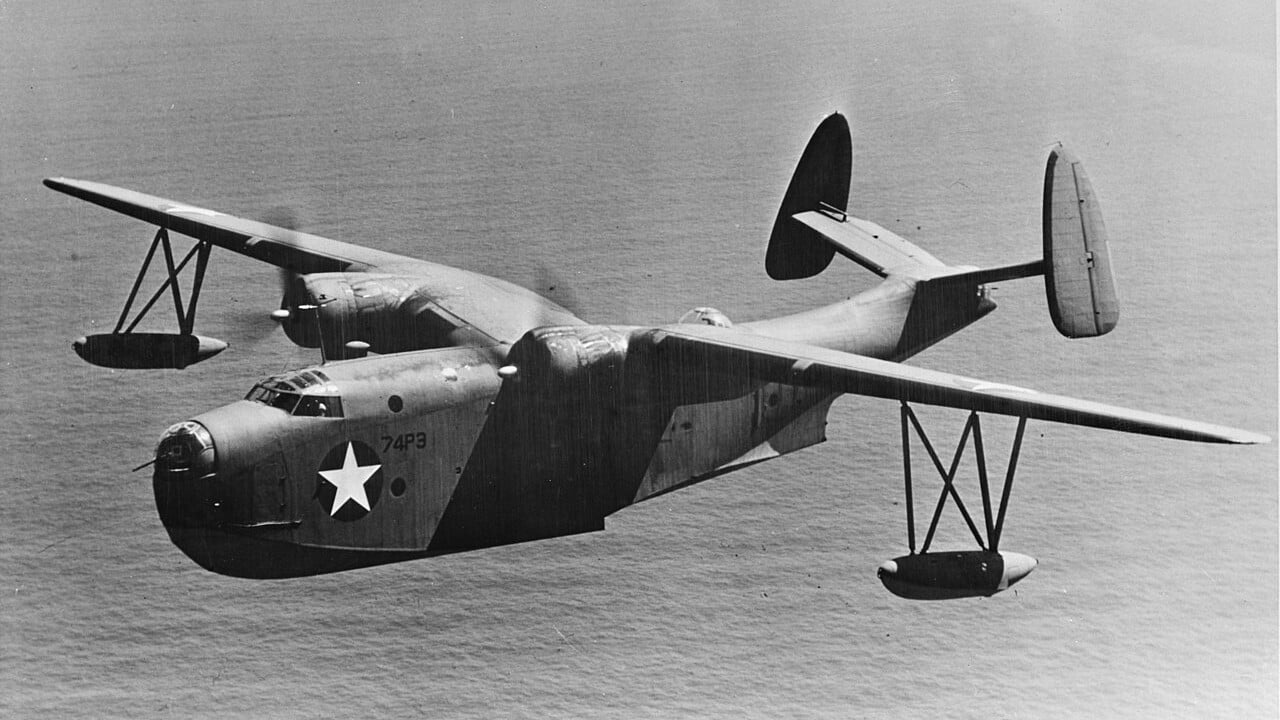
On the afternoon of 30 June 1942, a US Navy flying boat on patrol from Bermuda was sent to hunt a U-boat that had given itself away by talking too much on the radio. Diving out of the sun through low cloud, the big grey aircraft caught U-158 on the surface and dropped two depth charges. According to uboat.net, they burst directly under her stern and she sank immediately.
The aircraft was a Martin PBM Mariner of Patrol Squadron 74, and that was the first U-boat a Mariner sank. Its distinctive bent wings and inward-leaning twin tails would become a familiar shape over the Atlantic, the Caribbean and the Pacific. Yet ask most people to name an American wartime flying boat, and they will say Catalina.
Informazioni rapide
- Tipo: Twin-engine patrol bomber flying boat (PBM-5A: amphibian)
- Produttore: Glenn L. Martin Company, Baltimore
- Primo volo: 18 February 1939 (XPBM-1)
- Entrato in servizio: Autumn 1940, US Navy patrol squadrons VP-55 and VP-56
- Equipaggio: Nine (NASM)
- Motori: Two Wright R-2600 radials (1,600-1,700 hp); PBM-5: Pratt & Whitney R-2800, 2,100 hp
- Costruito: 1,366 (Smithsonian NASM)
- U-boats: Ten of the 29 sunk by US patrol aircraft in WWII
- Pensionato: US Navy 1956, US Coast Guard 1958
- Sopravvissuti: One intact: PBM-5A BuNo 122071, Pima Air & Space Museum
A scale model that won a contract
The Mariner was born out of a fight. In the mid-1930s the Glenn L. Martin Company wanted back into the Navy patrol business, which Consolidated’s PBY Catalina dominated. Martin’s Model 162 promised much better performance than the PBY, and Consolidated disputed the claims and pushed the Navy to demand a full-size prototype before any production order.
Martin could not afford to wait. Instead it built a three-eighths scale flying model, the Model 162A “Tadpole Clipper”, which began testing in late 1937. It worked well enough, and Europe looked dangerous enough, that the Navy ordered production PBM-1s before the full-scale XPBM-1 had flown. The real thing made its first flight on 18 February 1939.
Its signature was the gull wing. Mounting the wing on a deep hull and angling its inner sections upward put the two big radial engines high above the salt spray, without the parasol mounting and external bracing of the Catalina. The bombs went into bays inside the engine nacelles rather than on external racks, so the Mariner stayed faster when loaded. Production aircraft also got an upward-canted tailplane that tipped the twin fins inward.
Hunting U-boats from Bermuda to Brazil
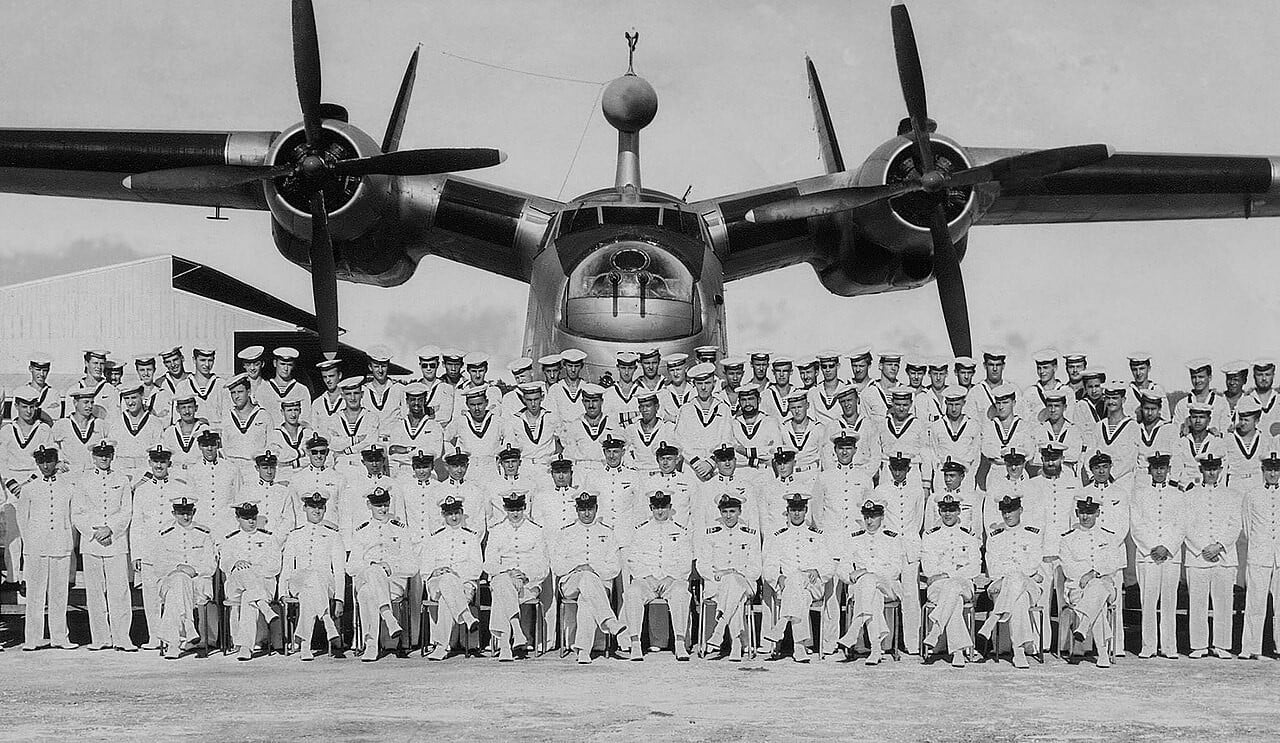
The first PBM-1s reached Navy patrol squadrons in the autumn of 1940, and Mariners flew Neutrality Patrols in the Atlantic before the United States entered the war. The improved PBM-3, with more powerful Wright R-2600 engines, powered turrets and fixed wing floats for rough open-ocean work, followed as war came. A crew of nine worked inside a hull roomy enough to later serve as a flying ambulance.
The hardest fighting came in the Caribbean in July and August 1943, when German U-boats waged an intense campaign against Allied shipping. The Smithsonian’s National Air and Space Museum says Mariners sank five of the ten submarines involved, but by then U-boats carried heavy anti-aircraft guns, and three Mariners were shot down and eight more badly damaged. Across the war, PBMs accounted for ten of the 29 U-boats sunk by American patrol aircraft.
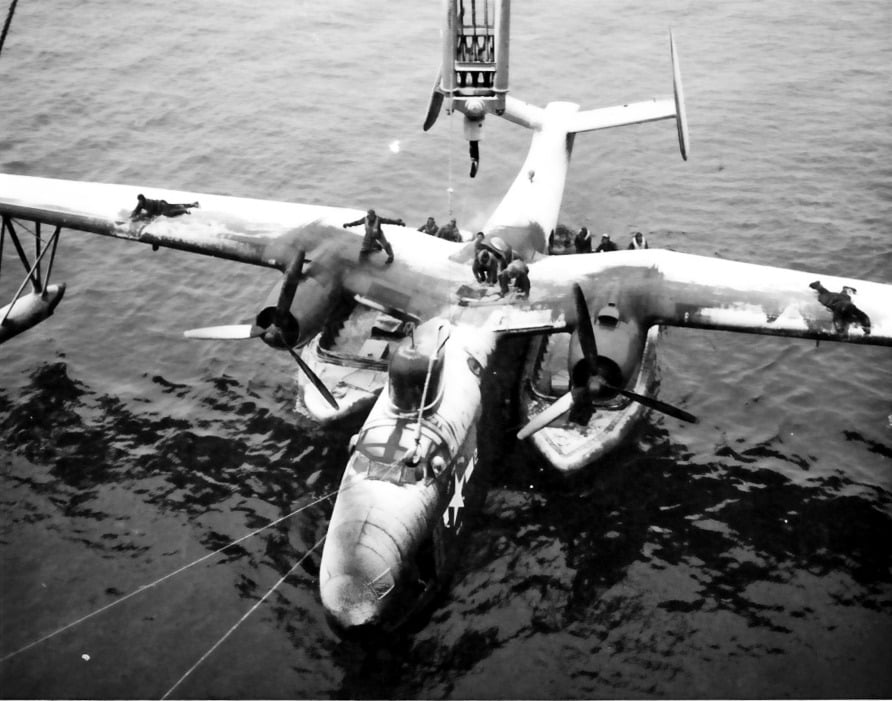
Archival footage via CriticalPast: a PBM-5 Mariner is hoisted off the deck of the transport USS Henderson and lowered into the water.
Britain received Mariners under Lend-Lease in 1943 but preferred its own Short Sunderland and sent them back. One thing stayed: it was the British who gave the PBM the name “Mariner”, which the US Navy then adopted.
Dumbos, Nightmares and the Pacific
In the Pacific, the Mariner found new jobs as the submarine threat faded. The PBM-5, which entered service in 1944 with Pratt & Whitney R-2800 engines, could carry rocket bottles for jet-assisted take-off. That mattered on “Dumbo” rescue missions, landing in heavy Pacific swells to pick up B-29 crews and carrier pilots who had bailed out or ditched.
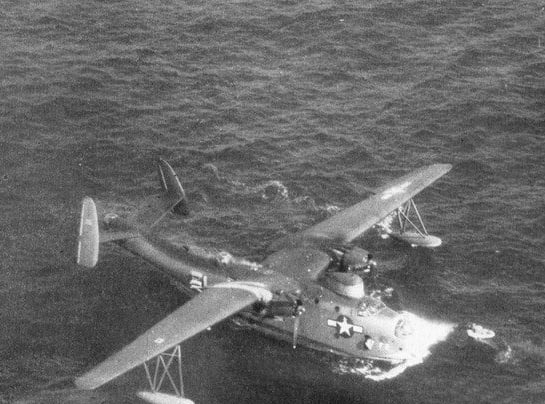
Mariners also flew “Nightmare” raids against Japanese shipping after dark, bombed shore installations across the Pacific islands and in mainland Japan, and claimed a number of Japanese fighters shot down by their gunners. During the invasion of Okinawa in 1945 they were deployed in large numbers, striking convoys and fishing downed airmen out of the sea.
Archival footage via CriticalPast: a rescued pilot comes aboard a PBM Mariner during air-sea rescue work in the Pacific.
From Antarctica to Korea
Peace did not ground the Mariner. PBMs supported the early atomic tests in the Pacific, and during Operation Highjump in 1946 and 1947 they helped map parts of Antarctica under Admiral Richard Byrd’s command. Flying boats with no wheels, however, could not use the growing network of land airfields, so Martin built 36 PBM-5A amphibians with retractable tricycle landing gear, which entered service in 1948 and 1949.
The Mariner’s last war was Korea, where PBMs flew long night patrols along the coast with powerful searchlights. Its replacement, Martin’s own P5M Marlin, began coming off the production line in 1952. The last Navy squadron flying the PBM, VP-50, gave them up in 1956, and the US Coast Guard, which had made the Mariner the backbone of its long-range search and rescue after the war, retired its last one in 1958.
Abroad, the Royal Netherlands Navy flew PBM-5As from Biak in Netherlands New Guinea in the late 1950s, and Argentina and Uruguay operated small numbers into the 1960s. Of the 1,366 Mariners built, according to the Smithsonian, only one survives intact: PBM-5A BuNo 122071, accepted by the Navy in 1948 and now on loan from the Smithsonian to the Pima Air & Space Museum in Tucson, Arizona.
It sits in the desert, about as far from the sea as a flying boat can get, in the markings of a Navy transport squadron. Its sisters sank U-boats, plucked pilots from the Pacific and flew over Antarctic ice. The Catalina got the fame. The Mariner, with its broken-backed wing, did a remarkable amount of the work.
Sources: Smithsonian National Air and Space Museum (PBM-5A Mariner), Pima Air & Space Museum, uboat.net (U-158), US Navy photographs via Wikimedia Commons, CriticalPast, Wikipedia (Martin PBM Mariner)
Header photo: US Navy via Library of Congress / Wikimedia Commons, public domain


0 Comments