

Imagine the deck of an aircraft carrier in 1950, a world of single-engine fighters and dive bombers. Then a dark-blue giant rolls onto the catapult: two huge radial engines turning big propellers, a jet engine buried in its tail, folded wings towering over the deck crew. It is the heaviest aircraft anyone has yet tried to fly off a carrier, and it was built to carry an atomic bomb.
That was the North American AJ Savage. Today it is one of the least remembered aircraft of the early Cold War. In its day it carried the US Navy’s whole claim to a place in the nuclear age.
It was also half piston bomber, half jet, a design that only makes sense once you understand the corner the Navy had painted itself into in 1945.
Informazioni rapide
- Tipo: North American AJ (later A-2) Savage, carrier-based nuclear attack bomber
- Primo volo: 3 July 1948 (XAJ-1 prototype)
- Motori: Two Pratt & Whitney R-2800 radials plus one Allison J33 turbojet in the tail
- Equipaggio: Three
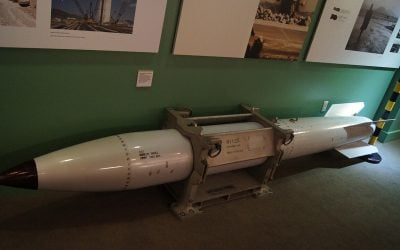
- Bomb load: 12,000 lb (5,400 kg), sized for the Mark 4 nuclear bomb
- Velocità massima: 471 mph (National Naval Aviation Museum)
- Produzione: 140 production aircraft (55 AJ-1, 55 AJ-2, 30 AJ-2P) plus three prototypes
- Servizio: 1949 to about 1960; replaced by the A3D Skywarrior
- Sopravvissuto: One: AJ-2 BuNo 130418, National Naval Aviation Museum, Pensacola
A bomber for the atomic age
On 13 August 1945, days after Hiroshima and Nagasaki, the Navy opened a design competition for a carrier-based bomber able to lift a 10,000-pound (4,536 kg) bomb. According to the National Naval Aviation Museum, the Navy wanted a heavy attack aircraft able to carry about five times the bomb load of the front-line bombers on its Essex-class carriers.
North American won. Before the year was out, the requirement had changed: the new bomber would be adapted to carry the Mark 4 nuclear bomb, which pushed the design bomb load to 12,000 pounds (5,400 kg). A contract for three XAJ-1 prototypes followed on 24 June 1946, and the first prototype flew on 3 July 1948.
In the meantime the Navy improvised. As an interim nuclear capability, it adapted the land-based P2V Neptune patrol bomber to take off from a carrier with rocket assistance. The Neptune could get off the deck but could not land back on it. After a mission, its crew would have to reach a friendly airfield or ditch at sea. The Savage would be the first nuclear bomber built to go out and come back.

Two pistons and a jet
The Savage’s strangest feature was its propulsion. Two 2,400 hp Pratt & Whitney R-2800 Double Wasp radials hung under its high wing. Buried in the rear fuselage was a third engine, an Allison J33 turbojet of 4,600 lbf (20 kN).
The logic was early-jet-age pragmatism. Piston engines of the day gave the range a carrier bomber needed; jets gave speed but burned fuel ferociously. So the J33 was only lit for take-off and for a high-speed dash near the target, breathing through an inlet on top of the fuselage that stayed closed the rest of the time. To keep the fuel system simple, the jet even burned the same aviation gasoline as the piston engines.
The result was a three-seat, high-wing bomber with a tricycle undercarriage, about 63 feet (19 m) long with a span of about 75 feet (23 m), and a top speed the Navy museum gives as 471 mph. Its outer wing panels and fin folded so it would fit on carrier elevators and in hangar decks.
Period footage from CriticalPast of AJ Savages being catapulted from the flight deck of USS Midway.
Too big for the boat
Development was hard. Two of the three prototypes were lost in crashes, though production had already been ordered in October 1947. Composite Squadron 5 (VC-5) took the first Savages in 1949, and the bomber carried out its first carrier take-off and landing aboard USS Coral Sea in 1950.
The problem was size. At first, only the big Midway-class carriers could operate it. Modernised Essex-class ships with strengthened decks, and later the giant Forrestal class, could handle it too, but the Savage never sat comfortably on any of them. Its wings had to be folded one at a time by a crewman standing on top of the fuselage with a portable hydraulic pump, a slow job when the deck needed clearing for other aircraft.

Flight deck crews disliked it for its bulk, its manual wing folding and its hydraulic leaks. Accidents and groundings followed in the early years, and squadrons often kept their Savages ashore, flying them out to carriers when needed. Squadrons sent detachments to Port Lyautey in Morocco to support carriers of the Sixth Fleet in the Mediterranean.
In the air, it was another story. When the systems behaved, crews found a surprisingly agile aircraft for its size.
Spy plane and flying gas station
The Savage soon found other jobs. The AJ-2P was a photo-reconnaissance version with a redesigned nose and an array of cameras, and 30 were built. They flew with photographic squadrons VJ-61 and VJ-62, also mapping territory for civilian agencies such as the US Coast and Geodetic Survey.
In the mid-1950s the bombers gained a hose-and-drogue refuelling kit fitted through the bomb bay, turning them into tankers for the Navy’s thirsty new jets. In July 1957, Savage tankers refuelled Marine Major John Glenn’s F8U-1P Crusader during Project Bullet, his record-setting coast-to-coast speed run, less than five years before he orbited the Earth.
Archive footage from CriticalPast of a US Navy AJ-2 Savage tanker refuelling a Grumman F9F-6 Cougar.

In total the Navy accepted 140 production Savages: 55 AJ-1s, 55 improved AJ-2s with more powerful engines, a taller fin and more fuel, and the 30 AJ-2Ps. From 1957, the all-jet A3D Skywarrior began replacing them in the heavy attack squadrons, and the last were retired around 1960. Survivors became A-2As and A-2Bs in the 1962 tri-service redesignation.
A long second life
Retirement was not the end. In the early 1960s, NASA’s Lewis Research Center flew AJ-2s on parabolic, microgravity-inducing flight paths to study how liquid hydrogen behaves in weightlessness.

Others became civilian firefighting tankers in the 1960s, dropping retardant over American forests. One AJ-2 later served Avco Lycoming as a flying test bed for its YF102 turbofan and its commercial ALF 502 derivative, with the engine slung on a retractable mount below the bomb bay.
That aircraft, Bureau Number 130418, is the last of its kind. It flew to Naval Air Station Pensacola in 1984 and is now preserved at the National Naval Aviation Museum, the only surviving Savage.
A Short History runs through the AJ Savage’s development and career.
The bridge to the jet bombers
The Savage was a transitional machine, and it looked it. But it proved that a carrier could launch and recover an aircraft big enough to carry a nuclear weapon, and the Navy built on that with the Skywarrior and later the A-5 Vigilante.
It was too big for the decks it served, temperamental, and quickly overtaken by jets. It was also the aircraft that turned the carrier into a nuclear weapons platform. Not bad for a bomber with an engine it was only allowed to use at the very end.
Sources: Wikipedia (North American AJ Savage), National Naval Aviation Museum / Naval History and Heritage Command, NASA Glenn Research Center, Vintage Aviation News
0 Comments