
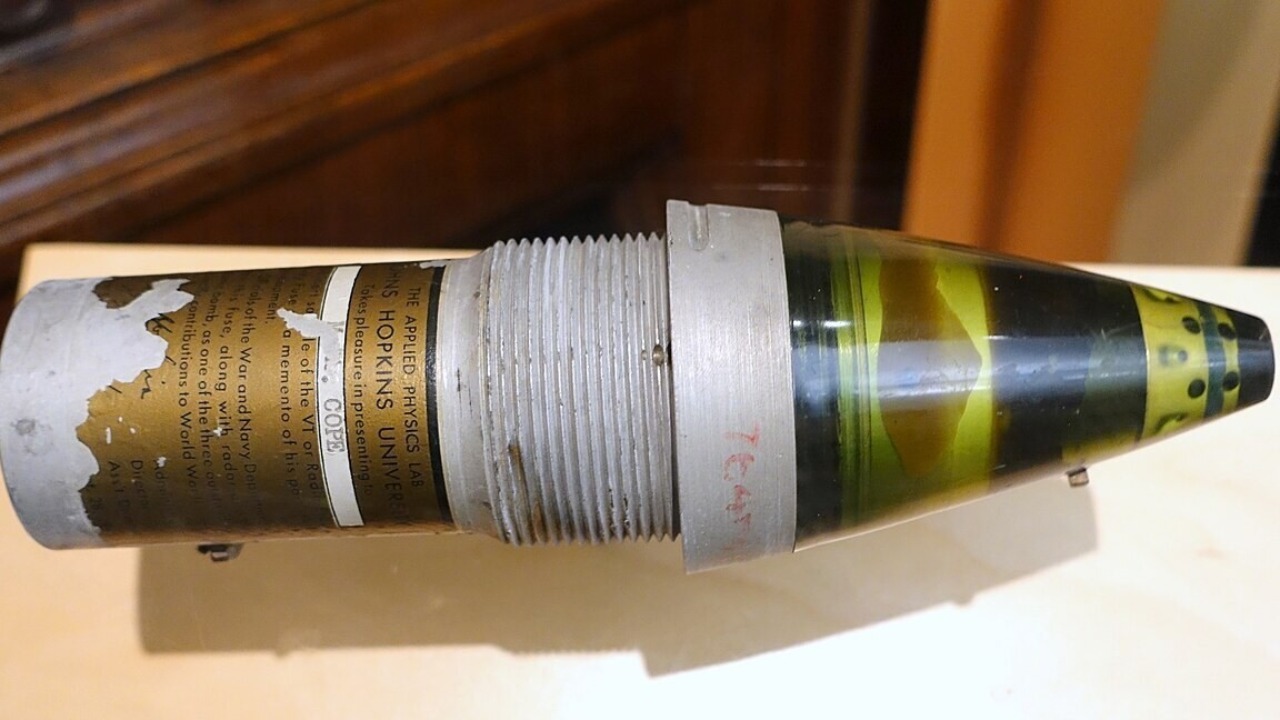
On the morning of 5 January 1943, four Japanese dive bombers jumped an American task force off Guadalcanal. One of them hit the New Zealand cruiser Achilles, and the group broke away. As they pulled off, the gunners of the light cruiser USS Elena sent a few rounds of 5-inch fire after them.
One of those shells never touched its target. It did not need to. Somewhere close behind a fleeing Aichi D3A, a tiny radio set packed into the nose of the shell sensed the aircraft, and the shell burst. The bomber went into the sea in flames. It was the first enemy aircraft ever brought down by a proximity fuze.
Nobody read about it in the newspapers. The device that did it was one of the best-kept secrets of the Second World War, built by an army of scientists and factory workers who mostly had no idea what they were making. By 1945 more than 22 million had been produced, and they had changed air defence, naval warfare and artillery for good.
Informazioni rapide
Che cos'è: A fuze carrying a miniature radio transmitter-receiver that detonates a shell when it passes close to a target
Cover name: VT, for variable time, chosen so the name gave nothing away
Developed by: Section T of the US National Defense Research Committee under physicist Merle Tuve, which became the Johns Hopkins Applied Physics Laboratory (APL)
Built on: British research shared through the Tizard Mission in 1940
Stresses survived: About 20,000 g on firing, with the shell spinning at hundreds of revolutions per second
Proof test: 12 August 1942, USS Cleveland: three radio-controlled target drones destroyed by four proximity bursts
First combat kill: 5 January 1943, USS Elena, off Guadalcanal
Produzione: More than 22 million fuzes by August 1945, from five main assembly firms and about 2,000 suppliers
Major uses: Pacific fleet air defence, the V-1 campaign against Britain and Antwerp, and field artillery from the Battle of the Bulge onwards
Why anti-aircraft fire almost never worked
In 1940 a heavy anti-aircraft shell could kill an aircraft in two ways. It could hit it, which against a small, fast, manoeuvring target was mostly luck. Or it could be fitted with a clockwork time fuze, set before firing, so it burst at a calculated point in space. If the range estimate was slightly wrong, or the pilot turned, the burst went off harmlessly in empty sky.
The numbers were grim. At the start of the Blitz, British estimates put the cost of one German bomber at around 20,000 rounds. Arleigh Burke, who fought Japanese night attacks with his destroyers in the Solomons, put it more bluntly after the war: the mechanical time fuzes only brought a plane down at night by accident.
The obvious answer had been around for years: a shell that could tell when it was near its target and explode on its own. The problem was doing it in 1940, with glass vacuum tubes, inside a projectile that would be fired out of a gun barrel. Germany researched dozens of designs and never fielded one in an anti-aircraft shell. Plenty of engineers considered the idea impossible.
A British idea and an American crash programme
The concept that worked came from Britain. Researchers including W. A. S. Butement proposed a radio fuze using the Doppler effect in 1939 and 1940, and tested prototypes in unguided rockets, which accelerate gently and do not spin. A gun shell was a different matter, and Britain had neither the resources nor the time. In September 1940 the Tizard Mission carried the British work across the Atlantic along with a trove of other British military technology.
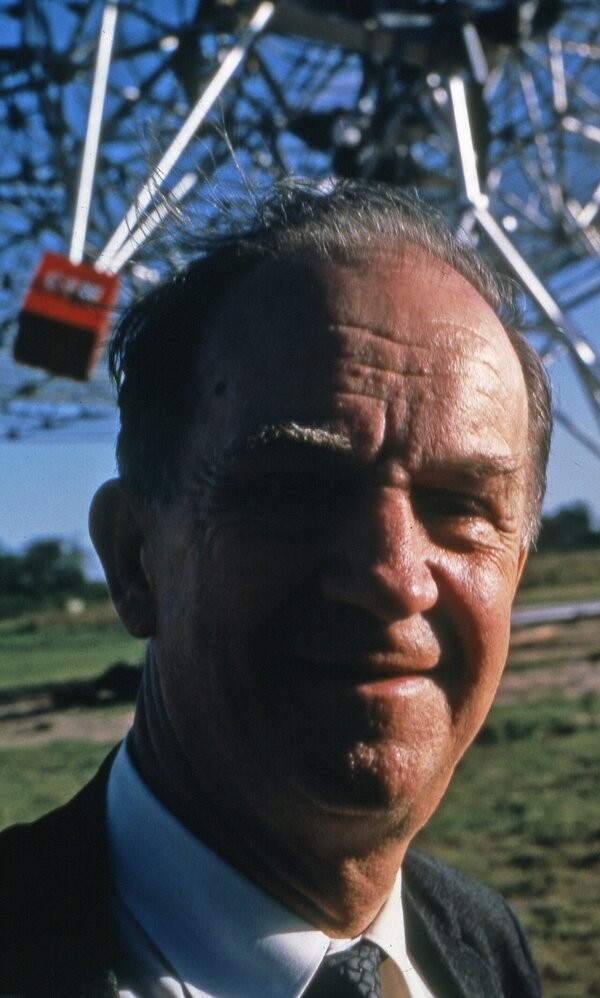
The US National Defense Research Committee gave the problem to Section T, chaired from August 1940 by Merle Tuve, a physicist at the Carnegie Institution’s Department of Terrestrial Magnetism. The work outgrew its building almost immediately. In March 1942 the Johns Hopkins University signed a contract to run a new laboratory for the project in a rented former garage in Silver Spring, Maryland. Tuve called it the Applied Physics Laboratory. Its staff grew from about 100 in 1942 to about 700 by 1944.
Tuve ran it like a war. His rules, posted on the laboratory walls, are still quoted: shoot for an 80 per cent job, because the war could not afford perfection, and remember that “the best job in the world is a total failure if it is too late.” He also insisted, loudly, that the Navy stay inside the programme rather than wait to be called.
The officer the Navy sent was Commander William S. Parsons, a gunnery specialist who would later arm the atomic bomb aboard the Enosa Gay. Tuve said Parsons’ involvement gave everybody confidence that this was not a silly exercise invented by civilians.
A radio set that survives being fired from a gun
The principle of the fuze was simple, and Tuve said so himself. The nose of the shell contained a small oscillator that transmitted a continuous radio signal. Anything nearby that reflected radio waves sent some of it back. Because the shell and the target were closing at enormous speed, the reflected signal interfered with the outgoing one and produced a low-frequency ripple, effectively a Doppler beat, that grew stronger as the shell got closer.
Amplifier tubes boosted that ripple. When it crossed a threshold, which in the Navy’s 5-inch shells corresponded to roughly 70 feet from an aircraft, it fired a gas-filled thyratron tube that dumped the charge of a capacitor into an electric detonator. The shell burst, and the fragments did the rest. If nothing came close enough, a self-destruct feature exploded the shell anyway so that duds would not land intact.
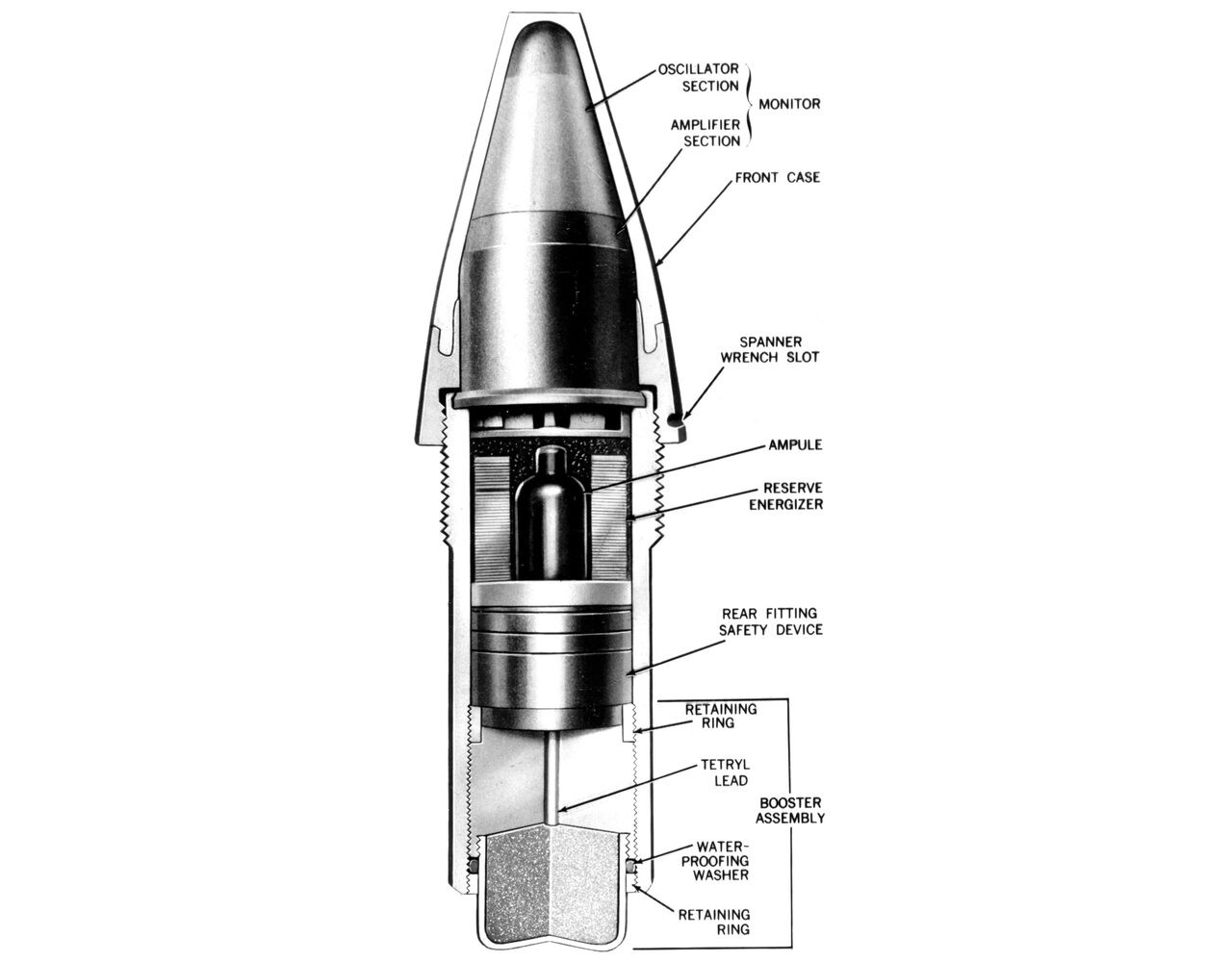
The genius was in the engineering, not the idea. Firing from a 5-inch gun subjected the electronics to about 20,000 times the force of gravity, and the rifling spun the shell at hundreds of revolutions per second. Ordinary radio tubes shattered. Hearing-aid tubes were the starting point, and a team including a young physicist named James Van Allen, later famous for the radiation belts that carry his name, spent most of a year making them survive.
The battery was its own problem. The answer was a reserve cell with its electrolyte sealed in a glass ampule: the shock of firing broke the glass, and the spin flung the fluid out across the plates, bringing the fuze to life only after it had left the barrel. A mercury switch kept the circuit shorted until spin had built up, and the safety standard set for the programme was no more than one muzzle burst in a million rounds.
Real Engineering’s explainer on the Mark 53 fuze walks through the oscillator, the Doppler beat and the shock-hardening that made a radio survive the inside of a gun barrel.
Three drones, four shells
Early test firings in January 1942 were only partly encouraging: only about half of the fuzes fired over water worked as designed. The Navy took the gamble anyway and ordered production. The real test came on 12 August 1942 aboard the new light cruiser USS Cleveland in Chesapeake Bay. The plan was two days of firing against radio-controlled target drones.
It lasted part of one. Cleveland’s guns destroyed all three drones on the first day with just four proximity bursts, and the trial was called off because there was nothing left to shoot at. Production went ahead at full speed.
The first 5,000 production shells were shipped to the South Pacific under Parsons’ supervision and divided between the carriers Enterprise E Saratoga and the cruiser Elena. The Allies had already agreed that the fuze would be used first at sea, where a dud would sink into deep water instead of landing on a beach for the enemy to study. That is how a quiet morning off Guadalcanal became the weapon’s debut.
Accounts differ slightly on the detail, two rounds or two salvos or the second of three, but agree on the essentials: the target was a Val dive bomber, it was brought down by a near miss, and it was the first of many.
The funny fuze goes to war in the Pacific
Sailors called it the funny fuze. Within weeks it was breaking up Japanese night attacks by G4M Betty torpedo bombers in the Solomons. Samuel Eliot Morison, the Navy’s official historian, wrote that “the night flickered with muzzle flashes, tracers, flares, float lights and the flaming pyramids of splashing ‘Bettys.’”
The statistics backed up the poetry. According to figures quoted by military historians, in 1943 only about a quarter of the anti-aircraft ammunition issued to the fleet carried proximity fuzes, yet those rounds accounted for around half of the Japanese aircraft brought down by naval gunfire. Vannevar Bush, who ran American wartime science, later estimated that the fuze raised the effectiveness of 5-inch anti-aircraft guns roughly sevenfold.
That mattered most in 1945. Kamikaze aircraft had to be destroyed, not merely damaged, and the radar-directed 5-inch battery firing proximity-fuzed shells was the fleet’s best long-range answer. Even so, the suicide attacks off Okinawa sank or damaged dozens of ships. Without the new fuze, the cost would have been far higher.
Shooting down the V-1
Over land, the fuze stayed under embargo. The Combined Chiefs feared that a single dud recovered by the Germans would let them copy it or jam it. Then, in June 1944, the first V-1 flying bombs fell on London: small, fast, low and impossible to predict for a time-fuzed gun battery.
Britain moved its heavy anti-aircraft guns to a belt along the coast, where duds would fall into the sea and the guns would not get in the way of the RAF fighters inland. The new combination of the SCR-584 tracking radar, an electrical gun director and proximity-fuzed 3.7-inch and 90 mm shells turned out to be devastating. Ralph Baldwin, an APL physicist who worked on the fuze, recorded the share of V-1s destroyed by the coastal guns climbing from 24 per cent in the first week to 79 per cent in the last. On one late day of the campaign, he wrote, 104 flying bombs were detected and only four reached London.
The gunners also found the fuze was almost too good. It was sensitive enough to burst near a seabird, and a number of gulls were recorded as kills. When the Germans turned the V-1 on the port of Antwerp in late 1944, proximity-fuzed American and British guns defended that too.
The Battle of the Bulge and a new kind of artillery
The ground war was where the proximity fuze changed tactics most. An artillery shell with a contact fuze buries part of its force in the ground. A shell with a time fuze can burst overhead, but only if observers can adjust the timing. A proximity-fuzed shell bursts automatically a few dozen feet above the ground, scattering fragments down into trenches and foxholes.
When the Germans launched the Ardennes offensive on 16 December 1944, the embargo on land use of the fuze was lifted within days. German infantry who had moved in the open, trusting that bad weather would blind the American observers, found the shells bursting above them anyway. Lieutenant General George S. Patton later wrote to Major General Levin H. Campbell Jr., the Army’s chief of ordnance: “The funny fuze won the Battle of the Bulge for us.”
Patton was exaggerating, as he tended to, but not by much. By the end of the war the proximity fuze was in use on Army and Navy guns, rockets and bombs, and Admiral Ernest King called its development a major scientific achievement that had contributed greatly to winning the war.
Radio Proximity Fuse: Weapon Behind Victory, the 1945 film released once the secret could be told, explaining how the fuze worked and where it was used.
22 million radios and one secret
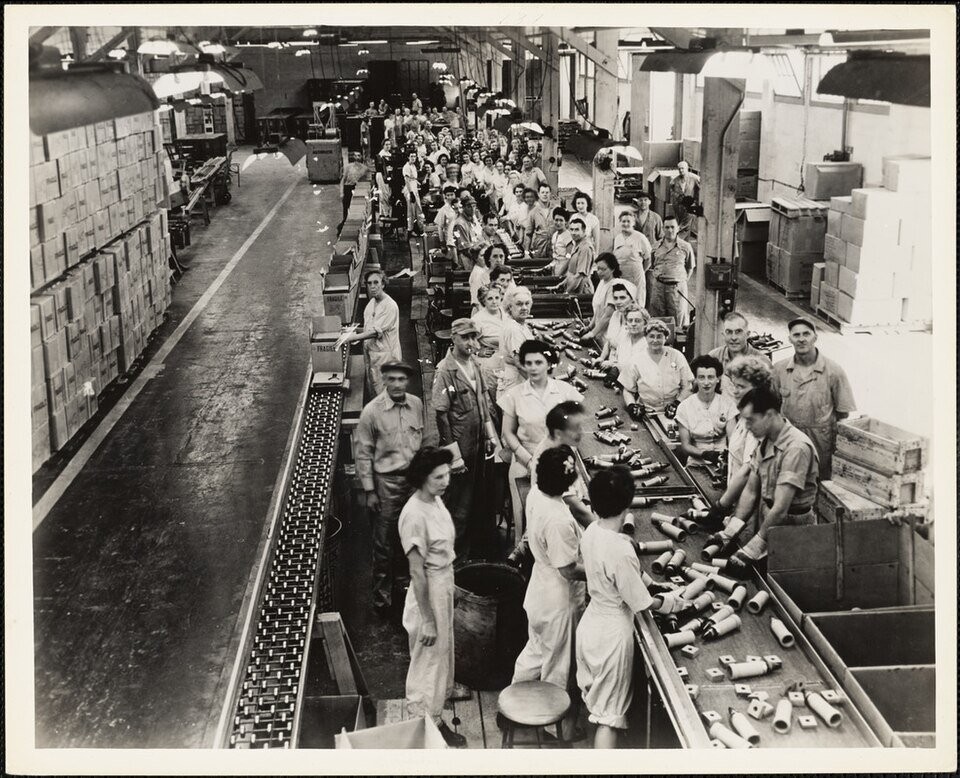
The industrial side of the story is as remarkable as the science. Assembly began in September 1942 at around 500 fuzes a day. By 1944 the lines were turning out tens of thousands a day, and by the summer of 1945 roughly 70,000. Crosley, Sylvania, RCA, Eastman Kodak and McQuay-Norris led a network of more than 2,000 suppliers, and in all 22,073,481 fuzes were produced up to 14 August 1945, at a total cost of around a billion wartime dollars.
APL’s own history estimates that about a million people took part in researching, building and using the fuze, and the secret still held. Neither Germany nor Japan worked out during the war why Allied guns had suddenly become so accurate. The fuze was also among the first mass-production uses of printed circuits, a small footnote that pointed straight at the electronics industry of the decades to come.
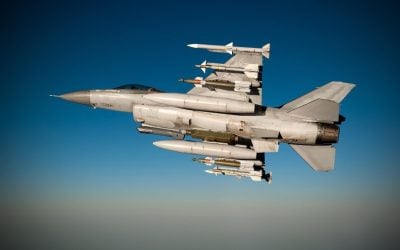
APL itself never closed. The laboratory Tuve founded to build a fuze went on to work on guided missiles, satellites and spacecraft. The proximity fuze lives on in nearly every surface-to-air and air-to-air missile, including the AIM-9 Sidewinder, which carries its own descendant of the idea: a weapon does not have to hit, only to know when it is close enough.
Curious Droid’s documentary places the proximity fuze alongside radar and the atomic bomb among the decisive scientific developments of the war.
The first Val that went into the sea off Guadalcanal in January 1943 was never hit at all. That was exactly the point.
Sources: Wikipedia, Proximity fuze and Merle Tuve; Johns Hopkins APL Technical Digest, “APL and the VT Fuze” (1962) and Dean C. Allard, “The Development of the Radio Proximity Fuze” (1982); Michael W. Robbins, “The Allies’ Billion-dollar Secret: The Proximity Fuze of World War II”, Military History / HistoryNet (2020); Chuck Oldham, “The Creation of the Proximity Fuze”, Defense Media Network (2013); Ed Jennings, “Crosley’s Secret War Effort”, via NavWeaps; Ralph B. Baldwin, The Deadly Fuze (1980), as cited by HistoryNet.
0 Comments