

The sea off the Outer Hebrides in late September is the colour of wet slate, and roughly 150 nautical miles out into it sat a 43-year-old American frigate with nobody aboard. The former USS Klakring had been towed across the Atlantic from Philadelphia to be shot at. Over the course of a single afternoon she was hit by at least five different weapon types, fired in a deliberate order, and then sunk by a torpedo.
Two of those weapons had never been fired at a real warship by the Royal Navy before. One of them was launched from a helicopter.
That is the part worth stopping on. Exercise Atlantic Thunder 2026 was a US 6th Fleet production, and the headline hardware was American: an Arleigh Burke destroyer, a brand-new Virginia class submarine, Strike Eagles out of Lakenheath. But the two genuine firsts belonged to the British, and the smaller of the two came off the back of a Wildcat.
Informazioni rapide
Bersaglio — ex-USS Klakring (FFG 42), Oliver Hazard Perry class. Commissioned 1983, decommissioned 2013. Named for Rear Admiral Thomas B. Klakring, three-time Navy Cross recipient.
Dove — roughly 150 nautical miles offshore of the MoD Hebrides range, north-west Scotland. Exercise window 14 to 25 September 2026.
Firing order — longest range inward: SM-6 from USS Paul Ignatius (DDG 117), then Naval Strike Missile from HMS Portland (F79), Sea Venom from an 815 NAS Wildcat, guided bombs from 48th Fighter Wing F-15Es, and finally a Mk 48 ADCAP from USS Massachusetts (SSN 798).
Sea Venom — MBDA, known as ANL in France. About 120 kg all-up, 30 kg semi-armour-piercing warhead, Mach 0.85, range beyond 20 km, INS plus imaging infrared seeker.
Naval Strike Missile — Kongsberg. Sea-skimming, high subsonic, replaced Harpoon in UK service. Ordered by the UK in 2023 under the I-SSGW programme.
Next time — the following Atlantic Thunder is targeted for 2028.
A frigate towed across an ocean to be shot at
Klakring was commissioned in 1983 and struck in 2013, and then did what most decommissioned American warships do: nothing at all, for thirteen years, tied up at the Philadelphia Naval Inactive Ship Maintenance Facility. In August 2026 she was towed out. Ship-spotters on the Delaware photographed her leaving, which is usually the first public sign that a SINKEX is coming.
Preparing a hull for this is not a matter of pointing missiles at it. Fuel, oil, loose wiring, batteries, anything that could leak or burn has to come out, and the US Navy does this to a published standard before the ship is allowed near a range. Then the instrumentation goes in. Naval Surface Warfare Center Carderock and Naval Information Warfare Center fitted sensors throughout the frigate before she crossed the Atlantic.
Those sensors are the actual point of the exercise. A missile hitting a real steel hull does things that no model reproduces reliably: how the blast propagates through compartments, where the structure folds, how fast water moves once it is inside. The Navy has said the resulting data will take several months to process. Everything you can film is secondary to a hard drive.
The division of labour was financial as much as operational. Under the bilateral arrangement, the Americans paid to prepare and tow the target; the British paid for the range. That is also, more or less, why the target was an American ship rather than a British one.
Longest range first, and why that matters
The engagement ran from the longest-range weapon inward, so that each impact could be assessed before the next one arrived. Fire the short-range weapons first and every later shot lands on a wreck already torn open by something else, which makes the data worthless.
USS Paul Ignatius opened with a RIM-174 Standard Missile 6, fired at what the US Navy describes as its maximum range in the anti-surface role. SM-6 is first and foremost an air-defence weapon, and its secondary career as a ship-killer is one of the more useful accidents of modern missile design: a very fast missile with a modest warhead, arriving from a long way away.

Air power was woven through the whole thing. F-15E Strike Eagles from the 48th Fighter Wing at RAF Lakenheath dropped guided bombs on the frigate, supported by KC-135 tankers of the 100th Air Refueling Wing out of Mildenhall. P-8 Poseidon maritime patrol aircraft from both navies took part, although no weapon release has been attributed to them, and their role appears to have been surveillance and targeting rather than strike.
Sea Venom: a helicopter missile gets a real target
HMS Portland’s embarked Wildcat, from 815 Naval Air Squadron, fired a Sea Venom at the Klakring. It was the first time the weapon had been fired operationally against a representative maritime target, and the crew ran the whole sequence rather than just the trigger pull: find the ship, fix it, identify it, strike it.
Sea Venom, called ANL on the French side of the MBDA programme, is not a ship-killer in the sense that NSM is. It is a 120 kg missile with a 30 kg semi-armour-piercing blast-fragmentation warhead, cruising at about Mach 0.85 out to more than 20 km, guided by inertial navigation and an imaging infrared seeker. Against a fast attack craft or a corvette, one is enough. Against a frigate, the intended effect is a mission kill rather than a sinking, and the usual answer is more than one missile.
A Wildcat can carry up to four. Initial operating capability was declared during Operation Highmast in 2025, and clearing this firing should allow full operating capability to follow.
There is a small factual trap around this missile that has already propagated through several reports of the firing. Sea Venom weighs roughly 120 kg; its warhead weighs 30 kg. Published accounts that credit each missile with a 120 kg warhead have swapped the all-up mass for the explosive load, and the difference is not cosmetic. A 30 kg warhead is what makes the multiple-missile tactic necessary in the first place.

NSM finally meets a ship
The other first was Portland’s Naval Strike Missile. The Royal Navy had launched one before — HMS Somerset in September 2025 — but that was a test shot rather than an engagement of a warship. Firing at the Klakring was the first time the weapon was used the way it would be used in anger, and the ship hit what it aimed at.
NSM is a Kongsberg design, sea-skimming and high subsonic, bought to replace the Harpoon Block 1C that the Royal Navy had run well past its sell-by date. Britain came to it late: the I-SSGW requirement dates from 2019 and the order was not placed until 2023, by which time Norway, Poland, Malaysia, the United States, Japan, Romania, Australia and Spain were already in the queue ahead of it.
Portland also worked as a node in the targeting network rather than simply a launcher. The link architecture was run out of Sixth Fleet headquarters and shared with the frigate, and the task force commander reported no communications problems across the whole engagement. For an exercise whose stated purpose is interoperability, that is arguably a bigger result than the missile impacts.
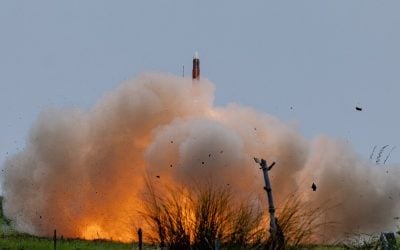
The Royal Navy’s own footage of the Naval Strike Missile leaving HMS Portland.
Both weapons are placeholders in a longer plan. The Future Cruise/Anti-Ship Weapon, named Stratus, is in development at MBDA and is intended to become the fleet’s heavyweight long-range anti-ship missile. NSM and Sea Venom are what the Royal Navy has in the meantime, and until 21 September neither had been pointed at a real warship by a British crew.
The last hit came from underneath
What actually sank the Klakring was none of the above. After the missiles and the bombs, USS Massachusetts put a Mk 48 Advanced Capability torpedo into her, and that was the end of it. A heavyweight torpedo detonating under a keel breaks a hull in a way that no anti-ship missile is designed to, which is why SINKEX programmes so often finish this way.
Massachusetts is worth a paragraph of her own. She is the 25th Virginia class boat, commissioned in March 2026, and she went to sea without the traditional post-shakedown availability that normally follows commissioning. That was a deliberate decision to offset the US Navy’s current shortage of available attack submarines, and it has been publicly described as a calculated risk. She was photographed at the Royal Navy’s Faslane base earlier in September.
There is one wrinkle in the record worth flagging rather than smoothing over. US 6th Fleet material dates the SINKEX to 20 September; Navy Lookout and the Royal Navy timeline put it on 21 September, within an exercise window running 14 to 25 September. The imagery released by the US Air Force carries both dates in different fields of the same caption. We have not seen anything that resolves it.
What it was really for
Strip away the press language and Atlantic Thunder 2026 did three things. It gave two British weapon systems the one qualification that cannot be simulated. It produced a dataset on how a real warship fails under modern warheads, which will not be published and will matter for years. And it demonstrated that a targeting network run from a headquarters ashore can hand a Royal Navy frigate a firing solution without dropping the link.
The next iteration is already being planned for 2028, half the gap between the last two. By then the Royal Navy expects its first Type 26 frigate in service and NSM fitted more widely across the fleet. Whether there will be a British hull on the receiving end next time is a different question, and the answer to that one is usually about money.
Sources: Royal Navy; U.S. Naval Forces Europe-Africa / U.S. 6th Fleet; DVIDS; Navy Lookout; Forces News; Naval News; MBDA Sea Venom/ANL product documentation; Kongsberg; GlobalSecurity.org; Naval Technology. Quotations are as released by the Royal Navy and U.S. Task Force 65.


0 Comments