
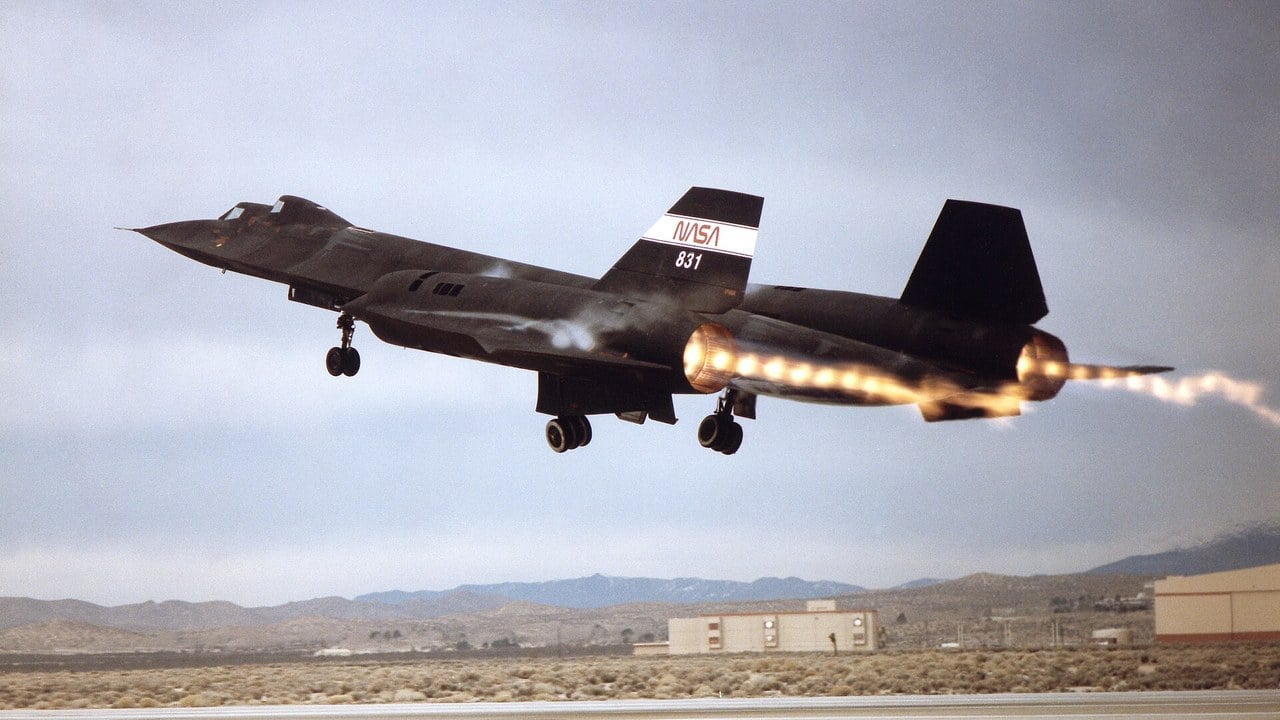
Watch an SR-71 Blackbird leave the runway in full afterburner and the exhaust does something strange. The flame is not a smooth torch. It is a string of bright, evenly spaced beads, glowing knots strung out behind each nozzle like lights on a wire.
They are called shock diamonds, also Mach diamonds or thrust diamonds, and they are not fire in the usual sense. They are a standing pattern of shock waves and expansion waves locked in place inside the exhaust jet, made visible where the gas is suddenly squeezed and heated.
Once you know what to look for, you see them everywhere: behind fighters on night take-offs, under rockets on the launch pad, even in the muzzle flash of artillery. Here is why they form, why they glow, and why some engines never show them.
Informazioni rapide
- Also called: Mach diamonds, thrust diamonds
- Cosa sono: A standing pattern of shock waves and expansion fans in a supersonic exhaust jet
- Needed: A supersonic exhaust whose pressure does not match the surrounding air
- Over-expanded: Exhaust pressure below ambient; typical at low altitude, where the diamonds are most vivid
- Under-expanded: Exhaust pressure above ambient; typical at high altitude
- Mach disk: The shock straight across the jet that marks each diamond
- Why they glow: The shock heats the gas and ignites leftover fuel in the exhaust
- First diamond: Roughly 0.67 x nozzle diameter x the square root of (chamber pressure / outside pressure), an empirical rule
- Seen on: SR-71, F-22, X-59, Bell X-1 and X-2, Space Shuttle main engines, rocket tests
A supersonic jet that does not fit its surroundings
Shock diamonds need two ingredients. The first is a supersonic exhaust. An afterburning fighter engine and a rocket both push their exhaust through a convergent-divergent nozzle: the gas is squeezed to the speed of sound at the narrow throat, then accelerates to supersonic speed as the nozzle widens again. NASA’s Glenn Research Center notes that afterburning turbojets and turbofans need a variable-geometry nozzle of exactly this type.
The second ingredient is a pressure mismatch. A nozzle is shaped for a particular outside pressure. Near the ground, where the air is thick, the exhaust usually leaves the nozzle at a lower pressure than the surrounding atmosphere. Engineers call that over-expanded. High up, where the air is thin, the exhaust leaves at a higher pressure than its surroundings: under-expanded.
Either way the jet cannot simply flow off into the air. It has to adjust its pressure to match, and because it is moving faster than sound, it cannot do that smoothly. Supersonic gas can only change its pressure abruptly, through shock waves, or by turning through fan-shaped regions called expansion fans.
Shocks, fans and the Mach disk
Take the over-expanded case, the one you see at an air show. The heavier outside air squeezes the jet inwards at the nozzle lip. That squeeze takes the form of oblique shock waves, angled across the flow, which compress the gas and turn it towards the centreline.
Where those angled shocks meet in the middle, the flow can no longer be turned, and a shock forms straight across the jet, perpendicular to the flow. This is the Mach disk, named after the physicist Ernst Mach, who first described such a shock. It marks the first diamond. The dark stretch between the nozzle and that first disk has its own name: the zone of silence.
Scott Manley explains why rocket exhausts look the way they do.
Behind the Mach disk the jet has now been over-compressed. So it expands again through an expansion fan, overshoots, and drops below ambient pressure once more. The outer edge of the jet reflects the waves back inwards, a new set of shocks forms, and the whole sequence repeats. Each pairing of a shock with an expansion fan makes one diamond.
In a perfect, frictionless gas the chain would go on for ever. In reality the jet’s edges rub against the still air, a turbulent shear layer grows and mixes in, and the pattern fades a few diamonds downstream. In the under-expanded case at altitude the order simply flips: the expansion fan comes first, then the shocks.
Why the diamonds glow
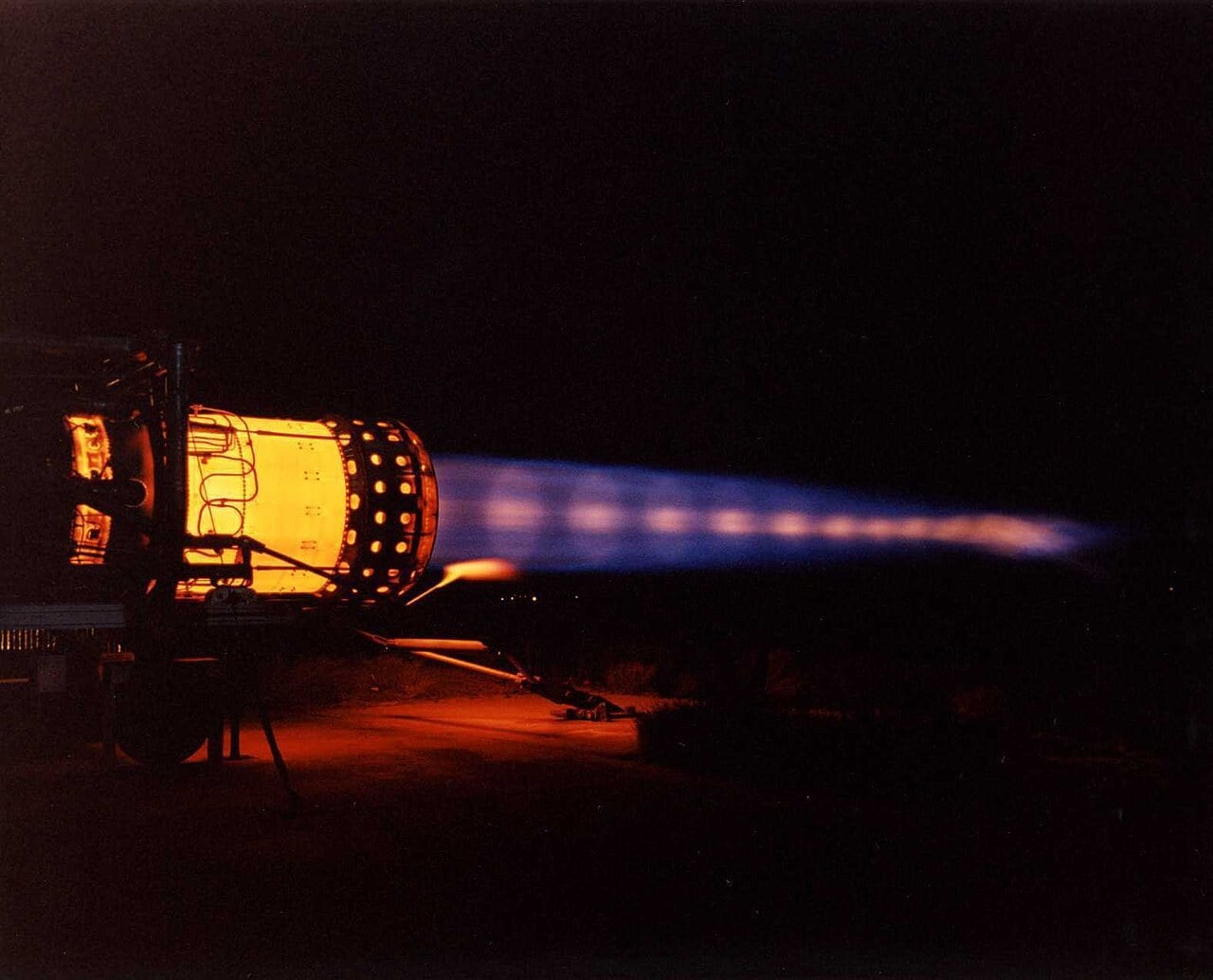
A shock wave is a sudden compression, and compressing a gas heats it. As the exhaust passes through each Mach disk, its temperature jumps. In a fighter’s afterburner plume or a rocket exhaust, the gas still carries fuel that has not finished burning, and that sudden heat makes it burn.
That is why the disks light up while the stretches in between look darker, and why the diamonds are so vivid in an afterburner plume, where the reheat stage sprays extra fuel into the exhaust. It also explains why they are most dramatic close to the ground. The thicker the outside air, the bigger the mismatch with the nozzle, and the stronger the shocks.
The colour, by the way, belongs to the chemistry of the burning gas rather than to the shocks themselves, which is a story Afterburner has told in its guide to afterburner flame colours.
A rule of thumb for the first diamond
Where does the first diamond sit? Laboratory experiments on supersonic gas jets produced an empirical rule, published by Ashkenas and Sherman in 1966 and still quoted today. The distance from the nozzle to the first Mach disk is roughly 0.67 times the nozzle diameter, multiplied by the square root of the ratio between the chamber pressure and the outside pressure.
It is a rule of thumb from experiments with simple nozzles, not a design formula for a fighter, but the aha is in the square root. Quadruple the pressure ratio and the first diamond moves only twice as far downstream. And because the outside pressure sits underneath the square root, the same engine climbing into thinner air pushes its first diamond further back.
NASA’s X-59 quiet supersonic demonstrator put on exactly this show during its maximum afterburner engine runs at Lockheed Martin’s Skunk Works in Palmdale in January 2025. Its engine, a modified F414-GE-100, is similar to the engines of the US Navy’s F/A-18E/F Super Hornet.
NASA Glenn Research Center footage of the X-59 running its engine and afterburner during ground tests.
Why some jets show them and others do not
No supersonic exhaust, no diamonds. An airliner’s high-bypass turbofan has no afterburner, and most of its thrust comes from a large, relatively slow and cool stream of fan air, so there is no hot, supersonic, fuel-rich plume to light up. That is why the glowing beads belong to fighters on take-off and rockets on the pad, not to the jet taking you on holiday.
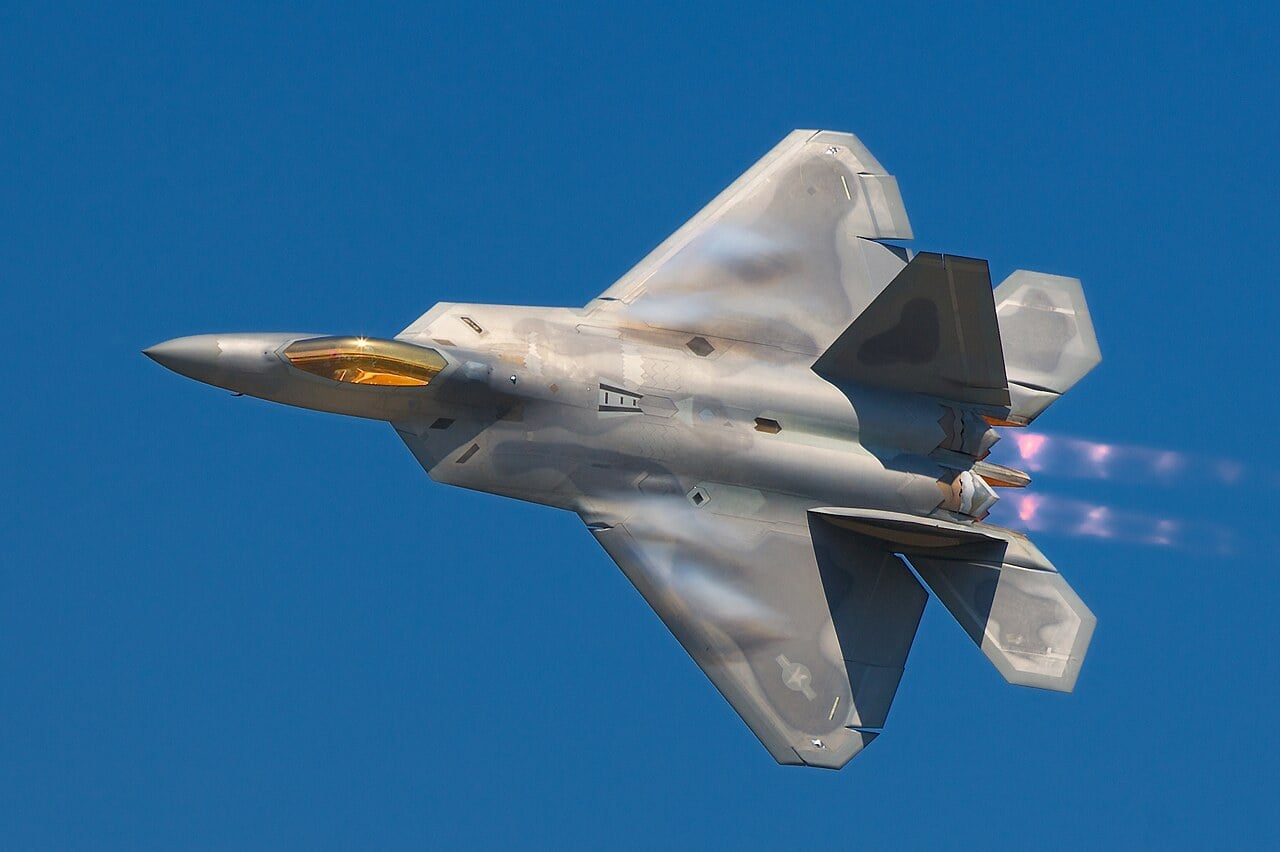
Even on a fighter, the effect comes and goes. Without afterburner the plume is much cooler and carries far less unburnt fuel, so there is much less to light up. With the burner lit, at low altitude, on a dark evening or in a test cell, they jump out. An F-22 Raptor at an air show often trails a faint chain of them, and the SR-71’s Pratt & Whitney J58 engines produced some of the most photographed diamonds of all.
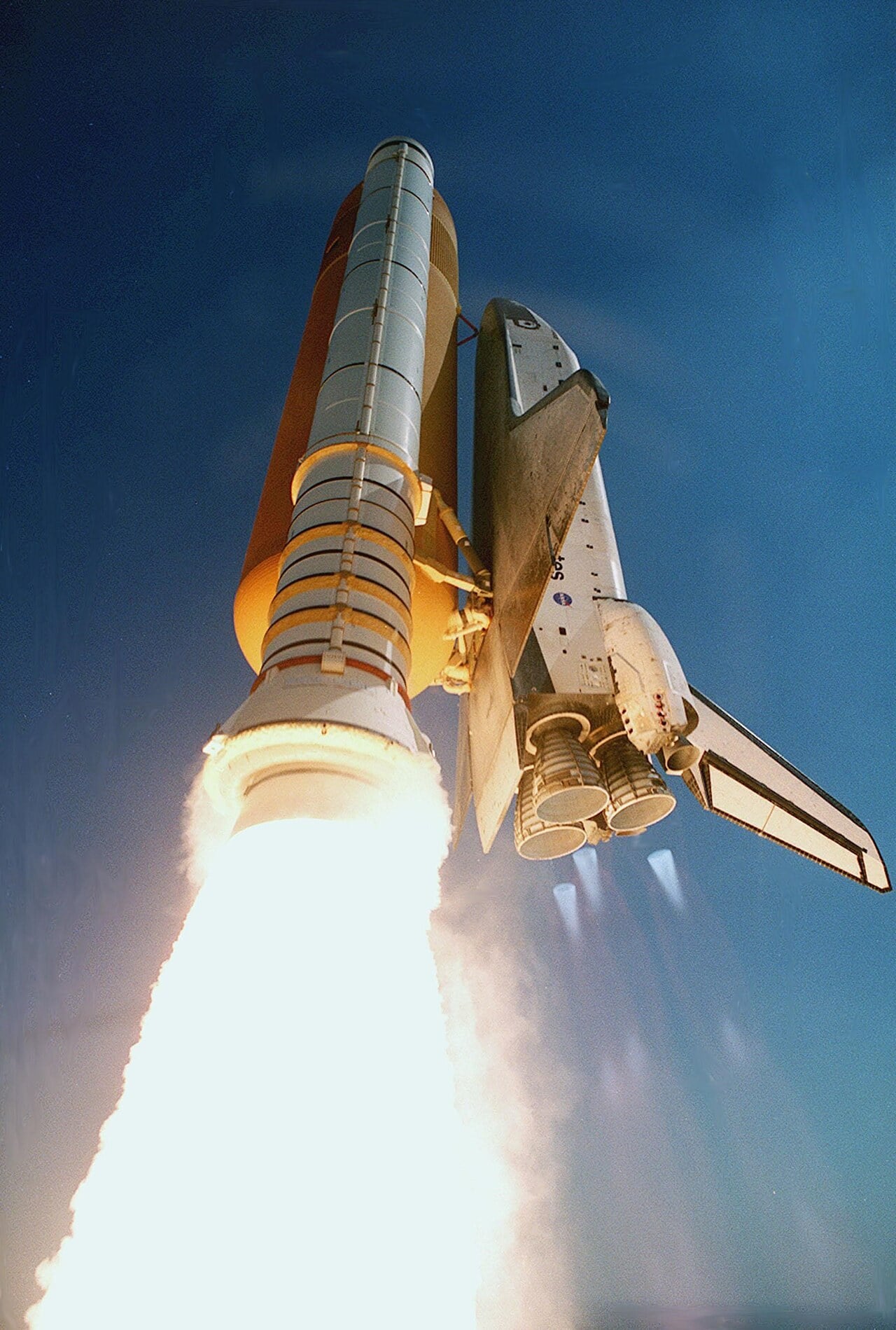
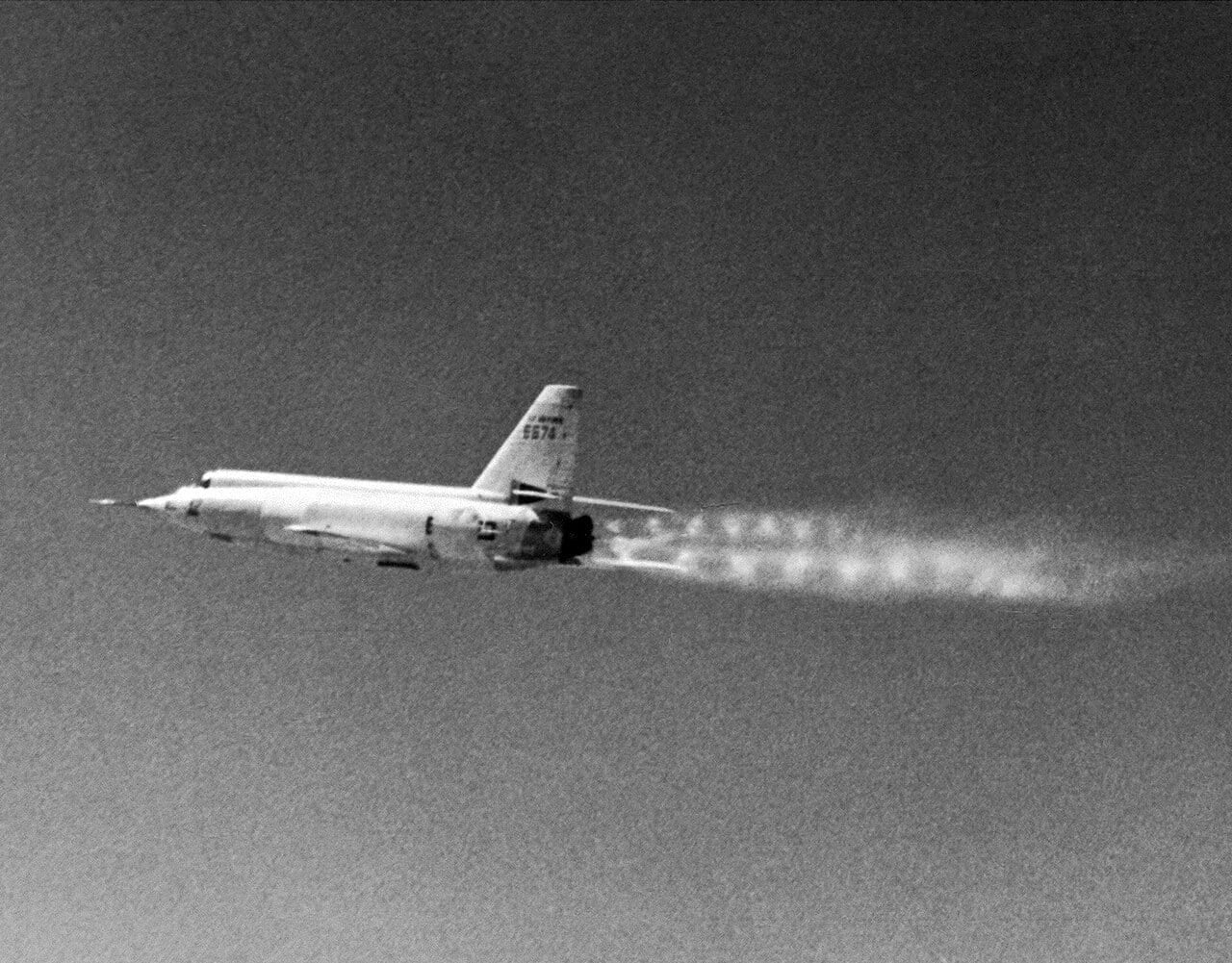
Rockets show them too. The Space Shuttle’s main engines left pale blue Mach diamonds beneath the orbiter at lift-off, and one of the most famous photographs of the phenomenon shows the rocket-powered Bell X-1 in flight. Today’s rocket builders still get asked about them.
Rocket company Relativity Space answers a common question: what are Mach diamonds?
The same physics turns up far from aviation. Artillery muzzle blasts produce shock diamonds that make the flash visible to the enemy, which is one reason for flash suppressors. Astronomers have even suggested that regularly spaced knots in the jets streaming from distant radio galaxies may be shock diamonds on a cosmic scale.
So next time a fighter lights its burners at dusk, look for the beads. They are a map of the air fighting back against the exhaust: every glowing diamond is a place where the atmosphere has squeezed the jet, heated it, and set its leftover fuel alight.
Sources: NASA (X-59 engine tests, February 2025; X-2 and STS-99 image records); NASA Glenn Research Center, Beginner’s Guide to Aeronautics (Nozzles; Nozzle Design); Aerospaceweb.org, “Shock Diamonds and Mach Disks”; Ashkenas and Sherman (1966), as cited in arXiv:2107.06522; Wikipedia (Shock diamond)


0 Comments