
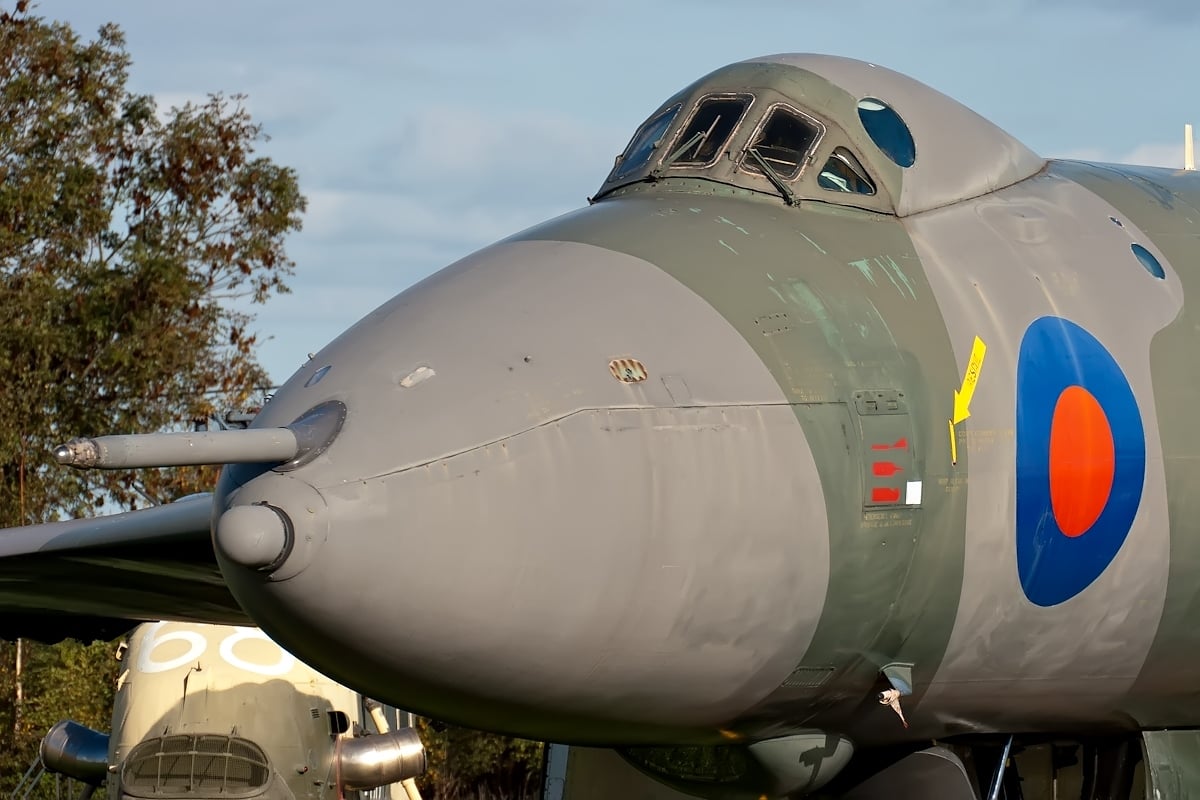
For twelve hours on Saturday 14 October 1961, the skies over the United States and Canada were closed to airliners. About 2,900 commercial flights were cancelled or delayed while NORAD, the North American Air Defense Command, fought off a simulated nuclear attack by its own bombers. Among the attackers were eight Avro Vulcans of the Royal Air Force, playing Soviet heavy bombers. Their performance became one of the RAF’s favourite Cold War stories.
A reel on Instagram says the Vulcans “nuked” America by penetrating its defences. That is broadly true, with some important nuances about how they did it and what the exercise was meant to test.
Informazioni rapide
- Esercizio: Sky Shield II, the largest of three NORAD exercises (1960, 1961, 1962)
- Data: 14 October 1961, 12 hours
- Civil impact: Commercial aviation in the US and Canada grounded; about 2,900 flights cancelled or delayed
- RAF force: Eight Vulcan B.2s: four from No. 83 Squadron via Lossiemouth, four from No. 27 Squadron via Kindley AFB, Bermuda
- Vulcan altitude: About 56,000 feet, above the rest of the attacking force
- Risultato: Only one Vulcan in the northern wave was “shot down”; one southern Vulcan reached Plattsburgh AFB, New York
A Continent Grounded
Sky Shield was designed to test NORAD’s whole system of radars, computers and fighters against a realistic mass bomber attack, and to test how quickly civil air traffic could be cleared out of the way. The first exercise, in September 1960, had already disrupted about a thousand US airline flights. Sky Shield II was bigger still: more than 50 US fighter-interceptor squadrons took part, and airliners on both sides of the border stayed on the ground from 1 p.m. to 1 a.m. Eastern time. At New York’s three airports alone, 955 arrivals and departures and 26,800 passengers were affected.
The attackers came from Strategic Air Command and the RAF. B-47s flew low and jammed the ground radars, B-52s came in at 35,000 to 42,000 feet with B-57s in support, and the RAF Vulcans flew highest of all.
The Northern Wave
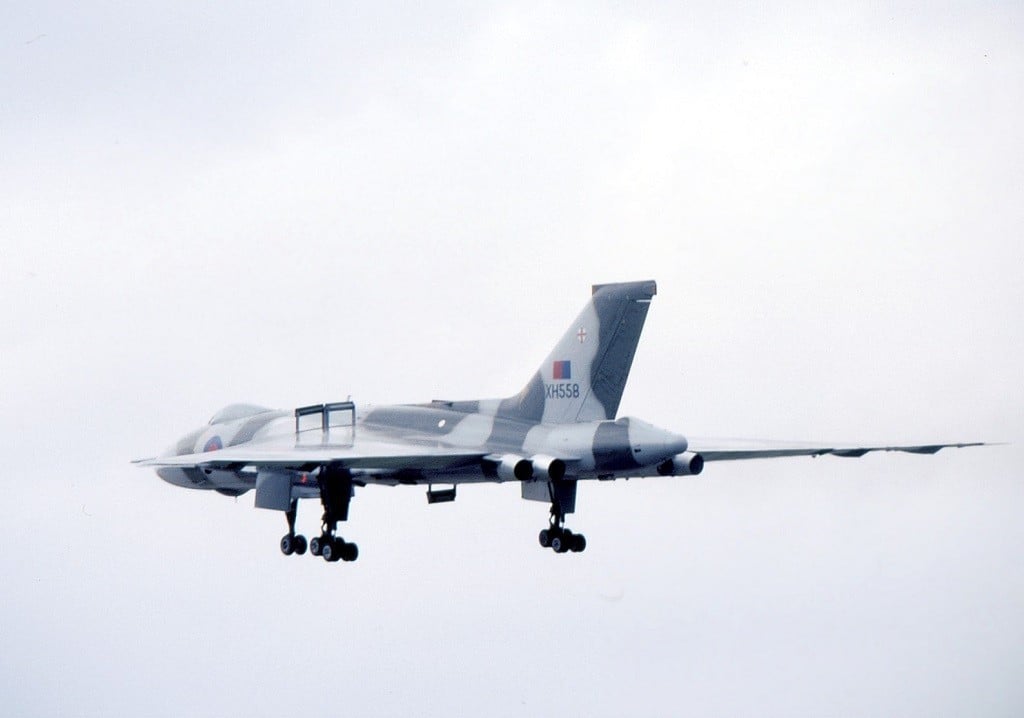
No. 83 Squadron’s four Vulcans approached from the north, out of Scotland. Their electronic countermeasures worked so well that, according to the Vulcan to the Sky Trust’s history of the exercise, only the lead aircraft was detected. An F-101 Voodoo “shot it down” near Goose Bay, Labrador, the exercise’s first kill. The interceptors concentrated on the B-52s, and most lacked the performance to climb to 56,000 feet anyway. The other three Vulcans passed through unopposed and landed at Stephenville, Newfoundland.
The Southern Wave and Plattsburgh
No. 27 Squadron’s four Vulcans came from Bermuda, behind a screen of jamming. When they were about 50 miles from the coast, the fighters were released, and F-102 Delta Daggers went for the three lead aircraft. The fourth Vulcan turned north behind the jamming and flew on unchallenged until it landed at Plattsburgh Air Force Base in upstate New York. In the logic of the exercise, it had reached the heart of the north-east.
That is the origin of the “Vulcan nuked America” story. Accounts differ on how many Vulcans would have been counted as intercepted and where the survivors landed, but they agree on the main point: most of the RAF bombers were never touched.
What NORAD Learned
The Vulcans were not the only attackers to get through. Nearly half of the simulated enemy flights at low altitude escaped detection, chaff and jamming forced controllers to fall back on manual tracking, and NORAD estimated that it would have intercepted no more than a quarter of a real Soviet bomber force. NORAD’s commander, General Laurence Kuter, stressed afterwards that the exercise was not a contest, and that flight-safety restrictions and the absence of simulated nuclear detonations had distorted many of the results.
For the RAF, the exercise was proof that the Vulcan’s altitude and electronic warfare equipment could get it to its targets, at least in 1961. Within a few years, improving Soviet surface-to-air missiles pushed the V-force down to low level, and Britain’s deterrent moved to submarines; we tell that story in Skybolt and Blue Streak.
What the Viral Reel Gets Right
The reel is right that RAF Vulcans took part in Sky Shield II in 1961, playing Soviet bombers, and that they largely penetrated North America’s defences. Two things are worth adding. Not every Vulcan got through: at least one in each wave was intercepted. And NORAD’s weaknesses were not exposed by the British alone; the whole exercise showed how hard it was to stop a determined bomber attack. The footage in the reel, from the 1960 Farnborough air show, shows V-bombers, not the exercise itself.
Visualizza questo post su Instagram
Sources: Air & Space Smithsonian, “This Is Only a Test”; Vulcan to the Sky Trust, “Operation Sky Shield”; Wikipedia, Operation Sky Shield.
Domande frequenti
What was Operation Sky Shield?
Did RAF Vulcans get through NORAD defences in 1961?
Which RAF squadrons took part in Sky Shield II?
How did the Vulcans avoid interception in Sky Shield?
How many flights were grounded during Sky Shield II?
What did NORAD learn from Sky Shield II?
Post correlati
0 Comments