
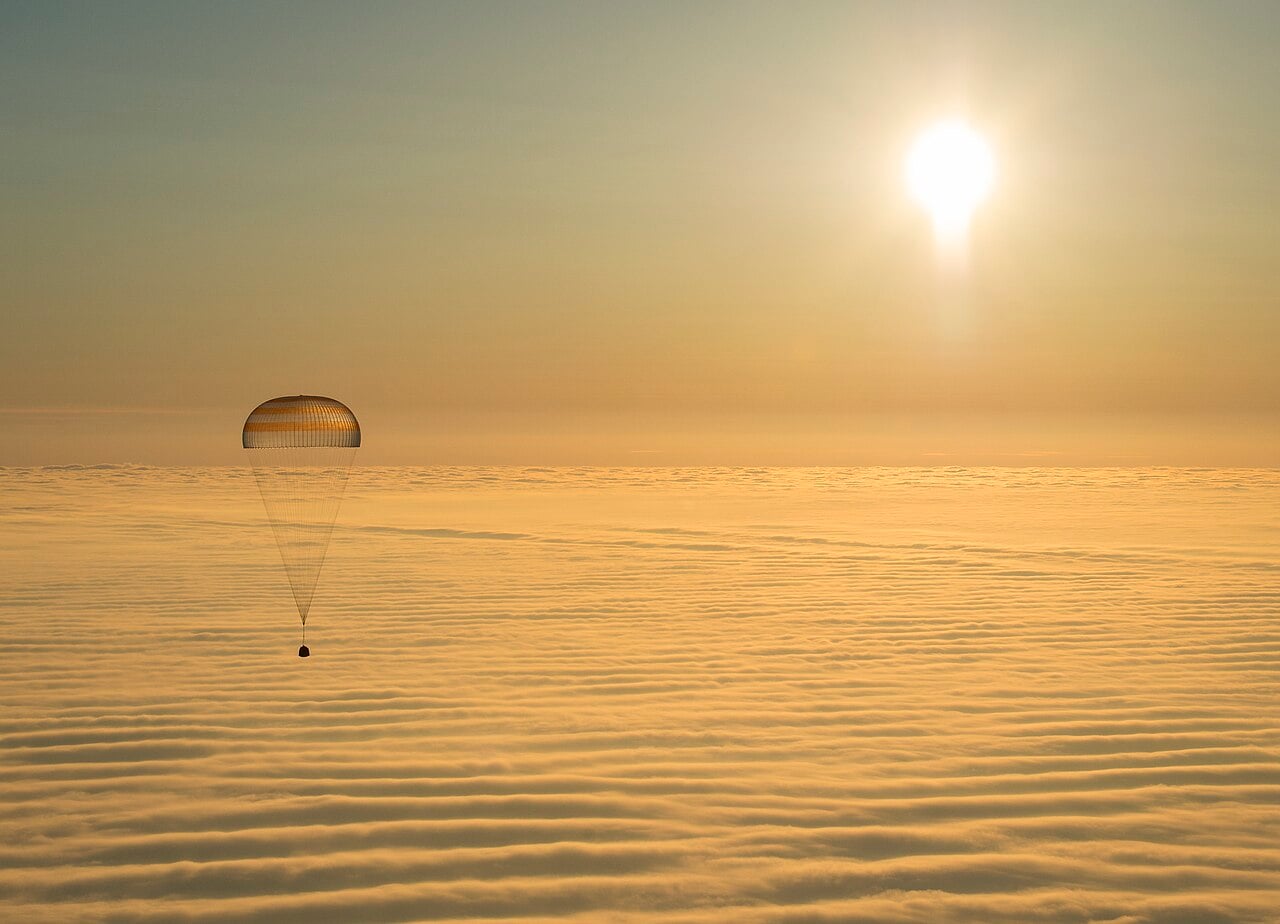
Every Soyuz crew that comes home from the International Space Station ends the trip in the same place: the flat, empty steppe of central Kazakhstan, typically south-east of the town of Zhezkazgan. The region has been the Soviet and Russian landing zone since the 1960s, and the town has its own Soviet-era monument to the conquerors of space. Here is what happens between undocking and the moment the capsule hits the ground.
Informazioni rapide
- Area di atterraggio: Steppe of central Kazakhstan, often about 150 to 200 km south-east of Zhezkazgan
- Undocking to landing: About three and a half hours
- Deorbit burn: About 4 minutes 15 seconds, slowing the Soyuz by about 115 m/s
- Entry interface: About 100 km altitude
- Parachutes: Drogue about 24 m², main about 1,000 m², opening around 10.7 km
- Final descent: About 7 m/s under the main parachute
- Soft-landing engines: Six small engines fire about 0.8 m above the ground, slowing it to about 1.5 m/s
Why Kazakhstan
The Soviet space programme launched from Baikonur in Kazakhstan, and it brought its crews down on land rather than at sea. The steppe south of Zhezkazgan and around Arkalyk offered what a land recovery needs: hundreds of kilometres of flat, sparsely populated ground under the ground tracks of the launch orbits. Russia still uses the same region today under agreements with Kazakhstan. Recovery forces, with helicopters and all-terrain vehicles, work out of Karaganda and Zhezkazgan; in one 2007 landing described by VOA, ten helicopters flew from the Karaganda air base, about 300 km away.
From Undocking to Deorbit
Using the European Space Agency’s published timeline for a typical return, the Soyuz undocks from the station, backs away slowly, and fires a short separation burn. A couple of hours later, about 12 km from the station, it performs the deorbit burn: roughly 4 minutes 15 seconds of thrust that reduces its speed by about 115 metres per second. That is enough to lower the far side of its orbit into the atmosphere.
Three Modules Become One
About 23 minutes after the burn, at around 140 km altitude, the Soyuz separates into its three parts. The orbital module and the service module burn up; only the bell-shaped descent module, with the crew inside, is built to survive. It reaches the top of the atmosphere, the entry interface at about 100 km, a few minutes later, and its heat shield takes the brunt of re-entry while the crew feel several times their normal weight.
Parachutes and a Last-Second Kick
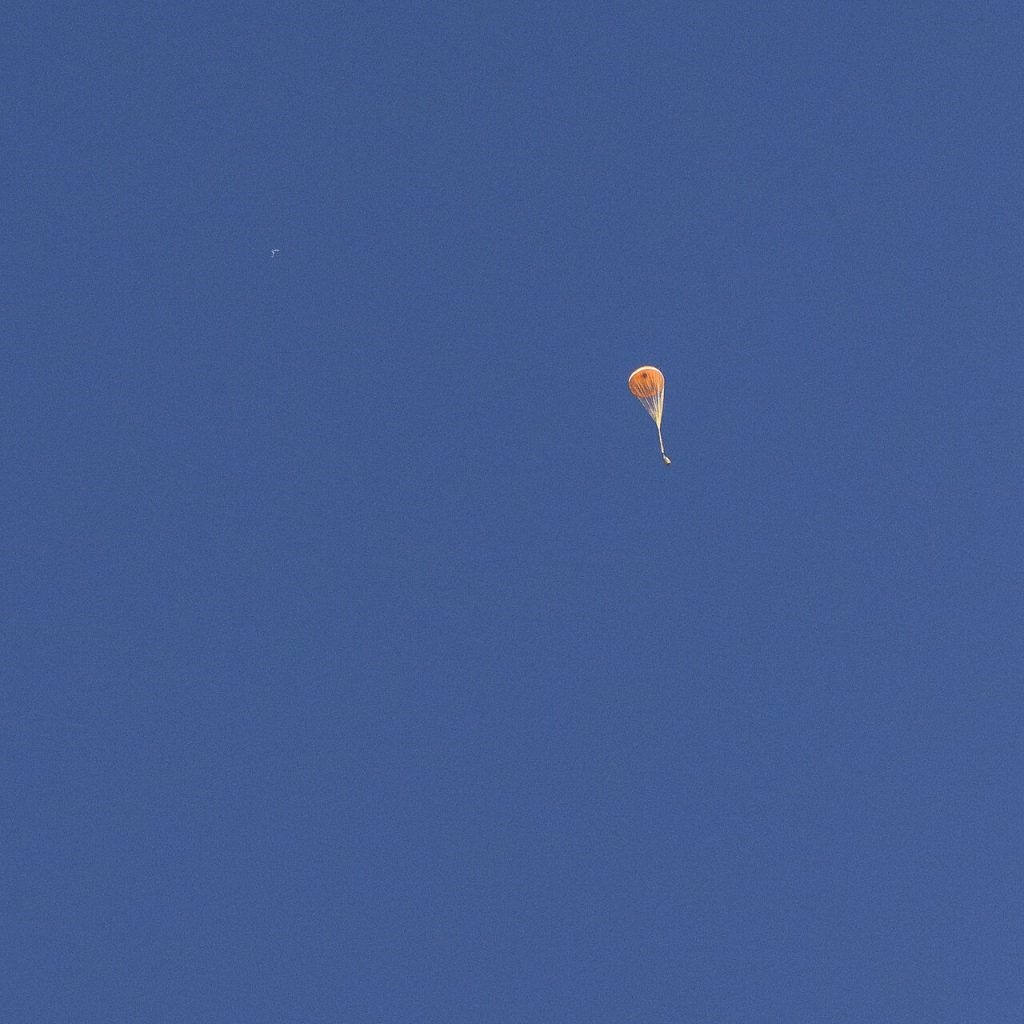
At about 10.7 km, the parachute sequence starts. A small drogue of about 24 square metres slows the capsule from roughly 230 to 80 metres per second, then the main parachute of about 1,000 square metres opens and brings it down to about 7 metres per second. The heat shield is released to expose the landing engines. About two seconds before touchdown, at roughly 0.8 metres above the ground, six small solid-fuel engines fire to cut the landing speed to around 1.5 metres per second. It is still a hard jolt, and crews often describe the landing as a car crash.
Recovery teams reach the capsule within minutes, help the crew out after months of weightlessness, and carry them to medical checks before flights home to Star City near Moscow or to Houston.
The Monument in Zhezkazgan
Zhezkazgan’s place in spaceflight is marked by a Soviet-era monument to the conquerors of space, a reminder that this copper-mining town has been the gateway home for generations of cosmonauts and, since the end of the Space Shuttle programme, for American, European and Japanese astronauts too. Details of the monument’s date and designers circulate online, but we were unable to confirm them from an authoritative source.
Sources: European Space Agency, Soyuz TMA-03M undocking, re-entry and landing sequence (2012); NASA, Soyuz TMA-17M landing site image (11 December 2015) and Soyuz MS-17 landing image (17 April 2021); Voice of America (18 May 2007).
Domande frequenti
Where do Soyuz capsules land?
How long does it take a Soyuz to get from the space station to the ground?
How does a Soyuz slow down before landing?
Why does Russia land Soyuz in Kazakhstan instead of the sea?
Which parts of the Soyuz come back to Earth?
Is a Soyuz landing rough?
Post correlati


0 Comments