
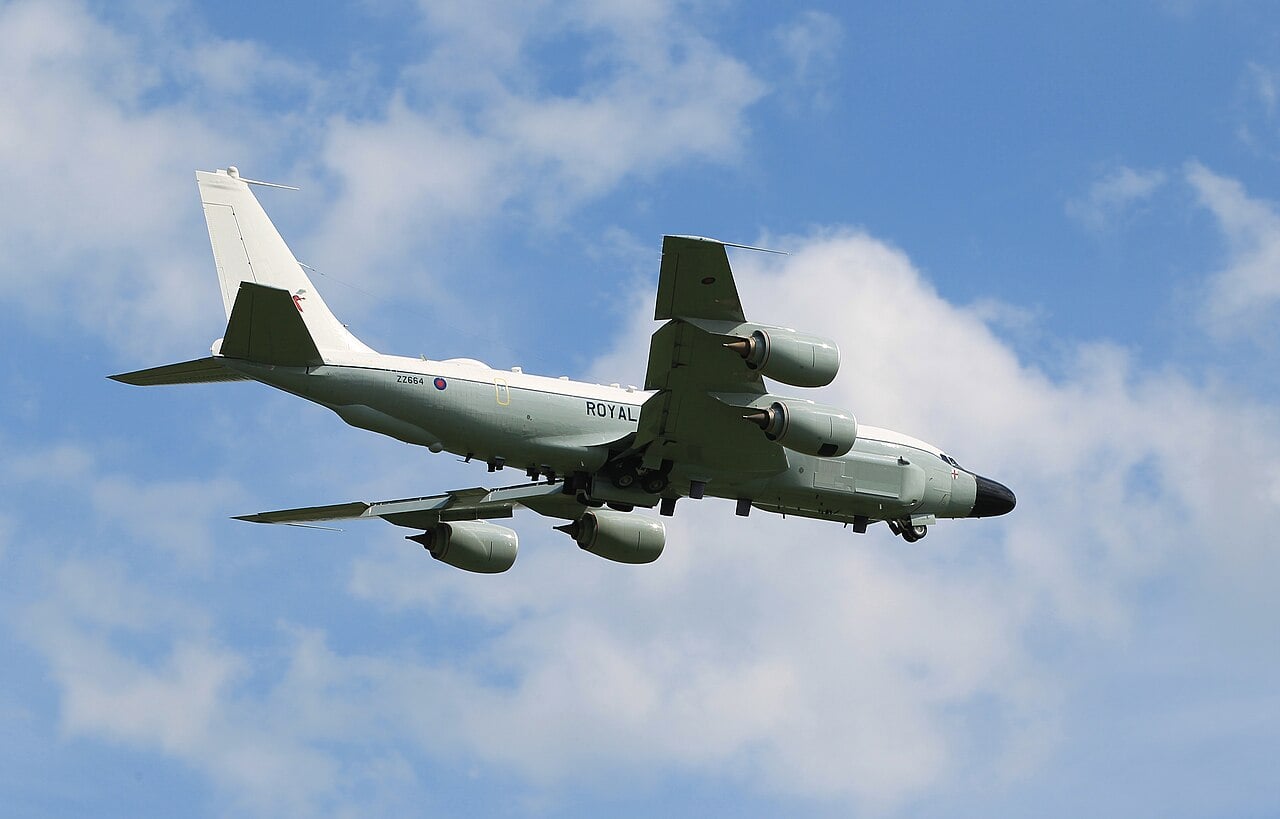
Open a flight-tracking app on almost any day and look at the Black Sea or the Baltic. Among the airliners you will often find something that does not belong: a four-engined jet flying long racetrack patterns off a coastline, or a drone orbiting at 50,000 feet for most of a day. They are spy planes, and anyone with a phone can watch them.
It seems like a contradiction. Why would an intelligence-gathering aircraft broadcast its own position to the world? The answer lies in a technology called ADS-B, in the rules of international airspace, and in a network of tens of thousands of enthusiasts' receivers.
Informazioni rapide
- ADS-B: Automatic Dependent Surveillance-Broadcast: the aircraft broadcasts its identity, position, altitude and velocity
- Frequencies: 1090 MHz Extended Squitter for most aircraft; 978 MHz UAT for some US general aviation
- US mandate: Required in most controlled US airspace since 1 January 2020
- MLAT: Multilateration: locating aircraft without ADS-B position data from the timing of their transponder signals at several receivers
- Flightradar24 network: More than 50,000 receivers on seven continents and in space, according to the company
- Encryption: None: ADS-B signals are unencrypted and can be received by anyone
How ADS-B Gives the Game Away
ADS-B is simple. An equipped aircraft works out its position from satellite navigation and broadcasts it automatically, along with its identity, altitude and speed, with no action from the pilot. Air traffic control uses the data, and so do other aircraft. So does anyone else with a cheap receiver and an antenna, because the signals are not encrypted.
Flight-tracking services such as Flightradar24 collect these broadcasts from volunteers' receivers around the world. For aircraft whose transponders send an identity but no position, they use multilateration: several receivers note the precise moment the same signal arrives, and the differences in timing reveal where the aircraft is. Many military aircraft fall into this category, according to Flightradar24, because they carry Mode S transponders that send less data.
Flightradar24 explains how ADS-B tracking works. Video: Flightradar24
Why Spy Planes Switch Their Transponders On
Reconnaissance aircraft such as the RC-135 usually fly in international airspace, often through busy airline corridors. Broadcasting their position lets air traffic controllers and airliners see them and keep their distance. According to The Aviationist, that safety and deconfliction role, under the principle of due regard in international airspace, is why military aircraft transmit at all.
Crucially, switching the transponder on gives little away to an adversary. The country being watched tracks these aircraft on its own radar anyway, with or without ADS-B. The people who learn most from the broadcasts are the public and the open-source intelligence community.

The Hex Code Affair
Not every broadcast is what it seems. On 7 September 2020, during a mission near China's Hainan island, a US Air Force RC-135W transmitted a Malaysian aircraft's hex code instead of its own, according to The Aviationist. It caused a stir online, but the change made no difference to Chinese air defences, which identify aircraft by radar, flight plans and track history, not only by transponder codes.
Hopkins suggested the only audience such tricks confuse is the amateur tracking community, and argued the practice was counterproductive.
What the Trackers See
When Russia invaded Ukraine in 2022, Flightradar24 published a guide to the military traffic its users were watching around the country: RQ-4 Global Hawk drones under the callsign FORTE flying distinctive patterns over the Black Sea at more than 50,000 feet, RAF RC-135s from Waddington near Ukraine's western border and Belarus, NATO E-3 AWACS, tankers and transports.

The watching continues. On 25 September 2026, UK Defence Journal reported, based on Flightradar24 data, that both of the RAF's operational Rivet Joints had flown intelligence missions at the same time, one around the Baltic and Kaliningrad and one over the Black Sea. Specialist sites such as ItaMilRadar track the same aircraft day by day. What was once secret is now, at least in outline, a matter of public record.
The Canada Aviation and Space Museum explains ADS-B in two minutes. Video: Canada Aviation and Space Museum
What the Trackers Do Not See
There are limits. Aircraft can fly with their transponders off, and many military missions do. Flight trackers show where an aircraft is, not what it is doing. And privacy programmes such as the FAA's LADD scheme can hide some aircraft from tracking websites, though because ADS-B is unencrypted, the raw data can still be received by anyone listening.
So the next time you spot a lonely jet circling off a coastline on your flight-tracking app, you may be looking at a spy plane at work. It is visible because its crew want other aircraft to see them. What it is listening to stays secret.
Captain Joe on ADS-B and the future of aircraft surveillance. Video: Captain Joe
Sources: Flightradar24, Wikipedia (ADS-B), The Aviationist, UK Defence Journal

0 Comments