
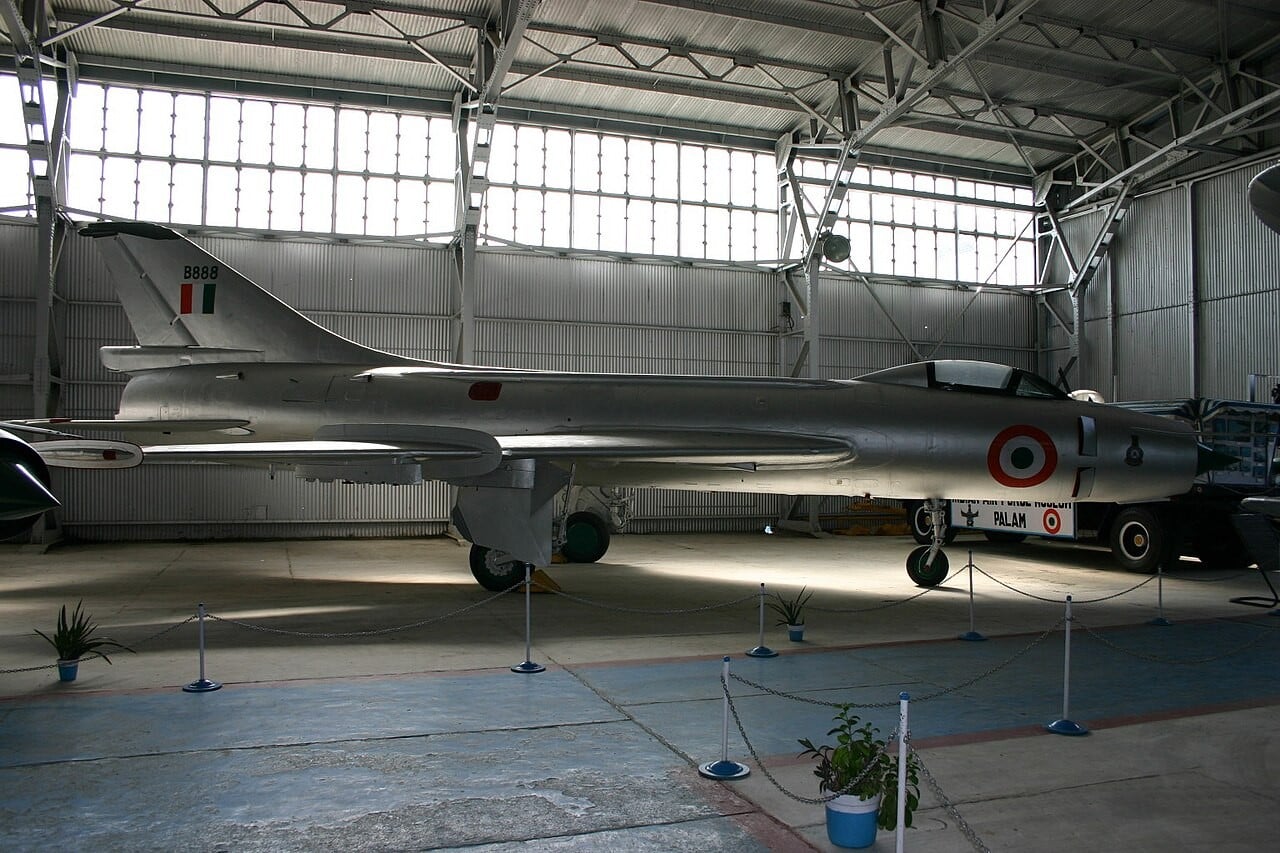
Somewhere over West Pakistan in December 1971, a missile fired by a Pakistani fighter slammed into the tail of an Indian Sukhoi Su-7. The blast carried away half the rudder and wrecked the elevators, ailerons and flaps. Wing Commander H.S. Mangat, commanding officer of No. 32 Squadron, flew the jet home anyway. Its battered tail section now sits in the Indian Air Force Museum at Palam.
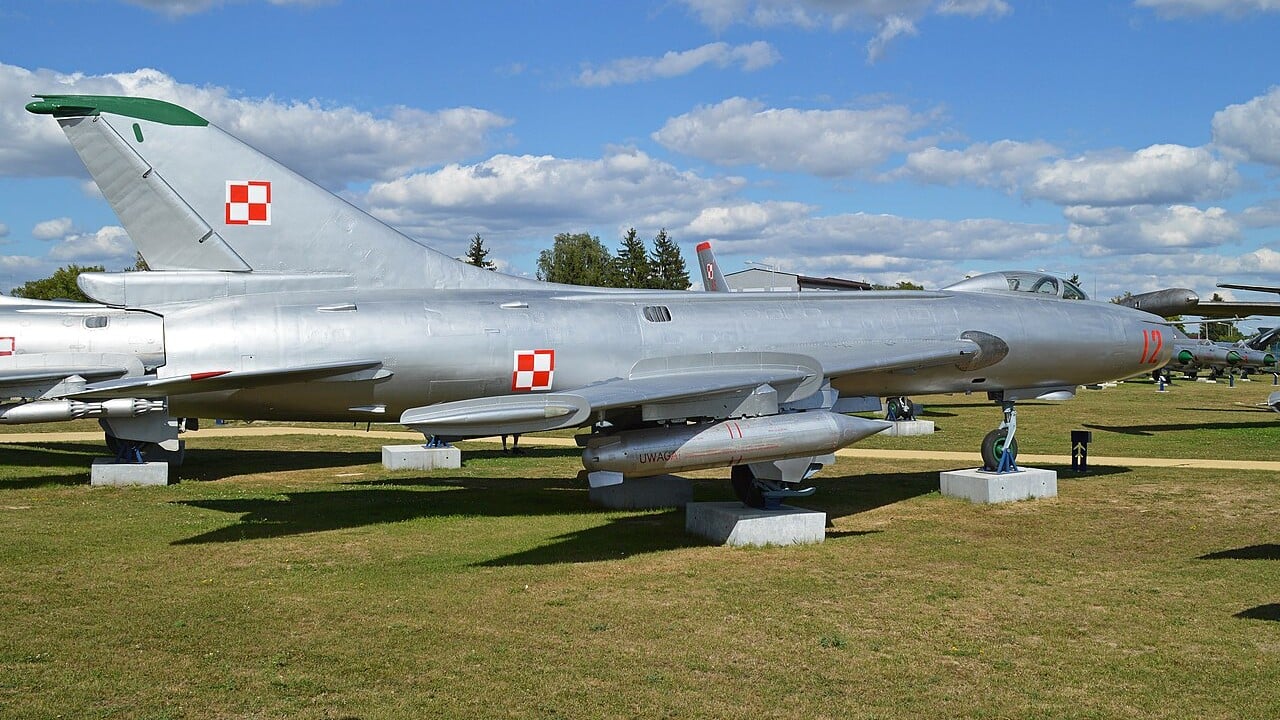
That was the Su-7 in a single story. NATO called it Fitter. It was thirsty, heavy on the controls, short on range and fast to land, and pilots who flew it in combat came to trust it with their lives. For most of the 1960s it was the Soviet Union’s main fighter-bomber, and it went to war in South Asia and the Middle East.
Informazioni rapide
- Tipo: Single-seat supersonic fighter-bomber (two-seat trainers: Su-7U/UM/UMK)
- NATO name: Fitter-A (trainers: Moujik)
- Primo volo: 7 September 1955 (S-1 prototype, A.G. Kochetkov)
- Su-7B service entry: 1961
- Motore: One Lyulka AL-7F afterburning turbojet, around 94 kN (21,000 lb) with afterburner
- Armamento: Two 30 mm NR-30 cannon plus bombs and rockets on external hardpoints
- Costruito: More than 1,800 of all variants
- Combattere: 1971 Indo-Pakistani War, Six-Day War, War of Attrition, 1973 war, Afghanistan
- Successore: Su-17 (variable-geometry derivative), MiG-27
A fighter that found another job
The Su-7 was born as an interceptor-style frontline fighter. Pavel Sukhoi’s design bureau, re-established after Stalin’s death, built a swept-wing prototype called the S-1 around the new Lyulka AL-7 turbojet. Test pilot A.G. Kochetkov flew it for the first time on 7 September 1955.
The S-1 broke new ground for Soviet designers. It was the first Soviet aircraft with an all-moving tailplane and a translating centrebody, a movable cone in the nose intake that managed airflow to the engine at supersonic speed. The wings were swept at around 60 degrees.
As a fighter, though, it never really took off. Only a little more than 130 of the fighter version were built before Soviet planners committed to the lighter MiG-21. Instead, in 1958 Soviet frontline aviation asked Sukhoi for a ground-attack variant. The resulting S-22 prototype flew in 1959 and entered service as the Su-7B.
All engine, little range
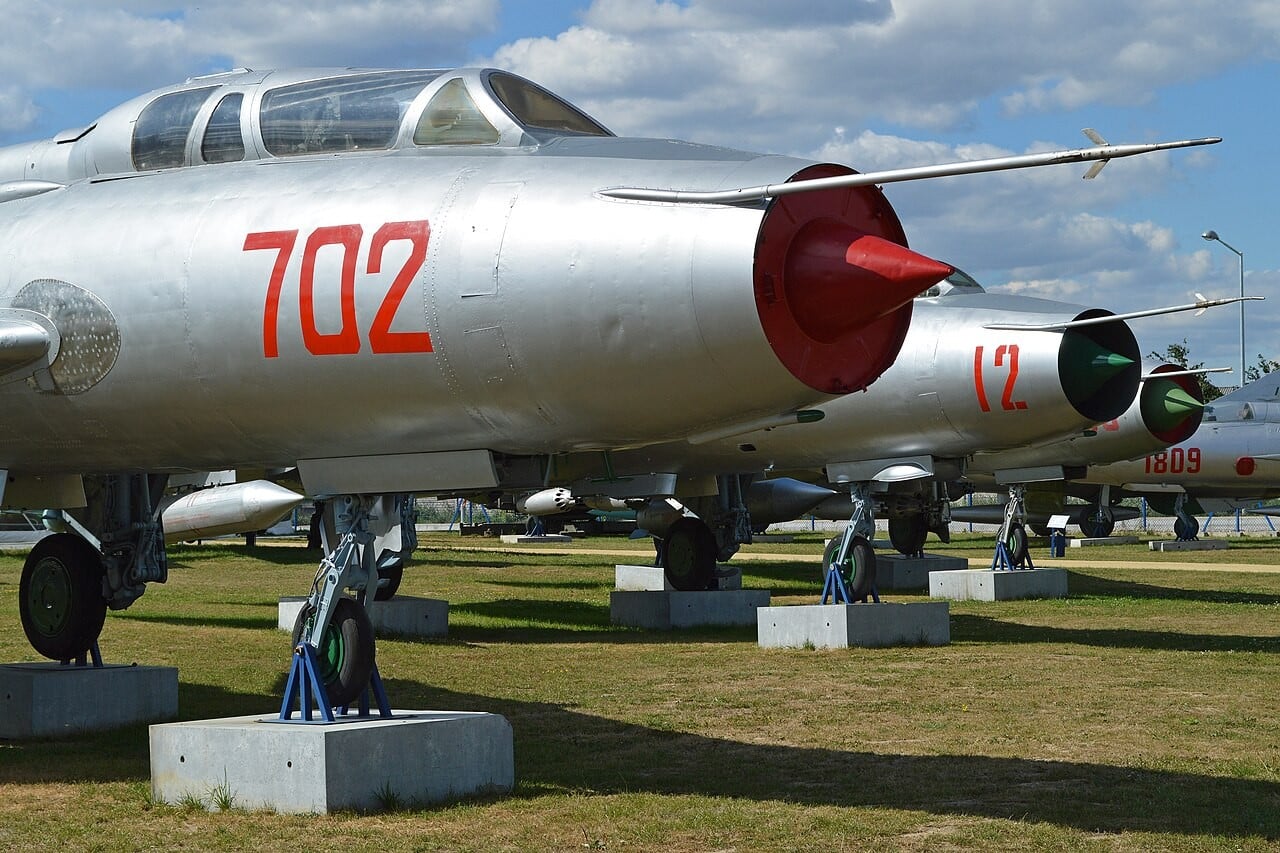
The heart of the Su-7B was its Lyulka AL-7F turbojet, producing around 94 kN (21,000 lb) of thrust in afterburner. It gave the Fitter real speed at low level, where Indian pilots found that, with reheat lit, it could leave even the MiG-21 behind. It also drank fuel so fast that even short missions usually needed drop tanks on two of the hardpoints, leaving less room for bombs and rockets.
The highly swept wing brought another problem: a high landing speed and long runways. Sukhoi tried several fixes. The Su-7BKL added skids beside the main wheels for rough strips, twin brake parachutes and provision for rocket boosters to shorten take-off. Fixed armament was a pair of 30 mm NR-30 cannon in the wing roots.
Production of the family ran until the early 1970s, with more than 1,800 built, including two-seat trainers that NATO called Moujik. Hundreds were exported. The type was not forgiving: Ukraine’s Antonov State Aviation Museum counts 114 crashes and more than 220 accidents in the Soviet Union alone.
A look at the Su-7 in Soviet Air Force service.
India’s whale of a fighter
India evaluated the Su-7 in 1966 and 1967 while its home-grown HF-24 Marut was held back by engine problems. No. 26 Squadron received the first aircraft in March 1968, and within about 18 months the Aeronautica militare indiana had six Su-7 squadrons and some 140 aircraft.
Not everyone was charmed at first. Indian pilots joked that the solidly built jet had been designed as a tank, and Bharat Rakshak’s history recalls a Gnat squadron commander whose only verdict after his first Su-7 flight was a single word: “Why?” Over time, though, the type earned the nickname that stuck in India, a “whale of an aircraft”.
The jet became the backbone of India’s daytime strike force in the December 1971 war with Pakistan. The six squadrons flew nearly 1,500 offensive sorties, from runway attacks on forward airfields to close air support against Pakistani armour in the Chhamb and Shakargarh sectors. At the peak, pilots flew up to six sorties a day each.
The ground fire was ferocious, and the big Su-7 was exposed on every low-level pass. Many aircraft came home peppered with holes. Indian figures put the losses at 14 aircraft, most of them to anti-aircraft fire, though both sides made claims that remain disputed.
Mangat’s jet was one of the survivors. It was hit by an air-to-air missile fired by a Aeronautica militare pakistana Shenyang F-6, the Chinese-built MiG-19. Flight Lieutenant J.S. Ghuman brought his Su-7 back with pieces of a missile still lodged in its tail.
The tempo was relentless. One Indian base commander later described a campaign that grew rather than tapered off, with ground crews patching battle damage around the clock.
Fitters in the Arab-Israeli wars
In the Middle East the Su-7 had a harder time. The Egyptian Air Force lost its first batch of 14 aircraft during the Six-Day War of June 1967. Moscow replaced them, and Egyptian Su-7s flew in the War of Attrition along the Suez Canal and against Israeli ground forces in the October 1973 war.
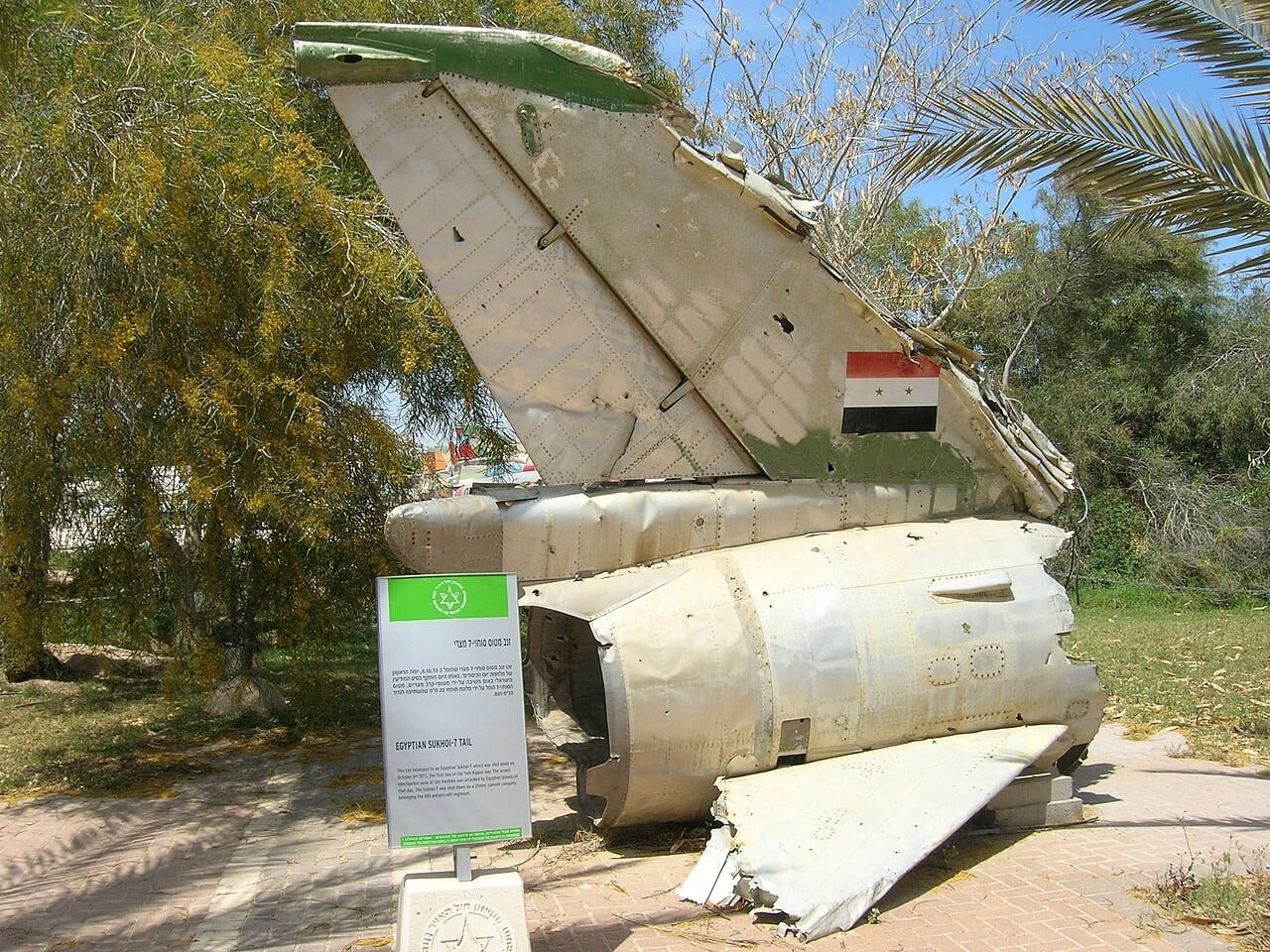
IL Syrian Air Force received its first Su-7s shortly after the 1967 war and used them heavily for low-level ground attack in the October 1973 war, suffering considerable losses. The Iraqi Air Force took deliveries from 1967, and Algeria and Afghanistan also flew the type. Afghan Su-7s were used extensively during the Soviet war there, where high-altitude fields and hard use took a steady toll.
From Su-7 to Su-17
Sukhoi kept chasing the Fitter’s weak spot: take-off and landing. One experimental Su-7, the Su-7IG, was fitted with variable-geometry outer wings that could spread for slow flight and sweep back for speed. It led to the Su-17, the first variable-sweep aircraft to enter Soviet service, which was exported as the Su-20 and Su-22.
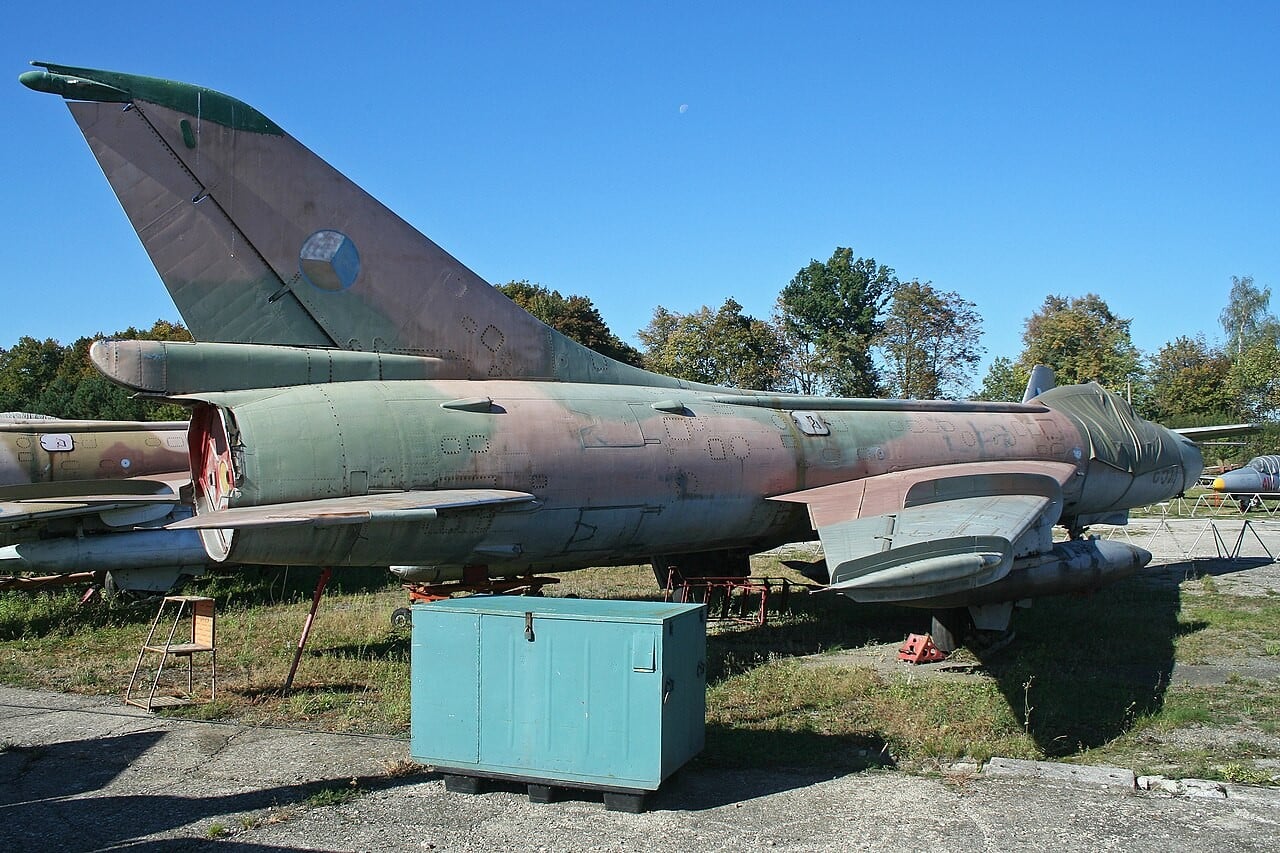
In Soviet service, the remaining Su-7s were replaced by Su-17s and MiG-27s between 1977 and 1986. India retired its last Su-7s in 1986, and Poland and Czechoslovakia kept theirs until 1990.
Air Commodore K.C. Kuruvilla, a veteran of the 1971 war, on the Su-7 in combat against Pakistan.
The Su-7 never had the elegance of a pure fighter. It was a big engine with a cockpit, wings and guns attached. But in December 1971, flown low through a wall of flak by pilots who refused to quit, it delivered exactly what India asked of it, and often brought them home with half a tail.
Sources: Bharat Rakshak (Pushpindar Singh Chopra, “A Whale of a Fighter”), O.K. Antonov State Aviation Museum, WarHistory.org
Header photo: Alan Wilson / Wikimedia Commons, CC BY-SA 2.0
0 Comments