
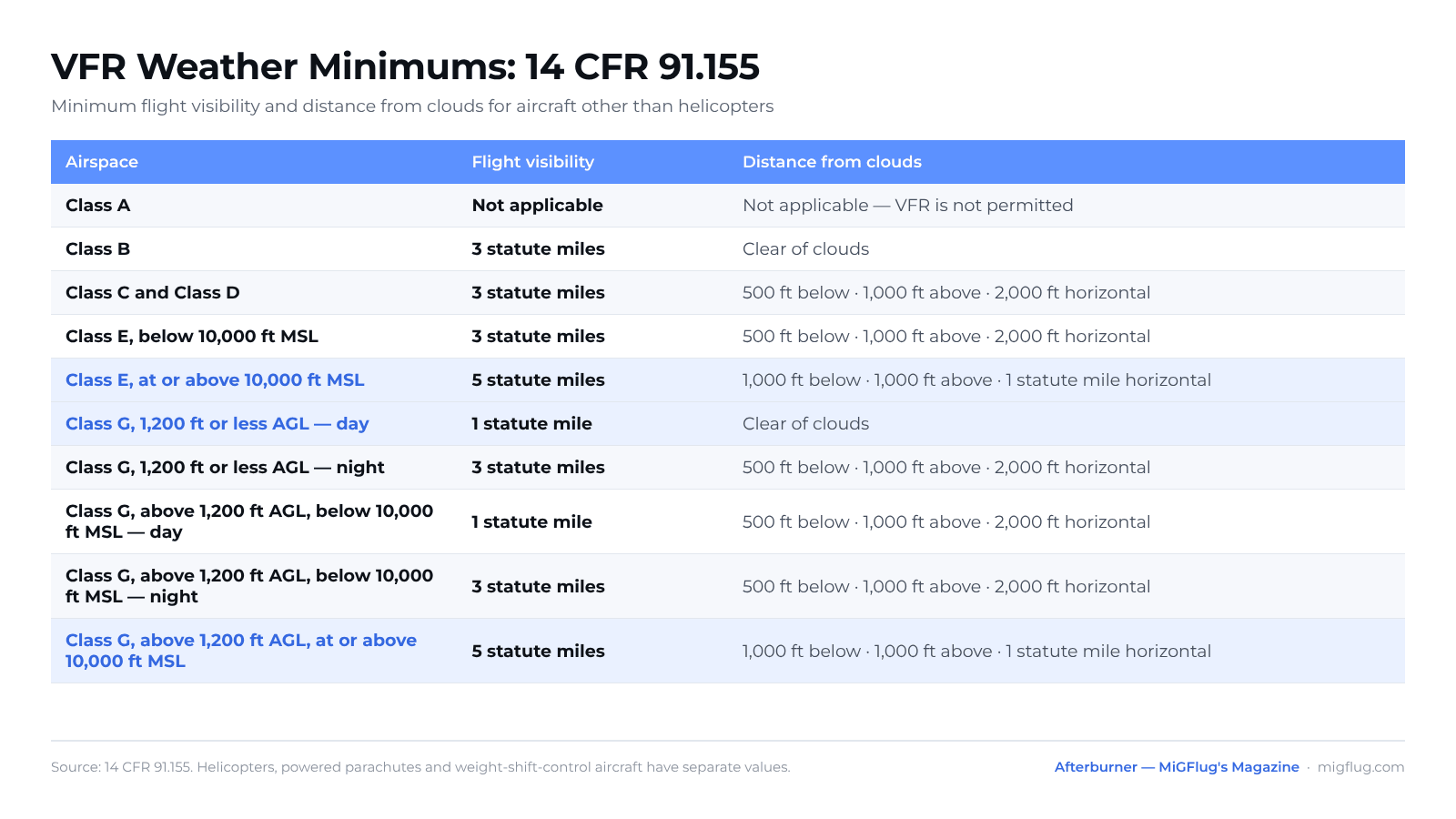
Every student pilot memorises the table. Three miles, five hundred below, a thousand above, two thousand horizontal. Then one statute mile and clear of clouds somewhere near the bottom, and five miles with a mile of horizontal clearance somewhere near the top, and a column for helicopters that nobody can ever quite recall.
Almost nobody is taught why. The table gets presented as a list of arbitrary numbers to be survived on a written exam and then half-forgotten. It is not arbitrary. 14 CFR 91.155 is a designed object, and once you can see the design, the numbers stop needing to be memorised at all.
Here is the whole thing, and then the reasoning underneath it.
Informazioni rapide
The rule: 14 CFR 91.155, “Basic VFR weather minimums”
The standard case: 3 statute miles visibility, 500 ft below, 1,000 ft above, 2,000 ft horizontal
The outlier: Class B is 3 statute miles but only clear of clouds
The lowest bar: Class G at or below 1,200 ft AGL by day, 1 statute mile and clear of clouds
The break point: 10,000 ft MSL, where the figures jump to 5 miles and 1,000/1,000/1 mile
Helicopters get their own, lower, numbers throughout — down to half a statute mile
Origine: Doc. No. 24458, 56 FR 65660, 17 December 1991, as amended
What the Rule Actually Says
Section 91.155 is titled “Basic VFR weather minimums” and it has five paragraphs. Paragraph (a) is the table everyone knows: for each class of airspace, a minimum flight visibility and a minimum distance from clouds. Paragraph (b) carves out two exceptions in Class G below 1,200 feet. Paragraph (c) sets a ceiling limit. Paragraph (d) governs taking off, landing and entering a traffic pattern. Paragraph (e) is a definition.
The rule dates from Doc. No. 24458, published at 56 FR 65660 on 17 December 1991, and has been amended since. The featured table at the top of this article reproduces paragraph (a) for aircraft other than helicopters.
Two numbers run through almost all of it. Three statute miles of flight visibility, and a cloud clearance block of 500 feet below, 1,000 feet above and 2,000 feet horizontal. Pilots shorthand that as “three one five two”, or draw it as a little diagram with the aeroplane in the middle. That is the default case, and it applies in Class C, Class D, and Class E below 10,000 feet MSL.
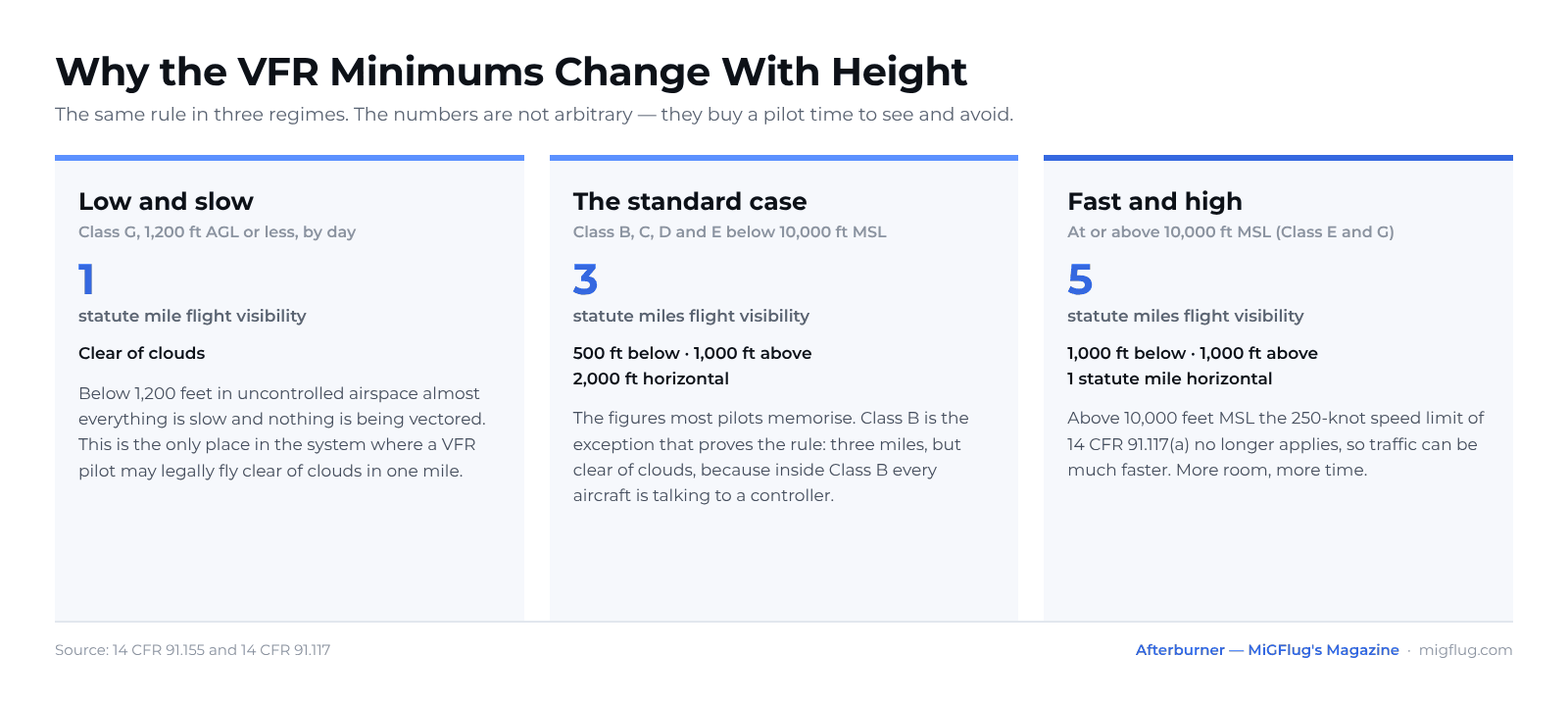
Everything else in the table is a deliberate departure from that default. There are exactly three departures, and each one has a reason.
Departure One: Class B, Where Everybody Is Being Watched
Class B asks for three statute miles of visibility, the same as the default, but requires only that you stay clear of clouds. No 500 below, no 1,000 above, no 2,000 horizontal.
That looks backwards. Class B is the busiest airspace in the system, wrapped around the largest airports, and it has the loosest cloud-clearance requirement in controlled airspace. The reason is that you cannot be in Class B at all without an explicit ATC clearance. Every aircraft inside it is known to a controller and is being separated. The cloud clearance in the default case exists so that a VFR pilot has time to see and avoid an aircraft emerging from a cloud. Inside Class B there is nothing emerging unannounced, so the margin is not needed, and insisting on it would make the airspace unusable on a day with a broken layer at 2,500 feet.
Read that way, Class B is not an anomaly. It is the clearest statement of what the cloud clearances are for.
Departure Two: 10,000 Feet MSL, Where Everything Gets Faster
At or above 10,000 feet MSL, in both Class E and Class G, the figures jump: five statute miles of flight visibility, and 1,000 feet below, 1,000 feet above and one statute mile horizontally.
The reason is in a different regulation. 14 CFR 91.117(a) caps indicated airspeed at 250 knots below 10,000 feet MSL. Above that altitude the cap goes away. The same closure geometry that three miles and 2,000 feet buys you at 200 knots buys you very little against an aircraft doing 400, so the rule gives you more room and, more to the point, more time.
Note the detail that catches people out: the trigger is 10,000 feet MSL, not AGL, and in Class G it is combined with the 1,200 ft AGL test, so a Class G row can require you to be above 1,200 feet AGL E at or above 10,000 feet MSL before the five-mile figures bite.
FlightInsight’s walk through the table, above, is the clearest video treatment we found of the airspace-by-airspace breakdown.
Departure Three: Class G Below 1,200 Feet, Where the System Lets Go
This is the one that generates the most confusion, and the most search traffic, because four different sets of numbers apply inside the same block of air.
In Class G at 1,200 feet AGL or less, by day, an aeroplane needs one statute mile of flight visibility and may fly clear of clouds. That is the lowest bar anywhere in 91.155 for an aeroplane, and it is the only place in the national airspace system where a VFR pilot may legally operate clear of clouds in a single mile of visibility. A helicopter in the same place and time needs only half a mile.
At night the same airspace demands three statute miles and the full 500/1,000/2,000 block for aeroplanes, and one mile clear of clouds for helicopters. Above 1,200 feet AGL by day, the aeroplane visibility figure stays at one mile but the cloud clearances snap back to the default.
The logic is the same as everywhere else: Class G is uncontrolled, nothing in it is being separated, and below 1,200 feet on a clear day almost everything flying is slow and visually navigating. Take away the daylight and the risk calculation changes, so the numbers change with it.
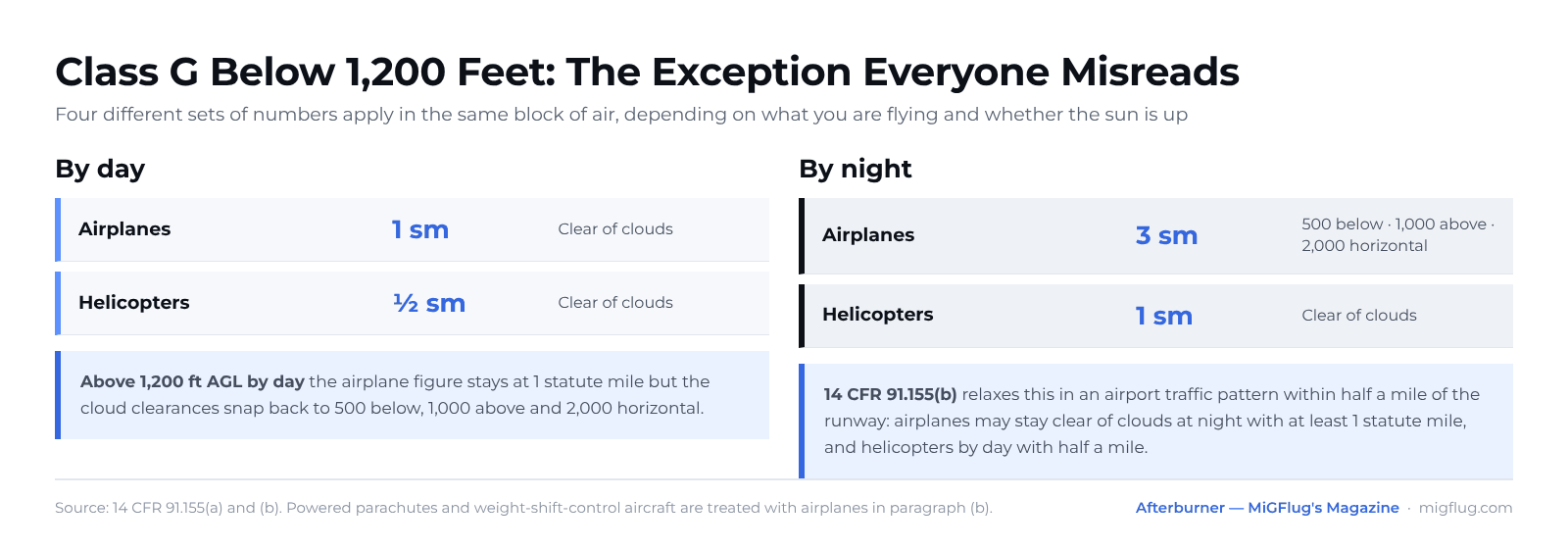
Paragraph (b) then adds a further relaxation that very few pilots can quote. Inside an airport traffic pattern, within half a mile of the runway or helipad of intended landing, helicopters may operate clear of clouds with at least half a mile of flight visibility; and aeroplanes, powered parachutes and weight-shift-control aircraft may do the same at night with at least one statute mile but less than three. It is a narrow carve-out, and it exists so that the rule does not make a legal night circuit impossible at an uncontrolled field under a low deck.
The Two Paragraphs Nobody Memorises
Paragraph (c) is a single sentence and it catches people out because it is not about visibility at all. Under VFR you may not fly beneath a ceiling of less than 1,000 feet within the lateral boundaries of controlled airspace designated to the surface for an airport. Three miles of visibility underneath an 800-foot overcast does not make the flight legal there.
Paragraph (d) is the one that keeps student pilots on the ground. You may not take off, land, or enter a traffic pattern within the surface area of Class B, C, D or E airspace unless ground visibility at that airport is at least three statute miles — or, if ground visibility is not reported, flight visibility during the operation is at least three. That is why the reported value at the field, not the pilot’s own assessment, is usually what decides the question.
Both paragraphs carve out an exception and both point to the same place: 14 CFR 91.157.
Paragraph (e) is the definition that makes the table work at a boundary: an aircraft operating at the base altitude of a Class E area is treated as being in the airspace directly below it.
What the Table Is Not
The minimums are a legal floor, not a recommendation. That distinction is the whole safety argument, and the accident record supports it. The AOPA Air Safety Institute’s analysis of NTSB data from 2008 to 2020 counted 111 fatal accidents in which a VFR flight encountered instrument conditions, plus another 97 fatal accidents in which VFR into IMC was a contributing factor — 49 of them loss of control and 37 controlled flight into terrain. Sixty-nine per cent happened in daylight. Eighty-one per cent of the pilots were on no flight plan at all.
An FAA study of 98 Alaskan commercial accidents between 1983 and 2000 found something more uncomfortable still: in roughly 53 per cent of cases the pilot made an active decision to continue into instrument conditions, and only about 10 per cent were genuinely inadvertent. The weather was as forecast in 59 per cent of them.
One statute mile and clear of clouds is legal in Class G by day. It is also, for a pilot without an instrument rating in rising terrain, close to the worst visual environment imaginable. Our piece on 178 seconds covers what happens next, and this article is not going to retell it.
If you are hunting for the memory aid rather than the reasoning, the video above is the most popular treatment of it. Our view is that the mnemonic is a crutch and the design is the thing worth carrying.
The Shape of the Thing
Strip away the rows and 91.155 says something simple. Where traffic is controlled, you need less room from cloud, because nothing will come out of one unannounced. Where traffic is fast, you need more room and more visibility, because closure speeds eat your reaction time. Where traffic is slow, uncontrolled and close to the ground in daylight, the rule trusts you with the least.
Three variables — control, speed, light — and every number in the table falls out of them. That is worth more than the mnemonic, because it survives the checkride.
Sources: 14 CFR 91.155 (GPO, Code of Federal Regulations, 2024 edition) and 14 CFR 91.117; Legal Information Institute, Cornell Law School; FAA Safety Team course material, “VFR Weather Minimums”; AOPA Air Safety Institute, VFR into IMC accident analysis; FAA Alaska Region, “VFR into IMC: A Review of Accidents Involving Alaskan Air Taxi Commercial Flight Operations 1983 to 2000” (Kobelnyk, 2004).


0 Comments