
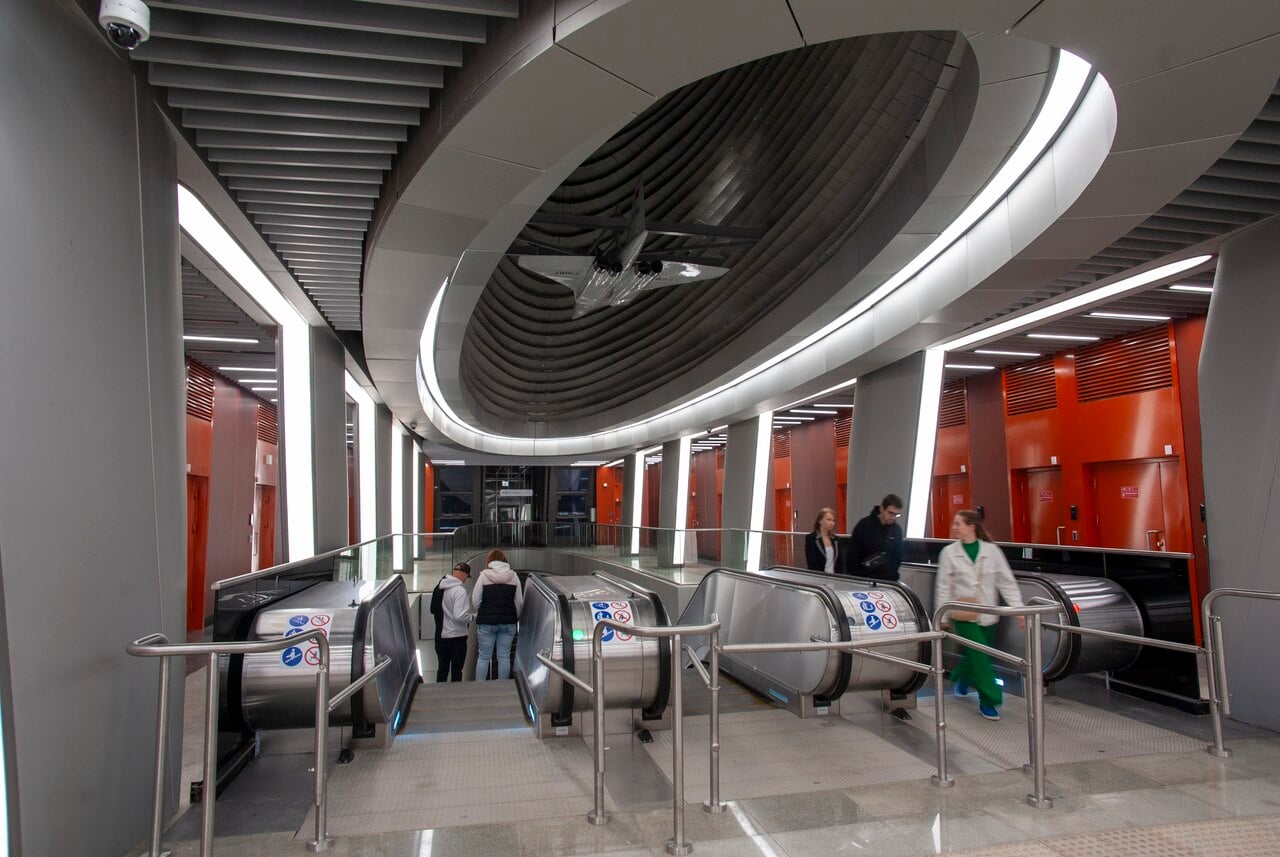
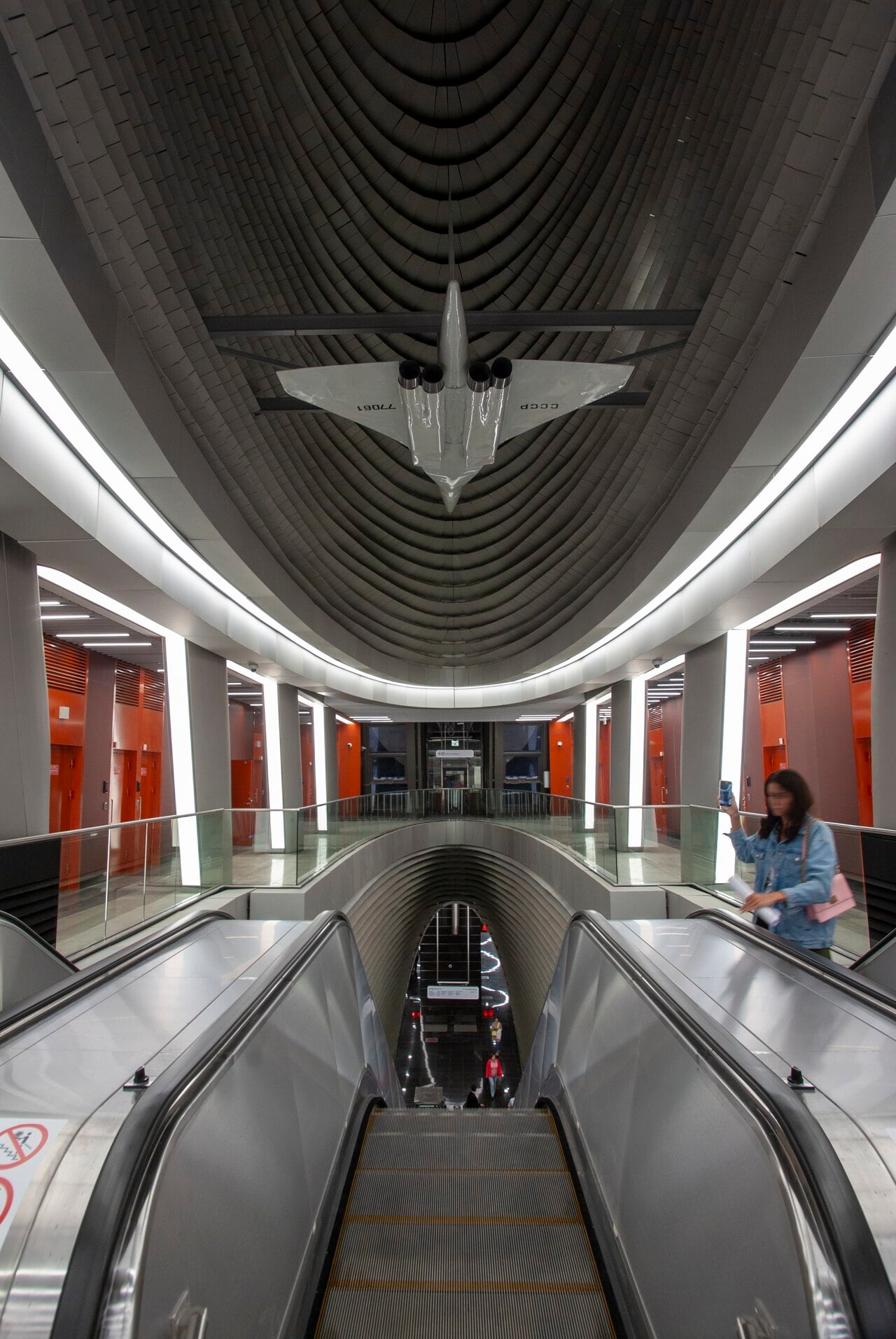
It is the sixth of September, 2023, and on the far south-western edge of Moscow a train pulls into a brand-new station for the first time. The passengers who step off at Pykhtino could be forgiven for thinking they have walked into an aircraft museum. A long terracotta wall runs beside the track, covered in white line drawings of aircraft. Overhead, ten ring-shaped lights hang like the open mouths of jet engines. And above the escalators, suspended in a pool of light, a gleaming Tu-144 supersonic airliner points its nose towards daylight.
The model is one tenth the size of the real thing, built from aluminium alloys and stainless steel and assembled piece by piece inside the station. It is the most theatrical aviation display in the Moscow metro, but it is not the first. Pykhtino is the newest chapter of a story that began 85 years earlier, when Soviet architects first decided that a journey underground should feel like a flight through the sky.
Quick Facts
- Stations in this story: Mayakovskaya, Aeroport, Aviamotornaya (two stations), Pykhtino, Aeroport Vnukovo
- Oldest: Mayakovskaya and Aeroport, both opened 11 September 1938
- Newest: Pykhtino and Aeroport Vnukovo, opened 6 September 2023
- Mayakovskaya mosaics: 35 panels by Alexander Deineka, 34 survive
- Pykhtino centrepiece: 1:10 scale Tu-144 model over the escalators
- Airport first: Aeroport Vnukovo: the first metro station in Russia at an airport
A field called Khodynka
To understand why aviation runs so deep beneath Moscow, start with a patch of open ground north-west of the old city. The Khodynka field began serving as an airfield in 1910, with flying schools and air shows drawing crowds of Muscovites. After the revolution it passed to the Soviet air fleet administration, which set up a research centre there, and the country’s first scheduled international flights to the West departed from its grass.
Khodynka went through several names before settling as the Central Aerodrome named after Mikhail Frunze. In 1931 it received Moscow’s first air terminal building. Around it grew an aviation district of design bureaus, factories and test facilities. When the metro’s planners pushed the Zamoskvoretskaya line north along Leningradsky Prospekt in the late 1930s, the sky was already the neighbourhood’s defining industry.
1938: the sky goes underground
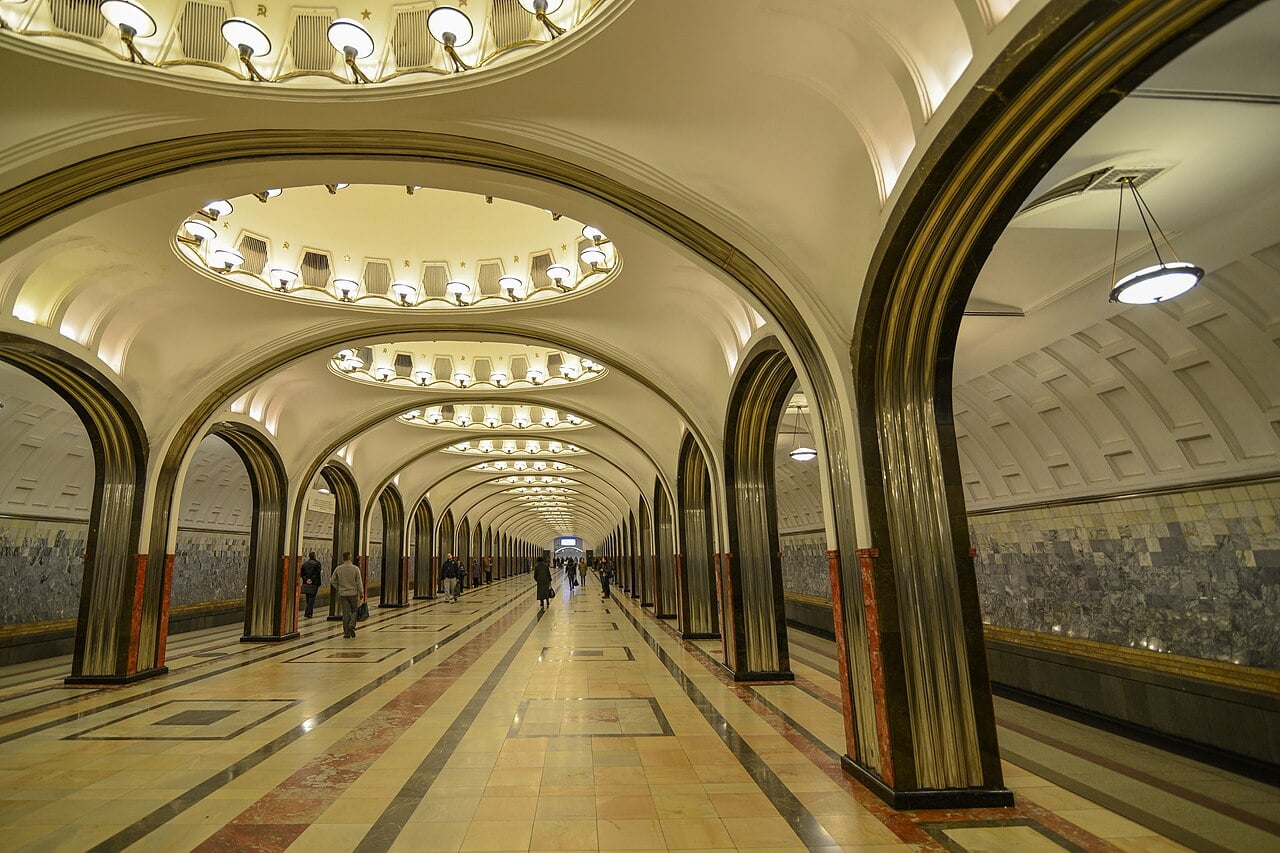
On the eleventh of September, 1938, the second stage of the Moscow metro opened, and with it two stations that made aviation part of the system’s identity. The more famous of them was Mayakovskaya, designed by the architect Alexey Dushkin. Dushkin replaced the heavy pylons of earlier stations with slender arches and columns, which let the central hall flow open from end to end.
Those arches were an aviation story in themselves. The steel structures that carry the vault were fabricated at the Dirigiblestroi works near Moscow, the state enterprise set up to build airships, because it had the know-how for large, light metal structures. A popular legend holds that the station was assembled from ready-made airship hull frames; the magazine Vokrug Sveta treats that as a myth. What is not in doubt is the finish: Mayakovskaya’s columns and arches were faced in polished stainless steel, the first time the material was used in the Moscow metro.
Twenty-four hours of Soviet sky
Dushkin gave the station a ceiling of shallow oval cupolas, and the painter Alexander Deineka filled them with sky. He designed 35 smalt mosaic panels, assembled in the Leningrad workshop of the mosaicist Vladimir Frolov. Thirty-four survive; one was lost when a hermetic gate was installed at the old exit. Together they form a single composition that has come down under the names “A Day of the Soviet Land” and “A Day of the Soviet Sky”, running from morning through day and night to morning again.
A passenger walking the platform has to tilt their head back to see it, and that is the point. Every scene is viewed from below, as if the onlooker were lying in a meadow watching the heavens. Aircraft are everywhere. One panel shows the ANT-25 in which Valery Chkalov flew over the North Pole. Another shows an air parade over the Kremlin’s Spasskaya Tower, with I-15 biplanes in formation; a night scene over the same tower carries an airship. Parachutists drop through the frame, and one cupola holds the stratospheric balloon USSR-1, which climbed to about 19 kilometres in 1933.
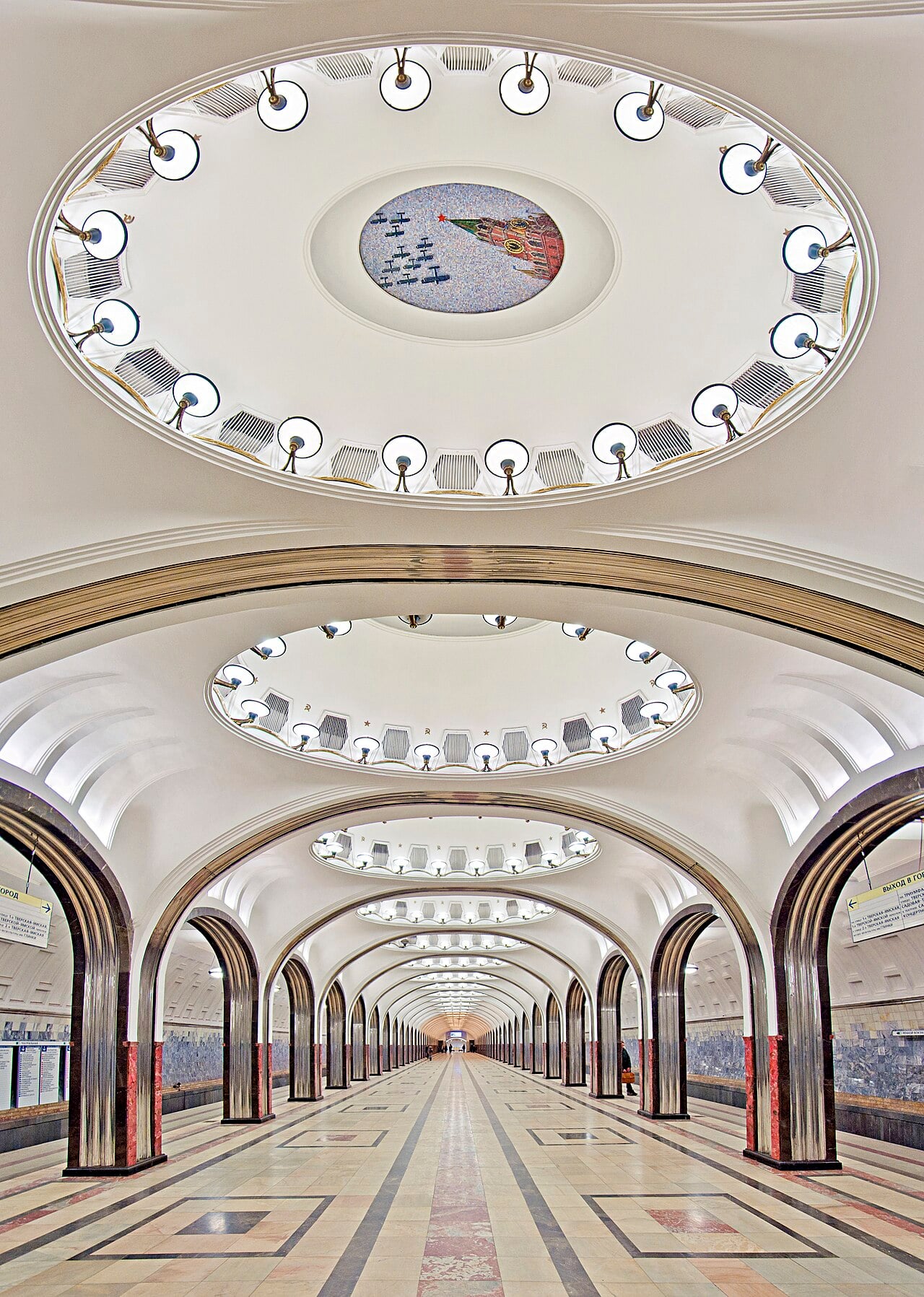
The design travelled further than any of the aircraft on its ceiling. In 1939 Mayakovskaya’s architecture and decoration won the Grand Prix at the International Exhibition in New York, the World’s Fair whose theme was “the World of Tomorrow”. Moscow’s architecture critic Alexander Zmeul calls Mayakovskaya the first aviation-themed station in the Moscow metro, and it remains the yardstick every later one is measured against.
A short walk through Mayakovskaya, Alexey Dushkin’s 1938 station with Deineka’s aviation mosaics in the ceiling cupolas. Video: Globetrotterschik.
Aeroport: a hangar under Leningradsky Prospekt
Two stops further north, the same day brought a quieter tribute. Aeroport station took its name from the Central Aerodrome on Khodynka, just to the west. Its architects, Boris Vilensky and Vladimir Yershov, gave it a single vault, which made it only the second single-vault station on the network and the first built by the open-cut method.
According to Moscow’s city government, that vault deliberately echoes the shape of a hangar for flying machines. The aviation references are subtle. The track walls carry fan-shaped marble panels that read as parachutes, and long relief lines sweep across the ceiling like searchlight beams or parachute rigging. Today many passengers see contrails in them, although in 1938 the jet age had not yet begun.
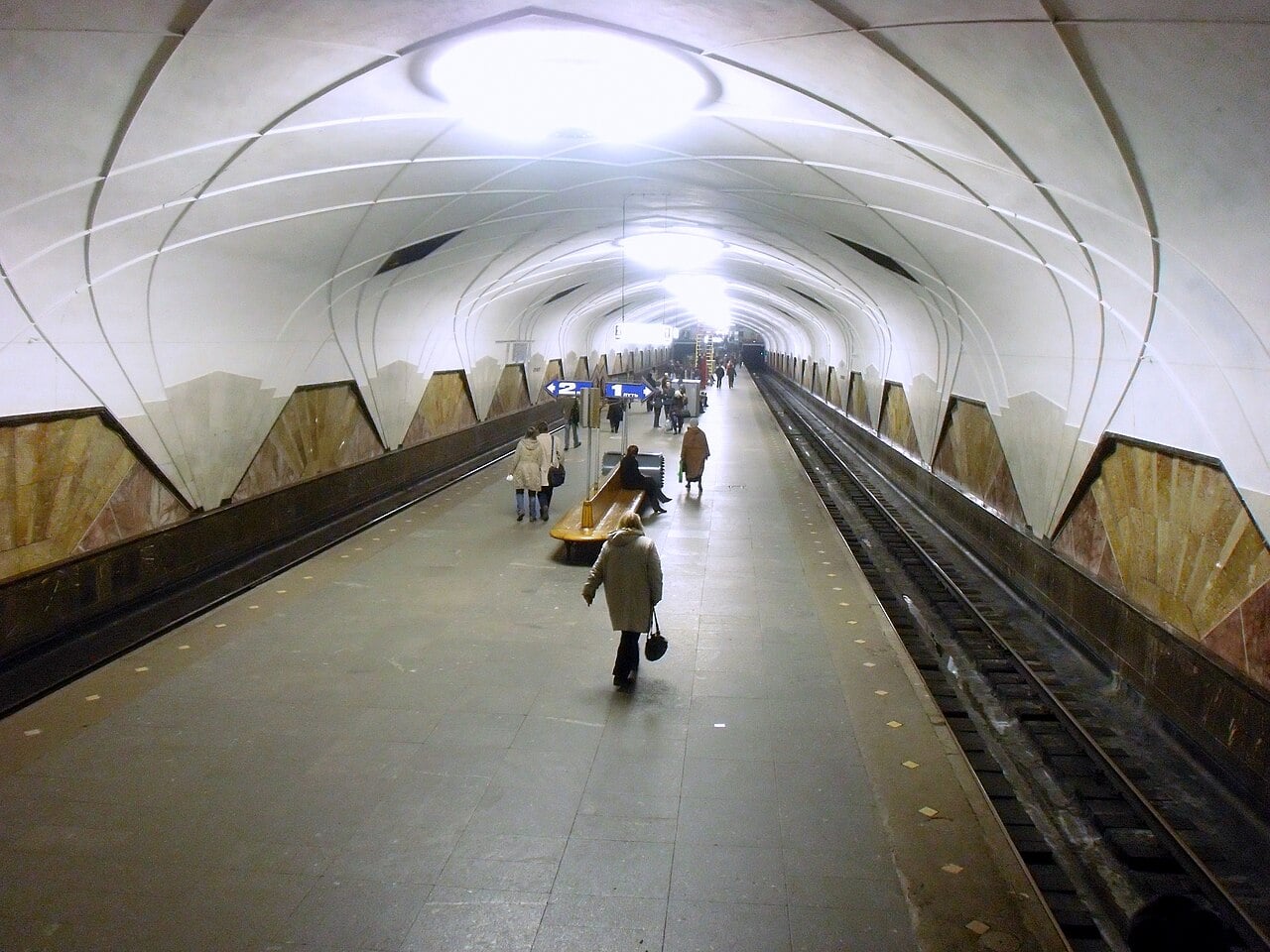
Aeroport kept its link with air travel for decades. On the last day of 1965 the Moscow Air Terminal opened on Leningradsky Prospekt next to the station. Passengers checked in and dropped their bags in the city, then rode buses to their aircraft; until 1971 there was even a helicopter shuttle to the airports. The terminal closed in 2005 and was later demolished, but the metro station that carries the aerodrome’s memory is still there.
November 1941: the meeting beneath the bombs
Within three years, the sky over Moscow had become a battlefield. In the first days of July 1941, two weeks after the German invasion, the first phase of a new airport at Vnukovo, south-west of the city, opened ahead of schedule. It had been under construction since 1937 to relieve Khodynka, and instead of airliners it soon hosted a special-purpose air group and a fighter regiment defending the capital.
Underground, the metro became a shelter, and Mayakovskaya, then the deepest station on the network, gained a place in history. On the sixth of November, 1941, with the front only a short distance from the city, the Moscow City Council held its annual meeting on the eve of the Revolution anniversary on Mayakovskaya’s platform rather than in a theatre. Stalin spoke there. Invitations did not name the venue, which was passed on by word of mouth. The next day, troops paraded through Red Square. Moscow’s official portal still tells the story, including the legends about beer served from train carriages parked at the platform, while noting that fact and folklore are now hard to separate.
Above the people gathered that night, Deineka’s peacetime sky of parachutists and parade formations was still glowing in its cupolas.
Aviamotornaya: a golden sky for the engine builders
The next great aviation station came almost four decades later. Aviamotornaya opened on the Kalininskaya line in 1979, named after the street above it, home to the Central Institute of Aviation Motors, the country’s leading aero-engine research centre. The architect Alexander Strelkov gave it one of the most lavish interiors of its era: a vault covered in golden four-sided pyramids that seems to hover over the hall like a metal carpet.
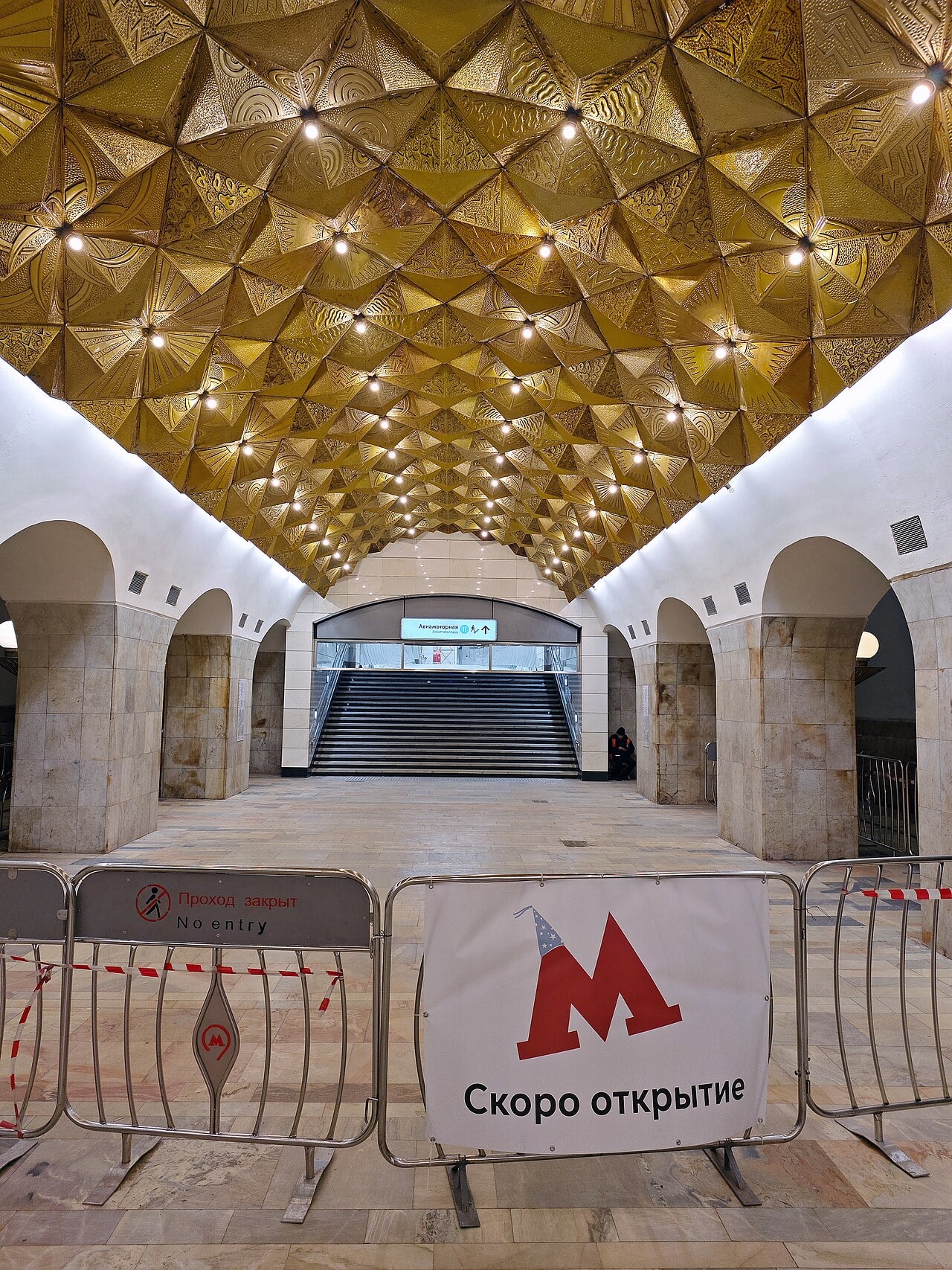
At the end of the platform stood a metal composition of Icarus in flight, by the artist Anatoly Mosiychuk with Dzhems Bodnieks and Khaim Rysin. It was an unexpected choice for a station honouring engine builders. The mythical first aviator, after all, flew on wax and feathers, and fell. But it gave the hall a focal point, and generations of commuters met “under Icarus”.
In the 2020s Icarus had to move. A second Aviamotornaya station opened in March 2020, first as part of the Nekrasovskaya line and since 2023 on the Big Circle Line, and the two had to be joined. The old end wall made way for a staircase, and the composition, treated against corrosion, was mounted on a black Karelian granite wall in the upper escalator hall of the new transfer, which opened on 30 December 2024.
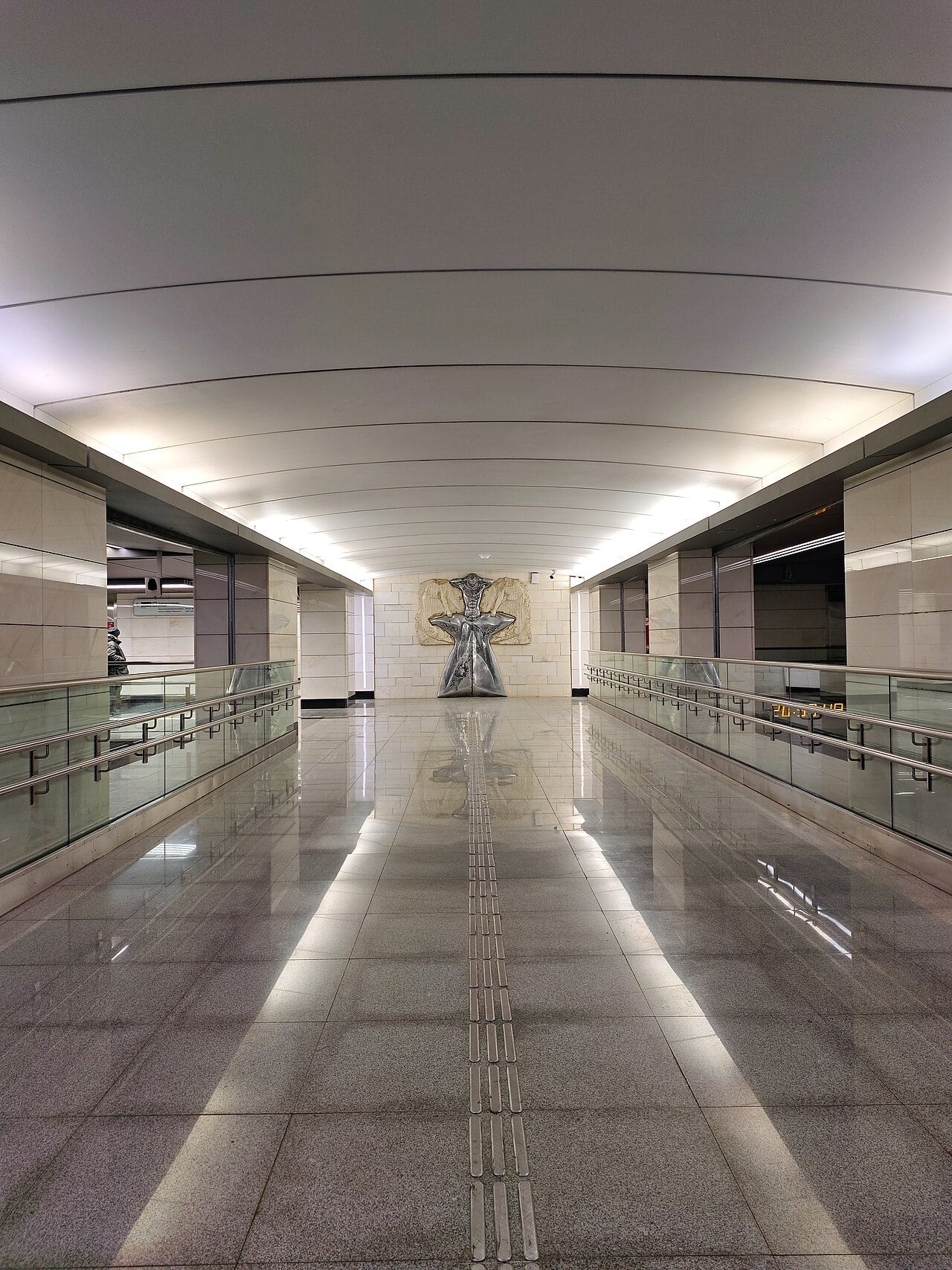
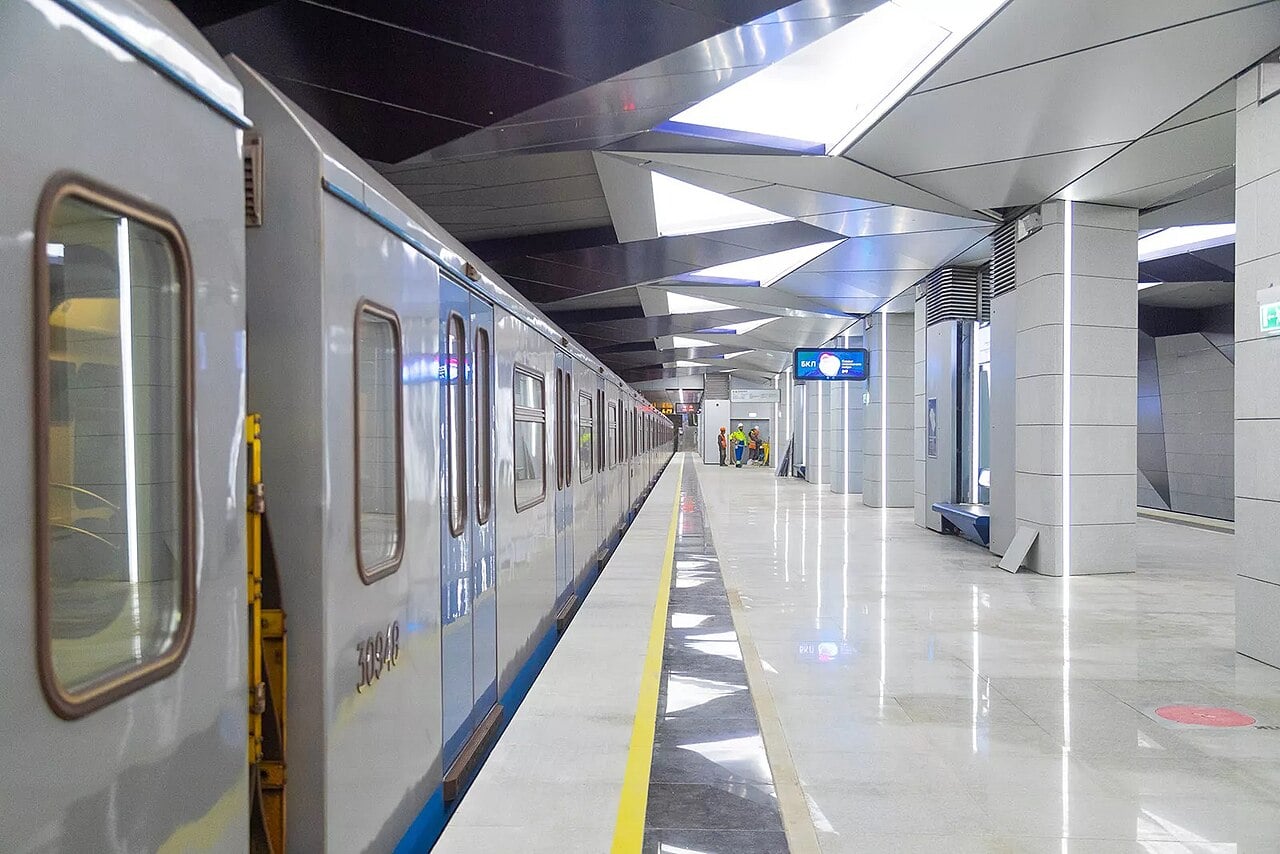
The new station picked up the theme. Designed by Leonid Borzenkov, it was described in Moscow’s press as the first fully aviation-themed station in more than 40 years, with columns shaped like aircraft tail sections and small dart-shaped aircraft projected onto them, climbing as if on rising air. In its second entrance hall the sculptor Alexander Rukavishnikov added two compositions in aluminium, marble and fibre-concrete, titled “Winged People. Sky” and “Winged People. Nike”. Moscow’s construction department says the aviation theme ties the two stations’ artwork together.
Vnukovo: from the Tu-104 to the platform
After the war, scheduled flights moved from Khodynka to Vnukovo, and Vnukovo became the gateway to the jet age. On the fifteenth of September, 1956, a Tupolev Tu-104 left Vnukovo on the first regular jet passenger service in the Soviet Union, flying to Irkutsk via Omsk and landing about seven hours and ten minutes after take-off. The Tupolev name has been bound up with the airport ever since, and today Vnukovo bears the name of Andrei Tupolev.
For more than eight decades, though, the metro never reached it. That changed on the sixth of September, 2023, when the last two stations of the Solntsevskaya branch opened: Pykhtino and Aeroport Vnukovo, on a 5.2-kilometre extension. Between them, trains climb into daylight to cross the valley of the Likova river on a 460-metre metro bridge, the second-longest in Moscow, before diving underground again into the airport.
Aeroport Vnukovo is fully integrated into the airport, with an underground passage to Terminal A, the underground Aeroexpress rail terminal and the station square. Leonid Borzenkov, who also designed the new Aviamotornaya, finished it in silver, “aviation” tones, repeating the triangular ceiling panels and lighting of the terminal above. Along the track walls, portraits of the aircraft designers Andrei and Alexei Tupolev, printed on aluminium, look down over maps and images of Tupolev civil aircraft including the Tu-104, Tu-114 and Tu-154. The ride to the Moscow-City business district takes about 40 minutes, roughly half what it did before.
Pykhtino: a museum you pass through
Which brings us back to the station before the airport, the one that stops first-time visitors in their tracks. Pykhtino is named after a nearby village, and has no airport of its own. Its aviation theme was chosen because the streets of the new neighbourhood around it are named after Soviet pilots and aircraft designers; the station itself sits near Letchika Gritsevtsa Street, which translates as Pilot Gritsevets Street.
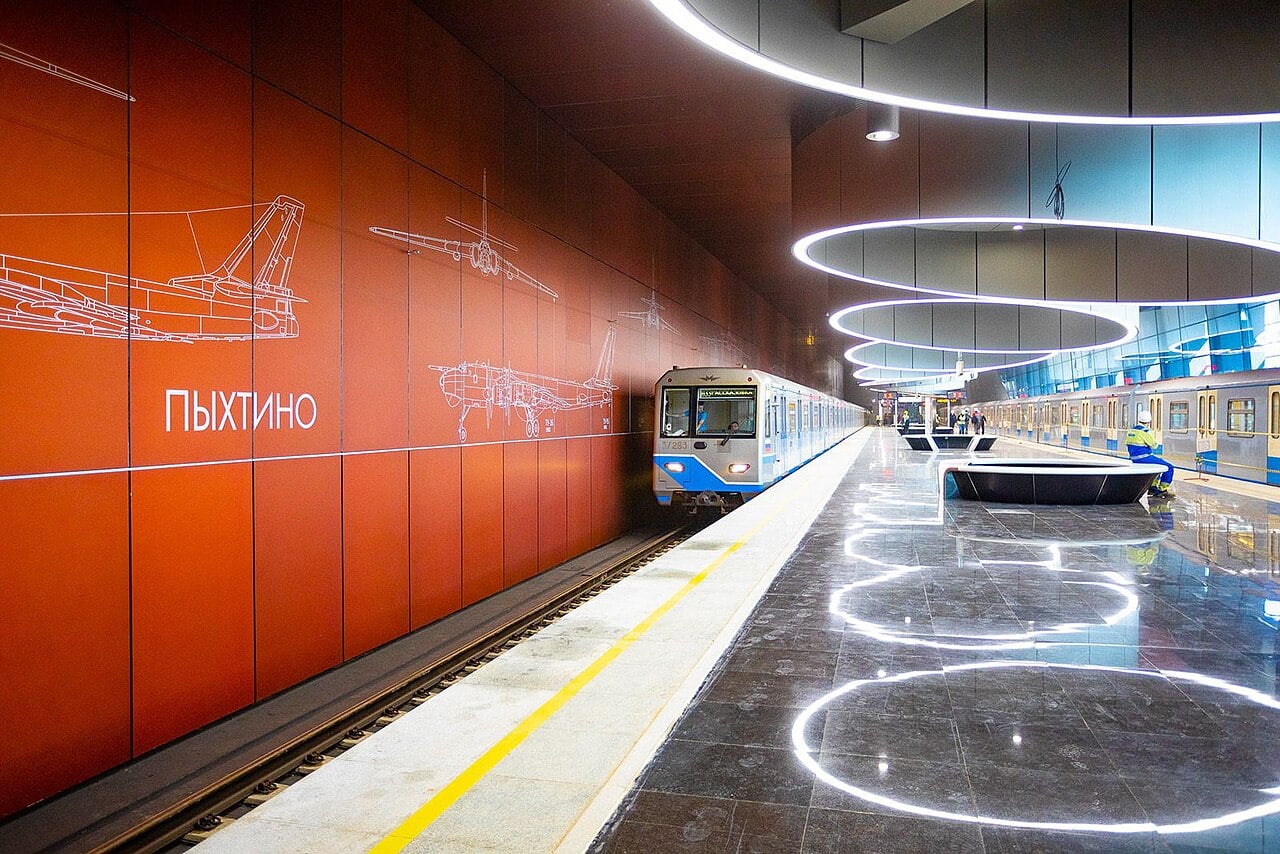
Because of the terrain, Pykhtino is only partly underground. One track wall is solid, the other is a panoramic window looking out over the Likova valley, where on a clear day the outline of Vnukovo airport should be visible once landscaping is complete. The solid wall carries the station’s timeline: a chronological band of aircraft drawings by the graphic designer Alexei Yakimenko. When the plans were published in 2020, Moscow’s chief architect Sergei Kuznetsov said the band would run from the propeller-driven ANT-3 to the supersonic Tu-160, tracing the industry’s history from overcoming gravity to supersonic speed.
Ten turbine-shaped light fixtures hang over the platform, a black floor sets off the terracotta wall, and light boxes on the columns are shaped like wings. Then there is the Tu-144, floating at the top of the escalators where a narrowing space ends in a lantern. It is a fitting choice: the Tu-144 was the world’s first supersonic airliner to fly (its rivalry with Concorde is told in MiGFlug’s Concorde vs Tu-144 comparison), and it carried Aeroflot passengers on the route from Moscow to Alma-Ata in 1977 and 1978, operating from Domodedovo rather than Vnukovo.
A walk around Pykhtino: the turbine lights, the aircraft timeline on the track wall, the glazed wall over the valley and the Tu-144 model above the escalators. Video: Worldwide Metro.
Looking up
Put the stations side by side and a pattern appears. In 1938, aviation was the most modern thing a Soviet designer could imagine, so Dushkin and Deineka hid an entire sky in the ceiling and asked passengers to look up. Aeroport borrowed the shape of a hangar. Aviamotornaya, in 1979, honoured the engine makers with gold and a myth. By 2023 the theme had turned into a history lesson, laid out along a wall at Pykhtino and in the faces of the Tupolevs at Vnukovo.
Through all of it, the stations have quietly tracked the city’s aviation geography: from the grass of Khodynka, through the engine institute on Aviamotornaya Street, to the runways of Vnukovo where the Soviet jet age began. The next time you ride an escalator in Moscow, look up. There is a good chance something is flying overhead.
Sources: Moscow City Government (mos.ru), Metro in the War Years: Bomb Shelter, Concert Hall and Library (9 May 2016); mos.ru, history of Aeroport metro station and the Central Aerodrome on Khodynka; mos.ru, Sergei Kuznetsov on the design of Pykhtino station (30 June 2020); mos.ru, Pykhtino and Aeroport Vnukovo: two months of operation (12 November 2023); mos.ru, Historic Icarus panel installed at the Aviamotornaya transfer hub (2024); mos.ru, Sobyanin opens transfers at Aviamotornaya and Elektrozavodskaya (December 2024); Vedomosti, Sobyanin opens the first metro station in Russia on airport territory (6 September 2023); Alexander Zmeul, The new Aeroport Vnukovo and Pykhtino stations tell an enthusiastic story about aviation, Moskvich Mag (7 September 2023); Moskvich Mag, Sixty years ago the Moscow Air Terminal opened near Aeroport station (31 December 2025); Moskva 24, Ten unknowns: Alexander Deineka’s mosaics at Mayakovskaya (6 June 2016); Vokrug Sveta, history of Mayakovskaya station and its Deineka mosaics; Vokrug Sveta, Vnukovo, Moscow’s oldest airport, turns 80 (2021); Rossiyskaya Gazeta, 70 years since the first regular Tu-104 flight; Tulane University, Moscow Architecture image collection: Aeroport and Maiakovskaia metro stations; Rusmania, Aviamotornaya station; msk1.ru, Transfer at Aviamotornaya opened (30 December 2024).


0 Comments