

Every task card a mechanic signs on a modern airliner, from a lubrication point on a flap track to a borescope look inside an engine, traces back to a meeting room. Long before the type carried its first passenger, engineers from the manufacturer, planners from the airlines that bought it and specialists from the regulator sat down and argued, system by system, over what could fail, whether anyone would notice, and what it would cost if they did not.
The method they use is called MSG-3. The regulator's side of the table is the Maintenance Review Board. Together they produce the document that sets the minimum inspection programme for an entire fleet, and they keep revising it for as long as the aircraft flies.
Quick Facts
- MSG: Maintenance Steering Group, an airline-industry task force (today coordinated by Airlines for America)
- MSG-1: 10 July 1968, used for the Boeing 747-100 and its engines
- MSG-2: 8 January 1970
- MSG-3: Original revision 30 September 1980, revised many times since
- Output: Maintenance Review Board Report (MRBR): minimum scheduled tasks and intervals
- Who writes it: Industry Steering Committee: manufacturer, engine maker, vendors, launch operators
- Who approves it: The regulator's Maintenance Review Board chairperson (FAA guidance: AC 121-22C)
- FAA scope: Transport category airplanes with 10+ seats or 33,000 lb+ maximum weight, Transport category A helicopters, powered-lift
From fixed overhauls to failure logic
The first generation of jet airliners was maintained on a simple belief: every component had a natural lifetime, and if you overhauled it before that lifetime ran out, it would not fail. In the early 1960s, with FAA approval, US airlines began a series of engineering studies on aircraft in service to test that idea. According to the history of reliability-centred maintenance, the studies found the assumption was wrong for nearly every part of a complex jet.
Most failures, it turned out, were not tied to the age of the part at all. The lesson that came out of the work was to stop trying to predict lifetimes and start asking what each failure would actually do to the aircraft.
That thinking produced the first formal decision logic for airline maintenance. The FAA's advisory circular on Maintenance Review Boards records that in 1968 the Maintenance Steering Group's first task force, MSG-1, developed maintenance requirements decision and analysis logic, and that the FAA and industry used it to build the initial programme for the Boeing 747-100 and its engines.

MSG-2 followed on 8 January 1970 as a universal version for later types. In 1978, United Airlines engineers Stanley Nowlan and Howard Heap published the Reliability-Centered Maintenance report sponsored by the US Department of Defense, which carried the same ideas to a wider audience. Then, on 30 September 1980, the FAA, airlines and US and European manufacturers issued a new document with new decision logic: MSG-3.
MSG-3 has been revised again and again since then. The FAA's list of revisions shows it adding enhanced zonal analysis for aging wiring, lightning and high-intensity radiated field protection, fuel tank safety and structural health monitoring. The industry group that maintains it was renamed the Maintenance Programs Industry Group in 2006, though the document kept its MSG name.
Sofema Aviation Academy walks through the MRB process and the evolution from MSG-1 to MSG-3.
How MSG-3 thinks
MSG-3 begins with what a system does. Instead of starting with a list of parts and asking when to overhaul each one, analysts start with the functions an aircraft system performs and ask how each function can fail. The first question in the logic is the one that shapes everything else: if this function fails, will the crew know?
If the failure is evident, the analysis asks whether it affects safety, then whether it affects operations, and if neither, it is treated as purely economic. If the failure is hidden, the danger is different, because a dead backup system may sit unnoticed until a second failure makes it matter. Hidden failures that could affect safety get scheduled checks designed to expose them. Safety categories are the ones the regulator watches most closely: in FAA guidance, only tasks from MSG-3 categories 5 and 8, the safety categories, can be credited against certification maintenance requirements, and those tasks cannot be folded into routine zonal inspections.
Once the consequence is known, the analysts pick a task that is both applicable and effective. The menu is short: lubrication or servicing, an operational or visual check, an inspection or functional check, restoration, or discard. Structures get their own analysis for fatigue, environmental and accidental damage. Zones of the aircraft get general visual inspections, the flashlight-and-mirror look at everything in a bay that catches leaks, corrosion and loose installations.
Who sits on the committee
The analysis is not done by the regulator. Under the FAA's advisory circular AC 121-22C, the manufacturer forms an Industry Steering Committee with the engine maker, other vendors and the airlines expected to operate the aircraft. The committee writes a Policy and Procedures Handbook, sets up working groups for systems, structures, zonal and other areas, and prepares the proposed Maintenance Review Board Report. The guidance sets a goal of at least three operators at each working group meeting.
The regulator's side is the Maintenance Review Board itself. In the FAA's process, the Aircraft Evaluation Group manager assigns an MRB chairperson, who builds a board of evaluation specialists, inspectors and engineers from the certification office, and assigns FAA advisors to each working group by specialty. Other national authorities can take part through letters of confirmation, which is how one analysis can serve regulators on several continents.
The timetable is strict. Working group data packages go to the regulators 30 days before each meeting, and the final proposal reaches the MRB chairperson at least 90 days before the expected approval. Once approved, the report sets the minimum scheduled tasks and intervals for that type.
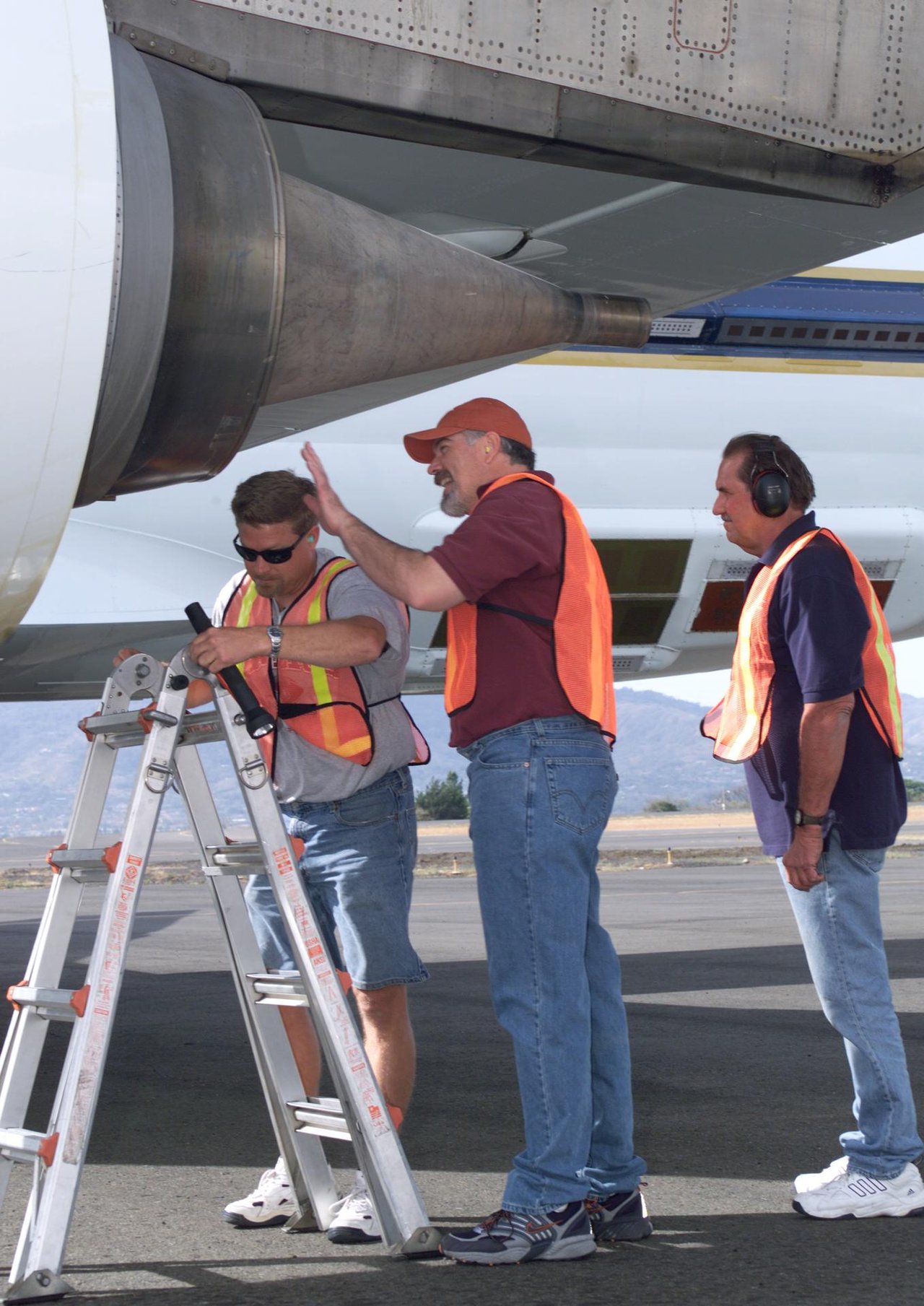
Report, planning document, programme
An MRB report is not something a mechanic works from directly. The manufacturer folds it into its maintenance planning document, and each airline then builds its own approved maintenance programme on top, adding tasks for its own routes, climate and experience. In the United States, the operator's certificate-holding district office must approve that programme and accept later changes.
The letters that passengers hear about, the A, B, C and D checks, sit at this last level. They are how an airline chooses to package thousands of individual MSG-3 tasks, each with its own interval in flight hours, cycles or calendar time, into visits to the hangar.
The separation matters. The MRB report is the floor: an airline can add to it but cannot quietly drop below it. A carrier flying short hops along a salty coastline could, for example, choose to inspect for corrosion more often than the minimum, while another operator of the same type on long, dry sectors may package its tasks quite differently.
Why the intervals keep moving
An MRB report is supposed to stay alive. The FAA's guidance calls for an annual joint review by the manufacturer, the steering committee and the MRB chairperson, and it lays out how intervals can be optimised once real fleet data exists. Proposals must weigh scheduled and unscheduled findings, use worldwide samples across different operating environments and aircraft ages, and treat each task on its own merits.
The guidance also contains a brake. If a manufacturer does not follow the formal data process, it is limited to no more than a 10 percent escalation of an interval, and it cannot go further until the task has been repeated and enough data exists. Interval growth is where maintenance programmes earn their savings, and it is also where the risk lies, which is why the safety-category tasks are watched so closely.
A training introduction to how MSG-2 and MSG-3 differ in the way they generate maintenance tasks.
For anyone who has watched a jet disappear into a hangar for weeks, MSG-3 is the hidden script. The checks look routine because thousands of decisions were made long before, in a room where an airline planner, a manufacturer's engineer and a regulator agreed what could fail, whether anyone would notice, and how often someone needed to look.
Sources: FAA Advisory Circular AC 121-22C (Maintenance Review Boards, 2012), Wikipedia (Reliability-centered maintenance), Sofema Aviation Services, NASA Image and Video Library



0 Comments