
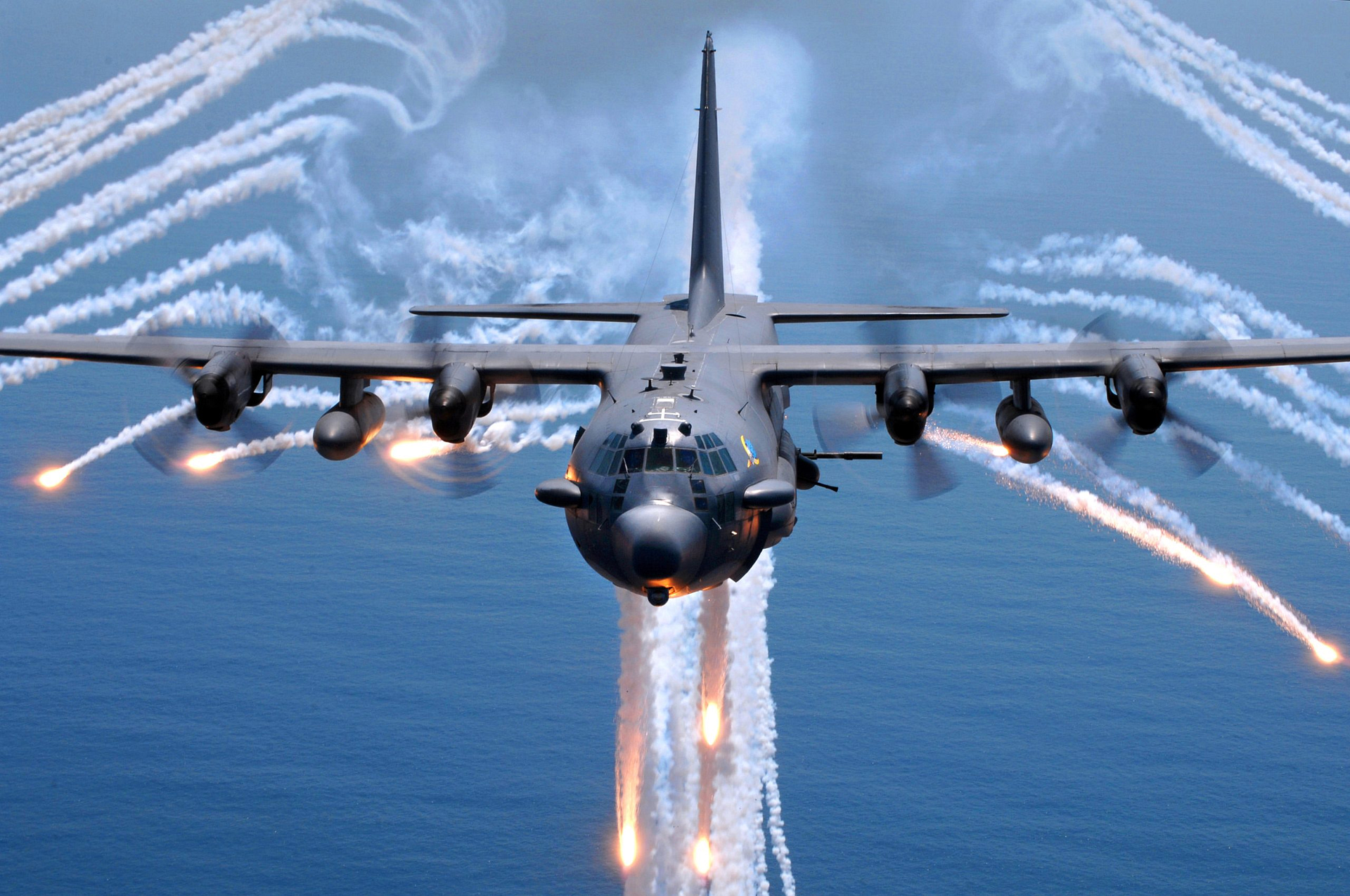
Lockheed AC-130 Gunship
“Spooky · Spectre · Ghostrider”
A Hercules transport rebuilt into a flying artillery battery — a heavily armed gunship that banks into a slow left-hand circle and rains cannon and howitzer fire down on a single point of ground.
The AC-130 gunship: a flying battery that turns circles in the sky
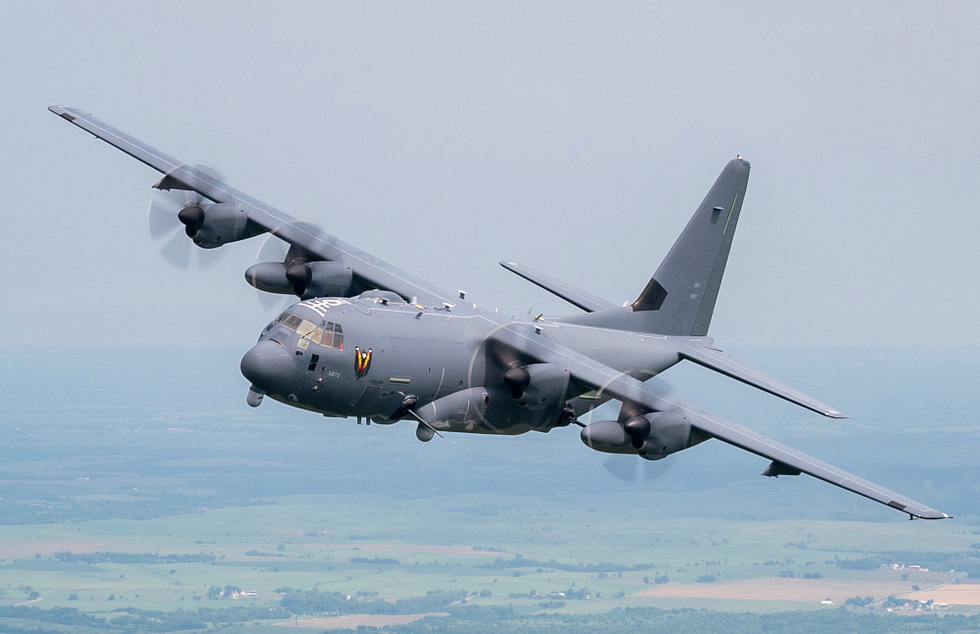
The AC-130 is one of the strangest and most lethal ideas in modern air warfare: take a lumbering four-engined Lockheed C-130 Hercules cargo plane, cut gun ports along its left side, fill the cargo hold with cannon, a howitzer, sensors and fire-control computers, and send it to war. Instead of diving on a target like a fighter, the gunship flies a continuous banking left-hand circle — a pylon turn — that keeps every side-firing weapon pointed at one spot on the ground while the aircraft orbits above it. The result is an aircraft that can loiter for hours and put a devastating, sustained weight of fire onto a single point.
The concept grew out of the AC-47 “Spooky” — the “Puff the Magic Dragon” of Vietnam, a converted Dakota with side-firing miniguns. It worked so well that the Air Force wanted a bigger, longer-ranged platform, and the C-130 was the obvious choice. The first AC-130A prototype reached Vietnam in 1967 and flew its first combat in 1968, hunting trucks moving supplies down the Ho Chi Minh Trail at night. Over the following decades the gunship evolved through a family of versions — the AC-130A/E/H Spectre, the AC-130U Spooky II, the AC-130W Stinger II and today’s AC-130J Ghostrider — each carrying a shifting mix of 7.62 mm miniguns, 20/25 mm Gatlings, a 40 mm Bofors and, on the heavy versions, a 105 mm howitzer.
What ties the family together is the marriage of firepower to sensors. Long before “precision strike” became routine, gunship crews fused low-light television, infrared and radar to find targets in the dark and walk rounds onto them with a precision no fast jet could match. The AC-130 became the signature aircraft of Air Force Special Operations Command (AFSOC), flown over Grenada, Panama, the Gulf, Somalia, the Balkans, Afghanistan and Iraq. It is also, by design, a slow, low-flying and vulnerable machine that depends utterly on friendly control of the sky: when that protection thinned, gunships paid for it — most starkly with the loss of Spirit 03 in the 1991 Gulf War. It is a uniquely American weapon, and one that carries real controversy alongside its reputation.
01Why the AC-130 gunship flies in circles: the pylon turn explained
A conventional attack aircraft points its nose at the target and fires along its flight path, which gives it only a fleeting firing pass. The AC-130 does the opposite. Because its guns fire out of the left (port) side of the fuselage, the aircraft banks into a steady left-hand turn and holds it, flying a circle around the target. In that geometry — the pylon turn — the guns stay locked on a single aim point on the ground for as long as the crew wants, and the aircraft can keep firing continuously rather than in split-second passes.
The trade-off is stark. To hold that orbit the gunship must fly relatively low and slow, which makes it an easy target for anti-aircraft guns and man-portable missiles. That is why the AC-130 is almost always used at night, and only where friendly forces already control the air. Its whole tactical logic — loiter, orbit, saturate one point with fire — only works when nothing is shooting effectively back.
What makes the AC-130 gunship special
Side-firing guns and the pylon turn
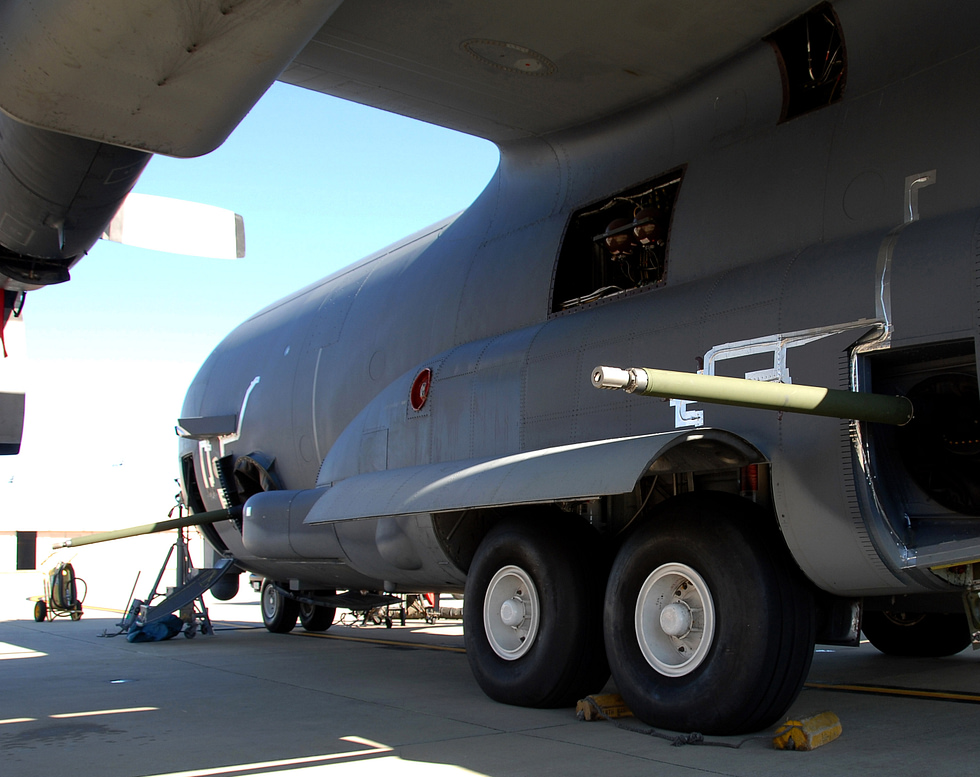
The defining feature. Weapons fire out of the aircraft’s left side, so the AC-130 attacks by flying a banking left-hand circle that keeps the guns trained on one ground point. Unlike a fighter’s fleeting pass, the gunship can orbit and fire continuously for as long as it loiters overhead — the essence of the “flying battery.”
Sensors, fire control and hours of loiter
The C-130’s size lets the gunship carry a fused sensor suite — low-light TV, infrared and radar — tied to fire-control computers that put rounds on target in darkness. Four turboprops give it the endurance to orbit for hours, so it can stay overhead a firefight far longer than any jet, watching and striking on call.
Escalating firepower — up to a 105 mm howitzer
Gunship armament has grown steadily: from 7.62 mm miniguns and 20 mm Gatlings to a 40 mm Bofors and, on the heavy AC-130H/U, a full 105 mm M102 howitzer — the largest gun routinely flown by any aircraft in the West. The AC-130J adds a 30 mm cannon and wing-mounted precision missiles and bombs.
02The AC-130 gunship’s guns: from miniguns to a 105 mm howitzer in the cargo hold
Early AC-130A gunships carried a mix of 7.62 mm miniguns and 20 mm Vulcan cannon. As targets hardened, the firepower grew: a 40 mm Bofors cannon was added for heavier punch, and then — remarkably — a 105 mm M102 howitzer, a towed field-artillery piece adapted to fire from a recoil mount inside the fuselage. On the AC-130U “Spooky II” the fit settled on a 25 mm Gatling, the 40 mm Bofors and the 105 mm. The newest AC-130J “Ghostrider” carries a 30 mm GAU-23/A cannon and the 105 mm, and adds standoff precision-guided munitions — small-diameter bombs and Griffin/Hellfire-class missiles — letting it strike from farther out than gunfire alone allows.
03The AC-130’s great weakness: a slow, low gunship that needs a friendly sky
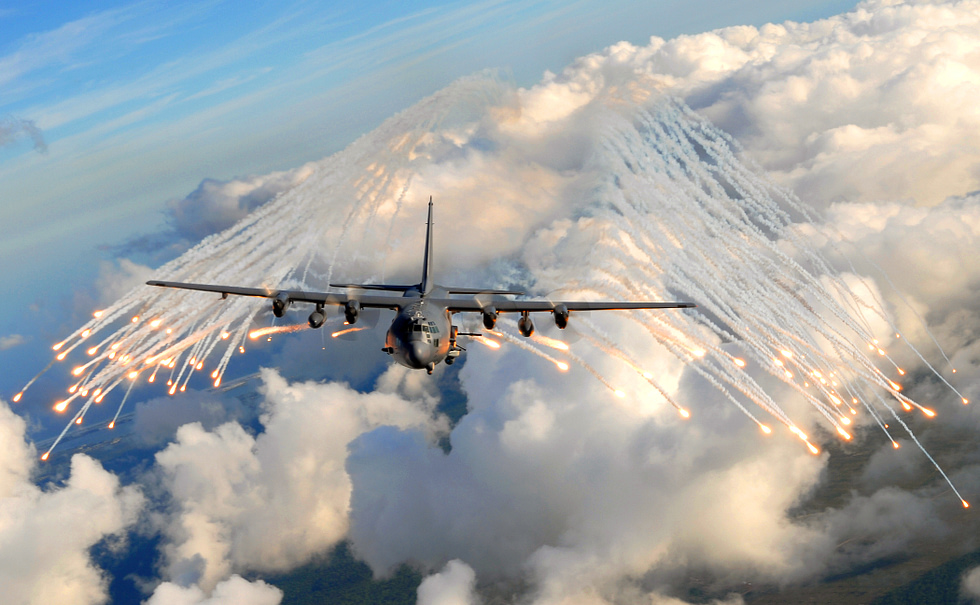
Everything that makes the gunship deadly also makes it fragile. To hold its firing orbit it flies low and slow in a predictable circle — ideal conditions for anti-aircraft artillery and shoulder-fired missiles. The AC-130 has essentially no ability to dogfight or outrun a threat; it survives by operating at night, behind sensors and jammers, and only where friendly forces already own the air. When that cover failed, the cost was severe: several gunships were lost over Vietnam, and in 1991 Spirit 03 was shot down over Kuwait with the loss of all 14 aboard — the single largest US Air Force loss of life of the Gulf War. The gunship is a specialist, not an all-weather, all-threat warplane.
Full AC-130J Ghostrider specifications
Airframe & Performance
- 全体人员
- Up to ~13 (varies by mission)
- 长度
- 29.8 m (97 ft 9 in)
- 翼展
- 40.4 m (132 ft 7 in)
- 高度
- 11.9 m (39 ft)
- Max takeoff weight
- ~74,400 kg (~164,000 lb)
- Max speed
- ~670 km/h (~362 kn / 416 mph)
- Cruise / orbit altitude
- Typically low; ceiling ~8,500 m
- 范围
- ~3,000+ km (air-refuelable)
- Airframe basis
- C-130J / MC-130J Hercules
Propulsion, Armament & Cost
- Engines
- 4 × Rolls-Royce AE 2100D3 turboprops
- Main guns
- 30 mm GAU-23/A · 105 mm M102 howitzer
- Precision munitions
- GBU-39 SDB · AGM-176 Griffin · Hellfire-class
- Sensors
- EO/IR, radar, fire-control fusion
- First AC-130 combat
- 1968 (AC-130A, Vietnam)
- AC-130J delivered
- From 2017 (AFSOC)
- Unit cost
- ~US$165 million (commonly cited; estimates vary)
- Cost per flight hour
- No reliable public figure
04The AC-130J Ghostrider’s operating costs: what a flying gunship is worth
The AC-130J is a low-rate, special-mission conversion of the C-130J, so precise, official cost figures are limited. Per-aircraft flyaway costs are commonly cited at around US$165 million, though published estimates vary and depend heavily on how the sensor and weapons fit is accounted for; the wider Ghostrider programme has been reported in the low billions of dollars for the fleet. No reliable public cost-per-flight-hour figure exists specifically for the AC-130 — open figures for C-130 variants run into the low tens of thousands of dollars per hour, but any precise gunship number should be treated as an estimate rather than an official figure.
From “Puff the Magic Dragon” to the Ghostrider
The gunship idea proves itself
The side-firing AC-47 “Spooky” — “Puff the Magic Dragon” — shows the value of a circling gunship over Vietnam, driving demand for a bigger platform.
AC-130A to Vietnam
The first C-130-based gunship prototype (Gunship II) deploys to Southeast Asia for combat evaluation.
First AC-130 combat
The AC-130 flies its first combat missions, hunting trucks by night along the Ho Chi Minh Trail — the role that made its name.
Spectre over the Trail
Heavily armed AC-130s become the premier truck-killers of the war, but several are lost to increasingly dense North Vietnamese air defences.
Grenada and Panama
Gunships fly in Operation Urgent Fury (Grenada, 1983) and Just Cause (Panama, 1989), cementing their place in US special operations.
Spirit 03 is lost
On 31 January an AC-130H is shot down over Kuwait during the Battle of Khafji, killing all 14 aboard — the Gulf War’s largest single US Air Force loss of life.
Somalia, the Balkans, Afghanistan, Iraq
AC-130U “Spooky II” and AC-130H Spectre gunships fly over Mogadishu, the Balkans, and the post-2001 wars as an AFSOC mainstay.
The AC-130J Ghostrider
A new, precision-armed gunship built on the C-130J enters service, carrying a 30 mm cannon, the 105 mm howitzer and standoff guided munitions.
From the gun deck: twelve AC-130 stories
Puff the Magic Dragon
The AC-47 “Spooky” proved a circling, side-firing gunship could dominate a battlefield.
Read the full story
The geometry of the pylon turn
Because the guns fire left, the aircraft attacks by holding a banking left-hand circle around the target.
Read the full story
Truck-hunting on the Trail
By night, Spectre gunships stalked convoys moving supplies down the Ho Chi Minh Trail.
Read the full story
A field howitzer in the cargo hold
The heavy gunships mounted a 105 mm M102 howitzer — artillery, firing from an aircraft.
Read the full story
Urgent Fury
AC-130s provided fire support during the US invasion of Grenada.
Read the full story
Just Cause
Spectre gunships fired in support of the assault to remove Manuel Noriega.
Read the full story
The loss of Spirit 03
An AC-130H stayed on station past dawn at Khafji and was shot down with all 14 aboard.
Read the full story
Over Mogadishu
AC-130 gunships operated over Somalia during the US intervention.
Read the full story
Seeing in the dark
Fused low-light TV, infrared and radar let gunship crews find and hit targets at night.
Read the full story
AC-130U “Spooky II”
A pressurised, radar-equipped gunship carrying a 25 mm Gatling, a 40 mm Bofors and the 105 mm.
Read the full story
The Kunduz strike, 2015
A US AC-130U mistakenly struck an MSF hospital in Afghanistan, killing dozens.
Read the full story
AC-130J Ghostrider
The newest gunship pairs the 105 mm and 30 mm guns with standoff precision weapons.
Read the full story
The AC-130 gunship in pictures
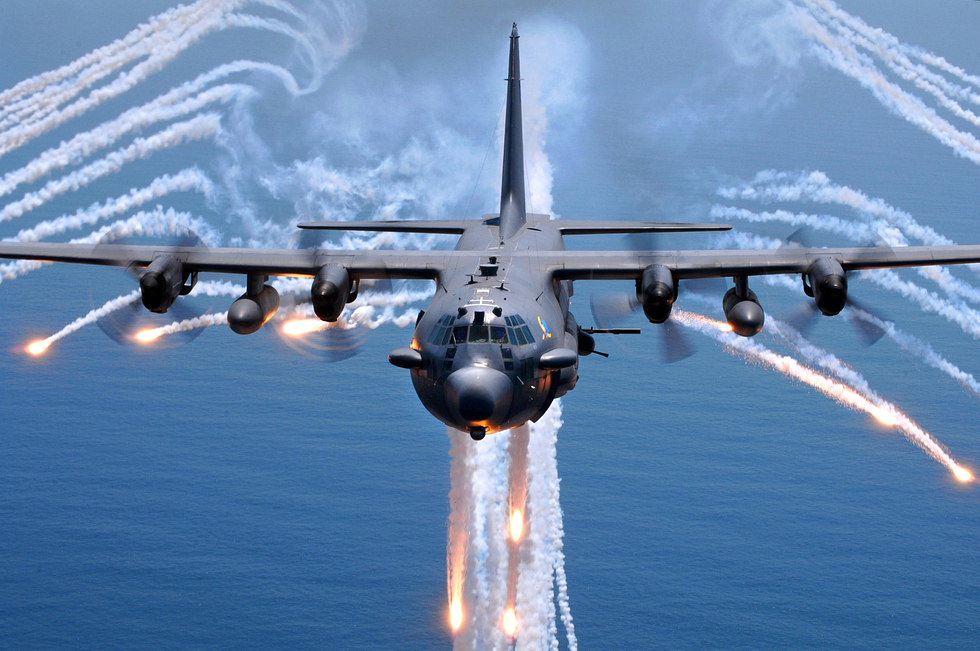
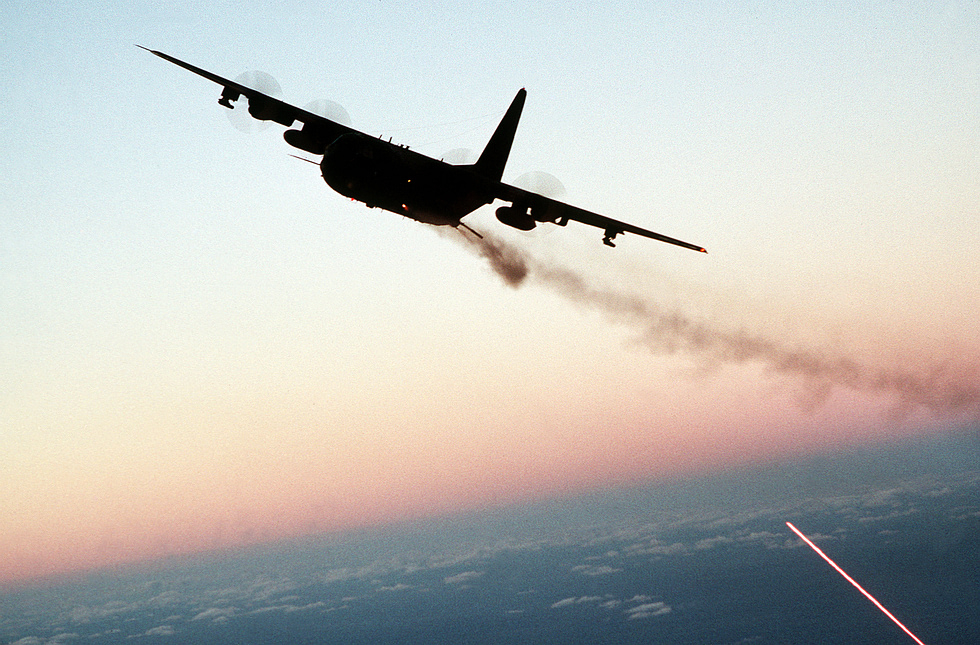
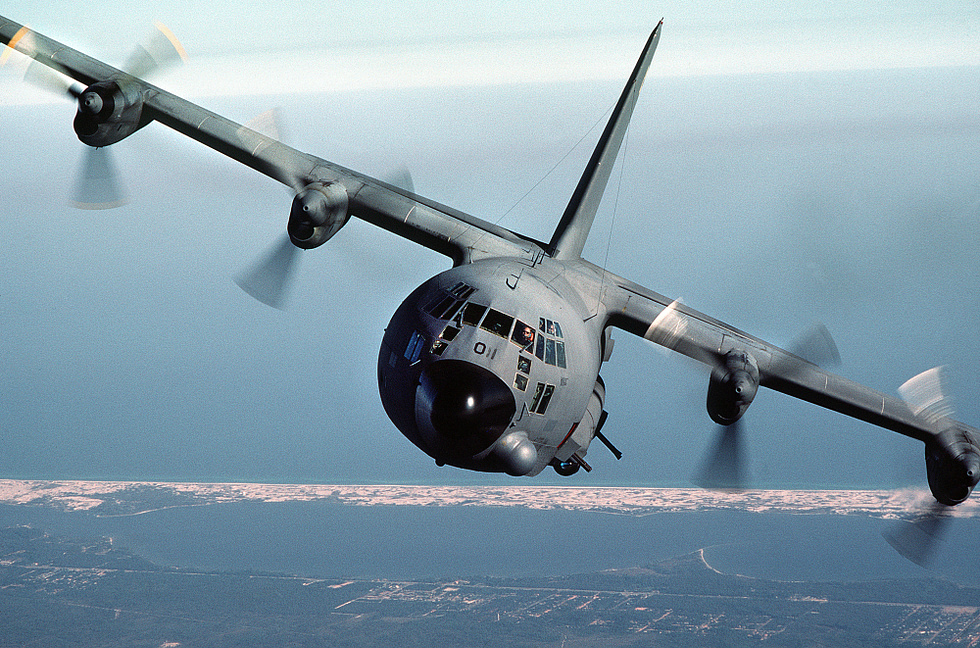
The AC-130 gunship in motion
A verified, high-authority video feature for the AC-130 is coming soon. In the meantime, explore the photo gallery above and the operations map below.
Where the AC-130 gunship operates
The gunship’s war record
The AC-130 is not an air-to-air fighter — its record is written on the ground. For more than half a century it has provided close air support and interdiction for US and allied forces, from the Ho Chi Minh Trail to the wars in Afghanistan and Iraq. Its greatest strength is persistence and precision; its greatest weakness, exposed most painfully in the loss of Spirit 03, is vulnerability whenever it is caught low and slow in a contested sky.
Compare the combat record of every military aircraft. Figures as of August 2026.
Everything people ask about the AC-130
Can I fly in an AC-130?
What is the pylon turn, and why does the AC-130 fly in circles?
What guns does the AC-130 carry?
What is the difference between Spectre, Spooky and Ghostrider?
Has an AC-130 ever been shot down?
Is the AC-130 still in service?
You can’t fly the gunship.
These, you can.
Some legends only live in museums — others are fuelled and waiting. MiGFlug has put civilians in real military jet cockpits since 2004.
 Fly the L-39 AlbatrosThe world’s most-flown jet trainer — aerobatics included
 Fly the F-104 Starfighter“The missile with a man in it”
 Fly the MiG-21The Cold War’s most-produced jet
 驾驶T-33流星战斗机America’s first jet trainer
 Fly the DH VampireA piece of early jet history
 Fly the S.211Agile Italian jet trainer
 Fly the MB-326The classic Aermacchi jet
 Fly the MiG-15The Soviet legend of the Korean War
Continue the tour
Every fact, checked
- Air Force Special Operations CommandOfficial operator of the AC-130; fact sheets on the Ghostrider and gunship mission.
- National Museum of the US Air ForceReference for AC-130 variants, armament and Vietnam-era gunship history.
- American Special Ops — AC-130 SpectreVariant breakdown, armament fits and operational history.
- Special Operations Warrior Foundation — Spirit 03Account of the 1991 loss of Spirit 03 at the Battle of Khafji.
- Task & PurposeOn Spirit 03 and why no AC-130 has been lost to enemy fire since.
- Médecins Sans Frontières — KunduzMSF account of the 2015 Kunduz hospital airstrike, presented alongside the US investigation.
- Air & Space Forces MagazineAC-130J Ghostrider specifications, weapons fit and fleet status.
- Airforce TechnologyTechnical reference for the AC-130J airframe, engines and munitions.