
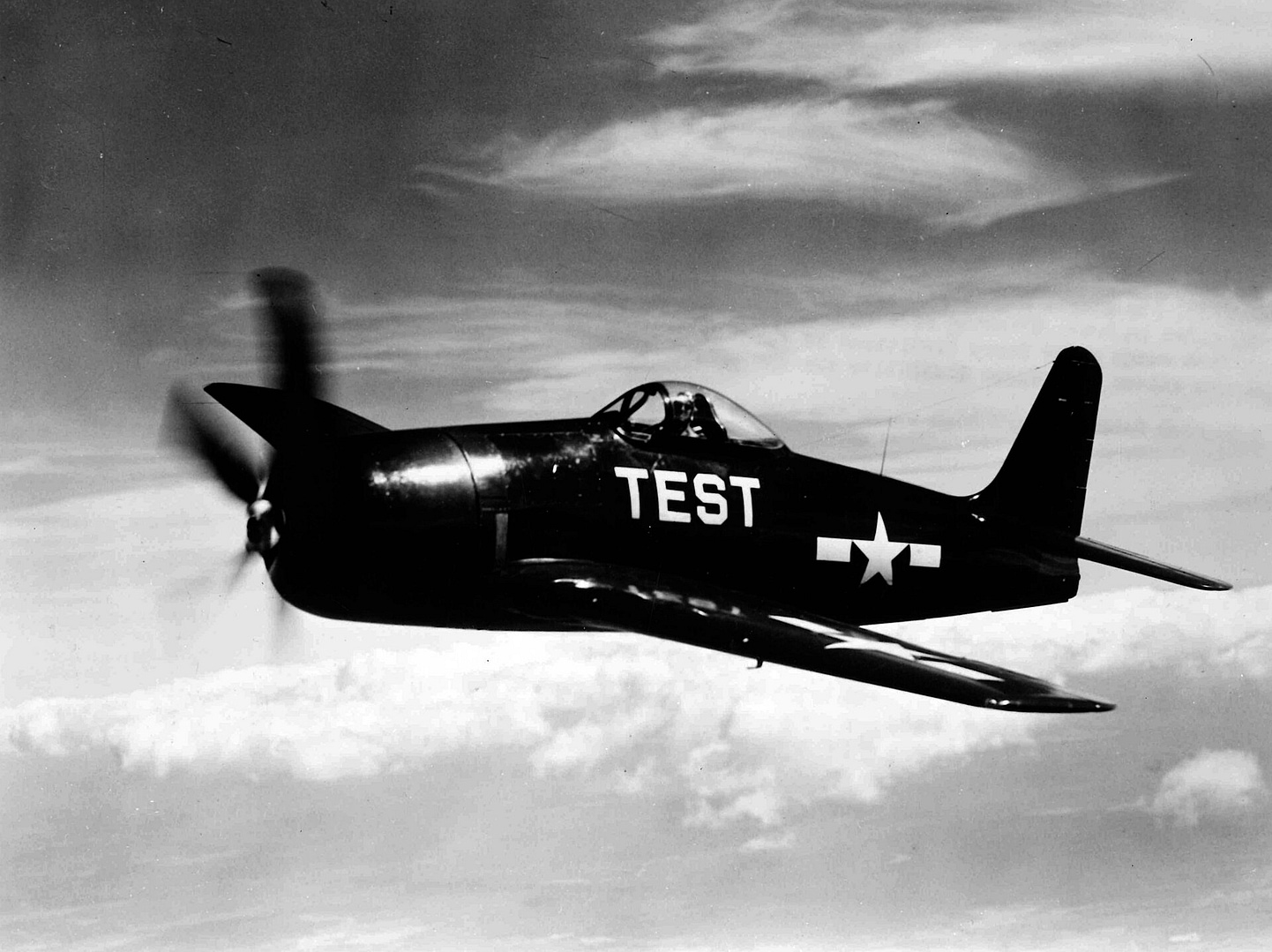
Grumman F8F Bearcat
The last and lightest of the great US Navy piston fighters — a rocket-climbing interceptor wrapped around one huge radial engine, which reached the fleet just too late for WWII and then found immortality as the fastest piston aeroplane on Earth.
The Grumman F8F Bearcat: the last great piston fighter
By 1943 Grumman had a problem worth solving. Its F6F Hellcat was winning the Pacific air war, but naval planners wanted something that could climb faster and reach an incoming raider sooner — a lightweight interceptor to protect the fleet. Grumman’s answer, first flown on 21 August 1944, was radical in its simplicity: take the same class of engine as the Hellcat, the mighty Pratt & Whitney R-2800 Double Wasp, and wrap the smallest, lightest airframe the company could build around it. The result, the F8F Bearcat, weighed roughly a fifth less than the Hellcat while carrying almost the same power.
The payoff was spectacular. The Bearcat could climb at around 4,500 feet per minute at sea level — and in a famous demonstration a stripped example reportedly bettered 6,000 ft/min, a rate of climb no propeller fighter of its era could match and one that would not be routinely beaten until the jet age. It was light on the controls, viciously fast in the roll, and a favourite of the test pilots who flew it. It is often described as an anti-kamikaze interceptor, though the truth is more nuanced: design work was already under way before organised kamikaze attacks began in late 1944, so it is best understood simply as a rocket-climbing point-defence fighter.
The one thing the Bearcat never got was the war it was built for. Deliveries to Fighting Squadron 19 began in May 1945, and the first Bearcat-equipped air group was still working up when Japan surrendered that August. The F8F reached the fleet just too late to fire a shot in the Second World War. Instead it became the US Navy’s premier piston fighter of the immediate post-war years, and from 1946 to 1949 it equipped the Navy’s Blue Angels demonstration team — the last propeller aircraft the team ever flew.
That lightness came with one notorious quirk. To save weight, the outer few feet of each wing were engineered to shear away under excessive load, letting the inner wing be built lighter. In theory the tips would break clean at high g; in practice they sometimes broke asymmetrically — one tip departing while the other stayed on — throwing the aircraft into a sudden, often fatal roll. Grumman tried wiring the tips with explosive cord so one failure would trigger the other; when that proved unreliable the safety tips were abandoned and the wing simply reinforced.
Jets ended the Bearcat’s front-line US career almost as fast as it had begun; it was largely gone from the fleet by around 1952. But the aeroplane found a second life abroad. 法国 flew Bearcats hard in the First Indochina War, where they became the type’s only combat mounts — several were destroyed on the ground by Viet Minh artillery at Dien Bien Phu in 1954. Thailand made the Bearcat its principal fighter of the mid-1950s, and the South Vietnamese Air Force flew ex-French examples into the early 1960s.
Its most enduring fame, though, came on the race course. In 1969 Darryl Greenamyer’s modified Bearcat “Conquest I” set a piston-engine world speed record of about 483 mph (777 km/h), finally breaking a mark the Messerschmitt Me 209 had held since before the war. Two decades later the legendary “Rare Bear” pushed the piston record to 528 mph (850 km/h) and became the winningest Unlimited racer in the history of the Reno National Championship Air Races. Eighty years after it first flew, the last great US Navy piston fighter is still, by the numbers, the fastest of them all.
01The Grumman F8F Bearcat’s design brief: why Grumman built the smallest plane it could around a huge engine
Grumman’s design team, led by chief engineer William Schwendler, worked to a single obsession: minimum weight. Where the F6F Hellcat had grown big and rugged, the Bearcat was pared back to the smallest airframe that could still carry the 2,000-plus horsepower R-2800 Double Wasp and land on a carrier. Empty, it came out roughly 20% lighter than the Hellcat while using the same engine family — the entire point of the exercise. A close-cowled fuselage, a bubble canopy for all-round vision, a compact folding wing and famously light controls all followed from that one weight-saving goal. The Bearcat was less a new idea than the Hellcat’s recipe distilled to its essence: put the biggest possible engine on the lightest possible aeroplane, and climb.
What makes the F8F Bearcat special
The best power-to-weight of any US piston fighter
The Bearcat put a ~2,100 hp R-2800 onto an airframe weighing only around 3.2 tonnes empty — roughly a fifth lighter than the Hellcat on the same engine class. The result was a sea-level climb of about 4,500 ft/min, with lightened demonstration aircraft reportedly exceeding 6,000 ft/min. No propeller fighter of the period climbed better, and few would until jets arrived.
The break-away ‘safety’ wingtips
To trim weight, the outer wing panels were built to shear off under excessive g — commonly cited at around 8.5–9 g — so the inner spar could be lighter. The flaw: tips could break asymmetrically, snapping the aircraft into a lethal roll. Grumman tried explosive Primacord to force both tips off together; when that failed in service, the tips were deleted and the wing reinforced.
From carrier deck to race pylon
The Bearcat became the greatest air-racer of the piston age. In 1969 Greenamyer’s “Conquest I” set a ~483 mph piston world speed record, ending the Me 209’s 30-year reign. In 1989 the heavily modified “Rare Bear” raised it to 528 mph — still the fastest piston aeroplane on record — while dominating the Reno races.
02The Grumman F8F Bearcat’s safety wingtips: a weight-saving idea that could kill
The idea was elegant on paper. The wing’s limit load was 7.5 g, but the ultimate load it had to survive was far higher. Rather than build the whole wing to take that ultimate load, Grumman designed the outer ~3 ft of each tip to break away once loads climbed past roughly 8.5–9 g, shedding lift and area before the main spar could fail — saving over 200 lb. The problem was consistency: manufacturing tolerances and fatigue meant one tip could let go while the other held, and the resulting asymmetric lift rolled the aircraft violently, killing several pilots including a member of the Blue Angels. Grumman’s fix — an explosive cord and microswitch that would blow the second tip off the instant the first departed — proved unreliable and maintenance-heavy. In the end the safety tips were simply removed and the wing structurally reinforced.
03The Grumman F8F Bearcat in air racing: Conquest I, Rare Bear and the piston speed record
When the US Navy retired its Bearcats, the type’s power-to-weight made it the natural weapon for unlimited air racing. On 16 August 1969, Darryl Greenamyer flew his modified F8F “Conquest I” to a 3-km piston-engine world record of 482.46 mph (776.45 km/h), finally breaking the mark Fritz Wendel’s Messerschmitt Me 209 had held since 1939; that aircraft now hangs in the Smithsonian. Two decades on, Lyle Shelton’s F8F-2 “Rare Bear” — re-engined and radically reworked — set a piston 3-km record of 528.31 mph (850.24 km/h) on 21 August 1989, a figure Guinness still lists as the fastest for any piston-engined aircraft. Rare Bear also holds a startling 3,000 m time-to-climb record and is widely counted as the winningest Unlimited racer in Reno history.
Full F8F Bearcat specifications
Airframe & Performance (F8F-1)
- 全体人员
- 1
- 长度
- 8.61 m (28 ft 3 in)
- 翼展
- 10.92 m (35 ft 10 in)
- 高度
- 4.22 m (13 ft 10 in)
- 空重
- ~3,207 kg (~7,070 lb)
- Max takeoff weight
- ~5,873 kg (~12,947 lb)
- Max speed
- ~678 km/h (421 mph) at ~6,000 m
- 攀升速率
- ~4,500 ft/min (~23 m/s); more when lightened
- 设备天花板
- ~11,800 m (~38,700 ft)
- 范围
- ~1,780 km (~1,105 mi)
Propulsion, Armament & Cost
- 引擎
- 1 × P&W R-2800-34W Double Wasp (18-cyl radial)
- Power
- ~2,100 hp (~1,566 kW)
- Armament (F8F-1)
- 4 × 0.50 in (12.7 mm) M2 Browning
- Armament (F8F-1B / -2)
- 4 × 20 mm cannon
- Ordnance
- Bombs, rockets, drop tanks
- First flight
- 21 August 1944
- Built
- ~1,265 (1945–1949)
- Unit cost
- No reliable public figure (WWII-era Navy contract)
- Cost per flight hour
- No reliable public figure
04The Grumman F8F Bearcat’s operating costs: a wartime bargain with no clean modern figure
The Bearcat was a US Navy wartime and early-Cold-War product, procured on military contracts that were never expressed as a single open-market flyaway price in constant dollars — so a firm unit cost simply does not exist in the public record, and any precise figure quoted for it is an estimate. No credible cost-per-flight-hour number survives for the type in service either. The only real cost data today comes from the warbird world, where a flyable Bearcat is a multi-million-dollar aircraft that burns expensive high-octane avgas through a thirsty 2,000-plus-horsepower radial — but those are collector and race-team figures, not a Navy operating cost. Treat any hard dollar-per-hour number attached to the F8F as a guess.
From lightweight interceptor to air-racing legend
Design begins
Grumman starts work on a lightweight carrier interceptor — the smallest airframe it can build around the R-2800 Double Wasp.
First flight
The XF8F-1 prototype flies on 21 August, roughly a fifth lighter than the Hellcat on the same engine class.
Enters service — too late
Deliveries to VF-19 begin in May; the first Bearcat air group is still working up when WWII ends in August. No combat.
The Blue Angels adopt it
The Navy’s flight-demonstration team flies the F8F from 1946 to 1949 — the last propeller aircraft it ever operated.
Jets take over
The Bearcat is largely withdrawn from the US front line as jet fighters replace it, lingering only in reserve and utility roles.
Combat at last — with France
French Bearcats fight in the First Indochina War; several are destroyed on the ground by Viet Minh artillery at Dien Bien Phu.
Conquest I sets the record
Darryl Greenamyer’s modified Bearcat sets a ~483 mph piston world speed record, ending the Me 209’s 30-year reign.
Rare Bear, the fastest of all
The heavily modified “Rare Bear” raises the piston 3-km record to 528 mph — a mark that still stands today.
From origin to legend: twelve Bearcat stories
The interceptor born from the Hellcat
Grumman wanted something that could climb faster than the Hellcat and reach a raider sooner.
Read the full story
Smallest plane, biggest engine
The whole design was built around a single obsession — minimum weight.
Read the full story
The climb that stunned the test pilots
A stripped Bearcat reportedly bettered 6,000 ft/min — unheard of for a piston fighter.
Read the full story
The war it missed by weeks
The first Bearcat air group was still working up when Japan surrendered.
Read the full story
The Blue Angels’ last propeller
From 1946 to 1949 the Navy’s demonstration team flew the Bearcat.
Read the full story
The wings that broke off on purpose
To save weight, the outer wingtips were built to shear away under excessive load.
Read the full story
When only one tip let go
Asymmetric breakaway threw the aircraft into a sudden, often fatal roll.
Read the full story
Bearcats over Dien Bien Phu
The Bearcat’s only combat use came in French hands in Indochina.
Read the full story
The Bearcat’s Asian afterlife
Thailand and South Vietnam flew Bearcats into the early 1960s.
Read the full story
Greenamyer beats the Messerschmitt
In 1969 “Conquest I” broke a speed record set before WWII.
Read the full story
Rare Bear, the fastest piston plane alive
The modified F8F-2 set a 528 mph record that still stands.
Read the full story
Why warbird pilots still love it
Eighty years on, the Bearcat remains a prized and thrilling warbird.
Read the full story
The F8F Bearcat in pictures
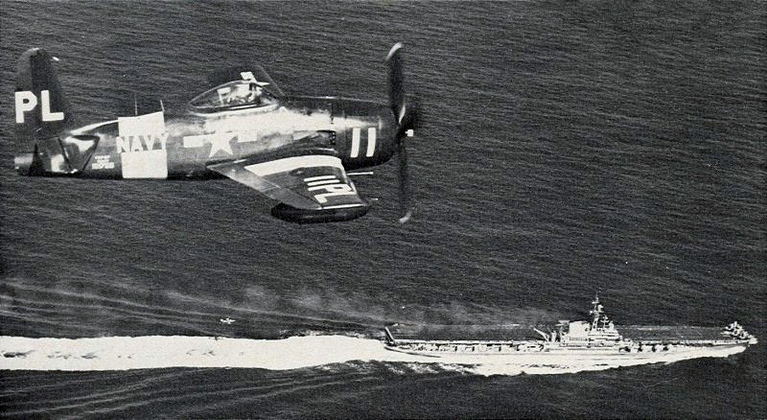
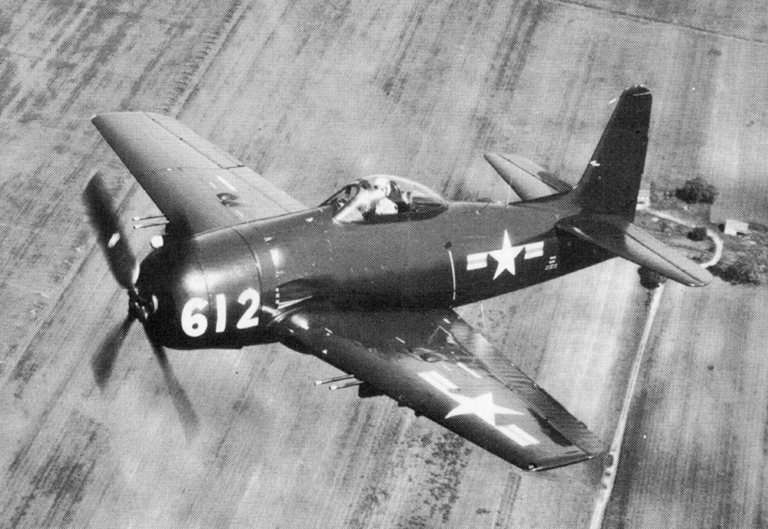
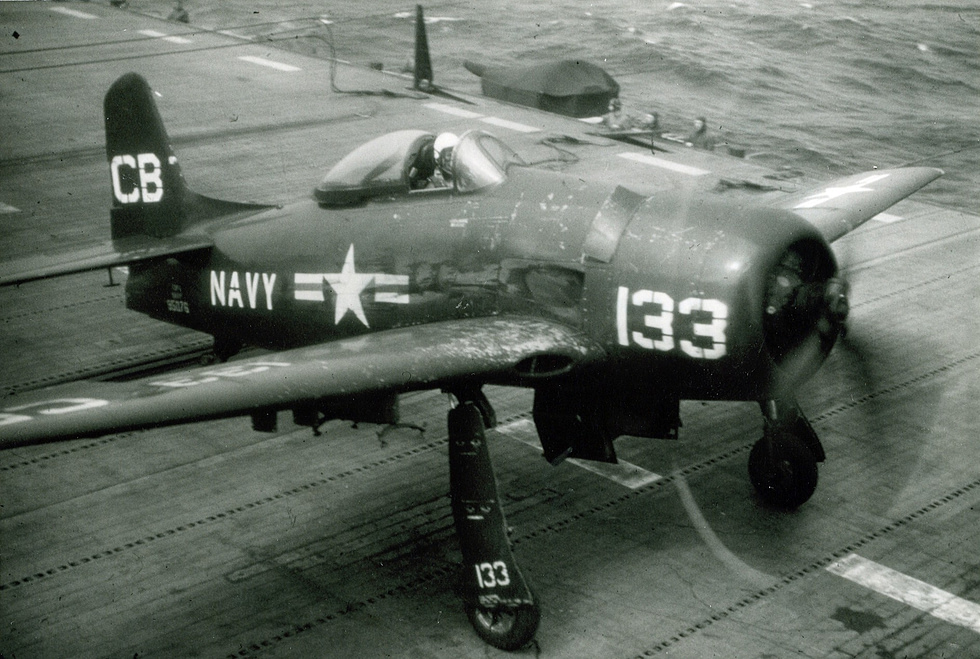
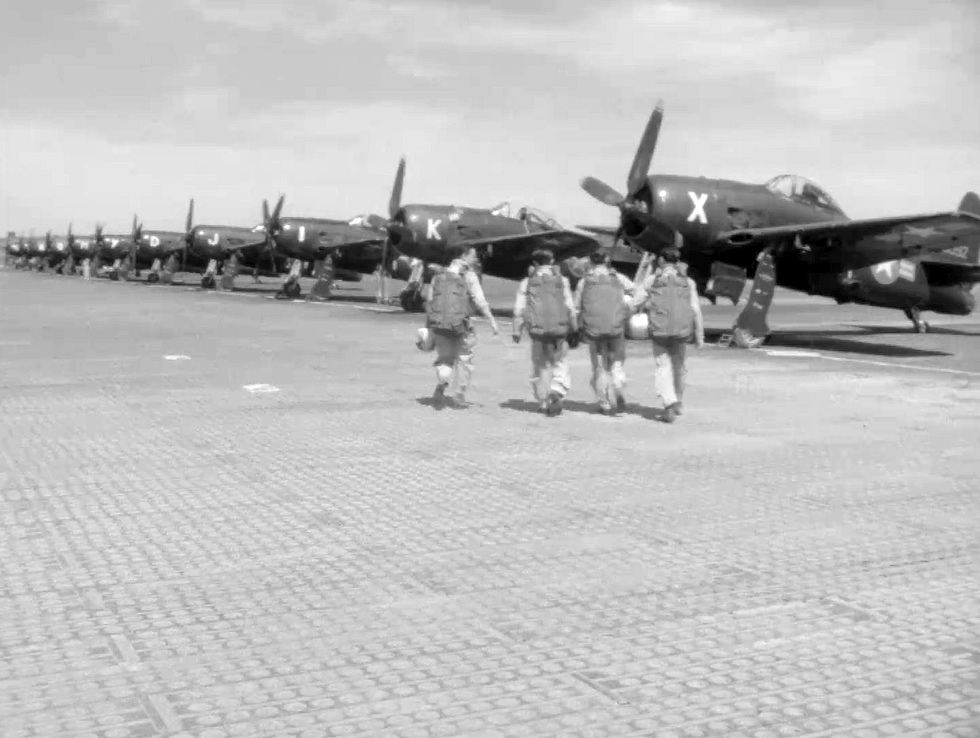
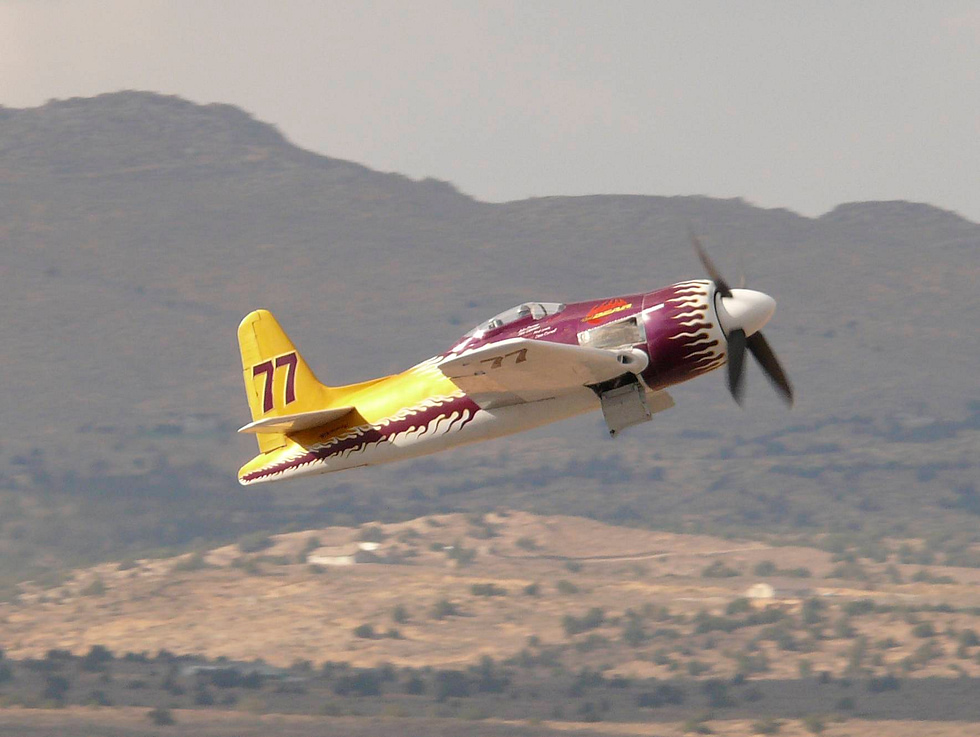
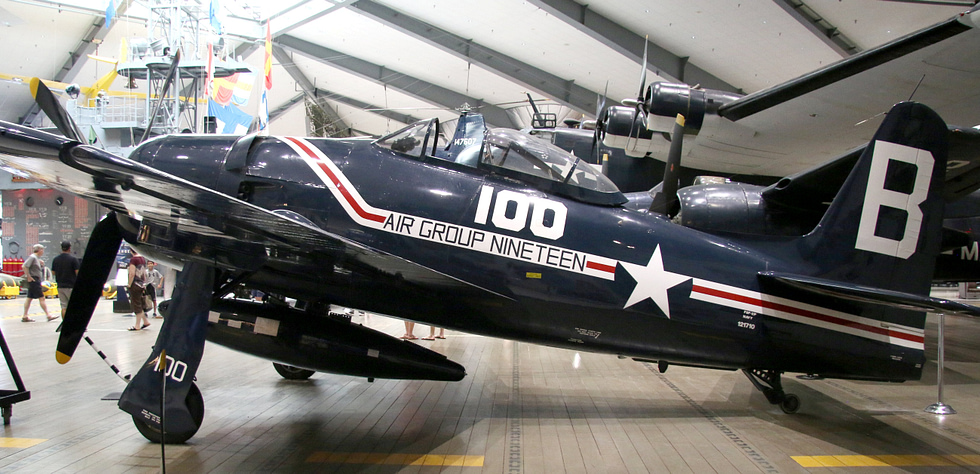
The F8F Bearcat in motion
A hand-picked F8F Bearcat film is coming soon. For now, the gallery above and the twelve stories below cover the aircraft in depth.
Where the F8F Bearcat flew
The score that defines it
The Bearcat’s combat story is one of near-misses. Built as a war-winning interceptor, it reached US Navy squadrons just after WWII ended and never fought under the American flag. Its only combat use came in French hands in Indochina, where it flew as a fighter-bomber rather than a dogfighter. The Bearcat’s real record was written not in kills but in climb, speed and the air-racing pylons it went on to dominate.
Compare the combat record of every military aircraft. Figures as of July 2026.
Everything people ask about the F8F Bearcat
Can I fly in an F8F Bearcat?
Did the F8F Bearcat fight in World War II?
How fast could the F8F Bearcat climb?
What were the Bearcat’s ‘safety’ wingtips?
Did the F8F Bearcat ever see combat?
What is “Rare Bear”?
How many F8F Bearcats were built?
Is the F8F Bearcat still flying?
You can’t fly the Bearcat.
These, you can.
Some legends only live in museums — others are fuelled and waiting. MiGFlug has put civilians in real military jet cockpits since 2004.
 Fly the L-39 AlbatrosThe world’s most-flown jet trainer — aerobatics included
 Fly the F-104 Starfighter“The missile with a man in it”
 Fly the MiG-21The Cold War’s most-produced jet
 驾驶T-33流星战斗机America’s first jet trainer
 Fly the DH VampireA piece of early jet history
 Fly the S.211Agile Italian jet trainer
 Fly the MB-326The classic Aermacchi jet
 Fly the MiG-15The Soviet legend of the Korean War
Continue the tour
Every fact, checked
- National Naval Aviation Museum — F8F BearcatOfficial US Navy specifications, service entry with VF-19, retirement and French use.
- This Day in Aviation — XF8F-1 first flightFirst-flight date and pilot, prototype engine and the ~1,265 production total.
- This Day in Aviation — “Conquest I” recordGreenamyer’s 482.46 mph piston record and the Me 209 mark it broke.
- Guinness World Records — fastest piston aircraftRare Bear’s 528.31 mph (850.24 km/h) record, Lyle Shelton, 21 August 1989.
- HistoryNet — “An Engine With a Saddle”Design intent, climb performance, Blue Angels dates and the safety-tip nuance.
- U.S. Navy Aircraft History — F8F Safety TipsDetailed account of the break-away wingtips, asymmetric failures and the Primacord fix.
- wwiiafterwwii — F8F post-war serviceFrance in Indochina, South Vietnamese and Thai operation of the Bearcat.
- Flight Journal — Rare BearThe Bearcat’s air-racing career and its status as the winningest Unlimited racer.