
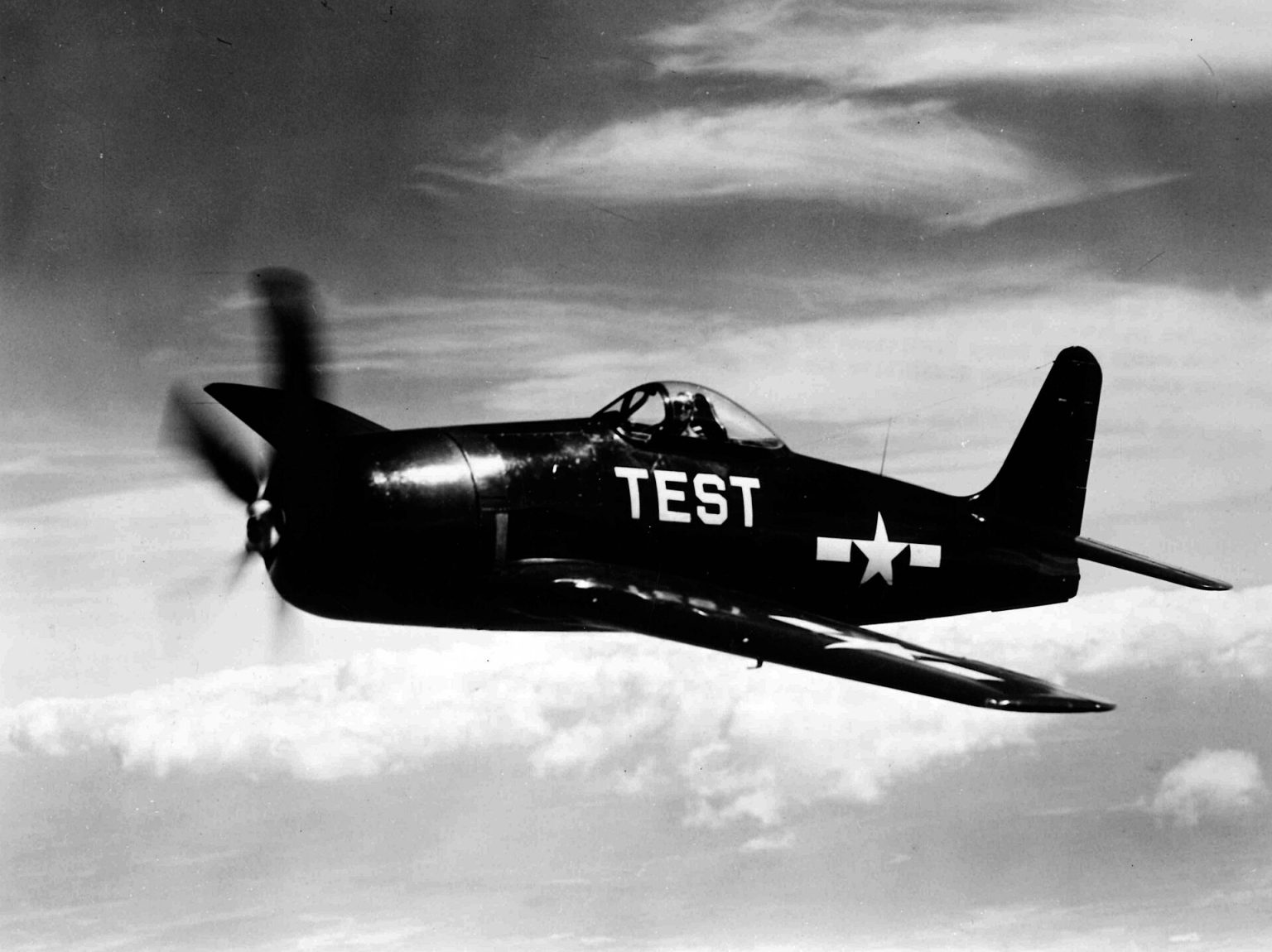
Grumman F8F Bearcat
The last and lightest of the great US Navy piston fighters — a rocket-climbing interceptor wrapped around one huge radial engine, which reached the fleet just too late for WWII and then found immortality as the fastest piston aeroplane on Earth.
The Grumman F8F Bearcat: the last great piston fighter
By 1943 Grumman had a problem worth solving. Its F6F Hellcat was winning the Pacific air war, but naval planners wanted something that could climb faster and reach an incoming raider sooner — a lightweight interceptor to protect the fleet. Grumman’s answer, first flown on 21 August 1944, was radical in its simplicity: take the same class of engine as the Hellcat, the mighty Pratt & Whitney R-2800 Double Wasp, and wrap the smallest, lightest airframe the company could build around it. The result, the F8F Bearcat, weighed roughly a fifth less than the Hellcat while carrying almost the same power.
The payoff was spectacular. The Bearcat could climb at around 4,500 feet per minute at sea level — and in a famous demonstration a stripped example reportedly bettered 6,000 ft/min, a rate of climb no propeller fighter of its era could match and one that would not be routinely beaten until the jet age. It was light on the controls, viciously fast in the roll, and a favourite of the test pilots who flew it. It is often described as an anti-kamikaze interceptor, though the truth is more nuanced: design work was already under way before organised kamikaze attacks began in late 1944, so it is best understood simply as a rocket-climbing point-defence fighter.
The one thing the Bearcat never got was the war it was built for. Deliveries to Fighting Squadron 19 began in May 1945, and the first Bearcat-equipped air group was still working up when Japan surrendered that August. The F8F reached the fleet just too late to fire a shot in the Second World War. Instead it became the US Navy’s premier piston fighter of the immediate post-war years, and from 1946 to 1949 it equipped the Navy’s Blue Angels demonstration team — the last propeller aircraft the team ever flew.
That lightness came with one notorious quirk. To save weight, the outer few feet of each wing were engineered to shear away under excessive load, letting the inner wing be built lighter. In theory the tips would break clean at high g; in practice they sometimes broke asymmetrically — one tip departing while the other stayed on — throwing the aircraft into a sudden, often fatal roll. Grumman tried wiring the tips with explosive cord so one failure would trigger the other; when that proved unreliable the safety tips were abandoned and the wing simply reinforced.
Jets ended the Bearcat’s front-line US career almost as fast as it had begun; it was largely gone from the fleet by around 1952. But the aeroplane found a second life abroad. France flew Bearcats hard in the First Indochina War, where they became the type’s only combat mounts — several were destroyed on the ground by Viet Minh artillery at Dien Bien Phu in 1954. Thailand made the Bearcat its principal fighter of the mid-1950s, and the South Vietnamese Air Force flew ex-French examples into the early 1960s.
Its most enduring fame, though, came on the race course. In 1969 Darryl Greenamyer’s modified Bearcat “Conquest I” set a piston-engine world speed record of about 483 mph (777 km/h), finally breaking a mark the Messerschmitt Me 209 had held since before the war. Two decades later the legendary “Rare Bear” pushed the piston record to 528 mph (850 km/h) and became the winningest Unlimited racer in the history of the Reno National Championship Air Races. Eighty years after it first flew, the last great US Navy piston fighter is still, by the numbers, the fastest of them all.
01The Grumman F8F Bearcat’s design brief: why Grumman built the smallest plane it could around a huge engine
Grumman’s design team, led by chief engineer William Schwendler, worked to a single obsession: minimum weight. Where the F6F Hellcat had grown big and rugged, the Bearcat was pared back to the smallest airframe that could still carry the 2,000-plus horsepower R-2800 Double Wasp and land on a carrier. Empty, it came out roughly 20% lighter than the Hellcat while using the same engine family — the entire point of the exercise. A close-cowled fuselage, a bubble canopy for all-round vision, a compact folding wing and famously light controls all followed from that one weight-saving goal. The Bearcat was less a new idea than the Hellcat’s recipe distilled to its essence: put the biggest possible engine on the lightest possible aeroplane, and climb.
What makes the F8F Bearcat special
The best power-to-weight of any US piston fighter
The Bearcat put a ~2,100 hp R-2800 onto an airframe weighing only around 3.2 tonnes empty — roughly a fifth lighter than the Hellcat on the same engine class. The result was a sea-level climb of about 4,500 ft/min, with lightened demonstration aircraft reportedly exceeding 6,000 ft/min. No propeller fighter of the period climbed better, and few would until jets arrived.
The break-away ‘safety’ wingtips
To trim weight, the outer wing panels were built to shear off under excessive g — commonly cited at around 8.5–9 g — so the inner spar could be lighter. The flaw: tips could break asymmetrically, snapping the aircraft into a lethal roll. Grumman tried explosive Primacord to force both tips off together; when that failed in service, the tips were deleted and the wing reinforced.
From carrier deck to race pylon
The Bearcat became the greatest air-racer of the piston age. In 1969 Greenamyer’s “Conquest I” set a ~483 mph piston world speed record, ending the Me 209’s 30-year reign. In 1989 the heavily modified “Rare Bear” raised it to 528 mph — still the fastest piston aeroplane on record — while dominating the Reno races.
02The Grumman F8F Bearcat’s safety wingtips: a weight-saving idea that could kill
The idea was elegant on paper. The wing’s limit load was 7.5 g, but the ultimate load it had to survive was far higher. Rather than build the whole wing to take that ultimate load, Grumman designed the outer ~3 ft of each tip to break away once loads climbed past roughly 8.5–9 g, shedding lift and area before the main spar could fail — saving over 200 lb. The problem was consistency: manufacturing tolerances and fatigue meant one tip could let go while the other held, and the resulting asymmetric lift rolled the aircraft violently, killing several pilots including a member of the Blue Angels. Grumman’s fix — an explosive cord and microswitch that would blow the second tip off the instant the first departed — proved unreliable and maintenance-heavy. In the end the safety tips were simply removed and the wing structurally reinforced.
03The Grumman F8F Bearcat in air racing: Conquest I, Rare Bear and the piston speed record
When the US Navy retired its Bearcats, the type’s power-to-weight made it the natural weapon for unlimited air racing. On 16 August 1969, Darryl Greenamyer flew his modified F8F “Conquest I” to a 3-km piston-engine world record of 482.46 mph (776.45 km/h), finally breaking the mark Fritz Wendel’s Messerschmitt Me 209 had held since 1939; that aircraft now hangs in the Smithsonian. Two decades on, Lyle Shelton’s F8F-2 “Rare Bear” — re-engined and radically reworked — set a piston 3-km record of 528.31 mph (850.24 km/h) on 21 August 1989, a figure Guinness still lists as the fastest for any piston-engined aircraft. Rare Bear also holds a startling 3,000 m time-to-climb record and is widely counted as the winningest Unlimited racer in Reno history.
Full F8F Bearcat specifications
Baseline note: the figures below describe the F8F-1, the .50-calibre-armed first production mark that reached Fighter Squadron 19 in May 1945 and equipped the Blue Angels from August 1946. Deltas for the cannon-armed F8F-1B, the radar-carrying F8F-1N and F8F-2N, the taller-finned F8F-2 with its E-series R-2800, the F8F-2P photo-reconnaissance mark and the two civil G-58s are in grey. Two warnings before the tables begin. Grumman set out to build a 8,750 lb fighter and never got there — carrier-landing structure put the better part of half a ton back on — so every Bearcat weight in print records an argument the design brief had already lost. And the empty weight is genuinely contested: 7,070 lb and 7,650 lb both circulate widely in reputable compilations, a 580 lb spread on an aeroplane whose entire case rested on weight. Where authorities disagree the range is given rather than a false single number. Speed figures likewise vary by five to ten miles per hour between sources depending on whether water-methanol injection is assumed, and French and Thai service figures are documented far more thinly than United States Navy ones.
Dimensions & weights
- Crew
- 1. The Bearcat was single-seat throughout; no two-seat trainer conversion was ever put into production
- Length
- 8.61 m (28 ft 3 in) — roughly 1.5 m (5 ft) shorter than the F6F Hellcat it was meant to complement. The F8F-2 is usually quoted marginally longer at 8.66 m (28 ft 5 in)
- Wingspan
- 10.92 m (35 ft 10 in), against the Hellcat's 13.06 m (42 ft 10 in). Seven feet of span went out of the design in the pursuit of weight and roll rate
- Wingspan, wings folded
- 7.24 m (23 ft 9 in). The Bearcat folded upward outboard of roughly two-thirds span rather than using Grumman's classic Sto-Wing rearward fold; folded-width figures differ slightly between manuals
- Height
- 4.21 m (13 ft 10 in). The F8F-2 carried a fin and rudder about 0.30 m (12 in) taller to hold the torque of the more powerful E-series engine — the quickest way to tell the marks apart in a photograph
- Wing area
- 22.67 m² (244 sq ft), against the Hellcat's 31.03 m² (334 sq ft). A quarter less wing for very nearly the same engine
- Aspect ratio
- 5.26 — short, stubby and stiff, chosen for roll response and structural economy rather than for lift-to-drag or for loiter
- Aerofoil
- NACA 23018 at the root, NACA 23009 at the tip — a deep, conventional mid-1930s section, thick enough at the root to bury guns, ammunition and the main undercarriage
- Empty weight
- 3,207–3,470 kg (7,070–7,650 lb). The two figures are irreconcilable and both are widely cited; the higher one probably includes service equipment the lower one does not
- Loaded weight, fighter
- 4,354 kg (9,600 lb) in clean interception trim — the condition in which every headline climb figure was recorded
- Maximum take-off weight
- 6,105 kg (13,460 lb) with external tanks and ordnance. At that weight the Bearcat was an ordinary fighter-bomber, which is exactly how the French flew it
- Design gross-weight target
- 3,969 kg (8,750 lb), never achieved. The gap between this row and the one above it is the whole story of the programme
- Wing loading
- 205 kg/m² (42 lb/sq ft) at fighter gross weight — high for a 1944 naval fighter, and the reason the Bearcat wanted to be flown fast
Performance
- Maximum speed
- 678 km/h (421 mph) at 6,000 m (19,700 ft). The XF8F-1 prototype recorded 682 km/h (424 mph); the F8F-2 reached 730 km/h (454 mph). The Bearcat was slightly slower than a contemporary Corsair and comfortably faster than a Hellcat
- Cruising speed, long range
- 262 km/h (163 mph) — the economical setting used to reach the quoted range figure, not a useful tactical speed
- Rate of climb, initial
- 23.2 m/s (4,570 ft/min); some compilations give 22.7 m/s (4,465 ft/min). Either figure is roughly 30 per cent better than the Hellcat, and it is the number the entire aeroplane exists to produce
- Time to 3,050 m (10,000 ft)
- 94 seconds in the November 1946 demonstration flown by a stripped, lightly fuelled F8F-1. The record stood for a decade until a jet took it. Service aircraft at operational weights were slower
- Take-off run, record demonstration
- 35 m (115 ft) at the light weight flown for that climb record — quoted constantly, achieved once, and not representative of a loaded deck launch
- Service ceiling
- 11,795 m (38,700 ft); the F8F-2 is credited with 12,430 m (40,800 ft). Respectable rather than exceptional — the Bearcat was optimised for the climb, not for the top of it
- Range, internal fuel
- 1,778 km (1,105 miles) at economical cruise. Against a Corsair or a Hellcat this is short, and it was a deliberate, knowing trade
- Ferry range with centreline tank
- ~2,400 km (~1,500 miles) with the 568 litre (150 US gal) drop tank fitted
- Combat radius with ordnance
- ~400 km (~250 miles) carrying bombs or napalm — the figure that mattered in Tonkin, and the one that made Dien Bien Phu nearly impossible to support properly
- Time over a target 300 km out
- minutes, not hours — French Bearcats flying to Dien Bien Phu from Cat Bi and Gia Lam had roughly ten minutes overhead before fuel forced them home. An interceptor's fuel fraction is a close-support aircraft's handicap
- Design load factor
- 7.5 g — originally the point at which the outer wing panels were meant to shear off, and after the safety-tip system was abandoned simply a placard limit the pilot was expected to respect
Propulsion & systems
- Engine
- 1 × Pratt & Whitney R-2800-34W Double Wasp, 18-cylinder twin-row air-cooled radial (C series) — the same family that powered the Hellcat, the Corsair, the P-47 and the B-26. The Bearcat's only trick was the airframe wrapped around it
- Displacement and dimensions
- 45.96 litres (2,804.5 cu in); bore 146.05 mm (5.75 in), stroke 152.4 mm (6.00 in)
- Rated power
- 1,566 kW (2,100 hp), rising to about 1,790 kW (2,400 hp) on water-methanol injection. The F8F-2's E-series R-2800-30W gave 1,678 kW (2,250 hp), and about 1,864 kW (2,500 hp) wet
- Engine dry weight
- 1,073 kg (2,360 lb) — roughly a third of the empty airframe. On a fighter this small the engine is not a component, it is the aeroplane
- Supercharging
- engine-driven, with water-methanol injection for combat power (the W in the designation). The F8F-2's -30W used a variable-speed single-stage blower; descriptions of the -34W's exact arrangement differ between sources
- Propeller
- Aeroproducts four-blade constant-speed, 3.84 m (12 ft 7 in) — smaller than the Hellcat's 3.96 m (13 ft) three-blade unit, with an extra blade to absorb the same power in less disc
- Internal fuel
- ~690 litres (~183 US gal) in a single fuselage tank; early aircraft were held to ~610 litres (~160 US gal) purely to save weight. No wing tanks, because the wings were too thin outboard and too full inboard
- External fuel
- one 568 litre (150 US gal) centreline drop tank, plus two 379 litre (100 US gal) wing tanks when the pylons were not carrying ordnance
- Structure
- flush-riveted and spot-welded, in heavy-gauge 302W aluminium alloy skin — a strong, smooth, expensive skin chosen because a small aeroplane taking carrier arrestments has nowhere to hide its loads
- Safety tips (wing)
- outer panels outboard of the fold hinge deliberately built light and designed to break away above 7.5 g, saving 104 kg (230 lb). Withdrawn in service after asymmetric separations; see the armament section below for what happened next
- Canopy
- one-piece sliding bubble over a cut-down rear fuselage — the first on a United States Navy fighter, and a genuine step forward in what a naval pilot could see behind him
- Carrier equipment
- arrester hook and catapult hooks, hydraulically folding wings, cleared for the small escort carriers that could not operate a Hellcat — the requirement that started the whole programme
04The Grumman F8F Bearcat’s operating costs: a wartime bargain with no clean modern figure
The Bearcat was a US Navy wartime and early-Cold-War product, procured on military contracts that were never expressed as a single open-market flyaway price in constant dollars — so a firm unit cost simply does not exist in the public record, and any precise figure quoted for it is an estimate. No credible cost-per-flight-hour number survives for the type in service either. The only real cost data today comes from the warbird world, where a flyable Bearcat is a multi-million-dollar aircraft that burns expensive high-octane avgas through a thirsty 2,000-plus-horsepower radial — but those are collector and race-team figures, not a Navy operating cost. Treat any hard dollar-per-hour number attached to the F8F as a guess.
Armament & payload
The Bearcat carried four guns and very little else, and that was a decision rather than an oversight
Everything about the Bearcat's armament follows from the mission it was drawn for: get off a small deck fast, climb faster than anything else afloat, and shoot down a kamikaze before it reached the ships. Four .50-calibre Brownings were judged enough for that, and the two extra guns the test pilots asked for were refused on weight and balance grounds. When the war the aeroplane was designed for ended before it arrived, the Navy and then the French found themselves holding a short-legged, lightly armed interceptor and using it as a fighter-bomber, a role for which it was adequate and never good.
The cannon-armed F8F-1B and F8F-2 fixed the hitting-power complaint properly — four 20 mm AN/M3 will destroy anything a .50 will damage — and by then the type was flying close support over Tonkin, where the guns mattered less than the two wing pylons. Ordnance fits varied considerably between United States Navy manuals, French Armée de l'Air practice in Indochina and later Thai and South Vietnamese use; treat any single loadout table as one operator's convention rather than the type's ceiling.
Gun
- F8F-1 and F8F-1N: 4 × 12.7 mm (.50 in) Browning AN/M2 machine guns, two per wing, roughly 300 rounds per gun
- F8F-1B, F8F-2 and F8F-2N: 4 × 20 mm AN/M3 cannon replacing the Brownings — a substantially heavier punch for a modest weight and ammunition-capacity penalty
- The F8F-1C designation was applied briefly to the cannon aircraft before they were redesignated F8F-1B; the two designations describe the same machine
- F8F-2P photo aircraft normally flew with two cannon rather than four, the space and weight going to cameras
- Grumman's test pilots asked for six guns. Weight and centre-of-gravity limits refused them, and the four-gun battery stayed for the type's whole life
Air-to-air
- Guns only. The Bearcat entered service before practical guided air-to-air missiles existed and left front-line service before they were common; no Bearcat ever carried one
- Mk 8 illuminated reflector gunsight as standard — a fixed sight requiring the pilot to solve the deflection problem himself
- The F8F-1N and F8F-2N carried an AN/APS-19 radar in a pod under the starboard wing for night and all-weather interception; twelve of each mark are usually counted, though F8F-1N totals as high as thirty-six appear in some registers
- No Bearcat is credited with an air-to-air victory in any air force. The aeroplane built expressly to shoot down aircraft never shot one down
Air-to-surface guided
- None, at any point, in any service. The Bearcat carried no guided air-to-surface weapon of any kind
- Every French, Thai and South Vietnamese attack sortie was flown with unguided iron: bombs, rockets, napalm and gunfire
- This card is kept rather than deleted because the absence is analytically important. Against dug-in Viet Minh artillery on the ridges above Dien Bien Phu, unguided ordnance delivered in short dives by aircraft with ten minutes of loiter was simply not accurate enough to matter
Bombs
- Two wing pylons, each rated for a 454 kg (1,000 lb) bomb — the type's maximum practical bomb load of ~907 kg (~2,000 lb)
- Smaller United States stores in common use: 45 kg (100 lb), 113 kg (250 lb) and 227 kg (500 lb) general-purpose bombs
- French service in Indochina used metric ordnance of 50 to 250 kg (110 to 550 lb), the heavier weapons on the centreline where the drop tank would otherwise hang
- Napalm tanks were the French weapon of choice against troops in the open and against the approach trenches at Dien Bien Phu — effective in clear weather, useless in the valley's monsoon cloud
Rockets
- 4 × 127 mm (5 in) High Velocity Aircraft Rockets on underwing rails, the standard United States Navy air-to-ground rocket of the period
- Some accounts credit later aircraft with a heavier rail fit; four HVAR is the figure the specification tables agree on and the one to quote
- Rockets and bombs competed for the same wing stations, so a French Bearcat over Tonkin carried one or the other, plus its centreline tank, and rarely both
- Against bunkers and artillery in hillside casemates the HVAR was the best tool the French had and still substantially the wrong one
Pods & other stores
- One 568 litre (150 US gal) centreline drop tank — on a fighter with only ~690 litres (~183 US gal) internal, this was less an option than a routine necessity
- Two 379 litre (100 US gal) underwing tanks when the pylons were not needed for ordnance
- AN/APS-19 radar pod under the starboard wing on the F8F-1N and F8F-2N
- Cameras: the F8F-2P carried a vertical and oblique installation in the rear fuselage; French reconnaissance Bearcats of EROM 80 and ERP 2/19 Armagnac carried K-17 and K-22 cameras in modified fuel tanks, an improvisation that says a good deal about how the type was actually used
- No gun pods, no external cannon packs, no countermeasures equipment. The Bearcat's pylons carried fuel, bombs, rockets or nothing
Three typical loadouts
- Fleet interception, United States Navy 1946–49
- Four guns, full internal fuel, no external stores. Clean, light and climbing at better than 23 m/s (4,500 ft/min) — the configuration in which every quoted Bearcat performance figure was recorded, and the only one in which the aeroplane was doing the job it was designed for.
- Fighter-bomber sortie, Tonkin delta 1951–53
- Four 20 mm cannon, two 250 kg (550 lb) bombs or napalm tanks on the wing pylons, 568 litre (150 US gal) centreline tank. Launched from Bach Mai, Gia Lam or Cat Bi against Viet Minh positions and supply routes within a couple of hundred kilometres — well inside the type's comfortable radius, and the mission at which it genuinely worked.
- Close support over Dien Bien Phu, March–May 1954
- Cannon, napalm or bombs, centreline tank, and around ten minutes overhead after a transit of roughly 300 km each way. Attacking through cloud and 37 mm anti-aircraft fire into a valley the French no longer controlled, with no guided weapons and no ability to loiter. The Bearcat was not the reason Dien Bien Phu fell, but it is a precise illustration of why a short-ranged interceptor cannot be conjured into a close-support aircraft.
Sourcing caveat: United States armament figures come from Navy specification tables and are firm. French ordnance practice in Indochina is documented far more loosely, and rounds-per-gun figures in particular vary between sources; the ammunition capacities above should be read as typical rather than definitive. Where a source gives a Bearcat carrying more than four HVAR or more than two 1,000 lb bombs, it is describing an overload case, not a normal fit.
Variants
The Bearcat spent five years in the United States Navy, nine in French and Asian hands, and half a century as the fastest thing at Reno
The requirement came out of a meeting at Pearl Harbor on 23 June 1942, when Midway veterans including Lieutenant Commander Jimmie Thach told Grumman's Jake Swirbul what they actually wanted from the next fighter. The answer was climb: get up fast, get above the attacker, come down on him. Grumman spent eighteen months on the problem and then did the only thing available without a bigger engine — kept the Hellcat's R-2800 and built the smallest, lightest airframe that could take carrier arrestments around it. The result was 20 per cent lighter than a Hellcat, climbed 30 per cent faster and was some 50 mph quicker. It could also operate from the escort carriers, which until then had been stuck with the obsolete Wildcat because a Hellcat was too heavy for them. The price was paid in fuel and guns, and it was paid knowingly. The frequently repeated claim that the design was shaped by Grumman engineers examining a captured Focke-Wulf Fw 190 in England is poorly documented; Grumman's own account traces the aeroplane to the Thach meeting and to eighteen months of Pacific combat analysis.
The safety tips deserve their own paragraph, because they are the most interesting engineering decision on the aeroplane and the one that failed. Rather than build the whole wing to take high-g loads, Grumman built only the inner panels strong and designed the outer panels, outboard of the fold hinge at roughly two-thirds span, to shear cleanly away above 7.5 g. An overstressed Bearcat would arrive home short of about two feet of wing on each side, flyable and repairable, having saved 104 kg (230 lb) on every airframe ever built. In controlled testing it worked. In squadron service, repeated carrier-landing loads and ordinary manufacturing variation meant that sometimes only one tip left, which handed the pilot an instant, violent asymmetric roll at exactly the moment he could least afford one. The Navy's first fix was an explosive system to blow both tips off together; that was abandoned after a ground technician was killed when one fired accidentally. The final answer was to strengthen the outer panels, delete the frangible feature entirely and placard the aircraft at 7.5 g — which is to say, the limit the structure used to enforce became a number the pilot was simply told to observe. Accounts of the fatal accident and of the exact sequence of modifications vary between sources and primary documentation is thin; the outline above is the version on which the standard references agree.
It arrived too late to matter. The first production F8F-1s came off the line in February 1945, Fighter Squadron 19 was operational on 21 May 1945 and was still working up when Japan surrendered. The order for 2,023 aircraft was cut back, and the parallel General Motors contract for 1,876 F3M-1s was cancelled outright without a single aeroplane being built. What the Bearcat got instead of a war was an audience: twenty-four Navy fighter squadrons, and from August 1946 the Blue Angels, who flew it in place of the Hellcat, first showed the diamond formation in four F8F-1s at Birmingham on 7 June 1947, and kept it until converting to the F9F-2 Panther on 20 August 1949. The team's yellow "Beetle Bomb" Bearcat, used for the comedy solo, crashed on take-off at Pensacola on 24 April 1950, killing Lieutenant Robert Longworth. The squadron was disbanded that November for Korea.
The combat came from France, and it is worth being precise about who flew it: these were Armée de l'Air aircraft, not Aéronavale ones. The French Navy stayed with the Hellcat and later the F4U-7 Corsair and never operated a Bearcat. Around 160 of an agreed 197 airframes reached Indochina from 1951, equipping GC 1/9 Limousin, GC 3/6 Roussillon, GC 2/8 (later 2/22) Languedoc, GC 1/6 Corse, GC 1/8 (later 1/22) Saintonge, GC 1/21 Artois, GC 2/9 (later 2/21) Auvergne and the reconnaissance units EROM 80 and ERP 2/19 Armagnac. With the Viet Minh possessing no air force, the interceptor flew fighter-bomber and reconnaissance sorties in cockpit temperatures above 40 °C, and 103 were lost to combat and accidents. At Dien Bien Phu in 1954 the type's founding compromise came due: flying from Cat Bi and Gia Lam some 300 km away, Bearcats had roughly ten minutes over the valley, no guided weapons, and Viet Minh 37 mm guns waiting in the cloud. Viet Minh sapper raids on both airfields in early March 1954 destroyed and damaged aircraft on the ground before the siege had properly begun. The French groups were dissolved in spring 1956 and no Bearcat went home; 28 survivors passed to the Republic of Vietnam Air Force, which flew them from 1956 until they were replaced from 1960 by A-1 Skyraiders and T-28 Trojans, and others went to Thailand, which had also received Bearcats directly under American military aid from the late 1940s. Published Thai delivery totals vary widely, from around 100 to around 200 airframes, and no figure could be corroborated firmly enough to state here.
Then came the second life. A stock Bearcat flown by Mira Slovak for Bill Stead won the first Reno National Championship Air Races in 1964, and the type has haunted the unlimited class ever since — small, light, and already fitted with more power per pound than anything else available. Darryl Greenamyer's heavily modified F8F-2 "Conquest I" (N1111L) won Reno six times and on 16 August 1969 took the FAI 3 km world speed record for piston-engined aircraft at 777.38 km/h (483.04 mph), finally breaking the mark Fritz Wendel had set in a Messerschmitt Me 209 in 1939 and held for thirty years. Lyle Shelton went further: he pulled the wreck of BuNo 122629 out of an Indiana field in 1969, rebuilt it around a Wright R-3350 and propeller taken from a Skyraider under a DC-7 cowling, and as "Rare Bear" it took the 3 km piston record to 850.26 km/h (528.33 mph) on 21 August 1989 and climbed to 3,000 m in 91.9 seconds in 1972, beating the stock Bearcat's own 1946 record. Both marks still stand. Greenamyer's 1969 speed is also cited as 776.4 km/h (482.5 mph) in some sources, a difference of measurement convention rather than of substance.
- XF8F-1 (1943–44 / 2)
- Two prototypes ordered 27 November 1943; first flight 21 August 1944, nine months from the start of design. The second aircraft gained a triangular dorsal fillet ahead of the fin to cure directional instability.
- F8F-1 (1945–48 / 658–765 depending on the tally used)
- The initial production mark: R-2800-34W, four .50-calibre Brownings, safety tips as built and later deleted. Deliveries began 21 May 1945.
- F8F-1B, briefly F8F-1C (1946–48 / 100–126)
- Four 20 mm AN/M3 cannon in place of the machine guns. The two designations describe the same aircraft and the published totals conflict accordingly.
- F8F-1N and F8F-2N (1946–49 / 12 each, some registers give up to 36 F8F-1N)
- Night fighters with an AN/APS-19 radar pod under the starboard wing; a single F8F-1E tested the earlier APS-4 set.
- F8F-1D and F8F-2D (postwar conversions / small numbers)
- Drone-director conversions for controlling target drones — the standard retirement job for a fast, obsolete, plentiful fighter.
- F8F-2 (1948–49 / 293)
- The definitive mark: E-series R-2800-30W of 2,250 hp, revised cowling, fin about a foot taller, cannon armament standard, 730 km/h (454 mph).
- F8F-2P (1948–49 / 60)
- Photo-reconnaissance, cameras in the rear fuselage and normally two cannon rather than four. The variant that survives in the largest proportion relative to numbers built.
- F3M-1 (ordered 5 February 1945 / 0 built)
- General Motors Eastern Aircraft licence production, 1,876 aircraft with the R-2800-34W and increased fuel. Cancelled at the end of the war with none completed. A planned Canadian Car and Foundry F4W-1 never left paper either.
- G-58A and G-58B (1946–48 / 2)
- New-build civil Bearcats: Grumman's own company demonstrator and the "Gulfhawk 4th" for Gulf Oil. Genuine Grumman airframes that never carried a Bureau Number.
- Export transfers (1951–56 / no new designations)
- Around 160 to the French Armée de l'Air for Indochina, 28 of the survivors onward to the Republic of Vietnam Air Force from 1956, and a substantial but poorly documented batch to the Royal Thai Air Force under American military aid.
Around 1,265 Bearcats were built in total, though the published sub-variant tallies do not add cleanly and figures between 1,263 and 1,266 all appear in print. Roughly twenty airframes survive and every one of them is an original Grumman aeroplane — no Bearcat reproduction has ever been built, and the two civil G-58s are factory-built Bearcats rather than conversions. Fourteen are listed as airworthy: F8F-1s 90454 (Fountain Hills, Arizona) and 95255, F8F-2s 122614, 122619 and 122629 — Rare Bear itself — the last four with Lewis Air Legends at San Antonio; F8F-1B 122095 at Indianapolis; F8F-2s 121748 and 122637 at Houston, 121752 with the Erickson Aircraft Collection at Madras, Oregon and 121776 at Wilmington, Delaware; both civil G-58s, at Planes of Fame in Chino and the Palm Springs Air Museum; F8F-2P 121714 with The Fighter Collection at Duxford, the only flying Bearcat outside the United States apart from F8F-1 122120, kept airworthy by Tango Squadron in Thailand. Three are static exhibits: Conquest I (121646) at the Smithsonian's Steven F. Udvar-Hazy Center, F8F-2P 121710 at the National Naval Aviation Museum at NAS Pensacola, and F8F-1 94956 at the Royal Thai Air Force Museum in Bangkok. Three more are under restoration, at Bentonville, Arkansas (F8F-1 95356), Livermore, California (F8F-2 121679) and with the CAF Southern California Wing at Camarillo (F8F-2 122674). Registers of this kind go stale quickly: several aircraft counted as airworthy have not flown in years, and Rare Bear has not raced since taking second place in 2015.
From lightweight interceptor to air-racing legend
Design begins
Grumman starts work on a lightweight carrier interceptor — the smallest airframe it can build around the R-2800 Double Wasp.
First flight
The XF8F-1 prototype flies on 21 August, roughly a fifth lighter than the Hellcat on the same engine class.
Enters service — too late
Deliveries to VF-19 begin in May; the first Bearcat air group is still working up when WWII ends in August. No combat.
The Blue Angels adopt it
The Navy’s flight-demonstration team flies the F8F from 1946 to 1949 — the last propeller aircraft it ever operated.
Jets take over
The Bearcat is largely withdrawn from the US front line as jet fighters replace it, lingering only in reserve and utility roles.
Combat at last — with France
French Bearcats fight in the First Indochina War; several are destroyed on the ground by Viet Minh artillery at Dien Bien Phu.
Conquest I sets the record
Darryl Greenamyer’s modified Bearcat sets a ~483 mph piston world speed record, ending the Me 209’s 30-year reign.
Rare Bear, the fastest of all
The heavily modified “Rare Bear” raises the piston 3-km record to 528 mph — a mark that still stands today.
From origin to legend: twelve Bearcat stories
The interceptor born from the Hellcat
Grumman wanted something that could climb faster than the Hellcat and reach a raider sooner.
Read the full story
Smallest plane, biggest engine
The whole design was built around a single obsession — minimum weight.
Read the full story
The climb that stunned the test pilots
A stripped Bearcat reportedly bettered 6,000 ft/min — unheard of for a piston fighter.
Read the full story
The war it missed by weeks
The first Bearcat air group was still working up when Japan surrendered.
Read the full story
The Blue Angels’ last propeller
From 1946 to 1949 the Navy’s demonstration team flew the Bearcat.
Read the full story
The wings that broke off on purpose
To save weight, the outer wingtips were built to shear away under excessive load.
Read the full story
When only one tip let go
Asymmetric breakaway threw the aircraft into a sudden, often fatal roll.
Read the full story
Bearcats over Dien Bien Phu
The Bearcat’s only combat use came in French hands in Indochina.
Read the full story
The Bearcat’s Asian afterlife
Thailand and South Vietnam flew Bearcats into the early 1960s.
Read the full story
Greenamyer beats the Messerschmitt
In 1969 “Conquest I” broke a speed record set before WWII.
Read the full story
Rare Bear, the fastest piston plane alive
The modified F8F-2 set a 528 mph record that still stands.
Read the full story
Why warbird pilots still love it
Eighty years on, the Bearcat remains a prized and thrilling warbird.
Read the full story
The F8F Bearcat in pictures
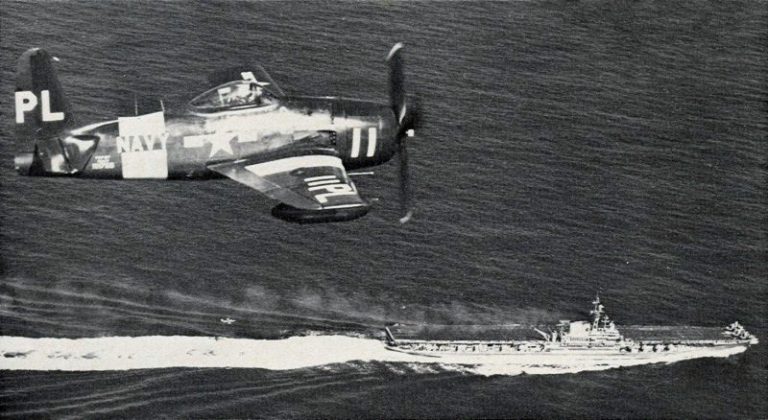
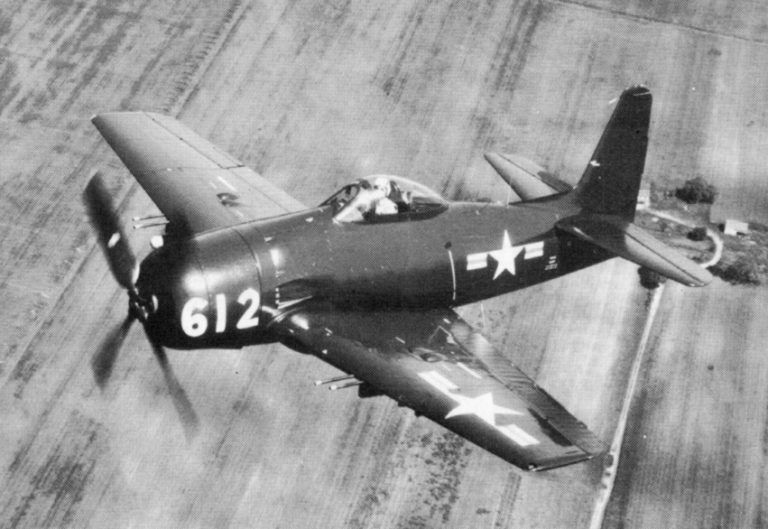
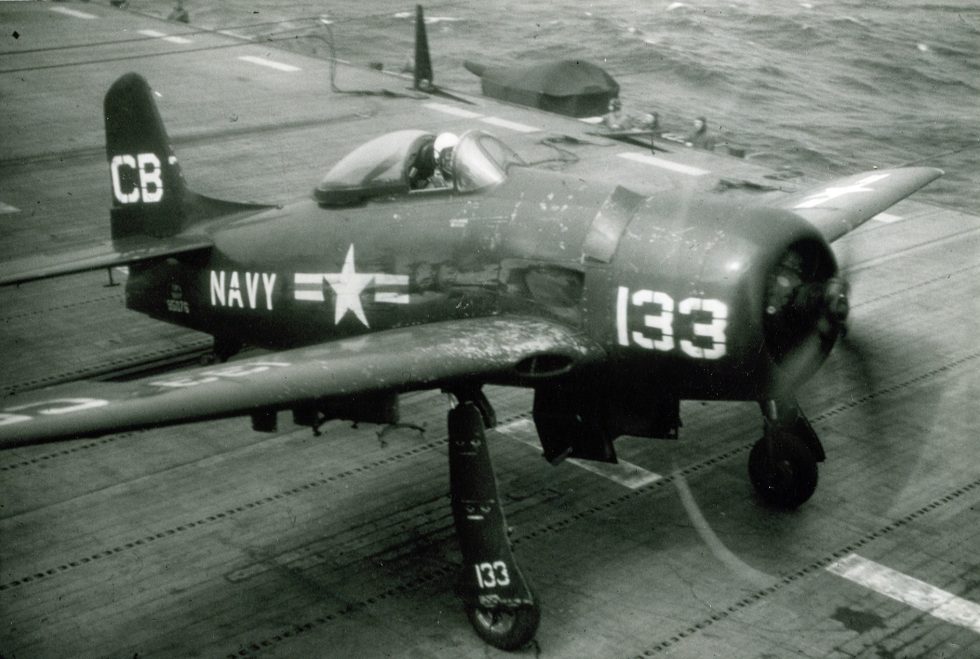
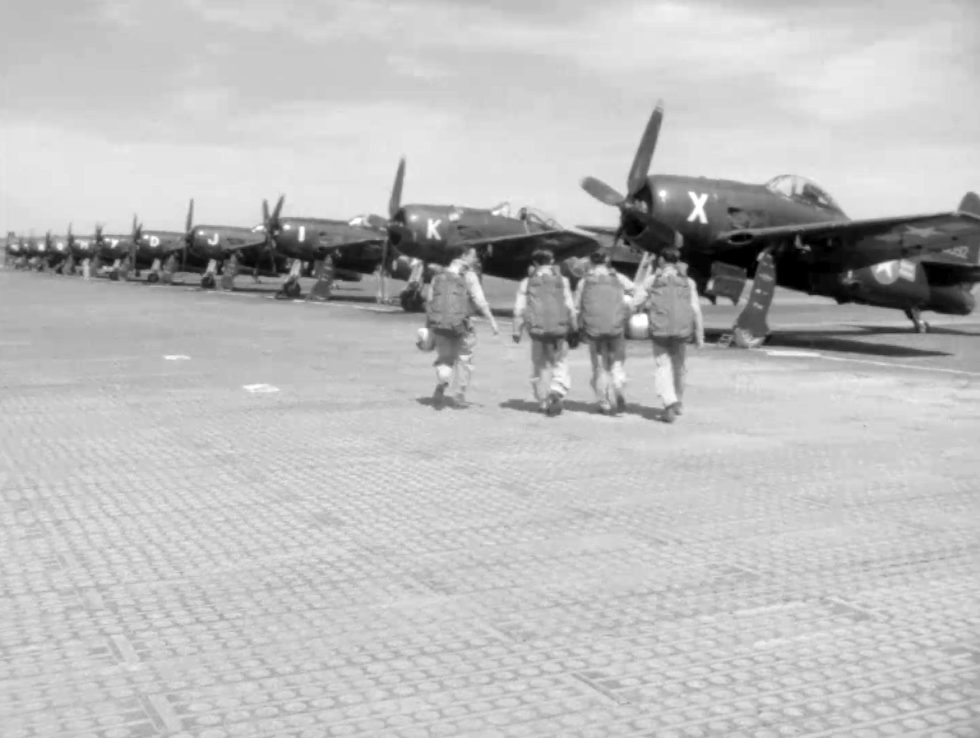
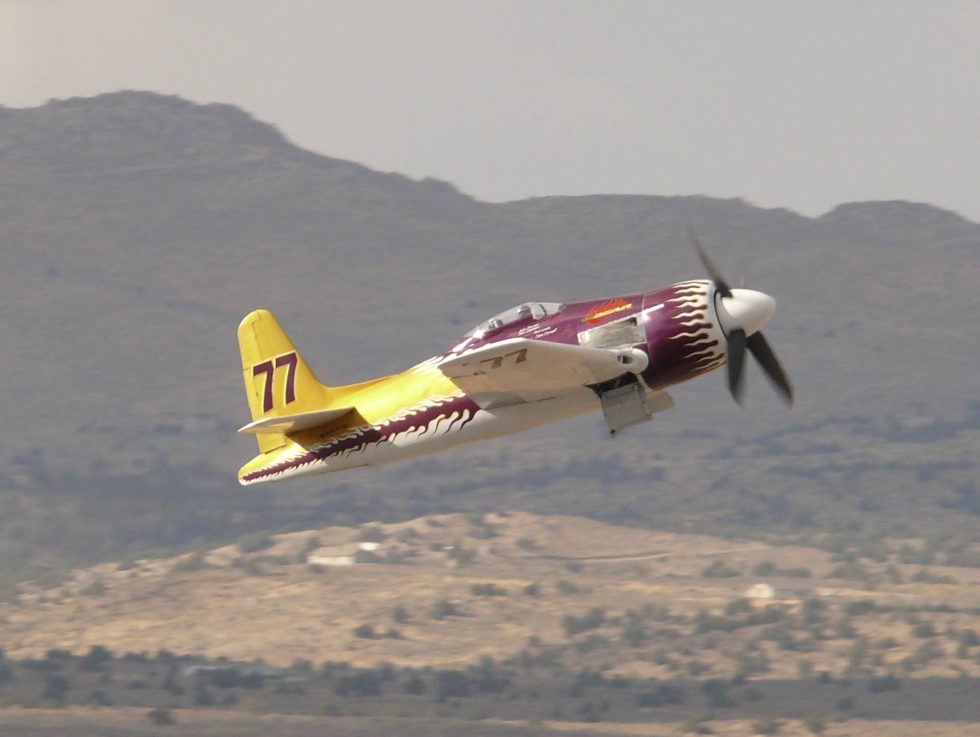
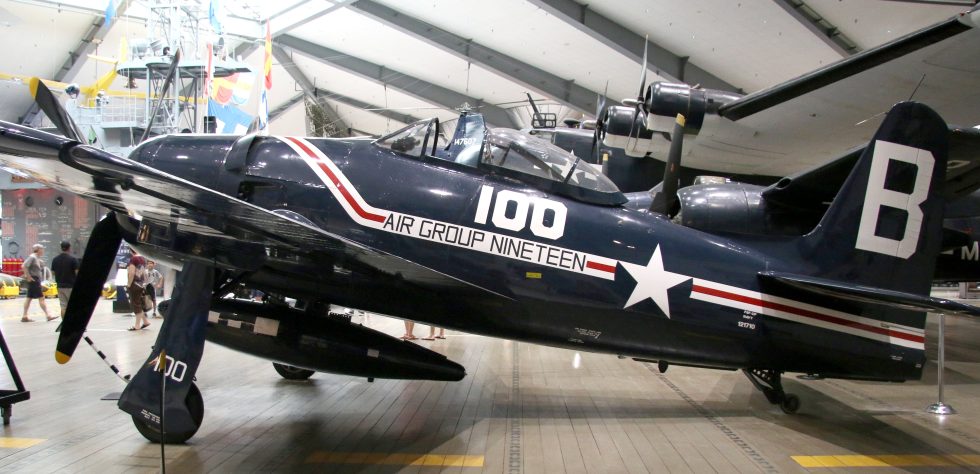
The F8F Bearcat in motion
A hand-picked F8F Bearcat film is coming soon. For now, the gallery above and the twelve stories below cover the aircraft in depth.
Where the F8F Bearcat flew
The score that defines it
The Bearcat’s combat story is one of near-misses. Built as a war-winning interceptor, it reached US Navy squadrons just after WWII ended and never fought under the American flag. Its only combat use came in French hands in Indochina, where it flew as a fighter-bomber rather than a dogfighter. The Bearcat’s real record was written not in kills but in climb, speed and the air-racing pylons it went on to dominate.
Compare the combat record of every military aircraft. Figures as of July 2026.
Everything people ask about the F8F Bearcat
Can I fly in an F8F Bearcat?
Did the F8F Bearcat fight in World War II?
How fast could the F8F Bearcat climb?
What were the Bearcat’s ‘safety’ wingtips?
Did the F8F Bearcat ever see combat?
What is “Rare Bear”?
How many F8F Bearcats were built?
Is the F8F Bearcat still flying?
You can’t fly the Bearcat.
These, you can.
Some legends only live in museums — others are fuelled and waiting. MiGFlug has put civilians in real military jet cockpits since 2004.
 Fly the L-39 AlbatrosThe world’s most-flown jet trainer — aerobatics included
 Fly the F-104 Starfighter“The missile with a man in it”
 Fly the MiG-21The Cold War’s most-produced jet
 Fly the T-33 Shooting StarAmerica’s first jet trainer
 Fly the DH VampireA piece of early jet history
 Fly the S.211Agile Italian jet trainer
 Fly the MB-326The classic Aermacchi jet
 Fly the MiG-15The Soviet legend of the Korean War
Continue the tour
Every fact, checked
- National Naval Aviation Museum — F8F BearcatOfficial US Navy specifications, service entry with VF-19, retirement and French use.
- This Day in Aviation — XF8F-1 first flightFirst-flight date and pilot, prototype engine and the ~1,265 production total.
- This Day in Aviation — “Conquest I” recordGreenamyer’s 482.46 mph piston record and the Me 209 mark it broke.
- Guinness World Records — fastest piston aircraftRare Bear’s 528.31 mph (850.24 km/h) record, Lyle Shelton, 21 August 1989.
- HistoryNet — “An Engine With a Saddle”Design intent, climb performance, Blue Angels dates and the safety-tip nuance.
- U.S. Navy Aircraft History — F8F Safety TipsDetailed account of the break-away wingtips, asymmetric failures and the Primacord fix.
- wwiiafterwwii — F8F post-war serviceFrance in Indochina, South Vietnamese and Thai operation of the Bearcat.
- Flight Journal — Rare BearThe Bearcat’s air-racing career and its status as the winningest Unlimited racer.