
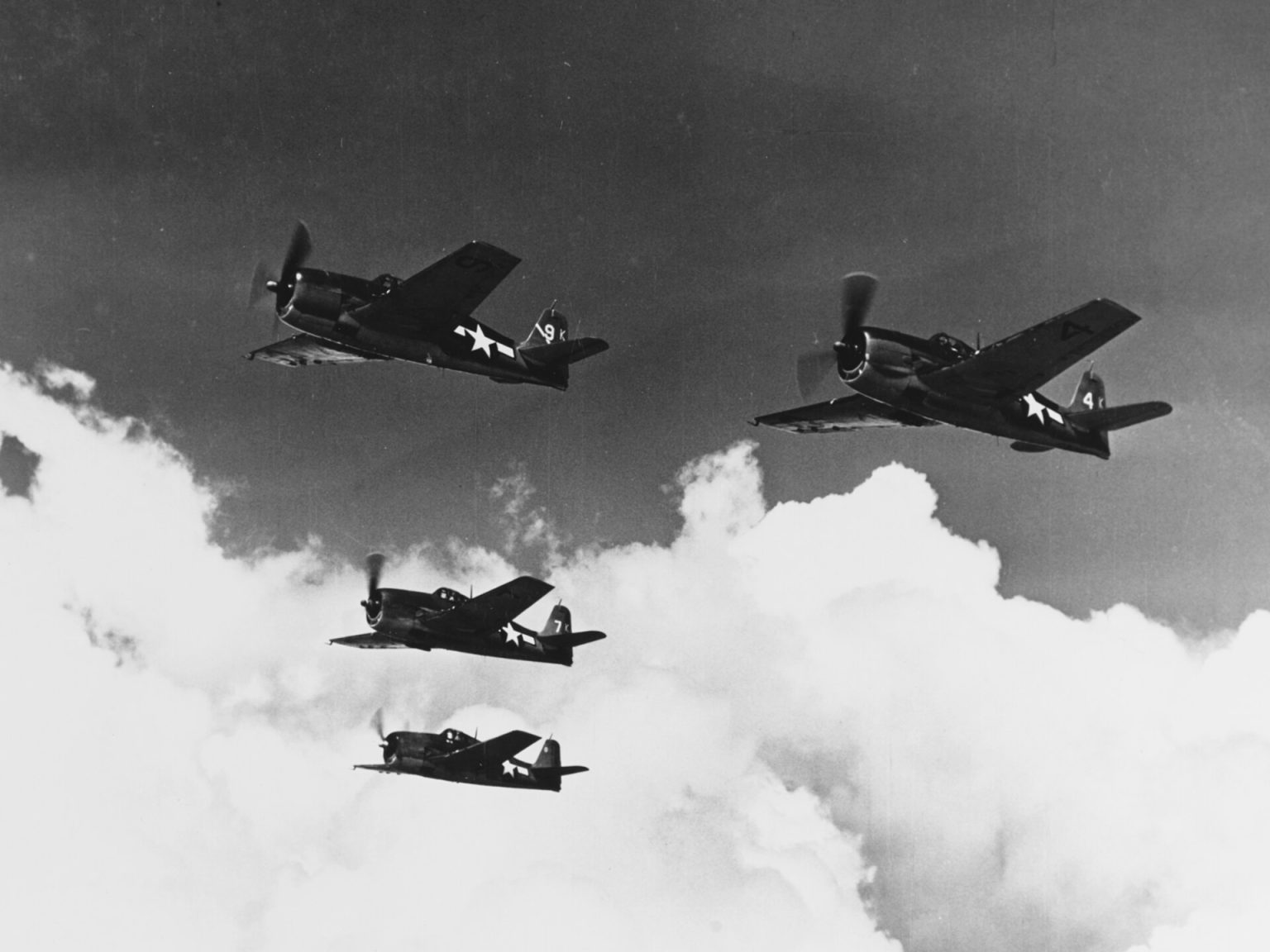
Grumman F6F
“Hellcat”
The rugged Grumman carrier fighter built to beat the A6M Zero — and the aircraft that broke Japan’s naval air power, from Marcus Island to the Marianas Turkey Shoot.
The Hellcat: built to beat the Zero
When the Pacific war began, the US Navy had no fighter that could reliably beat the Mitsubishi A6M Zero. The nimble Japanese fighter out-turned and out-climbed the Navy’s early F4F Wildcats, and American pilots survived by teamwork and tactics rather than raw performance. Grumman’s answer was not a dogfighter but a heavyweight: the F6F Hellcat, a rugged, heavily armed carrier fighter built around the massive Pratt & Whitney R-2800 Double Wasp radial.
The prototype XF6F-1 first flew on 26 June 1942, and after switching to the more powerful R-2800 the type was rushed into production. Hellcats entered combat with squadron VF-5 during the Marcus Island raid on 31 August 1943, and within a year they had swept Japanese air power from the skies over the central Pacific. Grumman built 12,275 Hellcats in barely two years — a rate that reflected both the airframe’s simplicity and the Navy’s desperate need for carrier fighters.
The Hellcat’s reputation rests on numbers as impressive as they are debated. Navy records credit F6F pilots with roughly 5,100 to 5,270 enemy aircraft destroyed — about three-quarters of the Navy’s air-to-air victories in the Pacific — and the type is routinely quoted with a kill-to-loss ratio of about 19 to 1. That figure should be read as a wartime claim rather than an audited fact: victory counts across every air force were inflated, and the exact ratio depends on how losses are counted. What is not in doubt is that the Hellcat produced more US Navy aces than any other fighter, and that its blend of power, armour, self-sealing tanks and forgiving handling let ordinary pilots survive their first fights and become veterans.
01The F6F Hellcat versus the A6M Zero: how Grumman beat Japan’s carrier fighter
The Zero could out-turn the Hellcat at low speed, so Grumman and the Navy fought a different battle. Hellcat pilots used the R-2800’s power and their aircraft’s superior dive and high-speed handling to attack from above, fire a heavy burst from six .50-calibre guns, and climb away before the lighter Zero could respond. The cardinal rule — never turn with a Zero — was reinforced by lessons from a captured example and by hard experience. Combined with armour and self-sealing tanks the Zero lacked, it turned the Pacific air war decisively in America’s favour from late 1943.
What makes it special
A rugged airframe around the R-2800 Double Wasp
The Hellcat was built around the 18-cylinder Pratt & Whitney R-2800 Double Wasp, a twin-row radial delivering roughly 2,000 hp — up to about 2,200 hp with water injection in the F6F-5’s -10W engine. Grumman wrapped it in a famously tough structure: cockpit armour plate, a bullet-resistant windscreen and self-sealing fuel tanks. Pilots repeatedly brought home Hellcats riddled with battle damage.
A carrier fighter designed to beat the Zero
Unlike the lightweight Zero, the Hellcat was engineered for the brutal realities of carrier war. Grumman’s space-saving “Sto-Wing” folding wings let carriers pack more fighters aboard, and a wide-track undercarriage made deck landings forgiving. The design was set in 1941 — before a flyable Zero was captured — so the popular idea that the Hellcat was ‘built from’ the Zero is a myth; the captured fighter mainly refined tactics.
Six .50-calibres and forgiving handling
The Hellcat carried six wing-mounted .50-calibre M2 Browning machine guns — a hard-hitting battery ideal for the short firing passes its tactics demanded. Some late night-fighters swapped two guns for 20 mm cannon. Just as important was the aircraft’s stable, predictable handling: it tolerated rough landings and let relatively inexperienced pilots hold their own, a decisive edge as the Navy expanded rapidly.
02The F6F Hellcat and the Akutan Zero: what the captured fighter really taught America
In June 1942 a Zero flown by Petty Officer Tadayoshi Koga crash-landed almost intact on Akutan Island in the Aleutians. Recovered and test-flown that autumn, it exposed the Zero’s real weaknesses — stiff ailerons above about 200 knots and an engine that cut out under negative-G. Popular history says the Hellcat was designed from it, but the timeline debunks that: Grumman’s specification was dated February 1941 and the prototype flew before the captured Zero was airworthy. Its true value was tactical — telling US pilots exactly how to fight the Zero.
03The F6F Hellcat’s night-fighters: radar Hellcats after dark
Grumman built dedicated radar night-fighters — the F6F-3N and -3E, and the later F6F-5N (roughly 1,189 of the latter) — carrying an AN/APS-6 radar pod on the starboard wing, some with 20 mm cannon replacing two machine guns. Flying from carriers and island strips, they countered night intruders and torpedo attacks and extended fleet air defence around the clock in 1944–45.
Full specifications
Baseline note: the figures below describe the F6F-5, the definitive version and the most numerous at 7,870 of the 12,275 Hellcats built. Deltas for the F6F-3 that fought the first year of the type's war, and for the radar-equipped F6F-3N and F6F-5N night fighters, are in grey. Performance figures for wartime American naval fighters are unusually solid — the Navy's Standard Aircraft Characteristics sheets and the Bureau of Aeronautics trials data survive intact — so there is little to hedge here. What does need hedging is further down: the claimed kill ratio.
Dimensions & weights
- Crew
- 1
- Length
- 10.24 m (33 ft 7 in)
- Wingspan
- 13.06 m (42 ft 10 in) spread; 4.93 m (16 ft 2 in) folded
- Wing fold
- Grumman "Sto-Wing": the panels outboard of the undercarriage bays pivot about a skewed diagonal axis and lie back alongside the fuselage with the leading edges pointing down. The same patented mechanism as the Wildcat and the Avenger, and the reason a wartime Essex-class carrier could stow so many aircraft
- Height
- 3.99 m (13 ft 1 in)
- Wing area
- 31.0 m² (334 sq ft), aspect ratio 5.5 — a very large wing for a single-seat fighter, and the single most consequential number on this page
- Aerofoil
- NACA 23015.6 at the root, NACA 23009 at the tip
- Empty weight
- 4,190 kg (9,238 lb)
- Gross weight
- 5,714 kg (12,598 lb)
- Maximum take-off weight
- 6,992 kg (15,415 lb) with external stores and drop tanks
- Internal fuel
- 946 litres (250 US gal; 208 imp gal) in self-sealing tanks. Roughly two and a half times a Spitfire IX's internal capacity, in an aeroplane with one pilot and one engine. Big wing, big tanks, long legs — that is the Hellcat's design logic in six words
- Armour
- 96 kg (212 lb) of cockpit armour plate, plus armour around the oil tank and oil cooler and a bullet-resistant windscreen. The F6F-5 substituted a flat armoured-glass front panel for the F6F-3's curved Plexiglas plus internal screen, which improved the view as well as the protection
- Wing loading
- 184 kg/m² (37.7 lb/sq ft) at gross weight — lower than an F4U Corsair, well below a P-51D, and the reason a 5.7-tonne fighter could be turned and landed like a much smaller one
Performance
- Maximum speed
- 629 km/h (391 mph; 340 kn); the F6F-3 on the dry-rated R-2800-10 managed 605 km/h (376 mph). An F4U-1D Corsair did about 684 km/h (425 mph), and that gap is real and never closed
- Stall speed
- 135 km/h (84 mph; 73 kn) — and, more to the point, a stall with ample warning, no wing drop worth the name and immediate recovery. The Corsair's stall dropped the left wing hard, which is the whole story of why one of these aeroplanes went to the carriers in 1943 and the other did not
- Rate of climb
- 13.2 m/s (2,600 ft/min) initial
- Time to altitude
- 6,100 m (20,000 ft) in 7 minutes 42 seconds
- Service ceiling
- 11,370 m (37,300 ft)
- Combat range
- ~1,520 km (~945 mi; ~821 nmi) on internal fuel
- Ferry range
- 2,462 km (1,530 mi; 1,330 nmi) with drop tanks
- Take-off run
- 244 m (799 ft) at gross weight, which on an Essex-class deck with wind over the bow meant no catapult was needed
- Lift-to-drag ratio
- 12.2; zero-lift drag coefficient 0.0211 (drag area 0.655 m²; 7.05 sq ft) — unremarkable numbers for a large radial-engined fighter, and the price of that big wing and deep fuselage
- Power-to-mass
- 0.16 hp/lb (0.26 kW/kg)
- Handling against the A6M5 Zero
- Navy trials against a captured Model 52 concluded: faster at every altitude, better climb above 4,270 m, faster roll above 378 km/h — and comprehensively out-turned below about 320 km/h. The trials report was blunt: "Do not dogfight with a Zero 52. Do not try to follow a loop or half-roll with a pull-through. To evade a Zero 52 on your tail, roll and dive away into a high-speed turn." Hellcat pilots were taught to fight in the vertical and in the dive, and the ones who obeyed lived
- Deck-landing manners
- Deliberately forgiving, and designed that way from the start. Wide-track undercarriage retracting rearwards into the wing with a 90° twist; low approach speed; excellent view over a nose that slopes away from a raised cockpit; docile behaviour in the cut. A BuAer officer told Grumman's designers to raise the cockpit with the line "you can't hit 'em if you can't see 'em". He was thinking about gunnery; the pay-off came on the approach
Propulsion & systems
- Engine
- 1 × Pratt & Whitney R-2800-10W Double Wasp — 18-cylinder twin-row air-cooled radial with a two-speed two-stage supercharger and water injection (the F6F-3 used the R-2800-10 without water injection; the two experimental XF6F-6s used the 1,566 kW/2,100 hp R-2800-18W and four blades, and hit 671 km/h — too late to matter)
- Power
- 1,640 kW (2,200 hp) with water injection at take-off; 1,491 kW (2,000 hp) dry. The same engine family powered the F4U Corsair and the P-47 Thunderbolt — three of the war's toughest aircraft, all built around one exceptionally durable radial
- Propeller
- Hamilton Standard three-blade constant-speed, 3.99 m (13 ft 1 in) diameter
- Gunsight
- Mk 8 reflector sight, replacing the earlier telescopic type; the sight was mounted high on the coaming behind the flat armoured windscreen panel
- Radar
- None on the day fighter. The F6F-3E carried AN/APS-4 in a pod under the starboard wing (18 conversions); the F6F-3N and F6F-5N carried AN/APS-6 in a bulbous fairing on the starboard outer wing leading edge, with a small scope in the centre of the instrument panel and its controls on the port cockpit wall. It was flown, aimed and interpreted by a single pilot at night, over water, and it worked
- Carrier equipment
- Arrester hook, catapult points, hydraulic or manual Sto-Wing fold, flotation and dye-marker gear
- Protection
- Self-sealing fuel tanks, 96 kg of cockpit armour, armoured oil system, bullet-resistant windscreen — and an airframe built to Grumman's usual standard. The company's nickname, the Grumman Iron Works, was earned rather than marketed
- First flight
- 26 June 1942 (XF6F-1 with the Wright R-2600); 30 July 1942 for the R-2800-engined XF6F-3, and 3 October 1942 for the first production F6F-3
- Service entry
- February 1943 with VF-9 aboard USS Essex; first combat 1 September 1943, when Hellcats from USS Independence shot down a Kawanishi H8K flying boat
- Number built
- 12,275 — 4,402 F6F-3 and 7,870 F6F-5, all of them at Bethpage on Long Island, and 11,000 of them inside two years. Grumman credited the rate to a design that needed almost no alteration once tooling was cut
- Retired
- 1961 (Uruguayan Navy). US night-fighter squadrons flew F6F-5Ns until 1954; French Aeronavale and Armee de l'Air Hellcats fought in Indochina into the early 1950s
04The F6F Hellcat’s cost: what a wartime carrier fighter was worth
A Hellcat is often quoted at around US$35,000 in wartime dollars, but that figure is poorly documented and should be treated as approximate — some cost tables list higher numbers, and mass production drove unit prices down over time. No reliable cost-per-flight-hour figure exists for a 1940s piston fighter operated in wartime conditions, so any precise modern ‘per-hour’ number you see attached to the type is an estimate rather than a sourced fact.
Armament & payload
Six half-inch Brownings did nearly all of the Hellcat's work, and the aeroplane was built around getting them into position rather than around the guns themselves
The Hellcat's battery was conventional for an American fighter of 1943 — six .50-calibre AN/M2 Brownings with 400 rounds each, giving something under thirty seconds of fire. Against the aircraft it met, that was more than sufficient. The A6M Zero, the D4Y Judy and most of what the Imperial Japanese Navy put up in 1944 carried little armour and no self-sealing tanks, and a two-second burst from six .50s was usually decisive. The Navy trialled a mixed fit of two 20 mm AN/M2 cannon and four .50s, and it went into service almost exclusively on late F6F-5N night fighters, where a single pass on a radar contact justified the heavier punch and the American-built Hispano's reliability problems were tolerable.
What changed over the type's two years was everything hung underneath. The F6F-3 began with a single centreline point for a drop tank; by the F6F-5 there were two more racks on the wing centre-section, zero-length rocket launchers outboard, and a clearance to 1,814 kg of stores including a Mark 13 torpedo. Hellcats dropped 5,899 tonnes of bombs during the war. That is a substantial secondary career for a fleet interceptor, and it is why so much of the type's 1945 flying — over Iwo Jima, over Okinawa, over the Japanese home islands — was ground attack rather than air combat. Gun fits varied: all F6F-3s and most F6F-5s carried six .50s, while the cannon-and-machine-gun mix was a night-fighter fit rather than a fleet-wide standard, and Fleet Air Arm aircraft were delivered to the same American configurations.
Gun
- 6 × .50 in (12.7 mm) AN/M2 Browning in the wings, 400 rounds per gun, on all F6F-3s and the great majority of F6F-5s — roughly 28 seconds of continuous fire, harmonised by squadron preference rather than by a single fleet standard
- Alternative fit: 2 × 20 mm AN/M2 cannon (220 rounds each) in the inboard bays with four .50s outboard (400 rounds each). Cleared on all F6F-5s but used almost solely on late F6F-5N night fighters, because the American-built Hispano was persistently unreliable and the Navy did not want it as a fleet standard
- The guns fired outside the propeller disc with no synchronising gear, which made the installation simple, the rate of fire full and the maintenance quick — a Grumman preoccupation, and one reason carrier deck crews could keep more Hellcats serviceable than anything else afloat
- Ammunition was almost always a belted mix of armour-piercing incendiary and tracer. Against unarmoured, unprotected Japanese airframes it was devastating; against a B7A or a late J2M with some protection, less so, and the 20 mm option existed for exactly that reason
Air-to-air
- Guns only. No air-to-air missile existed in 1943–45, on this aircraft or any other. Every one of the Hellcat's claimed victories was scored with machine guns or cannon
- The 5 in HVAR rocket was occasionally fired at bomber formations in the Pacific as a scatter weapon; it was never effective and never doctrine
- What substituted for a missile was radar fighter direction. Ship-based CIC teams vectored Hellcat combat air patrols onto raids 110 to 240 km out, with height and heading advantage already in hand. On 19 June 1944 that system, not the aeroplane, is what produced the numbers
- Night interception was the other force multiplier: an F6F-5N with AN/APS-6 could find and close on a target its pilot could not see, alone, from a carrier, at night. The first night-fighter Hellcat victories came in November 1943
Air-to-surface guided
- None carried. The Hellcat never employed a guided air-to-surface weapon in service
- The US Navy did field one — the ASM-N-2 Bat radar-homing glide bomb, used operationally from April 1945 — but it weighed close to 1,000 kg and went to PB4Y-2 Privateer patrol bombers, not to single-seat fighters. The USAAF's radio-steered Azon likewise went to B-24s and B-17s
- The closest the Hellcat came was as the weapon rather than the launcher. In late 1952, Guided Missile Unit 90 flew F6F-5K drones each carrying a 907 kg (2,000 lb) bomb from USS Boxer against bridges in Korea, radio-controlled from an escorting AD Skyraider — a converted Second World War fighter used as a cruise missile, seven years after its war ended
- For everything else the Hellcat aimed by eye, in a dive, down the gunsight
Bombs
- Up to 1,814 kg (4,000 lb) total on the F6F-5 across a centreline rack and two wing centre-section racks — a heavier load than many twin-engined light bombers of 1939 carried
- Centreline: 1 × 907 kg (2,000 lb) bomb, or 1 × Mark 13 aerial torpedo. The torpedo capability was cleared and demonstrated; in practice the fleet had Avengers for that and Hellcats almost never used it
- Underwing: 2 × 454 kg (1,000 lb), 227 kg (500 lb) or 113 kg (250 lb) bombs, or 6 × 45 kg (100 lb) in Mk 3 bomb clusters
- Late-model F6F-3s could already exceed 907 kg of bombs once the wing racks were retrofitted; the F6F-5 made the fighter-bomber fit standard from the factory
- Across the war Hellcats dropped 5,899 tonnes (6,503 short tons) of bombs. In 1945 — over Iwo Jima, Okinawa and the home islands — that was most of what many squadrons did, because by then there was very little left to intercept
Rockets
- 6 × 5 in (127 mm) HVAR on zero-length stub launchers, three under each wing — the standard Pacific ground-attack fit from 1944 and the weapon that made carrier fighters genuinely useful against bunkers, coastal shipping and dug-in artillery
- Eight-rocket installations were flight tested on early F6F-5s; six remained the operational norm
- 2 × 11.75 in (298 mm) Tiny Tim — a 500 lb-warhead rocket propelled by a motor built from oil-well casing, cleared on the F6F-5 for hardened targets. Heavy, unwieldy and rarely carried, but it was on the clearance list
- The HVAR was accurate enough to be aimed with the standard reflector sight in a shallow dive, which meant no new training pipeline and no new equipment. That is why it spread across the fleet so fast
Pods & other stores
- 1 × 568 litre (150 US gal) centreline drop tank, with clearance for up to three across the centreline and wing racks on the F6F-5. Added to 946 litres internal, this is what let Hellcats escort strikes to the Marianas, the Philippines and eventually Tokyo
- AN/APS-6 radar fairing on the starboard outer wing of the F6F-3N and F6F-5N — a bulbous pod containing a scanning dish, feeding a small scope in the middle of the instrument panel
- AN/APS-4 radar pod slung on an underwing rack on the 18 F6F-3E conversions; the pod format meant a standard airframe could be turned into a night fighter and back again
- Camera fit: F6F-5P photographic reconnaissance conversions carried cameras in the rear fuselage, retaining full armament. The Fleet Air Arm operated the equivalent as the Hellcat FR Mk II
- Drone conversion kit: F6F-3K and F6F-5K radio-control installations, initially for target work and then, in Korea, for one-way bombing missions
Three typical loadouts
- Fleet combat air patrol, Philippine Sea, 19 June 1944 (F6F-3/-5)
- Six .50s with 400 rounds a gun, one 568 litre centreline drop tank, no other stores. Launched on radar warning, stacked in layers by a shipboard fighter director, and vectored onto inbound raids 110 km out with a height advantage already established. Task Force 58 put up every fighter it had; four Japanese raids totalling 373 carrier aircraft lost 243 of them, and American losses that day were around thirty aircraft of all types.
- Close air support, Okinawa, spring 1945 (F6F-5)
- Six .50s, six 5 in HVAR rockets on zero-length launchers, two 227 kg (500 lb) bombs on the wing racks, no drop tank. Rockets aimed through the standard gunsight in a shallow dive. This was the Hellcat's dominant mission in the last year of the war, and it is the half of the type's record that the kill-ratio arguments always skip.
- Night interception (F6F-5N), 1944–45
- AN/APS-6 radar in the starboard wing fairing, two 20 mm cannon inboard with four .50s outboard, one drop tank, and flame-damped exhausts. One pilot flying the aeroplane, working the radar, reading the scope and shooting. Night-fighter Hellcats operated from carriers and from island strips, and the fit stayed in US service until 1954 — the last Hellcats in uniform anywhere in America.
Sourcing caveat: armament and store figures are from the Navy's Standard Aircraft Characteristics sheet for the F6F-5 and from Jane's Fighting Aircraft of World War II. They describe cleared configurations, not typical ones. A fleet Hellcat on a combat air patrol carried guns and a tank and nothing else; the four-thousand-pound figure describes what the airframe was stressed and wired for, not what squadrons routinely flew with.
Variants
The Hellcat was not designed around a captured Zero, and the myth obscures something more interesting about how it was actually developed
The story that Grumman built the Hellcat by copying a Zero recovered intact in the Aleutians is repeated everywhere and is not true. Grumman had been working on a Wildcat successor since 1938. The XF6F-1 contract was signed on 30 June 1941, five months before Pearl Harbor. The Akutan Zero was not recovered until July 1942 and did not fly in American hands until late September — by which time the R-2800-powered XF6F-3 had already flown, on 30 July, and the first production F6F-3 was ten days from its own first flight. The timeline simply does not permit it.
What did happen is better documented and more instructive. Grumman and the Bureau of Aeronautics rebuilt the aircraft during 1942 around combat reports from Wildcat pilots who had actually fought Zeros. On 22 April 1942 Lieutenant Commander Butch O'Hare walked the Grumman shop floor and talked the engineers through F4F-versus-A6M engagements — the day after telling President Roosevelt that what the Navy needed was "something that would go upstairs faster". Four days later BuAer directed Grumman to abandon the 1,193 kW Wright R-2600 and rebuild the airframe around the 1,491 kW Pratt & Whitney R-2800. BuAer's Lieutenant Commander A. M. Jackson told the designers to raise the cockpit and slope the forward fuselage away from it. Every one of those decisions came from combat experience, and every one of them shows in the finished aeroplane. That is a far better engineering story than reverse-engineering a captured fighter, and it is the one worth telling.
The claimed record is extraordinary and needs handling carefully. US Navy and Marine Hellcat pilots flew 66,530 combat sorties and claimed 5,163 aircraft destroyed — 56 per cent of all American naval air victories in the war — for 270 Hellcats lost in air combat. Add 52 Fleet Air Arm claims and eight over southern France and the total reaches 5,223, and the headline ratio 19:1. The denominator is solid: aircraft losses were counted carefully. The numerator is not. Air-combat claims in every air force of the war ran high, typically by a factor of two or three, because several pilots credit themselves with the same falling aircraft, because a smoking machine that escapes is recorded as destroyed, and because Japanese unit records after mid-1944 are incomplete. The honest statement is that the Hellcat's real exchange ratio was lopsided beyond anything else that flew from a carrier deck, and that 19:1 is a claim ratio rather than a loss ratio. It is also worth noting that only 270 of the 2,462 Hellcats lost in the war fell to enemy fighters at all: 553 went to anti-aircraft fire, 341 to operational causes and 1,298 in training and ferry flights at home.
The Great Marianas Turkey Shoot on 19 June 1944 is the day the ratio was set, and the aeroplane was only part of the reason. American aircrew arrived with several hundred hours before their first combat; their Japanese opponents, after two years of attrition, arrived with a fraction of that. Task Force 58 had radar, dedicated Combat Information Centres, disciplined radio nets and enough frequencies to run them — the fighter-direction system that Midway had lacked. Behind the fighters lay a gun line firing VT proximity-fuzed shells. The Japanese Z-Plan had been captured in March 1944 and translated. Against all that, the Zero was fast, agile, unarmoured and flown by novices. A superb aeroplane in the hands of well-trained pilots inside a working air-defence system beat an obsolete one flown by beginners, and it is a mistake to credit the Hellcat with more than its share. It is also a mistake to credit it with less: the day after the turkey shoot, the long-range strike against Ozawa's fleet cost Task Force 58 about eighty aircraft, almost all to fuel exhaustion and night ditching rather than to the enemy.
Which brings the Corsair question, usually argued badly. The F4U was the faster aeroplane by roughly 55 km/h, climbed harder at height, carried further, had more development left in it and went on to fight in Korea and to serve into the 1960s. The Hellcat had lower wing loading, a gentler stall, a better view on the approach, a wider undercarriage and no vices — and it was in fleet service on carriers in early 1943, when the Corsair had been sent ashore to the Marines because it bounced, stalled off the left wing in the cut and gave its pilot nothing to look at over the nose. The Fleet Air Arm cleared the Corsair for deck work in 1943 with a curved approach and a raised seat, and the US Navy followed in late 1944 once those fixes and others were adopted. So: the Corsair was the better aeroplane and the Hellcat was the better carrier fighter of 1943 and 1944, which was the war that had to be fought at the time. Both are true, they were built in almost identical numbers, and neither statement diminishes the other.
- XF6F-1 (1942, 1 built)
- The original prototype, flown on 26 June 1942 with a 1,193 kW (1,600 hp) Wright R-2600 Cyclone. Sound aeroplane, wrong engine. Later rebuilt as the four-cannon XF6F-4 and then converted to production F6F-3 standard.
- XF6F-3 (1942, 1 built)
- The same airframe strengthened around the R-2800-10 Double Wasp, first flown 30 July 1942. Grumman estimated a 25 per cent performance gain over the XF6F-1; the estimate was about right, and this is the aircraft the Hellcat actually became.
- F6F-3 (1942–44, 4,402 built)
- First production version and the aircraft of the type's first year: Tarawa, Rabaul, Truk, the Marshalls and the Marianas. Six .50s, one centreline rack, curved windscreen with an internal armour-glass screen. Late examples had the water-injected engine of the F6F-5.
- F6F-3E and F6F-3N (1943–44, 18 and about 200)
- The first Hellcat night fighters. The -3E carried AN/APS-4 in an underwing pod; the -3N carried the better AN/APS-6 in a starboard wing fairing. First victories in November 1943 — single-seat, single-pilot radar interception from a carrier deck, which had never been done at scale before.
- F6F-5 (1944–45, 7,870 built)
- The baseline here and the definitive Hellcat. Water-injected R-2800-10W, tidier cowling, spring-loaded aileron tabs, flat armoured windscreen panel, strengthened rear fuselage and tail, wing racks and rocket launchers as standard, and mostly a plain glossy sea blue finish.
- F6F-5N (1944–45, roughly 1,530)
- Night fighter with AN/APS-6, and the main user of the two-cannon-and-four-machine-gun mix. Flown by US Navy and Marine night squadrons ashore and afloat, and the last Hellcat in American service, soldiering on until 1954.
- F6F-5P and F6F-5K (1944–52, small numbers converted)
- Photographic reconnaissance conversions with rear-fuselage cameras and full armament retained; and radio-controlled drones, first as targets and then, in Korea in 1952, as bomb-carrying one-way weapons launched from USS Boxer.
- XF6F-6 (1944, 2 converted)
- Two F6F-5s fitted with the 1,566 kW (2,100 hp) R-2800-18W and a four-blade propeller. At 671 km/h (417 mph) the fastest Hellcat of all, and never produced — by then the F8F Bearcat was coming and the war was ending.
- Hellcat F Mk I, F Mk II, NF Mk II, FR Mk II (1943–46, 1,263 to the Fleet Air Arm)
- Lend-Lease Hellcats, briefly called the Gannet Mk I before the Royal Navy adopted American names wholesale in 1943. Flown off Norway, in the Mediterranean and in the East Indies; 1844 Naval Air Squadron aboard HMS Indomitable was the highest-scoring unit with 32.5 claims. Most were dumped at sea or scrapped in 1945 under Lend-Lease terms.
- FV-1 (1943, cancelled)
- Proposed Canadian Vickers licence production. Cancelled before any aircraft was laid down, because Bethpage was already building them faster than the fleet could absorb them.
Something under thirty complete Hellcats survive worldwide, and the number that fly in any given year is in single figures — a handful in the United States with Planes of Fame, the Commemorative Air Force, the Palm Springs Air Museum, Fagen Fighters and others, and one at Duxford with The Fighter Collection. It is a small inheritance for the second most-produced American naval fighter of the war, and the reason is straightforward: the Hellcat was superseded almost immediately. The F8F Bearcat arrived within months of VJ Day, the type was gone from front-line American squadrons by 1946 except in the night-fighter role, thousands were scrapped where they stood or dumped over the side, and the Fleet Air Arm's 1,263 aircraft were destroyed under the terms of Lend-Lease rather than paid for. A number of the survivors were recovered decades later from Californian lakebeds and Pacific lagoons, which is a fitting end for an aeroplane whose whole life was spent over water.
From drawing board to Turkey Shoot — and beyond
Design begins
Grumman’s XF6F specification is dated February 1941 and the Navy contract follows on 30 June 1941 — before Japan’s Zero was captured intact.
First flight
The prototype XF6F-1 flies at Bethpage, New York, on 26 June 1942; Grumman soon standardises on the R-2800 Double Wasp.
Into combat
Hellcats enter combat with VF-5 at Marcus Island on 31 August 1943 and quickly become the Navy’s main carrier fighter; Britain’s Fleet Air Arm also begins flying them.
The Marianas Turkey Shoot
At the Battle of the Philippine Sea, 19–20 June 1944, Hellcats help destroy the bulk of Japan’s carrier aircraft in a lopsided air battle.
McCampbell’s nine
On 24 October 1944, David McCampbell downs nine aircraft in a single mission — a US record that earns him the Medal of Honor.
Production ends
Grumman completes the 12,275th and last Hellcat in November 1945, after barely three years of building.
France in Indochina
The French Aeronavale flies F6F-5 Hellcats in the First Indochina War, including strikes from the carrier Arromanches in the Gulf of Tonkin.
Hellcat drones
Surplus F6F-5K drones serve as targets and, over Korea, as television-guided attack drones launched from USS Boxer.
From the cockpit: twelve Hellcat stories
Built to beat the Zero
Grumman’s brief: out-power and out-tough Japan’s agile carrier fighter, not out-turn it.
Read the full story
The Akutan Zero
A captured Zero shaped US tactics — not the Hellcat’s fundamental design, despite the legend.
Read the full story
The Great Marianas Turkey Shoot
19–20 June 1944: Japanese naval air power collapses in a single lopsided air battle.
Read the full story
Bring the pilots home
Battle-torn Hellcats routinely returned to the carrier and trapped aboard safely.
Read the full story
David McCampbell — the Navy’s top ace
34 career victories, including a record nine enemy aircraft downed in one mission.
Read the full story
The great ace-maker
The Hellcat produced more US Navy aces than any other fighter of the war.
Read the full story
Radar Hellcats after dark
Wing-mounted AN/APS-6 radar turned the Hellcat into a nocturnal hunter in 1944–45.
Read the full story
Hellcats in the Fleet Air Arm
Britain’s Royal Navy flew roughly 1,200 Lend-Lease Hellcats from 1943.
Read the full story
The Double Wasp story
Pratt & Whitney’s R-2800 gave the Hellcat — and the Thunderbolt and Corsair — its muscle.
Read the full story
The 19:1 claim
A famous kill ratio — but a wartime claim, not an independently audited fact.
Read the full story
Hellcat drones
Surplus F6Fs became target drones — and TV-guided attack aircraft over Korea.
Read the full story
French Hellcats over Vietnam
The Aeronavale flew F6F-5s in the First Indochina War in the early 1950s.
Read the full story
The Hellcat in pictures
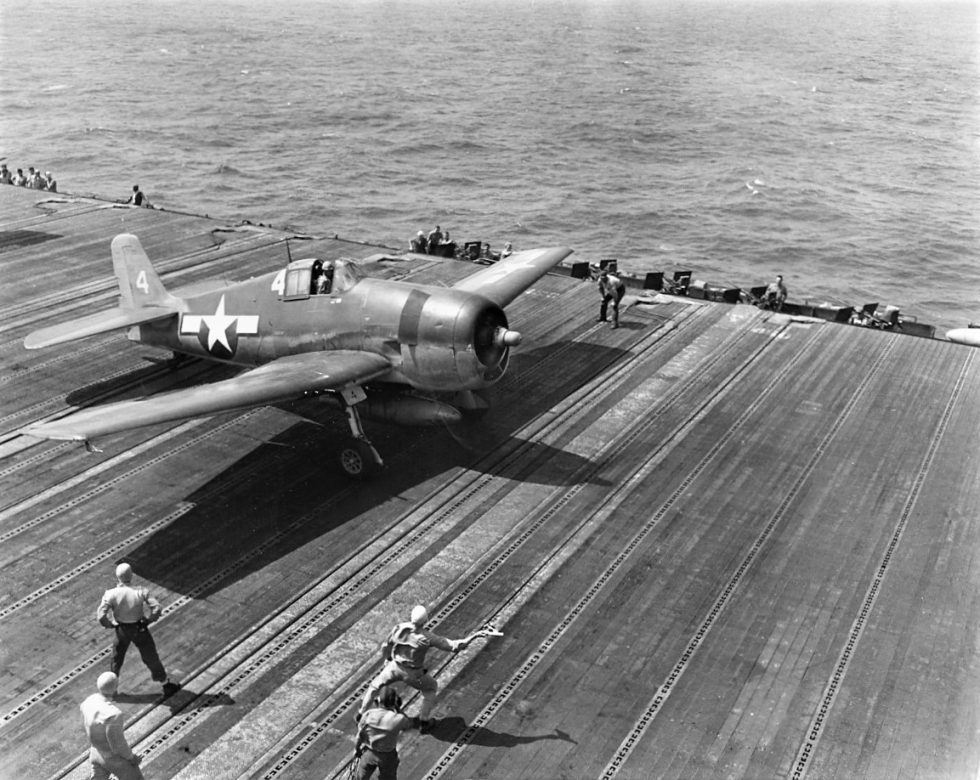
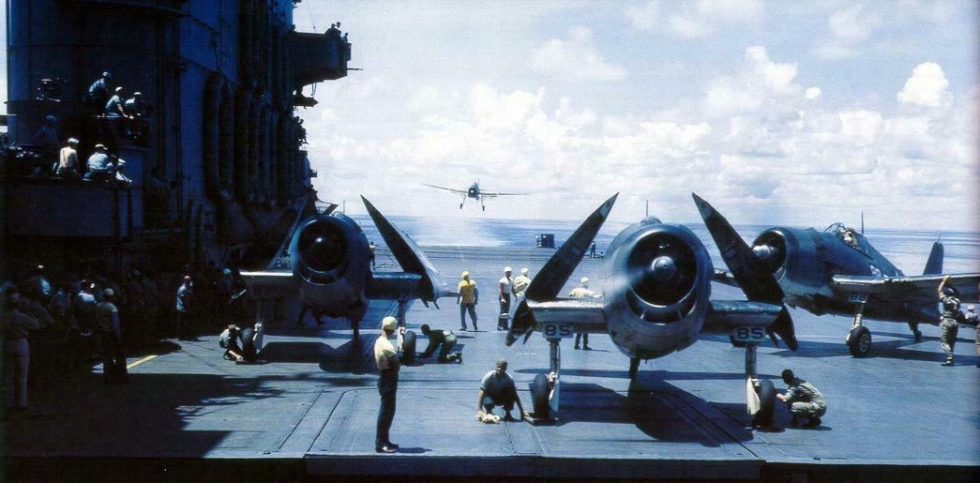
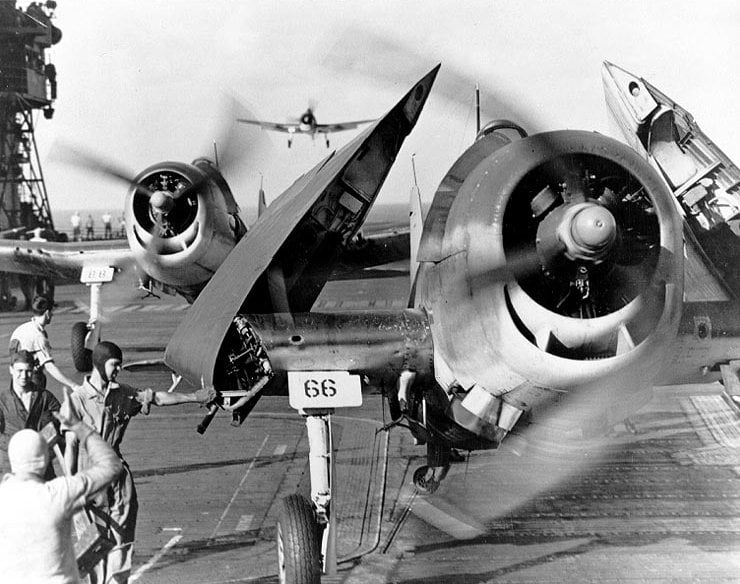
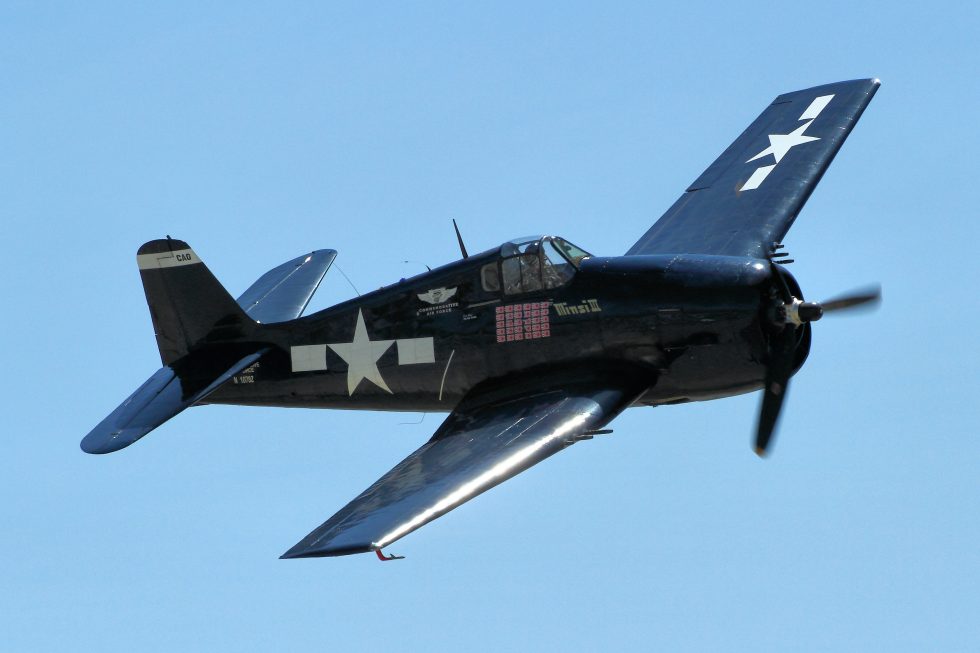
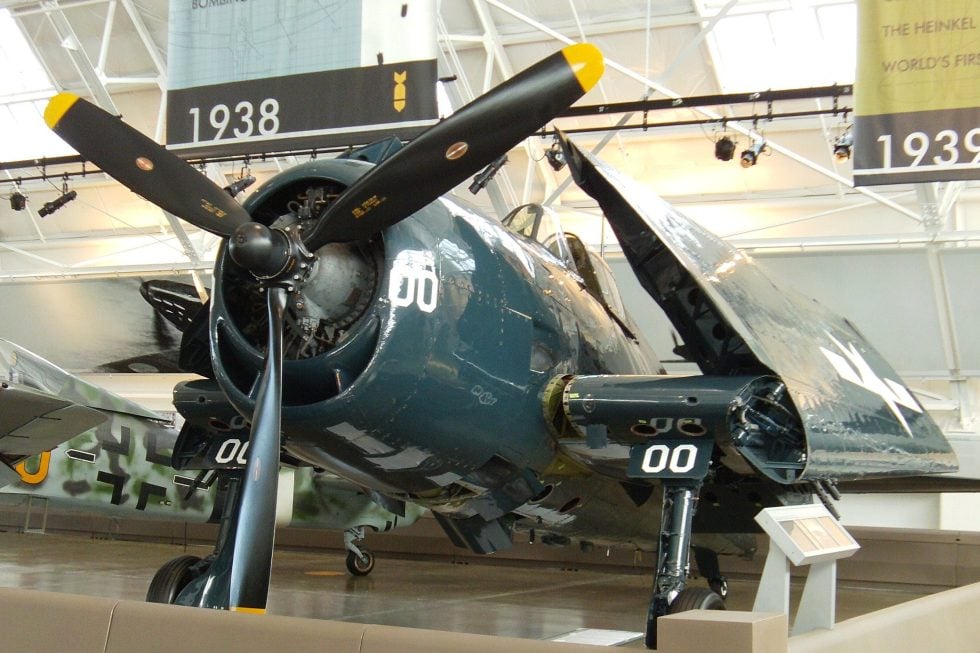
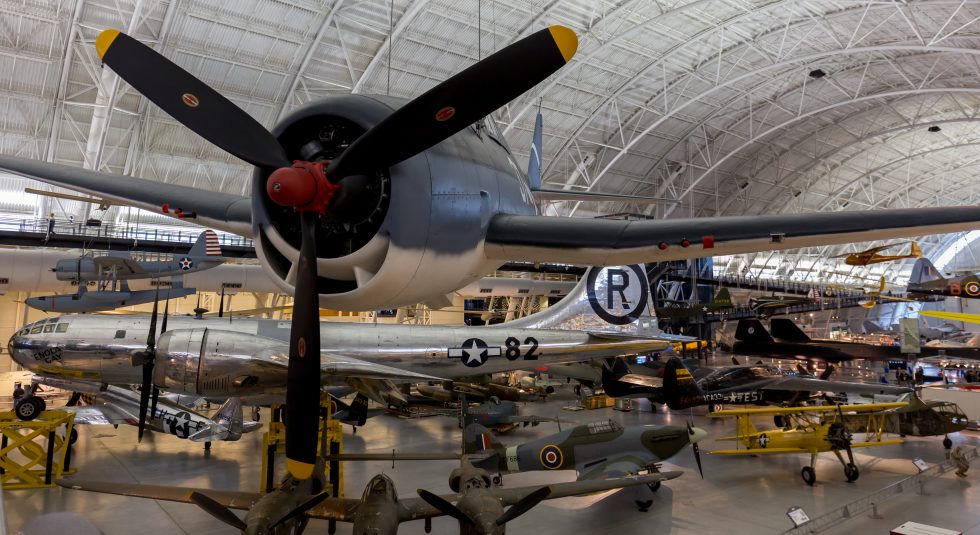
The Hellcat in motion
A dedicated Hellcat video feature is coming soon. In the meantime, explore the photo gallery above and the interactive operations map below.
Where the Hellcat flew
The score that defines it
The Hellcat’s record is written in the destruction of Japanese carrier air power. Navy records credit F6F pilots with the large majority of the Navy’s Pacific air-to-air kills, and the type produced more aces than any other American naval fighter. The famous figures below are genuinely dominant — but the wartime claims behind them should be read with the usual caution.
Compare the combat record of every military aircraft. Figures as of July 2026.
Everything people ask about the F6F Hellcat
Can I fly in an F6F Hellcat?
How many aircraft did the Hellcat shoot down, and what was its kill ratio?
What engine did the Hellcat use?
What was the Marianas Turkey Shoot?
Did the British use the Hellcat?
How many Hellcats were built?
Is the Hellcat still flying?
You can’t fly the Hellcat.
These, you can.
Some legends only live in museums — others are fuelled and waiting. MiGFlug has put civilians in real military jet cockpits since 2004.
 Fly the L-39 AlbatrosThe world’s most-flown jet trainer — aerobatics included
 Fly the F-104 Starfighter“The missile with a man in it”
 Fly the MiG-21The Cold War’s most-produced jet
 Fly the T-33 Shooting StarAmerica’s first jet trainer
 Fly the DH VampireA piece of early jet history
 Fly the S.211Agile Italian jet trainer
 Fly the MB-326The classic Aermacchi jet
 Fly the MiG-15The Soviet legend of the Korean War
Continue the tour
Every fact, checked
- Naval History and Heritage Command — F6F-5 HellcatPrimary source for F6F-5 dimensions, weight, engine, speed, ceiling, armament, 12,275 built and the kill figures.
- Naval History and Heritage Command — F6F-3 HellcatFirst flight and service dates, first combat at Marcus Island, night-fighter numbers and the “75% of Navy victories” figure.
- Vintage Aviation News — First Flight of the F6F HellcatConfirms the 26 June 1942 first flight, the engine transition and Bethpage production.
- U.S. Naval Institute — “The Hellcat-Zero Myth”Debunks the Akutan-Zero design myth using the 1941 specification and contract timeline.
- The Aviation Geek Club — The Story of Koga’s ZeroWhat the captured Zero actually contributed — tactics rather than the core airframe.
- Congressional Medal of Honor Society — David McCampbellMedal of Honor citation: nine kills on 24 October 1944, seven on 19 June 1944.
- Tailspin Topics — F6F DronesPostwar F6F-5K target drones and the TV-guided attack drones launched from USS Boxer over Korea, 1952.
- Britannica — Battle of the Philippine SeaIndependent figures for the “Turkey Shoot”: 200+ Japanese aircraft lost on 19 June, ~130 US losses over two days.