
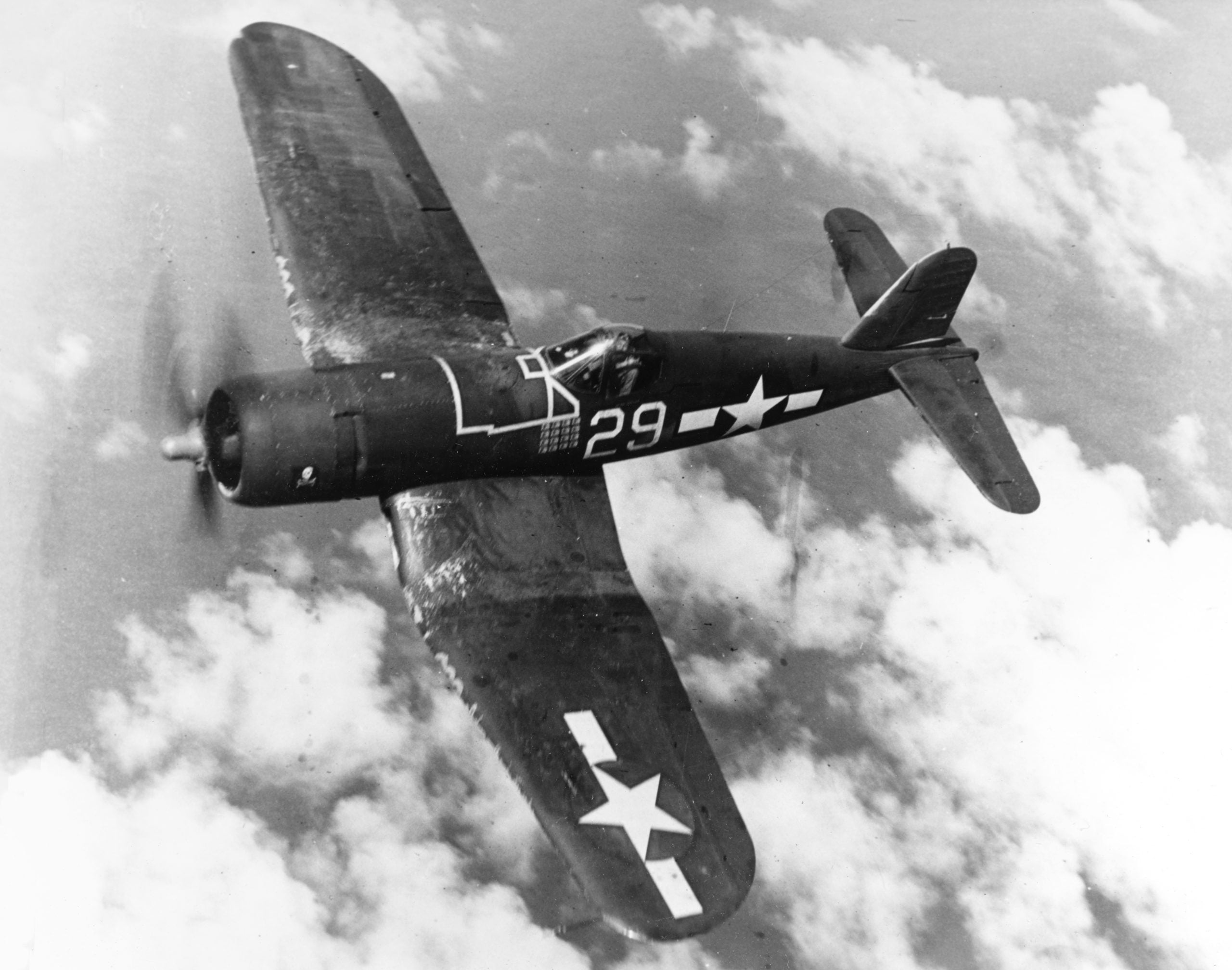
Vought F4U Corsair
“Whistling Death”
The bent-wing terror of the Pacific — a gull-winged Navy fighter so fast and so rugged it fought from Guadalcanal to Korea, outlived every other American piston fighter, and even shot down a jet.
The bent-wing bird built around a giant engine
In 1938 the US Navy asked its industry for a single-seat carrier fighter that could simply outperform everything else in the sky. At Chance Vought, chief engineer Rex Beisel and his team answered by wrapping the smallest possible airframe around the largest, most powerful engine available — the twin-row Pratt & Whitney R-2800 Double Wasp radial. To turn all that power into thrust they hung an enormous propeller, over four metres across, on the nose.
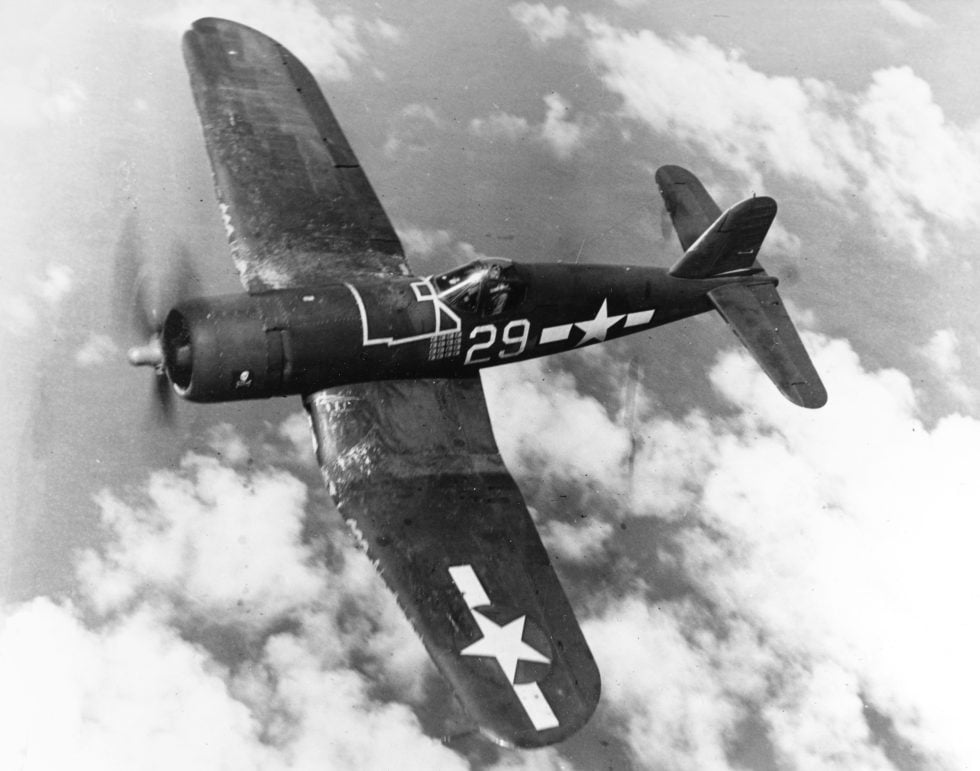
That propeller created the aircraft’s signature problem, and its signature solution. To keep the huge blades clear of the deck without stilt-like landing gear, Beisel bent the wing: it dropped sharply down from the fuselage and then angled back up to the tips, the famous inverted gull wing. The bend let the wing meet the fuselage at an efficient right angle, shortened the undercarriage, and gave the Corsair its unmistakable silhouette. When the XF4U-1 first flew on 29 May 1940, it soon became, by most accounts, the first American single-engine fighter to exceed 400 mph in level flight.
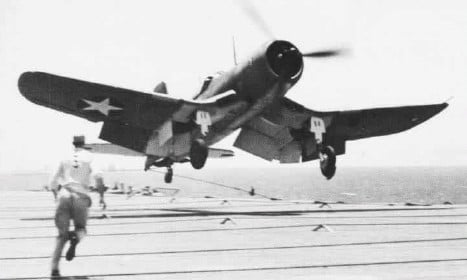
Getting that raw performance aboard a carrier proved harder. The long nose blocked the pilot’s view over the bow on approach, the stiff landing gear bounced, and early models could stall a wing without warning in the groove. The US Navy initially judged the F4U unsuitable for carriers, so the first Corsairs went to war from land with the US Marine Corps, flying from Guadalcanal from February 1943. Ironically it was Britain’s Fleet Air Arm, using a curving carrier approach, that cleared the type for deck operations first; US carrier clearance followed in 1944.
Once unleashed, the Corsair dominated. Japanese troops reportedly nicknamed it “Whistling Death” for the shriek of air through its wing-root intakes, while overworked rookie Navy pilots gave it the darker name “Ensign Eliminator.” Its speed, firepower and legendary ruggedness made it a superb fighter and an even better ground-attack machine — a role it carried into the Korean War a decade later, where a Corsair even shot down a MiG-15 jet. Built from 1942 until 1953, it was the last and longest-produced American piston-engine fighter.
01The F4U Corsair’s inverted gull wing: why the bent wing exists
The gull wing was not a styling flourish — it was pure engineering. The R-2800 needed a huge propeller to absorb its power, and that propeller needed ground clearance. Mounting it on long, spindly landing gear would have made the aircraft heavy, fragile and unstable on a pitching deck. Instead Beisel dropped the wing to its lowest point right where the gear attached, so the legs could be short and strong, then swept the wing back up to the tips. As a bonus, the wing joining the fuselage at close to 90° reduced interference drag. The trade-off was a wing that could drop suddenly at low speed — part of what made early carrier landings so treacherous.
What makes it special
The gull wing and a four-metre propeller
The Corsair was designed around the biggest engine and propeller Vought could use. The Pratt & Whitney R-2800 spun a Hamilton Standard propeller over 4 metres in diameter — so large that a conventional low wing would have needed impossibly long landing gear. The inverted gull wing solved it, dropping to meet short, stout gear while clearing the blades, and gave the fighter its unmistakable bent-wing shape.
Rugged, and loaded for ground attack
The airframe was famously tough. Armed with six .50-calibre machine guns (later variants carried four 20 mm cannon) and able to haul up to around 4,000 lb of bombs and rockets, the Corsair was a devastating fighter-bomber. That ruggedness and lifting power made it the close-air-support aircraft of choice for the Marines in the Pacific and again over Korea.
Longevity and a jet-killing record
Corsairs are credited with roughly 2,140 Japanese aircraft destroyed in WWII air combat for a reported kill ratio near 11:1 (figures often quoted, but contested). Production ran from 1942 to 1953 — the longest of any US piston fighter — and in 1952 a Corsair became one of the very few propeller aircraft ever to shoot down a jet.
02The F4U Corsair’s carrier troubles: how the ‘Ensign Eliminator’ earned its name
The same features that made the Corsair fast made it a handful around the boat. The long nose hid the deck on final approach; the stiff main gear tended to bounce; and at low speed a wing could stall abruptly, dropping the aircraft toward the ramp. Early US carrier trials went so badly that the Navy sent the F4U to land-based Marine squadrons and put the F6F Hellcat on its decks instead. The British Fleet Air Arm cracked the problem first, flying a continuous curving approach that kept the deck in view, and cleared the Corsair for carriers in 1943. The US Navy followed in 1944, and by 1945 the F4U was a front-line carrier fighter.
03The F4U Corsair in Korea: from dogfighter to ground-attack mainstay
By the Korean War the piston-engined Corsair was outclassed as an air-superiority fighter by swept-wing jets, but it found a second life as a close-air-support and night-attack aircraft, flying from Navy and Marine carriers and land bases. It hammered troop concentrations and supply lines, and covered the Marines’ fighting retreat from the Chosin Reservoir in the brutal winter of 1950. On 10 September 1952, Marine Captain Jesse Folmar used his Corsair’s cannon to down a MiG-15 jet — one of the rare occasions a piston fighter destroyed a jet in air combat, though Folmar was himself shot down minutes later and rescued.
Full specifications (F4U-4)
Unless a line says otherwise, every figure below is for the F4U-1D — the definitive wartime Corsair, a fighter-bomber with the raised cockpit and clear canopy of the -1A, twin pylons for tanks or bombs and rails for rockets, and the mark that finally flew from American carrier decks in numbers from late 1944. Where the earlier F4U-1A, the much more powerful post-war F4U-4 or the Goodyear F2G differ materially, the delta is given in grey. Corsair figures vary noticeably between the manufacturer's brochure, Navy characteristics charts and squadron experience with worn engines and tired airframes, so treat single decimal places with suspicion.
Dimensions & weights
- Crew
- 1 pilot; the F4U-5N and other night-fighter marks stayed single-seat, with the radar operator's work done by the pilot
- Length
- 10.16 m 33 ft 4 in; the F4U-4 is essentially the same, the F4U-5 slightly longer at 10.53 m / 34 ft 6 in
- Wingspan
- 12.50 m 41 ft 0 in, and the shape is the point — the inverted gull wing bends sharply down from the fuselage and back up to the tips. Folded for the hangar deck the span drops to 5.19 m / 17 ft 0.5 in. Royal Navy Corsairs had about 20 cm / 8 in clipped from each tip to fit British hangars
- Height
- 4.60 m 15 ft 1 in with the tail down and the propeller vertical; quoted heights vary by up to half a metre depending on whether the blade is counted
- Wing area
- 29.17 m² 314 sq ft, unchanged across almost the whole family
- Empty weight
- 4,074 kg 8,982 lb; the F4U-4 rose to about 4,238 kg / 9,340 lb and the F4U-5 to roughly 4,442 kg / 9,795 lb
- Loaded weight
- 5,461 kg 12,039 lb in clean fighter trim with full internal fuel and ammunition
- Max takeoff weight
- 6,654 kg 14,669 lb with drop tanks and ordnance; the AU-1 attack variant was cleared to about 8,850 kg / 19,500 lb, which is a different aeroplane in everything but outline
- Internal fuel
- ~897 L ~237 US gal in a single self-sealing fuselage tank ahead of the cockpit. That tank is why the cockpit sits so far back and the nose is so long — the original leading-edge wing tanks were deleted, and the pilot was moved aft roughly 80 cm / 32 in to make room. Two ~568 L / ~150 US gal drop tanks were the standard external fit
Performance
- Max speed (altitude)
- 684 km/h 425 mph at 20,000 ft (6,100 m) with water injection. The F4U-4 reached 718 km/h / 446 mph at 26,200 ft, and the Goodyear F2G with the R-4360 was faster still low down at around 693 km/h / 431 mph at sea level
- Cruise speed
- 346 km/h 215 mph normal cruise — a long way below maximum, as with every fighter of the period, and the figure that governed range
- Rate of climb
- 15.8 m/s 3,120 ft/min initial at fighter weight. The F4U-4 was in another class at about 22.1 m/s / 4,360 ft/min, one of the best climb rates of any piston fighter to see service
- Service ceiling
- 11,250 m 36,900 ft; the F4U-4 reached about 12,650 m / 41,500 ft
- Combat radius
- ~500 km ~310 miles with drop tanks and a useful allowance for combat, though squadron practice varied enormously with the fit and the mission profile
- Ferry range
- ~2,510 km ~1,560 miles with external tanks; combat range on internal fuel was closer to ~1,620 km / ~1,005 miles
- Takeoff run
- 390 m about 1,280 ft from a hard runway at fighter weight in still air; from a carrier deck into 25 knots of wind the run was a small fraction of that, which is why deck-run figures and airfield figures should never be compared directly
- Landing run
- 520 m roughly 1,700 ft on brakes from a shore field. Aboard ship the landing was arrested in a few tens of metres, and it was the approach rather than the stopping that caused the Corsair's trouble
- Wing loading
- 187 kg/m² 38.3 lb/sq ft at loaded weight — high for 1943, and part of why the Corsair turned less willingly than a Zero and dived and zoomed far better
Propulsion & systems
- Engine
- Pratt & Whitney R-2800-8W Double Wasp 18-cylinder twin-row air-cooled radial, two rows of nine, with a two-stage two-speed supercharger and water-methanol injection. The Corsair was designed from the outset around the largest engine that could be fitted to a single-seat fighter, and the airframe follows from that decision rather than the other way round. The F4U-4 used the R-2800-18W, the F4U-5 the R-2800-32W with a variable-speed supercharger, the AU-1 a simplified single-stage R-2800-83W optimised for low-level attack, and the F2G the 28-cylinder R-4360 Wasp Major
- Power
- 1,678 kW 2,250 hp for takeoff with water injection; 2,000 hp military power dry. The F4U-4 gave 1,775 kW / 2,380 hp, the F4U-5 about 1,865 kW / 2,500 hp, and the F2G's Wasp Major some 2,240 kW / 3,000 hp
- Propeller
- 4.06 m Hamilton Standard 13 ft 4 in, three-blade Hydromatic constant-speed — at the time the largest propeller ever fitted to a fighter, and the single fact from which the whole aeroplane descends. All that power was useless unless it could be turned into thrust, and turning it required a disc this size. The F4U-4 onward used a four-blade propeller of slightly smaller diameter
- Inverted gull wing
- The defining engineering choice — a 4.06 m propeller swinging in front of a tailwheel aircraft needs a great deal of ground clearance, and on a conventional straight wing that clearance could only come from very long main undercarriage legs. Long legs on a carrier fighter are heavy, flexible, hard to retract and prone to collapse under the vertical impact of an arrested landing. Vought instead cranked the wing down from the fuselage and back up again, so the root met the fuselage at 90 degrees. Three things followed at once: the lowest point of the wing sat far enough below the thrust line to give the propeller its clearance with much shorter and stiffer gear; the right-angled wing-fuselage junction produced the least interference drag of any arrangement, so no large fillet was needed; and the main legs, retracting rearwards and rotating 90 degrees to lie flat in the wing, ended up in the strongest part of the structure. The cost was a wing that was expensive to build and, as it turned out, one that stalled asymmetrically
- Armament
- 6 × 12.7 mm M2 Browning six .50 in guns, three in each outer wing panel, roughly 390 rounds per gun and about 2,350 rounds in total. The F4U-1C substituted four 20 mm AN/M2 cannon. Underwing and centreline stations carried bombs, drop tanks and up to eight 5-inch HVAR rockets on the -1D
- Arrester gear & wings
- Hook, hydraulic fold, catapult hooks a retractable arrester hook under the rear fuselage, hydraulically folding outer wing panels that hinged upward at the outboard end of the gull crank, and catapult fittings. All of it was fitted from the first production aircraft — the Corsair was a carrier fighter by design from the beginning, whatever the first two years of its service life suggested
- First flight
- 29 May 1940 XF4U-1 prototype, Lyman Bullard at the controls, Stratford, Connecticut. On 1 October 1940 it became the first American single-engined fighter to exceed 400 mph in level flight, on a transit between Stratford and Hartford
- Service entry
- 1942 first squadron deliveries from late July 1942 and formal acceptance in December; combat debut with Marine squadron VMF-124 from Guadalcanal on 11 February 1943, flown from land rather than from a carrier deck
- Built
- ~12,571 1942–53, across three manufacturers: about 7,829 by Vought, 4,007 by Goodyear as the FG-1 series and 735 by Brewster as the F3A. Sub-totals differ slightly between sources depending on how prototypes and cancelled contracts are counted, but 12,571 is the figure almost everyone uses
- Unit cost
- ~US$75,000–100,000 a hedged period figure. Wartime aircraft costs were quoted on wildly inconsistent bases — airframe only, flyaway with engine and instruments, or with government-furnished equipment — and the price fell sharply as production matured. Very roughly US$1.3m–1.7m in today's money
- Cost per flight hour
- ~US$4,000–8,000 a hedged modern warbird estimate, not an official figure, and no authoritative published number exists. Owners of R-2800-powered warbirds typically cite fuel of the order of 200 litres an hour plus insurance, hangarage, and — the dominant term by far — reserves against an engine overhaul that can run into six figures. Real costs swing widely with how much of the maintenance the operator does in-house
04The F4U Corsair’s operating costs: from a wartime bargain to a millionaire’s warbird
In WWII a Corsair cost the government on the order of US$77,000 — an oft-quoted period figure that should be read as an approximation, since costs fell sharply as production scaled. No credible modern cost-per-flight-hour figure exists for the type. Today the equation is reversed: an airworthy F4U is a prized warbird, with restored examples commonly valued in the low-to-mid seven figures, and owners typically budget several thousand dollars per flight hour for fuel, maintenance and insurance on the thirsty R-2800 radial. Any precise dollar figure attached to a flying Corsair today is an estimate.
Armament & payload
The Corsair began as a six-gun interceptor and finished as the US Navy's heaviest-hitting piston attack aircraft, still dropping napalm over Korea a decade later
The armament fit tracks the Corsair's change of job almost line for line. The 1942 aeroplane carried six half-inch machine guns and nothing else, and was meant to shoot down fighters and bombers at altitude. By 1945 the same airframe was hanging two 1,000 lb bombs and eight rockets under a wing whose pylons had been added in the field before they were added on the production line. By 1952 the dedicated AU-1 had given up its high-altitude supercharging altogether in exchange for ordnance, armour and low-level power. Very little of this was foreseen in 1938, and all of it was possible because the airframe had been built around an enormous engine with power to spare.
Machine guns
Six 12.7 mm (.50 in) M2 Browning machine guns, three in each outer wing panel outboard of the fold, with roughly 390 rounds per gun and about 2,350 rounds in total — enough for something like 30 seconds of firing. The prototype had begun with a very different scheme, two cowl guns and one gun in each wing, plus a bizarre and short-lived provision for small anti-bomber bomblets dropped through the wing; combat reports from Europe swept all of that away in favour of a heavy wing battery. The six-gun fit was slightly lighter in throw than the eight guns of a P-47 but ample against Japanese aircraft, most of which were lightly built and, early in the war, poorly protected. The honest limitation is the one common to all .50 calibre batteries: excellent against airframes and vehicles, mediocre against anything meaningfully armoured.
Cannon (F4U-1C)
Two hundred F4U-1C aircraft replaced the six machine guns with four 20 mm AN/M2 cannon, roughly 231 rounds per gun. The weight of fire was far greater and against ground targets, barges and structures the difference was obvious; pilots who flew both generally preferred the cannon for strafing. The drawbacks were real as well — the guns were prone to jamming at low temperature and high altitude, the rate of fire was lower, and ammunition supply in the forward areas was a nuisance when every other Corsair on the field used .50 calibre. The -1C reached combat late, mostly with Marine squadrons around Okinawa in 1945. Cannon returned as standard on the post-war F4U-4B, F4U-5 and AU-1.
Bombs
Bomb carriage was an afterthought that became a primary role. Early F4U-1 aircraft had no shackles at all; Marine units in the Solomons improvised them. The F4U-1D standardised two pylons inboard on the centre section, each able to take a 1,000 lb bomb or a drop tank, with a centreline station capable of a 2,000 lb weapon — a load a single-seat fighter had no business carrying in 1940 and carried routinely by 1945. Dive-bombing suited the aircraft: it was heavy, stable in the dive and quick to accelerate away afterwards. The post-war AU-1 went further still, with ten underwing stations and a total external load approaching 1,800 kg (4,000 lb), at the price of high-altitude performance it no longer needed.
Rockets
The 5-inch High Velocity Aircraft Rocket was the Corsair's signature ground-attack weapon, carried on zero-length launch rails, typically four under each wing for a total of eight. HVAR was fast, flat-shooting and accurate enough for bunkers, barges, gun positions and rolling stock, and it turned a fighter into a credible substitute for artillery in places where artillery could not be landed. A handful of aircraft carried the far heavier 11.75-inch Tiny Tim for hardened targets. Rockets were used still more heavily in Korea, where Marine Corsairs flying from carriers and from rough strips ashore expended them in enormous numbers against dug-in positions, vehicles and supply routes.
Naval equipment
The Corsair was equipped for carrier work from the first production aircraft: a retractable arrester hook under the rear fuselage, hydraulically folding outer wing panels hinging up at the outboard end of the gull crank to cut the span from 12.50 m to 5.19 m, catapult hooks, flotation and survival gear. That the equipment was fitted and the aircraft was nonetheless judged unfit for deck operations for nearly two years is the central irony of the type — the problem was never the hardware but the approach, the view over the nose and the behaviour of the undercarriage and the wing at low speed. The tailwheel oleo was lengthened, the main oleo revalved and the cockpit raised before the aircraft became a satisfactory deck aeroplane.
Late & post-war fits
Napalm, carried in modified drop tanks, became a standard Corsair weapon in Korea and accounted for a large share of Marine close-support sorties; the aircraft's ability to loiter, absorb small-arms fire and deliver accurately at low level mattered more than speed. Radar-equipped night fighters — the F4U-2 conversion, then the F4U-4N and the excellent F4U-5N — carried a wing-pod radar and an armament of four 20 mm cannon. The AU-1 of 1952 was a purpose-built low-level attack Corsair with added armour and a single-stage engine. The last new-build variant, the F4U-7 for the French Aeronavale, went on to fly combat over Indochina, Algeria and Suez, retiring only in the mid-1960s.
Three typical Corsair fits
- Fighter sweep, Solomons 1943
- Six .50 in Brownings with a full 2,350-round load, one centreline drop tank, no other stores; climb to 20,000–25,000 ft and fight in the vertical. the classic land-based Marine and Navy F4U-1A fit over Rabaul and Bougainville, flown by squadrons such as VMF-214 and VF-17; speed, dive and zoom climb used deliberately to avoid the turning fight a Zero would win
- Marine close support, Okinawa 1945
- An F4U-1D with two 1,000 lb bombs on the centre-section pylons, eight 5-inch HVAR on zero-length rails and full gun ammunition. the fit that defined the Corsair's later war — close air support controlled from the ground within a few hundred metres of friendly troops, flown from captured airstrips and, by then, from carrier decks as well; also the standard configuration for anti-kamikaze combat air patrol when the bombs were left off
- Korea ground attack, 1951–53
- An F4U-4B or AU-1 with napalm tanks or 500 lb bombs, a full load of HVAR, and four 20 mm cannon for strafing. Marine squadrons ashore and Navy squadrons from Essex-class decks; slow, low, and repeatedly into light flak. The Corsair flew a very large share of United Nations close-support sorties in Korea, in a war whose air-to-air fighting had otherwise moved to swept-wing jets
Corsair armament is strongly mark-dependent and blanket statements are usually wrong for a large part of the fleet. The first F4U-1s had no bomb racks; pylons arrived as field modifications before they were standardised on the -1D; the -1C swapped the entire gun battery for cannon; rocket fits changed from experimental underwing posts to zero-length rails during 1944; and the AU-1 and F4U-7 were built to a different specification again. Ammunition and fuel loads were routinely trimmed in the field, and what an aircraft was cleared to carry frequently differed from what a squadron actually loaded. Check the specific mark and block before quoting any single figure.
Variants
Rejected for carrier decks, handed to the Marines, fixed piece by piece, and still in production in 1953 — the longest run of any American piston fighter
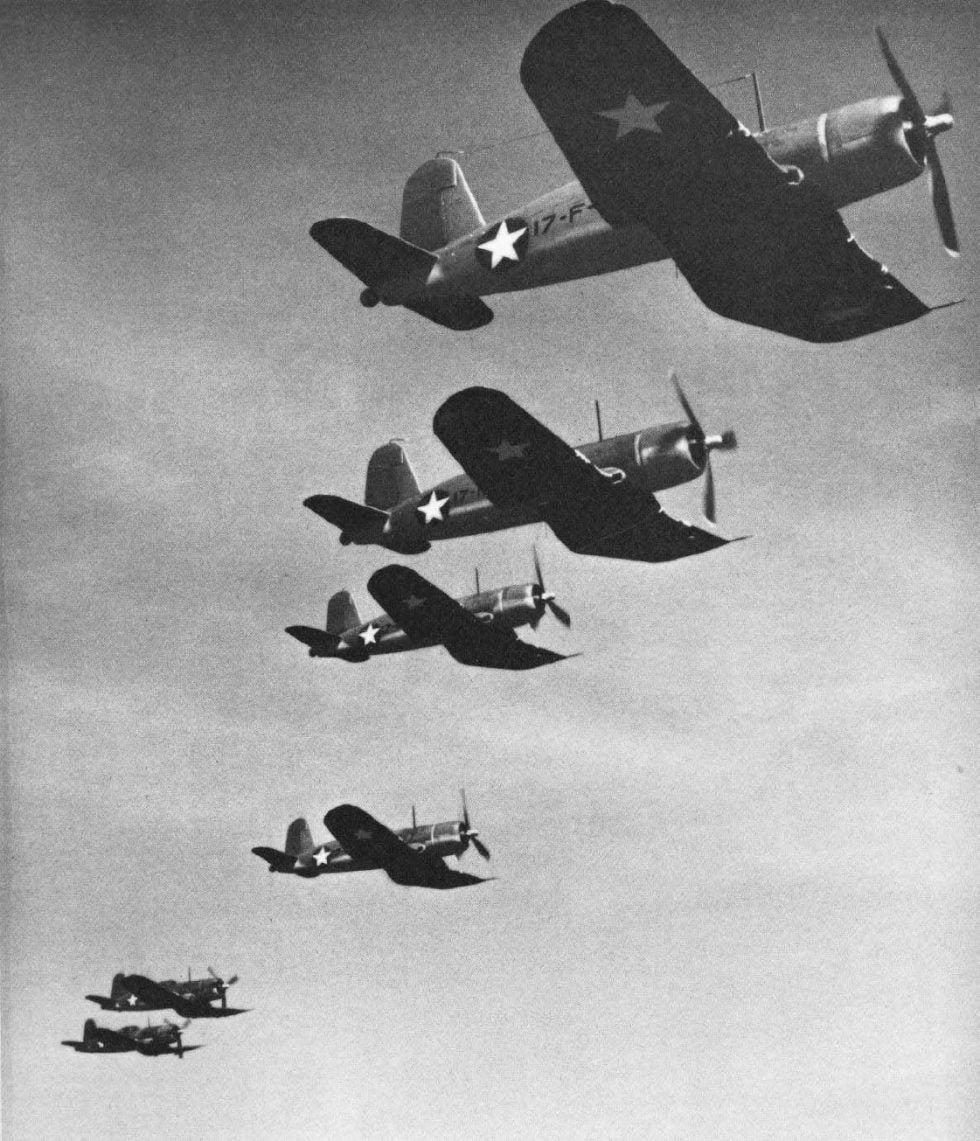
The Corsair's reputation now is of an outstanding fighter, and the record supports it; but the aircraft that reached the fleet in 1942 was very nearly a failure, and the reasons are worth stating plainly rather than folding into the legend. Carrier suitability trials, notably aboard USS Sangamon in September 1942, went badly enough that the US Navy declined to operate the type from decks at all. Three faults did it. The nose was extremely long, and on the nose-high approach the pilot could not see the deck or the landing signal officer ahead of him. The main undercarriage oleos were stiff and returned energy rather than absorbing it, so a firm touchdown bounced the aircraft back into the air — over the barrier, or into the next arrestor wire, or into whatever was parked forward. And the wing stalled asymmetrically: at low speed the left wing dropped without warning, exactly the behaviour that a pilot in the groove behind a carrier can least afford. The accident rate was high, and the nicknames — "Ensign Eliminator" among them — were earned. The Navy consequently gave the deck job to the Grumman F6F Hellcat, which was a less exciting aeroplane and an entirely predictable one, and issued the Corsair to land-based US Marine squadrons, where it did outstandingly well from Guadalcanal onwards. The fixes were unglamorous and effective: the cockpit was raised about 18 cm and given a clear-view canopy on the F4U-1A, replacing the heavily framed "birdcage"; the tailwheel strut was lengthened to flatten the deck attitude; the oleos were revalved to absorb rather than return energy; and a small triangular stall strip was fitted to the starboard wing leading edge, just outboard of the guns, which spoiled that wing's lift a fraction earlier and made the stall symmetrical and predictable. The last piece was not engineering at all but technique. The Royal Navy, which had no Hellcats to spare and needed the Corsair aboard, adopted a curving approach that kept the deck in view around the side of the nose until the last moment, and cleared the type for carrier operations in April 1944; the US Navy adopted the same technique and cleared its own Corsairs the same month. Neither the aircraft nor the pilots had changed as much as the method had. One popular claim is best left as a claim: the Japanese are widely said to have called the Corsair "Whistling Death", after the noise from its wing-root oil cooler intakes. The story is repeated everywhere, including in otherwise careful books, and it is poorly attested in contemporary Japanese sources; treat it as folklore rather than fact. The wartime air-combat record — often quoted as 2,140 victories against 189 losses, an 11-to-1 ratio — comes from US Navy statistics and, like all such figures on all sides, should be read as a claim total rather than a verified count. What is not in doubt is the length of the career: Corsairs fought in the Solomons in 1943, over Okinawa in 1945, throughout Korea in the close-support role from 1950 to 1953, and in French hands over Indochina, Algeria and Suez; the last military Corsairs, in Honduran service, were retired in 1979, and the type saw combat in the brief 1969 war between Honduras and El Salvador, in what is generally reckoned the last air combat between piston-engined fighters.
- F4U-1 (birdcage)
- The first production Corsair, with the R-2800-8, six .50 in guns and a heavily framed sliding canopy over a cockpit set well aft. Fast and powerful, and the aircraft that was judged unsuitable for carrier decks. Marine squadron VMF-124 took it into combat from Guadalcanal in February 1943. ~690 built before the raised-cockpit change
- F4U-1A
- The fix, applied on the production line: cockpit raised about 18 cm, a clear-view blown canopy, a longer tailwheel strut, revalved main oleos and a stall strip on the starboard wing. This is the mark that made the Corsair a usable naval fighter and the one the Royal Navy first took to sea. ~2,000 built by Vought, plus licence equivalents
- F4U-1C
- Cannon Corsair: the six machine guns replaced by four 20 mm AN/M2. Devastating for strafing, less loved for its jamming at altitude and its separate ammunition supply. Reached combat in 1945, mainly around Okinawa. 200 built
- F4U-1D
- The definitive wartime mark and the anchor for the figures above: -1A airframe with water injection, twin centre-section pylons for tanks or 1,000 lb bombs, and rails for eight 5-inch rockets. Built in parallel by Goodyear as the FG-1D. This is the fighter-bomber Corsair of 1944–45. ~1,685 by Vought, with a comparable Goodyear run
- F4U-4
- A substantially better aeroplane: the R-2800-18W of 2,380 hp, a four-blade propeller, a redesigned cockpit and a much improved climb of about 4,360 ft/min and 446 mph. It reached squadrons in the last months of the war and did most of the Navy's Corsair work in Korea. The F4U-4B added four 20 mm cannon. ~2,357 built
- F4U-5
- Post-war refinement: R-2800-32W with a variable-speed supercharger, about 2,500 hp and 470 mph, four cannon as standard, a lowered cowling for better view and metal-covered outer wings. The winterised F4U-5NL and the radar-equipped F4U-5N night fighter both flew hard in Korea, where a -5N pilot became the only US Navy ace of that war. ~223 built in all sub-types
- AU-1
- A dedicated low-level attack Corsair for the Marines, built for Korea. The two-stage supercharger was replaced by a simple single-stage R-2800-83W, extra armour was added around the engine and cockpit, and ten underwing stations carried up to about 4,000 lb. Slow and unimpressive high up, and very good at what it was for. 111 built, 1952
- F4U-7 (France)
- The final new-build Corsair, an AU-1 airframe with the F4U-4's two-stage engine, built for the French Aeronavale. Flew combat over Indochina, then Algeria, then Suez in 1956, and served into the mid-1960s. 94 built — the last delivered at the end of 1952, closing the line in 1953
- Goodyear FG-1 / Brewster F3A
- Licence production. Goodyear built the FG-1, FG-1A and FG-1D in quantity and to a good standard, many of them fixed-wing land-based aircraft for the Marines. Brewster's F3A suffered chronic quality and management problems, its aircraft were largely barred from carrier operations, and the contract was terminated in 1944. ~4,007 Goodyear, ~735 Brewster
- F2G "Super Corsair"
- Very few built — effectively a footnote. Goodyear married the airframe to the 28-cylinder, 3,000 hp Pratt & Whitney R-4360 Wasp Major with a cut-down rear fuselage and bubble canopy, as a low-level interceptor against kamikazes. The war ended before it mattered and the order was cancelled. Its fame is post-war and civilian: F2Gs won the Thompson Trophy air races in 1947 and 1949. ~10 production aircraft plus prototypes
The Corsair is one of the better-represented WWII fighters on the warbird circuit. A few dozen are airworthy worldwide — most in the United States, with a handful in Europe, Australia and New Zealand — and many more survive as static museum aircraft, gate guardians and long-term restorations, including a steady trickle of airframes recovered from Pacific island wrecks and from the lakes and harbours into which wartime training accidents put them. Two things explain the healthy population: the sheer size of the production run, and its unusual length. Corsairs were built from 1942 until 1953, the longest production run of any American piston-engined fighter, which meant late-build airframes with low hours were still being delivered when contemporaries like the P-47 and P-51 had been out of production for years. Surviving aircraft skew accordingly towards the FG-1D, F4U-4 and F4U-5.
From bent-wing prototype to the last piston fighter
The Navy asks for the fastest fighter
The US Navy issues a requirement for a high-performance single-seat carrier fighter; Vought’s Rex Beisel answers with the V-166B, built around the R-2800 radial.
First flight
The XF4U-1 prototype flies on 29 May and soon becomes, by most accounts, the first US single-engine fighter to top 400 mph in level flight.
Enters service — and trouble
The F4U-1 reaches squadrons, but carrier-landing problems see the Navy send it to land-based Marine units first.
Combat debut from Guadalcanal
Marine Corsairs go into action from land in the Solomons in February; Britain’s Fleet Air Arm clears the type for carriers.
Cleared for US carriers
With landing techniques mastered, the US Navy qualifies the Corsair for carrier operations; it becomes a dominant Pacific fighter-bomber.
Korea: back to war
Navy and Marine Corsairs fly close air support and night missions over Korea, covering the Chosin Reservoir withdrawal in 1950.
A Corsair downs a MiG-15
On 10 September, Capt Jesse Folmar shoots down a MiG-15 jet — a rare piston-over-jet victory — before being downed himself and rescued.
Production ends
The last Corsair is delivered after some eleven years — the longest production run of any US piston-engine fighter.
Foreign wars and the last dogfight
French Corsairs fight over Suez and Algeria; in 1969 Honduran and Salvadoran Corsairs meet in the “Football War” — the last combat between piston fighters.
From the cockpit: twelve Corsair stories
A wing bent around a propeller
Rex Beisel’s inverted gull wing solved a very physical problem: keeping a four-metre propeller off the deck.
Read the full story
The first 400-mph single
When the XF4U-1 flew in 1940 it opened a new performance class for US fighters.
Read the full story
The ‘Ensign Eliminator’
Bounce, a blind nose and a treacherous stall gave the early Corsair a fearsome reputation among new pilots.
Read the full story
Guadalcanal debut
The Corsair went to war from island airstrips, not carriers.
Read the full story
Whistling Death
Japanese troops reportedly named it for the eerie sound it made in a dive.
Read the full story
Pappy Boyington’s Black Sheep
Marine squadron VMF-214 turned the Corsair into a scoreboard over the Solomons.
Read the full story
The British curved approach
The Fleet Air Arm made the Corsair a carrier plane before the US Navy did.
Read the full story
VF-17 and Ira Kepford
The Navy’s VF-17 became one of the highest-scoring Corsair squadrons of the war.
Read the full story
Close air support at Chosin
Over Korea the Corsair became a mud-mover, and a lifeline for troops on the ground.
Read the full story
The Corsair that killed a jet
On 10 September 1952 Capt Jesse Folmar shot down a MiG-15 with cannon fire.
Read the full story
French Corsairs over Suez and Algeria
The Aeronavale flew the last new-build Corsairs into colonial wars of the 1950s.
Read the full story
The Football War — and the racers
The last dogfight between piston fighters was flown in Corsairs — and Corsairs later ruled air racing.
Read the full story
The Corsair in pictures
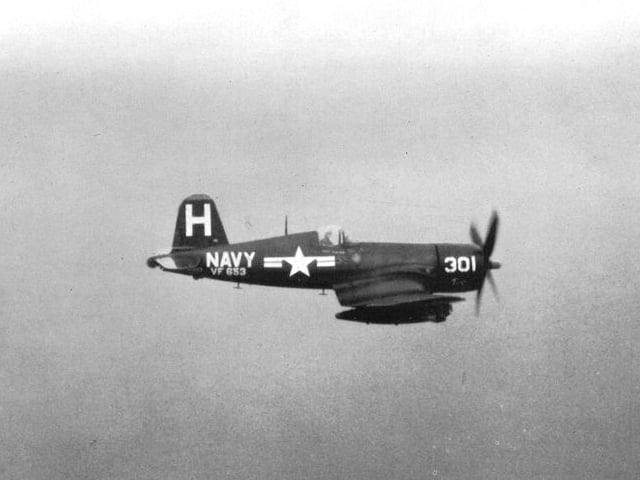
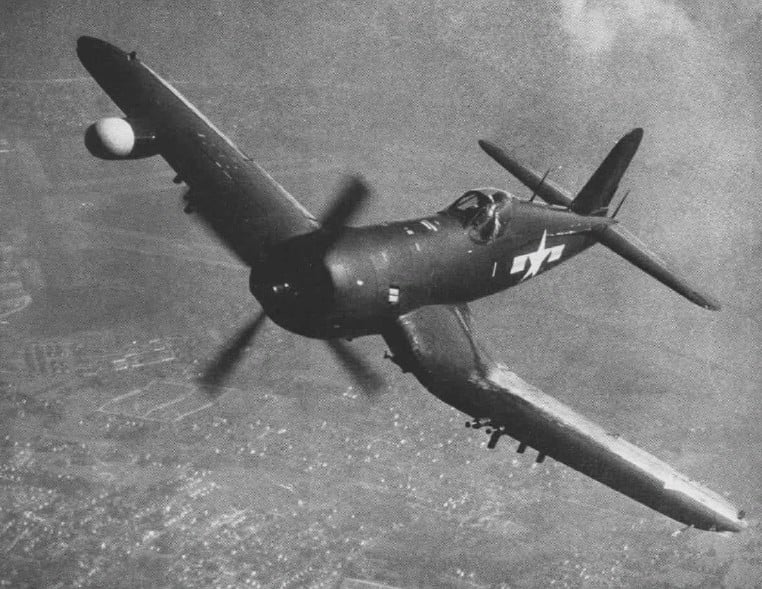
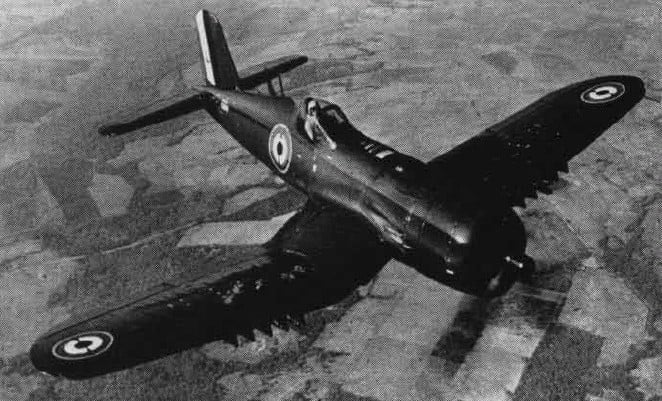
The Corsair in motion
Video coming soon — a verified, high-authority documentary embed will be added here.
Where the Corsair flew
The score that defines it
The Corsair’s reputation rests on the Pacific, where it was among the most effective Allied fighters of the war, and on a long second career as a ground-attack aircraft over Korea. The headline numbers below are the ones most often cited — treat the ratios as reported rather than exact, as wartime claims are inevitably imperfect.
Compare the combat record of every military aircraft. Figures as of July 2026.
Everything people ask about the F4U Corsair
Can I fly in an F4U Corsair?
Why is the F4U Corsair called “Whistling Death”?
Why does the Corsair have a bent (gull) wing?
Did a Corsair ever shoot down a jet?
How many F4U Corsairs were built, and for how long?
Was the Corsair really hard to land on carriers?
Is the F4U Corsair still flying today?
You can’t fly the Corsair.
These, you can.
Some legends only live in museums — others are fuelled and waiting. MiGFlug has put civilians in real military jet cockpits since 2004.
 Fly the L-39 AlbatrosThe world’s most-flown jet trainer — aerobatics included
 Fly the F-104 Starfighter“The missile with a man in it”
 Fly the MiG-21The Cold War’s most-produced jet
 Fly the T-33 Shooting StarAmerica’s first jet trainer
 Fly the DH VampireA piece of early jet history
 Fly the S.211Agile Italian jet trainer
 Fly the MB-326The classic Aermacchi jet
 Fly the MiG-15The Soviet legend of the Korean War
Continue the tour
Every fact, checked
- Naval History & Heritage Command — F4U-4 CorsairOfficial US Navy specifications and service history, including the Folmar MiG kill.
- National Naval Aviation Museum — F4U-1 CorsairDevelopment, the gull wing and Marine Corps service in the Pacific.
- The National WWII Museum — Vought F4U CorsairProduction totals, VMF-214 and the Corsair’s Pacific record.
- U.S. Naval Institute — “The Versatile and Long-Lived Corsair”Production ending in 1953, French service and the type’s longevity.
- HistoryNet — Soccer War CorsairThe 1969 Football War and the last piston fighter-versus-fighter combat.
- HistoryNet — Vought F4U-7 CorsairFrench Aeronavale Corsairs over Indochina, Suez and Algeria.
- The Aviation Geek Club — Folmar’s MiG-15 killDetailed account of the 10 September 1952 piston-over-jet victory.
- Smithsonian National Air and Space MuseumReference collection entry on Corsair design and preserved airframes.