
P-61 Black Widow
America’s first purpose-built night fighter
A big, twin-boom, radar-carrying hunter designed to kill in the dark — and, some say, the aircraft that scored the last Allied air victory of the Second World War.
The P-61 Black Widow: America’s hunter in the dark
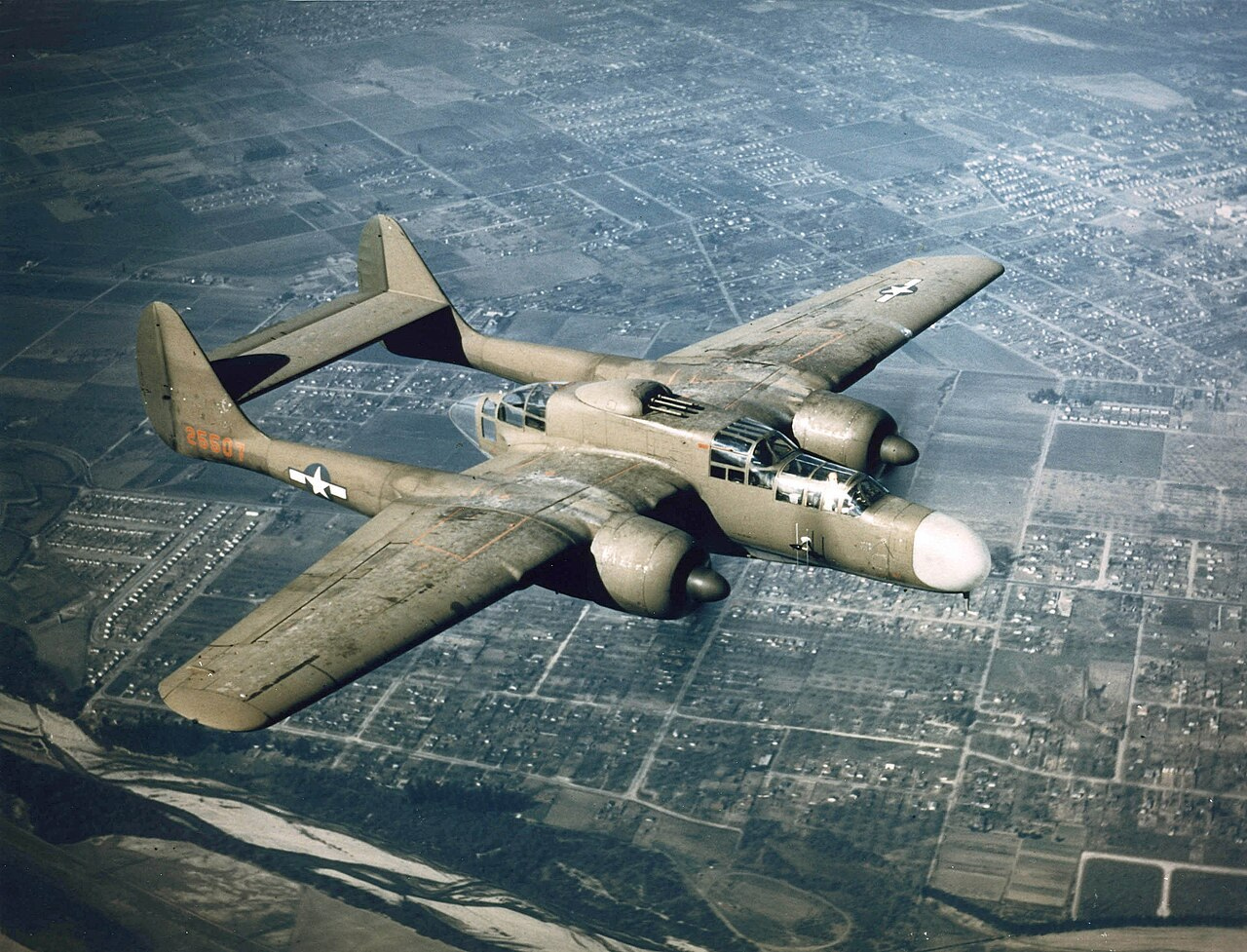
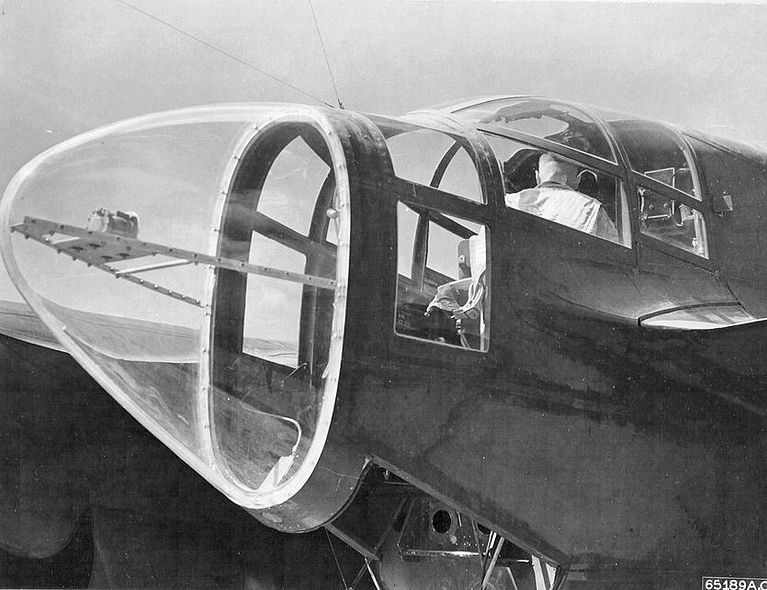
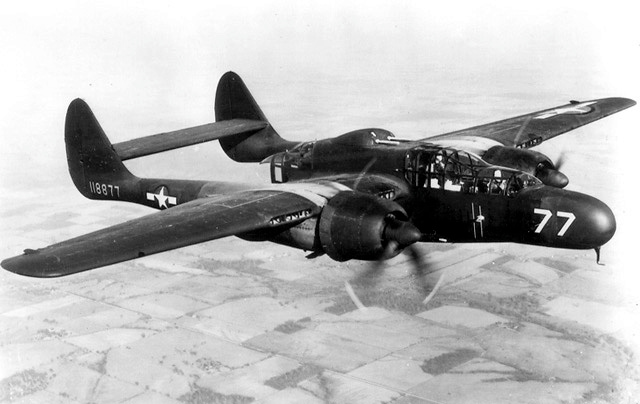
When the P-61 Black Widow first flew in 1942 it was something genuinely new: the first American aircraft designed from a blank sheet as a night fighter, and the first built around radar rather than having a set added later. It was big — bigger than some bombers — a twin-engine, twin-boom machine painted glossy black, carrying a three-man crew and a nose full of the latest SCR-720 airborne-intercept radar.
Jack Northrop’s team built it to a 1940 U.S. Army requirement shaped by the Blitz over Britain, where the RAF had learned how desperately hard it was to find and kill bombers in the dark. The answer was an aircraft that carried its own radar to find the enemy and enough firepower to destroy him in a single pass: four 20 mm cannon in the belly and, in a remote-controlled dorsal turret, four more .50-calibre machine guns.
That turret was clever and troublesome. It could be aimed independently by the gunner or locked to fire forward alongside the cannon, but at certain speeds it caused buffeting, and on many aircraft it was locked or removed altogether. Even without it the Black Widow hit hard — and, for its size, it was surprisingly agile, with full-span flaps and spoilers that let it turn with much smaller fighters.
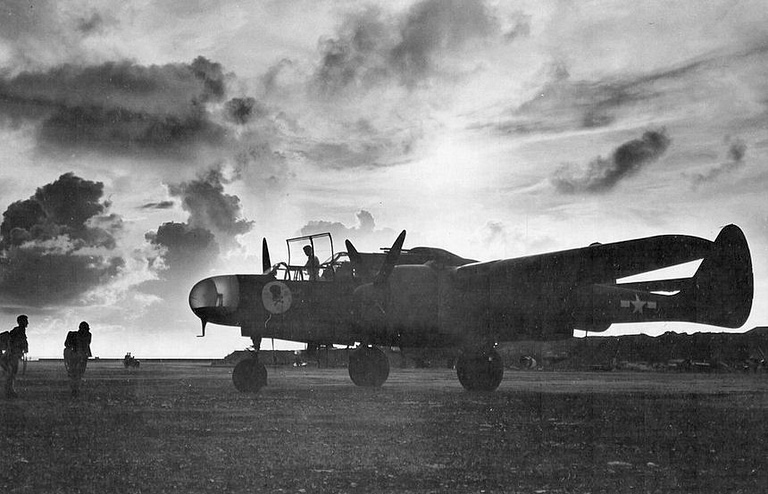
It reached combat in 1944, serving in the Pacific, in Europe and in the China-Burma-India theatre, hunting Japanese and German aircraft after dark and flying intruder missions against ground targets. Its crews learned a patient, methodical trade: vectored toward a contact by ground radar, then closing in on their own set until the enemy appeared, unseeing, in the darkness ahead.
One P-61B, “Lady in the Dark,” is often credited with the last Allied aerial victory of the war, downing a Japanese aircraft on the night of 14 August 1945 — though, fittingly for a night fighter, even that claim is wrapped in uncertainty. About 700 Black Widows were built, and a camera-carrying reconnaissance version, the F-15 Reporter, followed.
Retired by 1954 and overtaken by jet night fighters, the Black Widow survives today in just four examples. For a decade it had been the U.S. military’s dedicated eyes in the dark — the direct ancestor of every radar-equipped, all-weather fighter that came after.
01Why the P-61 Black Widow mattered: the birth of the radar night fighter
Before the P-61, night fighting was improvised — day fighters and bombers fitted with radar as an afterthought, feeling their way through the dark. The Black Widow was the first aircraft the United States designed from the outset to do nothing else: to carry a radar operator and his set, find an enemy no one could see, and kill him. It made the night-fighting crew a distinct profession, with its own tactics and its own aircraft.
That idea — an aircraft built around its sensors to fight in any weather, day or night — runs straight from the Black Widow to every all-weather interceptor and radar-armed fighter that followed. It was retired quickly, but its concept never was.
How the P-61 Black Widow was built
Radar in the nose
The Black Widow was built around its SCR-720 airborne-intercept radar, worked by a dedicated radar operator. Where earlier night fighters had radar bolted on, the P-61 was designed from the start to carry it and fight by it — the first American aircraft to do so.
Twin booms, big and agile
Two Pratt & Whitney R-2800 Double Wasp engines on a twin-boom airframe made the P-61 huge — a 66-foot wingspan, larger than some bombers. Yet full-span flaps and spoilers gave it startling agility, letting it turn with far smaller fighters.
Cannon and a turret
Four 20 mm cannon in the belly delivered a devastating single-pass punch, backed by a remote-controlled dorsal turret carrying four .50-calibre machine guns — a heavy battery for hunting bombers in the dark.
02The P-61 Black Widow’s radar: hunting with the SCR-720
The heart of the Black Widow was the SCR-720, a British-developed airborne-intercept radar with a range of a few miles, mounted in the aircraft’s nose and operated by the third crewman. Ground controllers would vector the P-61 into the rough area of an enemy aircraft; the radar operator would then pick up the target on his scope and talk the pilot in until it emerged, visually, from the darkness ahead — close enough to kill.
It was slow, patient, technical work, and it turned the night-fighter crew into a team: pilot, gunner and radar operator, hunting together by instrument in conditions where day fighters were useless.
03The P-61’s troublesome turret: the remote dorsal barbette
The Black Widow’s most advanced — and most troublesome — feature was its remote-controlled dorsal turret of four .50-calibre guns. It could be slaved to the pilot’s fixed cannon to fire forward, or aimed independently by the gunner to cover other angles. But at certain speeds the rotating turret set up severe buffeting that shook the whole aircraft, and on many P-61s it was locked to fire forward only, or removed entirely to save weight.
Northrop P-61B Black Widow specifications
Airframe & Performance
- 全体人员
- 3 (pilot, gunner, radar operator)
- 长度
- 15.11 m (49 ft 7 in)
- 翼展
- 20.12 m (66 ft)
- 空重
- ~10,640 kg (23,450 lb)
- Max takeoff weight
- ~16,420 kg (36,200 lb)
- Max speed
- ~589 km/h (366 mph)
- 设备天花板
- ~10,090 m (33,100 ft)
- 范围
- ~1,900 km (1,200 mi)
Radar, Armament & Programme
- Engines
- 2 × Pratt & Whitney R-2800 Double Wasp, ~2,250 hp each
- Radar
- SCR-720 airborne-intercept radar
- 武器
- 4 × 20 mm cannon (belly) + 4 × .50 in MGs (dorsal turret)
- First flight
- 26 May 1942 (XP-61)
- Built
- ~700
- Operators
- United States (Army Air Forces)
- Cost per flight hour
- Not recorded — retired from service in 1954
- Variants
- P-61A / B / C; F-15 Reporter (reconnaissance)
04The P-61 Black Widow’s variants: A, B, C and the F-15 Reporter
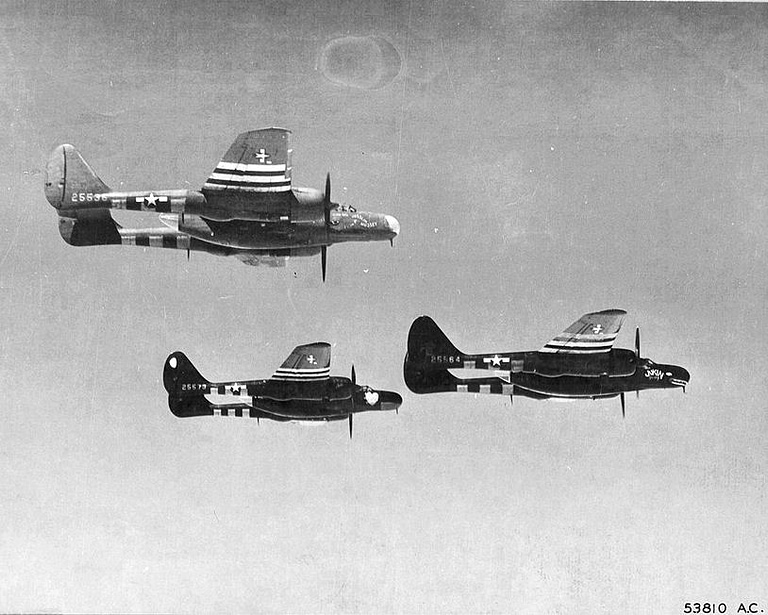
About 700 Black Widows were built. The P-61A was the initial production model; the P-61B added underwing hardpoints and refinements; the P-61C fitted turbo-supercharged engines for much higher speed and altitude, though it arrived as the war ended and few were built. Stripped of its guns and radar and fitted with cameras, the airframe also became the F-15 Reporter, a fast photo-reconnaissance aircraft that served into the post-war years.
05The survivors: four Black Widows left
Only four P-61s survive today. One is under long-term restoration at the Mid-Atlantic Air Museum in Pennsylvania — recovered from a mountainside crash site in New Guinea — while others are held by the U.S. Air Force and at the Beijing Air and Space Museum in China. None is currently airworthy, making the Black Widow one of the rarer surviving American combat aircraft of the war.
The P-61 Black Widow, from the Blitz to the jet age
A night-fighter is ordered
Shaped by the lessons of the Blitz over Britain, the U.S. Army issues a requirement for a radar night fighter.
First flight
The XP-61 makes its maiden flight on 26 May.
Production begins
The first production Black Widows roll out of Northrop’s Hawthorne plant.
Into combat
Night-fighter squadrons take the P-61 to war in Europe, the Pacific and the CBI theatre.
The last kill?
“Lady in the Dark” is credited with a Japanese aircraft on 14 August — perhaps the last Allied air victory of the war.
Becomes the F-61
The Black Widow is redesignated F-61 in the new U.S. Air Force.
Retired
Jet night fighters replace the piston-engine Black Widow in U.S. service.
Four survive
Only four P-61s remain, including one under restoration at the Mid-Atlantic Air Museum.
The P-61 Black Widow in eight stories
The first of its kind
America’s first purpose-built radar night fighter.
The full story
“Lady in the Dark” and the end of the war
It may have scored the final Allied victory of WWII.
The full story
A clever gun that shook the plane
The remote dorsal barbette caused as many problems as it solved.
The full story
A fighter the size of a bomber
It turned far better than its size suggested.
The full story
Why “Black Widow”
A nocturnal, deadly hunter — painted black.
The full story
How night interception worked
Patience, radar and a single killing pass.
The full story
From gunfighter to camera plane
The Black Widow’s fast reconnaissance cousin.
The full story
The rare survivors
Only four Black Widows remain in the world.
The full story
The P-61 Black Widow in photographs
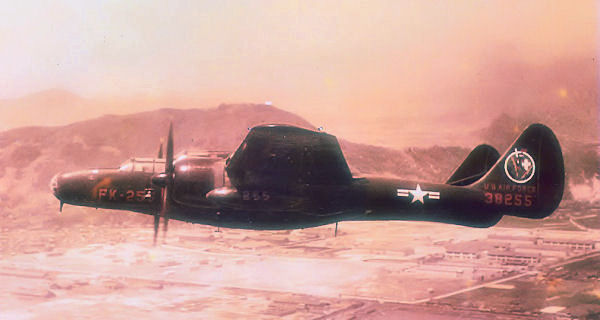
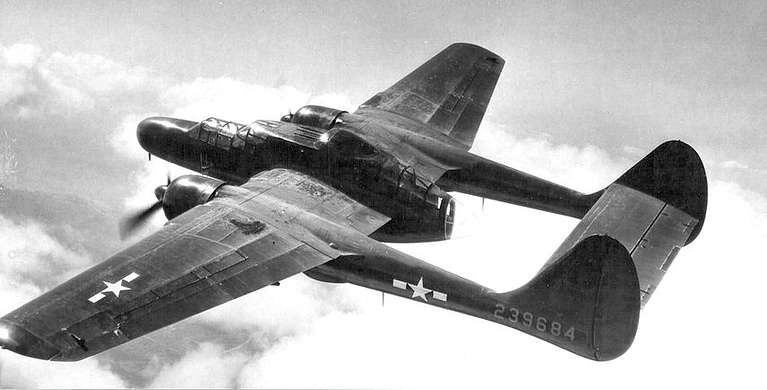
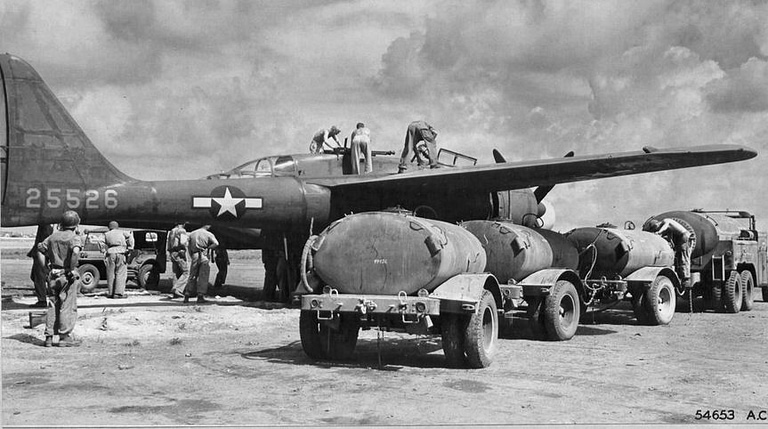
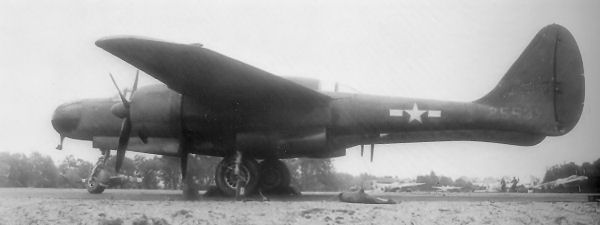
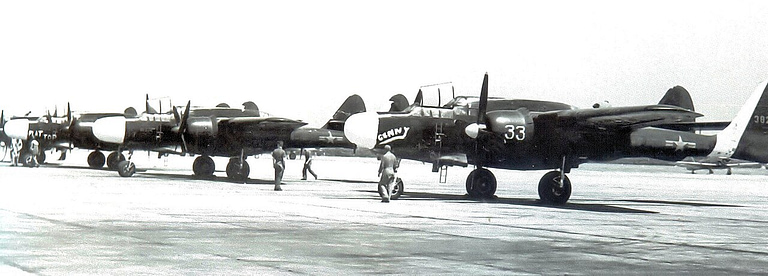
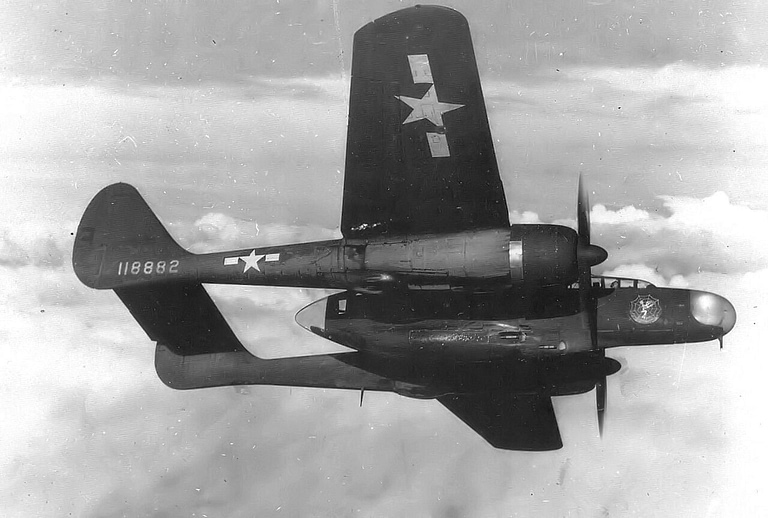
The Black Widow, in colour
Rare wartime colour film of the Black Widow — the big black night fighter on the ground and in the air in 1945.
Rare 1945 colour footage of the P-61 Black Widow night fighters (ZenosWarbirds).
Where the P-61 Black Widow flew — and survives
Hunting in the dark
The Black Widow fought a patient, invisible war — vectored onto enemy aircraft at night, closing on its own radar, and killing in a single pass. Its tally was modest but global, and it may have scored the very last Allied air victory of the war.
More than a scoreboard, the Black Widow was the ancestor of every radar-equipped, all-weather fighter that followed it. Compare the combat record of every military aircraft.
P-61 Black Widow: your questions, answered
Can I fly in a P-61 Black Widow?
No — only four survive and none is currently airworthy. But you can fly in a real military jet today: MiGFlug offers flights in genuine fighters and jet trainers such as the L-39 Albatros and the MiG-29. See migflug.com/flights-prices.
Was the P-61 the first American night fighter?
It was the first American aircraft designed from the outset as a radar-equipped night fighter, rather than a day aircraft with radar added later.
Why is it called the Black Widow?
After the black widow spider — a nocturnal, deadly hunter. The aircraft was finished in gloss black for its night role.
Did the P-61 score the last Allied kill of World War II?
A P-61B, “Lady in the Dark,” is often credited with the last Allied aerial victory, on the night of 14 August 1945 — though the claim is disputed.
How big was the P-61 Black Widow?
Very large for a fighter — a 66-foot wingspan, bigger than some medium bombers, with a crew of three: pilot, gunner and radar operator.
What was wrong with its turret?
Its remote-controlled dorsal turret caused buffeting at certain speeds, so on many aircraft it was locked to fire forward or removed entirely.
How many P-61 Black Widows survive?
Only four, including one under long-term restoration at the Mid-Atlantic Air Museum in Pennsylvania.
You can’t fly the P-61 Black Widow.
These, you can.
The Black Widow’s war is long over — but you can still strap into a genuine military jet. MiGFlug flies civilians in real fighters and jet trainers around the world.
 Fly the L-39 AlbatrosThe world’s most-flown jet trainer — aerobatics included
 Fly the F-104 Starfighter“The missile with a man in it”
 Fly the MiG-21The Cold War’s most-produced jet
 驾驶T-33流星战斗机America’s first jet trainer
 Fly the DH VampireA piece of early jet history
 Fly the S.211Agile Italian jet trainer
 Fly the MB-326The classic Aermacchi jet
 Fly the MiG-15The Soviet legend of the Korean War
Related aircraft
Where this chapter comes from
- National Museum of the U.S. Air ForceFact sheets on the P-61 Black Widow and American night-fighter development.
- Smithsonian National Air and Space MuseumBackground on the Black Widow and its radar and armament.
- Mid-Atlantic Air MuseumHome of the long-running P-61 restoration recovered from New Guinea.
- Imperial War MuseumOn the night-fighting war and airborne radar that shaped the P-61.
- MiGFlug — AfterburnerMiGFlug’s aviation magazine, on the great piston fighters and the birth of all-weather air combat.
Some P-61 figures — including performance and the disputed “last victory” claim — vary between sources; the most widely cited values are used here.