
P-61 Black Widow
America’s first purpose-built night fighter
A big, twin-boom, radar-carrying hunter designed to kill in the dark — and, some say, the aircraft that scored the last Allied air victory of the Second World War.
The P-61 Black Widow: America’s hunter in the dark
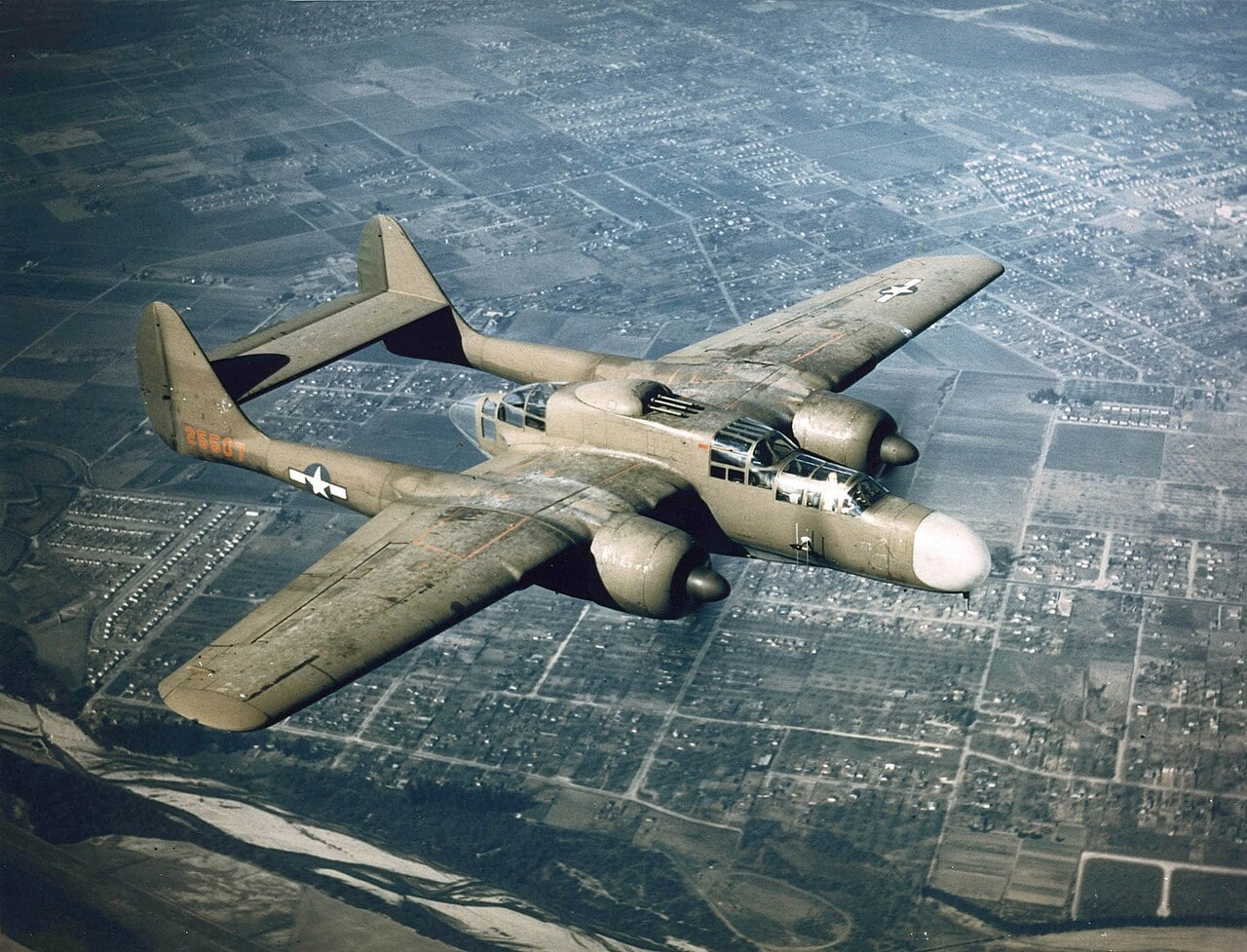
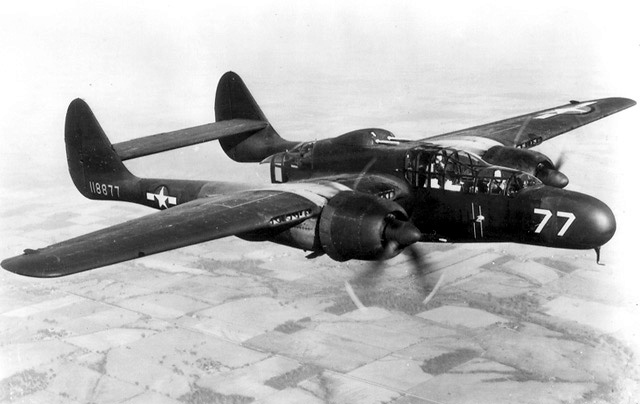
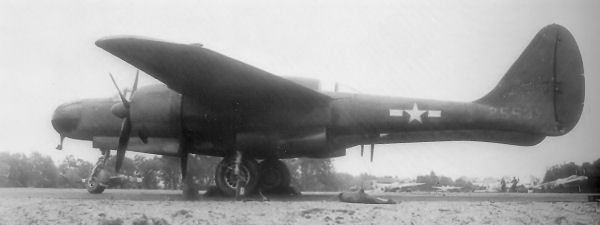
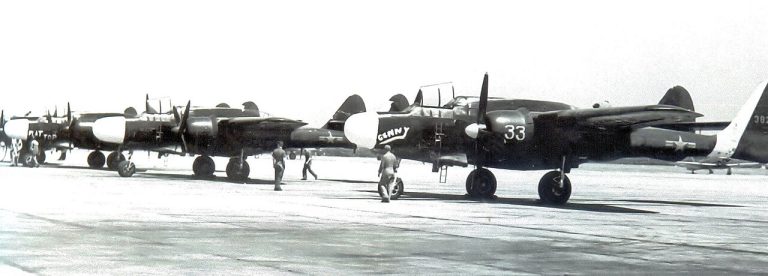
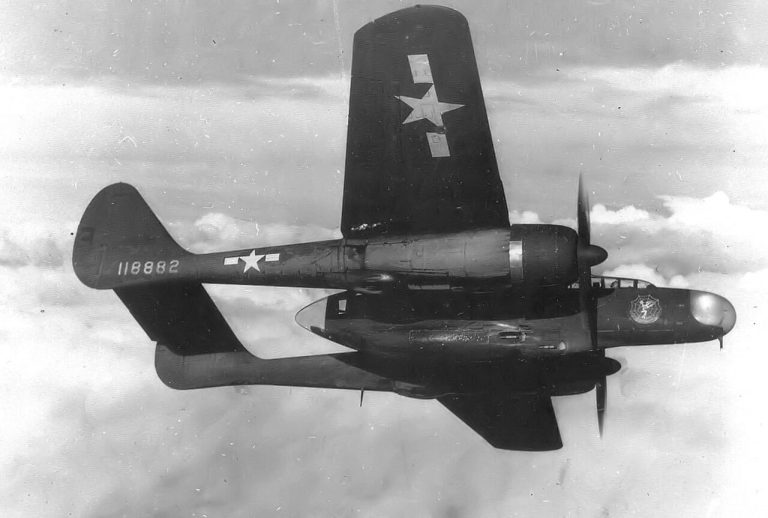
When the P-61 Black Widow first flew in 1942 it was something genuinely new: the first American aircraft designed from a blank sheet as a night fighter, and the first built around radar rather than having a set added later. It was big — bigger than some bombers — a twin-engine, twin-boom machine painted glossy black, carrying a three-man crew and a nose full of the latest SCR-720 airborne-intercept radar.
Jack Northrop’s team built it to a 1940 U.S. Army requirement shaped by the Blitz over Britain, where the RAF had learned how desperately hard it was to find and kill bombers in the dark. The answer was an aircraft that carried its own radar to find the enemy and enough firepower to destroy him in a single pass: four 20 mm cannon in the belly and, in a remote-controlled dorsal turret, four more .50-calibre machine guns.
That turret was clever and troublesome. It could be aimed independently by the gunner or locked to fire forward alongside the cannon, but at certain speeds it caused buffeting, and on many aircraft it was locked or removed altogether. Even without it the Black Widow hit hard — and, for its size, it was surprisingly agile, with full-span flaps and spoilers that let it turn with much smaller fighters.
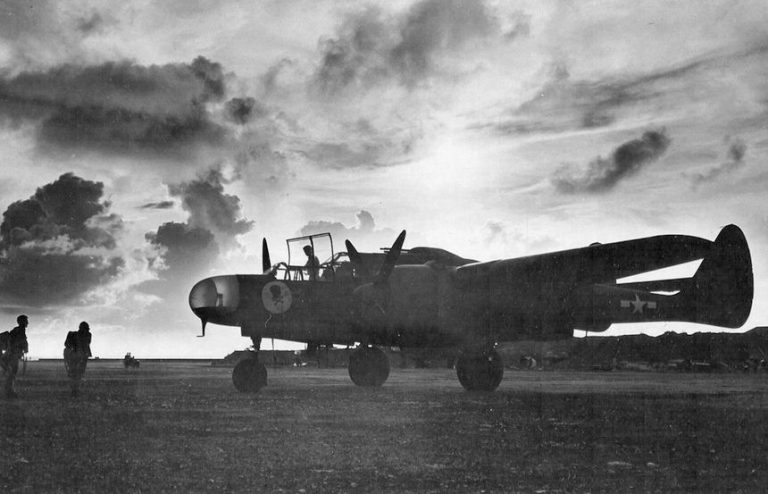
It reached combat in 1944, serving in the Pacific, in Europe and in the China-Burma-India theatre, hunting Japanese and German aircraft after dark and flying intruder missions against ground targets. Its crews learned a patient, methodical trade: vectored toward a contact by ground radar, then closing in on their own set until the enemy appeared, unseeing, in the darkness ahead.
One P-61B, “Lady in the Dark,” is often credited with the last Allied aerial victory of the war, downing a Japanese aircraft on the night of 14 August 1945 — though, fittingly for a night fighter, even that claim is wrapped in uncertainty. About 700 Black Widows were built, and a camera-carrying reconnaissance version, the F-15 Reporter, followed.
Retired by 1954 and overtaken by jet night fighters, the Black Widow survives today in just four examples. For a decade it had been the U.S. military’s dedicated eyes in the dark — the direct ancestor of every radar-equipped, all-weather fighter that came after.
01Why the P-61 Black Widow mattered: the birth of the radar night fighter
Before the P-61, night fighting was improvised — day fighters and bombers fitted with radar as an afterthought, feeling their way through the dark. The Black Widow was the first aircraft the United States designed from the outset to do nothing else: to carry a radar operator and his set, find an enemy no one could see, and kill him. It made the night-fighting crew a distinct profession, with its own tactics and its own aircraft.
That idea — an aircraft built around its sensors to fight in any weather, day or night — runs straight from the Black Widow to every all-weather interceptor and radar-armed fighter that followed. It was retired quickly, but its concept never was.
How the P-61 Black Widow was built
Radar in the nose
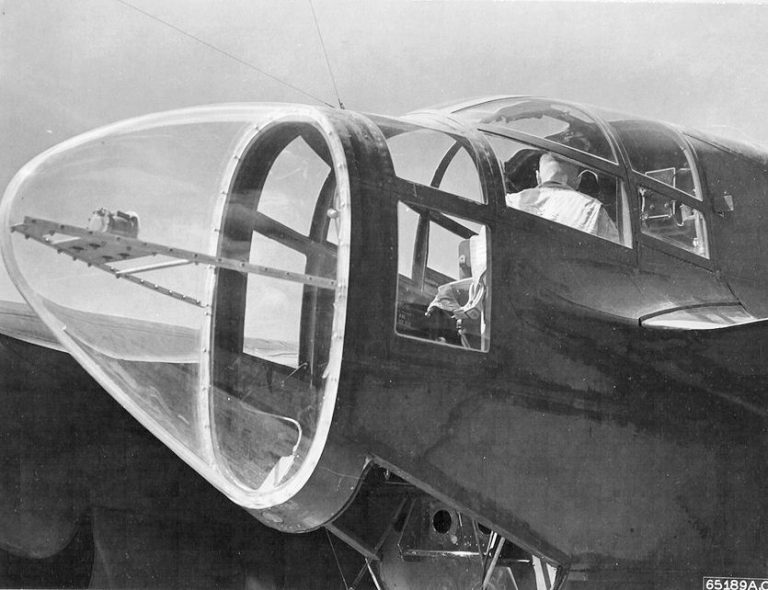
The Black Widow was built around its SCR-720 airborne-intercept radar, worked by a dedicated radar operator. Where earlier night fighters had radar bolted on, the P-61 was designed from the start to carry it and fight by it — the first American aircraft to do so.
Twin booms, big and agile
Two Pratt & Whitney R-2800 Double Wasp engines on a twin-boom airframe made the P-61 huge — a 66-foot wingspan, larger than some bombers. Yet full-span flaps and spoilers gave it startling agility, letting it turn with far smaller fighters.
Cannon and a turret
Four 20 mm cannon in the belly delivered a devastating single-pass punch, backed by a remote-controlled dorsal turret carrying four .50-calibre machine guns — a heavy battery for hunting bombers in the dark.
02The P-61 Black Widow’s radar: hunting with the SCR-720
The heart of the Black Widow was the SCR-720, a British-developed airborne-intercept radar with a range of a few miles, mounted in the aircraft’s nose and operated by the third crewman. Ground controllers would vector the P-61 into the rough area of an enemy aircraft; the radar operator would then pick up the target on his scope and talk the pilot in until it emerged, visually, from the darkness ahead — close enough to kill.
It was slow, patient, technical work, and it turned the night-fighter crew into a team: pilot, gunner and radar operator, hunting together by instrument in conditions where day fighters were useless.
03The P-61’s troublesome turret: the remote dorsal barbette
The Black Widow’s most advanced — and most troublesome — feature was its remote-controlled dorsal turret of four .50-calibre guns. It could be slaved to the pilot’s fixed cannon to fire forward, or aimed independently by the gunner to cover other angles. But at certain speeds the rotating turret set up severe buffeting that shook the whole aircraft, and on many P-61s it was locked to fire forward only, or removed entirely to save weight.
Northrop P-61B Black Widow specifications
Baseline note: the figures below describe the P-61B-15-NO (the largest single production block, 153 aircraft, and the one built with the four-gun dorsal barbette restored), the mark that did most of the type’s late-war night fighting. Deltas for the earlier P-61A and for the turbosupercharged P-61C are in grey. One correction to the usual telling before the tables: there was no British specification. The Royal Air Force never issued one for this aeroplane. What crossed the Atlantic in 1940 was operational experience, a British Purchasing Commission requirement for a radar-equipped interceptor able to loiter for something like eight hours, and — through the Tizard Mission of September 1940 — the cavity magnetron itself. The document Northrop actually built to was American: requirements drafted at Wright Field from the findings of Major General Delos Emmons’s board and telephoned to Northrop’s Vladimir Pavlecka by Colonel Laurence Craigie on 21 October 1940.
Dimensions & weights
- Crew
- 3 — pilot; a gunner seated high behind him with a periscopic sight for the dorsal barbette; and a radar observer in a separate compartment at the very back of the crew nacelle, facing his scopes with almost no view out. Aircraft delivered without the turret were flown by two, and many turret-equipped machines were flown two-up as well because trained gunners were scarcer than airframes
- Length
- 15.11 m (49 ft 7 in); the P-61A was 14.91 m (48 ft 11 in) — the B block added eight inches of nose to give the radar a better installation
- Wingspan
- 20.12 m (66 ft 0 in) — two feet more than a Bristol Beaufighter and within four feet of a Douglas A-20 medium bomber
- Height
- 4.47 m (14 ft 8 in)
- Wing area
- 61.53 m² (662.4 sq ft)
- Aspect ratio
- 6.58 — a broad, deep wing sized for endurance and for carrying full-span flaps, not for turning
- Empty weight
- 10,637 kg (23,450 lb) — empty, a Black Widow outweighed a fully equipped North American B-25J medium bomber, and it weighed about as much as three loaded Messerschmitt Bf 109Gs
- Gross weight
- 13,472 kg (29,700 lb). The XP-61 prototype had already reached 13,459 kg (29,673 lb) at take-off against a design estimate well below that, and the weight never came back down
- Maximum take-off weight
- 16,420 kg (36,200 lb) with four external tanks or four 1,600 lb bombs — the heaviest aircraft the United States Army Air Forces ever called a fighter
- Wing loading
- 220 kg/m² (45 lb/sq ft) at gross weight. High for 1944, and it mattered far less than it would have on a day fighter: the spoilers and full-span flaps bought back the low-speed end
- Power loading
- 2.99 kg/hp (6.60 lb/hp) at gross weight on two 2,250 hp engines. A P-51D managed about 2.1 kg/hp. This single row explains every complaint made about the aeroplane’s speed and climb
- Why a night fighter could afford all this
- Because none of the usual penalties applied. A ground-controlled interception is a stern chase set up by someone else, not a dogfight: what the crew needed was hours of loiter, a radar heavy enough to work, a third man to operate it, a stable gun platform and enough rounds to kill in one pass. Night fighters flew from established airfields with long, lit runways, they were not expected to escort bombers, and they were never meant to meet a single-seat fighter in daylight. Size bought endurance and equipment, and endurance and equipment were the mission
- Internal fuel
- ~2,420 l (~640 US gal, ~533 imp gal) in four self-sealing wing cells. Capacity figures vary between blocks and between sources; the XP-61E reconnaissance conversion took the total to about 4,380 l (1,158 US gal) by filling the space the radar and the turret had occupied
- Unit cost
- ~$180,000 in 1943 dollars, fully equipped — roughly three P-51Ds, which is a fair statement of what the Army thought a radar and a third crewman were worth
Performance
- Maximum speed
- 589 km/h (366 mph, 318 kn) at 6,100 m (20,000 ft); the P-61A is generally given as 583 km/h (362 mph), and the XP-61 prototype made 595 km/h (370 mph) clean and unarmed at 9,100 m (29,900 ft)
- Maximum speed, P-61C
- 692 km/h (430 mph, 374 kn) at 9,100 m (30,000 ft) on turbosupercharged engines — the aeroplane the crews had wanted since 1943, delivered from July 1945 and never used in anger
- Cruising speed
- 512 km/h (318 mph, 276 kn)
- Minimum controllable speed
- About 113 km/h (70 mph) with the full-span flaps down and the spoilers working. The type’s real party trick was not its top speed but its speed range: it could close at 580 km/h and then decelerate hard enough to stay behind a Ju 52 without overshooting
- Rate of climb
- 12.9 m/s (2,540 ft/min) initial at gross weight
- Time to 6,100 m
- 12 min 0 sec (to 20,000 ft); the P-61C reached 9,100 m (30,000 ft) in 14.6 min, and the experimental XP-61D managed 30,000 ft in 13.5 min
- Service ceiling
- 10,090 m (33,100 ft); P-61C 12,500 m (41,000 ft), XP-61D 13,100 m (43,000 ft)
- Range
- 2,170 km (1,350 miles, 1,170 nmi) internal
- Ferry range
- ~3,060 km (~1,900 miles) with four 625 l (165 US gal) drop tanks
- Endurance
- The British requirement that started the whole exercise asked for something near eight hours on station. The Black Widow did not quite reach that, but patrols of four to six hours were routine, and in the China-Burma-India theatre P-61 squadrons covered larger areas than any night fighters of the war
- Speed as flown, and the Mosquito trial
- On 5 July 1944 General Spaatz, who had asked for Mosquito NF.XVIIs and been refused for want of supply, ordered a fly-off between a P-61 of the 422nd Night Fighter Squadron and a Mosquito. The Black Widow won on every count claimed for it: faster at all altitudes, better rate of climb, and a decisively tighter turn. The American aircraft had been stripped and tuned for the occasion, and the result convinced almost nobody who had to fly against jets. Colonel Winston Kratz, who ran USAAF night-fighter training, gave the fairest verdict on record: "It was not a superior night fighter. It was not a poor night fighter. It was a good night fighter. It did not have enough speed."
- What it could not catch
- The V-1 was marginal — interceptions were made, but a diving approach was usually needed. In October 1944 a 422nd Squadron P-61 found a Messerschmitt Me 163 in the circuit and could not close on a gliding rocket fighter; another sighted an Me 262 and had no prospect of catching it. Contrary to a durable story, no P-61 ever fought a German jet
Propulsion & systems
- Engines
- Two Pratt & Whitney R-2800 Double Wasp 18-cylinder two-row air-cooled radials. The XP-61, YP-61 and P-61A-1 had the R-2800-10; from the P-61A-5 onward, and throughout P-61B production, the R-2800-65. Some reference tables give the production engine as the R-2800-25 or -25S instead; the designations overlap in the literature and the airframe was flown behind more than one dash number
- Engine dimensions
- 45.9 l (2,804 cu in), bore and stroke 146 × 152 mm (5.75 × 6.00 in), about 1,342 mm (52.8 in) diameter and roughly 1,070 kg (2,350 lb) dry per engine — two of the most reliable large piston engines ever built, and a large part of why the aeroplane was trusted over water at night
- Power ratings
- 2,000 hp (1,490 kW) for take-off on the R-2800-10; 2,250 hp (1,680 kW) on the -65 with water-methanol injection, which arrived with the P-61A-10 block. Combined 4,500 hp for a 13.5 tonne aeroplane
- Supercharging, and the decision that shaped the type
- Mechanically driven, two-speed. No turbosuperchargers were fitted to the P-61A or P-61B, although they had been studied and were expected to be worth roughly 80 km/h (50 mph) and 3,000 m (10,000 ft). That omission is the single technical reason the Black Widow was a good aeroplane below 6,000 m and an ordinary one above it
- P-61C powerplant
- Two R-2800-73 with General Electric CH-5 turbosuperchargers in conspicuous bulges beneath each nacelle, 2,800 hp (2,090 kW) at war emergency power. First accepted July 1945; the forty-first and last was taken on charge on 28 January 1946
- Propellers
- Curtiss Electric four-blade constant-speed fully feathering, 3.71 m (12 ft 2 in) diameter. The intended Curtiss units were not ready when the XP-61 was rolled out and Hamilton Standard propellers were fitted for the first flights
- Radar
- Western Electric SCR-720 — the reason the aeroplane exists. An S-band set at about 3.3 GHz and 9 cm, 70 kW peak, with a 74 cm (29 in) parabolic dish helical-scanning behind a nose radome, about 187 kg (412 lb) installed. Detection at roughly 8,000 m (five miles, about 8,500 yd) at height, minimum range about 114 m (375 ft). The radar observer worked a B-scope for the search and a C-scope for the kill, and fed steering to a repeater in front of the pilot. The RAF took the same set as AI Mk X and it outlived the war in the Meteor, the Vampire and the Sea Vixen, flying until 1970
- Radar lineage
- The SCR-720 descended from the SCR-268 gun-laying set by way of the SCR-520, of which only 108 were made because it was far too heavy. Western Electric simplified and lightened it to 412 lb, and the microwave principle underneath it — the resonant cavity magnetron — came directly from the Tizard Mission’s black box in September 1940. This is one of the clearest cases in the war of British physics and American production doing exactly what the exchange was meant to do
- Other electronics
- SCR-695 tail-warning radar from the P-61B-1 block, SCR-729 beacon interrogator and IFF, and on some aircraft the AN/APS-13 tail warner. Late P-61B-25 aircraft carried the APG-1 gun-laying radar, which aimed and fired the dorsal barbette automatically — the earliest fully automatic airborne gun-laying installation to reach an American operational unit
- Roll control and flaps
- Northrop’s most interesting engineering. Roll was handled by perforated spoiler panels about 3 m (10 ft) long on the upper wing, assisted by small guide ailerons at the tips, which freed nearly the whole trailing edge for flaps. The prototypes used Zap flaps that translated aft as they lowered; the manufacturing tolerances proved impossible to hold in production and single-slotted full-span flaps were substituted. The spoilers still gave a rolling moment below the stall
- Turret drive and fire control
- General Electric electric remote barbette, aimed through a General Electric 2CFR12A3 gyroscopic computing sight that could be taken over by the gunner, by the radar observer, or locked forward for the pilot. The computer worked. The aerodynamics did not
- Structure and protection
- All-metal stressed-skin twin-boom layout with a central crew nacelle and a tricycle undercarriage — convenient for night operations, because a nosewheel aeroplane sees where it is going on a blacked-out taxiway. Crew armour and self-sealing tanks were fitted. Most aircraft wore gloss black; early P-61As left Hawthorne in olive drab, and there was a genuine argument about which finish was harder to see in a searchlight beam
04The P-61 Black Widow’s variants: A, B, C and the F-15 Reporter
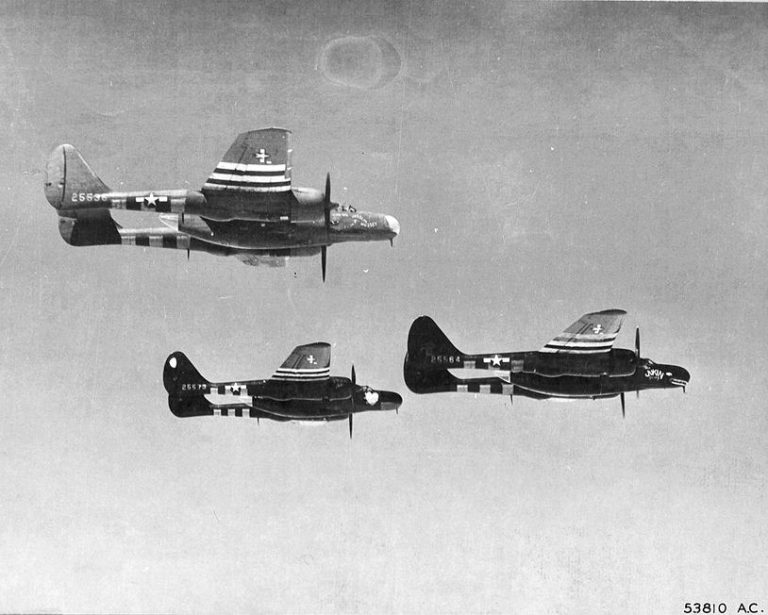
About 700 Black Widows were built. The P-61A was the initial production model; the P-61B added underwing hardpoints and refinements; the P-61C fitted turbo-supercharged engines for much higher speed and altitude, though it arrived as the war ended and few were built. Stripped of its guns and radar and fitted with cameras, the airframe also became the F-15 Reporter, a fast photo-reconnaissance aircraft that served into the post-war years.
05The survivors: four Black Widows left
Only four P-61s survive today. One is under long-term restoration at the Mid-Atlantic Air Museum in Pennsylvania — recovered from a mountainside crash site in New Guinea — while others are held by the U.S. Air Force and at the Beijing Air and Space Museum in China. None is currently airworthy, making the Black Widow one of the rarer surviving American combat aircraft of the war.
Armament & payload
The Black Widow carried the heaviest fixed gun battery of any American fighter of the war, and for most of 1944 half of it was missing
Four 20 mm Hispano cannon in the belly and four .50 calibre Brownings in a remotely controlled dorsal barbette was, on paper, a battery no other Allied fighter could match: on the order of 5 kg of metal a second from the cannon alone and something near 7 kg with the barbette firing as well, all of it from one concentrated group with no convergence to set and nothing to aim but the aeroplane. In practice the aeroplane fought most of its war with the cannon alone. The barbette’s four barrels, when trained anywhere but straight ahead, sat directly upstream of the horizontal tail, and rotating or elevating the turret in flight produced buffet severe enough that Northrop never satisfactorily cured it. The guns were locked forward, then deleted outright from the P-61A-5 block onward, and the General Electric turret mechanism went to the B-29 programme, which had priority for it. It came back on the P-61B in stages during 1944–45, by which time the mounting had been redesigned and, on the last block, given its own gun-laying radar. Gun and turret fits varied block by block and by depot rework, and the published block-by-block turret tables do not agree with one another; the account below follows the points on which the American and the specialist type literature converge.
Gun
- Four 20 mm Hispano AN/M2 cannon in the lower fuselage of the crew nacelle, 200 rounds per gun, 800 rounds in all. Grouped tightly on the centreline, which removed the convergence problem entirely: at any range the four guns put their shells in the same place, and a night fighter that gets one firing pass wants exactly that
- Four .50 in (12.7 mm) Browning M2 in the General Electric dorsal barbette, 560 rounds per gun, 2,240 rounds in all, using 910 mm (36 in) lightweight aircraft barrels in perforated sleeves. Full 360° traverse and elevation from horizontal to vertical, so a Black Widow could shoot at a bomber above it without changing course
- The buffeting. With the barbette trained off the centreline the barrels lay in line with the tailplane, and moving the turret in azimuth or elevation set up severe airframe buffet. Only the first 37 of the 45 P-61A-1 aircraft carried the turret at all; it was struck out of the P-61A-5, A-10 and A-11 blocks, so that well over half of all P-61As flew with a faired-over hole where it should have been
- The B-29 argument. It is usually said that the turrets went to the Superfortress, and that is true — General Electric’s remote turret capacity was committed to the bomber — but it was the second reason, not the first. The aerodynamics came first; the supply problem made the decision easy to live with
- The return. The barbette reappeared on the P-61B in a sequence that reads like a series of experiments: two guns on the B-11 and B-16 blocks, four on the B-15, a redesigned General Electric turret with four guns on the B-20, and on the B-25 an APG-1 gun-laying radar that aimed and fired it without a human hand. Where the turret was fitted but the gunner absent, it was commonly locked forward and fired by the pilot as part of the nose battery
Air-to-air
- No guided air-to-air weapon existed in American service during the war and none was ever projected for this aeroplane. Every P-61 victory was a gun kill — or, in two celebrated cases, not even that
- The weapon was really the system: SCR-720 in the nose, a radar observer who could hold a contact through a chandelle, ground-controlled interception vectoring from a Signal Corps station, and four cannon that would destroy anything they touched. The 422nd Night Fighter Squadron in Europe destroyed 43 enemy aircraft, produced three ace pilots and two ace radar observers, and flew cover over Bastogne during the Battle of the Bulge in December 1944. Its sister unit, the 425th, officially claimed none at all
- The honest record. In Europe the first success was a V-1 on 16 July 1944 for Lieutenant Herman Ernst and radar observer Edward Kopsel, after a first attempt the previous night was abandoned when the tail cone failed — a structural defect on early P-61As that had to be fixed before the aeroplane could be dived hard. The aircraft most often shot down were Ju 188s, Ju 52s, Bf 110s, Fw 190s, Do 217s and He 111s: a list of transports and second-line types that says a good deal about what the Luftwaffe still had flying at night in 1945. Aggregate figures of about 127 aerial victories for the whole type across one year of combat are widely quoted but are not an official consolidated total, and different compilations count V-1s and probables differently
- The Pacific was thinner still. The 6th Night Fighter Squadron opened the account on 30 June 1944 with a Mitsubishi G4M "Betty". Major Carroll C. Smith of the 418th, the leading American night-fighter pilot of the war, shot down four aircraft in one night on 29/30 December 1944 with radar observer Lieutenant Philip Porter. Against that, several Pacific squadrons finished the war with no confirmed kills at all, and the 550th’s only claim was a crippled B-29 destroyed after its crew had taken to their parachutes and left it on autopilot
- The last Allied air victory. On the night of 14/15 August 1945 a P-61B of the 548th Night Fighter Squadron named Lady in the Dark, flown by Lieutenant Lee Kendall with radar observer Lieutenant John Scheerer, closed on a Nakajima Ki-44 "Tojo"; the Japanese pilot dived to wave-top height, manoeuvred hard, and flew into the sea. Not a round was fired, and this was the second time the same aircraft had scored without shooting. The claim was never officially credited — Kendall received a Distinguished Flying Cross only in December 1990, after his paperwork surfaced forty-five years late. The title is contested and probably unprovable: Seafires of 887 Naval Air Squadron shot down Japanese fighters over Odaki Bay on the morning of 15 August, US Navy Hellcats fought over Tokyo the same morning, and reconciling ship, squadron and time-zone records to the minute has never been done convincingly. The safest statement is that Lady in the Dark has as good a claim as anyone and a better story than most
Air-to-surface guided
- None carried in service, none projected for the wartime aeroplane, and no American fighter of the period had any. The card is kept for consistency and the honest entry is that it was empty
- The one real exception came after the war and was not a weapon the P-61 used but one it carried aloft for somebody else: two P-61Cs (43-8336 and 43-8347) were used by the Navy to air-launch Martin PTV-N-2U Gorgon IV ramjet test vehicles, the first launch on 14 November 1947
- What the aeroplane did instead against surface targets was strafe with the four 20 mm from very low level on night intruder sorties over France, the Low Countries, Germany and the Philippines. Against locomotives, barges and vehicle columns the concentrated cannon group was devastating, and it needed no guidance at all
Bombs
- Up to four 1,600 lb (726 kg) bombs on the four underwing pylons of late blocks — nominally the heaviest bomb load carried by any American fighter of the war, and one very rarely taken up in that form
- The pylons arrived late and in stages, which constrained everything else. The P-61A-1, A-5 and A-10 had none. The P-61A-11 introduced one hardpoint per wing on the last 20 aircraft of the A run; the P-61B-2 restored them; the P-61B-10 and later carried four
- In practice loads were 500 lb (227 kg) or 1,000 lb (454 kg) general-purpose bombs on night intruder work, and the aeroplane was a good bomber for the job: it could find a target by radar, it could see the ground with its own eyes, and it could stay over the target area for hours
- There was no bombsight worth the name and no dive brakes. This was low-level work by eye and by feel, and it was flown at night
Rockets
- Six 5 in (127 mm) High Velocity Aircraft Rockets are listed as an alternative underwing store on late-block aircraft
- Operational use is thinly attested. HVAR appears in the type’s published stores tables rather than in squadron combat narratives, and no well-documented P-61 rocket attack is offered here because none could be corroborated
- The tactical niche rockets would have filled — a heavy punch delivered in one low pass — was already occupied by four 20 mm cannon firing from a single group, which is why crews reached for the guns
Pods & other stores
- Four drop tanks on the underwing pylons, of 625 l (165 US gal) or 1,170 l (310 US gal). This was the fit that mattered most, because the whole point of the aeroplane was time on station
- The radar itself is the principal "pod": SCR-720 in the nose, with SCR-695 tail warning, SCR-729 beacon interrogator and IFF. None of it was jettisonable and all of it had to be maintained by ground crews working in the dark
- Cameras, on the reconnaissance line. The XP-61E deleted the radar and the turret for a bubble canopy and extra fuel; the F-15A Reporter that grew from it carried six aerial cameras in a Hughes-built nose in place of every weapon except, on the prototype, none at all
- Exhaust flame dampers, and the black finish that gave the type its name. Neither was a store, and both were part of the armament in the sense that mattered: not being seen first
- One extraordinary non-combat fit. P-61B 42-39489 had a German ejection seat installed in the forward gunner’s compartment, and on 17 April 1946 Sergeant Lawrence Lambert was fired out of it at 486 km/h (302 mph) and 2,380 m (7,800 ft) — the first live American ejection, and a Distinguished Flying Cross for the man who volunteered
Three typical loadouts
- Anti-diver patrol, southern England, July 1944
- Four 20 mm with full 800 rounds, turret usually absent, no external stores, minimum fuel for a short high-speed sortie. Vectored onto a V-1 by ground control and by the glow of its own pulsejet, closing in a shallow dive because level flight left almost no speed margin. This is the mission that first proved the aeroplane and also first broke it — the tail cone failures came from exactly these high-speed dives
- Night interception, Ie Shima and Okinawa, summer 1945
- Four 20 mm, four .50 in the barbette with the gunner aboard, two 625 l drop tanks, SCR-720 and tail warner live. Five or six hours on a patrol line, working with a ground control intercept station and a shipborne fighter director, hunting single Japanese aircraft coming in low. Long, cold, usually empty, and occasionally decisive
- Night intruder, north-west Europe, winter 1944–45
- Four 20 mm, turret locked forward or absent, two 500 lb bombs and two drop tanks. Off at dusk to beat up airfields, road convoys and rail traffic behind the German lines, navigating by radar and dead reckoning and coming home on fumes. It was not the mission the aeroplane had been designed for, and it may have been the one it did most usefully
Sourcing caveat: ammunition capacities and the block-by-block turret and pylon tables differ between the standard American references, the Northrop factory records and the popular type literature, and the P-61B block totals published in general works do not add up to the 450 aircraft actually built. Victory totals are worse: the USAAF kept night-fighter claims by squadron rather than by type, and the commonly repeated aggregate of about 127 aerial victories should be read as an order of magnitude, not a ledger entry.
Variants
Northrop built 706 Black Widows, and the most useful thing the design ever did was take its guns out
The P-61 was ordered in January 1941, flew on 26 May 1942, and did not reach a combat squadron until the summer of 1944 — three and a half years from contract to first kill, in a war that lasted less than four after that contract was signed. Nothing was badly wrong with the programme; it was simply a large, complicated aeroplane with an electronic system at the centre of it, built by a young company, and it took the time such things take. By the time it arrived the Luftwaffe had almost stopped flying at night in numbers and the Japanese never had.
The interesting development history is therefore not the fighter but its descendants. Strip the radar, the turret and the third crewman out of a P-61B and you get the XP-61E, a clean, long-legged, bubble-canopied aeroplane with 4,380 litres of fuel that was intended as a bomber escort and was overtaken by the P-51D before it flew. Put cameras in its nose instead of guns and you get the F-15A Reporter, which is the only member of the family that did work no other aircraft could do: in 1947–49 the 8th Photographic Reconnaissance Squadron flew Reporters out of Japan on the Post-Hostilities Mapping Programme, and when North Korea invaded in June 1950 most of the aerial maps the United Nations command had of the peninsula were Reporter photographs. Take the guns out for a different reason and you get the weather aircraft: P-61Gs, and the Black Widows of the Thunderstorm Project.
- XP-61 (1941–42 / 2)
- Contract signed 11 January 1941 for two prototypes and wind-tunnel models, capped at $1,367,000. First flight 26 May 1942 on R-2800-10s, with Zap flaps and no turret initially. Already 13,459 kg at take-off, which set the tone for everything after
- YP-61 (1943 / 13)
- Service test batch ordered 10 March 1941. Production Zap flaps abandoned for single-slotted full-span flaps; the spoiler and guide-aileron roll control retained and vindicated
- P-61A (1943–44 / 200)
- First production mark, in four blocks: A-1 with R-2800-10 and turret on the first 37 of 45; A-5 with 2,250 hp R-2800-65 and no turret; A-10 with water injection; A-11 with one underwing hardpoint per wing on the final 20. Baugher counts 120 A-10s of which 20 became A-11s; other tables give 100 and 20 separately. Both routes reach 200
- P-61B (1944–45 / 450)
- The definitive war mark. Nose lengthened by eight inches, SCR-695 tail warning from the B-1 block, hardpoints restored and then doubled to four, and the dorsal barbette progressively reinstated: two guns on B-11 and B-16, four on B-15 and B-20, and APG-1 automatic gun-laying on B-25. The B-15 at 153 aircraft was the largest single block built
- P-61C (1945–46 / 41)
- R-2800-73 with General Electric CH-5 turbosuperchargers, 2,800 hp, 692 km/h at 9,100 m and a 12,500 m ceiling. Everything the crews had asked for, first accepted in July 1945, last accepted 28 January 1946, and never fired a shot in anger
- XP-61D and XP-61F (1944–46 / 2 conversions, plus 1 never completed)
- Two P-61As (42-5559 and 42-5587) converted by Goodyear with turbosupercharged R-2800-77s as the turbo testbeds, first flight November 1944; 430 mph at 30,000 ft and a 43,000 ft ceiling. Both scrapped in 1945–46 once the P-61C made them redundant. The XP-61F, a comparable conversion of an XP-61E, was abandoned before completion
- XP-61E (1945 / 2 conversions)
- Two P-61B-10s (42-39549 and 42-39557) rebuilt as long-range escort fighters: radar and turret deleted, tandem two-seat bubble canopy, four .50 in the nose over the retained four 20 mm cannon, and 4,380 l of fuel. 376 mph at 17,000 ft. The second was wrecked in April 1945 and the idea died when the XP-82 Twin Mustang showed 482 mph
- F-15A Reporter, from 1948 RF-61C (1946–47 / 36 built, plus 2 prototype conversions)
- The XP-61E airframe with a Hughes-built camera nose carrying six cameras, two crew under the bubble, and P-61C turbosupercharged engines: 440 mph at 33,000 ft, the fastest of the family. XF-15 flew 3 July 1945 and the turbocharged XF-15A on 17 October 1945; 175 were ordered in June 1945 and 36 delivered before cancellation in 1947, in blocks 45-59300/59319 and 45-59320/59335. Nine stayed in the United States and 27 went to the 8th Photographic Reconnaissance Squadron in Japan, which was deactivated on 1 April 1949
- P-61G (1945–46 / 16 conversions)
- Sixteen P-61Bs disarmed for weather reconnaissance. Together with the Thunderstorm Project aircraft these were the reason the type stayed in government hands into the 1950s: a fast, strong, radar-equipped aeroplane with three seats is an unusually good instrument platform
- F2T-1N and TP-61C (1945–47 / 12 to the Navy, plus dual-control conversions)
- Twelve P-61Bs transferred to the US Navy in September 1945 as Marine Corps night-fighter crew trainers, bureau numbers 52750–52761, the last struck off on 30 August 1947. Two P-61Cs did catapult trials at Patuxent River and one P-61A was catapult-tested, but no Black Widow ever flew from a carrier. TP-61C was the dual-control training conversion
- Thunderstorm Project aircraft (1946–49 / a handful of P-61B and P-61C airframes)
- The most valuable thing the type ever did. Under a joint Weather Bureau, NACA, Army Air Forces and Navy programme, disarmed Black Widows were deliberately flown into the most violent parts of thunderstorm cells — Florida in 1946, Ohio in 1947 — using the SCR-720 to find the worst of the cell rather than avoid it. The aeroplane was strong enough to come out again with its instruments and its crew intact. The results are the foundation of the modern understanding of thunderstorm structure, updraught and downdraught, and remarkably little of it has needed revising since
Totals and survivors. Production was 706 P-61s — 2 XP-61, 13 YP-61, 200 P-61A, 450 P-61B and 41 P-61C — all built at Hawthorne, California; add the 36 F-15A Reporters and the family total is 742 airframes. Four original aircraft survive and there are no reproductions and no flyable examples. P-61C-1-NO 43-8330 is on display at the Steven F. Udvar-Hazy Center of the National Air and Space Museum: a Thunderstorm Project aircraft, its guns and turret removed in July 1946, surplus in 1950 and transferred to the National Air Museum on 3 October 1950. P-61C-1-NO 43-8353 is at the National Museum of the United States Air Force at Wright-Patterson, presented to the Boy Scouts of America after the war, donated to the museum on 20 June 1958, and displayed with a reproduction turret in the markings of P-61B 42-39468, Moonlight Serenade of the 550th Night Fighter Squadron — the serial on the paint is not the serial of the airframe. P-61B-15-NO 42-39715, accepted 5 February 1945 and issued to the 427th Night Fighter Squadron, was left behind in Sichuan in 1947, passed through the Chengdu Institute of Aeronautical Engineering and Beihang University, and is displayed indoors at the Beijing Air and Space Museum; it spent several years dismantled in a car park before being reassembled and repainted by 2013. The fourth is P-61B-1-NO 42-39445 of the 550th Night Fighter Squadron, which Lieutenant Logan Southfield put into the side of Mount Cyclops a few hundred feet below the 2,100 m summit above Hollandia, Dutch New Guinea — now Jayapura, Papua, Indonesia — on 10 January 1945; he and radar observer Lieutenant Ben Goldstein were brought out two days later, and the aeroplane stayed on the mountain for forty-six years. The Mid-Atlantic Air Museum was founded in 1980 expressly to recover it, spent five years obtaining Indonesian consent (granted against a restored Stearman in trade), cut a helipad on the mountainside and lifted the aircraft out in pieces across a series of expeditions; the crated remains sailed from Jayapura in February 1991 and reached Baltimore on 5 April 1991. It has been under restoration to flying condition at Reading, Pennsylvania ever since, latterly under Russell Strine after his father Eugene "Pappy" Strine, who began it, died in 2018. It is honest to call it something over 70 per cent new construction. As of the museum’s spring 2025 report the fuselage is painted and carries its Moonbeam Dream nose art, applied in 2024; the radar operator’s station and cockpit are near complete; control surfaces are being covered and finished; and the outstanding work is the wings and two Pratt & Whitney R-2800s ordered from an overhaul shop at roughly $92,000 apiece with a delivery time measured in years. No first-flight date has been announced, and none should be believed until the engines are hung. Two further aircraft flew on into the civil register and were lost there: P-61B 42-39419, NX30020, used by Northrop as a hack and then by Jack Ammann Photogrammetric Engineers for aerial mapping, crashed fighting a fire on 23 August 1963, and F-15A 45-59300 — the last airworthy member of the family — crashed on take-off near Hollister, California on 6 September 1968. No Reporter survives anywhere.
The P-61 Black Widow, from the Blitz to the jet age
A night-fighter is ordered
Shaped by the lessons of the Blitz over Britain, the U.S. Army issues a requirement for a radar night fighter.
First flight
The XP-61 makes its maiden flight on 26 May.
Production begins
The first production Black Widows roll out of Northrop’s Hawthorne plant.
Into combat
Night-fighter squadrons take the P-61 to war in Europe, the Pacific and the CBI theatre.
The last kill?
“Lady in the Dark” is credited with a Japanese aircraft on 14 August — perhaps the last Allied air victory of the war.
Becomes the F-61
The Black Widow is redesignated F-61 in the new U.S. Air Force.
Retired
Jet night fighters replace the piston-engine Black Widow in U.S. service.
Four survive
Only four P-61s remain, including one under restoration at the Mid-Atlantic Air Museum.
The P-61 Black Widow in eight stories
The first of its kind
America’s first purpose-built radar night fighter.
The full story
“Lady in the Dark” and the end of the war
It may have scored the final Allied victory of WWII.
The full story
A clever gun that shook the plane
The remote dorsal barbette caused as many problems as it solved.
The full story
A fighter the size of a bomber
It turned far better than its size suggested.
The full story
Why “Black Widow”
A nocturnal, deadly hunter — painted black.
The full story
How night interception worked
Patience, radar and a single killing pass.
The full story
From gunfighter to camera plane
The Black Widow’s fast reconnaissance cousin.
The full story
The rare survivors
Only four Black Widows remain in the world.
The full story
The P-61 Black Widow in photographs
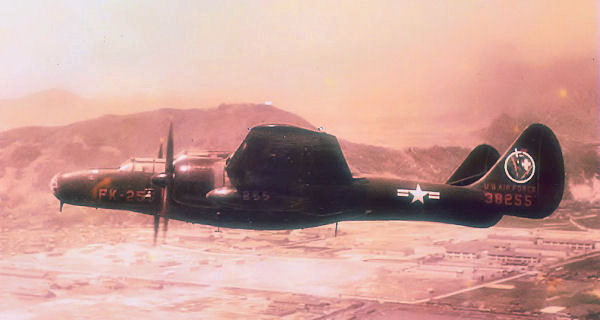
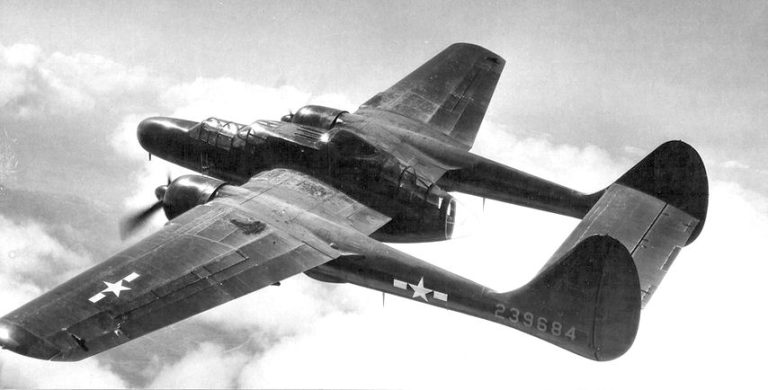
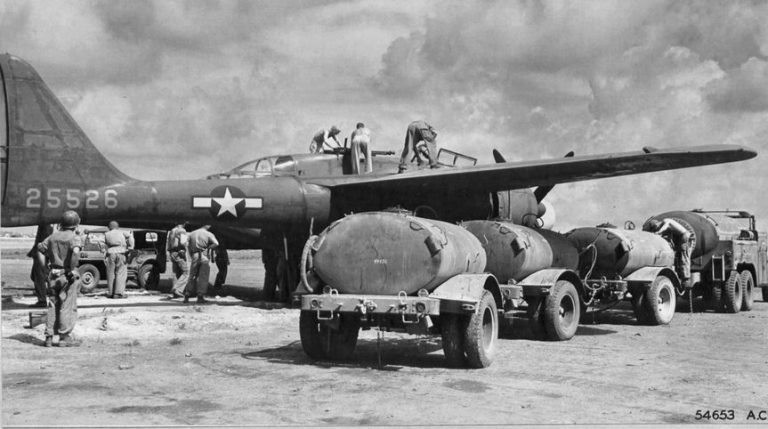
The Black Widow, in colour
Rare wartime colour film of the Black Widow — the big black night fighter on the ground and in the air in 1945.
Rare 1945 colour footage of the P-61 Black Widow night fighters (ZenosWarbirds).
Where the P-61 Black Widow flew — and survives
Hunting in the dark
The Black Widow fought a patient, invisible war — vectored onto enemy aircraft at night, closing on its own radar, and killing in a single pass. Its tally was modest but global, and it may have scored the very last Allied air victory of the war.
More than a scoreboard, the Black Widow was the ancestor of every radar-equipped, all-weather fighter that followed it. Compare the combat record of every military aircraft.
P-61 Black Widow: your questions, answered
Can I fly in a P-61 Black Widow?
No — only four survive and none is currently airworthy. But you can fly in a real military jet today: MiGFlug offers flights in genuine fighters and jet trainers such as the L-39 Albatros and the MiG-29. See migflug.com/flights-prices.
Was the P-61 the first American night fighter?
It was the first American aircraft designed from the outset as a radar-equipped night fighter, rather than a day aircraft with radar added later.
Why is it called the Black Widow?
After the black widow spider — a nocturnal, deadly hunter. The aircraft was finished in gloss black for its night role.
Did the P-61 score the last Allied kill of World War II?
A P-61B, “Lady in the Dark,” is often credited with the last Allied aerial victory, on the night of 14 August 1945 — though the claim is disputed.
How big was the P-61 Black Widow?
Very large for a fighter — a 66-foot wingspan, bigger than some medium bombers, with a crew of three: pilot, gunner and radar operator.
What was wrong with its turret?
Its remote-controlled dorsal turret caused buffeting at certain speeds, so on many aircraft it was locked to fire forward or removed entirely.
How many P-61 Black Widows survive?
Only four, including one under long-term restoration at the Mid-Atlantic Air Museum in Pennsylvania.
You can’t fly the P-61 Black Widow.
These, you can.
The Black Widow’s war is long over — but you can still strap into a genuine military jet. MiGFlug flies civilians in real fighters and jet trainers around the world.
 Fly the L-39 AlbatrosThe world’s most-flown jet trainer — aerobatics included
 Fly the F-104 Starfighter“The missile with a man in it”
 Fly the MiG-21The Cold War’s most-produced jet
 Fly the T-33 Shooting StarAmerica’s first jet trainer
 Fly the DH VampireA piece of early jet history
 Fly the S.211Agile Italian jet trainer
 Fly the MB-326The classic Aermacchi jet
 Fly the MiG-15The Soviet legend of the Korean War
Related aircraft
Where this chapter comes from
- National Museum of the U.S. Air ForceFact sheets on the P-61 Black Widow and American night-fighter development.
- Smithsonian National Air and Space MuseumBackground on the Black Widow and its radar and armament.
- Mid-Atlantic Air MuseumHome of the long-running P-61 restoration recovered from New Guinea.
- Imperial War MuseumOn the night-fighting war and airborne radar that shaped the P-61.
- MiGFlug — AfterburnerMiGFlug’s aviation magazine, on the great piston fighters and the birth of all-weather air combat.
Some P-61 figures — including performance and the disputed “last victory” claim — vary between sources; the most widely cited values are used here.