
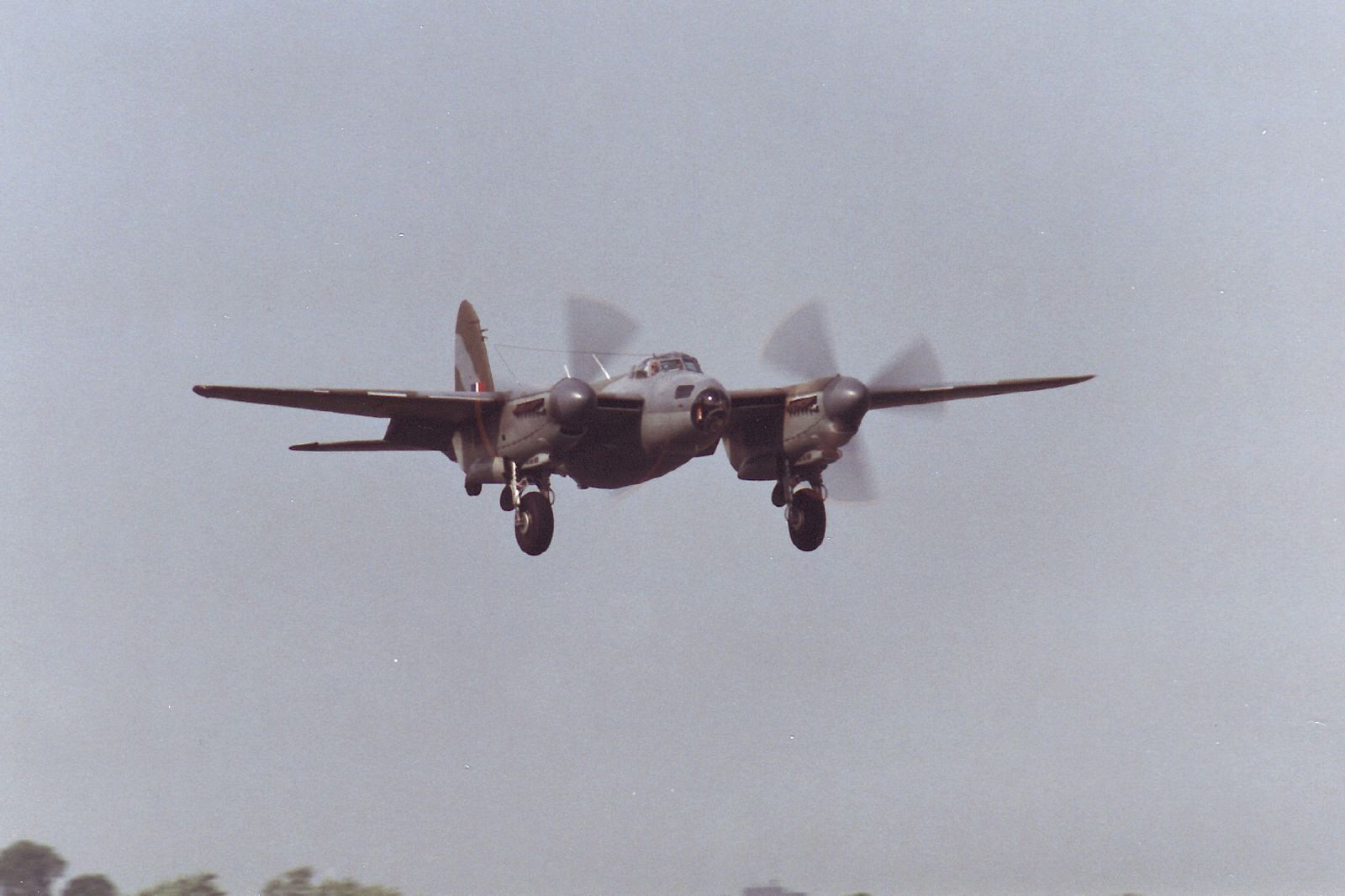
de Havilland Mosquito
“The Wooden Wonder”
A twin-Merlin warplane built almost entirely of plywood and balsa — conceived as an unarmed bomber so fast it needed no guns, and turned into one of the most versatile and effective aircraft of the Second World War.
The unarmed bomber that outran its own fighters
In the late 1930s the Air Ministry wanted bombers bristling with defensive turrets. Geoffrey de Havilland proposed the opposite: a small, twin-engined machine built of wood, carrying no guns at all, that would simply fly faster than the fighters sent to catch it. Officials were sceptical of an unarmed wooden bomber, and the idea was nearly killed on paper more than once before a modest order kept it alive.
The prototype, W4050, first flew from Hatfield on 25 November 1940 in the hands of Geoffrey de Havilland Jr. It was faster than a Spitfire in level flight. The airframe was a plywood–balsa–plywood sandwich, moulded in two half-shells and glued together — a design that freed up strategic aluminium and let the work be spread across hundreds of furniture makers, piano manufacturers and coachbuilders who had never built an aircraft before.
What followed was one of the most versatile careers of any aircraft in history. Powered by two Rolls-Royce Merlins, the “Mossie” served as a fast day bomber, a radar-equipped night fighter, a low-level fighter-bomber, a pathfinder marking targets for the heavy bombers, a photo-reconnaissance aircraft roaming deep over the Reich, and an anti-shipping strike aircraft — one version, the “Tsetse,” carrying a 57 mm gun. It flew some of the war’s most audacious precision raids, and it did so with one of the lowest loss rates of any aircraft in RAF Bomber Command.
01The de Havilland Mosquito’s wooden airframe: why a warplane was built like furniture
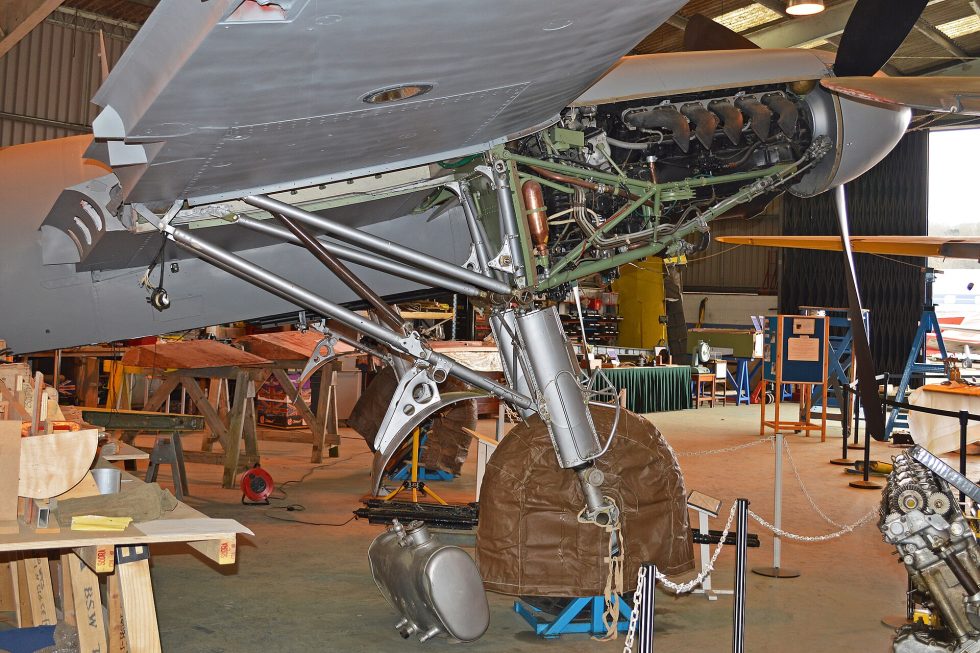
The Mosquito’s fuselage was moulded from thin sheets of birch and spruce plywood sandwiching a lightweight balsa core, formed in two halves over concrete or mahogany moulds and then bonded together with the equipment already fitted inside. The one-piece wing was built the same way. Wood was not a wartime compromise so much as a clever choice: it saved aluminium and skilled metalworkers for other aircraft, it produced an aerodynamically clean, light and strong airframe, and it let production be farmed out to an army of woodworking firms — cabinet-makers, coachbuilders and piano factories — across Britain, Canada and Australia. The main weakness surfaced in the heat and humidity of the Far East, where glues could fail and skins delaminate; better adhesives and reinforcement largely fixed it, though the “falling apart in the jungle” story is often overstated.
What makes it special
An all-wood airframe — and speed as armour
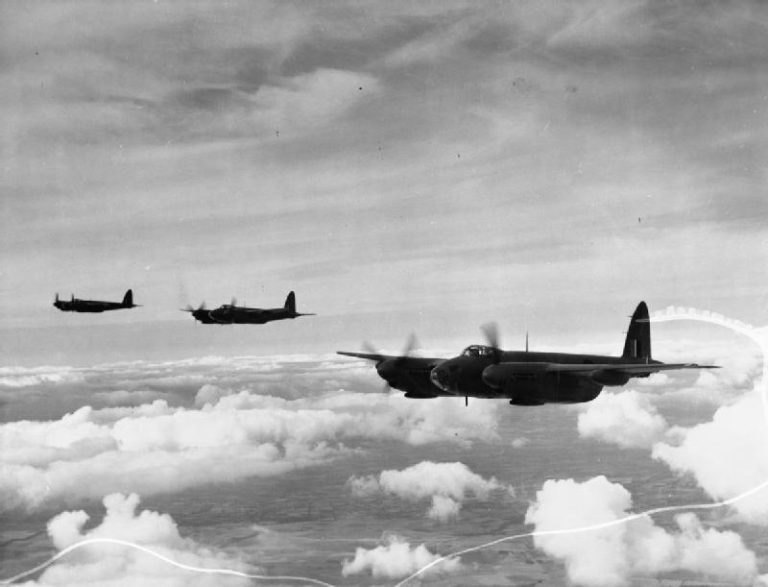
The Mosquito’s plywood-and-balsa monocoque was light, strong and clean. With two Merlins it was, for a time, among the fastest operational aircraft in the world — faster than the fighters meant to intercept it. That speed was its defence: early bomber versions carried no guns at all, trading turrets and gunners for pure pace.
One airframe, every mission
Few aircraft have done so many jobs so well. The Mosquito was a fast bomber, a night fighter with AI radar, a fighter-bomber and intruder, a pathfinder, a photo-reconnaissance platform, and an anti-shipping striker — including the “Tsetse” with its 57 mm Molins cannon. Late bombers even carried the 4,000 lb “cookie” blast bomb to Berlin.
The master of the precision raid
Flying fast and low, Mosquito crews pulled off some of the war’s most daring pinpoint attacks — breaching the walls of Amiens prison (Operation Jericho, 1944) and striking Gestapo headquarters in Oslo and Copenhagen. Married to the Oboe guidance system, Mosquito pathfinders also marked targets for the heavy-bomber streams with new accuracy.
02The Mosquito as pathfinder: how Oboe turned a wooden bomber into a precision marker
From December 1942, Mosquitoes of No. 109 Squadron pioneered Oboe, a blind-bombing system that used two ground stations in England to guide an aircraft along an arc and signal the precise release point. Flying high and fast, the Mosquito was the ideal Oboe carrier, and its target-marking flares gave the following heavy bombers an accuracy they had never had before — a key enabler of the Battle of the Ruhr. Pathfinder Mosquitoes flew tens of thousands of sorties for a loss rate widely cited at around 0.03%, the lowest of any Bomber Command type.
03The Mosquito’s anti-shipping war: the 57 mm “Tsetse” and the Banff Strike Wing
The FB Mk XVIII “Tsetse” replaced the four cannon with a single auto-loading 57 mm Molins gun — a modified six-pounder anti-tank weapon — for attacking U-boats and shipping. On 25 March 1944 a Tsetse helped sink U-976 off France. From late 1944 the Banff Strike Wing in Scotland, with British, Norwegian, Canadian and New Zealand crews, hammered German shipping along the Norwegian coast with cannon, rockets and bombs — one of the Mosquito’s deadliest campaigns.
Full specifications
Figures for the FB Mk VI fighter-bomber (the most-produced variant) unless noted; Mosquito performance varied widely by mark and loading.
Baseline: the B Mk XVI high-altitude pressurised bomber of 1944, the mark that flew the Light Night Striking Force runs to Berlin with a 4,000 lb Cookie in a bulged bay. The Mosquito was built in more than forty marks across bomber, night-fighter, fighter-bomber, photo-reconnaissance and naval roles, and the numbers move a long way between them — fighter and fighter-bomber figures are given in grey alongside.
Dimensions & weights
- Crew
- 2 (pilot and navigator/bomb aimer side by side, the navigator set slightly back; no gunner in any mark)
- Length
- 13.57 m (44 ft 6 in) — FB Mk VI 12.55 m (41 ft 2 in)
- Wingspan
- 16.52 m (54 ft 2 in) — common to all land-based marks
- Height
- 5.31 m (17 ft 5 in) tail down — FB Mk VI 4.65 m (15 ft 3 in)
- Wing area
- 42.18 m² (454 sq ft)
- Empty weight
- 6,638 kg (14,635 lb) — FB Mk VI 6,490 kg (14,300 lb)
- Loaded weight
- 10,430 kg (23,000 lb) at typical operational load
- Max takeoff weight
- 11,766 kg (25,917 lb) — FB Mk VI 10,100 kg (22,300 lb)
- Internal fuel
- ~2,450 L (~539 imp gal / ~647 US gal) — FB Mk VI ~2,060 L (~453 imp gal), plus 2 × 227 L (50 imp gal) or 2 × 455 L (100 imp gal) drop tanks
Performance
- Max speed
- 668 km/h (415 mph / 361 kt) at 8,500 m (28,000 ft) — the whole point: an unarmed bomber faster at height than the fighters sent after it. FB Mk VI 611 km/h (380 mph) at 4,000 m; NF Mk 30 682 km/h (424 mph)
- Cruise speed
- 394 km/h (245 mph) economical cruise; high-speed cruise around 523 km/h (325 mph)
- Rate of climb
- 14.2 m/s (2,800 ft/min) initial — FB Mk VI 9.5 m/s (1,870 ft/min)
- Service ceiling
- 11,300 m (37,000 ft) — the pressurised PR Mk 34 worked above 13,000 m (43,000 ft)
- Range with typical load
- ~2,200 km (~1,370 mi) carrying a 4,000 lb bomb load — enough for Berlin and back from East Anglia
- Ferry range
- ~2,990 km (~1,860 mi) with drop tanks; PR marks with extra tankage went considerably further
- Takeoff run
- 430 m (1,410 ft) — hard runway at operational weight; grass and full load lengthen it appreciably
- Landing run
- 520 m (1,700 ft) — flaps down, no brake chute; the type was unforgiving of a swing on one engine
- Bomb load
- ~1,814 kg (~4,000 lb) maximum — one 4,000 lb HC Cookie in the bulged bay, or 4 × 500 lb; FB Mk VI 2 × 500 lb internal plus 2 × 500 lb under the wings
Propulsion & systems
- Engines
- 2 × Rolls-Royce Merlin 72/73 two-stage, two-speed supercharged, handed pair (B Mk XVI); mark-dependent throughout — Merlin 21/23/25 in the FB Mk VI, Merlin 76/77 in late bombers and the NF Mk 30, Packard-built Merlins in Canadian aircraft
- Power each
- 1,275 kW (1,710 hp) at altitude — Merlin 25 in the FB Mk VI, 1,219 kW (1,635 hp) at low level
- Propellers
- de Havilland Hydromatic three-blade constant-speed, fully feathering, 3.81 m (12 ft 6 in) diameter
- Construction
- Wooden monocoque — plywood/balsa/plywood sandwich Birch plywood skins over an end-grain balsa core, the fuselage moulded in two half-shells over concrete or mahogany formers, fitted out while open and then glued together; wings of spruce and ply with a doped fabric finish. Casein glue first, formaldehyde-based adhesives later after tropical joint failures. It used almost no strategic light alloy, and it was built by furniture factories, cabinet shops, coachbuilders and piano makers — capacity and skilled labour that lay entirely outside the aircraft industry. That is the single most important fact about the aeroplane: it multiplied Britain’s production base instead of competing with it.
- Armament by role
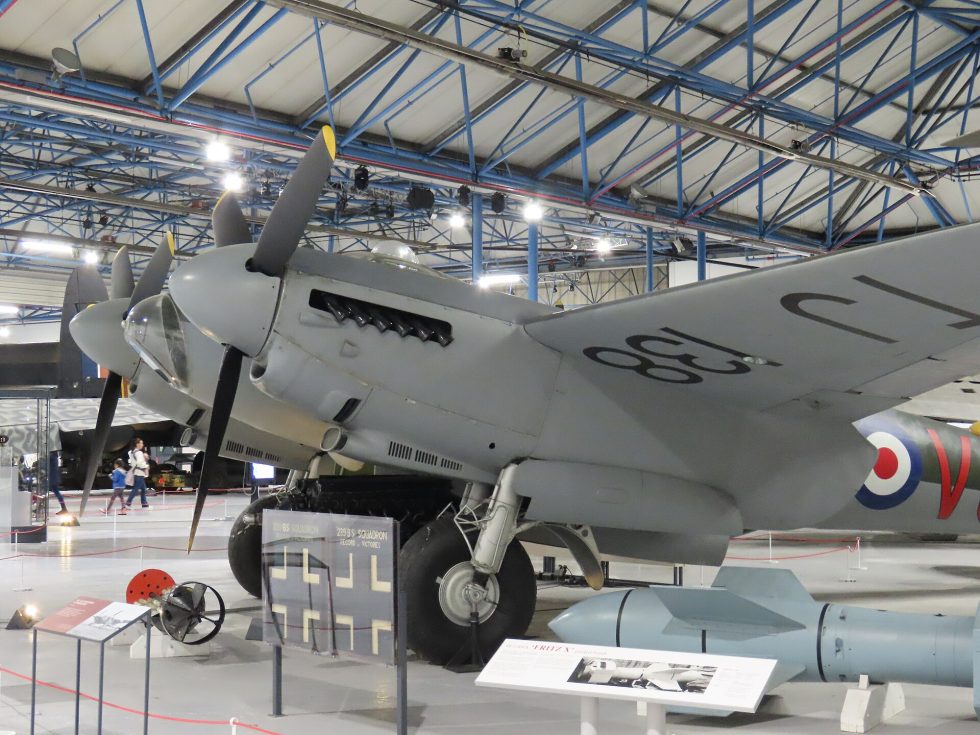
- 4 × 20 mm Hispano + 4 × .303 in Browning on fighter and fighter-bomber marks; 57 mm Molins gun on the FB Mk XVIII; bomber and photo-reconnaissance marks carried no guns at all
- Radar
- AI Mk IV to AI Mk X on night-fighter marks — metric AI Mk IV with arrowhead aerials on the NF Mk II, centimetric AI Mk VIII and the American-derived AI Mk X (SCR-720) in a thimble or bull nose from the NF Mk XIII onward; plus Serrate and Perfectos homers, Monica tail warning, and Oboe or H2S in Pathfinder bombers
- First flight
- 25 November 1940 prototype W4050 at Hatfield, flown by Geoffrey de Havilland Jr.
- Service entry
- September 1941 first operational sortie by a PR Mk I of No. 1 PRU on 20 September 1941; night fighters from early 1942, bombers from May 1942
- Built
- 7,781 (commonly cited all-marks total, 1940–1950: ~6,710 in Britain, ~1,134 by de Havilland Canada at Downsview, ~212 by de Havilland Australia at Bankstown)
- Unit cost
- ~£10,000–£12,000 (mid-war, airframe with engines; wartime costings vary widely by mark and by what is counted, so treat this as an order of magnitude — roughly a quarter of a four-engined heavy bomber, for two crew instead of seven)
- Cost per flight hour
- ~US$10,000–15,000 modern warbird operating cost, all-in with reserves — two Merlins burning roughly 450 L/hr in cruise, with overhauls running into six figures each. Only a handful of Mosquitoes are airworthy anywhere in the world, most of them rebuilt in New Zealand by Avspecs; the wooden structure is what makes this type exceptional, because glued timber degrades invisibly and cannot be inspected or patched the way aluminium can, so a “restoration” is very largely a new-build from original drawings.
04The de Havilland Mosquito’s costs: cheap wood versus expensive metal
The Mosquito was deliberately economical. By using non-strategic materials and semi-skilled woodworkers, it sidestepped the aluminium and skilled-labour bottlenecks that constrained metal aircraft. Wartime unit costs are hard to standardise, but a Mosquito is commonly cited at very roughly £10,000–13,000 — a fraction of a four-engined heavy bomber — while carrying a comparable blast bomb to Berlin with a crew of two rather than seven. Treat any single figure as an order-of-magnitude estimate: prices varied by mark, factory and year, and no reliable cost-per-flight-hour figure exists for a 1940s type. The handful of airworthy Mosquitoes flying today are, by contrast, among the most expensive warbirds in the world to restore and operate.
Armament & payload
“Speed is armour” — and four cannon for the nights when it wasn’t
The Mosquito was designed with no defensive guns at all, on the argument that a fast enough bomber does not need them. That gamble paid: the bomber and photo-reconnaissance marks flew unarmed over Germany for three years at loss rates well below the heavies. But the same airframe, given a gun bay and a nose full of Brownings, became one of the most heavily armed fighters of the war — and in the FB Mk XVIII, it carried a 57 mm anti-tank gun to sea.
Guns (fighter marks)
- 4 × 20 mm Hispano Mk II cannon in a bay under the cockpit floor, roughly 150–200 rounds per gun, belt-fed.
- 4 × .303 in Browning machine guns grouped in the nose above them, used for sighting bursts and for strafing.
- The whole battery fires forward within a few feet of the centreline, so there is no harmonisation cone to worry about — a very concentrated one-second burst.
- Muzzle flash blinded night-fighter crews, so flash eliminators and shortened barrels were fitted; late NF marks dropped the .303s entirely and kept four cannon.
Bombs
- Standard bomber fit: 4 × 500 lb in the bay; the FB Mk VI carried 2 × 500 lb internally with 2 × 500 lb or drop tanks under the wings.
- The 4,000 lb HC “Cookie” blast bomb, carried in a bulged bay on the B Mk IV Special conversions and then as standard on the B Mk XVI — a two-man aircraft delivering the same single weapon as a seven-man Lancaster.
- Target indicators and flares for the Light Night Striking Force and for Oboe-equipped Pathfinder marking.
- Highball, the naval bouncing bomb, was carried by 618 Squadron Mosquitoes; it was never used operationally.
Rockets
- 8 × RP-3 three-inch rockets on underwing rails, fitted to Coastal Command FB Mk VIs.
- 60 lb SAP/HE heads against shipping and flak positions; 25 lb solid armour-piercing heads for holing submarine pressure hulls below the waterline.
- Fired in pairs or salvo in a shallow dive; the Banff Strike Wing used them against German coastal convoys off Norway from 1944.
- Rockets and bombs were alternatives, not additions — the wing racks took one or the other.
Anti-shipping weapons
- The FB Mk XVIII “Tsetse”: a Molins 6-pounder Class M 57 mm gun with an auto-loader, roughly 25 rounds, firing at about one shell a second.
- Around two dozen were converted; they flew with 248 Squadron against U-boats and shipping in the Bay of Biscay, with extra armour around the crew and engines.
- Depth charges and 500 lb bombs on the same anti-submarine sorties; the naval TR.33 could carry a torpedo or mine.
- The gun worked, but the rocket proved simpler and more general-purpose, and it stayed the Coastal Command weapon of choice.
Radar & special equipment
- AI Mk IV metric radar on the NF Mk II, with arrowhead nose and wire dipole aerials; AI Mk VIII and AI Mk X centimetric sets in a thimble or bull nose from the NF Mk XIII.
- Serrate homed on German night-fighter Lichtenstein emissions and Perfectos triggered their IFF, letting 100 Group intruders hunt the hunters over their own airfields.
- Oboe blind-bombing in Pathfinder marks was accurate to a few hundred yards over the Ruhr; H2S was fitted to late bombers.
- PR marks carried F.52 and F.24 cameras in vertical, split-vertical and oblique mounts, with heating to stop the shutters freezing at altitude.
Unarmed marks
- The PR and bomber marks carried no guns, no turret and no gunner — the weight went into fuel, cameras or bombs.
- Defence was speed and height alone. It worked: Mosquito bomber losses ran at a small fraction of a percent per sortie against several percent for the four-engined heavies.
- Two crew at risk instead of seven, on aircraft that could be over Berlin twice in a night.
- The first Mosquito into RAF service was an unarmed PR Mk I, in September 1941, and photo-reconnaissance Mosquitoes were still flying operationally into the 1950s.
Three typical Mosquito fits
- Night fighter
- NF Mk XIII or NF Mk 30 — 4 × 20 mm Hispano, AI Mk VIII or Mk X centimetric radar in a thimble nose, no bombs, drop tanks for patrol endurance; 100 Group aircraft added Serrate and Perfectos for bomber-support intruder work over Germany.
- FB Mk VI intruder
- 4 × 20 mm Hispano and 4 × .303 in Browning, 2 × 500 lb bombs in the rear bay and either 2 × 500 lb or 8 × RP-3 rockets under the wings, with 50 imp gal drop tanks for the run into France or Norway at low level.
- Unarmed high-speed bomber
- B Mk XVI — one 4,000 lb Cookie in the bulged bay, pressurised cabin, Oboe or H2S, two crew, not a single gun aboard; cruising to Berlin above 30,000 ft on the strength of the fact that very little could catch it there.
Almost nothing above is true of “the Mosquito” in general. The airframe was a common denominator for at least four different aeroplanes, and armament, radar, tankage and even nose shape depended entirely on the mark and the squadron’s job that month. Field modification was routine, so two aircraft of the same mark on the same station could differ.
Variants
Forty-odd marks from one wooden airframe
De Havilland offered the Mosquito as a bomber and the Air Ministry wanted a fighter; in the end it got both, plus a reconnaissance aircraft, a maritime strike aircraft and a carrier aeroplane, all from a design that flew fourteen months after the drawings were begun.
- PR Mk I
- The first Mosquito into service, ~10 built — cameras and fuel in place of everything else, first operational sortie 20 September 1941.
- B Mk IV
- The first bomber mark, ~300 built; ~54 were modified with a bulged bay to carry the 4,000 lb Cookie as the B Mk IV Special.
- NF Mk II
- First night fighter, ~466 built — AI Mk IV radar, four cannon and four machine guns; some stripped of radar as Intruders over German airfields.
- FB Mk VI
- The most-produced mark by a wide margin, ~2,700 built — guns, bombs and rockets in one airframe, and the aircraft that flew the famous low-level precision raids.
- B Mk XVI
- Pressurised high-altitude bomber, ~1,200 built — two-stage Merlins, bulged bay, the Light Night Striking Force mainstay over Berlin.
- FB Mk XVIII Tsetse
- ~27 conversions carrying a 57 mm Molins gun with an auto-loader, flown against U-boats and shipping by Coastal Command.
- NF Mk 30
- High-altitude night fighter, ~526 built — two-stage Merlin 76s and AI Mk X, the definitive wartime night-fighter Mosquito.
- Sea Mosquito TR.33
- Navalised torpedo/reconnaissance version for the Fleet Air Arm, ~50 built — folding wings, arrester hook and four-blade propellers; a Mk VI had already made the first carrier landing by a twin-engined aircraft, on HMS Indefatigable in March 1944.
- Canadian and Australian production
- De Havilland Canada at Downsview built ~1,134 with Packard Merlins (B Mk VII, XX, 25 and FB Mk 26), many ferried across the Atlantic; de Havilland Australia at Bankstown built ~212 (FB Mk 40, PR Mk 40 and 41), the last of them completed after the war.
What the FB Mk VI is remembered for is a handful of raids flown at rooftop height with the accuracy of an aimed weapon. On 18 February 1944, Operation Jericho sent 140 Wing Mosquitoes against the prison at Amiens to breach its walls for Resistance prisoners: 255 got out, 102 prisoners were killed by the bombing, and Group Captain Percy Pickard, who led it, was shot down and killed. Others hit Gestapo headquarters buildings directly — Victoria Terrasse in Oslo in 1942 and again on New Year’s Eve 1944, the Central Population Registry in The Hague in April 1944, and the Shellhus in Copenhagen on 21 March 1945, where prisoners held in the attic as human shields were freed and Gestapo records destroyed.
The Copenhagen raid also killed children. One Mosquito of the first wave struck a light mast on the run-in and crashed beside the Jeanne d’Arc School; aircraft of the following waves, seeing smoke and fire, bombed the school in the belief that it was the target. Eighty-six children and eighteen adults died there. It is documented, it was not disputed afterwards by the crews or by the RAF, and it belongs in any honest account of what precision bombing meant in 1945 — the technique that freed the prisoners in the Shellhus and the technique that destroyed the school were the same technique.
Of 7,781 built, roughly thirty airframes survive worldwide in museums and collections, and only a small handful are airworthy — nearly all of them rebuilt in New Zealand by Avspecs, working from original de Havilland drawings and new-made wooden components. That is the direct consequence of the aircraft’s greatest strength: glued timber and balsa deteriorate invisibly with moisture and age, cannot be inspected like metal, and cannot be locally patched, so returning a Mosquito to flight is closer to building a new one than to restoring an old one, and it is correspondingly slow and expensive. Most survivors will never fly again.
From heretical idea to Wooden Wonder
The unarmed-bomber idea
De Havilland pushes a fast, gunless wooden bomber against Air Ministry scepticism; a small order under Specification B.1/40 keeps it alive.
First flight
Prototype W4050 flies from Hatfield on 25 November, promptly proving faster than contemporary fighters.
Into service
The Mosquito enters RAF service; the first operational sortie, on 20 September, is a photo-reconnaissance flight.
Oslo & the pathfinders
The daring low-level Oslo Gestapo raid (September) makes headlines; No. 109 Sqn begins Oboe pathfinding in December.
Berlin by daylight
On 30 January, Mosquitoes disrupt Nazi anniversary speeches in Berlin — the type famously credited with making Göring “green with envy.”
Operation Jericho
On 18 February, low-flying Mosquitoes breach the walls of Amiens prison; later marks carry the 4,000 lb “cookie” to Berlin.
The Shellhus raid
On 21 March, Operation Carthage destroys Gestapo HQ in Copenhagen — a triumph shadowed by the accidental bombing of a school.
End of the line
Production ends in 1950 after ~7,780 aircraft; the last RAF Mosquitoes, target-tugs, soldier on until 1963.
From the records: twelve Mosquito stories
The bomber nobody wanted
An unarmed wooden bomber sounded absurd — until it flew faster than the Spitfire.
Read the full story
Cabinet-makers and piano factories
Roughly 400 firms outside the aircraft industry built the Mosquito — furniture and piano makers among them.
Read the full story
Faster than everything, over Berlin
Stripped of guns and flying high and fast, PR Mosquitoes roamed deep over the Reich almost untouchable.
Read the full story
The raid that enraged Göring
Mosquitoes bombed Berlin in daylight to interrupt Nazi anniversary speeches by Göring and Goebbels.
Read the full story
The pathfinder that lit the way
Mosquitoes flew the Oboe blind-bombing system, marking targets for the heavy-bomber streams.
Read the full story
Operation Jericho
Low-level Mosquitoes blew holes in the walls of Amiens prison to free Resistance captives.
Read the full story
A flying anti-tank gun
The FB Mk XVIII carried a 57 mm Molins cannon to hunt U-boats and shipping.
Read the full story
The bouncing bomb that never was
Barnes Wallis designed a naval bouncing bomb for the Mosquito — but it was never used in anger.
Read the full story
V-1 killer in the dark
Radar-equipped Mosquitoes defended Britain by night and shot down hundreds of flying bombs.
Read the full story
Two men, one Berlin blockbuster
A wooden aircraft with a crew of two carried the same 4,000 lb blast bomb as a heavy bomber.
Read the full story
The Shellhus tragedy
A precision raid on Gestapo HQ in Copenhagen went right — and terribly wrong.
Read the full story
A handful still fly
Of the ~7,780 built, only around thirty survive, and just a few have been returned to the air.
Read the full story
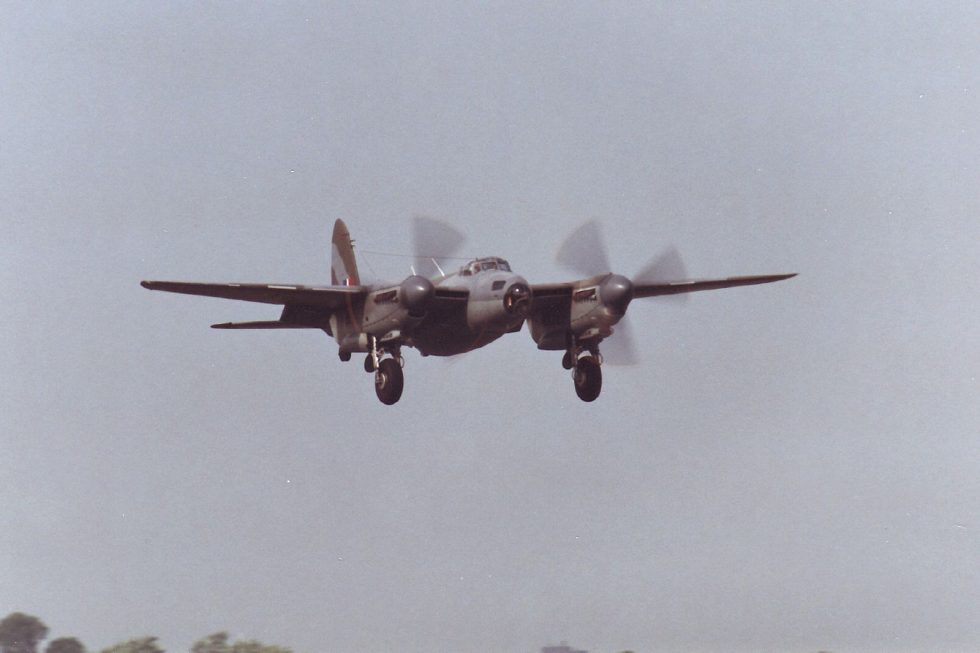
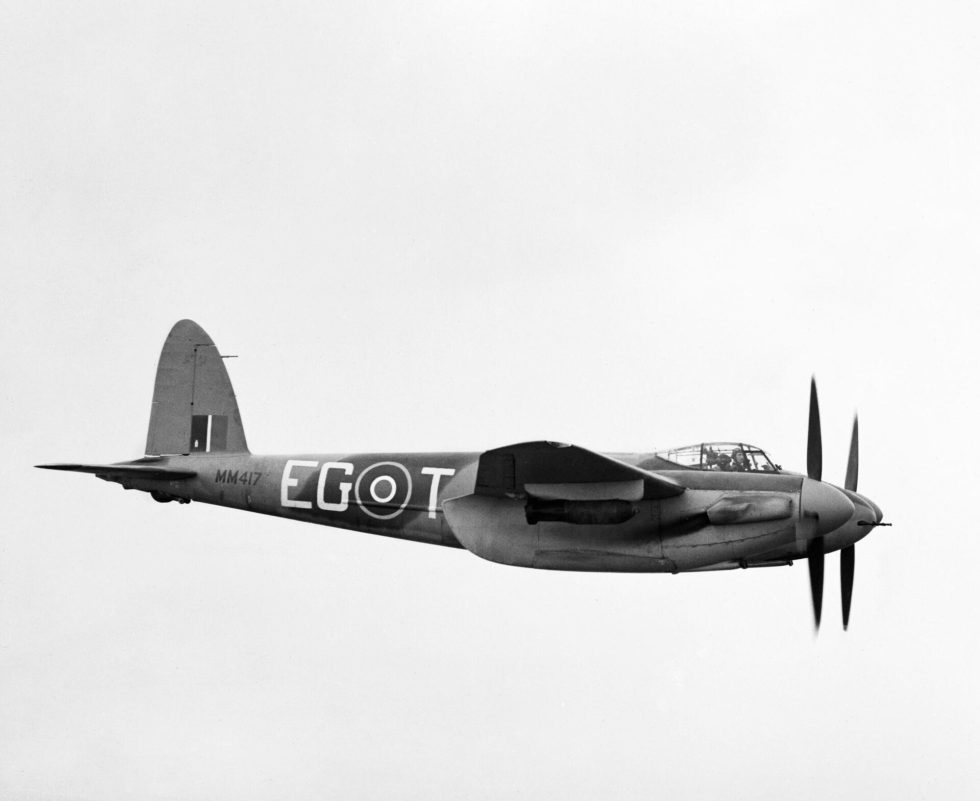
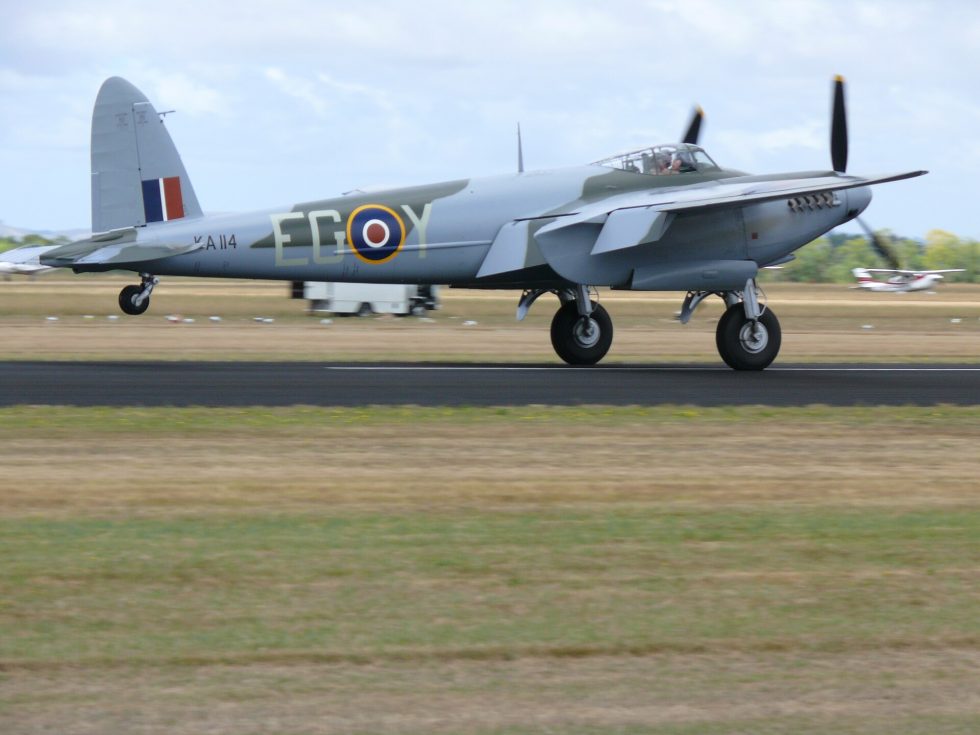
The Mosquito in pictures
The Mosquito in motion
Video coming soon. We are selecting a high-quality documentary on the Wooden Wonder to feature here.
Where the Mosquito flew
The record that defines it
The Mosquito’s record is written less in air-to-air kills than in versatility, precision and survivability. It flew as bomber, night fighter, striker, pathfinder and spy, hit targets others could not reach, and came home more often than almost any other type — a rare combination of daring and endurance.
Compare the combat record of every military aircraft. Figures as of July 2026.
Everything people ask about the Mosquito
Can I fly in a Mosquito?
Why was the Mosquito made of wood?
How fast was the de Havilland Mosquito?
What roles did the Mosquito fly?
How many Mosquitoes were built?
Are any Mosquitoes still flying?
Did Hermann Göring really praise the Mosquito?
You can’t fly the Mosquito.
These, you can.
Some legends only live in museums — others are fuelled and waiting. MiGFlug has put civilians in real military jet cockpits since 2004.
 Fly the L-39 AlbatrosThe world’s most-flown jet trainer — aerobatics included
 Fly the F-104 Starfighter“The missile with a man in it”
 Fly the MiG-21The Cold War’s most-produced jet
 Fly the T-33 Shooting StarAmerica’s first jet trainer
 Fly the DH VampireA piece of early jet history
 Fly the S.211Agile Italian jet trainer
 Fly the MB-326The classic Aermacchi jet
 Fly the MiG-15The Soviet legend of the Korean War
Continue the tour
Every fact, checked
- Royal Air Force MuseumCollection entries on the Mosquito — construction, roles and postwar service to 1963.
- Imperial War MuseumsRecords and imagery for Operation Carthage (Copenhagen) and the Mosquito’s wartime operations.
- de Havilland Aircraft MuseumThe manufacturer’s heritage museum — FB.VI specifications, armament and the prototype W4050.
- The People’s MosquitoProduction totals, the piano-factory subcontractor story, survivor status and raid write-ups.
- This Day in AviationDetailed, referenced account of the 25 November 1940 first flight and early performance.
- History of WarOperational figures, loss rates, the Tsetse, pathfinder and Light Night Striking Force detail.