
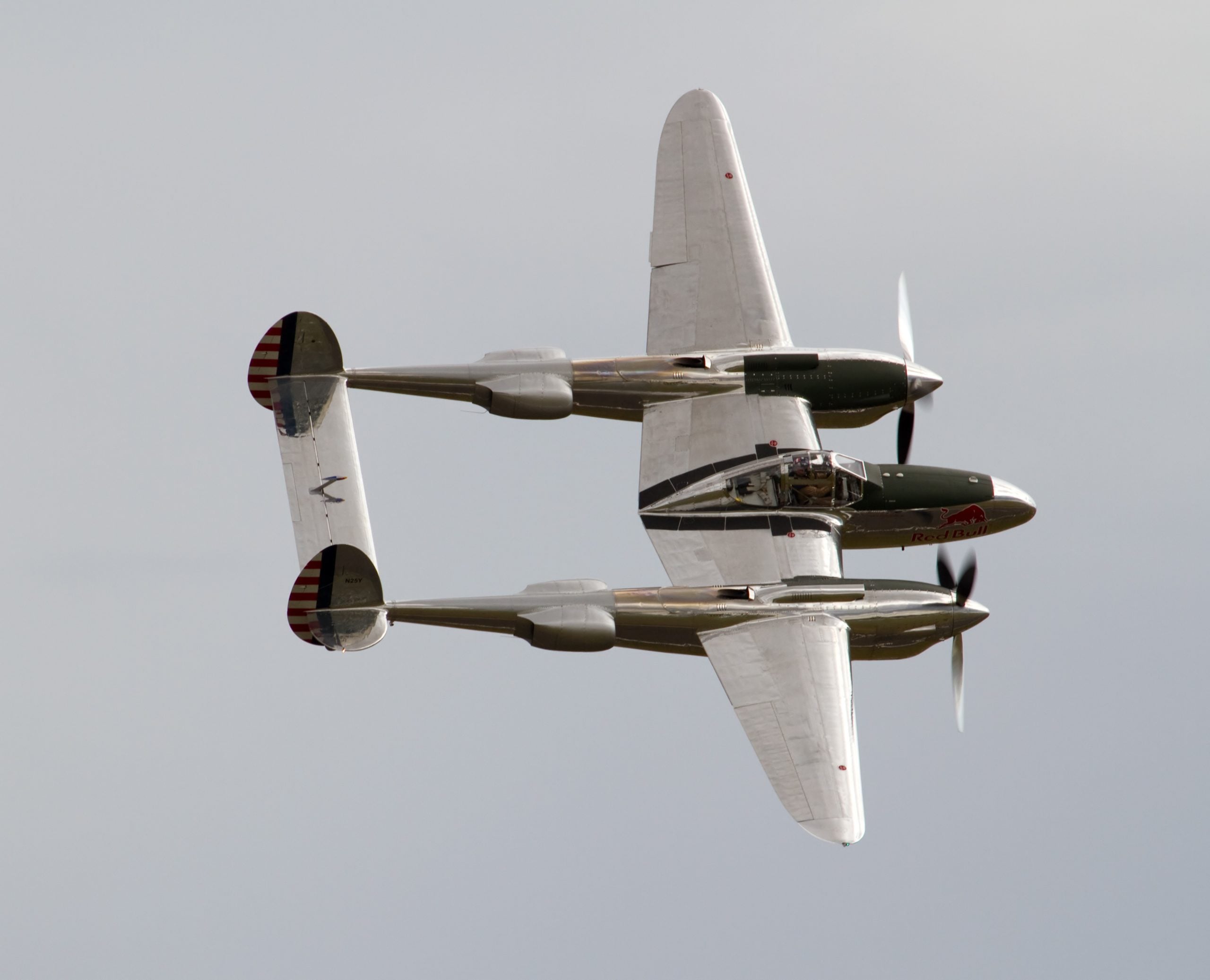
Lockheed P-38 Lightning
“Fork-Tailed Devil”
The twin-boom, twin-engine fighter that carried all its guns in the nose — long-range escort, photo-recon and bomber-killer, and the aircraft flown by America’s two highest-scoring aces of all time.
The fork-tailed fighter that ruled the Pacific
In 1937 the US Army Air Corps issued Circular Proposal X-608, calling for a high-altitude interceptor faster and higher-climbing than anything then flying. Lockheed had never built a fighter, but its team under chief engineer Hall Hibbard and a young Clarence “Kelly” Johnson answered with the radical Model 22: a twin-boom machine with two turbo-supercharged Allison V-1710 engines, tricycle landing gear, and every gun clustered in a central nose. The prototype XP-38 first flew on 27 January 1939 with Lt Ben Kelsey at the controls; two weeks later a record-setting transcontinental dash ended in a crash short of New York — but the raw performance was enough to launch production.
The Lightning became one of the most versatile aircraft of the war: long-range escort, bomber-interceptor, ground-attack platform and, above all, the “eyes of the air force” in its F-4 and F-5 photo-reconnaissance forms. Because its one 20 mm cannon and four .50-calibre machine guns all fired straight ahead from the nose, there was no wing-gun convergence zone — a pilot could hammer a target with concentrated fire out to long range. Its greatest theatre was the Pacific: America’s two top-scoring aces of all time, Richard Bong (40 victories) and Thomas McGuire (38), both flew it, and on 18 April 1943 P-38Gs flew a round trip of roughly a thousand miles to kill Admiral Isoroku Yamamoto.
It was not without demons. In high-speed dives the P-38 met compressibility: the nose would “tuck” under and the controls go heavy, a trap that killed test pilots until dive-recovery flaps were fitted in 1944. Over northern Europe its unheated cockpit froze pilots at altitude and the Allisons proved troublesome, so it never dominated there as it did in the Pacific and Mediterranean. German airmen are often said to have called it der Gabelschwanz-Teufel — the fork-tailed devil — though no primary German source for the phrase is ever produced. Around 10,038 were built, and Honduras flew the last military examples into the 1960s.
01The Lockheed P-38 Lightning’s origins: Kelly Johnson’s twin-boom answer to a 1937 interceptor spec
The 1937 requirement demanded speed and altitude that a single Allison engine simply could not deliver. Lockheed’s solution was to use two engines and, crucially, to give each a General Electric turbo-supercharger for high-altitude power — but the turbos, ducting and coolant radiators needed somewhere to go. The answer was the aircraft’s defining feature: twin booms running aft from the engines to a shared tailplane, with the pilot and armament in a slim central nacelle. The layout kept the guns out of the propeller arc (so they needed no synchronisation) and clustered them on the centreline.
The one-off XP-38 was fast enough to tempt the Air Corps into a coast-to-coast speed attempt on 11 February 1939. It covered the distance in about seven hours — a record pace — but iced its carburettors on the approach and crashed short of Mitchel Field, New York. The airframe was destroyed; the idea was not. A 13-aircraft service-test batch was ordered, and the Lightning was on its way.
What makes it special
All the guns in the nose
Unlike wing-gunned fighters, the P-38 packed one 20 mm Hispano cannon and four .50-calibre Brownings into its central nacelle, firing parallel straight ahead. There was no convergence zone where the streams crossed at a set distance — the guns stayed on target from close range out to around a thousand yards, giving a lethal, concentrated punch that rewarded accurate pilots.
Two turbo-supercharged Allisons
Power came from two liquid-cooled Allison V-1710 engines slung in the booms, each fed by a GE turbo-supercharger for high-altitude performance and turning counter-rotating propellers that cancelled engine torque. Two engines meant a wounded Lightning could limp home on one — and, with drop tanks, the range to escort bombers deep or fly the thousand-mile mission that killed Yamamoto.
One airframe, many jobs
The Lightning was a genuine multi-role aircraft. It flew as escort fighter, interceptor, dive- and skip-bomber and rocket-armed ground-attacker — and its unarmed F-4 and F-5 photo-reconnaissance versions (around 500 built) became the Allies’ principal high-altitude camera platform. A glazed-nose “Droop Snoot” even led formations of fighter-bombers as a bombing pathfinder.
02The P-38 Lightning’s compressibility problem: the dive that locked the controls
As the P-38 dived past roughly Mach 0.65–0.68, airflow over the wing approached the speed of sound and shock waves formed. The tail lost lift, the nose “tucked” further down, and the control column went immovable — a phenomenon called compressibility that could tear the aircraft apart in the pull-out. It killed Lockheed test pilot Ralph Virden in November 1941 and cost combat pilots their lives before it was understood. The eventual fix was a set of dive-recovery flaps under the wings, which restored lift and let the pilot recover; they arrived late in the P-38J production run (commonly cited as the J-25 block, spring 1944) and became standard on the P-38L.
03The P-38 Lightning in Europe: frozen cockpits and troublesome turbos
In the Pacific the Lightning was king; over northern Europe it struggled. Its cockpit heating was notoriously poor, and at 25,000 feet in a European winter pilots suffered genuine frostbite. The turbo-supercharged Allisons, run on European fuel in bitter cold, proved maintenance-hungry and prone to failures that a twin at least made survivable. Combined with the compressibility scare, this made the P-38 less favoured in the ETO than the later P-51 Mustang — even as the same aircraft dominated the warmer, longer-ranged Pacific and Mediterranean theatres.
Full specifications
Baseline is the P-38L-5-LO of 1944–45, the most-produced Lightning (3,923 by Lockheed plus 113 by Consolidated-Vultee at Nashville). Deltas for the earlier P-38J and for the unarmed F-4/F-5 photo-reconnaissance conversions are given in grey where they differ materially. Sub-block figures vary; wartime manuals and later reference works disagree by a few per cent on weights and ranges.
Dimensions & weights
- Crew
- 1 pilot; 2 in the P-38M night fighter
- Length
- 11.53 m (37 ft 10 in)
- Wingspan
- 15.85 m (52 ft 0 in)
- Height
- 3.91 m (12 ft 10 in)
- Wing area
- 30.43 m² (327.5 sq ft)
- Empty weight
- 5,800 kg (12,780 lb)
- Loaded weight
- 7,940 kg (17,500 lb)
- Max takeoff weight
- 9,798 kg (21,600 lb) with two 1,000 lb bombs or large drop tanks
- Internal fuel
- ~1,552 L (~410 US gal) P-38J/L with leading-edge tanks; ~300 US gal on earlier marks
Performance
- Max speed
- 667 km/h (414 mph) at 7,620 m / 25,000 ft, War Emergency Power
- Cruise speed
- 443 km/h (275 mph) long-range cruise nearer 350 km/h / 220 mph
- Rate of climb
- 20.3 m/s (4,000 ft/min) at sea level, clean
- Service ceiling
- 13,400 m (44,000 ft)
- Combat radius
- ~1,100 km (~700 miles) escort radius with two 300 US gal tanks
- Ferry range
- ~3,640 km (~2,260 miles) maximum, drop tanks, no combat allowance
- Takeoff run
- 610 m (2,000 ft) ground roll at loaded weight
- Landing run
- 670 m (2,200 ft) ground roll, no braking chute fitted
- Dive limitations
- Mach 0.68 placard compressibility onset; IAS limit fell steeply with altitude — around 290 mph IAS above 25,000 ft. Dive recovery flaps from late P-38J/L blocks restored control
Propulsion & systems
- Engines
- 2 × Allison V-1710 V-1710-111/113 in the P-38L; liquid-cooled V-12s turning counter-rotating propellers, the blades sweeping outward from the cockpit. Because the two engines cancelled each other, the Lightning had no torque, no P-factor and no swing on takeoff or in a gun run — the pilot aimed with rudder trim untouched, an advantage almost no single-engined fighter of the war enjoyed
- Power each
- 1,600 hp (1,193 kW) War Emergency Power; 1,475 hp takeoff rating
- Turbosuperchargers
- 2 × General Electric B-33 exhaust-driven, buried in the booms — the reason the type held its speed above 7,600 m / 25,000 ft. Turbo regulators and intercoolers were a chronic maintenance and reliability problem in the cold of northern Europe
- Nose armament layout
- All guns in the nose the twin-boom layout freed the central nacelle, so the whole battery sat ahead of the pilot rather than out in the wings. There was no convergence point to set and no cone of fire that opened and closed with range: the burst went straight ahead in a single dense stream out to the limit of the guns, roughly 1,000 m. Deflection shooting and long-range snap shots were markedly easier than with a wing battery
- Armament
- 1 × 20 mm + 4 × 0.50 in one Hispano AN-M2C cannon with 150 rounds and four Browning M2 machine guns with 500 rounds each
- Cockpit heating
- Inadequate cabin heat was drawn off the engines through a long, poorly insulated run and never worked properly. In the European theatre, at 9,000 m / 30,000 ft and −50 °C, pilots flew hours in genuine pain and suffered frostbite; some were too cold to work the controls accurately in combat. It was a real operational failing, only partly addressed late in production
- First flight
- 27 January 1939 XP-38; wrecked in a landing accident 11 February 1939
- Service entry
- 1941 P-38D deliveries from August 1941; first combat 1942
- Built
- 10,037 all marks including reconnaissance conversions
- Unit cost
- ~US$97,000 period figure, roughly 1944 flyaway; wartime accounting varied and costs fell sharply as output rose
- Cost per flight hour
- ~US$10,000–15,000 modern warbird estimate, hedged and highly operator-dependent. Two Allisons, two turbos and two propellers mean roughly double the consumables and far more than double the overhaul exposure of a single-engined warbird — the P-38 is among the most expensive piston fighters to keep flying
04The P-38 Lightning’s operating costs: why there is no cost-per-hour figure
A wartime P-38 is usually given a flyaway cost of about $97,000 in mid-war dollars — but that is the standard Army Air Forces average unit price carried in period cost tables, not a P-38L-specific, inflation-adjusted figure, and early low-rate aircraft cost considerably more. No credible cost-per-flight-hour number exists for a 1940s P-38: cost-per-hour is a post-war, jet-age accounting metric the USAAF simply did not track for wartime fighters. Any precise dollar-per-hour figure attached to a Lightning today is an estimate.
Armament & payload
P-38 Lightning armament: the whole battery in the nose
Every gun the Lightning carried sat in the nose, ahead of the pilot, between the two booms. That single layout decision shaped how the aircraft fought — and the pylons between the booms carried anything from a pair of 2,000 lb bombs to the drop tanks that gave the type a reach no other Allied fighter had in 1943.
Cannon & machine guns
One 20 mm Hispano AN-M2C with 150 rounds and four 0.50 in Browning M2 machine guns with 500 rounds per gun, all grouped in the nose. Roughly ten seconds of continuous fire from the cannon and about twenty from the Brownings. The mixed battery was deliberate: the cannon shells did structural damage, the tracer-laden machine gun stream showed the pilot where he was pointing. Early P-38D/E aircraft carried a 37 mm cannon instead, which jammed often and was dropped.
Bombs
Two inner-wing pylons between the booms and the nacelle. Early marks were cleared for 2 × 500 lb; the P-38J and L took 2 × 1,000 lb routinely and were cleared to 2 × 2,000 lb, about 1,800 kg (4,000 lb) total, at reduced fuel. Carrying that much meant giving up the drop tanks, so in practice a Lightning was either a long-range fighter or a bomber, rarely both on the same mission.
Rockets
From 1944, M10 triple-tube 4.5 in launchers under the wings, three rockets per tube cluster. These were inaccurate and draggy and were soon displaced by the 5 in HVAR on stub or tiered "Christmas tree" racks, up to seven per side. HVARs were the standard Pacific ground- and shipping-attack weapon in the last year of the war.
Drop tanks & range
The single most consequential fit. Two tanks of 165 US gal, later 300 and 310 US gal, roughly doubled combat radius to around 1,100 km (~700 miles). Combined with Charles Lindbergh's 1944 cruise-control tuition in the South West Pacific — low rpm, high manifold pressure, lean mixture — Fifth Air Force squadrons stretched missions well beyond anything the type was designed for. No other Allied fighter had that reach that early in the war.
Reconnaissance fit (F-4/F-5)
Guns out, cameras in. The F-4 (P-38E airframes, 99 built) and the much more numerous F-5 series (P-38G/J/L airframes) carried up to four or five K-17, K-18 or K-22 cameras in a reworked nose, unarmed, relying on speed and altitude. Something over 1,200 were built or converted. They flew the mapping and damage-assessment sorties for the Mediterranean, Normandy and the Pacific island campaigns and were among the most important Allied photo-reconnaissance aircraft of the war.
Pathfinder & special fits
The droop snoot conversion replaced the gun nose with a glazed bombardier position and a Norden sight, so a formation of bomb-carrying Lightnings could drop on the leader's release — level bombing from a fighter. A parallel "Pathfinder" conversion carried AN/APS-15 bombing radar in the nose for cloud cover. Conversion totals are poorly documented; roughly a hundred of each is the usual estimate. The P-38M night fighter added a radar operator behind the pilot and AN/APS-6 in a nose pod.
Three typical Lightning fits
- Pacific long-range escort
- Full guns + 2 × 300 US gal tanks Fifth Air Force, 1944. Cannon and four Brownings loaded, both pylons given to fuel, Lindbergh cruise settings. Escort radius around 1,100 km / 700 miles, seven- and eight-hour sorties over water — the mission profile that made Bong's and McGuire's scores possible
- European escort
- Full guns + 2 × 165 US gal tanks Eighth and Fifteenth Air Forces, 1943–44. Adequate reach to the German border and beyond, but flown in a freezing cockpit above 7,600 m / 25,000 ft with turbo and intercooler trouble; the mark that showed the type at its worst
- Ground attack
- Full guns + 2 × 1,000 lb bombs or the bombs swapped for 5 in HVAR clusters. Concentrated nose fire made the strafing pass exceptionally accurate; no drop tanks, so radius fell to a few hundred kilometres
Fits were strongly mark-dependent. A 1942 P-38F had a 20 mm cannon, no leading-edge fuel, no dive flaps and small tanks; a 1945 P-38L had dive recovery flaps, boosted ailerons, 410 US gal internal, rocket racks and clearance for 4,000 lb of bombs. Treat any single "P-38 loadout" figure as belonging to a particular block, not to the type.
Variants
P-38 Lightning variants: D through the P-38M night fighter
The Lightning was in continuous redesign from 1941 to 1945, and the difference between an early and a late airframe is larger than between most types and their successors. Two things dominate the story: a dive problem that killed pilots before anyone understood it, and a theatre split that made the same aircraft a disappointment over Germany and a war-winner over the Pacific.
- P-38D / P-38E
- 36 and 210 built 1941. First combat-capable marks; self-sealing tanks and armour on the D, the definitive 20 mm cannon battery on the E. Largely training and shakedown aircraft
- P-38F
- 527 built 1942. First mark to fight in numbers, in North Africa and the Pacific. Pylons for bombs or drop tanks; manoeuvring flaps added late in the run
- P-38G
- 1,082 built 1942–43. Uprated V-1710-51/55 engines. The mark that flew Operation Vengeance in April 1943
- P-38H
- 601 built 1943. 1,425 hp engines, but the intercoolers could not cope and power had to be restricted at altitude — the mark that exposed the cooling problem
- P-38J
- 2,970 built 1943–44. The big improvement. Core-type intercoolers moved into deep chin scoops under each engine, curing the power restriction; leading-edge tanks raised internal fuel to 410 US gal. Late J blocks introduced the dive recovery flaps and hydraulically boosted ailerons
- P-38L
- ~4,036 built 1944–45. Most-produced Lightning: 3,923 by Lockheed, 113 by Consolidated-Vultee. 1,600 hp WEP engines, dive flaps and aileron boost as standard, rocket racks, improved landing lights
- P-38M
- ~75 converted 1945. Two-seat night fighter: AN/APS-6 radar in an underslung nose pod, a radar operator in a cramped raised position behind the pilot, matt black overall. Reached the Pacific just as the war ended
- F-4 / F-5 reconnaissance
- ~1,200+ built or converted Unarmed camera-nose versions from E, G, J and L airframes. The Allies' principal high-performance photo-reconnaissance aircraft in the Mediterranean and Pacific, and heavily used over Normandy
- Droop snoot & Pathfinder
- ~100 each, hedged Field and depot conversions in 1944: a glazed bombardier nose with a Norden sight, or an AN/APS-15 radar nose, leading formations of bomb-carrying Lightnings. Conversion records are incomplete
Compressibility. Dived steeply from high altitude, the P-38 ran into trouble that pre-war aerodynamics had no vocabulary for. Airflow over the thick, high-lift wing reached local supersonic speed well before the aircraft did; shock waves formed, the wing lost lift behind them and the tail was hit by disturbed air. The nose tucked further down, the dive steepened, and the control column went solid — not heavy, immovable. Pulling harder achieved nothing. Aircraft were lost with the pilot doing everything right. Lockheed test pilot Ralph Virden was killed in a YP-38 in November 1941 investigating exactly this, and combat losses followed in Europe when pilots followed diving German fighters down. The practical answer, found after wind-tunnel and dive-test work, was a pair of small electrically actuated dive recovery flaps under the outer wings: deployed, they restored lift distribution and let the pilot pull out. They worked. But they only reached production on late P-38J blocks and the P-38L, in 1944, and a consignment of retrofit kits sent to the Eighth Air Force is generally reported to have been lost in transit. By then the type had already been judged in Europe, and much of its reputation there was set by aircraft that did not have the fix. Until the flaps arrived, the only guidance was a placard limit and the instruction not to chase anything downhill — a serious tactical handicap against fighters that could always dive away.
Europe versus the Pacific. The same aeroplane produced two opposite verdicts, and the reasons are concrete rather than mysterious. In north-west Europe the P-38 was asked to escort bombers at 7,600–9,100 m (25,000–30,000 ft) in air near −50 °C. The cockpit heating did not work, so pilots were frozen and slow. The Allison turbo installations, intercoolers and their regulators were unreliable in that cold and damp, and engine failures over the North Sea were common. Fuel and lubricant handling in the European supply chain did the engines no favours. Add compressibility with no dive flaps and a distinctive silhouette that the Luftwaffe learned to recognise at a distance, and the Eighth Air Force converted its Lightning groups to the P-51 as soon as Mustangs were available. In the Pacific the picture inverted. Combat there happened at moderate altitudes where the Allison was happy; distances were enormous and drop-tanked Lightnings could reach targets nothing else could; and over hundreds of kilometres of open ocean the second engine was not a complication but the reason a pilot came home. Reliability, range and firepower made it the Fifth Air Force's best fighter for two years. Both American aces of aces flew it: Richard Bong with 40 victories and Thomas McGuire with 38, first and second among all US pilots of the war, in the same type that the Eighth Air Force was busy replacing.
Operation Vengeance. On 18 April 1943, acting on decrypted Japanese signals giving Admiral Isoroku Yamamoto's inspection itinerary, sixteen P-38Gs of the 339th Fighter Squadron flew a long, low, navigation-critical route from Guadalcanal to intercept his aircraft near Bougainville. Both Betty bombers of the flight were shot down and Yamamoto was killed. Credit for the kill has been disputed for eighty years, chiefly between Rex Barber and Thomas Lanphier, and is unresolved. The mission was flown by Lightnings because no other Allied fighter in theatre had the radius to do it.
Survivors: of more than 10,000 built, only about ten are airworthy anywhere in the world today, with a similar number preserved static — making the Lightning one of the rarest of the major WWII fighters on the warbird circuit, far scarcer in the air than the Mustang, Spitfire or Corsair. The reason is cost and complexity: a twin means two Allison V-1710s to overhaul, two turbo installations, two propellers and a systems layout with almost no spares pool, on an airframe with a demanding single-engine handling case. Airworthy numbers drift by one or two either way as aircraft go into or come out of long restorations.
From 1937 spec to the last piston Lightning
The requirement
The US Army Air Corps issues Circular Proposal X-608 for a high-altitude interceptor; Lockheed answers with the twin-boom Model 22.
First flight & a famous crash
The XP-38 flies on 27 January with Ben Kelsey; a record transcontinental dash on 11 February ends in a crash short of New York.
Into service
Production P-38s begin reaching squadrons; the type will stay in production right through America’s war.
First combat & first cameras
P-38s open their account over the Aleutians and North Africa; the unarmed F-4 flies the Lightning’s first photo-reconnaissance missions.
Operation Vengeance
On 18 April, P-38Gs fly a ~1,000-mile round trip and shoot down Admiral Yamamoto’s aircraft over Bougainville.
Dive flaps — and a poet lost
Dive-recovery flaps cure the compressibility trap; on 31 July, F-5 pilot Antoine de Saint-Exupéry fails to return from a sortie over France.
Aces and the end of production
Top ace Richard Bong is credited with 40 victories; Thomas McGuire is killed on 7 January; P-38 production ends after ~10,038 aircraft.
The last Lightnings
Honduras, widely cited as the last military operator, retires its P-38s — ending the type’s front-line career.
From the cockpit: twelve Lightning stories
Kelly Johnson’s twin-boom gamble
Lockheed had never built a fighter — so it built the strangest one of the war.
Read the full story
Coast to coast, then into the ground
The XP-38 set a transcontinental pace — and crashed on the very flight that made it famous.
Read the full story
All the guns in the nose
No convergence zone meant the Lightning hit hard at any range.
Read the full story
The mission that killed an admiral
On 18 April 1943, P-38s flew a thousand-mile ambush to down Yamamoto.
Read the full story
Richard Bong: 40 kills
The top-scoring American ace in history flew nothing but the Lightning.
Read the full story
McGuire and ‘Pudgy’
America’s second-ranking ace was lost trying to save a comrade.
Read the full story
The dive that locked the controls
Compressibility could turn a fast dive into a death trap.
Read the full story
The fork-tailed devil?
The Lightning’s most famous nickname may be a myth.
Read the full story
The eyes of the air force
Stripped of guns and filled with cameras, the Lightning mapped the war.
Read the full story
The Droop Snoot
Lockheed gave some Lightnings a glass nose and a bombardier.
Read the full story
Frozen over the Reich
In a European winter the Lightning could freeze its own pilot.
Read the full story
The last Lightnings
A Central American air force flew the P-38 long after everyone else.
Read the full story
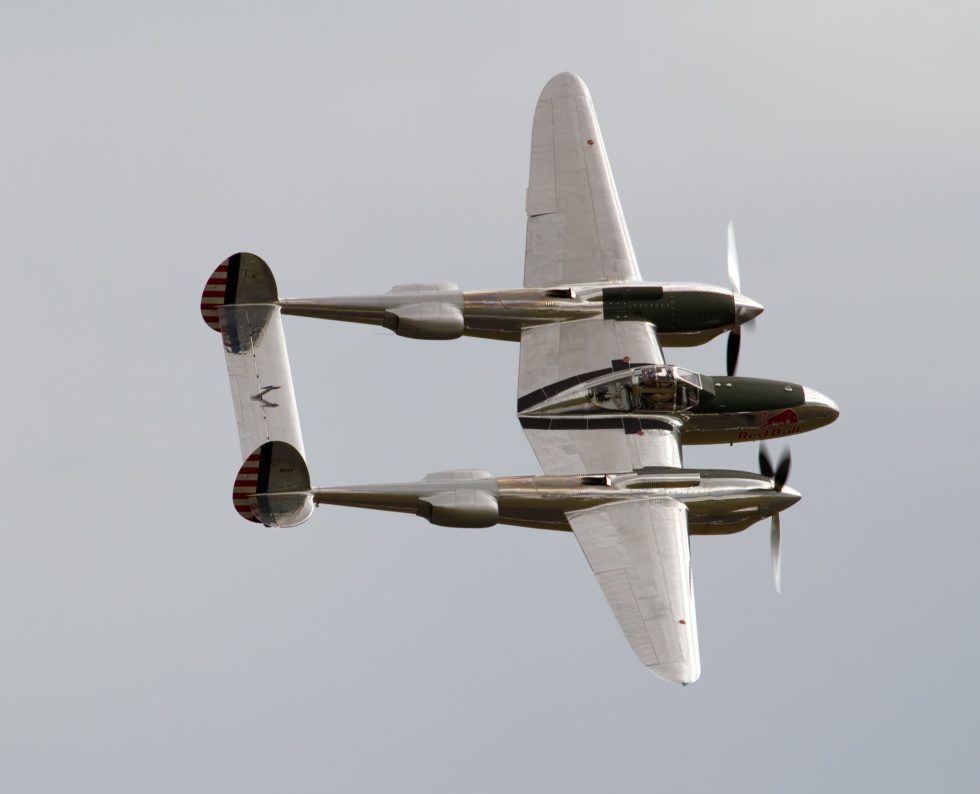
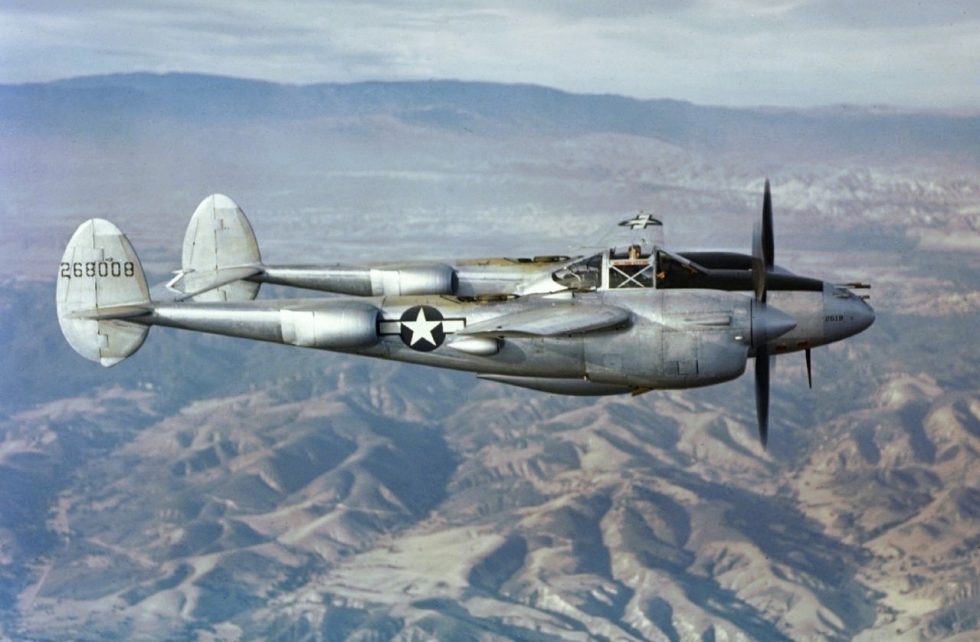
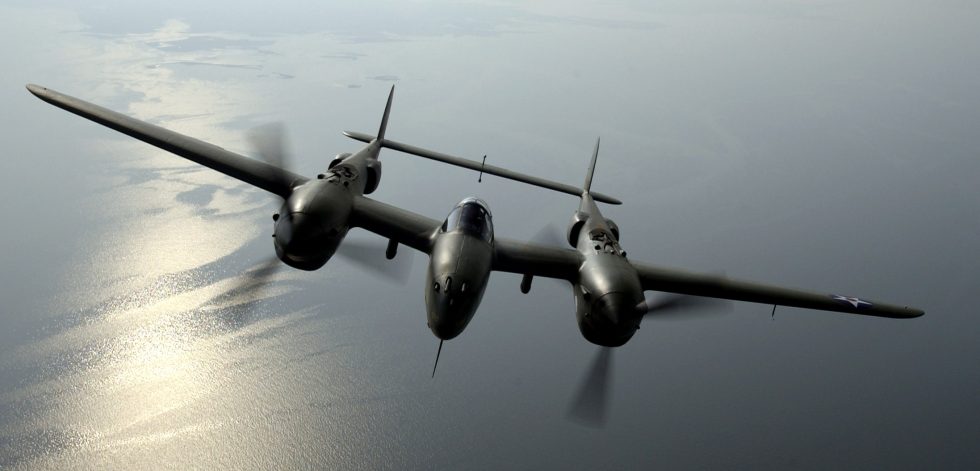
The Lightning in pictures
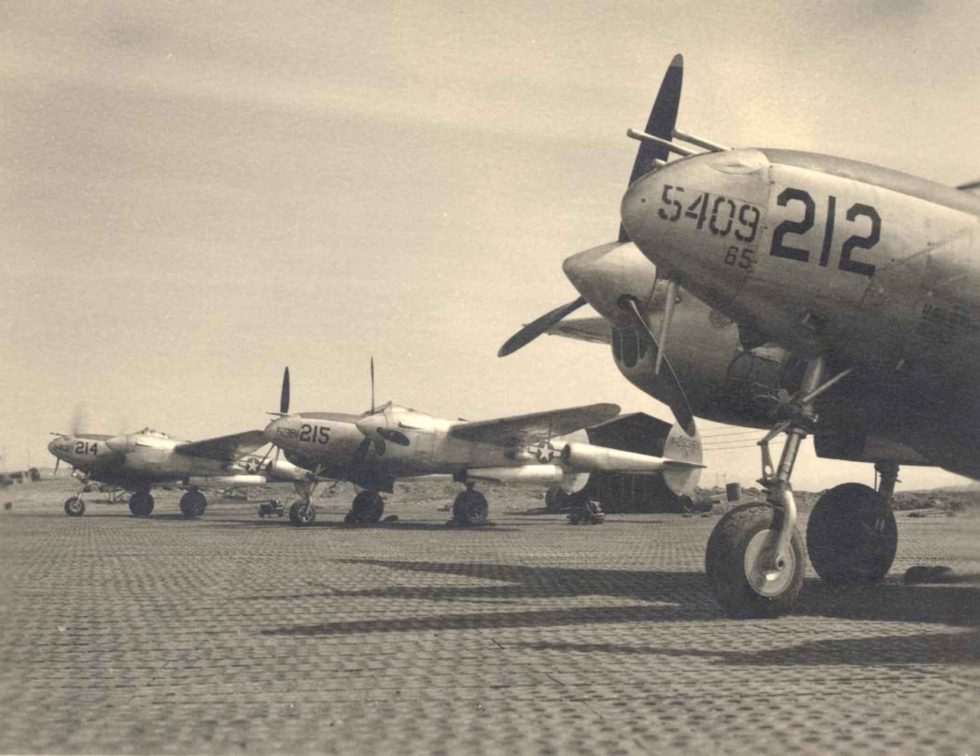
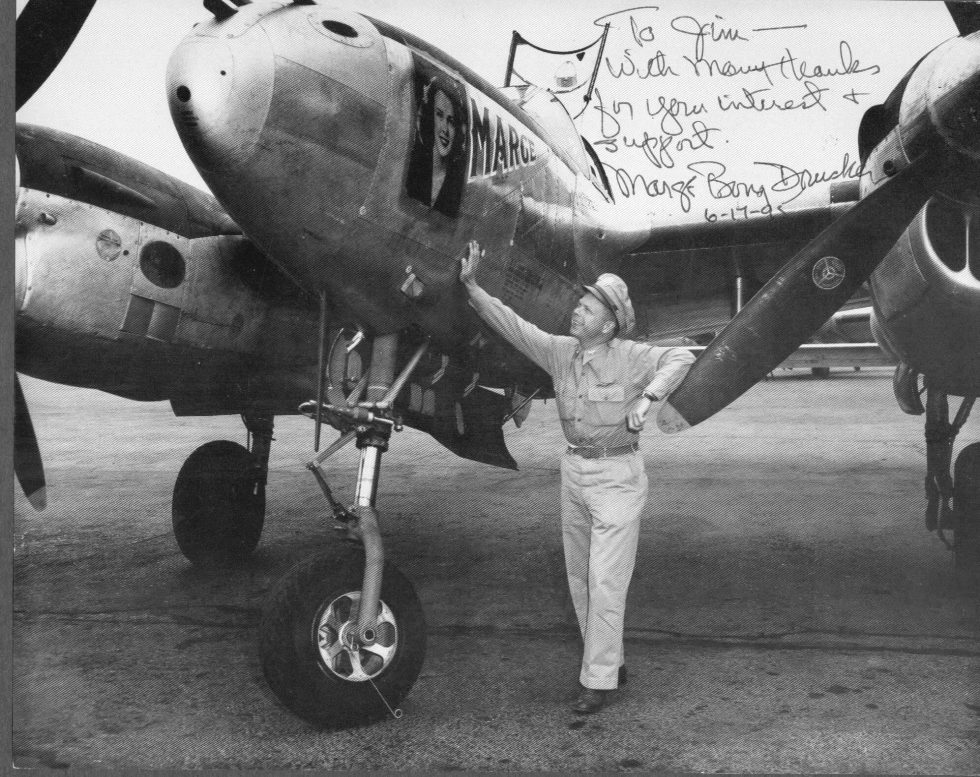
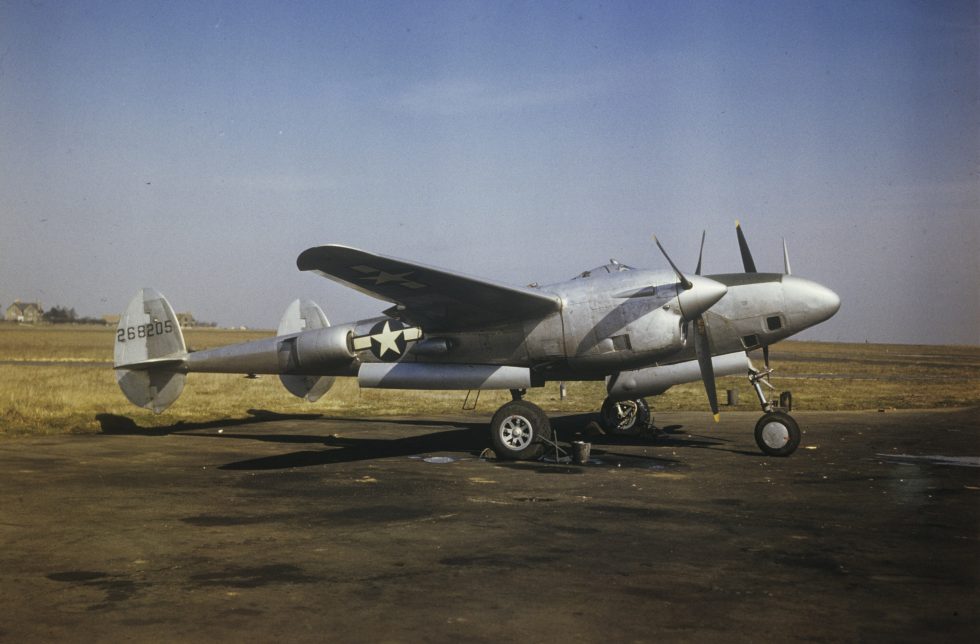
The Lightning in motion
Video coming soon.
Where the Lightning flew
The score that defines it
The Lightning’s record is written above the Pacific. It produced America’s two highest-scoring aces of all time, flew the mission that killed the architect of Pearl Harbor, and stayed in front-line combat from the Aleutians to the Philippines — a versatility few wartime fighters matched.
Compare the combat record of every military aircraft. Figures as of July 2026.
Everything people ask about the P-38 Lightning
Can I fly in a P-38 Lightning?
Why does the P-38 have two tail booms?
Who was the top P-38 ace?
Did a P-38 really kill Admiral Yamamoto?
What was the P-38’s compressibility problem?
Did the Germans call it the “fork-tailed devil”?
How many P-38s were built, and are any still flying?
Was the P-38 used in Europe?
You can’t fly the Lightning.
These, you can.
Some legends only live in museums — others are fuelled and waiting. MiGFlug has put civilians in real military jet cockpits since 2004.
 Fly the L-39 AlbatrosThe world’s most-flown jet trainer — aerobatics included
 Fly the F-104 Starfighter“The missile with a man in it”
 Fly the MiG-21The Cold War’s most-produced jet
 Fly the T-33 Shooting StarAmerica’s first jet trainer
 Fly the DH VampireA piece of early jet history
 Fly the S.211Agile Italian jet trainer
 Fly the MB-326The classic Aermacchi jet
 Fly the MiG-15The Soviet legend of the Korean War
Continue the tour
Every fact, checked
- National Museum of the US Air Force — P-38L fact sheetMuseum-grade specifications, production total (10,038) and service history.
- Smithsonian National Air and Space MuseumDesign, counter-rotating props and the ~500 recon airframes among 10,038 built.
- This Day in Aviation — XP-38 first flightFirst-flight date, Ben Kelsey, and the Hibbard/Johnson design team.
- NMUSAF — America’s Top Two AcesBong (40) and McGuire (38), both scored entirely in the P-38.
- Air & Space Forces MagazineOperation Vengeance and the Barber–Lanphier credit dispute.
- Defense Media Network — Classic WingsDive-recovery flaps, cockpit-heating problems and the Europe-versus-Pacific contrast.
- The National WWII MuseumAntoine de Saint-Exupéry, the F-5 Lightning and his loss on 31 July 1944.
- HistoryNet — Death by P-38The long over-water Yamamoto intercept flown by three P-38 squadrons.