
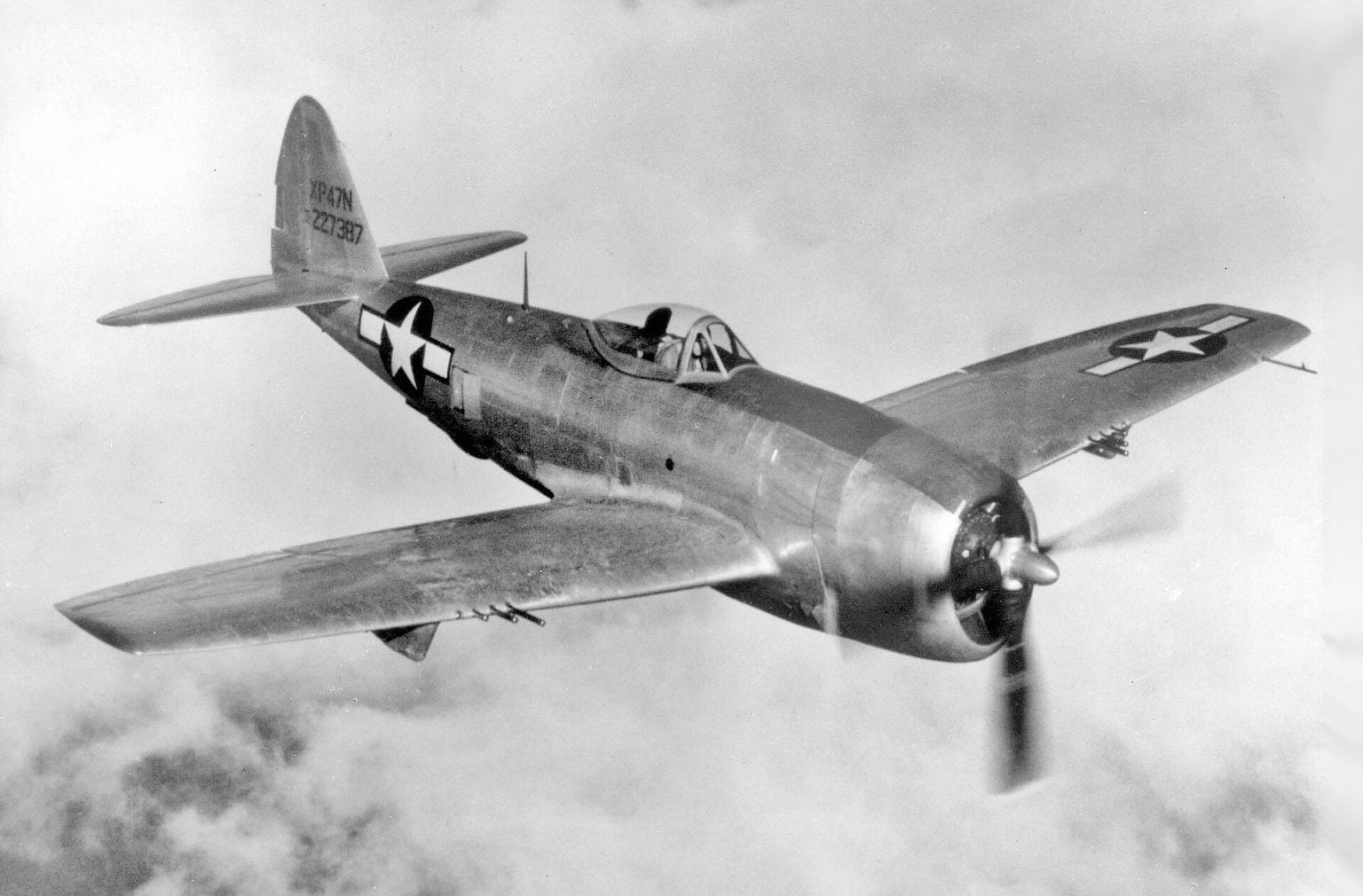
Republic P-47 Thunderbolt
“The Jug”
The biggest and heaviest single-engine piston fighter of the Second World War — a turbo-supercharged brute that escorted bombers at the edge of the stratosphere, then became the Allies’ most devastating ground-attack aircraft.
Built around an engine — and built to take a beating
In June 1940, as the Battle of Britain raged, Republic Aviation’s chief engineer Alexander Kartveli — a Georgian émigré who had worked for Blériot and Fokker — laid out a fighter unlike any other. Rather than draw an airframe and then find an engine, Kartveli started with the powerplant: the enormous 18-cylinder, turbo-supercharged Pratt & Whitney R-2800 Double Wasp radial and the maze of ducting its turbocharger demanded. Ordered as the XP-47B on 6 September 1940 and first flown on 6 May 1941, the result was the biggest and heaviest single-engine piston fighter of the war — a deep-bellied machine that tipped the scales past 17,000 lb loaded and carried eight .50-calibre Browning machine guns.
Thunderbolts reached England in 1942 and flew their first combat sweeps over occupied Europe in the spring of 1943 with the 4th and 56th Fighter Groups. Up high the Jug was in its element: the turbo-supercharger fed the R-2800 near-sea-level power above 25,000 ft, and nothing in the sky could out-dive it. But even with drop tanks it could not reach the deepest German targets, and from late 1943 the longer-legged P-51 Mustang took over primary long-range bomber escort. The Thunderbolt was handed a new job — and it found its true calling in it.
From the spring of 1944 the P-47 became the Allies’ pre-eminent fighter-bomber. Ranging over Normandy, the Falaise Gap and beyond, Ninth Air Force Thunderbolts strafed and rocketed German road and rail traffic into wreckage; USAAF tallies credit the type with thousands of locomotives, tens of thousands of railway cars and trucks, and thousands of armoured vehicles destroyed. What made it possible was the aircraft’s legendary toughness: the air-cooled radial had no coolant system to puncture, the engine itself formed a two-ton shield ahead of the pilot, and Jugs came home with cylinders shot away and fuselages riddled. By the time production ended in December 1945, Republic and its partners had built about 15,600 — more than any other American fighter in history.
01The Republic P-47 Thunderbolt’s nickname: why pilots called it the ‘Jug’
The most-repeated explanation is the simplest: the Thunderbolt’s fat, bottle-shaped fuselage reminded ground crews of a glass milk jug of the era. A more romantic story holds that “Jug” was short for “Juggernaut,” a nod to its size and hitting power — a version happily embraced by wartime public affairs. Neither origin is firmly documented, so the milk-jug shape is the safer bet, with juggernaut treated as folk etymology. Either way the nickname stuck, and no P-47 pilot ever seemed to mind it.
What makes it special
A turbocharger buried behind the pilot
Kartveli placed the General Electric turbo-supercharger in the rear fuselage, not on the engine. Exhaust from all 18 cylinders piped aft to spin the turbine, then compressed air ran forward through an intercooler to the carburettor. That ductwork is why the Jug was so deep and heavy — but it let the R-2800 make near-sea-level power above 25,000 ft, giving the Thunderbolt its high-altitude edge and a terminal dive nothing could match.
Built to bring its pilot home
The air-cooled radial had no radiator or coolant lines to sever, so a P-47 could keep flying with a whole cylinder shot away. The two-ton engine also formed a shield in front of the cockpit, and the pilot sat behind armour plate. Combat losses ran under 0.7% per sortie. Ace Robert Johnson famously limped home after taking some 21 cannon shells and 200-plus bullets from an Fw 190.
Eight fifties and a two-tonne punch
The Thunderbolt carried eight .50-calibre M2 Brownings — about 12.7 lb of lead per second, well above its rivals — plus up to roughly 2,500 lb of bombs or ten 5-inch HVAR rockets. That salvo, likened to a battery of field guns, shredded German rail, road and armoured columns and made the Jug the Allies’ deadliest ground-attack fighter in the West.
02The Republic P-47 Thunderbolt’s engine: how a rear-fuselage turbo made it a high-altitude fighter
The R-2800 Double Wasp was an 18-cylinder, two-row air-cooled radial rated at about 2,000 hp for take-off, and up to roughly 2,400–2,500 hp with water injection on late P-47D engines. Its high-altitude secret was the ducting: ambient air entered under the engine, was compressed and heated by the rear-fuselage turbo-supercharger, passed through an intercooler venting out the fuselage sides, and only then reached the carburettor. The system was heavy and complex, but it kept the engine breathing thin air at 30,000 ft — where the Jug fought best and dived like a stone.
03The Republic P-47 Thunderbolt as a fighter-bomber: what eight fifties and a rocket salvo did to the Wehrmacht
Once the P-51 took over long-range escort in late 1943, the Thunderbolt turned to the ground war and dominated it. Across the European theatre USAAF Thunderbolts are credited with wrecking on the order of 9,000 locomotives, 86,000 railway cars, 68,000 trucks and 6,000 armoured vehicles. The Brazilian squadron alone claimed 1,304 vehicles, 250 railway cars and 25 bridges. Eight fifties, up to 2,500 lb of bombs and rockets, and an airframe that could absorb ground fire made the Jug the aircraft German drivers feared on every road in daylight.
Full specifications
All figures below are for the P-47D — by far the most numerous Thunderbolt, with more than 12,500 built and the mark almost everyone means by "the Jug". The D itself splits in two: the early razorback blocks (D-1 to D-23) with a raised spine and heavily framed canopy, and the bubble-canopy blocks (D-25 onward) with the spine cut down and a one-piece teardrop hood adapted from the Hawker Typhoon. Where the two differ the bubble aircraft is quoted. The very fast P-47M and the long-range P-47N were different aeroplanes in important respects, and their deltas are given in grey.
Dimensions & weights
- Crew
- 1 pilot
- Length
- 11.02 m 36 ft 1.75 in
- Wingspan
- 12.43 m 40 ft 9 in; the P-47N stretched this to 12.98 m / 42 ft 7 in with squared-off wet-wing tips
- Height
- 4.47 m 14 ft 8 in, tail down
- Wing area
- 27.87 m² 300 sq ft; 322 sq ft on the P-47N
- Empty weight
- 4,536 kg 10,000 lb — heavier empty than a loaded Bf 109G or Spitfire IX
- Loaded weight
- 6,000 kg 13,230 lb, clean fighter configuration
- Max takeoff weight
- 7,938 kg 17,500 lb with bombs, rockets and tanks; the P-47N went to 9,390 kg / 20,700 lb, the heaviest single-engined fighter of the war
- Internal fuel
- ~1,400 L ~370 US gal on the D-25 onward; early D blocks carried only ~305 US gal, and the P-47N held ~570 US gal in a wet wing
Performance
- Max speed (altitude)
- 686 km/h 426 mph at 30,000 ft (9,150 m) — the figure that matters, because the Thunderbolt was slower than its rivals low down and faster than almost anything high up. The P-47M reached 761 km/h / 473 mph, the P-47N 752 km/h / 467 mph at 32,000 ft
- Cruise speed
- 563 km/h 350 mph normal cruise
- Rate of climb
- 15.9 m/s 3,120 ft/min initial at combat weight. Early razorbacks with the toothpick propeller climbed far worse, and the D-22 paddle-blade propeller plus water injection is what fixed it; even so, low-level climb never matched a Spitfire or a Bf 109
- Service ceiling
- 12,800 m 42,000 ft — among the highest of any single-engined fighter of the war, and the whole point of the turbosupercharger
- Combat radius
- ~760 km ~475 miles on internal fuel plus two 108 US gal drop tanks. Early unmodified Thunderbolts managed barely ~370 km / ~230 miles, which is the root of the escort-range problem
- Ferry range
- ~2,900 km ~1,800 miles with three external tanks; the P-47N stretched to ~3,540 km / ~2,200 miles, enough for eight-hour missions from Iwo Jima to Japan
- Takeoff run
- 610 m about 2,000 ft ground run at 13,000 lb on a hard runway; a fully-loaded fighter-bomber near 17,500 lb needed close to twice that, and P-47 units were fussy about airfield length in a way Spitfire units were not
- Landing run
- 640 m about 2,100 ft; the wide-track undercarriage and the sheer mass made it a stable, forgiving aircraft to land, unlike several of its contemporaries
- Dive speed
- 800 km/h 500 mph indicated placard limit, and pilots regularly went past it. The Thunderbolt out-dived everything it met in Europe; compressibility bit around Mach 0.75 and dive recovery flaps were fitted from the D-27 to make the pull-out survivable
Propulsion & systems
- Engine
- Pratt & Whitney R-2800-59 Double Wasp one 18-cylinder twin-row air-cooled radial of 45.9 litres, with a General Electric CH-5 exhaust-driven turbosupercharger; the P-47M and P-47N used the C-series R-2800-57
- Power
- 1,490 kW 2,000 hp for takeoff, and about 2,535 hp at war emergency power with water injection; the R-2800-57 in the M and N gave 2,800 hp
- Propeller
- 4-blade Curtiss Electric 3.96 m / 13 ft "paddle blade" from the D-22 onward, replacing the earlier narrow 3.71 m / 12 ft 2 in unit; the change alone added several hundred feet per minute of climb
- Turbosupercharger
- GE turbo aft of the pilot the defining feature and the reason for the aeroplane's size. Exhaust gas ran from the engine down ducts under the cockpit floor to a turbine in the rear fuselage, which drove a compressor; the compressed air was then piped all the way forward again through an intercooler to the carburettor. Roughly 12 m of large-diameter ducting running the length of the fuselage, plus intercooler doors and waste gates — enormously bulky and heavy, and the sole reason the R-2800 kept full rated power above 30,000 ft where mechanically-supercharged rivals were fading
- Armament
- 8 × .50 in M2 Browning four per wing, 267 to 425 rounds per gun, up to 3,400 rounds total; some early B and C aircraft and weight-saving field fits carried six
- Armour & protection
- About 105 kg of plate 230 lb of armour around the pilot plus an armoured windscreen, self-sealing tanks, and an air-cooled radial with no vulnerable coolant system at all — the combination behind a genuinely exceptional survivability record
- First flight
- 6 May 1941 XP-47B, Lowery Brabham at the controls
- Service entry
- 1942 first USAAF deliveries; combat debut with the Eighth Air Force over Europe in April 1943
- Built
- 15,636 1941–45, the most-produced American fighter of the war; roughly ~9,530 razorback D, ~3,028 bubble-canopy D, ~1,816 P-47N
- Unit cost
- ~US$85,000 period figure, commonly cited for 1945 and varying by block and contract; very roughly US$1.5m in today's money, and materially more than a P-51 Mustang
- Cost per flight hour
- ~US$5,000–10,000 modern warbird estimate, not an official figure. No authoritative published number exists; owners and operators of R-2800-powered warbirds typically cite this band once fuel at roughly 300 L/hr, insurance, and amortised engine overhaul are counted, and a single R-2800 overhaul alone can run into six figures
04The Republic P-47 Thunderbolt’s cost: what a Jug was worth then and now
In wartime dollars the Thunderbolt cost roughly $85,000 per aircraft at the 1944 flyaway price — cheaper than a P-38 Lightning and comparable to a P-51 Mustang, with early examples costing more. Because the type left frontline service decades ago, there is no meaningful modern cost-per-flight-hour figure: only a handful of airworthy warbirds survive, and their owners burn expensive avgas through a thirsty 2,000-hp radial. Any precise operating cost you see quoted for a flying P-47 today is a private estimate, not a published rate.
Armament & payload
The Thunderbolt carried eight heavy machine guns and, by 1944, an ordnance load that would have shamed a medium bomber of 1939
The P-47 was conceived as a high-altitude interceptor and ended the war as the finest ground-attack aircraft the USAAF possessed. Its armament tells that story directly: an eight-gun battery sized for shooting down bombers at 30,000 ft, progressively hung about with pylons, shackles and rocket rails until a single-seat fighter was routinely carrying 2,500 lb of bombs into flak at treetop height — and, thanks to an air-cooled engine and a great deal of armour plate, was routinely coming back.
Machine guns
Eight .50 in M2 Browning machine guns, four in each wing, with 267 to 425 rounds per gun and up to 3,400 rounds in total. Some early P-47B and P-47C aircraft, and a number of weight-conscious later fits, flew with six. The eight-gun battery threw something like 100 rounds a second and close to 5 kg of metal per second — a heavier weight of fire than almost any other Allied fighter armed with machine guns, and enough ammunition for roughly 30 seconds of continuous firing, which was an unusually generous allowance. The honest qualification is that .50 calibre was a poor bomber-killer compared with 20 mm or 30 mm cannon; against fighters, vehicles and unarmoured targets it was excellent, and against locomotives it was famously effective because a punctured boiler ended the locomotive.
Bombs
The Thunderbolt was not designed as a bomber and became one anyway. Two underwing pylons and a centreline shackle carried up to about 1,130 kg (2,500 lb) of stores — typically two 500 lb bombs, or two 1,000 lb bombs on the later D blocks, or fragmentation clusters and napalm tanks. That is a load comparable to some twin-engined medium bombers of a few years earlier, carried by a single-seat fighter that could then defend itself on the way home. Accuracy came from dive bombing, which suited the aircraft: it was stable, it accelerated hard downhill, and it was heavy enough to hold a line through flak-shaken air.
Rockets
First came the M8 4.5-inch rocket, fired from clusters of three tubes under each wing — the "bazooka tubes". They were draggy, inaccurate and disliked, and the tubes were often discarded after a mission. The replacement was much better: the 5-inch High Velocity Aircraft Rocket, hung on zero-length launch rails, up to five under each wing for a total of ten. HVAR was fast, flat-shooting and genuinely useful against tanks, bunkers, barges and rolling stock, although postwar analysis of claimed tank kills found that rockets destroyed far fewer armoured vehicles than pilots believed at the time — a correction worth stating plainly.
Drop tanks & range
The Thunderbolt entered combat in 1943 with an escort radius of barely 370 km (230 miles), which took it to the German border and no further, and this was the aircraft's central operational failing. The fix was incremental and urgent: a 200 US gal ferry tank pressed into combat use, then 75 US gal steel tanks, then the 108 US gal tanks (many of them British-made in laminated paper) that became standard, and finally extra internal fuel from the D-25. By mid-1944 a Thunderbolt could escort to roughly 760 km (475 miles). It was a real transformation — but the P-51 Mustang could go further still on less fuel, and by then the deep-penetration escort mission had largely passed to it.
Armour & survivability
The Thunderbolt's toughness is one of the few wartime reputations that survives close scrutiny intact. The R-2800 was air-cooled, so there was no radiator and no coolant line whose severing would seize the engine within minutes — the single biggest vulnerability of the Merlin-engined fighters in the ground-attack role. Around 230 lb of armour plate and an armoured windscreen protected the pilot, the airframe itself was massively built, and the engine would frequently keep running with whole cylinders shot away. The documented cases are startling: aircraft home with metres of wing missing, with trees and telegraph wire embedded in the leading edge, with the tail largely shot off. The Eighth Air Force loss rate for the P-47 was about 0.7 per 1,000 sorties, the lowest of any USAAF fighter, across roughly 746,000 sorties for about 3,499 aircraft lost to all combat causes.
Late-war fits
The bubble-canopy D-25 and later blocks cut down the rear fuselage and fitted a one-piece teardrop hood taken from the Hawker Typhoon, transforming the rearward visibility that had been the razorback's worst feature; a dorsal fillet was added from the D-40 to restore the directional stability the cut-down spine had cost. The same late blocks brought dive recovery flaps, the K-14 gyro gunsight, water injection as standard, zero-length rocket rails and the bigger internal tank. The P-47M, stripped for speed with the 2,800 hp C-series engine, was rushed to Europe to chase V-1 flying bombs and low-level jets; the P-47N married that engine to a new long-span wet wing for the Pacific.
Three typical Thunderbolt fits
- High-altitude escort, 1944
- Eight .50 in Brownings with a full ammunition load, one 108 US gal drop tank under each wing, no other stores; cruise at 25,000–30,000 ft above the bomber stream. the classic Eighth Air Force P-47D fit; radius about 475 miles, tanks jettisoned on contact, and the altitude band where the Thunderbolt was at its very best
- Ground attack, Normandy to the Rhine
- Two 500 lb bombs on the wing pylons, ten 5-inch HVAR on zero-length rails, a 108 US gal tank on the centreline, guns fully loaded. Ninth Air Force and Nineteenth Tactical Air Command armed reconnaissance; heavy, slow to climb, flown low and into light flak, and the role in which the Thunderbolt earned most of its reputation
- Long-range Pacific escort, P-47N
- About 570 US gal internal in the wet wing plus three external tanks for roughly 1,170 US gal total, eight guns, no bombs. VII Fighter Command from Iwo Jima and Okinawa in 1945; missions of seven to eight hours escorting B-29s to the Japanese home islands, with an autopilot fitted because the pilot workload was otherwise unmanageable
Armament and payload on the Thunderbolt are strongly mark- and block-dependent, and blanket statements are usually wrong for some large part of the fleet. Early P-47B and P-47C aircraft had no bomb shackles at all; the first pylons were field and depot modifications; maximum ordnance rose block by block through the D; rocket fits changed from tube clusters to rails mid-war; and the P-47N carried a different wing entirely. Ammunition loads were routinely reduced in the field to save weight, and the difference between what an aircraft was cleared to carry and what a squadron actually loaded on a given morning was often considerable. Block-level sources are worth checking before quoting any single figure.
Variants
The Jug went from a troublesome interceptor to the best ground-attack fighter America had — while losing the escort job to the Mustang
Two separate reputations are usually blurred into one. As a high-altitude escort fighter the Thunderbolt was genuinely excellent above 25,000 ft and unbeatable in a dive, but it began with far too little range, and although drop tanks and extra internal fuel eventually pushed its radius out to some 475 miles, the P-51 Mustang went further on less fuel and took over most of the deep-penetration escort work from mid-1944. As a ground-attack aircraft, however, the Thunderbolt was outstanding and had no real Allied rival: the air-cooled R-2800, the armour and the sheer structural mass meant it absorbed damage that would have downed anything with a radiator, and it brought a very large number of pilots home. The costs were real too — it was heavy, it climbed indifferently at low level next to a Spitfire or a Bf 109, it needed a long runway, and it was expensive to build and to fuel. Both halves of that account are true, and the trade-off is the aircraft.
- P-47B
- The first production Thunderbolt, with the R-2800-21 and a hinged canopy soon replaced by a sliding one. Fabric control surfaces caused fatal tail flutter and had to be redesigned in metal; the aircraft was fast and climbed to altitude well but was troublesome, and it never saw combat. 171 built, 1942
- P-47C
- The first combat mark. A slightly longer fuselage improved handling, a metal rudder cured the flutter, and — crucially — a centreline shackle finally allowed a drop tank. Flew the Eighth Air Force's first Thunderbolt missions from April 1943, when radio trouble and short range made the debut unimpressive. ~602 built
- P-47D razorback
- Blocks D-1 to D-23: the mark that made the aeroplane work. Better turbosupercharger ducting and cooling, water injection, underwing pylons, and from the D-22 the paddle-blade propeller that transformed the climb. Rearward visibility over the raised spine remained poor and pilots complained about it consistently. ~9,530 built, the single largest block of Thunderbolt production
- P-47D bubble canopy
- Blocks D-25 onward: cut-down rear fuselage and a teardrop hood adapted from the Hawker Typhoon, plus a larger 370 US gal internal tank, dive recovery flaps, the K-14 gyro gunsight and zero-length rocket rails. A dorsal fillet from the D-40 restored the directional stability lost with the spine. This is the definitive Thunderbolt. ~3,028 built
- P-47M
- A sprint interceptor: the 2,800 hp C-series R-2800-57 in a lightly modified D airframe, built to catch V-1 flying bombs and low-flying German jets. At 473 mph it was the fastest piston Thunderbolt, but it arrived in early 1945 with severe engine reliability problems that took months to trace and largely wasted its short career. ~130 built
- P-47N
- The Pacific Thunderbolt and the heaviest single-engined fighter of the war. A new long-span wet wing with squared tips carried about 570 US gal internally; with external tanks it flew missions of seven to eight hours escorting B-29s to Japan. An autopilot was fitted because no pilot could hand-fly that long. Max takeoff weight reached 20,700 lb. ~1,816 built, 1945
- XP-72
- Prototype only — never entered service. A near-total redesign around the 28-cylinder, 3,450 hp Pratt & Whitney R-4360 Wasp Major, intended as the Thunderbolt's successor and projected at close to 490 mph. Two were flown; the production order was cancelled as the war ended and jet fighters made the whole concept obsolete. 2 prototypes, 1944
Of more than 15,000 Thunderbolts built, comparatively few survive. Wartime attrition was heavy, and what the war left was scrapped fast: the type was obsolete the moment jets arrived, surplus airframes had almost no civilian value, and the aluminium was worth more than the aeroplane. Something in the region of forty to fifty airframes are accounted for today, of which roughly a dozen are airworthy in warbird collections in the United States and Europe — a genuinely small number for so large a production run, and far fewer than the flying P-51 Mustang population. The rest are static: museum exhibits, gate guardians and long-term restorations, with occasional additional airframes still being recovered from wartime crash sites and, in a few cases, returned to the air.
From drawing board to the last piston fighter
Kartveli’s design
Republic submits the XP-47B; the Army orders a prototype on 6 September, built around the turbo-supercharged R-2800.
First flight
The XP-47B flies on 6 May — then the largest and heaviest single-engine fighter yet built.
Into combat
The 4th and 56th Fighter Groups fly the first P-47 sweeps over Europe in spring 1943 as high-altitude bomber escorts.
The Mustang takes escort
From late 1943 the longer-ranged P-51 assumes deep bomber escort, freeing the Jug for the ground war.
The fighter-bomber war
After D-Day, Ninth Air Force Thunderbolts wreck German road and rail traffic across Normandy and the Falaise Gap.
Gabreski goes down
On 20 July, top USAAF ETO ace Gabby Gabreski strikes his propeller on a strafing run and is taken prisoner.
Production ends
Final deliveries in December bring the total to about 15,600 — the most of any US fighter.
The last Jugs
Peru retires the last operational P-47s, ending roughly a quarter-century of Thunderbolt service.
From the cockpit: twelve Thunderbolt stories
The plane that would not die
Robert Johnson flew home in a flying sieve after an Fw 190 emptied its guns into him.
Read the full story
Gabby Gabreski’s last pass
America’s top ace in Europe scored 28 — then lost it all on one more strafing run.
Read the full story
Why ‘Jug’?
A milk jug, not a juggernaut — probably.
Read the full story
Handing off to the Mustang
The Jug cleared the skies; the Mustang went the distance.
Read the full story
Death in the Falaise Gap
Eight guns and rockets turned a German retreat into a slaughter.
Read the full story
Home on 17 cylinders
The Double Wasp shrugged off shot-away cylinders.
Read the full story
Thunderbolts with red stars
The Soviets got about 195 Jugs and never quite warmed to them.
Read the full story
Big, burly and just right for the jungle
830 Thunderbolts fought Japan under British roundels.
Read the full story
Senta a Pua!
South America’s only fighter squadron in the war flew the Jug over Italy.
Read the full story
The Aztec Eagles
Escuadrón 201 flew the Mexican flag over Luzon.
Read the full story
Razorback to bubbletop
Cutting down the spine to let pilots see behind them.
Read the full story
The long Latin twilight
The Jug soldiered on into the 1960s.
Read the full story
The Thunderbolt in pictures
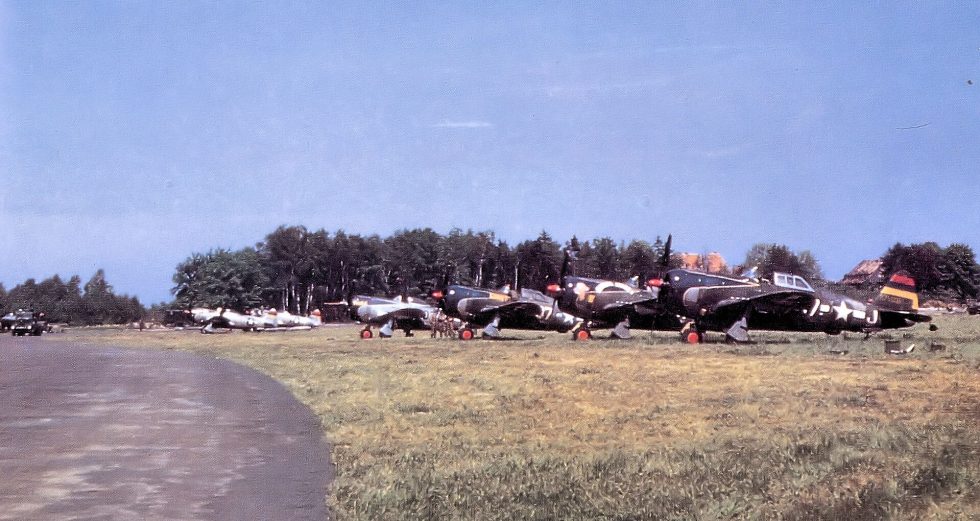
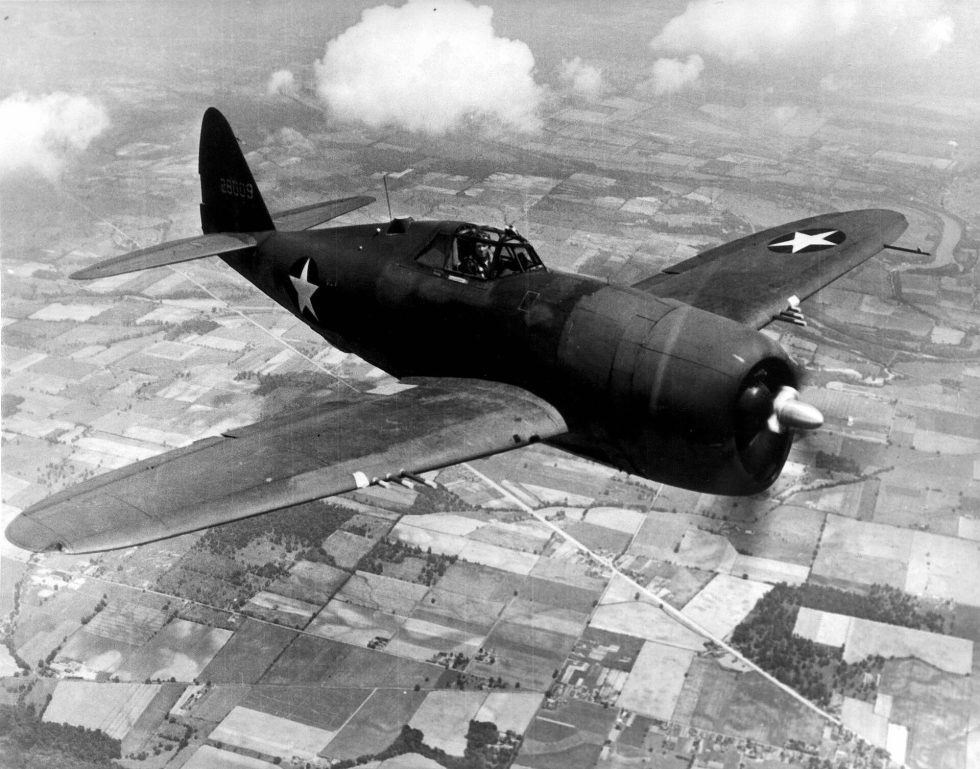
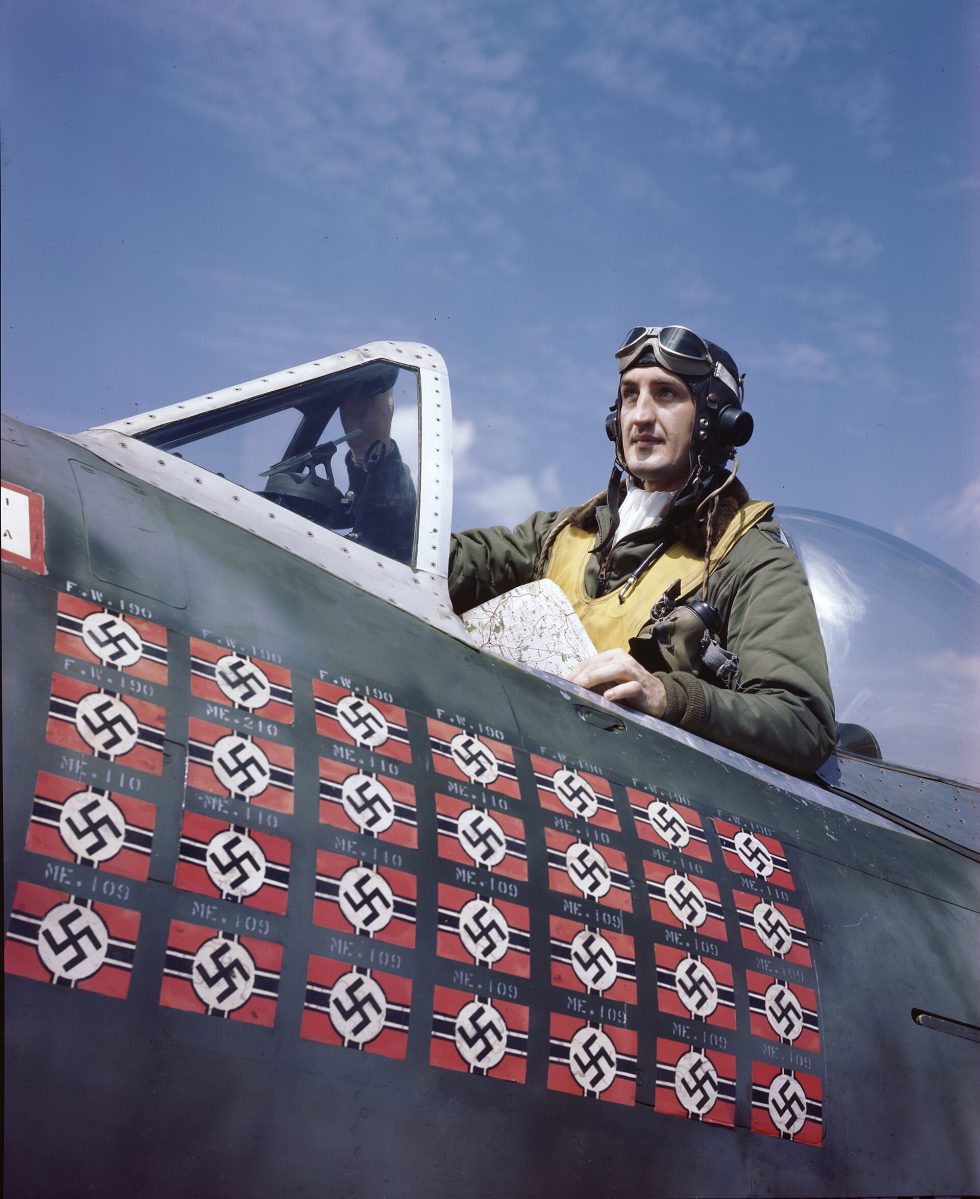
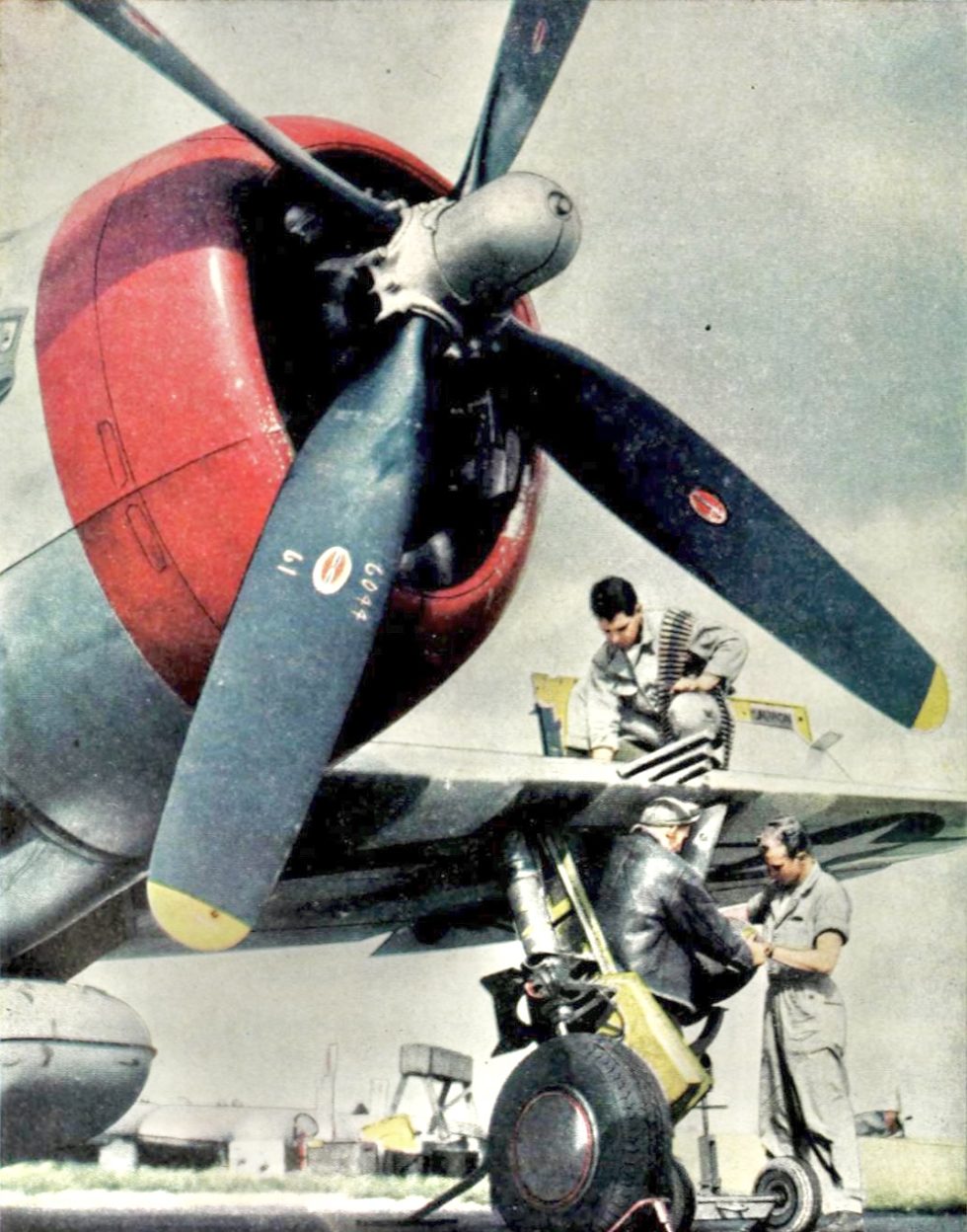
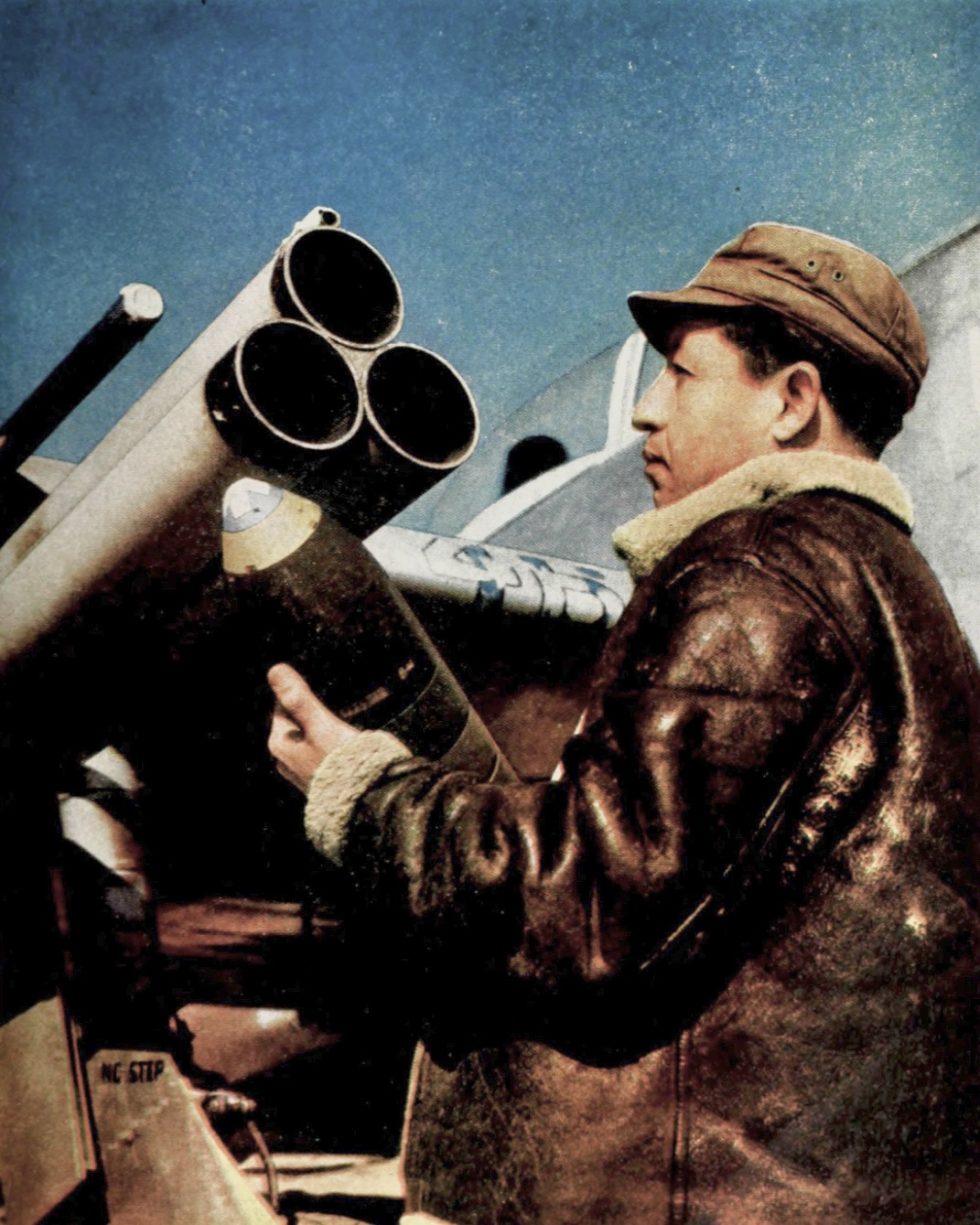
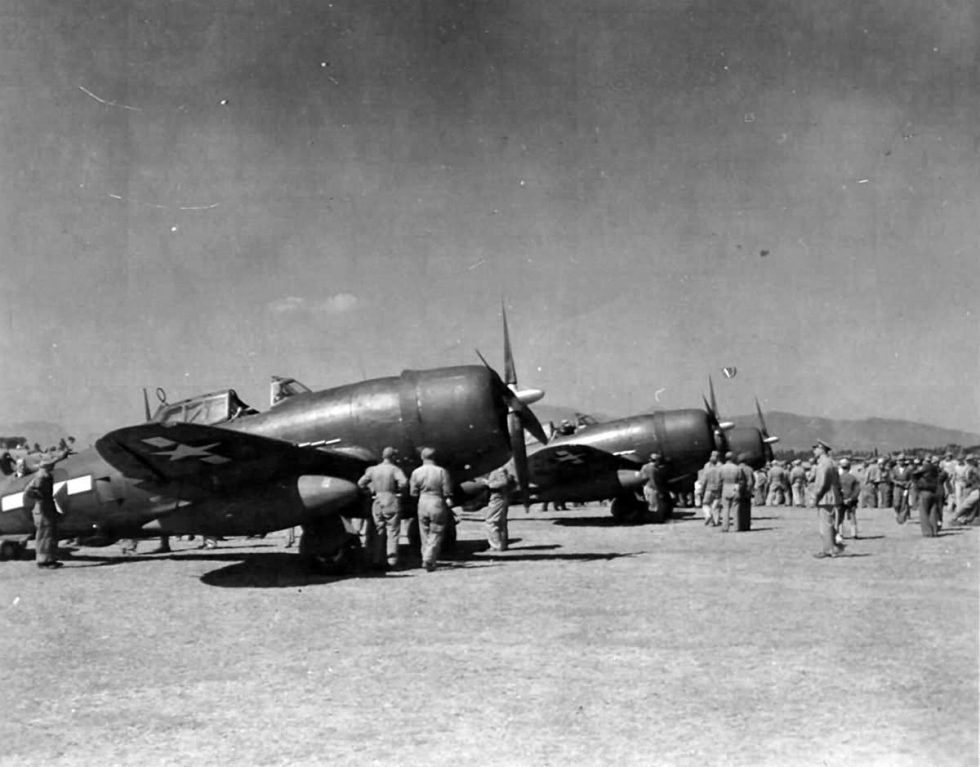
The Thunderbolt in motion
A curated, high-authority Thunderbolt film is coming soon to this exhibit. In the meantime, explore the photo gallery and the twelve stories above for the Jug’s history in detail.
Where the Thunderbolt flew
The score that defines it
The Thunderbolt’s record is written less in dogfights than in destruction. Even so, USAAF Thunderbolts were credited with shooting down 3,572 German aircraft — more than any other US fighter type — while flying about 546,000 sorties, at a loss rate under 0.7 percent per sortie. Its most enduring victories, though, were on the ground.
Compare the combat record of every military aircraft. Figures as of July 2026.
Everything people ask about the P-47
Can I fly in a P-47?
How many P-47 Thunderbolts were built?
Why was the P-47 called the “Jug”?
What engine did the P-47 use?
Was the P-47 better than the P-51 Mustang?
Who were the top P-47 aces?
Can you still fly a P-47 today?
You can’t fly the Thunderbolt.
These, you can.
Some legends only live in museums — others are fuelled and waiting. MiGFlug has put civilians in real military jet cockpits since 2004.
 Fly the L-39 AlbatrosThe world’s most-flown jet trainer — aerobatics included
 Fly the F-104 Starfighter“The missile with a man in it”
 Fly the MiG-21The Cold War’s most-produced jet
 Fly the T-33 Shooting StarAmerica’s first jet trainer
 Fly the DH VampireA piece of early jet history
 Fly the S.211Agile Italian jet trainer
 Fly the MB-326The classic Aermacchi jet
 Fly the MiG-15The Soviet legend of the Korean War
Continue the tour
Every fact, checked
- National Museum of the US Air Force — P-47D fact sheetOfficial dimensions, performance, engine and armament figures.
- Smithsonian National Air and Space MuseumProduction totals, ground-attack tallies, kill ratio and loss rate.
- This Day in AviationKartveli’s design, the XP-47B contract and the 6 May 1941 first flight.
- HistoryNet — the P-47 “Jug”Nickname, firepower, Luftwaffe kills, ground-attack record and the escort handoff.
- HistoryNet — Gabby GabreskiThe 20 July 1944 prop-strike, capture, and his two-war ace record.
- acepilots.com — Robert S. JohnsonThe 26 June 1943 battle-damage survival and Johnson’s 27 victories.
- History of War — P-47 in RAF serviceThe 830 RAF Thunderbolts and 16 squadrons in Burma.
- The Lyncean Group — P-47 powerplantThe rear-fuselage turbo-supercharger, intercooler and exhaust ducting.