
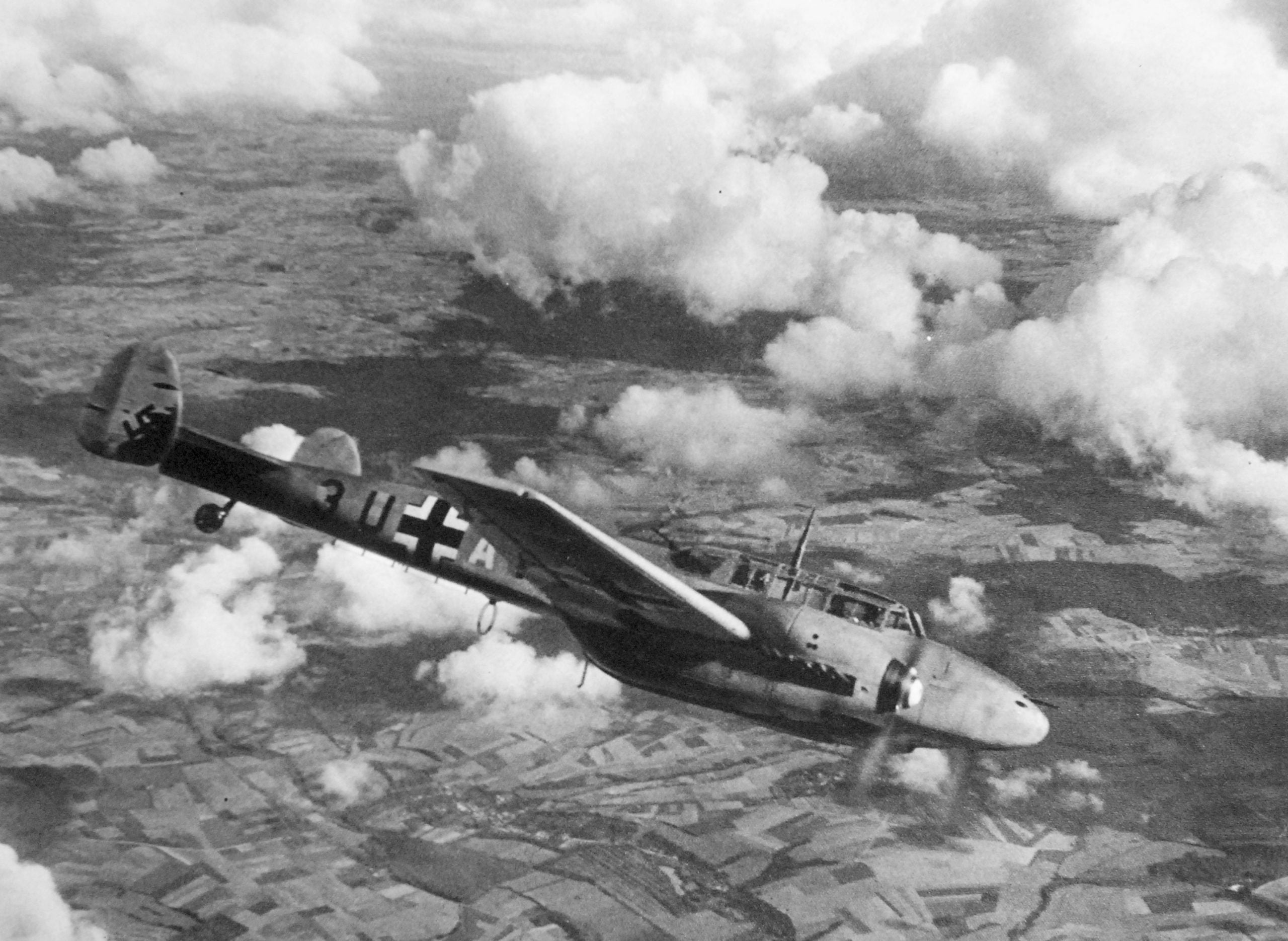
Messerschmitt Bf 110
“Zerstörer”
Nazi Germany’s twin-engine “destroyer” heavy fighter — humbled over Britain by day, then reborn as the deadliest night hunter of the war, stalking RAF bombers with radar and upward-firing cannon.
The Zerstörer that found its war in the dark
In the mid-1930s the rebuilding German air force fell for a seductive idea: the “Zerstörer” (destroyer) — a big, long-range, heavily armed twin-engine fighter that would range ahead of the bombers, sweep the sky clear and strike deep behind the front. Hermann Göring championed the concept and treated its hand-picked crews as an aerial elite. Messerschmitt’s answer, first flown on 12 May 1936, beat rival designs from Henschel and Focke-Wulf and entered service in 1937 as the Bf 110.
At first the doctrine seemed vindicated. Fast, well-armed and long-legged, the Bf 110 did real damage over Poland (1939), Norway and the Battle of France (1940), where it faced fewer and weaker opponents. When Zerstörer crews helped shred a formation of RAF Wellington bombers over Wilhelmshaven in December 1939, faith in the heavy fighter looked fully justified.
Then came the Battle of Britain. Pitted against nimble single-engine Spitfires and Hurricanes, the heavy twin simply could not turn with them. Losses were brutal — roughly 120 in August 1940 alone — and in a famous irony the escort fighter now needed its own escort of Bf 109s. Bf 110 units took to flying defensive circles just to survive. Its career as a day fighter over the West was effectively finished.
Its reinvention came at night. From late 1940 the Bf 110 became the backbone of the Nachtjagd, the night-fighter force defending Germany against RAF Bomber Command. Stable, roomy and heavily armed, it carried early airborne Lichtenstein radar on its nose and, from 1943, the upward-firing Schräge Musik cannon — a combination that let it creep beneath a bomber in the dark and fire up into its fuel tanks. The type’s top exponent, Heinz-Wolfgang Schnaufer, was credited with 121 night victories, more than any night-fighter pilot in history.
The Bf 110 also served as a fighter-bomber, reconnaissance aircraft and ground-attack machine on the Eastern Front, in North Africa and the Mediterranean. The Me 210 built to replace it flopped badly, so the “obsolete” design was kept in production — more than 6,000 were built before the war ended in 1945.
01The Messerschmitt Bf 110’s Battle of Britain ordeal: why the Zerstörer failed by day
The Zerstörer doctrine assumed a heavy twin-engine fighter could dominate lighter aircraft through firepower, speed and range. Against the RAF in 1940 that assumption collapsed. The Bf 110 was fast in a straight line but heavy and slow to turn, and single-engine Spitfires and Hurricanes could out-manoeuvre it with ease. Escorting slow bomber formations forced the 110s to fly low and slow — exactly where their disadvantage was greatest.
Losses mounted so quickly that the Luftwaffe began assigning Bf 109s to protect the Bf 110s that were themselves supposed to be protecting the bombers. Crews adopted the Abwehrkreis — a defensive circle in which each aircraft guarded the tail of the one ahead — a tactic of survival, not attack. By the autumn of 1940 the Zerstörer arm had been mauled, and the type was quietly withdrawn from daylight fighting over Britain. Its salvation would come in a role no one had planned for it: the night defence of the Reich.
What makes it special
A heavy nose battery on long legs
The Bf 110 concentrated its guns in the nose — typically two 20 mm cannon and four rifle-calibre machine guns, all firing straight ahead without the convergence problems of wing-mounted guns. Two engines gave it the range single-engine fighters lacked. Against bombers, unescorted formations and ground targets that concentrated firepower and reach made it genuinely dangerous.
Fast in a line, deadly slow in a turn
The same size that gave the Bf 110 its range and firepower made it a poor dogfighter. Heavy and with a wide turning circle, it could not follow single-engine fighters through tight manoeuvres. Over Britain in 1940 that flaw was fatal: pilots resorted to defensive circles, and the “destroyer” had to be escorted by the very Bf 109s it was meant to support.
Radar, darkness and Schräge Musik
The Bf 110’s stability and heavy armament made it an ideal night fighter. Fitted with Lichtenstein airborne radar — the draggy “stag’s-antler” nose aerials — and later the upward-firing Schräge Musik cannon, it could stalk RAF bombers through cloud and darkness and destroy them from below, often before the crew knew it was there.
02The Messerschmitt Bf 110’s Schräge Musik: the upward-firing cannon that terrorised Bomber Command
Schräge Musik — German slang meaning “slanted” or “jazz” music — was a pair of roughly 20 mm cannon mounted in the fuselage angled to fire upward and slightly forward. A night fighter would slide into the dark blind spot beneath a heavy bomber, below its defensive guns and the crew’s field of view, match speed, and then fire up into the wings and fuel tanks — deliberately avoiding the bomb bay, whose detonation could destroy the attacker as well.
The attacks were often invisible to the target and to nearby crews. For months RAF losses were misattributed to flak, and Bomber Command was slow to understand what was killing its aircraft. Combined with airborne radar, Schräge Musik turned the Bf 110 into one of the most lethal defensive weapons of the war.
03The Messerschmitt Bf 110’s night-fighter radar: the Lichtenstein “antlers” and how they worked
From late 1941 Bf 110 night fighters carried FuG 202 and later FuG 220 Lichtenstein airborne interception radar, whose forward-projecting dipole arrays earned the nickname “stag’s antlers.” Working with ground controllers who vectored the fighter into the bomber stream, the radar operator — the second or third crew member — used the set to close the final gap in darkness until the pilot could see the target’s exhaust.
The aerials cost speed: their drag cut a G-4’s top speed by tens of km/h compared with a clean machine. For the Nachtjagd it was a trade well worth making. Radar plus Schräge Musik meant the Bf 110 no longer had to out-fly anyone — it simply had to find its prey and slip beneath it.
Full specifications
Figures are for the Bf 110 G-4, the main late-war night-fighter variant. Early daylight Zerstörer (Bf 110 C) used the less powerful DB 601 engine and a two-man crew. Several figures vary between sources and are given as ranges.
Baseline is the Bf 110 G-4 night fighter of 1943–45, the mark in which the type finally found the war it was suited to: two Daimler-Benz DB 605 engines, a three-man crew, Lichtenstein radar on the nose and, on most aircraft, upward-firing cannon behind the cockpit. The earlier day-fighter marks were lighter and cleaner. The Bf 110 C-4 of 1939–40 — the Battle of Britain aircraft — used 1,100 PS DB 601A engines, weighed about 6,750 kg loaded, carried two crew and reached roughly 540–560 km/h with no aerials in the airflow. The Bf 110 E of 1941 added DB 601N engines, armour and underwing bomb racks as a fighter-bomber, gaining weight faster than power. Sub-variant figures vary by a few per cent between wartime Luftwaffe data sheets, captured-aircraft trials and post-war reference works, and radar-equipped aircraft differ again depending on which aerial array was fitted.
Dimensions & weights
- Crew
- 3 on night fighters pilot, radar operator and a rear gunner who also worked the radio; the day-fighter C and E marks flew with 2, pilot and radio operator/gunner
- Length
- 12.65 m (41 ft 6 in) for the G-4; the C-4 was 12.10 m (39 ft 8 in). Quoted lengths sometimes reach 13.05 m where forward-projecting radar aerials are counted in
- Wingspan
- 16.25 m (53 ft 4 in); 16.20 m on early marks
- Height
- 4.18 m (13 ft 9 in) tail down; 3.50 m (11 ft 6 in) commonly quoted for the C
- Wing area
- 38.40 m² (413 sq ft), unchanged across the whole family — which is why the late marks handled so much worse than the early ones
- Empty weight
- 5,090 kg (11,220 lb) for the G-4 with radar and armour; the C-4 was about 4,500 kg (9,920 lb)
- Loaded weight
- 9,400 kg (20,720 lb) normal operational weight for a G-4 night fighter; the C-4 flew at about 6,750 kg (14,880 lb)
- Max takeoff weight
- 9,900 kg (21,830 lb) overload, with drop tanks and a full Schräge Musik and rocket fit
- Internal fuel
- ~1,270 L (~280 imp gal / ~335 US gal) in four wing tanks. Two 300 L or 900 L drop tanks could be carried; the D-series instead used the notorious 1,200 L ventral Dackelbauch pannier, which leaked, caught fire and was quickly abandoned
Performance
- Max speed
- 550 km/h (342 mph) at 7,000 m / 23,000 ft for a clean G-4. With the FuG 220 Hirschgeweih aerial array fitted, a real night-fighting aircraft managed roughly 510–525 km/h (317–326 mph) — the aerials cost about 25–40 km/h, and some accounts put it nearer 50. The C-4 of 1940 did around 540–560 km/h clean, which was not enough against a Spitfire
- Cruise speed
- 470 km/h (292 mph) at 6,000 m / 19,700 ft; night patrols were flown far slower, often 300–350 km/h, to conserve fuel while under ground control
- Rate of climb
- 11.0 m/s (2,170 ft/min) at sea level at operational weight; about 11.6 m/s for the lighter C-4. Roughly 12 minutes to 6,000 m for a loaded G-4
- Service ceiling
- 8,000 m (26,250 ft) for the G-4; the C-4 reached about 10,000 m (32,800 ft). The loss of ceiling with weight mattered against high-flying Mosquitoes and Lancasters
- Range
- ~1,300 km (~810 mi) on internal fuel; a night interception sortie of two to three hours was typical
- Ferry range
- ~2,100 km (~1,300 mi) with two drop tanks; the long-range D-series with the ventral pannier was credited with about 2,400 km
- Takeoff run
- 560 m (1,840 ft) for a loaded G-4 on grass; nearer 450 m for a C-4
- Landing run
- 500 m (1,640 ft); the wide-track main gear made the aircraft notably easier to land than a Bf 109, one of its genuine virtues
- Wing loading
- 245 kg/m² (50 lb/sq ft) at G-4 loaded weight, against about 176 kg/m² (36 lb/sq ft) for the C-4 and roughly 150 kg/m² for a contemporary Spitfire — the single number that best explains the Battle of Britain
Propulsion & systems
- Engines
- 2 × Daimler-Benz DB 605B inverted-V12, liquid-cooled, direct fuel injection, driving through underslung nacelles with radiators in the wing centre section. Earlier marks used the DB 600 (B-series), DB 601A (C and D) and DB 601N/P (E and F)
- Power each
- 1,475 PS (1,085 kW / 1,455 hp) for takeoff on the DB 605B. The DB 601A of the Battle of Britain C-4 gave 1,100 PS; the airframe gained far more weight than the engines gained power over six years
- Propellers
- VDM three-blade constant-speed metal propellers, about 3.0 m diameter, with electric pitch control — the same system used on the Bf 109
- Radar installation
- FuG 220 Lichtenstein SN-2 on late G-4s, working at around 90 MHz through the four-mast Hirschgeweih (stag's antlers) array on the nose. It replaced the earlier 490 MHz FuG 202 and FuG 212 Lichtenstein sets and their smaller Matratze arrays after RAF Window chaff blinded them in July 1943. This is the central trade of the whole aircraft: the aerials that let a crew find a bomber in the dark cost roughly 25–40 km/h of speed and a measurable slice of climb and ceiling. Crews accepted it without argument, because a night fighter that cannot find anything is worth nothing at any speed. Passive sets — FuG 227 Flensburg homing on RAF Monica tail-warning radar and FuG 350 Naxos homing on H2S ground-mapping emissions — added further drag for further reach
- Armament
- 2 × 20 mm MG 151/20 and 4 × 7.92 mm MG 17 grouped in the nose, plus a twin 7.92 mm MG 81Z on a flexible rear mount. Most G-4 night fighters added 2 × 20 mm MG FF/M firing upward and forward at about 70 degrees as Schräge Musik; many swapped the four MG 17s for 2 × 30 mm MK 108 under the R3 field-conversion kit
- Crew positions
- Pilot, radar operator, gunner under one long glazed canopy. The pilot flew and fired everything fixed; the radar operator sat facing aft-ish over his Lichtenstein scopes and talked the pilot onto the target; the rear gunner handled the radio and the one rearward gun. Day-fighter marks carried two, and the workload on a radar-guided interception is the reason the third seat appeared
- First flight
- 12 May 1936 the Bf 110 V1 prototype, flown by Rudolf Opitz — underpowered on its DB 600 engines, and already slower than the specification promised
- Service entry
- 1937 first B-series deliveries; the C-series that actually equipped the Zerstörergruppen came through 1939, in time for Poland
- Built
- ~6,150 (figures between about 6,050 and 6,170 appear in different production tabulations). Production was wound down in 1941 in favour of the Me 210, then urgently restarted when that aircraft failed, and ran to February 1945
- Unit cost
- ~210,000 RM a commonly cited wartime airframe-and-engines figure, roughly two and a half times a Bf 109E. Reichsmark costs are difficult to compare across years and sources and should be treated as an order of magnitude, not an accounting fact
- Cost per flight hour
- No operating figure exists because no Bf 110 is airworthy anywhere, and none has flown since the 1940s. A small number of substantially complete airframes survive as static museum exhibits, together with recovered wrecks and salvaged sections in several collections. If one were ever restored to fly, the binding problem would be the DB 605 engines: no supported production line, no spares stream, and every part made one at a time. Comparable large piston warbird twins on the airshow circuit run in the region of ~$8,000–15,000 per flight hour, and a Bf 110 would sit at or above the top of that band. Treat that as an informed estimate for an aircraft that does not fly, not a quoted rate
04The Messerschmitt Bf 110’s cost: why no reliable price exists
The Bf 110 was a product of the wartime German state economy, built to state contracts and never sold on an open market, so a firm flyaway unit price in modern terms does not exist in the public record. Contemporary figures were quoted in Reichsmark and are hard to convert meaningfully across eight decades of inflation, currency change and a command economy. No credible cost-per-flight-hour number exists for the type either. Any precise dollar figure attached to a Bf 110 today should be treated as an estimate, not a sourced fact.
Armament & payload
Bf 110 armament: a heavy nose battery, a hopeless tail gun, and the cannon that killed Bomber Command crews
The Bf 110 was designed as a Zerstörer — a long-range strategic escort fighter meant to clear a path for the bombers and destroy anything that came up to meet them. Hermann Göring backed the concept personally and crewed the Zerstörergruppen with hand-picked men. The armament reflected that ambition: a concentrated nose battery heavier than anything a single-engined fighter of 1940 could carry. What the concept did not survive was contact with the Hurricane and the Spitfire. Three years later, the same battery pointed upward into the belly of a Lancaster made the Bf 110 one of the deadliest aircraft of the war.
Forward cannon & guns
The nose carried two 20 mm MG FF cannon in the lower bay and four 7.92 mm MG 17 machine guns in the upper decking — six weapons firing along the centreline with no propeller synchronisation and no convergence problem, since nothing was mounted in the wings. It was a genuinely heavy and genuinely well-arranged battery for 1940, and against bombers, flying boats and transports it was murderous. From 1941 the MG FF gave way to the belt-fed MG 151/20, roughly doubling the practical rate of fire and the muzzle velocity, and late night fighters often replaced the four rifle-calibre MG 17s with two 30 mm MK 108 under the R3 kit — a short-ranged, low-velocity weapon whose 330 g mine shell needed only three or four hits to destroy a heavy bomber. The battery was never the problem. The airframe carrying it was.
Defensive armament
Rearward defence was a single hand-held 7.92 mm MG 15 on a flexible mount for the radio operator, later upgraded to the twin-barrel MG 81Z. This was inadequate and everyone involved knew it. One rifle-calibre gun, aimed by hand by a man also responsible for the radio, covering a cone behind a twin-engined aircraft that could not out-turn its attackers, was not a defence. In the Battle of Britain the Zerstörergruppen resorted to forming defensive circles — each aircraft covering the tail of the one ahead — which protected them while abandoning the bombers they were escorting. By late August 1940 Bf 110 formations were themselves being given Bf 109 escort. A long-range escort fighter that requires a fighter escort has failed at the only thing it was built to do, and that is worth saying plainly.
Schräge Musik
The single most consequential weapon fit the aircraft ever carried, and one of the cheapest. Two 20 mm MG FF/M cannon were mounted in the rear fuselage firing upward and forward at roughly 70 degrees, aimed through a simple reflector sight in the cockpit roof. The night fighter slid into the blind spot underneath an RAF heavy bomber — neither the Lancaster nor the Halifax had a ventral turret — matched speed, and fired into the wing fuel tanks. Aiming for the wings rather than the bomb bay was deliberate: it gave the crew a chance to escape and gave the attacker a chance to survive the explosion. Crews frequently reported that the bomber stream never realised it was under attack. Field-improvised from 1943 and then factory-fitted, it turned interception into something closer to assassination. Heinz-Wolfgang Schnaufer, the leading night-fighter pilot of the war, scored all 121 of his victories on the Bf 110.
Bombs & ground attack
From the Bf 110 C-4/B onward the type doubled as a fast fighter-bomber, the Jabo role, carrying two 250 kg bombs on ETC racks under the centre fuselage. The dedicated E-series added four underwing ETC 50 racks and stronger fuselage mountings for two 500 kg bombs, giving a practical load of about 1,200 kg and an overload sometimes quoted at ~2,000 kg. In this work it was reasonably successful — it was fast at low level, it could absorb damage, and it hit hard — and it did useful service in Norway, the Balkans, North Africa, Crete and on the Eastern Front. The irony is unavoidable: the aircraft built to escort bombers ended up being one, because escorting bombers was the one thing it could not do.
Radar & night-fighting equipment
The second career began with FuG 202 Lichtenstein BC in 1942, a 490 MHz set behind a four-masted Matratze (mattress) aerial array, followed by the improved FuG 212 Lichtenstein C-1. When the RAF dropped Window chaff over Hamburg in July 1943 both sets were effectively blinded overnight, and the Nachtjagd switched to the longer-wavelength FuG 220 Lichtenstein SN-2 at around 90 MHz, behind the much larger Hirschgeweih antlers. Passive homers followed: FuG 227 Flensburg, which homed on the RAF's own Monica tail-warning radar, and FuG 350 Naxos, which homed on H2S navigation emissions — both letting a crew find the bomber stream without radiating anything. All of it hung in the airflow. The aerial arrays cost roughly 25–40 km/h, plus climb and ceiling. It was one of the best trades of the air war.
Anti-bomber weapons
Against American daylight formations the problem was different: closing on a combat box of B-17s meant flying through massed .50 calibre fire. The answer was standoff. The Werfer-Granate 21 (BR 21) was a 21 cm spin-stabilised rocket lifted straight from the army's Nebelwerfer, carried in one or two smooth-bore tubes under each wing and fired with a time fuse from around 1,000–1,200 m — outside effective defensive range. Accuracy against an individual aircraft was poor, and that was not the point: the burst of a 40 kg warhead inside a formation was meant to break the box apart so that single-engined fighters could pick off stragglers. The G-2/R1 went further still with a 37 mm BK 3,7 cannon in a ventral pack. The tubes cost speed and manoeuvrability, so a Bf 110 carrying them was helpless if escort fighters arrived — and from early 1944 the P-51 arrived every time.
Three typical Bf 110 fits
- Day Zerstörer escort
- 2 × MG FF, 4 × MG 17, 1 × MG 15 Bf 110 C-4 of ZG 26 or ZG 76, summer 1940. Clean airframe, full internal fuel, two crew, tasked with escorting He 111 and Do 17 formations to London. In practice the Gruppen were formed into defensive circles by RAF fighters within minutes of contact, and by September were being escorted themselves
- Radar night fighter
- FuG 220 SN-2 plus 2 × MG 151/20, 2 × MK 108 and Schräge Musik Bf 110 G-4/R3 of NJG 1 over the Ruhr, winter 1943–44. Three crew, Hirschgeweih array on the nose, vectored onto the bomber stream by ground control, then closing underneath to fire upward into the wing tanks. The definitive configuration and the one that made the aircraft famous
- Anti-bomber Pulk-Zerstörer
- 4 × Werfer-Granate 21 tubes plus nose battery Bf 110 G-2 of ZG 76 against Eighth Air Force B-17s, 1943. Rockets fired at about 1,000 m to break the combat box, then a gun pass on the scattered aircraft. Effective while the bombers were unescorted; catastrophic for the Zerstörer units once long-range Mustangs appeared
Fits were strongly mark-dependent and changed constantly, often at unit level. A 1940 C-4 had six fixed guns, one flexible gun, two crew and no radar; a 1944 G-4/R3 had cannon in the nose, cannon in the roof, a radar set, two passive homers, three crew and roughly 2,600 kg more weight on the same 38.4 m² wing. Any single figure quoted for "Bf 110 armament" belongs to one sub-variant, and frequently to one Geschwader's field modifications, rather than to the type as a whole.
Variants
Bf 110 variants: the failed escort fighter that its own replacement could not replace
The honest verdict on the Bf 110 has two halves and both are true. As the long-range escort fighter Göring built it to be, it failed decisively: over Britain in 1940 it was too large and insufficiently agile to live with single-engined fighters, the Zerstörergruppen took losses of a scale that removed them from the daylight battle, and by the end of August they required their own fighter escort. As a radar-carrying night fighter it was something else entirely — the backbone of the Nachtjagd, stable, roomy enough for three crew and a radar set, heavily armed, and flown by the highest-scoring night-fighter pilots of the war. Through the Battle of Berlin and on the Nuremberg raid of 30/31 March 1944, when RAF Bomber Command lost 95 aircraft in a single night, the Bf 110 inflicted losses that came close to making the night offensive unsustainable. Its intended successors, meanwhile, embarrassed the company that built it.
- Bf 110 B
- ~45 built 1937–38. Interim aircraft with 700 PS Junkers Jumo 210 engines because the intended DB 600 was unavailable. Badly underpowered; used mainly for training and trials
- Bf 110 C
- ~1,300 built 1939–40. DB 601A engines, squared-off wingtips, the first fully operational mark. Successful over Poland, Norway and France and against unescorted Wellingtons over the Heligoland Bight in December 1939 — then decisively outclassed over Britain in the summer of 1940. The C-4/B added bomb racks
- Bf 110 D
- ~300 built 1940–41. The long-range mark, fitted with the 1,200 L ventral Dackelbauch (dachshund belly) fuel pannier or large underwing drop tanks. The pannier leaked fuel and vapour, caused fires and was disliked to the point of being discarded in service
- Bf 110 E
- ~450 built 1941. Strengthened fighter-bomber with four underwing ETC 50 racks, additional armour and DB 601N engines. Heavier and slower than the C, and used hard in the Balkans, Crete, North Africa and the opening months of the Eastern Front
- Bf 110 F
- ~500 built 1941–42. DB 601F engines and better armour protection. The F-4 was the first purpose-built night-fighter sub-variant, some carrying early Lichtenstein radar — the point at which the type's second career actually begins
- Bf 110 G-2
- Part of ~3,000 G-series 1942–44. Day fighter and bomber destroyer with DB 605 engines, MG 151/20 cannon, Werfer-Granate 21 rocket tubes and, in the G-2/R1, a 37 mm BK 3,7 in a ventral pack. Deadly against unescorted American formations and desperately vulnerable once the P-51 reached Germany
- Bf 110 G-4
- The definitive night fighter 1943–45. Three crew, FuG 202/212 and later FuG 220 SN-2 radar, MK 108 cannon under the R3 kit and Schräge Musik upward-firing MG FF/M. The most numerous and most effective German night fighter of the war alongside the Ju 88 G, and the mount of Schnaufer, Lent and Sayn-Wittgenstein
- Me 210
- ~90 before cancellation The intended replacement, ordered in quantity off the drawing board in 1939 and a serious failure: vicious stall behaviour, longitudinal instability and a string of accidents. Production was halted in April 1942 at enormous cost, Willy Messerschmitt lost the chairmanship of his own company, and Bf 110 production had to be urgently restarted — which is the direct reason the G-series exists at all
- Me 410 Hornisse
- ~1,160 built 1943–44. The Me 210 fixed — lengthened fuselage, leading-edge slats, DB 603 engines — and a genuinely capable aircraft. It arrived far too late and in far too small a number to displace the Bf 110, which outlived its own replacement's replacement in front-line service
No Bf 110 is airworthy, and none has flown since the war. A small number of substantially complete airframes survive as static museum exhibits — most notably the RAF Museum's Bf 110 G-4 night fighter, a surrendered aircraft complete with its radar aerials and among the very few genuine Nachtjagd machines left anywhere — alongside a restored airframe recovered from a Norwegian lake and substantial wreck-recovered sections held by collections in Germany and elsewhere. Recovery projects continue to bring up material from crash sites, but with no supported DB 605 engine line and no flying precedent, a return to the air is not a realistic prospect.
From prestige weapon to night defender
The Zerstörer requirement
The Luftwaffe issues its twin-engine “destroyer” heavy-fighter requirement; Messerschmitt begins design work on the concept Göring championed.
First flight
The Bf 110 V1 prototype flies for the first time on 12 May 1936.
Enters service
The type enters Luftwaffe service; the definitive DB 601-engined C-series follows and is operational by early 1939.
Early success
Combat debut over Poland, then victories over Norway and France against weaker opposition seem to vindicate the Zerstörer idea.
Mauled over Britain
In the Battle of Britain the Bf 110 is out-turned by Spitfires and Hurricanes, suffers heavy losses, and has to be escorted by Bf 109s.
Hess & the night role
Rudolf Hess flies a Bf 110 solo to Scotland on 10 May; meanwhile the type is becoming the core of the growing Nachtjagd night-fighter force.
Radar and Schräge Musik
Lichtenstein-radar G-4s with upward-firing cannon devastate RAF night raids — the Nuremberg raid of 30/31 March 1944 costs Bomber Command 95 aircraft.
End of the line
Production ends after more than 6,000 built; the type serves to the war’s end in May 1945. No airworthy example survives today.
From the war: twelve Bf 110 stories
Göring’s heavy-fighter elite
The Zerstörer arm was meant to rule the skies ahead of the bombers.
Read the full story
The escort that needed escorting
Over southern England in 1940 the hunter became the hunted.
Read the full story
Slanted music
A pair of cannon aimed at the sky rewrote night air warfare.
Read the full story
The Night Ghost of St. Trond
121 credited night kills — the deadliest night hunter of the war.
Read the full story
Hess flies to Scotland
A deputy of the Nazi regime stole a Bf 110 and parachuted into a Scottish field.
Read the full story
Saved by a failure
The aircraft meant to replace the Bf 110 nearly killed its own pilots instead.
Read the full story
Nuremberg — Bomber Command’s worst night
On one clear night the night fighters had their greatest hour.
Read the full story
The antlers in the dark
Ugly nose spikes turned a failed day fighter into a radar predator.
Read the full story
Erprobungsgruppe 210
A hit-and-run unit revealed the Bf 110’s real talent — as a bomber.
Read the full story
The dachshund’s belly
A bulging under-fuselage tank stretched the 110 across the North Sea.
Read the full story
Sand and sea
From the Western Desert to the Mediterranean, the 110 found useful work.
Read the full story
Two left in the world
Of six thousand built, only a couple of intact Bf 110s remain.
Read the full story
The Bf 110 in pictures
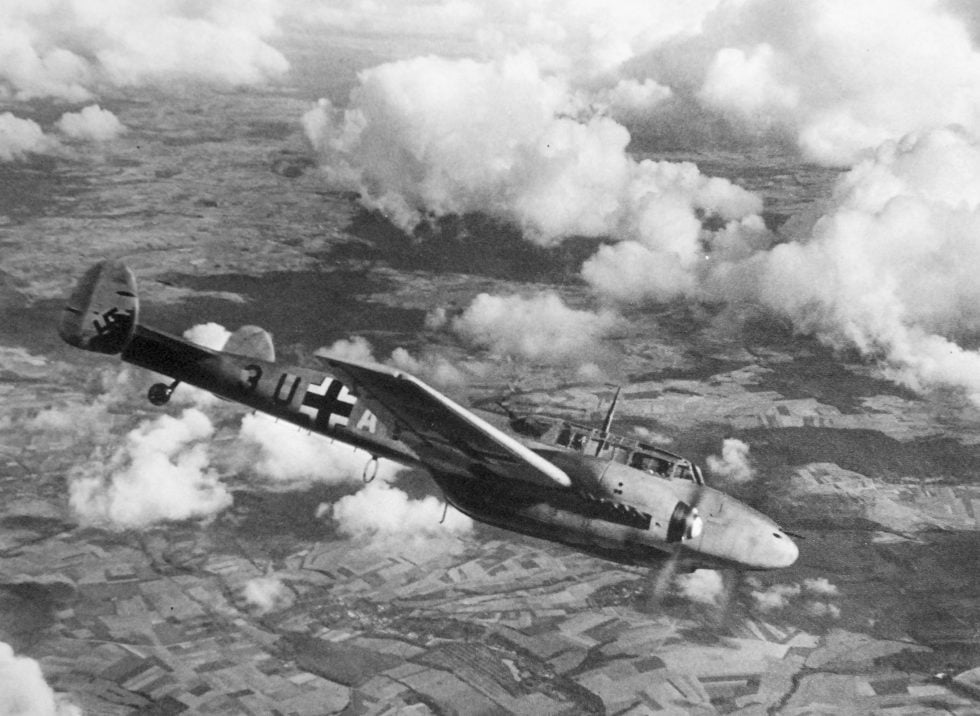
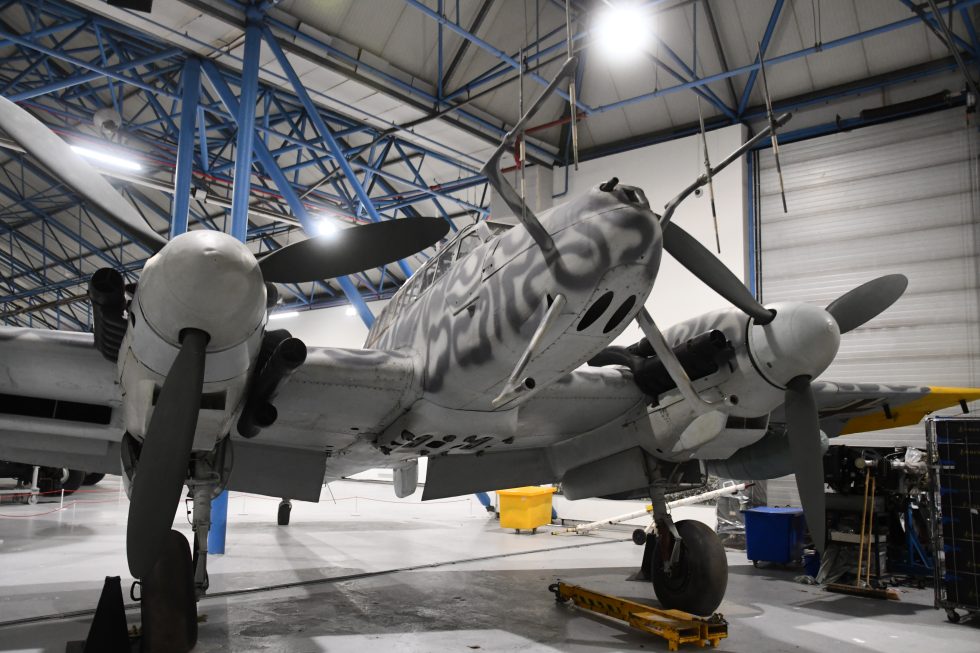
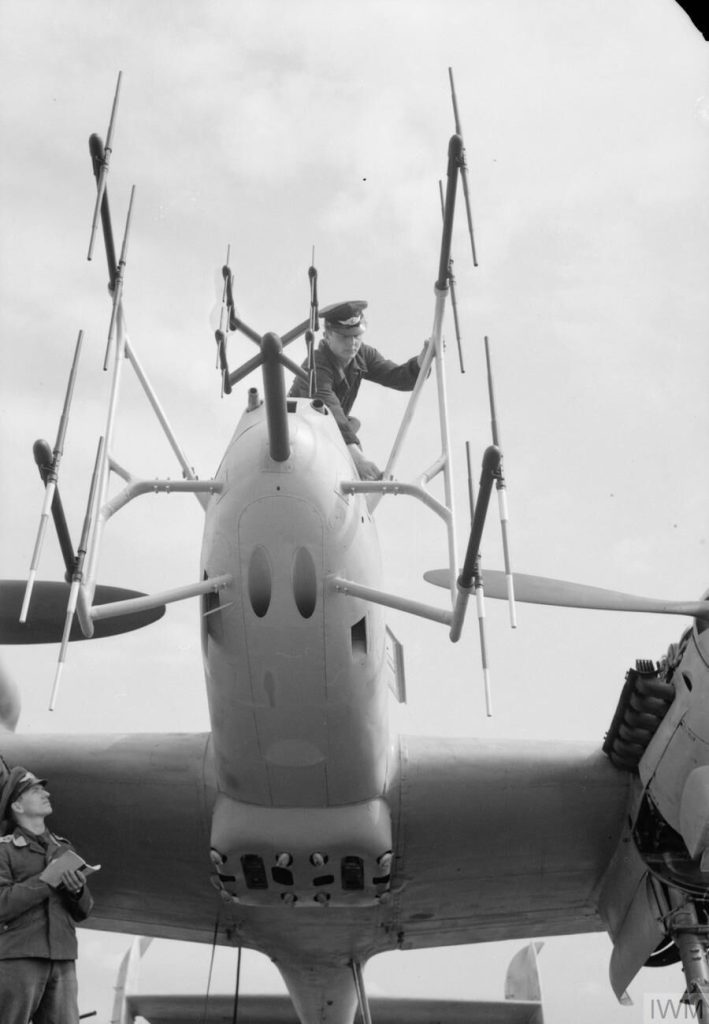
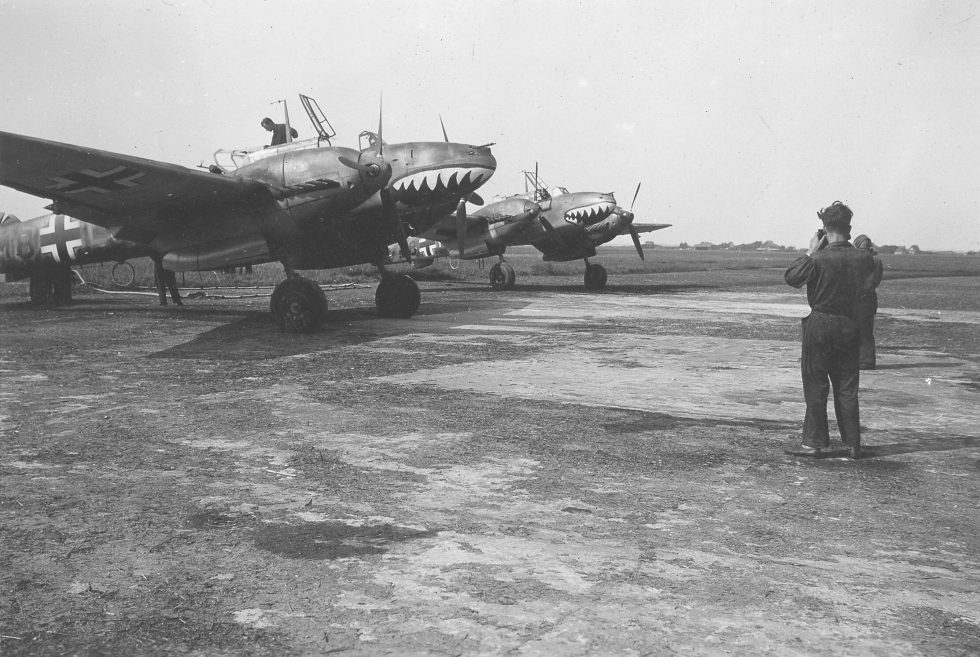
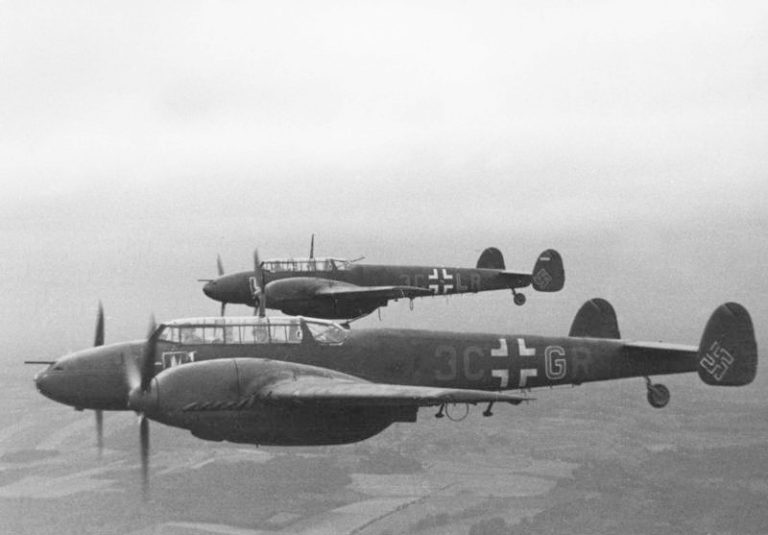
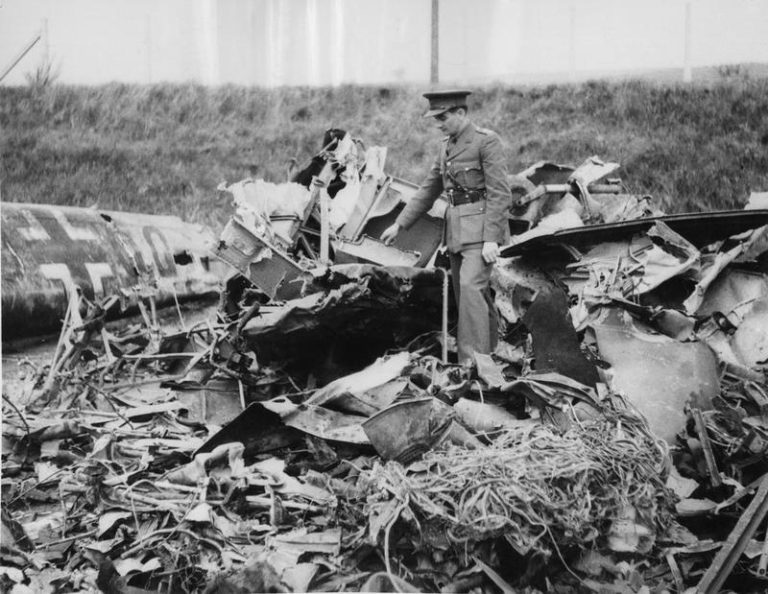
The Bf 110 in motion
A verified, high-quality Bf 110 video is coming soon to this exhibit.
Where the Bf 110 flew
A war fought in daylight and dark
The Bf 110’s record is a study in reinvention. As a day fighter it was outclassed the moment it met modern single-engine opposition; as a radar-equipped night fighter it became one of the most effective defensive weapons of the war. Its story is best told in three numbers.
Compare the combat record of every military aircraft. Figures as of July 2026.
Everything people ask about the Bf 110
Can I fly in a Bf 110?
Why did the Bf 110 fail in the Battle of Britain?
What was Schräge Musik?
How many Bf 110s were built?
Who was the top Bf 110 night-fighter ace?
Is any Bf 110 still flying?
What replaced the Bf 110?
Did Rudolf Hess really fly a Bf 110 to Britain?
You can’t fly the Bf 110.
These, you can.
Some legends only live in museums — others are fuelled and waiting. MiGFlug has put civilians in real military jet cockpits since 2004.
 Fly the L-39 AlbatrosThe world’s most-flown jet trainer — aerobatics included
 Fly the F-104 Starfighter“The missile with a man in it”
 Fly the MiG-21The Cold War’s most-produced jet
 Fly the T-33 Shooting StarAmerica’s first jet trainer
 Fly the DH VampireA piece of early jet history
 Fly the S.211Agile Italian jet trainer
 Fly the MB-326The classic Aermacchi jet
 Fly the MiG-15The Soviet legend of the Korean War
Continue the tour
Every fact, checked
- RAF Museum — Messerschmitt Bf 110 G-4The preserved night-fighter G-4 (W.Nr. 730301) at Hendon, with radar and Schräge Musik installation.
- HistoryNet — the Bf 110 as night fighterHow the “destroyer” found its calling defending the Reich against RAF night raids.
- HistoryOfWar.org — Messerschmitt Bf 110Development history, variants and combat record, plus the Me 210 replacement failure.
- Imperial War MuseumsBattle of Britain context and the Rudolf Hess flight of May 1941.
- Encyclopaedia BritannicaConcise reference on the Bf 110’s design, role and the Zerstörer concept.
- Bomber Command Museum of Canada — NurembergThe 30/31 March 1944 raid, Bomber Command’s costliest single night against the Nachtjagd.
- War History Online — Heinz-Wolfgang SchnauferProfile of the top-scoring night-fighter ace and his Bf 110 career.
- flugzeuginfo.net — Bf 110 dataTechnical specifications and variant breakdown cross-checked for this page.