
Junkers Ju 87
“Stuka”
The German dive bomber that became a symbol of early Blitzkrieg — feared for its precision attacks and wailing sirens, then exposed as slow and defenceless the moment it met modern fighters.
The dive bomber that defined — and outlived — its moment
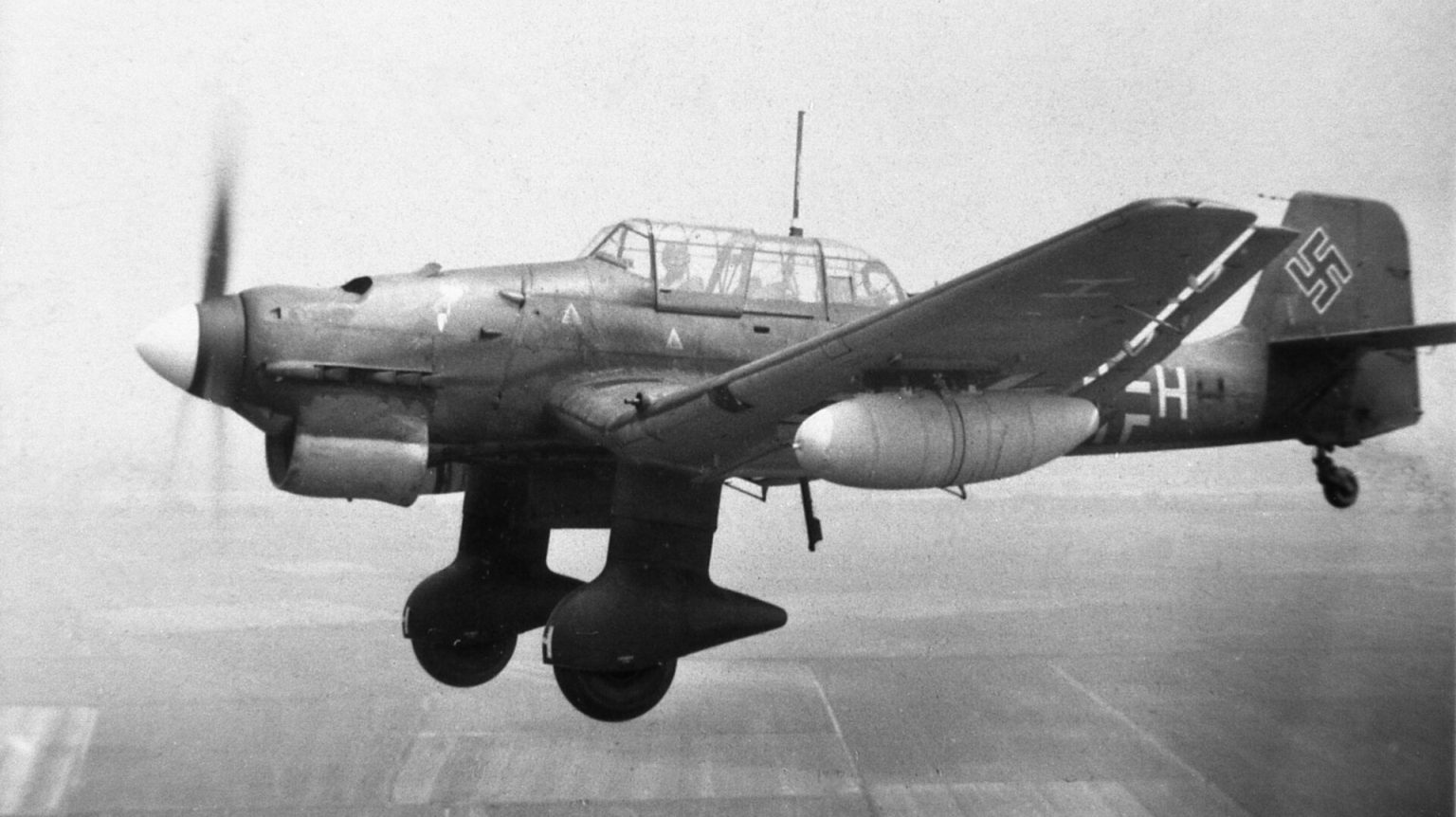
The Junkers Ju 87 — universally known by the German abbreviation “Stuka,” from Sturzkampfflugzeug (“dive-bombing aircraft”) — was among the most recognisable aircraft of the Second World War. Designed at Junkers by a team under Hermann Pohlmann and first flown in 1935, it entered Luftwaffe service in 1937. With its cranked inverted-gull wing, fixed spatted undercarriage and angular lines it was never fast or elegant, but it was built for one job: to plant a bomb on a small target by diving almost vertically onto it.
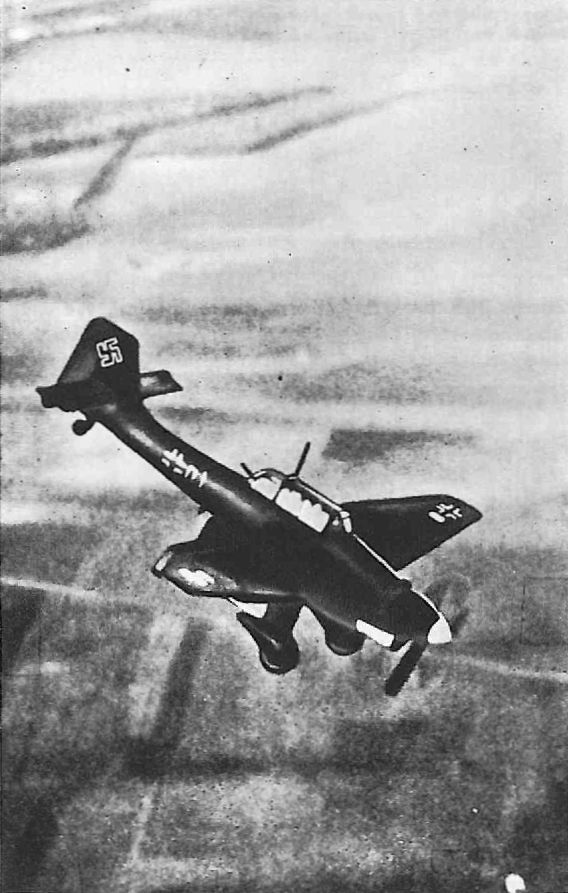
What set the Ju 87 apart was the engineering of the dive itself. Hydraulic brakes under the wings held it to a safe speed as it tipped into a dive of up to roughly 80 degrees; a pre-set altimeter warned the pilot when to release, and an automatic pull-out device could recover the aircraft even if the crew blacked out under the g-forces of recovery. A crutch under the fuselage swung the main bomb clear of the propeller arc before release. The result was an accuracy that level bombers of the day could not match.
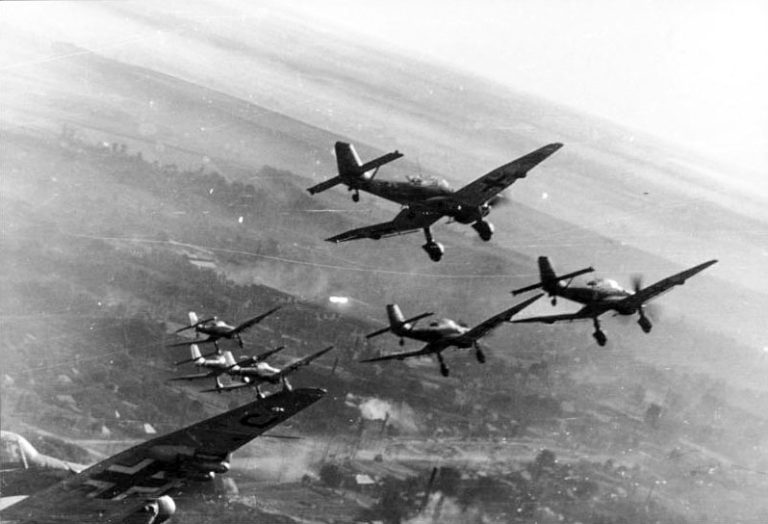
The Stuka’s reputation was made in the opening campaigns of the war. It saw combat first in Spain with the Condor Legion in 1937, then spearheaded the German assaults on Poland in 1939 and on France and the Low Countries in 1940. Operating as airborne artillery ahead of fast-moving armoured columns, it became a symbol of Blitzkrieg. Its steep, accurate attacks — announced by the wailing of propeller-driven sirens fitted to some aircraft — were as much a psychological weapon as a physical one.
That dominance depended on controlling the sky. When the Stuka met modern, well-flown fighters on equal terms, its weaknesses were brutally exposed. Slow, lightly armed and unmanoeuvrable, it proved highly vulnerable during the Battle of Britain in the summer of 1940, where RAF Hurricanes and Spitfires inflicted such heavy losses — culminating in the costly fighting of mid-August — that the Luftwaffe withdrew it from the daylight battle. The aircraft that had terrorised Poland and France could not survive over southern England.
The type found a longer future on fronts where the Luftwaffe still held an edge. In the Mediterranean it became a deadly anti-shipping weapon, savaging the convoys that supplied Malta; in January 1941 Stukas scored six bomb hits on the British carrier HMS Illustrious. On the Eastern Front after 1941 it served in huge numbers as close air support, and evolved into the specialised Ju 87G “tank-buster,” carrying two 37 mm cannon to attack Soviet armour from 1943.
By the middle of the war the design was clearly obsolete. As the Allies and Soviets gained air superiority the un-escorted Stuka became a liability, and it was increasingly relegated to night-harassment units and the anti-tank role. Production ended in 1944 after roughly 6,000 had been built across all variants. Beyond Germany the type also served with the air forces of Italy, Hungary, Romania and Bulgaria, among others. Today only two substantially complete examples remain, both on static display and neither airworthy.
01The Ju 87 Stuka in the Battle of Britain: why the dive bomber was pulled from the fight
In August 1940 the Ju 87 met its limits. Committed against radar stations, airfields and shipping in the opening phase of the Battle of Britain, the Stuka depended on an air superiority it no longer had. It was slow (a little over 380 km/h), defended by only a single rear machine gun, and dangerously exposed in the seconds after pulling out of a dive. RAF Hurricanes and Spitfires exploited all of it. Losses mounted quickly — on 18 August 1940, later called “the Hardest Day,” dive-bomber units were mauled — and within days the Luftwaffe pulled the type back from the cross-Channel battle to preserve it. Estimates commonly put Stuka losses in the battle at around a fifth of the force committed. It was a decisive demonstration that the dive bomber only worked when its own side owned the sky.
What made the Stuka special
Ju 87 dive-bombing: brakes, a set altimeter and an automatic pull-out
The Stuka’s precision came from a semi-automatic dive. Slatted hydraulic brakes deployed under the wings to cap the dive speed (around 600 km/h) so the aircraft would not over-speed or break up as it tipped into a dive of up to about 80°. The pilot set a contact altimeter beforehand; a warning light signalled the release point, and an automatic device (the Abfangautomat) could begin the pull-out and recover the aircraft even if the crew greyed out under roughly 6 g. A swinging crutch threw the centreline bomb clear of the spinning propeller before it fell.
The Ju 87’s ‘Jericho-Trompete’: a siren built to spread fear
Some Stukas carried wind-driven sirens on their undercarriage legs — the “Jericho-Trompete.” Spun by the airflow, they rose to a wailing shriek as the aircraft dived. They had no purpose beyond the psychological: they were meant to frighten the troops and civilians below, and featured prominently in the campaigns of 1939–40. They were later removed from many aircraft because the sirens created drag and slowed the Stuka down, and because their shock value faded as opponents learned the type’s real weaknesses.
The Ju 87G ‘Kanonenvogel’: a Stuka rebuilt to kill tanks
From 1943 a specialised variant, the Ju 87G, carried two 37 mm BK 3.7 cannon in underwing pods, firing tungsten-cored armour-piercing rounds to strike the thinner top and rear armour of Soviet tanks. It first saw major use around the Battle of Kursk. Heavy and draggy, it was flown without dive brakes and was highly vulnerable without fighter escort. Its best-known pilot, Hans-Ulrich Rudel, was credited with a very large number of tank kills — figures that were wartime claims and cannot be independently verified.
02The Ju 87 Stuka’s fixed undercarriage: why it never retracted
Unlike most modern combat aircraft of its day, the Stuka kept its main wheels down at all times, enclosed in large streamlined “spats.” The fixed gear added drag and cost speed, but it simplified the structure, saved weight and made the aircraft rugged enough to operate from rough forward airstrips — priorities that suited a dive bomber built for accuracy and durability rather than pace. The distinctive spatted legs, together with the cranked inverted-gull wing, gave the Ju 87 one of the most instantly recognisable silhouettes of the war.
03The Ju 87 Stuka on the Eastern Front: close support and the anti-tank role
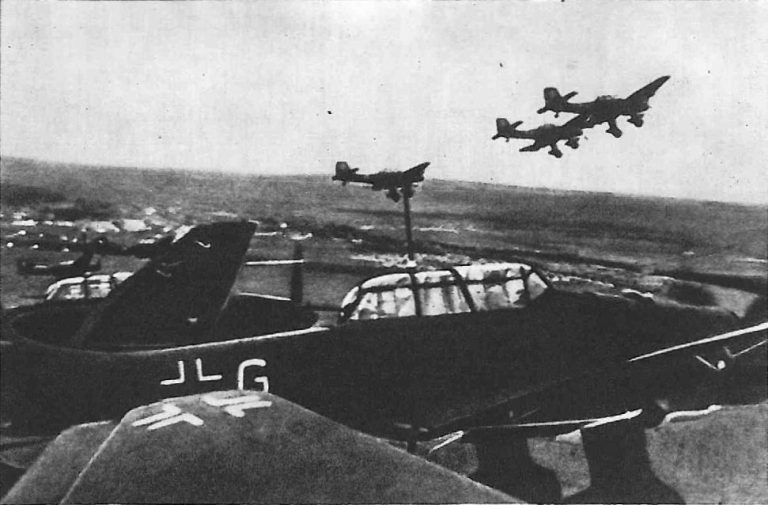
After the invasion of the Soviet Union in 1941, the Stuka served in large numbers as flying artillery for the German army, attacking strongpoints, vehicles and rail targets. As Soviet armour multiplied, the type was adapted into the cannon-armed Ju 87G to attack tanks directly, and later marks such as the Ju 87D were given more power, more armour and a heavier bomb load. But as Soviet fighters and anti-aircraft defences grew stronger, the slow Stuka suffered increasingly, and much of its later work shifted to night harassment. Production of the whole family ended in 1944.
Full specifications
Baseline figures are for the Ju 87 B-2, the 1939–41 production standard flown over Poland, Norway, France and the Channel. Grey text gives the main differences for the later D series (bigger engine, heavier loads, longer wing on the D-5) and the anti-tank G. Sources disagree on several Ju 87 numbers; where they do, the range is shown rather than a single tidy figure.
Dimensions & weights
- Crew
- 2 (pilot and rear gunner / radio operator, seated back to back)
- Length
- 11.10 m (36 ft 5 in)
- Wingspan
- 13.80 m (45 ft 3 in); D-5 long-span wing 15.00 m (49 ft 3 in)
- Height
- 4.01 m (13 ft 2 in), tail down on its fixed spatted undercarriage
- Wing area
- 31.90 m² (343 sq ft); D-5 33.68 m² (363 sq ft)
- Empty weight
- 2,760 kg (6,085 lb); D-5 about 3,900 kg (8,600 lb)
- Loaded weight
- 4,250 kg (9,370 lb) with one 250 kg bomb and full crew
- Max takeoff weight
- 4,400 kg (9,700 lb); D-5 up to 6,600 kg (14,550 lb)
- Internal fuel
- ~480 l (~127 US gal) in two wing tanks; the long-range R series carried ~1,080 l (~285 US gal) internally plus two 300 l (79 US gal) drop tanks
Performance
- Max speed
- 383 km/h (238 mph) at 4,400 m (14,400 ft). That is slow even by 1939 standards, and it is the central fact about the aircraft: carrying bombs it was slower still, and without friendly fighters overhead a Stuka formation was close to defenceless against modern monoplane fighters
- Cruise speed
- 320 km/h (199 mph) at 4,000 m (13,120 ft)
- Rate of climb
- 5.5 m/s (1,080 ft/min) at sea level, loaded — roughly 8 minutes to 4,000 m (13,120 ft)
- Service ceiling
- 8,200 m (26,900 ft)
- Range
- ~600 km (~370 miles) with a 250 kg bomb; radius of action was far shorter, commonly quoted at ~150–250 km (~95–155 miles) for a dive attack with reserves
- Ferry range
- ~800 km (~500 miles) clean; the R series with wing tanks and drop tanks reached ~1,400–1,500 km (~870–930 miles), which is what made it useful over the Norwegian coast and the Mediterranean
- Takeoff run
- 400 m (1,310 ft) loaded from grass; figures vary widely with load, surface and wind
- Landing run
- 450 m (1,475 ft); the fixed gear, big flaps and docile stall made it a forgiving field aircraft, which mattered on improvised Eastern Front strips
- Dive speed limit
- 600 km/h (373 mph) indicated, the permitted figure with dive brakes extended; dive angles of 60–80 degrees were normal and the brakes held the aircraft near this speed instead of letting it run away
Propulsion & systems
- Engine
- Junkers Jumo 211Da one 12-cylinder inverted-V, liquid-cooled, direct-injection engine; the D series used the Jumo 211J-1 with induction cooling
- Power
- 1,200 PS (1,184 hp / 883 kW) for takeoff; Jumo 211J-1 in the D gave 1,400 PS (1,380 hp / 1,030 kW)
- Propeller
- Junkers VS 5, three blades variable pitch, 3.40 m (11 ft 2 in) diameter; the D used the broader-chord VS 11
- Dive brakes & automatic pull-out system
- Hydraulic underwing dive brakes with an automatic recovery device This is the reason the aircraft existed. The pilot dialled the intended release altitude into a contact altimeter, extended the slatted brakes below the outer wings and rolled into a dive of up to about 80 degrees; the brakes capped the speed so the bombsight picture stayed stable, and red lines painted on the canopy glazing let him read the dive angle against the horizon. Pressing the bomb release swung the centreline bomb clear of the propeller arc on a crutch and simultaneously triggered the pull-out: the brakes retracted, elevator trim ran nose-up and the aircraft recovered itself at around 6 g whether or not the pilot was still conscious. Blacking out in the recovery was routine, and the system is why crews survived it
- Jericho-Trompete sirens
- Propeller-driven wailing sirens on the undercarriage legs A deliberate psychological weapon rather than a technical one: small air-driven sirens that screamed as the aircraft dived, intended to terrify the people underneath it. They were fitted mainly on early B models, were never universal, and were largely removed later in the war because they cost speed (commonly cited at roughly 20–25 km/h) for no military return. Whistles fitted to bomb fins were sometimes used instead
- Armament
- 2 × 7.92 mm MG 17 (wings) + 1 × 7.92 mm MG 15 (rear) D series replaced the single rear MG 15 with the twin-barrel MG 81Z; the G carried two 37 mm BK 3,7 cannon in underwing pods
- Bombsight
- Revi C/12C reflector sight plus canopy dive-angle reference lines and the contact altimeter that armed the automatic pull-out. There was no computing sight: accuracy came from the dive geometry and the pilot, and in practice a trained crew could put bombs within roughly 25–30 m of a point target, far better than level bombers of the day
- First flight
- 17 September 1935 (Ju 87 V1 prototype)
- Service entry
- 1936 with the Luftwaffe; combat debut with the Condor Legion in Spain from 1937, B-2 in front-line service from 1939
- Built
- ~6,000 total, ~5,700–6,500 depending on the source and on how conversions are counted: roughly ~262 A series, ~1,300 B and R, ~3,300 D, and ~200 G, most of the G being D airframes converted rather than new-build
- Unit cost
- Not reliably documented No dependable published Reichsmark price for a Ju 87 airframe circulates in the open literature. Comparable single-engine Luftwaffe types of the period were costed in the order of ~100,000 RM airframe-only, so any single Stuka figure should be treated as an estimate rather than a record
- Cost per flight hour
- No meaningful figure exists Only two substantially complete Ju 87s survive anywhere in the world and neither is airworthy. No Ju 87 has flown since the war, so there is no modern operating record, no fuel or maintenance baseline, and nothing to quote
04The Ju 87 Stuka’s cost: a cheap, mass-produced weapon
The Stuka was a state-produced military aircraft of the 1930s–40s, never sold on an open market, so a modern-style unit price or cost-per-flight-hour figure does not exist in the public record. What the record does show is that it was designed to be built cheaply and in quantity: roughly 6,000 were produced across all variants, with output peaking in 1943. Any precise dollar cost attached to a Ju 87 today is an estimate or a currency conversion, not a sourced historical price.
Armament & payload
“Kanonenvogel”: one accurate bomb, two rifle-calibre guns, and a siren
The Stuka was never a gun-fighter. Its whole design bought one thing: the ability to put a single medium bomb onto a small target from a near-vertical dive, at a time when level bombers routinely missed by hundreds of metres. That accuracy made it devastating against bridges, ships, strongpoints and, as documented history rather than legend, against civilians — Ju 87 units took part in the bombing of towns and in attacks on refugee columns during the invasions of Poland in 1939 and France in 1940, where crowded roads were struck deliberately to block them. The same aircraft then met the RAF over southern England in August 1940 and its reputation for invincibility collapsed inside a fortnight: slow, lightly armed and helpless once fighters reached it, the Ju 87 took losses the Luftwaffe could not absorb and was pulled out of the Battle of Britain. Everything below is the equipment behind both halves of that record.
Guns
Two 7.92 mm Rheinmetall-Borsig MG 17 machine guns in the wings, outboard of the propeller arc, firing forward with roughly 500 rounds per gun. Rifle-calibre and by 1940 close to useless against armoured aircraft; they were aiming and strafing weapons, not fighting weapons. Later D-5s substituted two 20 mm MG 151/20 cannon in the wings, which finally gave the type real strafing punch against soft targets and thin-skinned vehicles.
Bombs
The signature fit was one SC250 (250 kg / 550 lb) bomb on a centreline crutch that swung the weapon down and forward so it cleared the propeller in the dive, plus four SC50 (50 kg / 110 lb) bombs on underwing racks. A B-2 could lift a single 500 kg (1,100 lb) bomb over short ranges, normally by flying without the rear gunner. The D series raised this substantially, up to a nominal 1,800 kg (3,970 lb) on the centreline for very short-range work, though ~500–1,000 kg was the realistic operational load.
Anti-tank guns (Ju 87G)
The G, nicknamed Kanonenvogel (cannon bird), carried two 37 mm BK 3,7 cannon in underwing pods, fed by six-round clips with typically about 12 rounds per gun. Firing tungsten-cored rounds in shallow attacks from behind and above, it could penetrate the thinner rear and top armour of Soviet tanks. It was accurate but desperately slow and fragile, and it worked only where the Luftwaffe still held local air superiority. Hans-Ulrich Rudel, the most highly decorated Luftwaffe pilot of the war and the best-known G exponent, claimed several hundred tanks destroyed, a total historians treat with caution; he remained an unrepentant National Socialist and active in far-right politics until his death in 1982.
Dive-bombing equipment
Slatted hydraulic dive brakes under the outer wings, a contact altimeter on which the pilot preset the pull-out height, dive-angle lines painted on the canopy, a Revi C/12C reflector sight, and the automatic recovery device that retracted the brakes and trimmed the aircraft out of the dive on bomb release. Crews frequently greyed out or blacked out in the roughly 6 g recovery; the system flew the pull-out for them. Nothing else in 1939 combined this into a mass-produced, conscript-trainable package, and that, not the siren, is why the Stuka mattered.
Defensive armament
A single flexible 7.92 mm MG 15 in the rear cockpit on the A, B and R, worked by the radio operator over an open ring. It was inadequate against Hurricanes and Spitfires and everyone involved knew it. From the D series it was replaced by the twin-barrel MG 81Z with a much higher rate of fire, which improved matters against fighters attacking from dead astern but never made the aircraft survivable in contested airspace.
Late-war & night fits
As daylight operations became suicidal, surviving Ju 87 D airframes were pushed into Nachtschlachtgruppen, night harassment units flying single-aircraft nuisance and interdiction sorties with flame-damped exhausts, small bomb loads and occasionally containers of small anti-personnel bombs. It was a role the type could still perform because it was slow, stable and able to work from short, rough strips — the same qualities that had made it useless in daylight against fighters.
Three typical Stuka loads
- Classic dive attack
- Ju 87 B-2 — one SC250 (250 kg / 550 lb) on the centreline swing crutch, four SC50 (50 kg / 110 lb) under the wings, two wing MG 17 and one rear MG 15. Around 450 kg (990 lb) of bombs. This is the Poland and France standard, and the load flown against shipping and airfields in 1940.
- Long-range anti-shipping
- Ju 87 R-2 — one SC250 on the centreline, two 300 l (79 US gal) drop tanks on the wing racks in place of the small bombs, extra internal wing tankage. Bomb load traded for reach: this is the fit that let Stukagruppen operate over the Norwegian coast, Malta convoys and the eastern Mediterranean.
- Tank hunting
- Ju 87 G-2 — no bombs at all: two 37 mm BK 3,7 cannon in underwing pods with roughly 12 rounds each, wing machine guns usually deleted to save weight, long-span D-5 wing, rear MG 81Z retained. Attacks flown shallow from astern against the thin upper and rear armour of Soviet tanks, on the Eastern Front from 1943.
Loads varied enormously by mark, theatre and date, and paper maxima were rarely flown. The 1,000 kg and 1,800 kg figures quoted for late marks applied only at very short range, often with the gunner left behind and fuel cut back; the everyday operational load across the war was closer to 500 kg. Treat any single armament line as mark-dependent.
Variants
From Spain to the Eastern Front: seven Stukas
- Ju 87 A (1937)
- ~262 built. The first production Stuka: Jumo 210 engine of about 640 PS, heavy trousered undercarriage fairings, a bomb load limited to 250 kg with the gunner aboard. Blooded with the Condor Legion in Spain, which is where the Luftwaffe learned how to use it. Obsolete by 1939 and relegated to training.
- Ju 87 B-1 / B-2 (1938–41)
- ~1,000 built. The Blitzkrieg aircraft. Jumo 211 of 1,200 PS, redesigned smaller spats, greenhouse canopy, and on many early machines the Jericho-Trompete sirens. The B-2 added an improved engine, propeller and hydraulics. This is the mark of Poland, Norway, the Low Countries, France and the Battle of Britain, where it was withdrawn after severe losses in August 1940.
- Ju 87 R (1940)
- ~300 built. Long-range derivative of the B with extra wing tanks and provision for two 300 l drop tanks, roughly doubling radius at the cost of bomb load. Built for anti-shipping and coastal work: Norway, the Mediterranean, Malta and Crete, including the attacks on Royal Navy ships off Crete in 1941.
- Ju 87 D-1 / D-5 (1942–44)
- ~3,300 built, the most-produced version. Jumo 211J of 1,400 PS, cleaned-up cowling and canopy, better armour, twin MG 81Z rear gun and much heavier bomb capacity. The D-5 added a longer-span wing and 20 mm MG 151/20 wing cannon. It arrived in a war the type had already lost: by 1943 it could only operate where the Luftwaffe still held the sky.
- Ju 87 G-1 / G-2 (1943–45)
- ~200, almost all conversions. Anti-tank version with two 37 mm BK 3,7 cannon in underwing pods, the G-1 converted from D-3 airframes and the G-2 from the long-winged D-5. Effective against Soviet armour in skilled hands and hopelessly vulnerable in any other circumstance.
- Ju 87 C (1938–40)
- A handful of prototypes and pre-production aircraft. Navalised Stuka for the aircraft carrier Graf Zeppelin: folding wings, arrestor hook, catapult points and jettisonable undercarriage for ditching. The carrier was never completed, the programme was cancelled, and the airframes were absorbed into land-based units.
- Ju 87 H trainer conversions (1943–45)
- Small numbers, converted not built. Unarmed dual-control trainers produced by converting B, R and D airframes, with a second set of controls and bulged side glazing so the instructor could see forward. The suffix letters H-1 to H-8 track which parent mark each conversion came from.
Almost nothing survives. Only two substantially complete Ju 87s exist anywhere in the world: a Ju 87 R-2 at the Museum of Science and Industry in Chicago and a Ju 87 G-2 at the RAF Museum in London. Neither is airworthy, and no Ju 87 has flown since 1945. Beyond those two there is only recovered wreckage — airframes salvaged from lakes, the Baltic and Mediterranean seabeds and Eastern Front crash sites, some under long-term restoration for static display. Production totals here are rounded and vary between sources, particularly where D airframes were rebuilt as G conversions and counted twice.
From Blitzkrieg spearhead to obsolete relic
First flight
The prototype flies on 17 September 1935; the design is led at Junkers by Hermann Pohlmann.
Combat debut
The Ju 87 enters Luftwaffe service and is tested in combat in Spain with the Condor Legion.
Poland
Stukas open the German campaign in Poland, among the first air attacks of the war.
France & the Low Countries
The type spearheads the German breakthrough at Sedan as airborne artillery for the panzers.
Battle of Britain
Against RAF fighters the Stuka takes heavy losses and is withdrawn from the daylight battle after mid-August.
Mediterranean & Barbarossa
Stukas cripple HMS Illustrious off Malta and deploy in mass over the Soviet Union.
The tank-buster
The cannon-armed Ju 87G enters major use around the Battle of Kursk on the Eastern Front.
Production ends
After roughly 6,000 built, the obsolete Stuka leaves production; night-harassment work continues to 1945.
From the war: twelve Stuka stories
The opening bombs
Stukas struck the Polish town of Wieluń in the war’s first minutes on 1 September 1939.
Read the full story
How the dive worked
Wing brakes, a set altimeter and an automatic pull-out let the Stuka bomb with rare accuracy.
Read the full story
The Jericho Trumpet
Wind-driven sirens on the landing gear made the Stuka wail as it dived — a deliberate terror weapon.
Read the full story
The Hardest Day
On 18 August 1940 the Stuka took catastrophic losses over southern England.
Read the full story
Six hits on Illustrious
On 10 January 1941 Stukas struck the British carrier HMS Illustrious off Malta.
Read the full story
The Malta gauntlet
Based in Sicily, Stukas helped make the sea around besieged Malta a killing ground.
Read the full story
The cannon-bird at Kursk
The Ju 87G tank-buster, with two 37 mm cannon, entered major use around Kursk.
Read the full story
The most-decorated pilot
Hans-Ulrich Rudel flew a claimed 2,530 sorties — figures recorded as wartime claims.
Read the full story
The “Dora”
The Ju 87D gave the ageing design more power, more armour and a bigger bomb load.
Read the full story
The fixed gear
The Stuka never retracted its wheels — a deliberate trade of speed for simplicity and toughness.
Read the full story
From spearhead to liability
As the Allies won air superiority, the un-escorted Stuka became easy prey.
Read the full story
Only two left
Just two substantially complete Ju 87s survive, both grounded in museums.
Read the full story
The Stuka in pictures
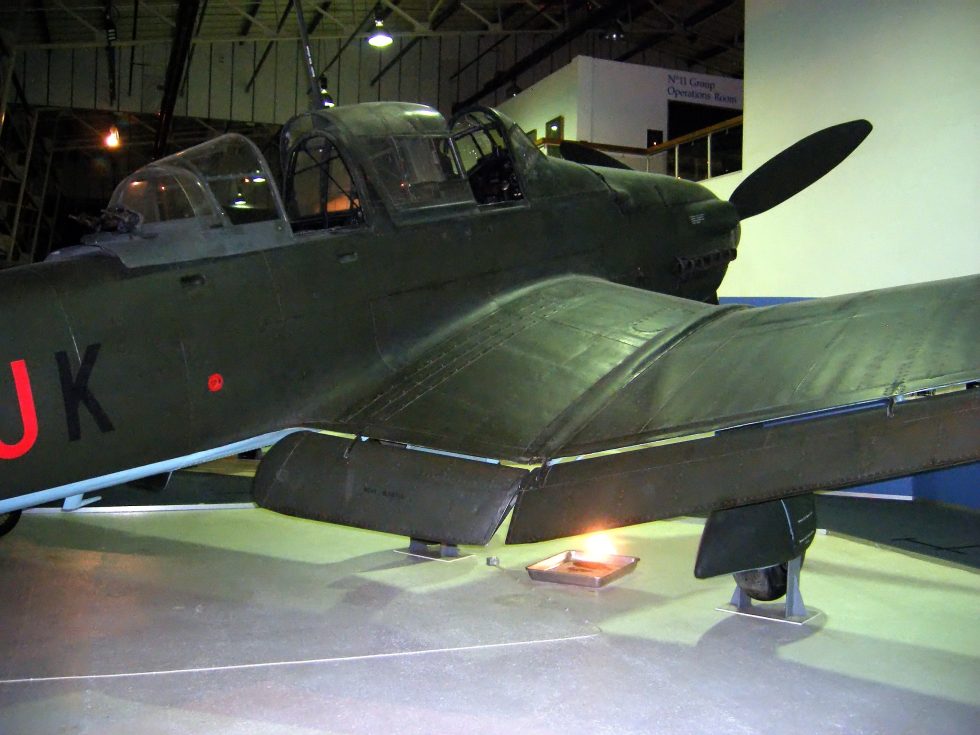
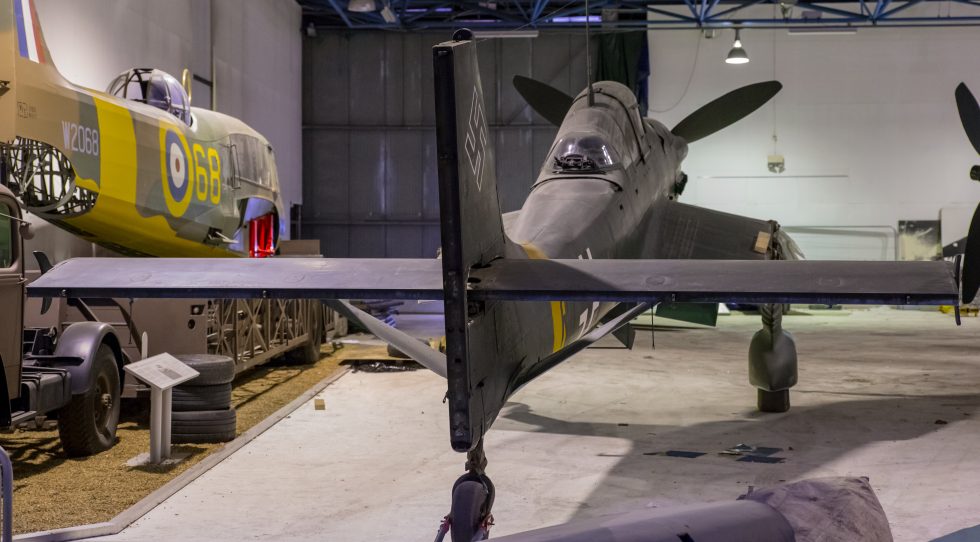
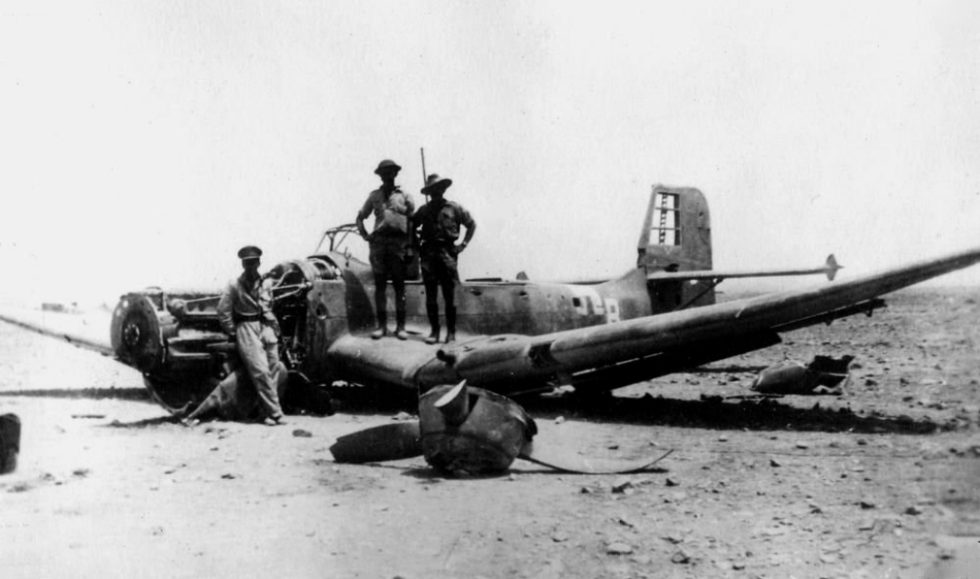
The Stuka in motion
A verified, high-authority video feature for the Junkers Ju 87 is still being selected — video coming soon. In the meantime, explore the photo gallery above and the operations map below.
Where the Stuka flew
What the Stuka actually achieved
The Ju 87’s record is a study in contrasts: devastating when Germany held the sky, and desperately vulnerable when it did not. Its greatest effect came as precision airborne artillery in the early campaigns and as an anti-shipping and anti-tank weapon; its greatest weakness was its helplessness against modern fighters.
Compare the combat record of every military aircraft. Many figures for this type are estimates and remain contested.
Everything people ask about the Ju 87 Stuka
Can I fly in a Ju 87?
What does “Stuka” mean?
Why did the Stuka have fixed landing gear?
What were the Stuka’s sirens?
How many Ju 87s were built?
Why did the Stuka fail in the Battle of Britain?
Are any Ju 87s left, and can I see one?
You can’t fly the Stuka.
These, you can.
Some legends only live in museums — others are fuelled and waiting. MiGFlug has put civilians in real military jet cockpits since 2004.
 Fly the L-39 AlbatrosThe world’s most-flown jet trainer — aerobatics included
 Fly the F-104 Starfighter“The missile with a man in it”
 Fly the MiG-21The Cold War’s most-produced jet
 Fly the T-33 Shooting StarAmerica’s first jet trainer
 Fly the DH VampireA piece of early jet history
 Fly the S.211Agile Italian jet trainer
 Fly the MB-326The classic Aermacchi jet
 Fly the MiG-15The Soviet legend of the Korean War
Continue the tour
Every fact, checked
- RAF Museum — Junkers Ju 87 collection recordMuseum record for the surviving Ju 87G-2, one of only two intact examples.
- RAF Museum — “The Hardest Day”Museum account of 18 August 1940 and the Stuka’s vulnerability to RAF fighters.
- World History Encyclopedia — Junkers Ju 87Overview of the design, dive mechanism, loss figures and foreign operators.
- The Armory Life — the Ju 87G “Kanonenvogel”Detail on the 37 mm BK 3.7 cannon, tungsten rounds and the Kursk debut.
- HistoryNet — the German StukaThe Jericho Trumpet siren as a terror device and its drag penalty.
- Royal Marines History — the Stuka attack on HMS IllustriousAccount of the 10 January 1941 attack: six hits, casualties and the units involved.
- Museum of Science and Industry, ChicagoHome of the surviving Ju 87R-2 dive bomber on display.
- Simple Flying — are any Stukas airworthy?Survey of the two surviving Ju 87s and why none can fly.