
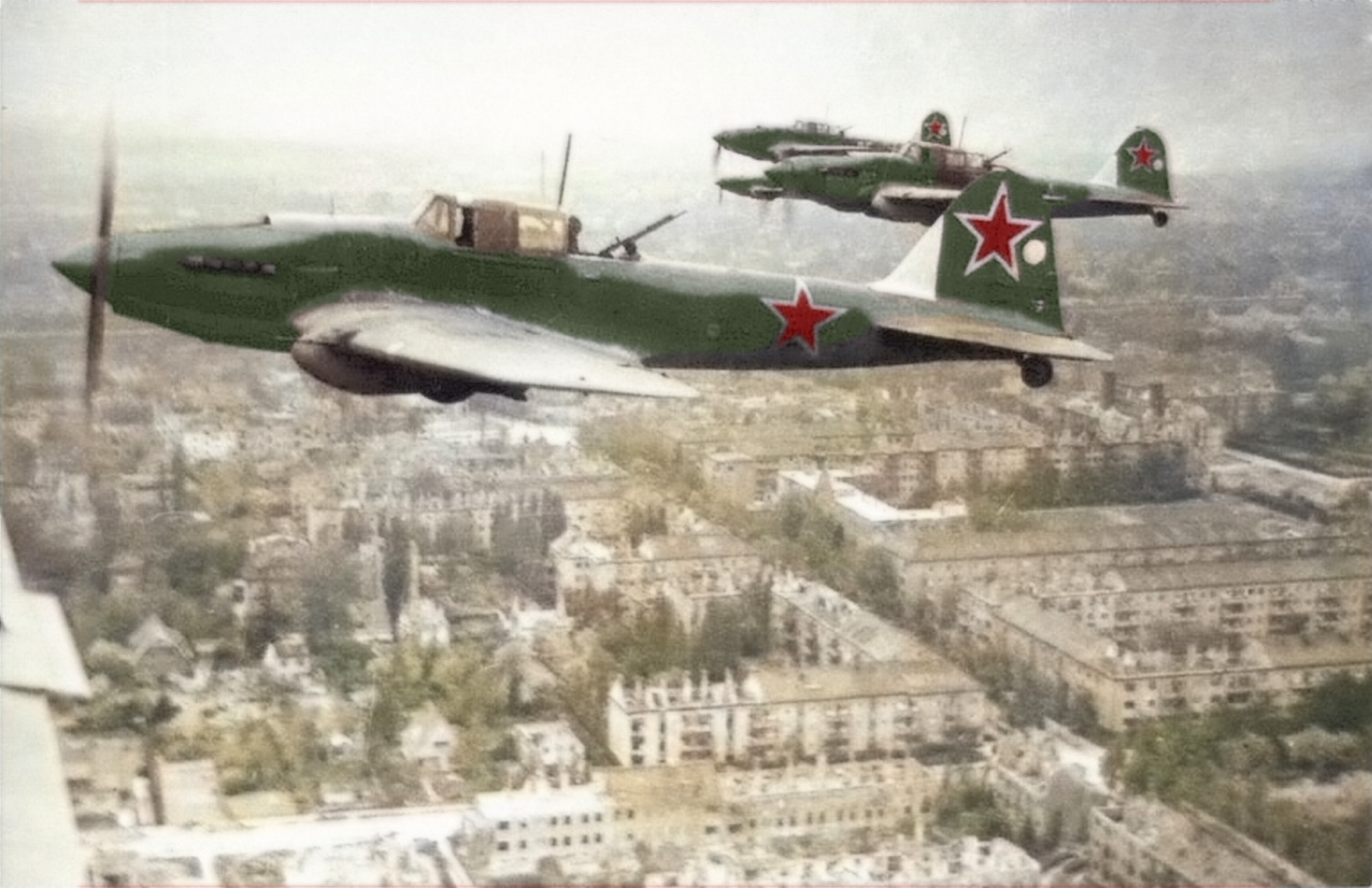
Ilyushin Il-2
“Sturmovik”
The Red Army’s armoured “flying tank” — a ground-attack aircraft whose armour was its airframe, built in greater numbers than any other military aircraft in history and central to victory on the Eastern Front.
The Il-2 Sturmovik: Stalin’s flying tank
In the late 1930s the Soviet designer Sergey Ilyushin set out to solve a problem that had defeated every other air force: how to build a ground-attack aircraft that could survive flying low and slow over a battlefield thick with rifle, machine-gun and light flak fire. His answer, first flown in 1939, was radical. Instead of bolting armour plate onto an existing airframe, he made the armour the airframe. A single formed shell of steel — the “bronekorpus,” commonly likened to a bathtub — wrapped the engine, coolant system, fuel and cockpit and carried structural loads itself. The armour did not just protect the aircraft; it was a load-bearing part of it.
The Il-2 entered service in 1941, days before the German invasion, and its early career was brutal. To boost performance the type initially flew as a single-seater, with no defence against fighters attacking from behind — and German pilots quickly learned to strike from the unprotected rear. Losses were severe. From late 1942 Ilyushin restored a second crewman: a rear gunner with a heavy 12.7 mm machine gun, sitting behind the armoured tub in a far less protected position. The two-seat Il-2 was still vulnerable, but it could now bite back, and it is the version most people picture today.
What made the Sturmovik feared was its firepower. It carried 23 mm cannon, unguided RS-82 and RS-132 rockets, and from 1943 the PTAB — small shaped-charge anti-tank bomblets scattered by the hundred, able to punch through the thinner top armour of German tanks. At the Battle of Kursk in July 1943, Il-2 units flying the “circle of death” carousel attacked massed Panzers with these weapons. German troops reportedly nicknamed the aircraft the “Black Death” and the “Concrete Plane” for its toughness. Built in staggering numbers — roughly 36,000 Il-2s, and about 42,000 counting the follow-on Il-10 — it remains the most-produced military aircraft in history.
01The Il-2 Sturmovik’s armoured bathtub: how the armour became the airframe
Most armoured aircraft of the era carried protection as dead weight — plates added on top of a conventional structure. Ilyushin inverted the idea. The Il-2’s forward fuselage was a single moulded shell of hardened steel, commonly cited between roughly 4 and 12 mm thick depending on location, that enclosed the Mikulin engine, the radiators, the fuel and the pilot, and simultaneously served as primary structure. Because the armour did double duty as skin and frame, the aircraft carried far more protection for a given weight penalty than a bolt-on scheme would allow — commonly cited at several hundred kilograms of steel.
The trade-off was performance: the Il-2 was heavy, and never fast or agile. But over the battlefield that mattered less than survivability. Returning Sturmoviks were routinely counted with dozens of hits, and accounts describe individual aircraft absorbing very large numbers of strikes and still flying home — figures that should be read as illustrative of its reputation for toughness rather than precise engineering data.
What makes the Il-2 special
Structural armour — the ‘bathtub’
The Il-2’s defining feature was its armoured shell, a single formed tub of steel that enclosed engine, radiators, fuel and pilot and doubled as load-bearing structure. Because the armour was the airframe, the aircraft could carry heavy protection where a bolted-on scheme could not — the origin of its “flying tank” reputation.
Anti-tank firepower — cannon, rockets & PTAB
The Sturmovik carried 2 × 23 mm cannon, machine guns, and up to eight RS-82 / RS-132 rockets. Its most devastating weapon arrived in 1943: the PTAB shaped-charge bomblet, dropped in hundreds to defeat the thin top armour of tanks — used to great effect at Kursk.
Built by the tens of thousands
Rugged, simple and made partly of wood and steel rather than scarce light alloys, the Il-2 was ideal for mass production. Around 36,000 were built — about 42,000 with the Il-10 successor — making it the most-produced military aircraft in history and a backbone of Soviet air power.
02The Il-2 Sturmovik at Kursk: PTAB bomblets and the ‘circle of death’
The PTAB (protivotankovaya aviabomba) was a small shaped-charge bomblet weighing about 1.5 kg. A single Il-2 could carry hundreds of them in its bomb bays and scatter them across an area, so that even near-misses could pierce the thinner armour on a tank’s engine deck and turret roof. First used in strength at the Battle of Kursk in July 1943, they let the Sturmovik attack massed armour far more effectively than free-fall bombs or cannon alone. Il-2 units also flew the “krug smerti” or circle of death — a rotating wheel of aircraft in which each covered the tail of the one ahead while taking turns to dive on the target. Soviet claims of tanks destroyed at Kursk were very high and are now regarded by historians as inflated, but the psychological and disruptive effect on German armour was real.
03The single-seat Il-2’s fatal blind spot — and the rear gunner who fixed it
To wring more speed and range out of the design, the Il-2 entered service as a single-seater. It was well protected from the front and below, but had nothing covering its tail — and German fighter pilots soon learned to attack from behind and slightly below, into the aircraft’s blind spot. Loss rates in 1941–42 were punishing. The fix was to restore the rear gunner that early prototypes had carried, armed with a 12.7 mm UBT machine gun, from late 1942. The gunner sat behind the armoured tub with much less protection than the pilot, and gunner casualties were heavy — but the two-seat Il-2 could finally defend its tail, and survivability improved markedly.
Full Il-2 specifications
Baseline figures are for the Il-2M3 — the two-seat “model 1943” aircraft with the uprated Mikulin AM-38F, the 23 mm VYa-23 cannon and, on later machines, the swept “arrow” outer wing panels. That is the definitive Il-2 and the one built in the greatest numbers. Grey text gives the main differences for the original single-seat aircraft of 1941, which was lighter, marginally faster and had nothing at all covering its tail. Il-2 figures scatter badly between sources: the type was built at four factories under wartime conditions, weights crept upward through the war, and Soviet published data was not always candid. Where sources disagree the spread is shown rather than one tidy number.
Dimensions & weights
- Crew
- 2 (pilot and rear gunner) on the M3. The 1941 aircraft was a single-seater; the gunner was added from late 1942 after losses to fighters attacking from behind became unsustainable
- Length
- 11.65 m (38 ft 3 in); some sources give 11.6 to 12.0 m depending on tail and spinner standard
- Wingspan
- 14.60 m (47 ft 11 in), essentially unchanged across every mark, though the late arrow-wing aircraft swept the outer panels back about 15 degrees to pull the centre of lift aft and cure the nose-heaviness caused by adding the gunner
- Height
- 4.17 m (13 ft 8 in), tail down
- Wing area
- 38.5 m² (414 sq ft). A large, thick, low-aspect wing carrying a very heavy aircraft slowly — wing loading rather than power was what pinned the Il-2 to low altitude
- Empty weight
- 4,425 kg (9,755 lb); sources range from roughly 4,360 to 4,725 kg for the two-seat aircraft. The 1941 single-seater was about 3,990 kg (8,800 lb)
- Loaded weight
- 5,875 kg (12,950 lb) at normal load with fuel, ammunition and a 400 kg bomb load. The 1941 single-seater was about 5,310 kg (11,700 lb)
- Max takeoff weight
- 6,360 kg (14,020 lb) overloaded. Front-line regiments routinely flew above the book figure, and pilots complained the aircraft handled like a loaded lorry at those weights
- Internal fuel
- ~730 l (~193 US gal / ~161 imp gal), about 535 kg, in tanks inside the armoured shell rather than in the wings — one of the few genuinely well-protected fuel installations of the war. Endurance ran to a little under three hours, but a typical strike sortie lasted well under one
Performance
- Max speed
- 410 km/h (255 mph) at 1,500 m (4,900 ft); about 390 to 407 km/h at sea level depending on engine setting. This was slow, and the number matters: a Bf 109G did well over 600 km/h. The Il-2 could not run from anything and could not fight anything on equal terms. It was an armoured gun and bomb platform designed to work between roughly 50 and 1,000 m over the battlefield, not a fighter, and every tactical problem it had flows from that. The lighter 1941 single-seater managed about 433 km/h (269 mph)
- Cruise speed
- 275 km/h (171 mph), the speed at which range figures are usually quoted. Attack runs were flown faster, in a shallow dive from a few hundred metres
- Rate of climb
- 7.5 m/s (1,475 ft/min) at sea level, falling to about 4.2 m/s by 3,000 m. Roughly 15 minutes to 5,000 m — an altitude the type had no business being at
- Service ceiling
- 4,525 m (14,850 ft) at operational weight; lightly loaded aircraft are credited with up to about 5,500 m. Academic either way: the AM-38 was a low-altitude engine with a single-speed supercharger, deliberately optimised for the height the Il-2 actually worked at
- Range
- ~720 km (~450 mi) on internal fuel with a combat load. Combat radius in practice was far shorter, commonly 150 to 250 km — Shturmovik regiments operated from rough strips close behind the front line and flew several short sorties a day
- Ferry range
- ~765 km (~475 mi) clean at economical cruise. There were no drop tanks; the Il-2 was a tactical aircraft with no pretensions to reach
- Takeoff run
- 400 m (1,310 ft) at normal weight from a firm grass strip; longer when overloaded or off soft ground. Published figures for this are unusually scarce and vary widely, so treat it as representative
- Landing run
- 500 m (1,640 ft), touching down around 145 to 155 km/h. Undercarriage that could survive rough forward airfields was a design requirement, and the wheels retracted only partly into the nacelles so a belly landing was survivable
- Bomb load
- ~400 kg (~880 lb) normal on the two-seat aircraft, ~600 kg (~1,320 lb) maximum overload. The single-seater could carry the same 600 kg maximum; adding the gunner and his gun ate directly into payload. Small by Western standards — the armour was paid for out of the bomb bay
Propulsion & systems
- Engine
- 1 × Mikulin AM-38F V-12, liquid-cooled, 46.7 l displacement, single-speed supercharger. The 1941 aircraft used the plain AM-38. The F was not more powerful at altitude but delivered more at low level on lower-grade fuel, which is exactly what the mission wanted
- Power
- 1,280 kW (1,720 hp) for takeoff, about 1,500 hp nominal; the earlier AM-38 gave roughly 1,600 hp. Even so the Il-2 was chronically underpowered for its weight, and this is the single fact behind its speed, its climb and its reputation for being a handful when loaded
- Propeller
- 3-blade AV-5L-158 variable-pitch, 3.60 m (11 ft 10 in) diameter; later aircraft used the AV-57-158
- Armoured shell
- ~700 kg armoured hull and the defining feature of the aircraft. The armour was not plate bolted onto a conventional airframe: the forward fuselage was the armour, a load-bearing bath of curved homogeneous and heterogeneous steel, 4 to 12 mm thick, that enclosed the engine, the radiator and oil cooler, the fuel and the pilot and carried the flight loads itself. That distinction is the whole point — the mass was structural rather than added, so the Il-2 got protection that would have been impossible as dead weight. It bought a great deal: Shturmoviks came home with dozens of holes, and small-calibre fire and shell splinters from below were largely defeated. It did not make the aircraft invulnerable, and 20 mm and heavier fire, especially from behind and above, went through. On two-seat aircraft the gunner sat behind the armoured bath with roughly 6 mm of plate, against up to 12 mm around the pilot
- Armament
- 2 × 23 mm VYa-23 cannon, 2 × 7.62 mm ShKAS wing-mounted, with 150 rounds per cannon and 750 per machine gun. Early aircraft carried 20 mm ShVAK instead; the Il-2-37 substituted two 37 mm NS-37. Plus underwing rails for RS-82 or RS-132 rockets and four small internal bays for bombs or PTAB bomblets
- Defensive gun
- 1 × 12.7 mm Berezin UBT on a swivel mount in the rear cockpit, 300 rounds, firing rearward and upward. Added from late 1942. A real weapon — but a single hand-aimed gun with a limited field of fire, and the man behind it was the least protected person on the aircraft
- First flight
- 2 October 1939 as the TsKB-55 two-seat prototype; the redesigned single-seat TsKB-57 flew on 12 October 1940 and the type was designated Il-2 in April 1941
- Service entry
- 1941 — deliveries from May, first combat with the 4th ShAP in early July, days into the German invasion. Production and training were both improvised under desperate pressure, and early losses reflect it
- Built
- ~36,000 — usually given as 36,183 Il-2s, which makes it the most-produced military aircraft of all time, by a wide margin and with no serious rival. Counting the redesigned Il-10 successor takes the family past 42,000. Only the Cessna 172, a civil light aircraft, has been built in comparable numbers by any type at all. Stalin’s telegram to the factory directors in December 1941 is the reason: the Il-2, he wrote, was needed by the Red Army like air, like bread
- Unit cost
- ~166,000 rubles (1943), down from ~236,000 rubles in 1941 as the factories learned the aircraft. Handle this number with care: these are internal Soviet planned-economy accounting prices, not market prices, and no honest conversion into wartime dollars or into today’s money exists. The trend — roughly a 30 per cent fall in two years while output multiplied — is the meaningful part, not the figure
- Cost per flight hour
- No meaningful figure exists. Almost no Il-2 flies. Of ~36,000 built, a handful are airworthy today, and every one of them is a rebuild around wreckage recovered from Russian lakes, bogs and crash sites, restored over years at extraordinary expense — restorations of this kind are generally reckoned in the millions of dollars, and the airframes are effectively new-build aircraft around salvaged identities. Operating one thereafter is comparable to other large piston warbirds, plausibly several thousand dollars an hour, but no operator publishes a rate and the aircraft fly a few display hours a year at most. Any figure quoted with confidence is a guess
04The Il-2 Sturmovik’s cost: why no dollar price exists
The Il-2 was a wartime Soviet state product, built to a planned economy’s output targets rather than sold on an open market, so there is no meaningful flyaway dollar price or cost-per-flight-hour figure for it. What the record does make clear is that it was designed to be cheap and fast to build — using wood in the rear fuselage and outer wings to spare scarce aluminium, and simple enough that factories could turn out thousands per month at the production peak. That affordability, as much as its armour, is why roughly 36,000 were built. Any precise cost figure attached to the type should be treated as an estimate.
Armament & payload
The armoured aeroplane that finally learned how to kill a tank
The Il-2 was built around a single idea: put a gun platform low over the battlefield and armour it well enough to survive there. What it should carry to destroy German armour took the Soviets most of the war to work out, and the honest answer is not the one the propaganda gave. Wartime claims for Shturmovik tank kills were enormous and are not supportable; postwar analysis of German tank losses attributes the overwhelming majority — commonly put at 95 per cent or more — to anti-tank guns, other tanks, mines and artillery, with air attack a small residual. The 23 mm and even the 37 mm cannon could damage tracks, wheels, optics and thin engine decking, and could destroy soft-skinned transport and towed guns readily, but they rarely defeated tank armour proper from an aircraft moving fast at a shallow angle. The weapon that actually worked was the one that appeared last: a small shaped-charge bomblet dropped in hundreds. Everything below is the equipment, in the order it was tried.
Cannon
Two wing-mounted cannon, one per side, outboard of the propeller disc. Early aircraft carried the 20 mm ShVAK with about 210 rounds per gun — a good aircraft cannon, useless against armour. From 1942 the standard became the 23 mm VYa-23 with 150 rounds per gun, a substantially harder-hitting weapon firing a heavier shell at around 900 m/s, which is what most Il-2s went to war with. Against trucks, half-tracks, guns, rail stock, parked aircraft and troops in the open it was devastating. Against the frontal or side armour of a Panzer IV or a Tiger it was not, and pilots who believed otherwise died closing to ranges where flak could reach them.
Machine guns
Two 7.62 mm ShKAS machine guns in the wings with 750 rounds each, firing at roughly 1,800 rounds per minute. Rifle-calibre and by 1943 nearly obsolete against anything armoured, they earned their place as a ranging and suppression weapon: long belts, a very high rate of fire, and enough of it to keep flak crews’ heads down through an attack run while the cannon and bombs did the work. Cheap, reliable and kept on the aircraft to the end.
Bombs
Four small internal bays in the wing centre section plus external racks, carrying a normal 400 kg on the two-seat aircraft and up to about 600 kg overloaded. Typical fits were four 100 kg FAB-100s, two 250 kg FAB-250s, or a scatter of 25 and 50 kg fragmentation bombs; incendiary loads and containers of small anti-personnel bomblets were also used. Accuracy from a shallow dive at low level was mediocre and area-effect weapons suited the aircraft far better than single large bombs.
PTAB anti-tank bomblets
The genuinely decisive anti-armour weapon, and the reason the Il-2 belongs in any account of tank fighting at all. The PTAB-2.5-1.5 was a 2.5 kg shaped-charge bomblet, credited with penetrating on the order of 60 to 70 mm of armour — far more than any gun the aircraft carried. Up to 192, and by some accounts more than 200, were loaded loose in the four bays and released in a stream, spreading across a strip of ground roughly 15 m wide and 70 m long. The point was geometry: a shaped charge falling more or less vertically strikes the thin engine deck and turret roof, where even a Tiger carried a fraction of its frontal protection. Held back deliberately until the Kursk offensive and first used in strength on 5 July 1943, the bomblets caused real and sudden losses among concentrated German armour, and single sorties destroying multiple tanks are documented. The Germans responded within days by dispersing their vehicle parks, which cut the effect sharply. Even so, this — not cannon fire — is what an Il-2 killing a tank actually looked like.
Rockets
Four to eight RS-82 (82 mm) or four RS-132 (132 mm) unguided rockets on underwing rails, the same family used by Soviet fighters. Impressive in newsreels and genuinely effective against area targets — supply columns, gun positions, bunkers, shipping — but wildly inaccurate against a point target such as a tank. The dispersion of unguided air-to-ground rockets in this era was such that a hit on a vehicle-sized object was close to chance, a limitation shared by the RAF’s RP-3 and the American 5 in HVAR. Later RBS versions with shaped-charge heads improved the armour-piercing potential without fixing the accuracy.
Defensive armament
None at all until late 1942. The single-seat Il-2 had a blind cone directly astern and German fighter pilots learned to attack from there and slightly above, into the one place the armoured bath did not cover; losses were catastrophic. The two-seat conversion added a rear cockpit with one hand-aimed 12.7 mm Berezin UBT and 300 rounds. It helped — forcing attackers to think about the approach was worth more than the hit probability — but the first conversions gave the gunner almost no protection at all, in some cases a canvas strap for a seat and 6 mm of plate behind him against the pilot’s 12 mm. Rear gunners are generally reckoned to have suffered several times the casualties of their pilots, with a factor of about four commonly cited. Many were not trained aircrew but ground personnel and, in some units, penal-company men.
Three typical Il-2 loads
- Battlefield interdiction (single-seat, 1941–42)
- 2 × 20 mm ShVAK, 2 × 7.62 mm ShKAS, 8 × RS-82 rockets and 400 kg of bombs. The classic early fit, flown against columns, bridges and troop concentrations in the retreat and the counter-offensives around Moscow. Flown low, often without fighter escort, and with nothing whatever covering the tail — the combination that produced the worst loss rates of the war for the type.
- Anti-armour, Kursk (Il-2M / M3, July 1943)
- 2 × 23 mm VYa-23, 2 × ShKAS, 1 × 12.7 mm UBT rearward, and up to 192 PTAB-2.5-1.5 bomblets. The load that actually worked against tanks, held in secrecy until the offensive opened. Attack in line astern from around 100 m, releasing the bomblets in a stream across a dispersed armoured formation. Effective for a matter of days before German dispersal drills blunted it, and never again as decisive.
- Heavy tank-buster (Il-2-37, 1943)
- 2 × 37 mm NS-37 in underwing pods, 50 rounds per gun, plus the rear gun and a reduced bomb load. The brute-force answer, and the one that did not work. Recoil from the big guns was heavy enough to throw the aircraft off aim after the first rounds and made accurate firing very difficult; handling deteriorated badly with the pods fitted, on an aeroplane that had no performance to spare. About 3,500 were built and the experiment was quietly dropped.
Fit was strongly mark- and date-dependent, and the figures above are representative rather than universal. Cannon type varied by producing factory as much as by model — ShVAK-armed and VYa-armed aircraft were in service simultaneously — ammunition loads differed between units, and overload bomb weights were flown routinely in defiance of the manual. Round counts, PTAB quantities and the number of rockets carried all vary between sources.
Variants
One airframe, four years of hard correction
- Il-2 single-seat (1941–42)
- Several thousand built. The production aircraft as it went to war: AM-38, two ShVAK or VYa cannon, two ShKAS, rockets and 400 to 600 kg of bombs, and no rear defence of any kind. Ilyushin had designed the prototype with a gunner and deleted him under official pressure to improve performance — a decision paid for in crews. Against Bf 109s attacking from astern the single-seater was close to defenceless, and the loss rate in 1941–42 was appalling, commonly cited at around one aircraft lost per thirteen sorties.
- Il-2 two-seat / Il-2M (late 1942–43)
- The correction, in a hurry. A rear cockpit with a 12.7 mm UBT, first improvised in the field by front-line units cutting into the rear fuselage before the factories caught up. The gunner sat outside the armoured bath, added weight and drag to an aircraft with no margin, and cut the normal bomb load from 600 to 400 kg. The Il-2M added the AM-38F engine to claw back some of the lost performance. Grim arithmetic, but survival rates for the aircraft improved sharply.
- Il-2M3 (arrow wing, 1943–45)
- The most-built version and the definitive Il-2. Outer wing panels swept back roughly 15 degrees to move the centre of lift aft and fix the centre-of-gravity problem introduced by the gunner, plus the AM-38F and standardised VYa-23 cannon. Handling and stability improved markedly. This is the aircraft that flew from Kursk to Berlin and the one most surviving airframes represent.
- Il-2-37 (1943)
- ~3,500 built. Two 37 mm NS-37 cannon in conformal underwing pods, 50 rounds per gun, intended as the definitive tank-killer and first used at Kursk. Recoil disrupted aim and the pods degraded handling on an already marginal aircraft; accuracy in service was poor. Dropped once PTAB bomblets proved the better answer.
- Il-2T (torpedo, dates uncertain)
- Existence and service both disputed. Described as a naval version with the cannon removed to carry a single 45 cm torpedo for the Baltic and Black Sea fleets. It appears in many variant lists, but several authorities regard it as a project only, with no confirmed operational use; Soviet naval aviation certainly flew standard Il-2s in the anti-shipping and mast-top bombing role. Treat any production figure for this variant with suspicion.
- Il-2U / UIl-2 (trainer, 1943–45)
- Roughly 1,200 built and converted. Dual-control conversion trainer with an instructor in the rear position in place of the gunner. It mattered more than trainers usually do: Shturmovik regiments were absorbing very inexperienced pilots at speed, and a type that killed novices on takeoff and landing needed a two-seater badly.
- Il-10 (successor, 1944–55)
- ~6,000 built, including Czechoslovak Avia B-33 production. Not a modified Il-2 but a clean redesign: all-metal, aerodynamically far cleaner, faster by around 100 km/h, with four 23 mm cannon and a powered rear turret. It reached front-line units in October 1944 and served long after the war, including in Korea. It is the aircraft the Il-2 should have become, arriving just as the war it was designed for ended.
Two things deserve stating plainly rather than in the margins. First, the Il-2’s anti-tank record was systematically overstated at the time — wartime Soviet claims for armour destroyed run far beyond what German loss records support, and postwar analysis credits ground weapons with the great majority of tank kills. The PTAB bomblet was the one Il-2 weapon that reliably defeated tank armour, and its window of real effectiveness was short. That does not make the aircraft a failure; it means its actual value lay in wrecking the transport, artillery, supply columns and troop concentrations behind the armour, which it did on a scale no other aircraft matched. Second, the cost was enormous. Over 10,000 Il-2s were lost in combat — usually given as 10,762 — with total write-offs including accidents very much higher, and a Shturmovik crew’s odds were among the worst of any flying job in the war. Early single-seat aircraft were desperately vulnerable to fighters from behind, and rear gunners, once they existed, died at several times the pilots’ rate. The “flying tank” name is genuine contemporary usage, applied by Soviet troops and echoed by German ones, as was the German Zementbomber or concrete aeroplane, a wry note on how hard it was to shoot down. The famous Schwarzer Tod, black death, is repeated in almost every account but is much better attested in Soviet and Russian writing than in German sources, and is best treated as a durable piece of wartime reputation rather than documented enemy usage.
Survivors: despite being the most-produced military aircraft in history, the Il-2 is one of the rarest of major wartime types. Something on the order of fifteen airframes survive worldwide, of which only a small number — a handful at most — are airworthy, among them aircraft flown in the United States and in Russia. Almost all of them are rebuilds around wrecks recovered decades later from lakes, marshes and crash sites in Russia and the former Soviet republics, restored over many years at very great cost. The remainder are static exhibits in Russian and eastern European museums. Two reasons explain the scarcity: the aircraft were used up in combat at a ferocious rate, and the survivors were scrapped almost immediately afterwards as obsolete, at a time and place with no interest in preserving them.
The Il-2 from drawing board to war’s end
Ilyushin proposes an armoured attacker
Sergey Ilyushin pitches a heavily armoured ground-attack aircraft (the BSh / TsKB-55) with an armour shell that forms part of the structure.
First flight
The prototype flies on 2 October 1939, initially as a two-seat design with a rear crewman.
Enters service — as a single-seater
The Il-2 reaches units just as Germany invades. Flown single-seat for performance, it proves dangerously exposed to fighters from behind.
The rear gunner returns
From late 1942 the two-seat Il-2 restores a rear gunner with a 12.7 mm machine gun, sharply improving survivability.
PTAB bomblets debut at Kursk
At the Battle of Kursk, Sturmoviks scatter shaped-charge PTAB bomblets over massed German armour to devastating disruptive effect.
Peak production
Soviet factories pour out Il-2s in enormous numbers; the type becomes the backbone of Red Army close air support.
War’s end — ~36,000 built
By VE-Day the Il-2 is the most-produced military aircraft in history; the more refined Il-10 is entering service alongside it.
Service across the Eastern Bloc
Poland, Czechoslovakia, Yugoslavia, Bulgaria and Mongolia operate Il-2s and Il-10s into the early 1950s before jets replace them.
From the Eastern Front: twelve Sturmovik stories
The armour that became the airframe
Sergey Ilyushin’s insight: make the armour a structural part of the aircraft, not dead weight.
Read the full story
Why they called it the ‘flying tank’
The armoured tub protected the vital core of the aircraft against small-arms and light flak.
Read the full story
The single-seat blind spot
Flown without a rear gunner for speed, early Il-2s were savaged by fighters attacking from behind.
Read the full story
The gunner who fixed it
A rear gunner with a heavy machine gun was restored — brave, exposed work behind the armour.
Read the full story
‘Like air, like bread’
A 1941 telegram reportedly demanded more Sturmoviks in the bluntest possible terms.
Read the full story
The ‘Black Death’
German troops are said to have given the Il-2 grim nicknames born of its toughness.
Read the full story
PTAB against the Panzers
Tiny shaped-charge bomblets, dropped by the hundred, could pierce a tank’s thin top armour.
Read the full story
The circle of death
Il-2s attacked in a rotating wheel, each covering the tail of the one ahead.
Read the full story
Home on a wing and a prayer
Sturmoviks routinely returned riddled with hits that would have downed lesser aircraft.
Read the full story
More than any aircraft ever built
Around 36,000 Il-2s rolled out — a number no other military aircraft has matched.
Read the full story
From Il-2 to Il-10
A cleaner, faster all-metal development carried the Sturmovik idea past 1945.
Read the full story
The Sturmovik after the war
Il-2s and Il-10s flew on across the Eastern Bloc before jets took over.
Read the full story
The Sturmovik in pictures
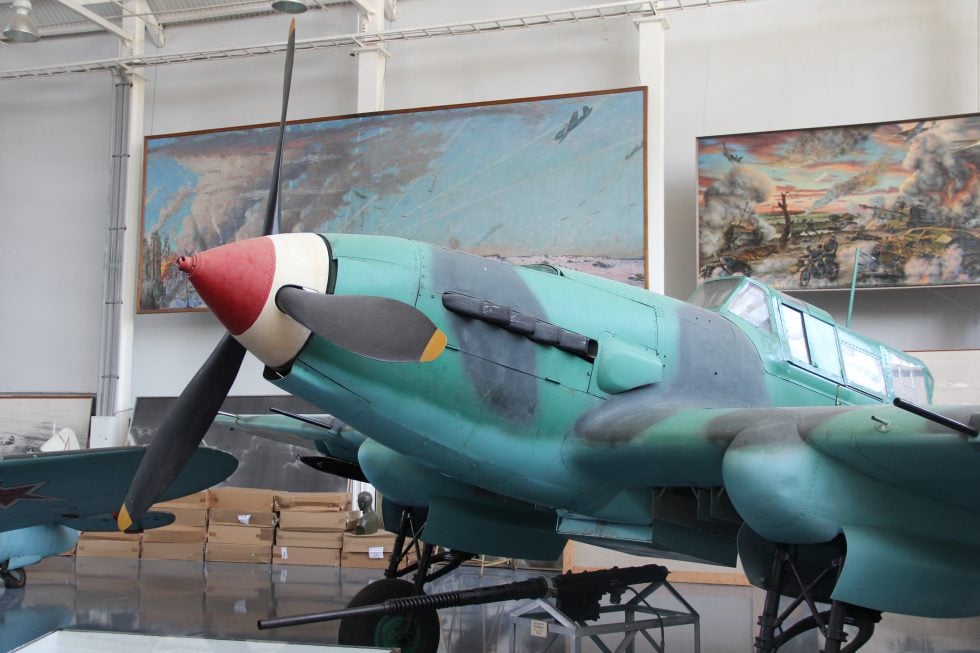
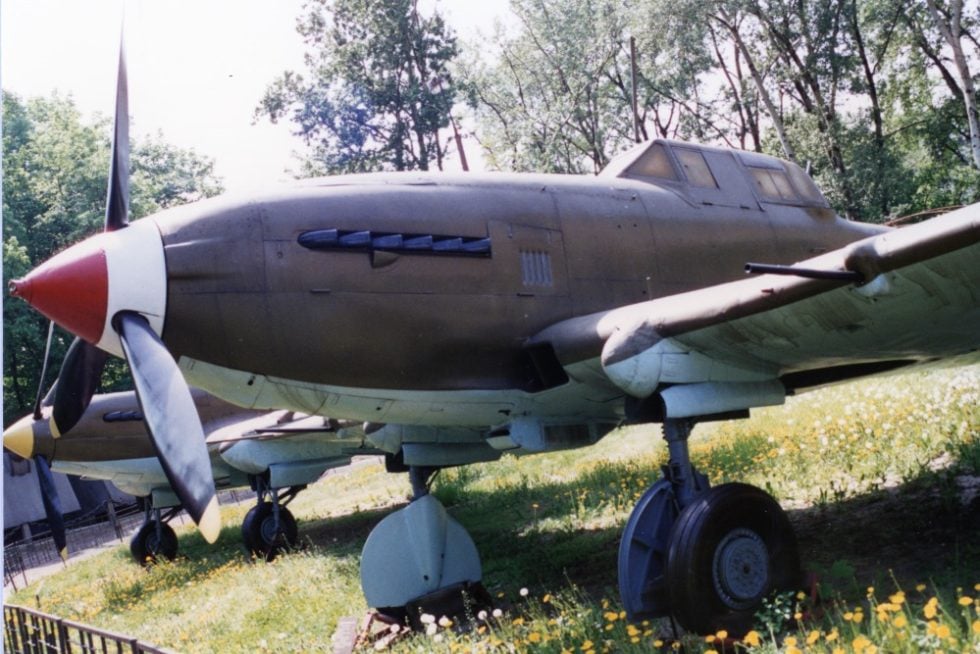
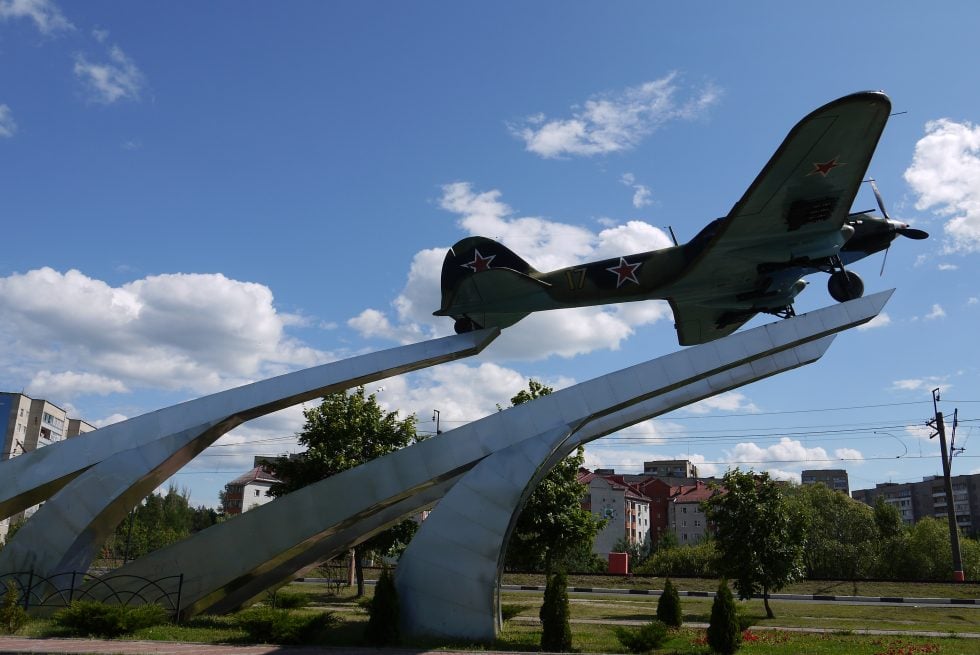
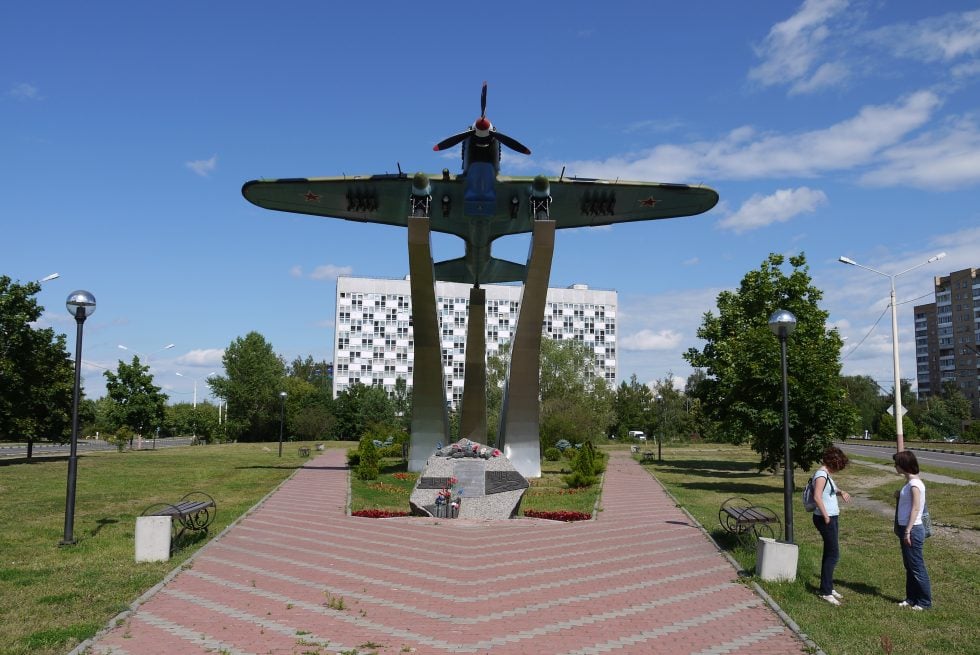
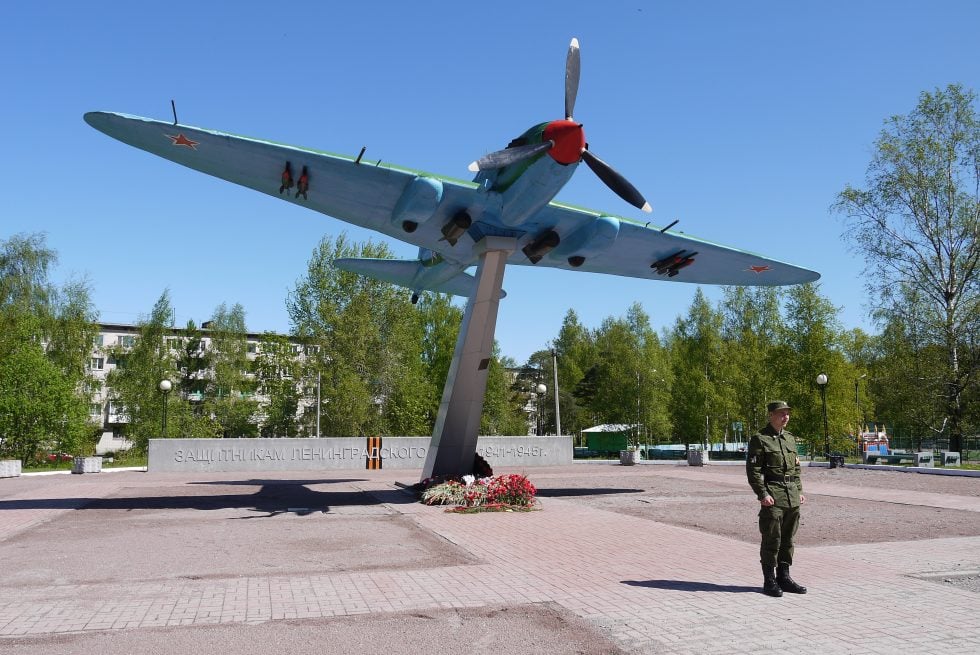
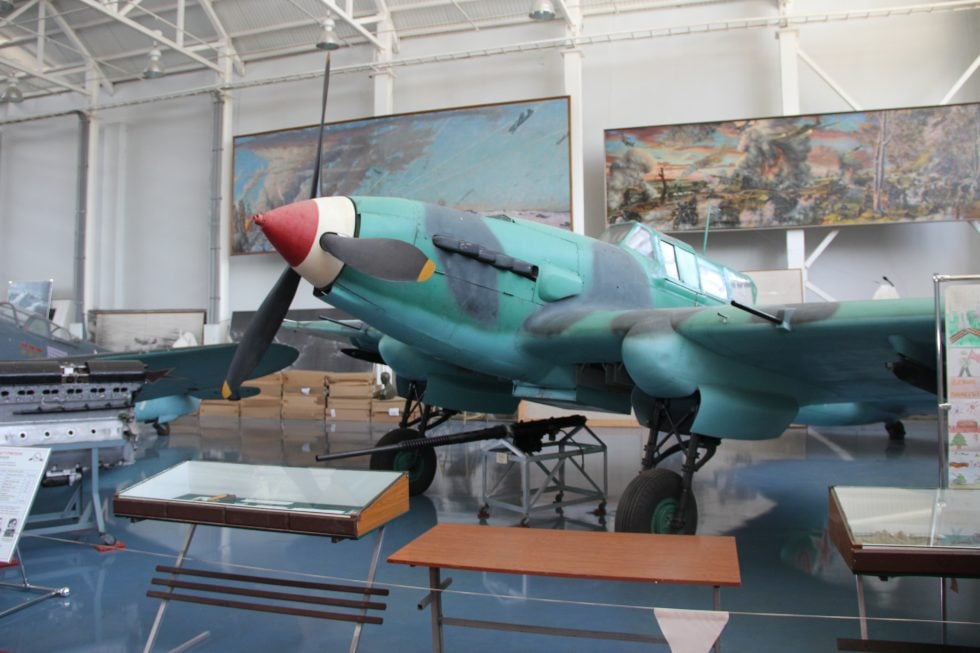
The Sturmovik in motion
A verified documentary feature for the Il-2 is on the way — video coming soon. In the meantime, explore the photo gallery above and the eyewitness stories from the Eastern Front.
Where the Sturmovik flew
The record that defines the Il-2
The Sturmovik’s significance is not measured in air-to-air kills but in mass, endurance and effect on the ground. It flew hundreds of thousands of close-support sorties over the Eastern Front, blunting German offensives and supporting Soviet advances from Moscow to Berlin — and it did so in numbers no other combat aircraft has ever matched.
Compare the combat record of every military aircraft. Figures as of July 2026.
Everything people ask about the Il-2 Sturmovik
Can I fly in an Il-2?
Why was the Il-2 called the ‘flying tank’?
How many Il-2s were built?
Why did the Il-2 add a rear gunner?
What were PTAB bomblets?
Why did the Germans call it the ‘Black Death’?
Is the Il-2 still flying?
You can’t fly the Il-2.
These, you can.
Some legends only live in museums — others are fuelled and waiting. MiGFlug has put civilians in real military jet cockpits since 2004.
 Fly the L-39 AlbatrosThe world’s most-flown jet trainer — aerobatics included
 Fly the F-104 Starfighter“The missile with a man in it”
 Fly the MiG-21The Cold War’s most-produced jet
 Fly the T-33 Shooting StarAmerica’s first jet trainer
 Fly the DH VampireA piece of early jet history
 Fly the S.211Agile Italian jet trainer
 Fly the MB-326The classic Aermacchi jet
 Fly the MiG-15The Soviet legend of the Korean War
Continue the tour
Every fact, checked
- Military Machine — Ilyushin Il-2 ShturmovikSpecifications, armour construction, production totals and the Stalin telegram.
- PlaneHistoria — The Flying TankThe structural armour bathtub, AM-38 engine, PTAB bomblets and the two-seat fix.
- The National Interest — The ‘Flying Tank’Why no aircraft has been built in bigger numbers, and its role crushing German armour.
- Military Factory — Ilyushin Il-2 (Bark)Reference specifications, armament fits and variant history.
- Iconic WW2 — Il-2, the flying tankDesign origins, the circle-of-death tactic and Eastern-Front service.
- MiGFlug Afterburner — The Il-2, the Most-Produced Military AircraftMiGFlug’s own feature on the Sturmovik’s record-setting production.
- The National WWII MuseumContext on Eastern-Front air power and Soviet ground-attack operations.